The Rat That Bit the World: How a Basement Pest Became Rock’s Most Honest Distortion Box
From Jeff Beck and Kurt Cobain to Graham Coxon and Nuno Bettencourt — the Pro Co RAT 2 distortion pedal's history, circuit, tone settings, and who uses it.
There is a version of distortion pedal history where everything happens in gleaming labs and engineering firms. Then there is the real story of the Pro Co RAT — designed in a cramped office, refined in a damp Kalamazoo basement infested with the rodents that gave it its name, and accidentally made better by an engineer who grabbed the wrong resistor off the shelf. The RAT was not supposed to exist in quite this form. It got here through a happy mistake, a stubborn circuit that refused to behave conventionally, and decades of guitarists deciding that something this raw and immediate was exactly what they needed. Jeff Beck ran one live for fifteen years. James Hetfield plugged one into a Marshall for Metallica’s debut album. Kurt Cobain used one on Nevermind. Graham Coxon of Blur has been hitting it on and off in choruses since the Britpop wars. Nuno Bettencourt keeps one on his board to this day with the Distortion knob turned all the way off. This is not a pedal you grow out of. This is a pedal that grows into you.
Born in a Rat-Infested Basement: The Origin Story
ProCo Sound Inc. evolved in 1974 from the remnants of another local studio-sound company in Kalamazoo, Michigan — the same city that had housed Gibson Guitar Corporation for decades. ProCo built its reputation on professional microphone cables and speaker snakes. The pedal was a side project, almost an accident of enthusiasm.
Scott Burnham was ProCo’s engineer and an avid guitarist who had grown frustrated modding existing fuzz and distortion boxes. He was unhappy with what he found inside them and decided he could build something better. In 1977 and 1978, he unveiled the first few custom-made prototypes, assembled in off-the-shelf hobby enclosures and named after the rodents that were sharing ProCo’s basement workspace. Those earliest units — known as Bud Box Rats — numbered around ten or eleven standard versions and one double-Rat configuration. They barely constituted a product line. They were closer to a proof of concept.
The key accident that made the RAT what it is came during the prototyping stage. Burnham mistakenly installed a 47-ohm resistor where a 470-ohm resistor was called for. That one-digit error pushed the op-amp gain stage dramatically harder, producing harmonically rich, saturated overtones that no careful engineering would have designed on purpose. Rather than fix the mistake, Burnham kept it. ProCo put the Rat into full production in 1979, and the happy accident has been living at the heart of the circuit ever since.
ProCo owner Charlie Wicks saw enough promise in those first prototypes to commit to mass production. The V1-A units of early 1979 were followed closely by V1-B versions that are, by guitar effect collector standards, virtually identical. Notable on all early Rats until around 1981 is a center-positioned tone control — the majority of players today are familiar with a Filter control in that location, and the distinction matters more than it might seem.
By the early 1980s the Rat had built serious word of mouth among players who needed a pedal that could replicate the fury of a cranked 100-watt stack without the decibel count. By the decade’s mid-point, it was a fixture on the pedalboards of hair metal bands, thrash outfits, and a handful of jazz-fusion guitarists who appreciated its ability to work at lower distortion settings as a pushing, grinding overdrive rather than a full-bore wall of gain.
Inside the Box: How the RAT’s Circuit Actually Works
The RAT’s circuit is built around a single op-amp gain stage, and the choice of op-amp is the most discussed element of its character. The original units used the Motorola LM308N — a chip with a slew rate of just 0.3 volts per microsecond, roughly forty times slower than the TL071 that was standard in most stompboxes of the era. That slowness is not a flaw. It is the mechanism behind a great deal of the RAT’s character.
A slow slew rate means the op-amp cannot accurately track high-frequency signal transients. As ElectroSmash’s detailed circuit analysis demonstrates, the LM308’s maximum reproducible output for a guitar-level signal tops out at around 5.3kHz. Harmonics above that frequency get progressively smeared and attenuated rather than cleanly amplified and clipped. The result is a distortion that feels dense and present in the midrange without becoming ice-pick bright at the top — a characteristic that stands in sharp contrast to faster op-amp-based circuits.
Maximum voltage gain through the clipping stage reaches a theoretical 67dB — comparable to the Big Muff Pi’s 60dB maximum and significantly higher than the Tube Screamer’s 41dB — though the clipping diodes and the op-amp’s own bandwidth limiting prevent the circuit from actually reaching that number in practice. What you hear is a heavily saturated, midrange-forward voice with controlled high-frequency content and attenuated bass both before and after the clipping stage.
The filtering is worth understanding in detail because it explains why the RAT sounds the way it does in a band mix. Two high-pass filters within the clipping stage — one with a cutoff at approximately 1,539Hz and another at 60Hz — attenuate bass content before it reaches the diodes. This means bass notes get clipped less aggressively than midrange and treble content, creating a frequency-selective distortion that keeps low strings from blooming into mush. The result is a mid-hump centered around 1kHz that cuts through a band mix with unusual efficiency.
The Filter control — note that it is a Filter, not a Tone control in the conventional sense — is a passive low-pass filter sweeping from a cutoff frequency of approximately 32kHz at the “zero” position down to around 475Hz at maximum. This is the opposite of how most guitarists expect a tone control to work. Turned to zero, the RAT is at its brightest and most aggressive. Turned up, the pedal gets darker and warmer. The control is not reversed because of an error. It is the natural behavior of a low-pass filter whose cutoff frequency decreases as resistance increases. First-time RAT users who spin the Filter clockwise expecting brighter tones will be confused. Every experienced RAT user learns to spin it counterclockwise for air.
The output stage is a JFET common-drain (source follower) configuration — useful because it presents a high input impedance to the Filter control without loading it, and presents a low output impedance to whatever comes next in the signal chain. This keeps the Volume and Filter controls independent from each other, which is not always guaranteed in simpler pedal designs.
In 2005, ProCo replaced the LM308N with the Texas Instruments OP07DP in production units. The OP07DP has a higher slew rate and different frequency behavior, and the change is the most disputed event in the Rat’s manufacturing history. Many players insist the LM308-era pedals sound noticeably more compressed and organic in the upper frequencies. Guitar World’s assessment — that “tonal differences are usually due to inconsistent component tolerances between one unit and another, so a brand new $90 Rat could actually sound better than a $900 LM308/Woodcutter example” — is pragmatically correct, even if it does not fully satisfy the vintage hunters. Production also moved to China in 2008, with Neutrik manufacturing for Pro Co Sound from that point.
The RAT Family: A Version Guide
The Rat family tree is wider than the standard RAT 2 on music store shelves today suggests. Understanding the versions helps you know what you are buying on the used market and what the “Woodcutter” and “LM308” conversations are actually about.
The original V1-A and V1-B production units from 1979 are defined by the Tone control in the center position, the Motorola LM308N op-amp, and the large format steel enclosure. These are the vintage collector pieces. In 1981, the Tone control became the Filter control and was relocated to the right of center — the layout all subsequent Rats have used. A smaller, physically more compact Rat appeared in 1984. That smaller format became the “Rat 2” in 1986 when an LED on/off status indicator was added, and the RAT2 was formally designated as such in 1988, also gaining 1N4148 diodes in place of the original 1N914s. The two diode types are functionally interchangeable, and the tonal difference is negligible to the point of being unmeasurable in the real world.
The Turbo RAT arrived in 1989 and is the most significant circuit variant. It replaces the silicon clipping diodes with LEDs, which have a higher forward voltage. The result is louder, less compressed output with a more aggressive, gnarly character — less of the RAT’s characteristic smoothness, more of a hard wall of sound. The BRAT (1997) was a budget-tier unit. The You Dirty RAT (2004) introduced a switchable clipping diode section. The Deucetone (2002) put two independent RAT channels in a single large enclosure. The ’85 Whiteface RAT Reissue (2010) was designed to replicate a specific transitional-era version of the original circuit.
The Lil’ Rat Mini is the current compact-format version, retaining the core RAT 2 circuit in a smaller chassis for pedalboard-space-sensitive builds.
Specs at a Glance
Famous Players
Jeff Beck
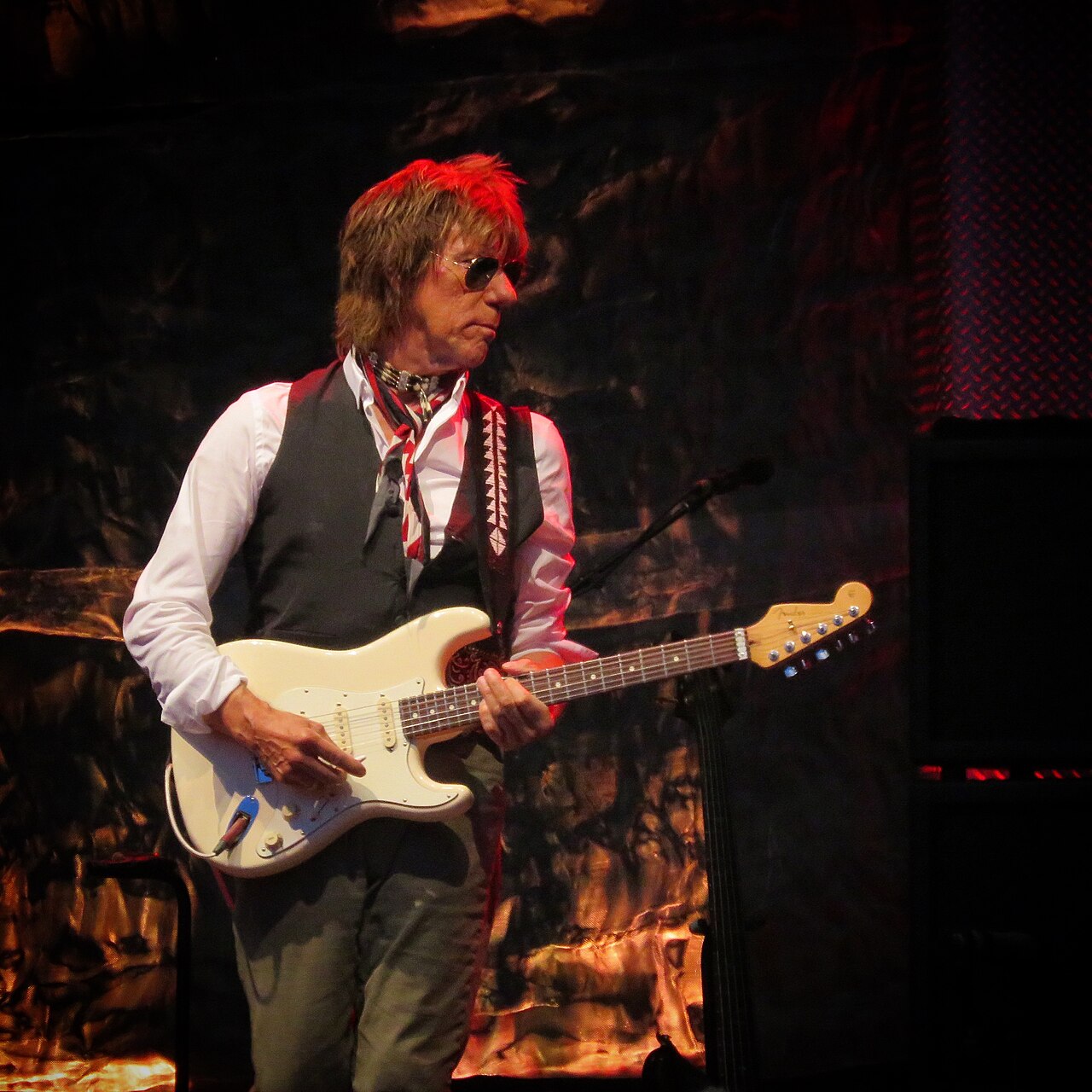
Jeff Beck ran a Pro Co RAT live from the mid-1980s through to 1999 and used it on the Guitar Shop album (1989) — the jazz-fusion record recorded with drummer Terry Bozzio and keyboardist Tony Hymas that stands as one of his most technically impressive studio statements. Beck’s relationship with the RAT represents what the pedal does at the higher end of the musical spectrum: its ability to add saturation, sustain and harmonic complexity without destroying dynamics made it compatible with Beck’s intensely nuanced, pick-free playing style. He was not using it as a bulldozer. He was using it to breathe fire into Stratocaster single-coil notes that needed to sustain across changing amp settings. According to Guitar World’s comprehensive RAT history by Chris Gill (December 2024), Beck’s documented live use spans roughly fifteen years — confirming the pedal as a long-term working tool rather than a passing experiment.
Jeff Beck’s full gear history →
Kurt Cobain
The conventional account of Kurt Cobain’s dirt chain credits the Boss DS-1 with the Nevermind sound — and that account is largely correct. The DS-1 was his primary distortion pedal, as confirmed by producer Jack Endino’s documentation of the Bleach recording sessions. But for one of Nevermind‘s most abrasive moments — “Territorial Pissings” — a RAT entered the picture differently. Producer Butch Vig split Cobain’s signal and ran a Pro Co RAT distortion pedal directly into the Neve mixing board alongside the amplifier signal, blending both into the final mix. The result is not the RAT as a standalone stomp — it is the RAT as a texture-adding parallel processor, its hard-clipped mid-hump smeared directly onto analog tape through a vintage console. That context is important: Cobain was not a committed RAT disciple in the way he was a committed DS-1 user, but the RAT gave Nevermind one of its nastiest moments.
Kurt Cobain’s full gear history →
Graham Coxon
Graham Coxon is the most unambiguous RAT devotee in this group. In a 2026 Guitar World interview, Coxon described his approach in the Blur years with characteristic directness: “I had this disgraceful pedalboard during the Blur years. It was this big fucking thing that, when we turned it on, it would be brighter than the stage lights. I’d be stabbing my foot away, trying to turn on a Rat pedal, but you couldn’t see it.” Elsewhere in the same interview: “When I was growing up, I had a Rat pedal. I would just hit that in the chorus and turn it off for the verse. That’s how simple it was.” Two Rat pedals running simultaneously is documented during certain periods of Blur’s live work — one for rhythm crunch, one stacked for lead gain. The RAT was central to the self-titled 1997 Blur album and the 13 album (1999). One important correction for the record: “Song 2,” the song most people associate with Blur’s wall of fuzz, was actually recorded through a DOD FX76 Punkifier, not a RAT. The Punkifier’s fuzz/overdrive hybrid circuit gave “Song 2” its specific character. The Rat’s territory in Blur’s catalog is broader, less famous, and more durably interesting.
Graham Coxon’s full gear history →
James Hetfield
The Pro Co RAT’s presence on Metallica’s debut album Kill ‘Em All (1983) is one of the most widely documented facts in the pedal’s history, and it explains a significant part of why thrash metal guitarists have gravitational pull toward the circuit to this day. Hetfield ran a RAT into a modified Marshall 1959 SLP at the recording sessions — the combination of the RAT’s hard-clipped midrange punch and the Marshall’s power amp saturation producing the rhythm guitar tone that set the standard for the genre’s first decade. The provenance is well-established across gear-documentation sources including Ground Guitar and Ultimate Guitar’s gear retrospectives, though a direct, first-person Hetfield interview quote specifically naming the RAT for Kill ‘Em All has not surfaced publicly. The body of circumstantial evidence is strong enough that the claim is treated as fact throughout guitar journalism. What is unambiguous is the sound itself: “Hit the Lights,” “The Four Horsemen,” “Motorbreath” — the rhythm guitar on every track of that album represents the RAT’s most influential moment in metal.
James Hetfield’s full gear history →
Nuno Bettencourt
Nuno Bettencourt’s RAT use is the most counterintuitive entry on this list and therefore the most instructive. In the March 2024 Premier Guitar Rig Rundown with Pat Badger and guitar tech John Thayer, the Pro Co RAT 2 is confirmed on Bettencourt’s board — but the Distortion knob is set to zero. Not low. Zero. Bettencourt runs the RAT entirely off its intended distortion function, using it purely as a bottom-end tightener and signal conditioner for single-note riffs. His explanation, referenced in Guitar.com reporting, cuts to the nature of the circuit’s output stage: the JFET source follower creates a low-impedance output with a specific input-impedance interaction that tightens the pick attack and firms up the low-end definition before the amp input, even when no actual clipping is occurring. The RAT at zero Distortion is functioning as a surgical tool for controlling how a clean or lightly driven signal interfaces with a loud amp. It has been on Bettencourt’s board since the Extreme years. It is not going anywhere.

Nuno Bettencourt’s full gear history →
Others Worth Noting
Guitar Player magazine’s headline for its 2022 RAT retrospective named Jeff Beck and Joe Perry in the same breath as Kurt Cobain and Thurston Moore — the latter’s use of the RAT with Sonic Youth helping define the pedal’s noise-rock and alternative credentials alongside its hard-rock and metal legacy. Guitar World’s comprehensive list adds Robert Fripp, David Gilmour, Andy Summers, Dave Grohl, Buzz Osborne of the Melvins, Frank Black of the Pixies, Bill Frisell, John Scofield, and Rivers Cuomo — a spread so wide it amounts to proof that the RAT circuit is not genre-specific, it is sonically fundamental.
Tone Recipes & Settings
Recipe 1: Jeff Beck Live Lead (Mid-80s to 1999)
The goal is singing, harmonically rich lead sustain from a single-coil guitar — the RAT adding body and compression without obscuring pick dynamics. Set Distortion to 10–11 o’clock (roughly 30–40% of the pot travel). Filter turned counterclockwise to around 8 o’clock — bright but not harsh. Volume set to match bypassed level. The amp should be a clean-to-edge-of-breakup tube design: Fender Twin or Princeton Reverb territory. The RAT does the saturation work; the amp does the final coloring. For sustaining bends, dig in with the pick and let the circuit breathe. This is a responsive, dynamic setting that rewards technique rather than covering for its absence.
Recipe 2: Kurt Cobain “Territorial Pissings” Snarl
If you want the abrasive, mid-focused snarl of that track without routing through a Neve console, maximize the RAT’s confrontational qualities: Distortion at 3 o’clock (75–80% of the range). Filter counterclockwise to 9–10 o’clock — aggressive but not fizzy. Volume above unity to drive the amp input. Run into a bright-voiced amp — a Fender Twin Reverb or similar — and let the combination of the RAT’s hard-clipped midrange and the amp’s clean headroom do the work without excess cab compression. The key is the RAT’s low end cut before clipping: single-note aggression comes through clearly; low-string chords stay articulate under the snarl.
Recipe 3: Graham Coxon Britpop Chorus Crunch
Coxon’s approach is simple and blunt, which is the point. Distortion at 2 o’clock (roughly 65%). Filter counterclockwise to 9 o’clock — open and present. Volume above bypassed level to punch through a loud band mix. The amp is a Marshall — Coxon ran 100-watt Super Leads through the Blur years. This setting represents the RAT as a chorus-switch tool: chorus verse clean, chorus pedal stomp — “that’s how simple it was.” The jump in energy from clean verse to RAT chorus is the whole trick. Do not overthink it. If you find yourself adjusting mid-song, you are doing it wrong.
Recipe 4: James Hetfield Kill ‘Em All Thrash Rhythm
Maximum Distortion — 4 o’clock or further — into a Marshall stack running hot. Filter counterclockwise to 10 o’clock: aggressive, cutting, no fizzy top end. Volume set high — you want the RAT to push the Marshall’s input hard. Mute strings with the picking-hand palm between riffs. The RAT at this setting produces the characteristic Metallica early-album tightness: low notes are articulate because the circuit’s high-pass filtering cleans up the bass before clipping; mids cut through at the 1kHz hump; highs are controlled by the LM308’s slew rate limiting. This is not a setting for delicacy. It is a setting for precision violence.
Recipe 5: Nuno Bettencourt Bottom-End Tightener (Distortion at Zero)
Turn the Distortion all the way off. Filter counterclockwise to 8 o’clock. Volume at or slightly above unity. This setting uses the RAT’s JFET output stage and signal-path impedance interaction to firm up pick attack and tighten low-end definition before the amp input — no audible distortion added. The effect is subtle but cumulative: single-note riffs gain snap and presence, and the interaction with a high-gain amp’s input stage becomes more controlled and predictable. This technique works with any RAT, any era, any op-amp — because it has nothing to do with the clipping section.
In the Chain: Where to Place the RAT 2
The RAT 2 follows standard distortion placement conventions: after tuner and wah (if wah is before dirt), before modulation and time-based effects. Its ~494kΩ input impedance is high enough to work comfortably after most true-bypass pedals without tone-sucking. It is not a 1MΩ input like some designs, but it is sufficiently high to avoid obvious loading issues with passive pickups.
One important exception: vintage Fuzz Face designs prefer to see the guitar directly at their input — a buffered signal changes their operating point. The RAT 2’s true bypass in current production means it does not affect the preceding signal path when disengaged. But if you are running a Fuzz Face before the RAT in an always-on configuration, consider the Fuzz Face first in the chain, RAT after, for the best fuzz behavior. The EHX Big Muff Pi has similar impedance considerations.
The RAT stacks well with a boost or light overdrive in front of it — a low-drive Ibanez TS9 Tube Screamer before the RAT narrows the frequency range that enters the clipping stage, tightening the character and adding sustain without changing the fundamental RAT voice. The opposite stack — RAT before TS9 — produces a different result: the TS9’s 700Hz mid-hump emphasizes a specific range of the already mid-forward RAT output, which can be useful for cutting through extremely dense mixes or for lead volume boosts where you want additional midrange presence without more gain.

Running a wah pedal before the RAT produces standard swept vowel sounds on the distorted signal; wah after the RAT creates a more aggressive, gnarly filter sweep. Coxon’s live rig used both configurations at various points during the Blur years.
RAT 2 vs. The Competition
Compared with the Boss DS-1 Distortion, the most direct competitor in the late-1970s to 1980s hard-clipping op-amp space: Guitar Player’s Dave Hunter notes that “the DS-1 begins to compress more as you turn up the gain, whereas the Rat stays raw and immediate almost to the end of the dial.” This is accurate. The DS-1’s tilt-EQ Tone control differs fundamentally from the RAT’s low-pass Filter, and the DS-1’s input buffering means it handles impedance interactions differently. Both are essential hard-clipping op-amp distortions; they are not interchangeable voices, and the choice between them is genuinely a tone question rather than a quality question.
Against the EHX Big Muff Pi, the RAT occupies a very different position in the clipping taxonomy. The Big Muff runs a four-transistor cascaded circuit with symmetrical silicon diode clipping in the feedback loop, producing a smoother, more compressed, more “woolly” saturation. The RAT’s op-amp hard-clipping with the LM308’s frequency-limited behavior produces a tighter, more articulate, more “biting” character. Both have significant mid presence in their designs, but the Muff’s scooped character requires more volume from the amp; the RAT’s 1kHz hump cuts without needing extreme volume. For small-room or moderate-volume playing, the RAT is generally the more practical tool.
The Turbo RAT deserves its own comparison note. The LED clipping diodes have a higher forward voltage than silicon diodes, which means the signal must swing further before clipping occurs. The result is louder, more open-sounding output with less of the RAT’s characteristic “collapse” — you get more headroom and a less compressed wall of sound. Players who find the standard RAT 2 too smooth or too forgiving at extreme Distortion settings often prefer the Turbo. Players who want the RAT’s specific texture and midrange density almost universally prefer the standard RAT 2 or vintage silicon-diode units.
Buying Guide
The current Pro Co RAT 2 retails at approximately $99 USD and represents straightforward value for a proven circuit. The OP07DP-era production (2005–present) sounds sufficiently close to the LM308 originals for live and recording use; the differences are real but are not nearly as dramatic as the online forums suggest. For most players in most contexts, the current production RAT 2 is the correct answer.
Used RAT 2 units in excellent condition typically sell on Reverb in the $50–75 range — excellent value for a pedal at this level of documented influence. LM308-era units (pre-2005, USA-made) command $100–200 depending on condition and provenance, with genuine vintage V1-A and V1-B units from 1979–1981 reaching $300–500+. The “Woodcutter” units — from a specific production period associated with a particular factory employee — are discussed endlessly and priced accordingly; their sonic difference from adjacent production units is disputed by most objective listeners.
The Turbo RAT ($99 new, $50–80 used) is a genuine circuit variant worth considering separately. The BRAT is not recommended for serious use — it was a cost-reduced budget unit. The Lil’ Rat Mini ($90 new) uses the core RAT 2 circuit in a smaller enclosure and is the recommended choice for pedal-board-space-constrained builds.
Living with the RAT 2: Ownership Notes
The Filter control is the first thing that trips up new RAT owners. Remember: counterclockwise is brighter. If you dial it clockwise expecting treble, you will be confused and the pedal will sound muddy. Start with the Filter at its counterclockwise minimum and work inward. Most players land between 8 o’clock and 10 o’clock for practical use.
The RAT runs on standard 9V DC center-negative power with minimal current draw — well under 10mA — meaning it will share a power supply without complaint. The 9V battery option works and is convenient for grab-and-go use; battery-powered operation produces no noticeable sonic difference from DC adapter power in this circuit.
Current production RAT 2 units are true bypass. The transition from the RAT’s input impedance characteristics to whatever comes next in a buffered bypass system is clean. Players who care about signal-path transparency throughout will have no objection to modern RAT 2 units in standard use.
The Volume knob requires more travel than players coming from other pedals might expect. The RAT’s output level runs hot, and the knob responds quickly — set it carefully if you are matching levels with a bypassed signal, and be aware that higher Volume settings interact with amp input stages in ways that can add useful character beyond what the Distortion control alone produces.
For direct recording without a cab, the RAT’s raw character needs a cab simulator or impulse response loader — its frequency content is voiced for speaker interaction, and the raw output directly into a DAW sounds noticeably harsh. A cab sim post-RAT resolves this completely.
Frequently Asked Questions
What is the difference between the Pro Co RAT and the RAT 2?
The original Rat (1979) used a Tone control and was later given a smaller enclosure in 1984. The “Rat 2” designation emerged in 1986 when an LED on/off indicator was added, and was formally established in 1988 with the simultaneous switch from 1N914 to 1N4148 clipping diodes. The core circuit is functionally the same between original and RAT 2 production. The primary audible difference most players note between different eras is the LM308 versus OP07DP op-amp change in 2005.
Is the Filter knob working backwards on my RAT 2?
No — it is working exactly as designed. The Filter control is a passive low-pass filter: turning it clockwise lowers the cutoff frequency, removing treble. Turning it counterclockwise raises the cutoff frequency, allowing more treble through. This is the natural behavior of the circuit; it only seems “backwards” if you expect a conventional bright/dark control. Start counterclockwise for the full frequency range and work inward.
Does it matter whether my RAT 2 has an LM308 or OP07DP op-amp?
The LM308 has a significantly slower slew rate (0.3V/μs vs OP07DP’s approximately 0.3V/μs — though implementations vary), which produces a specific high-frequency limiting character at maximum gain that many players prefer. The difference is real but subtle, and component tolerances between individual units of the same op-amp type often account for more variation than the chip swap itself. Current production RAT 2 units sound excellent; the premium for LM308-era units reflects collector demand more than a dramatic practical gap in everyday use.
Did James Hetfield really use a RAT on Kill ‘Em All?
This is the most consistently documented fact in Pro Co RAT history, appearing across Guitar World’s comprehensive RAT history, Ultimate Guitar’s gear profiles, and multiple equipment retrospectives. The combination was a RAT into a modified Marshall 1959 SLP. A direct, first-person Hetfield interview quote specifically confirming the RAT for those sessions has not been definitively catalogued in primary sources — the knowledge lives in production documentation and gear-journalism record. The body of evidence is strong enough that the claim is treated as established fact throughout guitar media.
What is the difference between the RAT 2 and the Turbo RAT?
The Turbo RAT replaces the silicon clipping diodes with LEDs, which have a higher forward voltage (~1.7–2V vs silicon’s ~0.6V). The signal must swing further before clipping begins, producing louder, less compressed, more aggressive output. The Turbo sounds bigger and rawer; the RAT 2 sounds tighter and more midrange-focused. Players after maximum aggression often prefer the Turbo; players after the classic RAT character in a dense band mix prefer the RAT 2.
Did Graham Coxon use the RAT on “Song 2”?
No. “Song 2” was recorded with a DOD FX76 Punkifier, a fuzz/overdrive hybrid pedal introduced at Summer NAMM 1995. The RAT appears throughout Blur’s 1997 self-titled album and the 1999 album 13, but it is not the source of “Song 2″‘s distinctive sound. Coxon’s 2026 Guitar World interview confirms his sustained relationship with the RAT across the Blur years; it is just not the pedal behind Blur’s biggest hit.
Can the RAT 2 work for jazz or clean applications?
At low Distortion settings — 7 to 8 o’clock, barely off minimum — the RAT functions as a mild pushing overdrive that adds harmonic complexity without heavy clipping. Jazz players including Bill Frisell and John Scofield have used the pedal in this manner. Nuno Bettencourt’s zero-Distortion technique (used purely as a signal conditioner and bottom-end tightener) represents the most extreme version of this approach. The RAT is not a clean boost, but it has useful territory below the midrange gain settings where most of its reputation lives.
How does the RAT 2 compare to the Big Muff Pi?
These are fundamentally different circuits with different clipping mechanisms. The Big Muff Pi uses cascaded transistors with diode clipping in the feedback loop, producing a smoother, more compressed, scooped-midrange character that requires high amp volume to cut through a mix. The RAT uses op-amp hard-clipping with a 1kHz mid-hump that cuts naturally at moderate volumes. For small-room or stage work in a full-band mix, the RAT’s midrange presence is generally more practical. For wall-of-sound fuzz and shoegaze applications, the Big Muff’s compressed bloom is the more appropriate tool.
Image credits
- Graham Coxon: XoxoHell, Wikimedia Commons, CC BY 2.0.
- Jeff Beck: Shannon Kringen, Wikimedia Commons, CC BY-SA 2.0.
- Nuno Bettencourt: SebastyneNet, Wikimedia Commons, CC BY-SA 4.0.
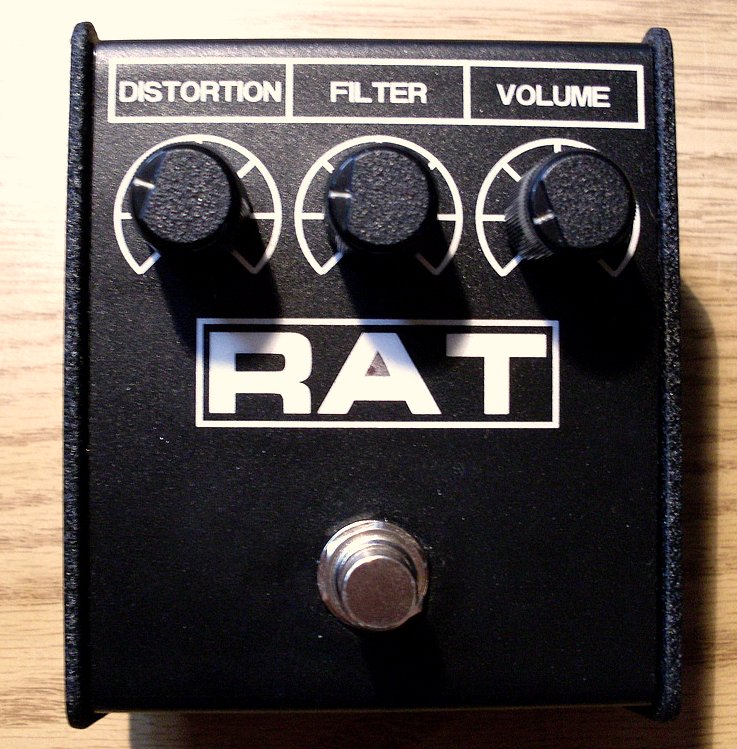
- Top image: ProCo RAT 2, photographed 12 December 2008. Photo: Roadside Guitars. Source photograph · CC BY-SA 2.0. Source image unchanged by GuitarGangsters.
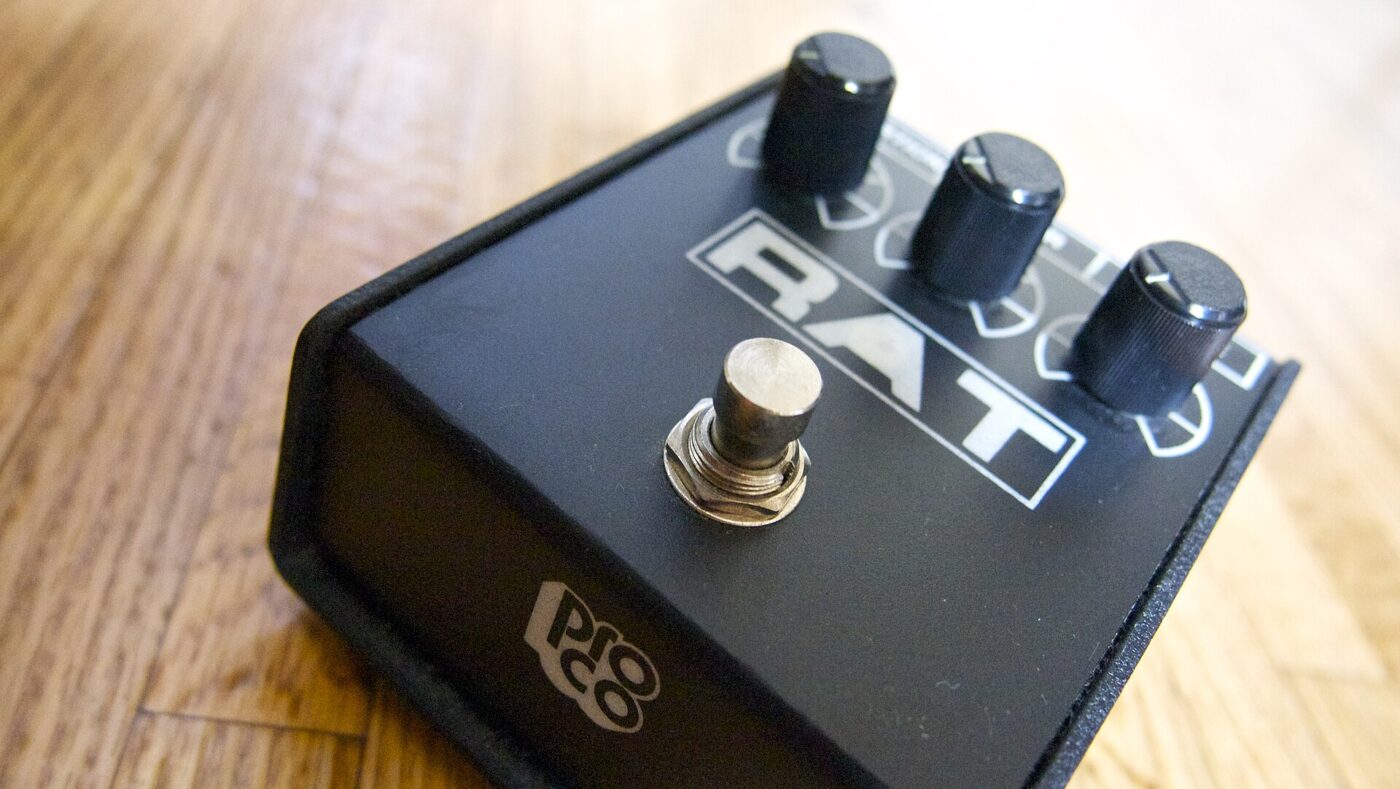
- Pro Co RAT 2: photo by Shunichi Kouroki, via Wikimedia Commons, CC BY 2.0.
Latest News
Related

On This Day
Monday 9 November
From this week: