Dobro Hound Dog Round Neck: The Guitar Named After a Legal Problem
The Dobro Hound Dog Round Neck resonator: the 1967 Hound Dog name origin, full specs, spider vs biscuit tone, honest player facts and buying advice.
Most guitars are named after a person, a place, or a marketing meeting. The Dobro Hound Dog is named after a four-year stretch in the late 1960s when the Dopyera family owned the factory, the tooling, the patents and the know-how — but not the word “Dobro.” They had to call their instruments something. They called them Hound Dogs.
That is the kind of origin story that usually gets sanded off a spec sheet, and it is the most interesting thing about an instrument that otherwise looks like a straightforward budget resonator. Because the Hound Dog Round Neck is exactly that: a maple-bodied, spider-bridge resophonic guitar with a normal guitar neck on it, built to put an unmistakable American sound in the hands of somebody who has never owned one. It is not a boutique instrument. It is not a vintage instrument. It is a doorway, and it has been a very effective one for close to thirty years.
What follows is the full picture: where the name came from, what the guitar is actually made of, what the spider bridge does that a biscuit bridge does not, which famous-player claims hold up and which do not, how to make it sound like a record, and what to look at before you hand over the money.
Where the Hound Dog Name Actually Comes From
To understand the Hound Dog you have to understand that “Dobro” has spent most of its existence being fought over.
Dopyera versus Dopyera
John Dopyera, a Slovak-American designer working in Los Angeles, invented the resonator guitar in the 1920s at the urging of George Beauchamp — the goal being a guitar loud enough to hold its own in a dance orchestra, in the years before electric amplification existed. Those first instruments were the National tricones of 1927. We covered that origin story in full in our feature on the National Reso-Phonic Style O, and it is worth reading alongside this one, because the two brands are siblings that spent decades suing each other.
Dopyera left National and, with his brothers, founded Dobro — a contraction of DOpyera BROthers, which happens also to mean “good” in Slovak, a coincidence the family enjoyed pointing out. The technical break with National was decisive. Where National screwed a cone into the body dome-up and sat a wooden biscuit on top of it, Dobro turned the cone upside down: an inverted cone, dish-up, with an eight-legged aluminium “spider” bridge straddling it, transferring string energy to the cone’s outer rim rather than its centre. That single design decision is why a Dobro and a National do not sound alike, and we will come back to it.
1966–1970: the years Dobro was not Dobro
In 1966 the Dobro trademark was sold to Semie Moseley of Mosrite — the Bakersfield company best known for the Ventures models. The Dopyeras kept making resonator guitars; they simply could not put the word “Dobro” on the headstock. For a period the instruments went out labelled Replica 66. Then, in 1967, Rudy and Emile Dopyera formed the Original Musical Instrument Company — OMI — and put a new brand name on the peghead: Hound Dog.
It was not a tribute. It was a workaround. “Hound dog” had been slang for the instrument for years, an affectionate jab at the whining, vocal, slightly mournful quality of a slide moving across a resonator cone. The family took the nickname the players had given them and used it as a legal shield until 1970, when Mosrite went into liquidation and OMI bought the Dobro name back. Even after that, the Hound Dog label hung around for a while — a habit that had outlived its reason.
Gibson, Nashville, and the second life of the name
Gibson acquired OMI in 1993, renaming the operation Original Acoustic Instruments and eventually consolidating production in Nashville, Tennessee. Here is a dating trap worth flagging, because dealer copy gets it wrong constantly: a great deal of retail text says Gibson “acquired Dobro in 1997.” The 1997 date is real, but it is the date the California operation wound down — the Los Angeles Times ran a piece that March headlined around the end of the Dobro era in Orange County. The acquisition was 1993; the move was 1997. If a listing tells you a guitar is from “the year Gibson bought Dobro,” ask which event the seller means.
Gibson then did the obvious thing: it revived Hound Dog as the name for the affordable tier, keeping “Dobro” proper for the expensive Nashville-built professional instruments. So the name that once meant “we are legally forbidden from saying Dobro” now means “this is the accessible one.” In the current era the line sits under Epiphone, which is where you will find it in a shop today.
What the Hound Dog Round Neck Actually Is
Two words in the name do the heavy lifting. Round neck means it is a guitar: normal action, normal neck profile, played in the normal position, fretted with fingers if you want. The alternative is a square neck — a solid, chunky, unplayable-in-the-normal-sense neck with the strings raised an inch off the fingerboard, meant to be laid flat across the lap and played exclusively with a steel bar. That is the bluegrass instrument. This is not that. A round neck lets you fret chords, play slide in standard or open tuning with the guitar held conventionally, and generally treat it as a very loud, very distinctive acoustic guitar.
Hound Dog means the affordable tier — plywood body rather than solid, imported rather than Nashville-built in current production, and a price that sits under a thousand dollars rather than over three.
Specifications
| Feature | Detail |
|---|---|
| Type | Wood-body resophonic guitar, round neck (conventional playing position) |
| Resonator system | Single inverted cone with spider bridge — the classic Dobro configuration |
| Cone | Proprietary Dobro cone, nickel-plated |
| Coverplate | Nickel-plated fan-pattern coverplate |
| Soundholes | Round screened soundholes plus traditional f-holes |
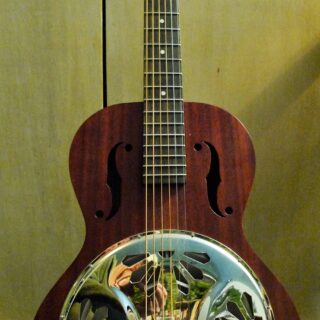
| Body | Figured maple ply; Deluxe fully bound in black, standard model unbound |
| Body depth | 3.5″ |
| Neck | Mahogany, joined at the 12th fret |
| Fingerboard | Rosewood or pau ferro depending on production run, 12″ radius, pearl dot inlays, unbound |
| Frets | 19 |
| Scale length | 25″ |
| Nut | Tusq; width listed as 1.75″ (some sources list 1.68″ — see below) |
| Truss rod | Single action, Gibson bell-shaped cover |
| Bridge | Spider with ebony-capped hard maple saddle base |
| Tailpiece | Nickel-plated |
| Tuners | Grover |
| Headstock | Dobro decal |
| Electronics | Deluxe: custom-designed Fishman resonator pickup. Standard: none |
| Finish | Vintage Brown (Deluxe); other finishes across the line’s history |
| Street price | Around $799 for the Deluxe Round Neck as of July 2026 |
The family: three guitars with one name
Shopping for a Hound Dog is confusing because at least three quite different instruments share the badge.
Hound Dog Round Neck (standard). The plain version — maple body, no binding, no pickup. The entry point, and the one most often found used.
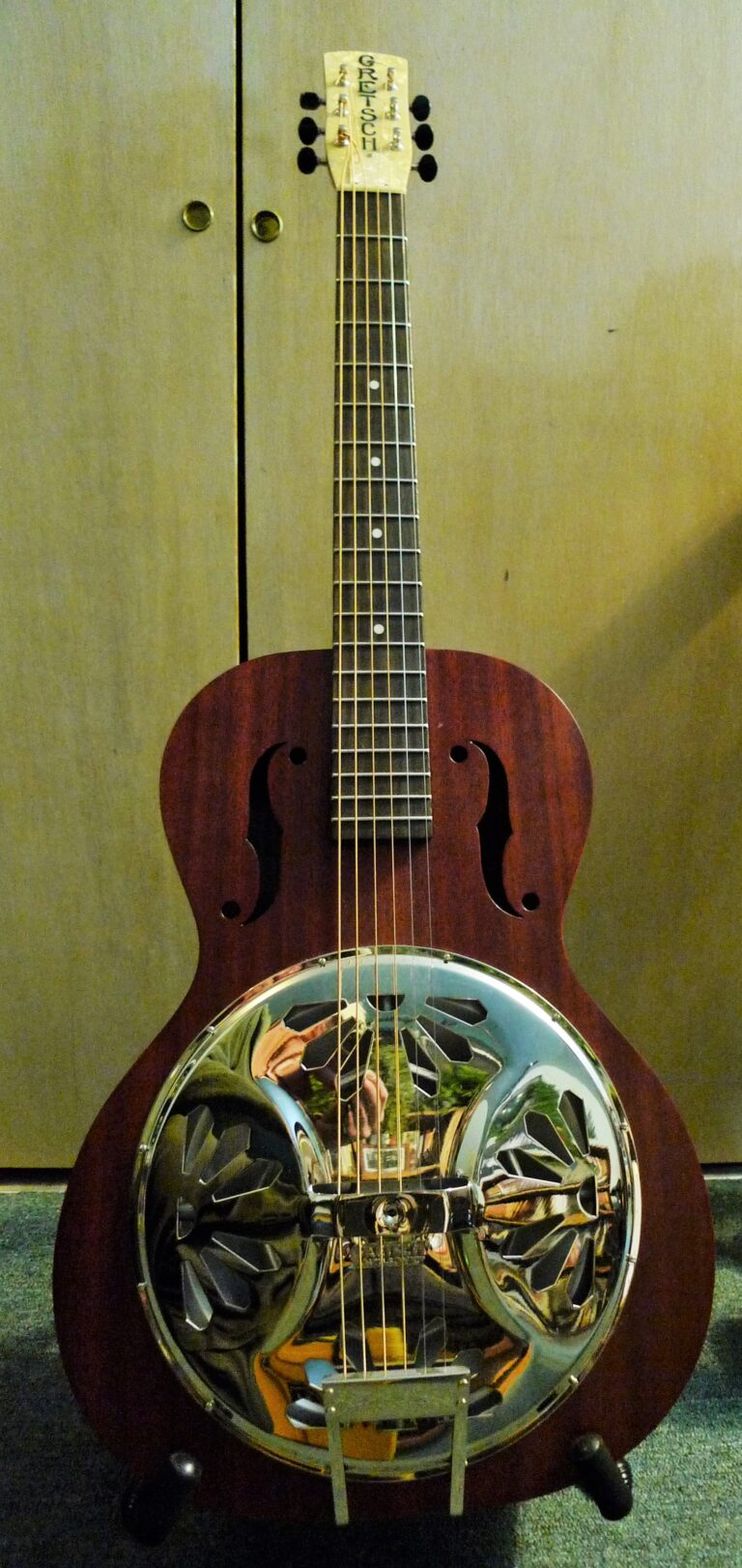
Hound Dog Deluxe Round Neck. Figured maple ply top with black binding around body and rims, and the Fishman resonator pickup fitted as standard. This is the version currently in dealer inventory and the one most people mean when they say “Hound Dog round neck” today.
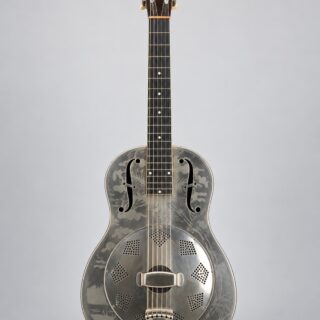
Hound Dog M-14 Metalbody. A completely different animal despite the shared name — a nickel-plated bell brass body with a biscuit bridge, not a spider. It is Epiphone’s answer to a metal-body National, and its spec sheet diverges everywhere: 24.75″ scale instead of 25″, 14th-fret neck joint instead of 12th, a 1960s SlimTaper profile, a dual-action truss rod, bone nut at 1.75″, Grover Mini Rotomatics at 18:1, and D’Addario EJ42 mediums out of the box. Gibson’s own page for it now carries a “no longer available” notice while remaining live for reference. If you want the metal bark rather than the wooden bark, that is the model — but do not assume the two Hound Dogs sound related. They do not.
The documentation conflicts, stated plainly
Three of them, and they matter when you are reading a listing.
Fingerboard wood. Some official and dealer descriptions say rosewood; others, including the fullest current spec sheets, say pau ferro. Both are almost certainly true of different production runs — pau ferro became a widespread rosewood substitute across the industry after the 2017 CITES restrictions, and the Hound Dog was not exempt from that. Check the guitar, not the copy.
Nut width. The detailed spec block lists 1.75″. A widely syndicated shorter spec summary lists 1.68″. That is a real, feelable difference of about 1.8 mm at the nut. Measure it if fingerstyle spacing matters to you.
Truss rod. The wood-body Deluxe is documented with a single-action truss rod. The metal-body M-14 gets a dual-action rod, and Gibson’s own copy for that model makes a point of it, noting that early original instruments “often suffered from warped necks.” A single-action rod can only counteract string tension; it cannot pull a back-bowed neck forward. On a guitar likely to be strung with heavy gauges and possibly tuned up to open A, that is worth knowing before you buy blind.
Spider Versus Biscuit: Why This Does Not Sound Like a National
The physics here are simple and the consequences are large.
In a biscuit system — Nationals, the Gretsch G9200 Boxcar in its single-cone form, the M-14 — the cone sits dome-up and a small maple biscuit at the apex takes the string energy. Everything is funnelled into the centre of a stiff aluminium diaphragm. The result is a hard, fast transient with a strong upper-midrange bark, quick decay, and that horn-like compression when you dig in.
In a spider system, the cone is inverted, dish-up, and an eight-legged aluminium spider spans it, delivering the string energy to eight points around the cone’s rim. The cone is loaded around its circumference rather than stabbed in the middle. Practically, that means:
- More sustain. A spider Dobro rings noticeably longer than a biscuit National. This is why the design won the bluegrass world — you can hold a note through a phrase.
- A vocal, nasal midrange rather than a metallic clang. The character sits lower and rounder; the “cry” is in the 800 Hz to 2 kHz region rather than the 2–4 kHz bark of a metal-body biscuit guitar.
- Softer attack. The transient is less violent, which is why the spider design rewards smooth bar technique and punishes ham-fisted picking less than a biscuit does.
- Less absolute volume, more usable tone. A metal biscuit guitar will out-shout this. It will not out-sing it.
Layer the wooden body on top of that. Maple ply is stiff and bright, but it is still wood, and it absorbs and warms in a way brass and steel do not. A maple-body spider guitar is the least aggressive resonator configuration in common production — which is precisely why it works in a band mix with singers, fiddles and mandolins, and why it is the sound of the Grand Ole Opry rather than the sound of a Delta street corner.
Famous Players: An Honest Accounting
This section is going to disappoint anyone shopping for reflected glory, and it is better to say so directly than to launder plausible names into implied endorsements.
The names that get attached to this guitar, and what is actually true
Mark Knopfler is the single most cited name in resonator marketing, and his instrument is not a Dobro. It is a National Style O — a metal-body, biscuit-bridge guitar, bought from the Leeds bluesman and luthier Steve Phillips, heard on “Romeo and Juliet” and “Telegraph Road,” and photographed against the clouds on the cover of Brothers in Arms. Different company, different bridge system, different material, different sound. If you buy a Hound Dog expecting that album cover, you have bought the wrong guitar; see our Style O feature for the one you wanted.
Jerry Douglas is the greatest living exponent of the spider-bridge instrument, and he is genuinely relevant to the design — but he plays square-neck instruments, lap-style, and has for decades worked with custom builders rather than production models. A round-neck Hound Dog is his instrument’s cousin, not his instrument. Same is true of Mike Auldridge of the Seldom Scene, whose name Epiphone’s own copy invokes, and of Josh Graves, who dragged the Dobro into bluegrass in the mid-1950s with Flatt and Scruggs by translating Earl Scruggs’s banjo rolls onto it — the single most consequential thing anyone ever did with the instrument. All square-neck players.
Bukka White fails a simple chronological test. His signature instrument was a metal-body National, and his most celebrated recordings predate the Hound Dog name by three decades. No pre-1967 artist played a Hound Dog, because the brand did not exist.

Ry Cooder is a real resonator player — but his defining slide voice is bottleneck on Nationals and on modified electrics, not on a wooden spider guitar. His relevance here is stylistic, not literal.
Where the round-neck wooden Dobro genuinely lives
Strip out the misattributions and there is still a real tradition, it is just less glamorous. Beecher “Bashful Brother Oswald” Kirby played a wood-body Dobro on the Opry stage alongside Roy Acuff for the better part of six decades and did more than any single person to make the instrument’s sound familiar to American ears. That is the lineage the Hound Dog actually belongs to: country, gospel, string band, front-porch music.
On the blues side, the round-neck wooden resonator is the guitar of players who wanted resonator projection without resonator harshness — a sound closer to Mississippi John Hurt‘s warmth than to the steel-bodied ferocity of Son House or Tampa Red. And the modern round-neck slide vocabulary — Kelly Joe Phelps‘s lap-style work on a conventionally-necked guitar, Chris Whitley‘s battered National, Keb’ Mo’‘s clean acoustic slide, Bonnie Raitt‘s bottleneck phrasing — is all playable on this instrument even where the artists themselves used something else.
The honest summary: no famous player is documented using this specific SKU. It is a modern, affordable, imported instrument named after a legal workaround from 1967. What it gives you is access to a sound that famous players made famous on more expensive versions of the same idea. That is a perfectly good reason to buy a guitar. It is just not the same as an endorsement.
Tone Recipes and Settings
Acoustic, in a room or in front of a microphone
A resonator is a directional instrument — the cone throws forward, hard. Do not mic it like a flat-top.
The classic Opry sound: small-diaphragm condenser, 25–30 cm out, aimed at the coverplate but off-axis by roughly 30 degrees, pointed slightly toward the neck join. Straight on-axis at the cone gives you a nasal honk with no body. Rolling off below 90 Hz cleans up boom without touching the character, since almost nothing musical lives down there on this guitar.
For a warmer, blues-leaning tone: large-diaphragm condenser at 40–50 cm, positioned to see both the coverplate and the upper bout, with a gentle 2–3 dB dip around 1.2 kHz to take the edge off the nasal peak. Add a touch of plate reverb with a short pre-delay; a resonator sits beautifully in a plate and badly in a big hall.
In a band: the guitar’s power band overlaps the human voice almost exactly. If it is fighting the singer, do not turn the guitar down — carve 3 dB out at 1 kHz on the guitar and let it own 2–4 kHz instead.
Plugged in through the Fishman
The Deluxe’s Fishman resonator pickup is designed to read the cone rather than the top, and it behaves like an under-saddle piezo in one important respect: it exaggerates attack and thins body.
- Amp or DI starting point: bass at 6, mids at 7, treble at 4. Resonators need the mids up and the treble down — the reverse of a flat-top acoustic setting.
- Add a preamp with a notch filter if you play loud. A cone is a large stiff diaphragm in a wooden box and it will feed back around 200–350 Hz before anything else does.
- Light compression helps — 3:1 ratio, slow attack around 20 ms so the pick transient survives, 2–4 dB of gain reduction. It evens out the enormous dynamic swing between fingerpicked passages and slide.
- Avoid chorus and heavy modulation. The instrument already has a built-in shimmer from the cone; adding more makes it seasick.
Tunings and strings
Open G (D–G–D–G–B–D) is the default for round-neck slide and the tuning most players reach for first. Open D (D–A–D–F#–A–D) gives a darker, more Delta-flavoured result. Standard tuning works fine for fingerstyle and for chord work behind a singer — one of the real advantages of the round neck over a square neck is that you are not locked into an open tuning.
Strings matter more here than on a normal acoustic, because the cone needs to be driven. Anything lighter than .012 sounds anaemic and undernourished. Mediums — .016 to .056, the gauge Epiphone ships on the metal-body model — are a sensible target for slide work. If you are fretting a lot as well as sliding, .012–.054 is a workable compromise. Bear in mind the single-action truss rod when you commit to a heavier set.
How It Compares
Versus the Gretsch G9200 Boxcar: the closest direct competitor and the most useful comparison. Both are affordable wood-body spider-bridge round-neck resonators. The Boxcar undercuts the Hound Dog Deluxe substantially on price and comes without a pickup as standard; the Hound Dog answers with the Dobro name on the headstock, a figured maple ply body, binding and the fitted Fishman. If you are buying purely on sound-per-dollar the Boxcar is the harder value to argue with. If the brand lineage matters to you — and for a lot of buyers it genuinely does — the Hound Dog is the one with the family tree.
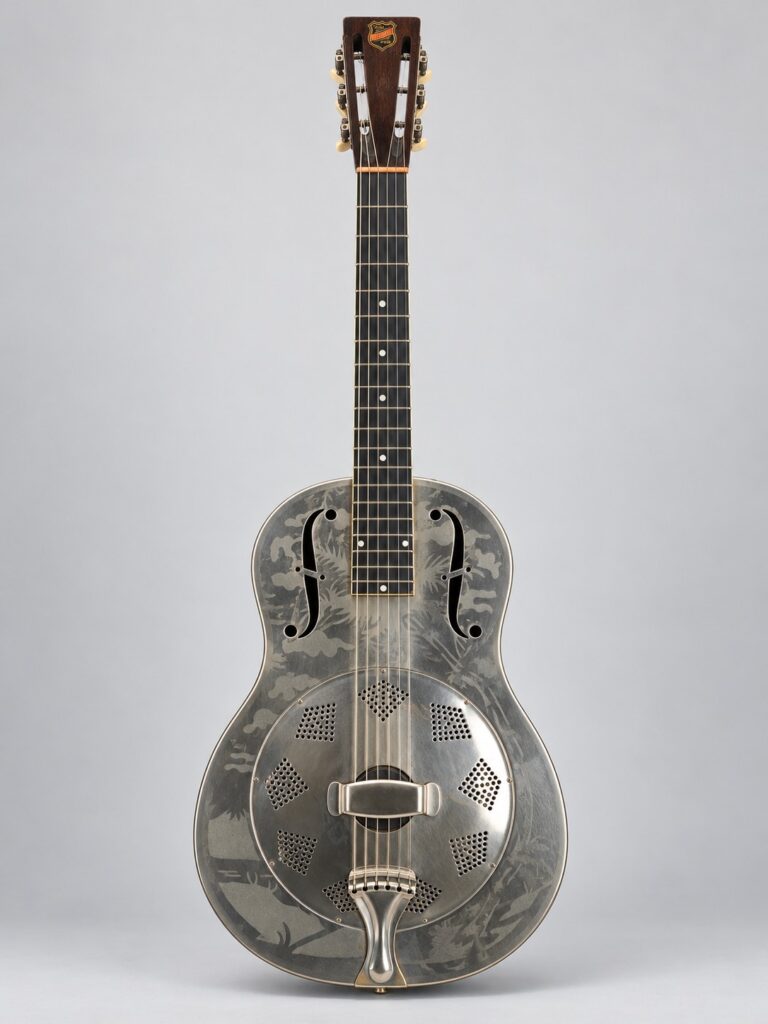
Versus a National Reso-Phonic Style O: not really a competition, more a fork in the road. Metal body, biscuit bridge, five to six times the price, and a completely different voice — loud, dry, percussive, metallic. Buy the National for Delta blues and steel-bodied authority. Buy the Hound Dog for warmth, sustain and country phrasing.
Versus the Recording King Dirty 30s Series 7 Single-0 and the Recording King ROS-626: those are conventional flat-tops trading on the same Depression-era aesthetic. They will do everything a normal acoustic does and none of what a resonator does. If you want vintage looks with modern versatility, they are the better buy; if you want the actual cone sound, they cannot get there.
Versus a square-neck Dobro: a genuinely different instrument for a genuinely different job. If your ambition is bluegrass lap playing with a Stevens bar, buy the square neck and learn it properly. A round neck raised with a nut extender is a compromise that satisfies nobody fully, though it is a cheap way to try before you commit.
Buying Guide
New versus used, USA versus import
This is the decision that matters most, and it hinges on a date. Gibson built Hound Dogs in Nashville during the Original Acoustic Instruments era — you will find 2003, 2004 and 2005 examples on the used market explicitly stamped Made in U.S.A., with curly Eastern maple bodies, 16-fret rosewood boards, open sound-well construction and Grover tuners. Those are structurally different instruments from current production and they trade at a premium that is generally deserved.
Current production is Epiphone-branded and imported. Build quality is consistent and the value is real, but a “Dobro Hound Dog” listing tells you nothing on its own. Ask for a photo of the label inside the soundhole and of the headstock decal before you buy anything remotely vintage-priced.
What to check before you pay
- Cone condition. The single most important component and the one nobody photographs. Look through the soundholes for creasing, dents around the spider legs, or corrosion. A tired cone is the difference between a guitar that sings and one that thuds — and a replacement is an inexpensive, transformative upgrade.
- Spider seating. The spider must sit flat in the cone’s well. Rocking, rattling or a buzz that follows one particular string usually means a seating problem, not a fret problem.
- Coverplate screws. Loose ones buzz sympathetically at volume and drive people insane while they hunt for the cause. Snug, not cranked.
- Neck relief and the single-action rod. Confirm there is adjustment left in both directions you actually need. A back-bowed neck on a single-action rod is a repair, not a setup.
- Ply separation. These are plywood bodies. Check the binding seams and the rim edges on the Deluxe for lifting, particularly on instruments that have lived somewhere dry.
- Fishman output. Plug it in. Resonator pickups are mounted under significant mechanical stress and intermittent output is not unheard of.
Living With One
A wooden resonator is more fragile than a metal one and more temperamental than a flat-top. The maple ply body is reasonably stable, but the cone is a thin spun-aluminium diaphragm under constant load, and it does not enjoy impacts, heat, or being leaned against a radiator. The optional Epiphone hardshell case is worth its roughly $129 the first time somebody knocks the guitar over.
Setup is where most owners get the biggest return. A resonator’s action is adjusted at the saddle inserts in the spider — you shave or shim the ebony-capped maple saddle, you do not sand the bridge. It is a job worth paying a tech for once, after which you will know how it is done.
Expect it to be loud, expect it to be unforgiving of sloppy left-hand muting, and expect it to make you play differently. That last part is the real reason to own one. A resonator does not reward the things a dreadnought rewards. It rewards space, restraint, and single notes allowed to ring — which is why so many players report writing songs on one that they would never have written on anything else.
Frequently Asked Questions
Is the Dobro Hound Dog Round Neck a real Dobro?
Yes, in the sense that Dobro is a trademark currently owned by Gibson and applied to this instrument with full legitimacy, and the guitar uses the genuine inverted-cone spider-bridge design that defines a Dobro. No, in the sense that it is not built in Nashville alongside the professional-tier instruments. It is the affordable line, which is exactly what the Hound Dog name has designated since Gibson revived it.
What is the difference between a round neck and a square neck?
A round neck is a normal guitar neck with normal action, played in the normal position — you can fret it, play slide with it, or both. A square neck has a solid squared-off neck with the strings raised roughly an inch above the fingerboard, and can only be played flat across the lap with a steel bar. Square necks are the bluegrass standard. Round necks are the versatile option and the right choice for anyone who is not committed to lap technique.
Does it sound like the guitar on the cover of Brothers in Arms?
No. That is a National Style O — a metal-body biscuit-bridge guitar with a much harder, more metallic voice. The Hound Dog is wood-bodied with a spider bridge, which produces a warmer, more sustaining, more vocal tone. Both are resonators; they are not interchangeable sounds.
Which model should I buy — standard or Deluxe?
The Deluxe adds binding, a figured maple ply body and the fitted Fishman pickup. If you will ever plug in, the Deluxe is the sensible buy, since retrofitting a resonator pickup afterwards costs money and involves working around the cone. If you only ever play acoustically, the standard model saves you real money for the same fundamental sound.
What is the M-14 Metalbody and should I consider it instead?
The M-14 shares the Hound Dog name and almost nothing else. It has a nickel-plated bell brass body and a biscuit bridge rather than a spider, a 24.75″ scale, a 14th-fret neck joint and a dual-action truss rod. It is the metal-body, Delta-blues-flavoured option. Gibson’s page for it currently carries a discontinued notice, so it is a used-market proposition.
What strings and tuning should I start with?
Open G tuning and a medium set, .016 to .056 or thereabouts. The cone needs mass and tension to be driven properly, and anything under .012 will sound thin and lifeless. Open G is the most common round-neck slide tuning and the one most instructional material assumes.
Can I use it for bluegrass?
You can play bluegrass repertoire on it, but you will not be playing it the way bluegrass Dobro players do — that idiom is built around lap technique with a steel bar on a square neck, the tradition Josh Graves established with Flatt and Scruggs and Jerry Douglas carried forward. Round-neck Dobro belongs more naturally to blues, country backing, folk and Americana.
Is it worth around $799?
For a fitted Fishman pickup, a figured and bound maple body, Grover tuners, a Tusq nut and the genuine Dobro trademark, it is fair rather than remarkable — the Gretsch Boxcar is the tougher value comparison and wins on price. What the Hound Dog offers is the name, the binding and the plug-in-and-go convenience. Buy it because you want the sound and want it stage-ready, not because you expect it to appreciate.
Image credits
- The body of an acoustic guitar with an orange top: Nenad Stojkovic, Wikimedia Commons, CC BY 2.0.
- A technician working on guitar electronics with a tool: Shixart1985, Wikimedia Commons, CC BY 2.0.
- A hand on the neck of a twelve-string acoustic guitar: Nenad Stojkovic, Wikimedia Commons, CC BY 2.0.
Latest News
Related
On This Day
Tuesday 10 November
From this week: