
Gear Timeline
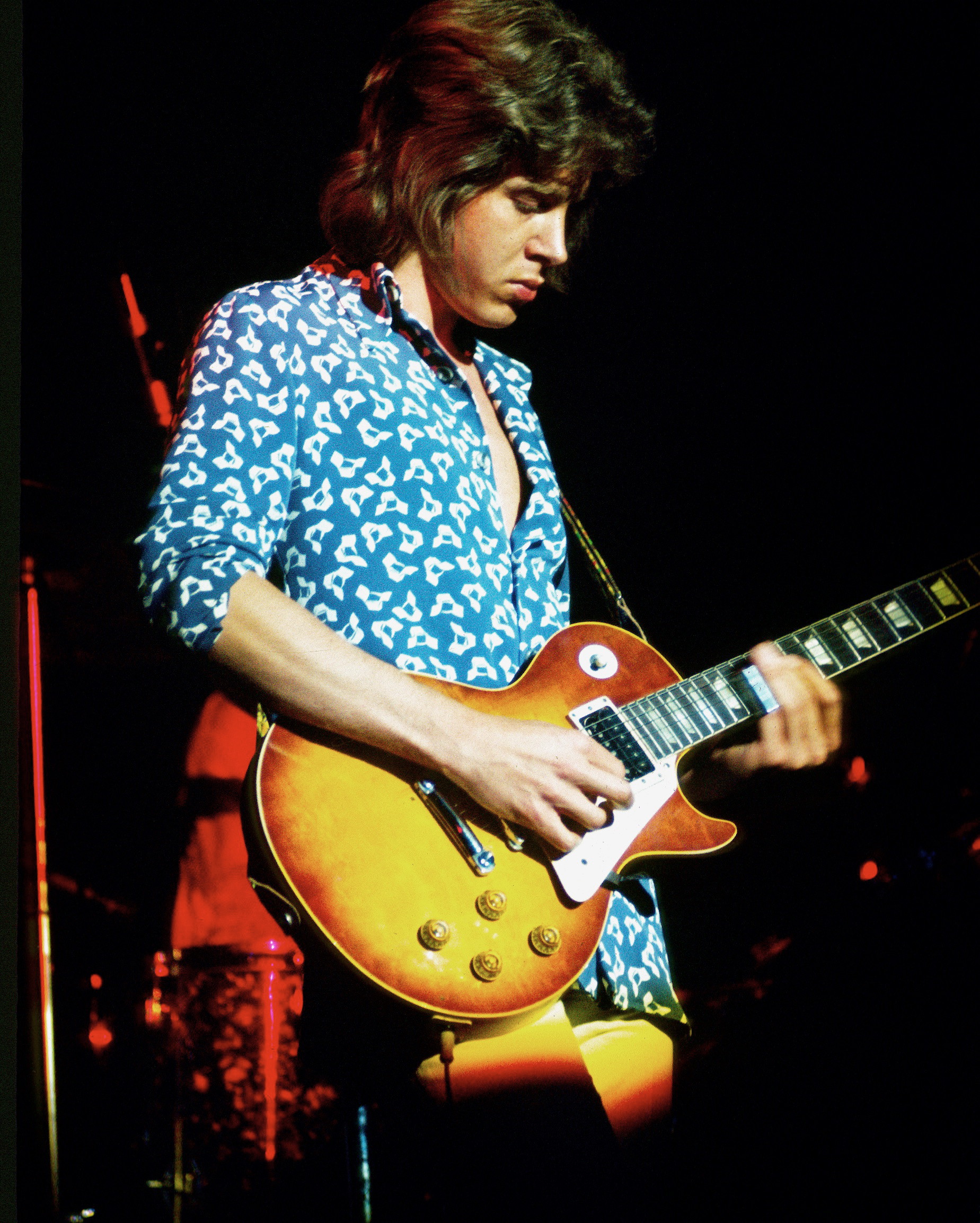
There is a live performance from 1972 — the Rolling Stones, “Love in Vain,” filmed for the Ladies and Gentlemen concert film — that is, by any reasonable musical assessment, one of the finest things a lead guitarist has ever done on a rock and roll stage. Mick Taylor, twenty-two years old, playing a Gibson Les Paul through an Ampeg amplifier, takes a blues song from Robert Johnson’s catalog and delivers it as a sustained meditation on what the electric guitar can do when played by someone who has fully inhabited the tradition the song comes from, fully mastered the technical vocabulary required to express it, and fully committed to the emotional content demanded by the moment. The solo does not show off. It sings. Every note is in exactly the right place, with exactly the right weight, at exactly the right time. It is the work of a master.
Mick Taylor is the most underrated guitarist in rock history. This is not a minority opinion among serious guitarists — it is a consensus view among the people who actually know what they’re talking about. He joined the Rolling Stones at twenty years old in 1969, replacing Brian Jones. He played on Let It Bleed (partially), Sticky Fingers, Exile on Main Street, Goats Head Soup, and It’s Only Rock ‘n’ Roll. He left at twenty-five in 1974, having contributed to what is widely considered the greatest sustained run of albums by any rock band in history. During those five years, he elevated the Stones’ guitar playing from competent and occasionally brilliant to something genuinely transcendent. The solos on “Sway,” “Can’t You Hear Me Knocking,” “Moonlight Mile,” and the various improvisational extensions on the band’s live recordings constitute a body of lead guitar work with almost no peer in rock music.
Born Michael Kevin Taylor on January 17, 1949, in Welwyn Garden City, Hertfordshire, Taylor grew up in a musical household and became a guitarist in his early teens after seeing Bill Haley and the Comets as a nine-year-old. He was playing professionally by his early teens and at sixteen — sixteen — substituted for Eric Clapton at a John Mayall’s Bluesbreakers gig when Clapton failed to show. At seventeen he officially replaced Peter Green in the Bluesbreakers. At eighteen he had already established himself as one of the finest blues guitarists in Britain. His trajectory was not meteoric. It was inevitable.
He left the Stones in 1974 amid personal difficulties and has had a post-Stones career that, while intermittently productive, has never fully recaptured his commercial position. This is the second tragedy of Mick Taylor — the first being that he was in the greatest rock band in the world at exactly the age when his gifts were at their most extraordinary, and then left, and the combination of gifts and context was never quite replicated afterward. What remains is the recordings. And the recordings are enough.
Background: From Hertfordshire to Altamont and Beyond
Welwyn Garden City in 1949 was — and remains — a small planned town in Hertfordshire, conceived as a “garden city” outside London’s urban sprawl, notable primarily for its orderly streets and its lack of the industrial blues tradition that spawned most of Mick Taylor’s musical influences. The blues that shaped him came through records and through the increasingly active British blues scene centered on Alexis Korner’s Blues Incorporated and its descendants. He absorbed American blues — Robert Johnson, Elmore James, B.B. King, the whole tradition — through the specific British filter of his generation, learning the vocabulary secondhand and then, through exceptional talent, internalizing it so completely that the secondhand quality disappeared entirely.
His debut at a John Mayall concert at sixteen — substituting for Clapton when Clapton didn’t show, reportedly asking Mayall from the audience if he could sit in, being allowed to, and making a strong enough impression that Mayall remembered him — is one of the better origin stories in rock guitar history. The immediate predecessor he was covering for (Clapton) and the immediate successor he would replace (Peter Green) are both among the most celebrated guitarists in British blues history. Taylor’s ability to not merely fill those shoes but to develop something genuinely his own within the Bluesbreakers context says everything about his musical intelligence.
His Bluesbreakers recordings — Crusade (1967) and Bare Wires (1968) in particular — demonstrate a fully mature approach already in place by his late teens: the singing vibrato, the precise intonation, the blues vocabulary applied with genuine understanding of its harmonic and emotional logic, and a particular quality of musical imagination that expressed itself in solos that felt composed rather than improvised even when they were improvised. This last quality — the solo that feels inevitable rather than accidental — is the hardest thing for a guitarist to develop and the thing that most clearly distinguishes Taylor from most of his contemporaries.
He bought his first Les Paul Sunburst from Keith Richards — a transaction that would define the sound of his tenure with the Stones. That first ‘Burst, plus the 1958 Les Paul Standard that became the “Ya-Ya’s Guitar” (visible on the cover of Get Yer Ya-Ya’s Out! in Charlie Watts’s hands), formed the core of his guitar arsenal through the Stones years. Combined with Ampeg amplifiers and the minimal effects approach that characterized the whole Stones sonic philosophy of the period, these guitars produced the specific lead guitar sound on some of rock’s most celebrated recordings.
He left the Stones in December 1974, citing various reasons including substance problems, a desire for musical freedom outside the Stones’ commercial context, and relationship complications. The subsequent decades have included solo albums, collaborations with various musicians (Jack Bruce, Carla Olsen, Bob Geldof, Taj Mahal), and occasional high-profile appearances with former colleagues, but no sustained commercial success comparable to the Stones period. He has continued to perform and record, and his playing on records and in live contexts from the 1980s onward demonstrates that the fundamental gifts — the vibrato, the intonation, the musical imagination — remained intact throughout.
The Rig: Mick Taylor’s Guitars, Amps, and Effects
Guitars
The centerpiece of Mick Taylor’s guitar history with the Rolling Stones is a 1958 Gibson Les Paul Standard — the guitar that appears on the cover of Get Yer Ya-Ya’s Out! The Rolling Stones in Concert, held aloft by Charlie Watts, and which has been at Hard Rock International’s Orlando headquarters as part of the Vault collection. The guitar entered the Stones’ collective arsenal in 1968 or 1969, coinciding with Taylor’s arrival in the band. Taylor purchased the guitar from Keith Richards — the 1958 Sunburst becoming the starting point of his Les Paul obsession — and used it extensively on the 1969 and 1972 tours and associated recordings.
The guitar’s specific characteristics have been documented by Hard Rock guitar tech Kip Elder: the neck measures .905 inches at the first fret, graduating to .983 at the 12th fret — significantly thicker than later Les Paul necks, the “wide and fat” neck profile associated with the 1958 models. The nut measures just over 1.7 inches wide. The finish has faded dramatically to what Elder describes as “now lemonburst.” The original Bigsby B7 vibrato that the guitar had when Taylor purchased it was removed and replaced with a factory-stock nickel-plated stop tailpiece, leaving two mounting holes as evidence. The double-black PAF pickups that it originally came with were swapped out at some point for replacements. The headstock bears considerable wear from its high-mileage touring history.
The guitar was present at the Altamont Speedway Free Festival on December 6, 1969 — the concert that ended the 1969 tour, filmed for Gimme Shelter, where the violence that marred the show unfolded partly in view of the Stones on stage. Taylor played the Ya-Ya’s Guitar at Altamont. After his departure from the Stones, he sold it to Guitar Grapevine in Denmark Place, London, in the early 1980s, from which it eventually reached its current home at Hard Rock.
Taylor also used a 1959 Les Paul Standard that he had purchased directly from Richards — the guitar that, in a sense, introduced the two guitarists and created the professional relationship that would define Taylor’s career. This guitar, with its PAF humbuckers and the specific resonance characteristics of the late-1950s Les Paul construction, was his primary instrument through the John Mayall’s Bluesbreakers period and into the early Stones recordings. The ’59 Standard — with its figured maple top, mahogany body, and the particular warmth and sustain of the late-1950s construction — is the configuration that most Les Paul players consider the pinnacle of Gibson’s design, and Taylor used one of the genuine articles.
His preference for Les Paul Standards from the 1958-1960 period, with wide and fat neck profiles, reflects a consistent physical preference that has characterized his playing throughout his career. Taylor has noted that the wide neck gives him more room to vibrate strings accurately, supporting the particularly expressive vibrato that is his most immediately recognizable technical attribute.
Despite the Les Paul association in discussions of his Stones work, the Gibson SG Standard was actually his primary instrument for the Get Yer Ya-Ya’s Out live album — the 1969 Madison Square Garden recordings on which his playing is most widely heard by casual Stones listeners. For the 1969 tour that produced the Ya-Ya’s album, he used the SG/Les Paul interchangeably, with some photos showing him with the Les Paul and others with the SG. The SG Standard for slide guitar passages was particularly documented: he used the SG with open G tuning for the Stones’ slide guitar material, including “Midnight Rambler” in live performance.
For some of the Stones’ most significant recordings, including “Can’t You Hear Me Knocking” from Sticky Fingers, Taylor used a Gibson ES-345 — the stereo-capable semi-hollow body that sits between the ES-335 and ES-355 in Gibson’s lineup. The ES-345’s warmer, more complex semi-hollow tone contrasted with the more aggressive character of the Les Paul and gave certain Stones recordings — particularly “Dead Flowers” and related Sticky Fingers material — their specific tonal quality. As one forum analysis noted specifically: “Taylor used a 355 [ES-345], not an LP, for Can’t You Hear Me Knocking.” The confusion between models reflects how fluid Taylor’s guitar choices were within sessions, with instruments often shared between him and Richards as part of the Stones’ communal equipment approach.
After leaving the Stones, Taylor’s instrument choices broadened. A Gibson ES-355 Custom in walnut appears in photos of his work with Jack Bruce, the bass player with whom he collaborated on various projects through the 1970s and 1980s. The 355’s additional luxury appointments (triple-bound body, ebony fingerboard, multiple binding layers) and its stereo capability gave it a different sonic character from the 335/345 family.
Taylor has used Fender guitars in various contexts both during and after the Stones years. A sunburst Stratocaster appears in performance photographs. He used a Fender Telecaster for slide on “You Gotta Move” during the Sticky Fingers sessions, per detailed session documentation. In contemporary performance, he plays Fender Stratocasters alongside his vintage Gibsons, and has described genuine affection for the Strat’s versatility while maintaining that he would never stop playing his old Les Pauls. His contemporary use of Stratocasters reflects a broader instrumental horizon than the exclusively Gibson approach of his peak Stones period.
Taylor used a hybrid string set — lighter gauges on the treble strings for bending, heavier gauges on the bass strings for body and tone. He has specified that his third string is .017 and his sixth string is .052. This asymmetric tension approach — light on top for slinky bending, heavier on the bottom for rhythm weight — is similar to the approaches used by other blues-influenced players who need maximum bending freedom in the treble register. The .009 gauge high E (documented in analysis of his Stones-era tone) combined with the heavier bass strings gave him the combination of flexibility and fullness that his style required.
Amps
Mick Taylor’s primary amplification during his most celebrated period with the Rolling Stones was Ampeg — specifically the SVT (Super Valve Technology) head, which was the most powerful bass amplifier of its era, repurposed for guitar use. Taylor used the Ampeg SVT — 300 watts of tube power running two 4×12 cabinets — providing enormous volume and the specific tonal character of Ampeg’s tube amplifiers. The SVT was originally designed for bass guitar, and its response to guitar pickups differs from guitar-specific amplifiers: more round in the low-mids, less bright in the upper frequencies, with a particular compression character at high volumes that complemented the Les Paul’s natural warmth. The specific combination of Les Paul through pushed Ampeg that defines Taylor’s Stones sound is immediately identifiable and unlike almost any other guitar tone in rock.
The Ampeg connection was shared with Keith Richards — both guitarists using non-Master Ampeg amplifiers during the same period, creating the specific tonal environment of the Sticky Fingers and early Exile sessions. The Ampeg’s round, warm, mid-forward character contrasted with the Marshall’s sharper, more aggressive tone that dominated hard rock of the same era, giving the Stones’ recordings a specific sonic quality distinct from their contemporaries.
After the Ampeg period, Taylor moved to Marshall amplification for live performance — specifically a 50-watt head, providing the specifically British crunch and midrange authority that Marshall delivers. The transition from Ampeg to Marshall changed the character of his live tone: the Marshall’s sharper, more defined attack and the EL34 tubes’ particular saturation character replaced the SVT’s round warmth with a more aggressive, forward presence. Both approaches suited different musical contexts within the Stones’ varied catalog.
Taylor has noted using a Fender Deluxe amp alongside Marshall heads for studio and smaller venue work — the Fender’s clean American character providing a different tonal option from the British Marshall. “He uses an old Fender Deluxe along with a 50 watt marshall head,” per documented sources. The dual-amp approach — warm American clean paired with British crunch — is a combination that many classic rock guitarists of the era used for the tonal variety it provides.
Effects
Like the other guitarists in the Rolling Stones’ classic lineup, Mick Taylor used minimal effects — his tone was primarily a function of the guitar’s pickups, the amplifier’s natural saturation, and his playing technique. The beauty of his tone on recordings like “Love in Vain” (1972 film version) and the Exile material comes specifically from this directness: no processing between the guitar and the amp, no layer of effects obscuring the specific quality of the notes and the specific expressiveness of the bending and vibrato. Taylor has confirmed this approach in interviews: “I believe Taylor used no effects in ’72 for that Love In Vain performance,” as documented in the guitar community research, which aligns with what the recording sounds like.
One specific effect documented in Taylor’s Stones-era setup is a Dunlop Cry Baby wah pedal, used in a “cocked” position — fixed at a specific angle rather than being swept — to create a specific EQ boost and tonal color without the sweep effect of conventional wah use. As described in gear documentation: “He used a wah in cocked position during the Stones era to heat up the amp a little bit.” This technique — using the wah as a fixed filter rather than a dynamic effect — is a traditional blues approach that adds upper-midrange presence without the obvious modulation of conventional wah use. The cocked wah in front of an already-working tube amp pushes the amp’s input with a frequency-shaped signal, producing a specific vocal, forward character in the tone.
The Fulltone Tube Tape Echo appears in documentation of Taylor’s Stones-era setup — a warm, organic tape echo providing the ambient depth that gives sustained notes their spatial presence in recordings. The tube tape echo’s specific character — warmer repeats that degrade organically, contributing to rather than detracting from the musical content — suited the Stones’ recording approach of capturing organic, full-frequency sound rather than processed, digital-adjacent effects.
For slide guitar passages — which appear in his Stones work on “Country Honk,” Stones live performances, and various other contexts — Taylor used a glass slide. The glass’s warmth and smoothness, compared to the more metallic character of steel slides, suited his approach to slide as a lyrical, melodic tool rather than a primarily percussive or aggressive one. His slide guitar playing within the Stones’ context drew on the open G tuning tradition that Keith Richards had established as part of the band’s rhythmic vocabulary, adding a lead dimension to the open G approach.
Playing Style & Tone Philosophy
Mick Taylor’s playing style is the product of a specific and unusual combination: the British blues tradition’s commitment to American source material, combined with an extraordinary natural gift for melodic construction and the most expressive vibrato in rock guitar. The result is lead guitar playing that sounds simultaneously completely blues-grounded and completely individual — recognizably in the tradition, genuinely his own expression within it.
The vibrato is the first thing you notice, and it is the thing that most distinguishes him from every other guitarist associated with the Rolling Stones, or indeed from most rock guitarists of any era. Taylor’s vibrato is wide, slow, and deeply controlled — each oscillation of the string deliberate and precisely measured, the width and speed calibrated to the specific emotional weight of the note being sustained. It is more like a cello player’s vibrato than a guitar player’s — a classically trained string player’s conception of vibrato as the primary vehicle of expression, applied to the electric guitar with unusual precision. This vibrato cannot be imitated by guitarists who haven’t developed the specific wrist and arm coordination it requires, which explains why Taylor’s solos have so many admirers and so few genuine imitators.
His melodic construction — the way he builds solos as sustained melodic statements rather than as sequences of impressive technical gestures — reflects his deep familiarity with the blues tradition’s emphasis on melody and expressiveness over display. The blues, at its highest development, is a vocal music: the guitar is a voice, and the best guitar solos sing. Taylor’s solos sing with the specific quality of a trained, natural singer’s voice — the notes phrase naturally, breathe at the right moments, return to important pitches with the emphasis that a good melody requires, and resolve in ways that feel genuinely satisfying rather than arbitrarily concluded.
His approach to the Les Paul — specifically the 1958-1960 construction with the wide, fat neck — was functional as well as aesthetic. The wide neck gave his large hands the room they needed for the specific lateral string movements of his vibrato technique, and the heavy strings (.052 on the low E) gave the instrument the weight and sustain that his full-bodied tone required. The combination of heavy strings, wide neck, PAF humbuckers, and Ampeg amplification created a specific physical environment for his playing in which everything he did could express itself fully.
His tone philosophy was about transparency and directness: the guitar’s natural voice, the amp’s natural response, nothing between them that changed the relationship. The Ampeg’s warmth was not an effect — it was the environment in which his playing lived. The Les Paul’s specific resonance was not a tonal choice — it was the instrument through which his musical voice spoke. This is the approach of a musician who thinks about music before he thinks about gear, and who chooses gear that makes the music maximally audible rather than maximally impressive.
How to Sound Like Mick Taylor
Getting anywhere near Mick Taylor’s tone requires accepting from the outset that most of what you hear is in the vibrato — and the vibrato is genuinely hard to develop to his level. But the gear guidance is specific and achievable.
Guitar: A Gibson Les Paul with PAF-style humbuckers is the historically correct starting point. A 1958-1960 vintage or a faithful replica (Gibson Custom Shop Historic models, or a well-made production Les Paul Standard) with a wide, fat neck profile is the ideal. The neck thickness matters: Taylor specifically favored the wide necks of the late-1950s models, and the feel difference between a fat 1950s neck and a slim 1960s neck is substantial. If you can find a Les Paul with a neck that measures close to .900 inches at the first fret, that’s the physical starting point.
Amp: Ampeg tube amplifiers for the most authentic sound — specifically an Ampeg V4 (100-watt version) or similar vintage Ampeg tube head if you can find one. The Ampeg’s specific round warmth and its response to Les Paul humbuckers is genuinely different from other amplifiers, and difficult to replicate with Marshall or Fender alternatives. For those without access to vintage Ampegs: a good Marshall 50-watt head at high volume or a pushed Fender Twin provides an approximation, though the specific Ampeg character will be absent. Any warm, full-range tube amp driven toward natural saturation will move in the right direction.
Amp Settings (Ampeg V4 or equivalent warm tube amp):
| Control | Setting (0–10) | Notes |
|---|---|---|
| Volume | 6–8 | Working hard but not fully saturated |
| Bass | 5–7 | Full — Ampeg’s warmth lives in the low-mids |
| Mid | 5–6 | Present — the vocal midrange quality |
| Treble | 4–6 | Controlled — not harsh, but not dark |
| Presence | 4–5 | Moderate — adds definition without brightness |
The technique — the real work: Develop wide, slow vibrato. This is the most important single technical element and the hardest to develop quickly. Practice sustaining notes at high volume and developing the specific wrist and arm movement that produces wide, controlled oscillation. Taylor’s vibrato comes from the arm and wrist together, not just the wrist — a sweeping motion that gives the oscillation its width. Practice it daily, patiently, for months. The gear will get you in the neighborhood. The vibrato will get you to the destination.
Influence & Legacy
Mick Taylor’s influence on guitar playing is disproportionate to his public profile — he is less famous than his achievement warrants, and his specific technical contributions are less often cited than they deserve. But among serious guitarists, his influence on the concept of lead guitar as a melodic, expressive voice rather than a technical display is deep and lasting.
The specific players who have most directly absorbed his approach are concentrated in the blues-rock tradition: players who valued the singing quality of a sustained note over the impressive complexity of a fast run, who developed wide vibratos rather than the narrow, fast versions common in rock, who thought melodically rather than pattern-based. Gary Moore, who played with an emotional expressiveness analogous to Taylor’s though from a harder rock context, acknowledged Taylor’s influence explicitly. John Mayer’s blues-adjacent playing shows the Taylor influence in its willingness to sustain notes and develop melodic ideas slowly rather than filling every available space with movement.
The Stones’ catalog from the Taylor years — Sticky Fingers, Exile on Main Street, Goats Head Soup — is the most direct documentation of his contribution to the language of rock guitar. “Sway,” “Moonlight Mile,” “Can’t You Hear Me Knocking,” “Time Waits for No One,” “Winter” — these are lead guitar performances of genuine compositional intelligence, each one a complete melodic statement rather than a collection of impressive gestures. They raise the standard of what is possible in a rock band context and demonstrate that guitar playing of genuine musical depth can function commercially.
For context on how Taylor fits into the broader Rolling Stones guitar tradition, the comparison with Keith Richards’ rhythm guitar philosophy at #28 illuminates the complementary roles that made the Taylor-era Stones so exceptional: Richards’ groove-locked rhythm foundation providing the space in which Taylor’s melodic lead playing could develop with maximum expressiveness. The two approaches needed each other.
The connection to the British blues tradition from which Taylor emerged runs through Eric Clapton’s approach to blues guitar at #9 — Taylor literally replaced Clapton in the Bluesbreakers at sixteen, inhabiting the same musical space and developing his own distinct voice within the same tradition. The comparison between the two approaches — Clapton’s more aggressive, bending-forward, American-style blues and Taylor’s more fluid, vibrato-centered, melodically focused approach — represents two different expressions of the same deep engagement with American blues by British musicians of the same generation.
The broader question of why Mick Taylor’s reputation has not grown to match the scale of his achievement is worth examining directly. The answers are several. He was in the Rolling Stones but not a Stone in the same sense that Jagger, Richards, Watts, and Wyman were — he was a member of the band without being part of the partnership that owned and defined it. He left at twenty-five, cutting short the accumulation of public awareness that length of tenure provides. His post-Stones career, while genuinely musical, was commercially marginal and didn’t generate the kind of high-profile moments that sustain a guitarist’s public profile. And his style — fluid, melodic, technically demanding but not technically demonstrative — doesn’t lend itself to the quick impression that fast, flashy playing makes. You have to listen to Mick Taylor to understand what he’s doing. Many people haven’t listened carefully enough.
Those who have listened carefully have arrived at the same conclusion: that “Love in Vain” from the 1972 tour, that “Time Waits for No One” from It’s Only Rock ‘n’ Roll, that “Sway” from Sticky Fingers — these are lead guitar performances of genuine musical greatness, and they came from a guitarist who had been playing professionally for less than a decade. The 1958 Les Paul Standard, the Ampeg SVT, the wide fat neck, the .009-.052 string hybrid set, the glass slide, the cocked wah: these are the tools. The music they made is permanent.
And the direct Bluesbreakers lineage connects to the broader context of John Mayall’s role as the crucible through which Clapton, Green, and Taylor all passed — three of the most gifted blues guitarists in British history occupying the same guitar chair in the same band in succession, each shaping the tradition and each being shaped by it in turn. Taylor’s position in this succession — following Clapton and Green, each of whom is indisputably great — and his ability to develop something genuinely his own rather than merely maintaining what his predecessors had established is a measure of his extraordinary gifts.
Mick Taylor is seventy-six years old in 2026. He performs regularly at a level that demonstrates the technique remains intact. The vibrato is still there. The melodic intelligence is still there. The wide fat neck is still his preference. And somewhere, presumably in the Hard Rock Vault in Orlando, Charlie Watts’s hands are still wrapped around the Ya-Ya’s Guitar on a faded lemonburst Les Paul that a twenty-year-old guitarist from Hertfordshire played at Altamont in 1969 and on the stage at Madison Square Garden and in the basement of Villa Nellcote and at the Checkerboard Lounge when nobody knew they were watching one of the finest guitarists who ever existed. The recordings know. The recordings always will.
The case for Mick Taylor as the greatest lead guitarist who ever played with the Rolling Stones is not actually controversial among people who have studied the catalog. It is stated plainly by critics, by fellow musicians, and by guitarists who have spent time analyzing what he did. Keith Richards himself — who has no incentive to minimize his own contribution to the band’s guitar work — has acknowledged Taylor’s abilities in terms that leave no ambiguity. The issue is not that Taylor’s gifts are in dispute. The issue is that his cultural profile, for the reasons described above, doesn’t match the scale of those gifts. This is the perennial condition of the truly great musician who doesn’t occupy a frontman role, who doesn’t have an instantly quotable public personality, and who made his most important music inside a larger organization rather than in his own name. The music remains. It is enough. It is more than enough.
A final note on his Bluesbreakers recordings: Crusade (1967) and Bare Wires (1968) are among the finest blues guitar records made by a British musician in the 1960s, and they are almost entirely unknown outside dedicated blues-guitar circles. They are also available, they are not difficult to find, and if you haven’t heard them — if you know the Stones material but not the Mayall work — you owe yourself the experience of hearing the vibrato and the melodic intelligence at their earliest fully developed state. He was seventeen. The music sounds like the work of someone who had been living inside the blues tradition for forty years. It is the most astonishing debut in British blues guitar history.
Frequently Asked Questions: Mick Taylor Guitars & Gear
What guitar did Mick Taylor play with the Rolling Stones?
Mick Taylor’s primary instruments with the Rolling Stones were Gibson Les Paul Standards from the 1958-1960 period, with wide and fat neck profiles that he particularly favored. His most historically documented guitar is a 1958 Gibson Les Paul Standard known as the “Ya-Ya’s Guitar” — visible on the cover of Get Yer Ya-Ya’s Out! being held by Charlie Watts — which he purchased from Keith Richards before joining the Stones. He also used a 1959 Les Paul Standard, also purchased from Richards. For the 1969 tour that produced the Ya-Ya’s live album, he played a Gibson SG Standard extensively, particularly for slide guitar passages in open G tuning. For specific recordings including “Can’t You Hear Me Knocking,” he used a Gibson ES-345 semi-hollow body. His string preference was a hybrid set with .009 on the high E and .052 on the low E.
What amps did Mick Taylor use with the Rolling Stones?
Mick Taylor’s primary amplification during his peak Stones period was Ampeg — specifically Ampeg SVT heads (300 watts) running two 4×12 cabinets for live performance. He used non-Master Ampeg amplifiers alongside Keith Richards, giving the 1969-1972 Stones live sound its specific round, warm, mid-forward tonal character. The SVT was originally designed for bass guitar, and its response to Les Paul humbuckers produced the specific warmth and compression that characterizes recordings like the “Ladies and Gentlemen, The Rolling Stones” film. He later used a Marshall 50-watt head for live performance, and a Fender Deluxe for studio and smaller venue applications.
What is the “Ya-Ya’s Guitar”?
The “Ya-Ya’s Guitar” is the nickname for Mick Taylor’s 1958 Gibson Les Paul Standard, visible on the cover of the 1970 Rolling Stones live album Get Yer Ya-Ya’s Out! in Charlie Watts’s hands. The guitar entered the Stones’ arsenal in 1968 or 1969 and was Taylor’s primary instrument through the 1969 and 1972 tours. Its characteristics include a thick neck (.905 inches at the first fret), a “now lemonburst” faded finish, a stop tailpiece (replacing the original Bigsby B7 that Taylor removed), and replaced PAF pickups. The guitar was played at the Altamont Speedway Free Festival in 1969. After Taylor left the Stones, he sold it to Guitar Grapevine in London in the early 1980s. It is now at Hard Rock International’s Vault in Orlando, Florida.
Why did Mick Taylor leave the Rolling Stones?
Mick Taylor left the Rolling Stones in December 1974, citing multiple factors including personal difficulties, desire for greater musical freedom, and what he described as feeling constrained by the band’s commercial requirements. Substance problems were also a factor in this period. The departure came during the recording of It’s Only Rock ‘n’ Roll and represented the end of what is widely considered the greatest sustained period in the Stones’ recording history. Taylor himself has described the decision with some ambivalence in subsequent interviews, noting that while he needed to leave at the time, the band and the musical environment it provided were exceptional. He was twenty-five years old when he left, which means he was in the greatest rock band in the world from twenty to twenty-five, producing recordings that have never been surpassed.
What makes Mick Taylor’s vibrato distinctive?
Mick Taylor’s vibrato is considered among the most expressive and technically accomplished in rock guitar history. It is wide, slow, and deeply controlled — each oscillation of the string deliberate and precisely measured, more analogous to a cello player’s vibrato than to conventional guitar vibrato technique. The width and speed are calibrated to the emotional weight of the specific note being sustained, creating a deeply vocal quality in his sustained lines. The technique originates in a combination of wrist and arm movement rather than just the wrist, giving the oscillation its characteristic width. Taylor’s preference for wide, fat neck Gibson Les Pauls supported this technique by giving his hand more room for lateral string movement. Developing this specific vibrato is considered one of the most difficult technical challenges in blues-influenced guitar playing.
How did Mick Taylor get into John Mayall’s Bluesbreakers?
At sixteen years old, Mick Taylor was in the audience at a John Mayall’s Bluesbreakers concert where the scheduled guitarist (Eric Clapton) had failed to appear. Taylor asked Mayall from the audience if he could sit in, Mayall agreed, and Taylor — already familiar with the band’s material — made a strong enough impression that Mayall remembered him. A year and a half later, after Clapton and his replacement Peter Green had both moved on to form their own bands, Mayall called Taylor (now seventeen or eighteen) and asked him to join officially. Taylor’s Bluesbreakers recordings — Crusade (1967) and Bare Wires (1968) — demonstrated a fully mature blues guitarist already in place by his late teens, including the distinctive vibrato and melodic sensibility that would later define his Stones work.
Is Mick Taylor in the Rock and Roll Hall of Fame?
Mick Taylor was inducted into the Rock and Roll Hall of Fame as a member of the Rolling Stones in 1989. The Rolling Stones were in the Rock and Roll Hall of Fame’s inaugural era of inductions, recognizing the band’s foundational importance to rock history. The induction covered the full membership, including Taylor’s five-year tenure as lead guitarist from 1969-1974 — the period that produced Sticky Fingers and Exile on Main Street, widely considered the band’s greatest recordings. Taylor has continued to perform and record as a solo artist and collaborator following his Rock and Roll Hall of Fame induction, and is regarded by serious guitar players as one of the finest and most underappreciated guitarists in the history of rock music.
Related stories
Sylvain Sylvain Guitars & Gear: The Complete Guide to the New York Dolls’ Gretsch, Les Paul Junior & Automatic Guitar Proto-Punk Rig
Sylvain Sylvain guitars & gear: New York Dolls guitarist. Les Paul Junior 'automatics', Gretsch Golden Anniversary, white Les Paul Custom stolen by Steve Jones — proto-punk tone.
Ted Nugent Guitars & Gear: The Complete Guide to the Motor City Madman’s Byrdland Rig
Ted Nugent guitars & gear: the Motor City Madman's Byrdland rig. 12 vintage Gibson Byrdlands, Fender Twin Reverbs, Peavey 6505, zero effects, and the Stranglehold tone.
Ted Turner Guitars & Gear: The Complete Guide to Wishbone Ash’s Twin Guitar Pioneer’s Rig
Ted Turner guitars & gear: Wishbone Ash's twin-lead pioneer. Stratocasters, Firebird, Orange amps, and the Argus-era tone fully explained.