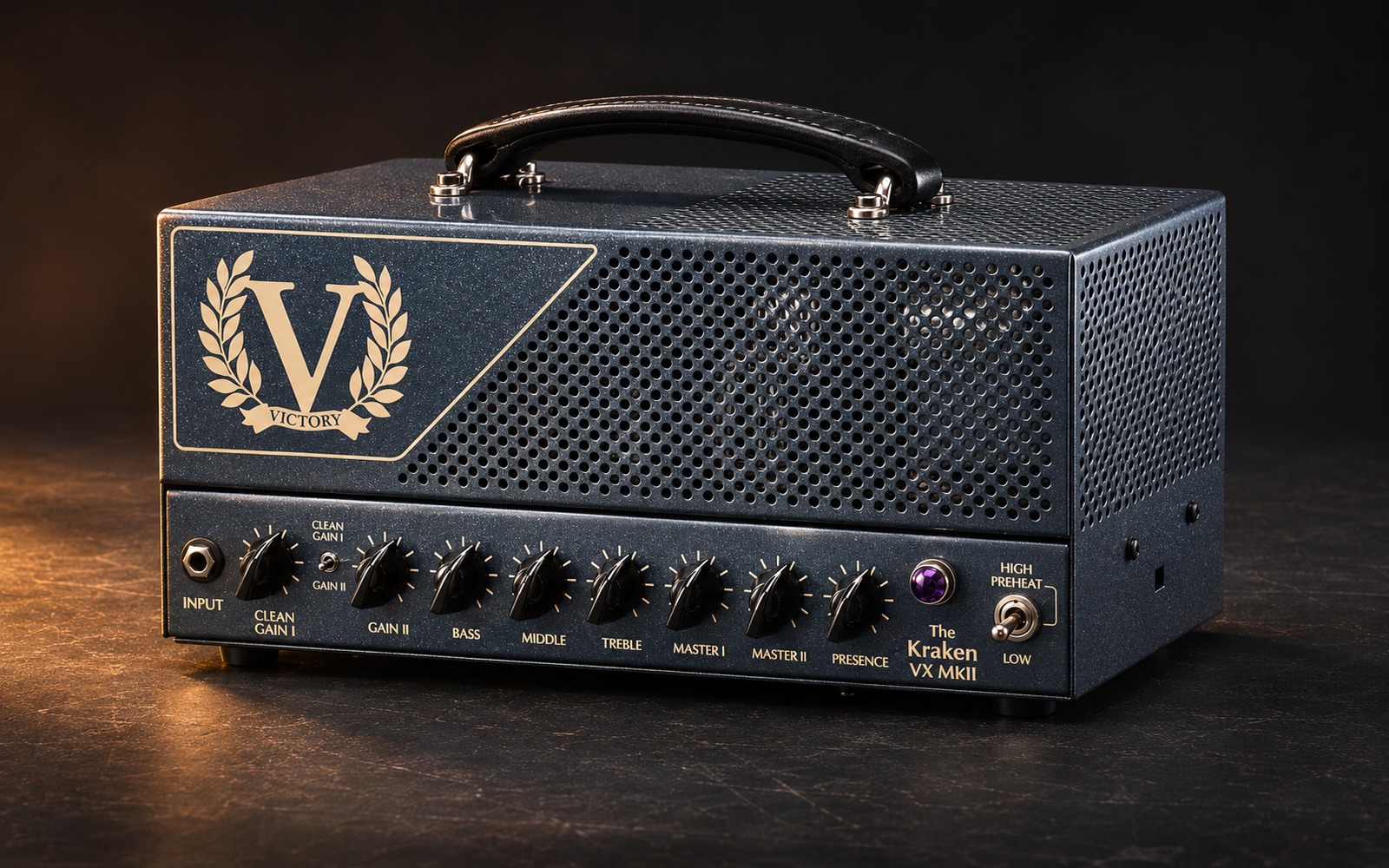
Four Years in the Making: Victory VX Kraken MKII and the Amp That a YouTube Guitarist Built
Victory VX Kraken MKII: Rabea Massaad's co-designed 50W tube head. British crunch, American high-gain, clean mode. Full specs, tones and buying guide.
In 2013, Victory Amplifiers opened its doors in England with a simple premise: build high-end, hand-wired tube amplifiers that compete with the best boutique names in the world, but price them like they actually want to sell them. Designer Martin Kidd — formerly of the revered Cornford Amplification — brought a pedigree that boutique collectors recognize immediately. But the amp that defined Victory’s commercial breakthrough was not a recreation of a vintage classic or a chasing of the Dumble myth. It was a collaboration with a self-taught guitarist from the UK with a YouTube channel and a very specific tonal obsession.
Rabea Massaad plays in FrogLeap, Toska, and Dorje. He makes videos online. He is also, as of 2015, the co-designer of the VX The Kraken — a two-channel tube head built around the two amps he was running in stereo on stage: a Marshall JCM900 for British crunch and a Peavey 5150 for American high-gain devastation. Victory and Rabea distilled that stereo rig into a single lunchbox head, gave it a mythology-appropriate name, and watched the metal community take notice.
In 2023, after four years of development, that collaboration produced the VX The Kraken MKII. It adds a clean channel, a presence control, a presence shift switch, and enough ergonomic refinements to constitute a genuine generational leap. This is not a cosmetic refresh. It is, as Rabea himself put it, “the culmination of four years of development” — an attempt to expand the original’s scope without touching what made it work. The result, according to Guitar World and Guitar.com, is one of the finest metal amps currently in production at any price.
A Brand Born from Boutique DNA
Victory Amplifiers launched in 2013, founded by industry veteran Nick Drinkwater and built on the circuit work of Martin Kidd. Kidd’s background at Cornford — a brand whose handwired combo amps sold for thousands and developed a devoted following before the company folded in 2012 — gave Victory instant credibility in the tone-obsessed corner of the guitar world where brand history is treated as specification.
The company’s philosophy from the start was the lunchbox format: compact, steel-chassis heads running real tubes, priced in the £999–£1,399 range rather than the £2,000–£4,000 of comparable boutique products. The V30 The Countess MKII — co-designed with Guthrie Govan — and the V40 The Duchess became flagship examples of that clean-pedal-platform approach. The Kraken was always the outlier: the amp designed not for clean tones and pedalboard possibilities, but for players who want the amp itself to be the distortion source.

The original VX Kraken arrived in 2015, and its design brief was unusually transparent. Rabea ran a JCM900 and a Peavey 5150 in stereo. The Kraken put both voices into one enclosure: Gain I, British-voiced and crunch-oriented, in the JCM900 tradition; Gain II, American-voiced and high-gain searing, in the 5150 tradition. Victory did not advertise these DNA references evasively. They leaned into the comparison, because they were confident the result stood up to it.
The MKII process began shortly after the MkI established itself as one of the go-to metal heads in its class. Over four years, Rabea and Kidd iterated on three additions the original lacked: a genuine clean mode, a presence control, and a rear-panel presence shift option. The clean idea came, appropriately, from the Kraken’s bigger sibling — the VX100 Super Kraken, where a preamp tube was disengaged to access cleaner sounds. In the lunchbox format there was no room to replicate that approach, so Kidd found a different solution: attenuating the first gain stage to produce what Rabea described as “chimey, glassy goodness” — a naturally compressed clean channel that sits closer to Marshall than Fender in character, but is unmistakably its own thing.
What Changed from MkI to MKII
The MKII looks like the MkI with its graphite sparkle finish and front-panel layout, but the engineering changes are substantive. Here is what is new and what has been removed.
Added in MKII: Clean mode on Gain I (footswitchable or front-panel toggle); Presence control on front panel (works in the power section); Presence Shift switch on rear panel (brightens the presence control’s range); Gain I Balance pot on rear panel (trims the level difference between Clean and Gain I modes); External Bias Test Points with adjustment screw on rear panel (makes tube biasing accessible without removing chassis).
Removed from MkI: Single-ended mode (the MkI had four power modes including a single-ended rear-panel option; the MKII retains only 50W/9W); footswitchable effects loop (the MKII’s loop is series and bypasses hard, but cannot be engaged or disengaged by footswitch).
The effects loop change is the one most likely to catch existing Kraken users off guard. Players who were routing a noise gate or time-based effects through the loop and kicking it in and out mid-song will need to adjust their workflow. The trade-off is a loop that is completely out of the signal chain when bypassed — no latching relay, no switching noise, no tonal coloration from an inactive loop sitting in the path.
The Gain I Balance rear pot is a thoughtful addition. Because the Clean and Gain I modes share the same gain control, switching between them can produce a volume step. The balance pot trims that difference so the two voices sit at matched levels before they hit the shared master volume section. It requires a screwdriver to access (recessed into the rear panel), but it is a one-time setup, not a per-gig adjustment.
Specifications
Famous Players
Rabea Massaad — FrogLeap, Toska, Dorje, Vower (Verified: Co-designer; victoryamps.com artist page + multiple primary sources)
Rabea Massaad is the primary artist behind the Kraken in every meaningful sense of the word. He did not endorse a finished product — he designed it. The original VX Kraken was built around his stereo live rig, and the MKII was shaped by his evolving tonal needs: more versatility, a clean option for ambient passages, and better high-frequency control without thinning the core metal sound. Victory’s own artist page confirms his role explicitly: “Rabea also help design the Kraken range with Martin and works closely with our team in R&D.” Guitar.com, Guitar World, and MusicRadar all document the co-design relationship with consistent detail across independent reviews.
Rabea is a self-taught guitarist, songwriter, and producer. His playing spans progressive metal, ambient post-rock, and extended-range techniques, and his YouTube channel has given him an audience that extends well beyond his band work. He is one of a small number of YouTube-era guitarists whose instrument endorsements carry genuine technical credibility — not because he is famous, but because the products he has shaped reflect actual engineering conversations, not a marketing budget allocation.
It is worth noting what this means for the buyer. When a signature or co-designed amp ships with the original artist’s name attached, the risk is often that the artist’s specific requirements produce something inflexible for other players. The Kraken MKII avoids this. Rabea’s stated goals — versatility, feel, tonal balance between American and British characters — are transferable. The amp is not a locked-in recreation of one player’s patch. It is a platform that reflects years of real-world touring and recording use.
Louis Hardy — Higher Power (Verified: victoryamps.com MKII product page)
Louis Hardy plays guitar in Higher Power, the Leeds-based metallic hardcore band whose approach sits at the heavier end of the post-hardcore and metalcore spectrum. His presence on Victory’s own MKII product page as a named artist confirms SKU-level association, not merely brand affiliation. Higher Power’s sound makes him a credible fit for the Gain II channel’s aggressive American voicing.

Brandon Davis — Fever 333 (Verified: victoryamps.com MKII product page)
Brandon Davis is the guitarist for Fever 333, the Los Angeles rap-rock-hardcore trio whose live shows combine heavy riffing with political theatre. The band operates in a genre space — aggressive rock with broad dynamic range — where the MKII’s combination of a usable clean channel and a high-gain lead mode has practical value. Davis appears on Victory’s own MKII product page, establishing direct SKU documentation.
The Broader Kraken User Base
The original VX Kraken (MkI) attracted a wider community of players whose extended-range and progressive metal work made it a reference head in that niche. Jared Dines, the American metal YouTuber who helped popularise seven- and eight-string guitar content online, is documented on the original Kraken via Equipboard — though his listing is for the MkI, not the MKII specifically. The MkI and MKII share core circuit DNA, so the tone profiles documented by MkI players remain instructive for understanding what the MKII delivers, even if those players have not yet been documented upgrading.
Tone Recipes and Settings
Recipe 1: MKII Clean Channel — Ambient Chord Work with a Humbucker
Mode: Clean. Guitar: Gibson Les Paul Standard. Gain I Level: 9 o’clock. Master I: to taste (room volume). Bass: 12 o’clock. Middle: 1 o’clock. Treble: 11 o’clock. Presence: 9 o’clock. Presence Shift: off. Bass Focus: off. Notes: the clean channel on 6L6 power has inherent low-mid warmth. Keep the gain below 10 o’clock for maximum string-to-string clarity. The subtle compression flatters open chord voicings and arpeggios. Running the presence at 9 rather than zero adds definition without brightness; pulling it to zero gives a rounder, almost vintage character.
Recipe 2: Gain I British Rhythm — Classic JCM Territory
Mode: Gain I. Guitar: Gibson Les Paul Standard. Gain I Level: 12–1 o’clock. Master I: stage-appropriate. Bass: 12 o’clock. Middle: 2 o’clock. Treble: 12 o’clock. Presence: 11 o’clock. Bass Focus: off (looser, more vintage feel). Notes: this is the classic British crunch voice — mid-forward, fast attack, excellent for power-chord rhythm work in the AC/DC to Aerosmith to Soundgarden spectrum. Adding an Ibanez TS9 Tube Screamer in front (gain low, level high, tone at noon) pushes it into JCM800 territory for harder-edged riffing without fully committing to the Gain II American response.
Recipe 3: Gain I Djent — Tight Modern Crunch for Extended Range
Mode: Gain I. Guitar: 7-string or detuned 6-string. Gain I Level: 1 o’clock. Master I: stage-appropriate. Bass: 10 o’clock. Middle: 2 o’clock. Treble: 12 o’clock. Presence: 12 o’clock. Presence Shift: on (slightly brighter presence response). Bass Focus: on (tightens the low end substantially). Notes: engaging Bass Focus is the single most effective move for detuned guitars through Gain I. The low end of a 7-string or Drop-A 6-string without Bass Focus can become undefined; with it, the chugging rhythm patterns articulate clearly and stack well in a mix. This is exactly the voicing the amp was built around — the JCM900 inspiration made right for modern extended-range riffing.
Recipe 4: Gain II American Lead — Full High-Gain Territory
Mode: Gain II. Guitar: Fender Stratocaster (single-coils usable; humbuckers quieter). Gain II Level: 12–2 o’clock. Master II: slightly above Master I for a lead boost. Bass: 11 o’clock. Middle: 1 o’clock. Treble: 12 o’clock. Presence: 12 o’clock. Presence Shift: off. Bass Focus: on for tighter pick attack. Notes: Gain II is the 5150-inspired voice and it needs no apology or qualification. With the gain at noon there is already more than enough saturation for any conventional high-gain application. The harmonic content at this setting — squeals, feedback, pinch harmonics — is available without hunting for it. The Presence Shift is worth engaging only if you want a more sizzling, forward top end; at noon without Presence Shift the upper frequencies are punchy rather than cutting, which seats better in most live contexts.
Recipe 5: Master Volume Solo Override — Live Channel-Switching Setup
Channels: Gain I (rhythm) into Gain II (lead solo). Master I: set for mix-level rhythm. Master II: set 3–5dB above Master I for lead solo lift. Auto Assign: on (links Clean/Gain I to Master I automatically; links Gain II to Master II). Footswitch: use second supplied footswitch for solo override — engaging Gain II + Master II with a single stomp. Notes: this is the live setup the MKII was designed for. The two master volumes and the footswitch solo-override function eliminate the need for an external boost pedal in the signal chain, keeping the high-gain response clean from the Gain II preamp without a buffer in front of it. Clean mode, when needed for intro passages or ambient sections, is footswitchable from Gain I without touching the master — a three-mode live rig from a single head.
The MKII shares a single passive EQ section (Bass, Middle, Treble) across all three modes. Dialling these in for the context you use most — typically Gain II for metal, Gain I for crunch — is the first priority, with the Clean mode then balanced via the rear Gain I Balance pot. All settings are approximate starting points and should be adjusted for your guitar, cabinet, and room.
Comparisons
Victory V30 The Countess MKII
The Victory V30 The Countess MKII is the Kraken’s closest relative in the Victory catalogue — another 42W/7W lunchbox head with two gain channels and a shared EQ. But the design brief is fundamentally different. The Countess, co-designed with Guthrie Govan, is a versatile amp designed to be pushed by pedals; its Clean and Lead channels respond to what you put in front of them. The Kraken MKII is designed to be the sound source itself. If you want a tube amp that makes your pedalboard the instrument, the Countess is the better call. If you want the amp to deliver gain without a chain of drive pedals, the Kraken wins decisively.
Marshall JCM800 2203
The Marshall JCM800 2203 is the template for the Kraken’s Gain I channel, distilled through the evolution of the JCM900. The real JCM800 delivers a single channel of British crunch and needs pedals for high-gain lead work. The Kraken MKII adds the American Gain II channel, the clean mode, and the footswitchable master volumes — all in a package a fraction of the size. The JCM800 has the advantage of decades of documentation, a massive secondary market, and the kind of recorded track record that no 2023 amp can match. The Kraken MKII has the advantage of being new, fully serviced, and available without hunting through vintage market variables.
EVH 5150III 50W Head
The EVH 5150III 50W is the MKII’s most direct market competitor: an American-voiced high-gain lunchbox head with genuine heritage, at a similar price point. The 5150III adds a dedicated clean channel and three fully independent channel EQs — more tonal flexibility on paper. In practice, the Kraken’s shared EQ forces a more decisive dialling-in process that many players find clarifying rather than limiting. The 5150III’s clean channel is more convincingly hi-fi; the Kraken MKII’s clean has more harmonic complexity and character. Neither amp needs the other’s clean channel to justify its existence.
Mesa/Boogie Dual Rectifier
The Mesa/Boogie Dual Rectifier is the defining reference point for American high-gain voicing in a larger-format head. Guitar.com’s Darran Charles put the Kraken Gain II channel “in the same high regard as other iconic metal amps such as the Dual Rectifier and Diezel VH4” — and that comparison comes from an experienced reviewer who tested both. The Dual Rectifier is a heavier, more complex amp with three channels, silicon/tube rectifier switching, and an established vintage market. It is also considerably larger and heavier. The Kraken MKII fits in an aircraft overhead locker.
Diezel VH4
The Diezel VH4 sits at the top of the high-gain pyramid: four independent channels, transformer-balanced DI output, and a price in the £2,500–£3,000 range. For players who need that level of channel separation and the specific Diezel character — tight, precise, German-engineered — the VH4 has no peers. The Kraken MKII is not an alternative to a VH4 in that sense; it is a different premise. Two channels, less complexity, UK manufacture, roughly half the price. For players who need one exceptional high-gain voice and one usable clean, the MKII case is straightforward.
Buying Guide
Lunchbox vs Compact Sleeve
Victory offers the MKII in two enclosures: the steel lunchbox head (350 × 180 × 190mm, 7.15kg) and the compact head in a wooden sleeve (slightly larger footprint, £1,529 vs £1,399). The electronics are identical; the difference is aesthetics and practical handling. The lunchbox includes a padded carry bag that fits in aircraft overhead lockers — a meaningful spec for players who fly to gigs regularly. The wooden sleeve version looks more like a conventional amp head on a cab. Both are built to the same Victory standard.
MkI on the Used Market
The original VX Kraken (MkI) appears on the used market in the £400–£700 range depending on condition. It delivers the same two core gain voices — Gain I British and Gain II American — at a significant discount. What it lacks: the Clean mode, the Presence control, the Presence Shift option, the Gain I Balance trim, and the external Bias Test Points. If you primarily use the amp for high-gain work and rarely need a clean channel, the MkI is an outstanding value proposition. If the clean mode and presence sculpting are central to your use case, the MKII premium is justified.
Cabinet Pairing
Victory offers a full range of matching cabinets: 1×12 from £619, 2×12 from £899, and 4×12 at £1,299. The amp pairs with any 8Ω or 16Ω cabinet, and the guitar.com review used a Cornford 2×12 loaded with Celestion Vintage 30s with excellent results. For the Gain II voice specifically, a cabinet with Vintage 30s or Celestion G12T-75s — both of which handle upper-midrange crunch without getting brittle — is the natural match. Players seeking tighter low-end for djent or extended-range work will benefit from a closed-back cab; the Bass Focus switch provides surgical trim at the amp end, but cabinet type matters at the low end equally.
Tube Swapping
The MKII ships with 6L6 power tubes as standard. A recessed Bias Range switch on the chassis top allows switching to EL34 tubes without a major bias recalibration — the switch adjusts the bias range to accommodate either tube type, and the external Bias Test Points allow precise adjustment after a swap. The 6L6 character is more open and scooped in the upper midrange; EL34s push more mids and give the British Gain I voice a more authentic JCM900 character. For extended-range players who want the maximum low-end focus, 6L6 is the correct choice from stock. For players who want more midrange bite and compression, the EL34 swap is worthwhile.
Who Is This Amp For?
The MKII is aimed directly at serious amateur and professional players who want a giggable, compact, all-valve high-gain head without compromising on build quality or tonal credibility. The sweet spot is the progressive metal, metalcore, hard rock, and extended-range player who performs live and wants a single head to cover their entire tonal range. The clean channel is good enough to handle ambient passages and intro work; the Gain I channel covers rhythm duties from classic rock to modern metal; the Gain II channel handles any lead or extreme rhythm application you can throw at it. The amp is not subtle for low-gain or mild overdrive sounds — if that is the primary use case, the V30 Countess MKII or the V40 Duchess are better choices.
Ownership Notes
The MKII’s effects loop is series and hard-bypass when disengaged — which means if you are putting a reverb or delay in the loop, you will hear the complete removal of those effects when the loop is bypassed, not a blend. Plan your signal chain accordingly: time-based effects in the loop, drive pedals in front of the amp.
The front panel has no channel indicator LEDs. You know what mode you are in from the footswitch LEDs only. In a dark stage environment, the footswitch must be in a visible position. This is a genuine ergonomic limitation and one that Guitar World flagged explicitly in their review.
The dual footswitch operation is described as “slightly confusing” in Guitar World’s review, and it is worth studying the manual before the first gig. The supplied footswitches handle channel switching and master volume selection simultaneously, with an Auto Assign function that links volumes to channels when engaged. Once it is understood, the system is logical and practical — but it requires learning, unlike a simple A/B channel footswitch.
At 50W through an efficient 2×12 or 4×12 cabinet, the MKII is extremely loud. The 9W low power mode is genuinely useful for home and studio playing, but it does alter the feel of the power section — the 6L6 compression and sag at 9W is less pronounced, which changes the dynamic response slightly. For studio tracking at reduced volume, engage the low power mode and expect to compensate slightly with the gain and EQ settings. The external bias points mean tube replacement and bias checks are accessible without sending the amp to a tech — a meaningful ownership advantage for players who change tubes regularly or experiment with different tube brands.
FAQ
What exactly is the difference between the VX Kraken MkI and the MKII?
The MKII adds a footswitchable Clean mode on the Gain I channel, a front-panel Presence control, a rear Presence Shift switch, a rear Gain I Balance pot (trims level between Clean and Gain I), and external Bias Test Points with adjustment. The MKII removes the single-ended mode that was available on the MkI and makes the effects loop non-footswitchable (it is now hard-bypass only). The cosmetic difference is a darker graphite sparkle finish and chicken-head style knobs on the MKII.
Can I use EL34 tubes instead of the stock 6L6?
Yes. The MKII has a recessed Bias Range switch on the top of the chassis that accommodates either tube type. After swapping power tubes, use the external Bias Test Points and adjustment screw on the rear panel to set the bias correctly. EL34 tubes push more upper-midrange and produce a more compressed, mid-forward British character; 6L6 tubes are more scooped and open. Victory ships 6L6 as standard because Rabea Massaad prefers the 5150-style American voice of the Gain II channel at its most defined, which the 6L6 suits well.
Is the Kraken MKII too much gain for classic rock or blues?
The Gain II channel is a purpose-built high-gain voice and is not the right tool for classic rock or blues. The Gain I channel, backed off to lower gain settings, can cover hard rock rhythm territory in the JCM800/JCM900 tradition reasonably well. The Clean channel at lower gain settings provides an edge-of-breakup tone with more harmonic content than a typical hi-fi clean. But the honest answer is: if your primary application is classic rock or blues, there are better-suited amps at this price point. The Kraken MKII is optimised for metal and high-gain modern rock, and it makes no apology for that focus.
How does the effects loop work in the MKII versus the MkI?
The MkI’s effects loop was footswitchable — you could engage or disengage it remotely during a performance. The MKII’s loop is series and hard-bypass, meaning it is either in or out of the circuit, with no footswitch control. Victory describe the bypass as “completely out of the circuit when bypassed” — the trade-off for losing remote switching is a cleaner signal path when the loop is not in use. Players who relied on footswitching the loop to toggle reverb or delay should note this change before purchasing.
What cabinets does Victory recommend for the Kraken MKII?
Victory produces matching 1×12 (from £619), 2×12 (from £899), and 4×12 (£1,299) cabinets. The amp accepts any standard 8Ω or 16Ω speaker load. Independent reviews have used the Kraken successfully with Celestion Vintage 30-loaded cabs and Cornford 2×12 enclosures. For extended-range players or detuned tunings, closed-back cabinets pair well with the Bass Focus switch to maintain low-end definition.
Is Rabea Massaad actually the primary player of this amp, or is it a marketing association?
Rabea Massaad is the co-designer of the Kraken range, not a marketing endorser. Victory’s own artist page states plainly: “Rabea also help design the Kraken range with Martin and works closely with our team in R&D.” The guitar.com review documents the MKII’s design process — including the specific engineering decisions behind the clean channel and the presence controls — in Rabea’s own words. This is a genuine long-term collaboration, and the tonal decisions in the MKII reflect his actual playing priorities. He has used the amp on stage with his bands and in studio work, not only in promotional content.
Is the MKII worth the premium over the used MkI?
Depends entirely on your use case. If you primarily use the Gain I and Gain II channels for crunch and lead work and rarely need a clean mode, the used MkI at £400–£700 is an extraordinary value. The core gain tones of both channels are the same fundamental architecture. If the Clean mode is a functional necessity — for ambient passages, cleaner rhythm parts, or genre versatility — the MKII premium (roughly £700–£900 over a used MkI) is justified by a genuinely well-implemented clean voice plus the presence and bias-point additions. The external Bias Test Points alone make servicing significantly more accessible.
How does the Kraken MKII travel?
The lunchbox format (350 × 180 × 190mm, 7.15kg / 15.76lbs) fits in the padded carry bag included with the amp, which Victory note fits in standard aircraft overhead lockers. For touring guitarists who fly to gigs and rent cabinets at the venue, the MKII is a practical touring head — a full tube amp in a bag you check in like luggage or carry on. The steel chassis is built to touring standard, with larger-than-average machine screws and a construction philosophy that prioritises serviceability.
Image credits
- Top image: GuitarGangsters AI-generated reference illustration, not a photograph.
- A band playing outdoors with an orange amp: Fekist, Wikimedia Commons, CC BY-SA 4.0.
- The inside of a converted tube amp: Skimel, Wikimedia Commons, CC BY-SA 4.0.
- Guthrie Govan: ArtBrom, Wikimedia Commons, CC BY-SA 2.0.
Latest News
Related
On This Day
Monday 9 November
From this week: