The Lunchbox That Swings Both Ways: Inside the Victory V40 The Duchess
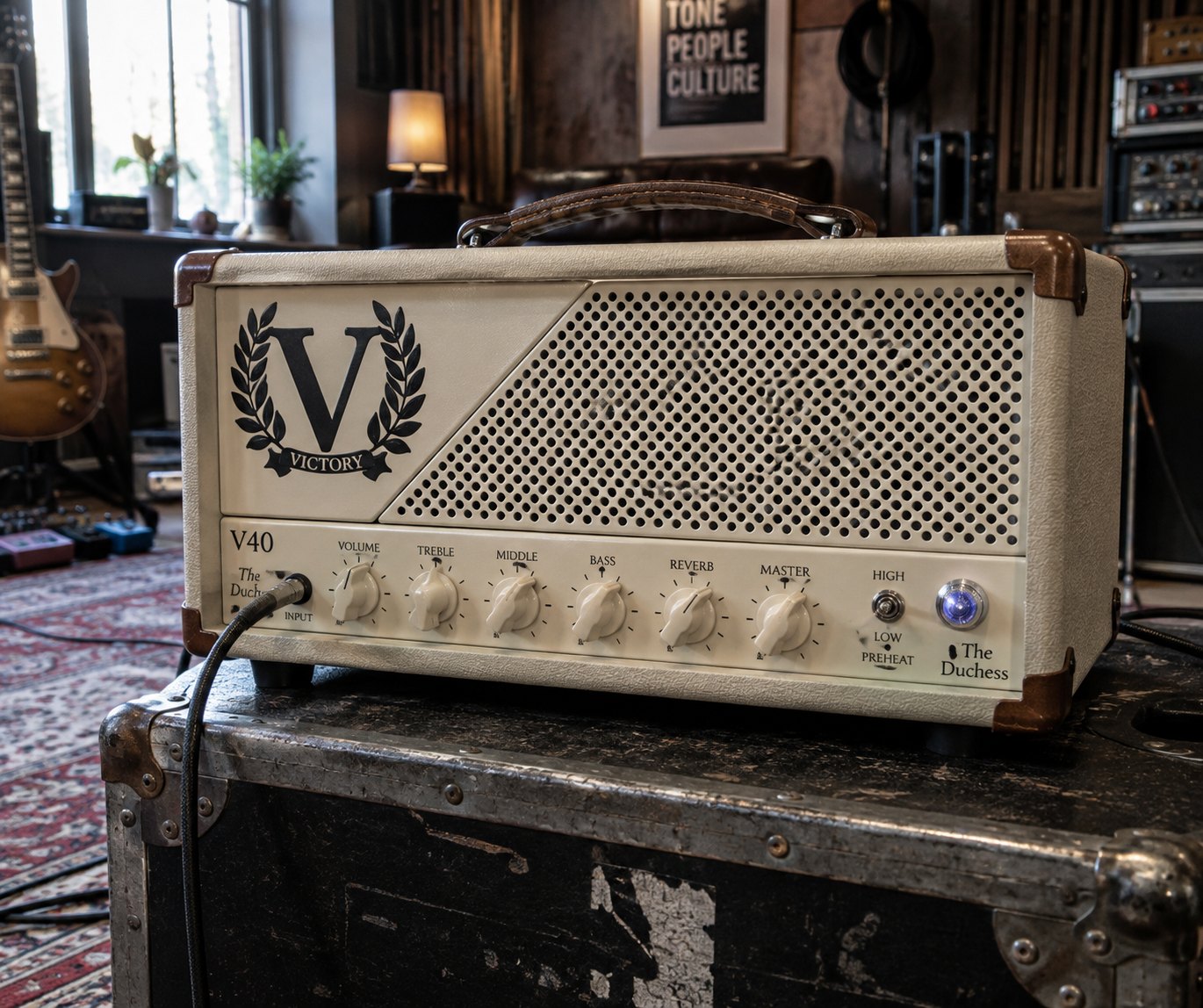
Victory V40 The Duchess Head. AI-generated reference illustration, not a photograph.
Victory V40 The Duchess: specs, circuit explained, tone recipes, artist connections, MkI vs MkII, and buying guide for this UK boutique lunchbox tube head.
Somewhere between Fullerton, California in 1962 and London, England in 1965, guitar amplifiers split into two warring tribes. American amps—blackface Fenders especially—gave you headroom, sparkle, and a clean canvas that bloomed gently into breakup. British amps—early Marshalls, Voxes—gave you more midrange aggression, faster drive, a certain gritty authority that cut through a live band like a hot knife. Most players spent the next sixty years picking a side, then stacking pedals to fake the other one.
Martin Kidd built an amp that refuses to choose. The Victory V40 The Duchess, launched in 2014 and still one of the most discussed lunchbox heads in the boutique market, does the American thing magnificently—and then, via a two-position voice switch and a mid-kick toggle, tilts toward the British thing with startling conviction. It is not a high-gain amp. It never tries to be. It is, instead, the finest $1,300 canvas a pedalboard player can buy: transparent, musical, alive under the fingers, and light enough to carry in one hand.
Understanding why it works—and whether it is the right tool for your specific situation—requires understanding the circuit philosophy behind it, the family it belongs to, and the very deliberate career arc Martin Kidd has been building since he first sat down at a workbench in the 1990s.
Martin Kidd, Cornford, and the Birth of Victory
Martin Kidd made his first guitar amplifier in the early 1990s. Over the following two decades he became one of the most respected British amp designers of his generation, chiefly through his work at Cornford Amplification—a small English company whose Carrera, Hurricane, and MK Series heads developed a devoted following among players who wanted boutique build quality at something approaching boutique-adjacent pricing. Cornford closed in 2011, a casualty of the post-2008 economic environment that put pressure on high-end UK manufacturing.
Kidd did not idle long. In 2013 he launched Victory Amplifiers, a new company built on a direct-to-dealer model that deliberately cut out third-party distributors to keep pricing competitive relative to other hand-built British amp makers. The founding range—a 10-watt studio combo called the Baron, a 50-watt two-channel head called the Earl, and a 100-watt flagship called the Duke—established the brand’s royal nomenclature immediately. Victory amps would be designed and built in England, hand-wired using tag boards where tonal benefits were greatest, with PCB integration where it offered better functionality, and wound with custom-designed transformers throughout.
The company grew quickly. 2014 saw two landmark additions: the Silverback, designed in collaboration with Rob Chapman, and—more important for this article—the V40 The Duchess. The Duchess was conceived from the outset as a single-channel clean platform: an amp that would do American-style warmth at the front of its dial and British-edged grind when pushed, but whose primary purpose was to make every pedal on your board sound its absolute best. That 2014 brief remains the Duchess’s mission statement a decade later.
The family expanded steadily. In 2017 the V40 Deluxe arrived—a 1×12 combo version adding tube-driven tremolo and spring reverb. The V140 Super Duchess followed in 2019, delivering 100 watts of clean headroom for players who needed stage volume without sacrificing the Duchess voicing. By 2023–2024, Victory had refined the original lunchbox head into the V40 The Duchess MkII, expanding the voice switch from two to three positions, the mid-kick from two to three stages, and adding a second digital reverb type. The fundamental character remained unchanged. Only its versatility width had grown.
Specifications: What You’re Actually Buying
A note on tube configuration: the V40 head uses three ECC83 preamp tubes and two EL34 power tubes. The V40 Deluxe combo differs—it carries two 12AX7 and two 12AT7 preamp tubes because the added tube-driven tremolo circuit changes the preamp section. If you are buying a used head and find a Deluxe service manual, be aware the tube complement described there does not apply to the standard compact head. The head’s own manual specifies 3× ECC83, 2× EL34.
The Circuit: Why It Does What It Does
The Duchess is, at its heart, an EL34 design—but one built around an unusually sophisticated tone-shaping network rather than raw gain. Understanding the interaction between Volume, Master, Voice switch, and Mid-Kick is the key to getting everything out of it.
The Volume control is pre-phase-inverter in function. As you push it, you are introducing power-stage coloration—the tubes begin to work harder and the character changes from a pristine clean to a natural, compressed, harmonically rich breakup. The Master Volume is post-phase-inverter, which means you can run Volume relatively high and Master low to get power-amp saturation at neighbour-friendly levels. This arrangement is why the amp responds so well to guitar-volume rollback: back off your instrument’s volume control and the Duchess cleans up almost immediately. Push the guitar volume back up and the drive reappears. That dynamic is the classic foundation of single-channel playing.
The Voice switch is where the amp’s transatlantic character originates. Voice I delivers American warmth—extended lows, scooped mids, shimmering highs—reminiscent of Fender blackface circuitry from the mid-1960s. It is open, airy, and forgiving. Voice II tightens the low end, adds upper-midrange mass, and produces a character closer to early British designs—Tweed-to-plexi territory—with faster, snappier attack on single coils. PG reviewer Joe Gore, writing about the V40 Deluxe, described this transition beautifully: the amp can sound like the Fenders that influenced early Marshall, or like the Marshalls that spun off from Fender, covering “pretty much the entire tweed-to-plexi gamut.” The MkII adds a third Voice position for greater lower-mid content, useful for players whose pickups run thin.
The Mid-Kick switch is your secondary shaping tool. In the standard (off) position the midrange is balanced. Engage mid-kick and low mids swell—humbuckers fill out, single coils thicken, and the amp acquires a more aggressive, British character even without touching the gain. In the MkII, the third mid-kick position adds upper-midrange gain, effectively delivering a mild preamp push and narrowing the gap between the V40 and a genuinely dirty amp. Used in combination with Voice II and a cranked Volume, the MkII can produce genuine amp-driven breakup before you have engaged a single pedal.
The single-ended mode deserves a paragraph of its own. On the rear panel, you can select one of the two power tubes to run alone in Class A operation. Combined with the 7W front-panel setting, this drops output to approximately 1.6 watts RMS. Take the Master low and you can coax power-tube saturation at conversation volume—a different character from attenuated 42-watt clean, not a simulation of it. True single-ended Class A power compression has a particular bloom, a slight cushioned squish, that attenuation cannot reproduce. For home recording players this mode alone is worth examining carefully.
The digital reverb was upgraded significantly in the MkII. The original version offered a single lush digital reverb—Guitar World’s Paul Riario called it “so beautifully ambient in its hybrid hall-meets-plate sounds, you’ll almost forget you can remove it from the circuit entirely.” The MkII delivers two modes: Vintage (a spring-style simulation suited to the amp’s tonal character) and Modern (an ambient reverb inspired by Victory’s Deputy design, running from subtle room to full shimmer). Each has separate Level and Dwell controls. Both remain footswitchable, both retain hard bypass.
Famous Players: Honest About the Sources
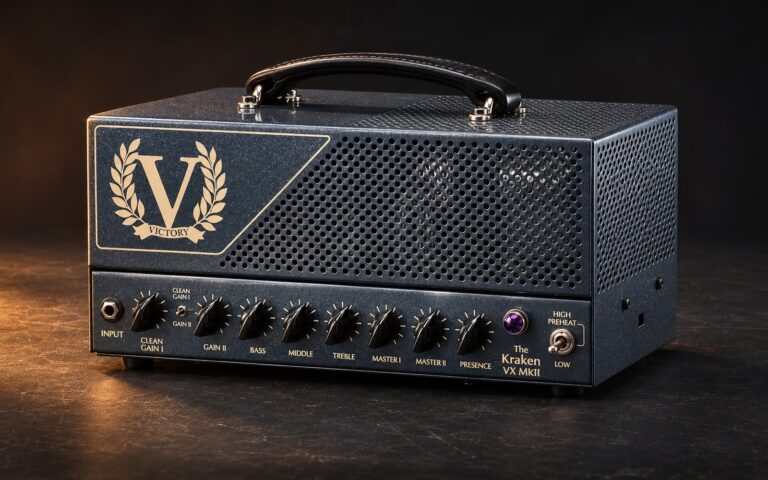
Victory’s highest-profile artists all designed their own different Victory instruments: Guthrie Govan collaborated on the Countess (a clean/crunch head with a very different voicing), Richie Kotzen developed the RK50 for high-headroom clean-to-crunch, and Rabea Massaad built the VX Kraken for heavy-gain applications. None of these players are documented using a V40 Duchess as their primary live or studio amp—because they each have an amp specifically designed for their needs.

The Duchess occupies a different space in Victory’s catalogue: it is the amp for players who generate their drive primarily through pedals, who value dynamic response and transparency over built-in saturation, and who want something portable enough to take to every session. Its users tend not to be instrument-endorsing rock headliners but working professionals and discerning amateurs who find it the most honest amplifier they have ever plugged into.
That said, the V40 Duchess does carry genuine artist associations—they are simply quieter about it than you would expect from a more headline-grabbing product.
James Bay appears on Victory’s own artist page for the V40 with a photo captioned “James Bay V40.” Bay is a Grammy-nominated British singer-guitarist (“Hold Back the River,” “Let It Go,” “Move Together”), known for a warm, blues-inflected clean-to-crunch sound built significantly around his pedalboard rather than amp preamp gain. The Duchess profile—transparent cleans, excellent pedal response, portable form—is an intuitive match for a working touring artist. The source here is Victory’s own product page, which is brand-level documentation rather than an independent primary source; it is reasonable to treat it as credible while noting the distinction.
Joey Landreth (Canadian blues-rock guitarist, younger brother of Sonny Landreth) appears on Equipboard’s V40 Duchess listing. Landreth’s warm, touch-sensitive electric playing—informed by his acoustic roots and his brother’s legendary slide work—makes him a natural fit for an amp this transparent. The Equipboard listing does not specify the form of the original evidence; treat as community-verified rather than photo-confirmed.
Mick Taylor (Rolling Stones 1969–1974, John Mayall’s Bluesbreakers) appears on Equipboard’s original V40 Duchess listing. Victory’s own About page also names Taylor as a player, though in context with the V140 Super Duchess (the 100-watt version). It is possible Taylor uses both—a V40 for smaller room work and a V140 for larger stages—or that the Equipboard entry reflects a working preference at a particular moment. Mick Taylor’s clean-to-breakup playing style, built on Les Paul-into-open-circuit dynamics, is entirely consistent with what the Duchess does best. The Rolling Stones connection and the John Mayall Bluesbreakers recordings that made his name were achieved with Clapton’s Marshall, not a Duchess—but the kind of sound Taylor has always pursued is exactly what this amp provides.
Tim Renwick (session guitarist for Pink Floyd’s A Momentary Lapse of Reason, The Division Bell, and subsequent tours; also worked with Elton John, Al Stewart, and Supertramp) appears on Equipboard’s V40 Deluxe listing. Renwick is a known British session professional whose clean, precise single-coil work is exactly the kind of playing a transparent, pedal-friendly amp supports. No specific photo or video source is attached to the Equipboard entry, so the connection is plausible but unverified at primary-source level.
The honest summary: the Duchess is not an amp players advertise by name in interviews. It is an amp players pack because it makes their pedalboard sound better than anything else they have tried at this price point and weight. That is its reputation, and it is earned.
Tone Recipes and Settings
Recipe 1: American Clean — Strat Into Voice I
Connect a single-coil guitar directly, no pedals. Set Voice to I, Mid-Kick off. Volume at noon, Bass 11 o’clock, Middle 1 o’clock, Treble noon, Master to taste (lower = cleaner, louder = more bloom). Reverb around 9–10 o’clock. This is the amp at its most Fender-adjacent: open, warm, slightly scooped, with that particular sparkle that makes Stratocaster single coils sing without edge. Lower your guitar’s volume to 6 for pristine jazz-adjacent tone; roll it to 10 for light natural breakup. Reference: James Brown rhythm guitar clean, classic soul and R&B chord work, fingerstyle acoustic-electric simulation.
Recipe 2: British Edge — Humbucker Into Voice II, Mid-Kick On
Plug in a Les Paul or humbucker-equipped guitar. Voice II, Mid-Kick engaged. Volume at 2 o’clock, Bass noon, Middle 11 o’clock, Treble 1 o’clock, Master at 9–10 o’clock for lower volumes. This is where the amp tilts toward British character—upper-mid push, tighter low end, a more compressed attack that rewards chord strumming. Not Marshall gain levels, but in the right zip code for classic blues-rock rhythm. Run a Tube Screamer in front with Drive at zero and Level boosted and you are in late-’60s Bluesbreakers territory with very little effort.
Recipe 3: Pedal Platform Clean — Full Pedalboard Showcase
The Duchess’s defining use case: Voice I, Mid-Kick off, Volume at 10–11 o’clock, Master at noon or above. The amp should be running clean and loud, providing a headroom ceiling that is generous without being surgical. Use the effects loop for time-based effects (delays, reverb, modulation) and plug overdrive/fuzz pedals into the front end. The amp’s transparency and even frequency response means your pedals sound more like themselves—the mid-hump of an Ibanez TS9 actually sounds like a TS9, rather than being coloured by an amp’s own eq character. This is what “pedal platform” means in practice, and the Duchess does it better than most British-voiced amps.
Recipe 4: Single-Ended Studio Recording
Rear panel single-ended mode, 7W front-panel switch engaged. One power tube running in Class A. Volume between 1–2 o’clock (pushing the preamp), Master at 8–9 o’clock (keeping speaker volume manageable). Mid-Kick on, Voice II. At this setting the amp produces a bloom, compression, and harmonic saturation that microphones love—a room-filling richness despite very modest actual SPL. Pair with a Shure SM57 off-axis on the speaker cone. Record two takes—one guitar-volume at 10 for grind, one at 6 for clean—and you have two entirely different performances from the same source chain. This is the home-studio musician’s secret weapon in this amp.
Recipe 5: Leads Over A Band Mix
Voice II, Mid-Kick on, Volume at 2 o’clock, Bass at 9 o’clock (trim low end in a live context to avoid clouding the bass guitar’s space), Middle at 2 o’clock, Treble noon, Master set to gig volume. Run an overdrive—any transparent mid-boosting drive works here: Klon-style, Timmy, or TS9—into the front end, drive at noon, tone neutral, level boosted. The combination of Voice II’s upper-mid push and the pedal’s boost ensures leads cut through a full band without resorting to a shrill treble spike. The single coil/humbucker crossover zone that this setting occupies—present but not harsh—is where solos land rather than stab.
Comparisons and Context
vs. Fender Deluxe Reverb
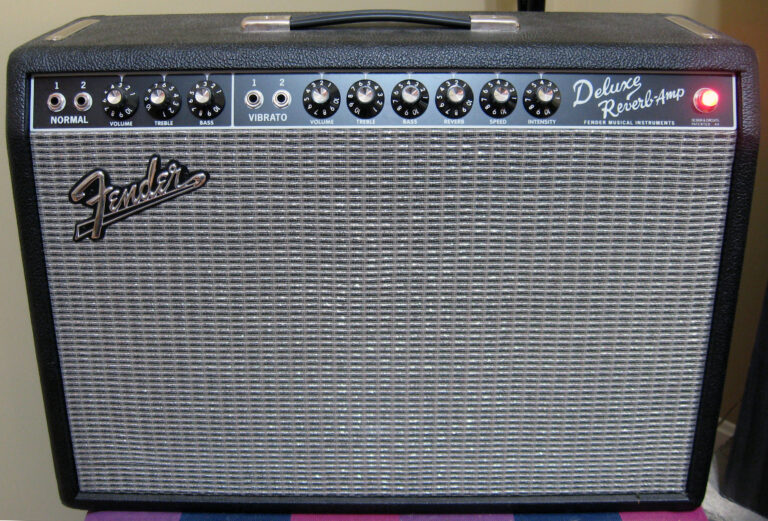
The Fender Deluxe Reverb is the amp the Duchess’s Voice I most directly evokes—but the comparison reveals how much the Duchess adds. The Deluxe Reverb is fixed in character: gorgeous American clean, natural breakup around volume 5–6, lovely spring reverb and tremolo. It does not do British. The Duchess does both, adds power reduction, adds an effects loop, and comes in a form factor one third the size and weight. The Deluxe Reverb costs less used (vintage examples excepted) and has the authenticity advantage of actually being the thing rather than evoking it. But if you genuinely need both sides of the transatlantic argument from one box, the Duchess wins.
vs. Marshall JCM800 2203
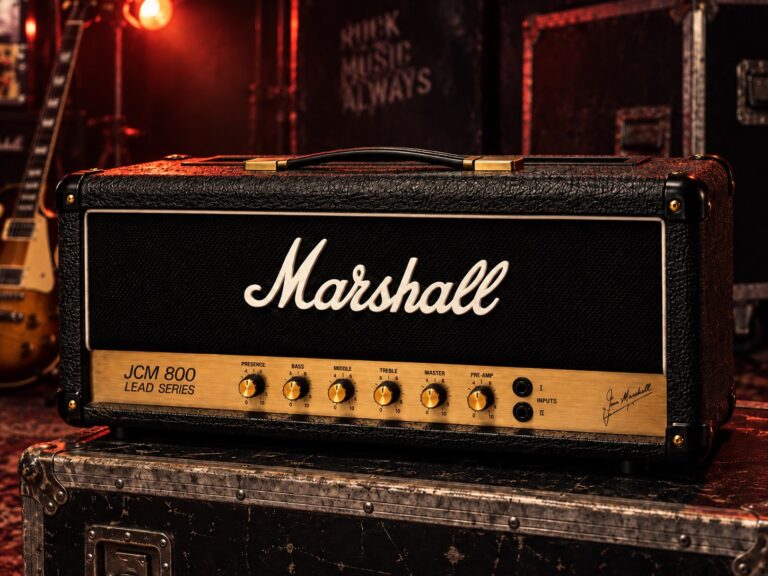
The Marshall JCM800 is what you reach for when you actually want Marshall gain from the amp itself—real preamp saturation, aggressive midrange, that particular compressed authority. The Duchess is not in this category. It can approximate a pushed Marshall with Voice II, Mid-Kick on, and Volume cranked, but it is not the same thing, and no serious high-gain or hard-rock player should buy a Duchess expecting JCM800 levels of drive. The JCM800 is also significantly louder at full power, fixed at 100 watts, and substantially heavier and larger. If drive from the amp is your priority, look elsewhere. If pedals are your primary drive source, the Duchess is the better platform.
vs. Blackstar HT Club 40 MkII
The Blackstar HT Club 40 MkII is the more affordable boutique-adjacent EL34 option—$699–799 at launch, street around $500–650 used, with four footswitchable voices (two clean, two OD), a built-in 4-channel USB audio interface, and Blackstar’s ISF EQ system. The Club 40 does high-gain from the amp itself; the Duchess does not. The Club 40’s ISF shaping is excellent and covers significant tonal ground. But the Duchess has more transparent response to pedals, better quality feel, point-to-board hand-soldering, and a more honest price-to-build-quality ratio at the boutique level. Players who need amp-driven dirt should consider the Club 40 seriously. Pedalboard-first players should try the Duchess before settling.
vs. Vox AC30
The Vox AC30 is the definitive British clean-to-chime amp—a world entirely its own, with EL84 power tubes, fixed bias, cathode bias options (depending on version), and a characteristic top-boost brightness that no other amp replicates. The AC30 pushes into breakup relatively early at full power and does not have the headroom the Duchess provides at 42 watts. For chimey British clean plus natural power-tube saturation the AC30 is incomparable. For headroom, pedal transparency, and voicing flexibility between American and British, the Duchess is a better tool. They are not the same category of amp despite occupying similar “boutique single-channel clean” territory.
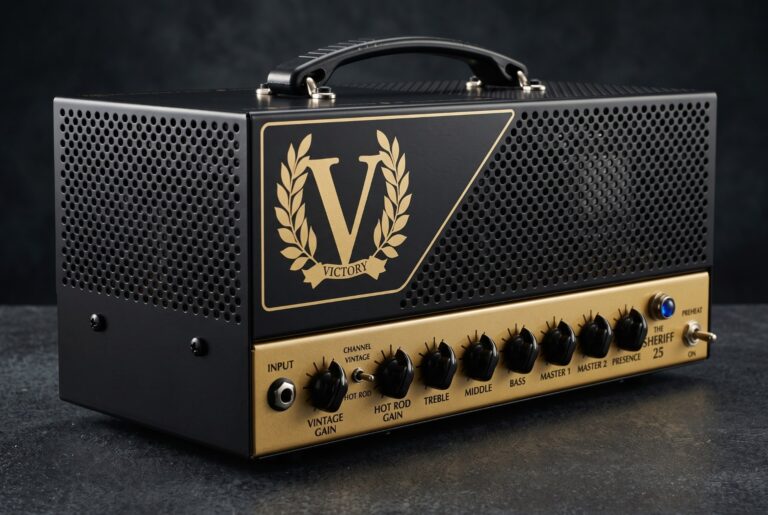
vs. Victory’s Own Signature Family
Understanding what the Duchess is NOT helps define what it IS. Guthrie Govan’s Victory Countess is a two-channel head with significantly more gain on tap. Richie Kotzen’s RK50 has a high-headroom clean channel voiced for his specific playing style. The VX Kraken is a high-gain metal head. None of these are substitutes for the Duchess, and the Duchess is not a substitute for them. Buy the Duchess if your drive comes from pedals and you want an honest, portable, English-built tube head. Buy one of the signature amps if you want drive, character, or features those designs were specifically built for.
Buying Guide
The Victory V40 The Duchess has been in production—with running updates—since 2014, and used examples circulate fairly regularly given the amp’s popularity. Here is what to consider when choosing between new and used, and between the variants.
New MkII ($1,500+): The three-way Voice and three-way Mid-Kick add meaningful versatility width—particularly the third Mid-Kick position, which provides genuine upper-midrange gain and partially addresses the “no high-gain” limitation of the original. The dual reverb modes are a genuine upgrade. If you are starting fresh and budget allows, buy the MkII.
Used MkI ($700–1,000 used): Significant savings with no meaningful sonic penalty for players who know how to use a two-position Voice switch. The fundamental circuit character is the same. Check: that the pressed-steel chassis shows no signs of dropping damage (lunchbox amps get carried carelessly), that the footswitch jack functions correctly (reverb issues here are common on used examples), that both EL34 power tubes are matched and the bias is set, and that the effects loop hard-bypass switch engages cleanly.
V40 Deluxe Head or Combo: Adds tube tremolo and spring reverb (the combo also adds a 1×12 Celestion G12H-75 Creamback speaker and a solid-wood cabinet, plus considerable weight—around 60lbs). The Deluxe head gives you the tremolo and spring reverb without the cabinet. Priced higher than the compact head; the tube tremolo and spring reverb are genuine extras. If you already own a great cab or want to choose your own speaker, the Deluxe head is a sensible target.
V140 Super Duchess: 100 watts. Same voicing philosophy, more clean headroom. For large stages where 42W may not be enough without a pedal-driven stage volume boost. Significantly heavier and more expensive. Very few applications below 500-capacity venues genuinely need 100 watts of clean headroom—most players who own a V140 are doing so for headroom margin, not raw volume.
Speaker cabinet pairing: The Duchess is not opinionated about speakers, but its transparency means cabinet choice matters more than with brighter, more character-driven amps. Celestion Creamback (75W or 65W) suits the British side of the voicing—smooth, balanced, with enough high-frequency definition to not muddy the clean. Celestion Alnico Gold or Blue pushes the clean side toward sparkle and air. Jensen C12N or P12N (in an American-voiced 1×12 open-back) emphasises the Fender character of Voice I. Vintage 30 is a usable but potentially mid-forward choice that can fight with the Mid-Kick switch on Voice II.
Ownership Notes
The V40 Duchess is a professional touring amp in a compact form factor. Several operational notes are worth passing on to first-time owners.
The EL34 power tubes benefit from matched replacement. Bias adjustment is accessible via rear-panel test points without removing the chassis—a considerate design choice that makes servicing accessible to non-technicians. The amp ships with a bias range switch for EL34/6L6 swapping; if you change between tube types, use it, then fine-adjust bias with a multimeter. Factory EL34 setting suits most playing styles. 6L6 reduces upper-mid push and brightens the high end—useful if your cab is already dark.
The hard-bypass switches on both the reverb and the effects loop are genuine hard-bypass: when switched out, the circuit is electrically removed from the signal path, not buffered around. This is preferable for audio quality but means that if you rely on the loop for always-on effects (tuner, compressor), you should leave the loop engaged at all times and manage bypass at pedal level.
The padded carry bag supplied with the MkI compact head is adequate for transport but not road-case level protection. A Gator or SKB lunchbox amp case is a worthwhile investment for gigging players who check gear into vans. The pressed-steel chassis is robust but not indestructible if dropped from height.
Volume before power-up: allow the amp to warm up in standby for 60–90 seconds before engaging the power switch. This is standard EL34 practice and extends tube life. The front-panel standby switch is present and should be used. Victory specifies this in the manual—it is not optional.
The amp ships with a single-button reverb footswitch. To footswitch the effects loop bypass, you need a separate latching switch into the rear panel’s loop switch jack. Not all players will need this, but live users running a wet/dry setup or switching reverb from amp versus rack should plan accordingly.
Frequently Asked Questions
Is the Victory V40 Duchess suitable for high-gain playing?
Not from the amp itself. The Duchess is explicitly a clean-to-edge-of-breakup amp, and even with Voice II and Mid-Kick fully engaged at cranked Volume settings, you reach British crunch territory rather than anything approaching modern high-gain. For high-gain tones, you need a dedicated drive pedal into the front end, or a different amp entirely. This is not a flaw—it is the design intent—but it rules the Duchess out as a primary amp for metal, nu-metal, or high-saturation rock playing without substantial pedal assistance.
What is the difference between the MkI and MkII?
The MkI has a two-position Voice switch (American/British) and a two-position Mid-Kick switch (off/on). The MkII expands each to three positions, adding a third Voice option for additional lower-mid content and a third Mid-Kick stage for upper-midrange gain. The MkII also replaces the original single digital reverb with a two-mode system (Vintage spring-style + Modern ambient), each with Level and Dwell controls. The fundamental circuit character—the clean tone, the dynamic response, the power stage—is unchanged.
Can I use the V40 for gigs without a PA?
42 watts of EL34 power through an efficient 2×12 cabinet will cover most rehearsal rooms and small-to-medium venue stages without PA support. In a loud band context (drummer playing hard, bass through a loud combo) you may find 42 watts limits your headroom before you reach the mix volume you need—particularly in Voice I where the clean headroom is maximised. The 7W setting is not appropriate for band volume use. If your gigs regularly involve drummers hitting hard, a 2×12 Duchess setup or a step up to the V140 is worth considering.
How does the power reduction compare to a Power Soak/attenuator?
The V40’s 7W setting is a genuine power reduction from the supply level—different from attenuating 42W after the output transformer. Single-ended mode (rear panel) further reduces to below 1W RMS. These reductions change the character of the power stage itself—a different kind of compression and bloom compared to an attenuated amp—rather than simply lowering volume while preserving 42W tube behaviour. For home recording or low-volume playing, the built-in reduction is preferable to an external attenuator because you are not re-converting power that has already been amplified. For players who specifically want 42W power-stage character at low speaker volume, an external attenuator remains an option via the speaker output.
Is the Duchess hand-wired?
Victory uses a combination of hand-wired tag boards and PCB construction where each method offers the best result. The Duchess is not point-to-point throughout, but significant sections of the circuit are hand-soldered to tag boards. This is the same approach most modern boutique builders use—not for cost reasons alone, but because circuit board integration provides better mechanical stability for components like jacks and switches, while tag boards offer sonic benefits in the signal path sections. Victory is transparent about this methodology on their About page.
What is the effects loop best used for?
Time-based effects: delay, reverb (external pedal units), modulation (chorus, phaser, tremolo). These are cleanest after the preamp section and before the power amp. Drive pedals, compressors, and wah are better in the front of the amp for the most natural feel. The loop’s hard-bypass switch allows you to remove it entirely from the circuit when not in use—a genuine audio quality benefit versus buffered bypass loops. For recording, a two-amp or re-amp setup can use the effects loop send as a preamp output to an external power amp or direct recording chain.
Does the Duchess take pedals well?
Yes—this is its primary design purpose. The transparency of the clean tone and the balanced EQ response mean pedals sound more like themselves rather than being coloured by the amp’s own character. Overdrives, fuzzes, and boosters all behave predictably. Boutique drives (Klon, Timmy, OCD, King of Tone) that have been voiced to sound natural in front of a clean amp respond especially well. The Duchess does not add or subtract from your pedalboard—it reveals it clearly. Players who have struggled to hear their pedals “properly” on cheap practice combos or dark-sounding stage amps often describe a V40 experience as the first time their boards sounded like the demos they bought the pedals for.
How does the Duchess compare to other boutique lunchbox heads at this price?
The lunchbox head market at $1,200–$1,800 is competitive: the Friedman Pink Taco (more gain, specifically Friedman voicing), the Orange Rocker 15 Terror (EL84, more naturally overdriven character), the Mesa/Boogie Mark V:25 (far more complex, multi-channel, far heavier). The Duchess competes on American/British voicing flexibility, build quality, and pedal transparency—not on channel count, gain, or complexity. If you want one amp that does one thing (clean pedal platform) exceptionally well, in a small box, built in England by an experienced designer, the V40 remains one of the strongest answers in its price range.
Image credits
- Guthrie Govan: ArtBrom, Wikimedia Commons, CC BY-SA 2.0.
- Top image: GuitarGangsters AI-generated reference illustration, not a photograph.
- Fender Deluxe Reverb: DlxReverbFront, Wikimedia Commons, CC BY-SA 3.0.
- Marshall JCM800 2203: GuitarGangsters AI-generated reference illustration, not a photograph.
Latest News
Related
On This Day
Monday 9 November
From this week: