Clean Enough to Bare Everything: The Two-Rock Classic Reverb Signature
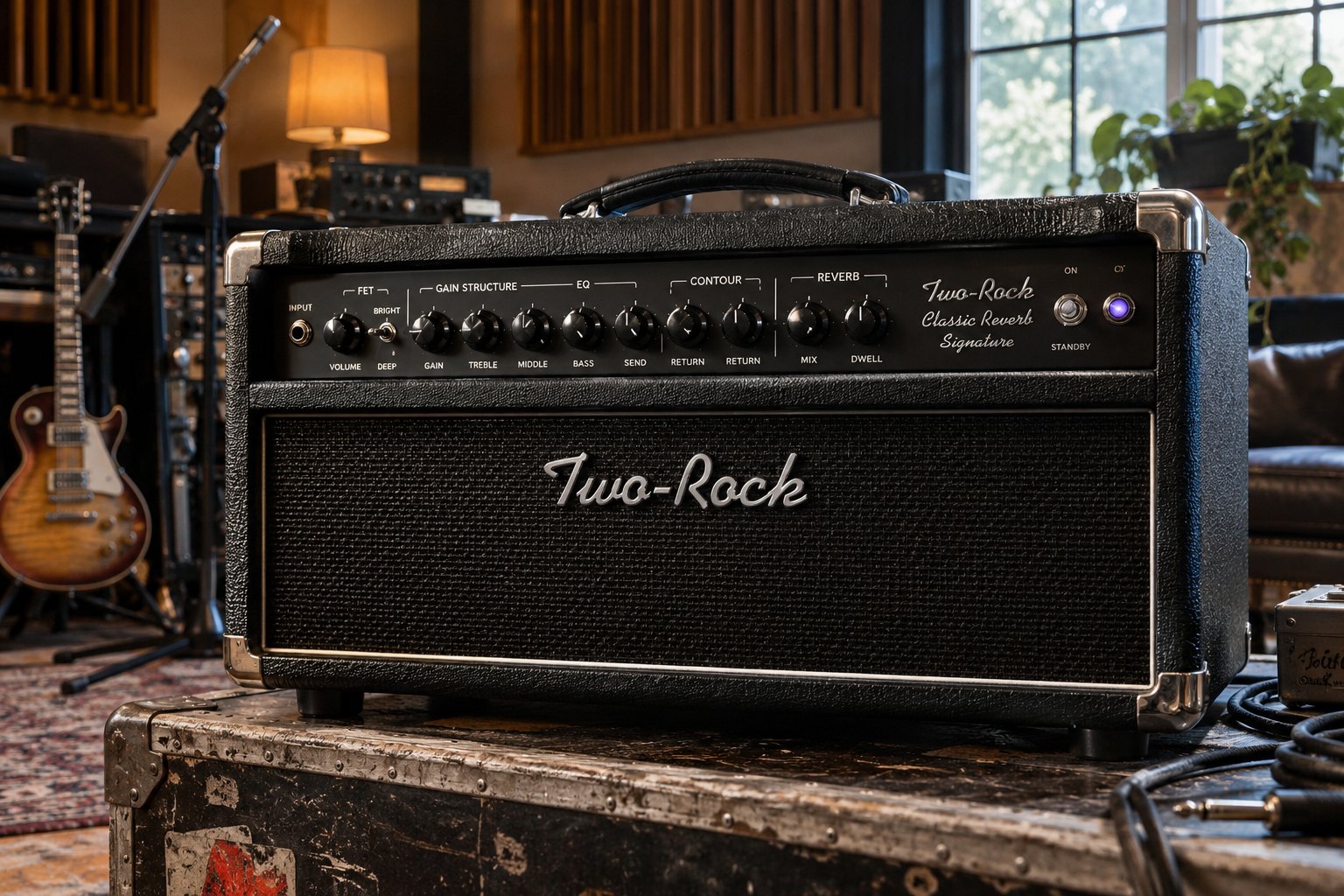
Two-Rock Classic Reverb Signature Head. AI-generated reference illustration, not a photograph.
The Two-Rock Classic Reverb Signature: three voicings, all-tube reverb, and handbuilt California clean. Full specs, verified players, buying guide.
There is a moment in the tone-chasing life when you realise the problem was never the pedals. You could stack a hundred overdrives, compressors, and delays in front of any amp and the chain would still smell like whatever the amp smells like. The Two-Rock Classic Reverb Signature is the amp that a specific kind of player discovers after that moment. It is handbuilt in Rohnert Park, California, runs on either 6L6 or 6V6 output tubes depending on the version you choose, and offers exactly one channel — clean — that manages to be three completely different preamp voices through a single three-position switch. It costs more than most players’ entire pedal collections. The reason people pay it is that when you plug a good Stratocaster into one of these, the guitar sounds like itself at roughly 1000 percent of its normal resolution. That’s the pitch. The following is everything else.
From Cotati to Rohnert Park: The Two-Rock Story
Two-Rock was co-founded by Bill Krinard in the 1990s out of the Sonoma County area of Northern California. The name was two founders, two rocks — the kind of blunt small-company naming convention that tells you nobody was thinking about brand equity. What Krinard was thinking about was high-headroom tube amplification with a lineage traceable back to Alexander Dumble, the semi-mythical California amp builder whose Overdrive Special and Dumbleland circuits had become the preferred architecture of a generation of players chasing the tone that SRV and Larry Carlton printed on tape. Two-Rock positioned itself explicitly in that tradition: Fender-voiced preamp stages with cascading gain architecture, enormous output sections for headroom, and sensitivity to pick attack that conventional blackface circuits couldn’t match at comparable prices.
Krinard and his partner eventually sold Two-Rock to Premier Builders Guild in 2010. By 2016, the brand was, in the words of current owner Eli Lester, “teetering on collapse.” Lester — who had spent his adult life in amp repair and modification, toured with Robben Ford, and played sessions with B.B. King — couldn’t watch the company dissolve. Alongside his business partner Mac Skinner, he bought the brand and started over. “We literally started all over,” Lester told Premier Guitar in 2025. “We threw away chassis, transformers, and all the old inventory. We said, ‘We don’t even want to make any of these models,’ and started from ground zero.”
The first thing Lester did was bring back Bill Krinard as a design collaborator. Krinard had built the circuits that made Two-Rock worth saving in the first place, and Lester had the sense to keep him involved rather than pretend the lineage didn’t exist. The amp they rebuilt first — the one Lester flew around the country personally demonstrating to dealers and players — was the Classic Reverb, redesigned and renamed the Classic Reverb Signature. It became the product that turned the revived Two-Rock into the boutique brand everyone was talking about.
Two-Rock currently operates out of 619 Martin Ave., Suite 5, Rohnert Park, CA 94928, with approximately 25 employees split between the amp factory and cabinet shop. In early 2024 they acquired Divided by 13, the Fred Taccone-founded brand that covers EL84 and EL34 territory — circuits that Lester didn’t want to build under the Two-Rock name for fear of diluting the brand identity. Both lines are now hand-built in the same facility. Two-Rock has no paid artist endorsements. Everyone on their artist page — including the players you would expect to be on the label — paid for their own amps.
What the Classic Reverb Signature Actually Is
The Humbucker Music description of the CRS (which has been up since the Lester era redesign) identifies what changed from the original Classic Reverb: “A new proprietary output transformer allowing you to switch from Class A to AB operation. The addition of a ‘gain structure’ switch allows one to switch from a Schofield Signature, Sterling Signature, or Traditional Two-Rock front-end.” Two-Rock’s own product page puts it slightly differently, but the substance is the same. This is a single-channel amp with a built-in identity switch. One knob position and the amp’s preamp character fundamentally changes. That is the core concept.
The cascading gain architecture — which Two-Rock describes as inspired by both Dumble and Leo Fender’s blackface circuits, not as a clone of either — delivers what players describe as “three-dimensional” tone and sensitivity. The comparison to Dumble is unavoidable but Two-Rock has been careful about it. “We’re definitely inspired by his amps, and I’m honored that people put us in that same camp, but we don’t make Dumble clones,” Lester said. “I’m equally inspired by Leo and kind of morph the two things together to make our amps.” The result is an amp that can go from glassy and immediate (position one) to harmonically dense and forward (position three) using a single switch while preserving the same fundamental character across positions.
The 100-watt output figure is frequently misread. These aren’t meant to fill arenas. “We use that wattage for bandwidth, not sheer volume,” Lester has said. A 100-watt power section produces a wider, more three-dimensional frequency response at any playable volume than a 20-watt section pushed to the same loudness. The proprietary output transformer compensates for impedance and phase differences when switching between high and low power modes, so the tone remains consistent whether you’re running at 100W or 50W.
Specifications
| Feature | Specification |
|---|---|
| Type | Single-channel all-tube amplifier head or 1×12 combo |
| Output configurations | 100/50W (4×6L6), 50W tube rectified (2×6L6), 40/20W (4×6V6) |
| Power switching | High/Low Power Switch; 100/50W and 40/20W versions use proprietary transformer for impedance/phase compensation; 50W version switches fixed bias ↔ cathode bias |
| Preamp voicing | 3-position Gain Structure Switch: (1) vintage black-panel feel, (2) Matt Schofield Signature front end — hotter input, (3) Traditional Two-Rock front end |
| Boost circuit | Foot switchable FET circuit with dedicated Gain control |
| Tone controls | Treble, Middle, Bass, Bright, Mid, Deep; Contour; Tone Stack Bypass (foot switchable) |
| Reverb | All-tube analog spring reverb; separate Send and Return controls; Reverb Defeat (foot switchable) |
| Effects loop | Passive |
| Speaker outputs | 4Ω, 8Ω, 16Ω |
| Chassis material | Thick aluminum, black or silver anodized |
| Head dimensions | 20 5/8″W × 12″H × 10 5/8″D, 43 lbs |
| Combo dimensions | 20 5/8″W × 22″H × 11″D, 55 lbs |
| Speaker (combo) | 12″ (manufacturer does not specify OEM; matching vertical cab uses Celestion G12-65s) |
| Head street price (August 2026) | $5,299 (100/50W or 50W tube rectified) |
| Combo street price (August 2026) | $5,740 (40/20W 6V6), $5,650 (50W tube rectified) |
| Head + 2×12 cab packages | $6,398–$6,998 depending on configuration and finish |
| Built | Rohnert Park, California, USA |
Famous Players: What the Sources Actually Say
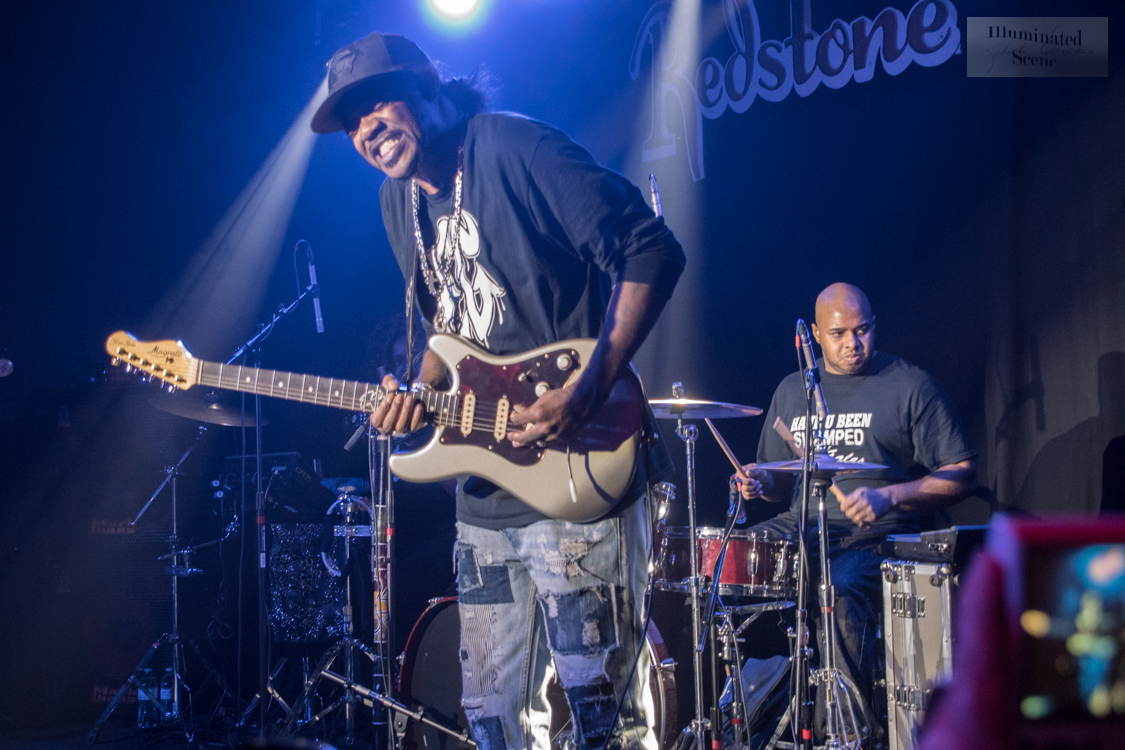
John Mayer, Matt Schofield, Eric Gales, and Oz Noy are listed as Classic Reverb Signature users. Each one requires a slightly different conversation.
Matt Schofield is the cleanest connection and the one the amp itself makes explicit. The middle position of the Gain Structure switch is described by Two-Rock as “much like the Two-Rock Matt Schofield Signature front end with a hotter input stage.” Two-Rock has released a video titled “Classic Reverb Signature Full Interview featuring Matt Schofield & Josh Smith,” and Schofield appears on Equipboard’s CRS page. His playing style — British blues-rock built on fluid legato, rhythmic chord work, and Strat through a clean platform — is precisely what the CRS was tuned to amplify. Schofield also has his own signature Two-Rock model; the CRS borrows his front-end voicing for the middle position but is a different amp, and both he and Josh Smith use the CRS independently.
John Mayer is a Two-Rock artist and is listed on Two-Rock’s official artist page. However, his specific Two-Rock is not the production Classic Reverb Signature. The amp he uses — sometimes called the “JM Proto” — is a custom-voiced circuit that Two-Rock built for him with its own character. The Chicago Music Exchange listed a “Two-Rock JM Proto #1 w/ 2×12 ‘Angry’ Cab” as an artefact of that collaboration: Mayer received the first prototype and asked Two-Rock to make him a version that sounded “angrier,” which is how the cab came to be labelled. His specific circuit eventually influenced the Two-Rock Bloomfield Drive (a production amp in the current line), not the Classic Reverb Signature. His connection to Two-Rock is genuine and deep; his connection to this specific model is not documented in primary sources.
Eric Gales is a Two-Rock artist who had his own signature model — the Two-Rock Eric Gales Signature — which was his primary amp during a significant stretch of his career (documented in a Premier Guitar Rig Rundown and announced by Two-Rock at NAMM 2011). His current rig, as documented in Premier Guitar’s 2023 Rig Rundown, uses DV Mark amplification and a DV Mark DV Gold 212V cabinet. His Two-Rock connection is historical and model-specific: it was the Eric Gales Signature, not the Classic Reverb Signature.
Oz Noy is documented on a custom Two-Rock “Gain Master 100” built specifically for him with old Fender transformers — a one-off commission, not the production Classic Reverb Signature. MusicRadar ran a piece titled “Oz Noy talks technique, tours and Two-Rock” that covers his amp setup in detail, and his circuit is meaningfully different from the CRS. He is a genuine Two-Rock user; he is not a Classic Reverb Signature user according to available primary sources.
Eight artists on Equipboard are confirmed on the production Classic Reverb Signature: Rhett Shull (Premier Guitar Rig Rundown, and his widely shared video declaring it “the best guitar amp I’ve ever owned”); Matt Schofield (Two-Rock’s own demo video); David Ryan Harris (YouTube interview, known for his work as a guitarist in John Mayer’s touring band); Butch Walker (studio tour video at 17:25); Henrik Freischlader (live performance documentation); John Osborne of Brothers Osborne; Andy Wood (Instagram); and Josh Smith (Two-Rock’s own Schofield/Smith interview video). Other Two-Rock brand users whose specific model is not confirmed as the CRS but who are documented Two-Rock players include Eric Johnson, Doyle Bramhall II, Joey Landreth, Ariel Posen, and Ben Harper — all mentioned by Eli Lester in the 2025 Premier Guitar profile as part of the organic artist community around the brand. Joe Bonamassa has also been associated with Two-Rock amplifiers in various contexts. The common thread across all of these players is dynamics-sensitive blues-influenced playing, which is precisely what the CRS rewards.
What This Amp Actually Sounds Like
The three-dimensional descriptor that players reach for is doing real work here. At its core, the Classic Reverb Signature is a very high-resolution clean amplifier. It produces an enormous amount of headroom — particularly in the 100/50W 6L6 version — and then uses that headroom to render every nuance of your playing at unusually high fidelity. Attack transients are fast and distinct. Dynamics respond to pick pressure rather than compressing them away. Harmonics ring with unusual depth because the amp’s cascading gain stages multiply them rather than masking them behind early clip.
Position one of the Gain Structure switch (down) produces the scooped, glassy quality of a vintage black-panel Fender circuit. Think Fender Deluxe Reverb stretched to 100 watts with additional control over the mid frequencies that the stock Fender design doesn’t offer. This is the setting where a Stratocaster with single-coils becomes an almost unfair advantage — the bell-like upper midrange clarity, the quack between positions two and four, the percussive attack of a well-adjusted neck pickup. SRV-adjacent tone lives here.
Position two (middle, the Schofield position) raises the input stage sensitivity and pushes the preamp harder before the power section even gets involved. The result is denser, more compressed clean tone with earlier harmonic saturation when you dig in. It’s the setting where a semi-hollow body or a humbucker-equipped guitar begins to breathe differently — thicker fundamentals, more singing sustain on lead lines, the quality that makes chord inversions feel like they have more weight. It is technically still “clean” but it’s the kind of clean that sits on the edge of hair.
Position three (up, Traditional Two-Rock) is the most forward and present voice — a slightly more immediate top end, higher overall sensitivity, and the biggest dynamic range of the three. This is the setting Eli Lester was demoing when he flew around the country with the amp in 2016, and it’s the one that sounds most like what reviewers describe as “Dumble-adjacent without being a clone” — clear, full, and almost uncomfortably honest about what’s happening at your fingertips.
The FET circuit (foot switchable) adds another layer. Engaging it raises the gain and sustain without coloring the fundamental tone in the way a pedal would. It’s described as a boost, but the experience is closer to increasing the amp’s sensitivity — more of the same tone, just further into it. The Tone Stack Bypass removes the passive tone circuit from the signal path entirely, producing a rawer, more direct response that some players prefer for certain styles. The all-tube spring reverb has separate Send and Return knobs, which means you can set decay and blend independently — a subtlety that becomes important when recording, where reverb that sounds right in a room can drown a mix.
Tone Recipes
Recipe 1: Texas Clean (Position 1, Stratocaster)
Gain Structure switch down. Volume at 10 o’clock. Treble at 2 o’clock, Middle at 12, Bass at 11. Deep at 9 (barely on), Bright at noon, Contour at noon. FET off. Reverb Send at 10 o’clock, Return at noon. This is the Fender-stretch setting: wide, open, glassy. A Stratocaster in position four (neck+middle) through this setting produces the clean tone that SRV was approaching with his Dumble and that John Mayer spent years refining. An Ibanez TS9 with drive at 9 and level at 2 o’clock pushes the front end into that sweet, mid-pushed lead territory without breaking the fundamental clarity.
Recipe 2: Schofield Blues (Position 2, Semi-Hollow)
Gain Structure switch middle. Volume at 11 o’clock. Treble at noon, Middle at 1, Bass at 11. Deep at 10, Contour at 1. FET engaged, Gain at 9 o’clock. Reverb light — Send at 9, Return at 10 o’clock. This pushes into the harmonically saturated territory where Matt Schofield lives: chord stabs with defined attack and decay, single notes that sustain without going syrupy. A Gibson 335 or semi-hollow with PAF-style humbuckers is the natural instrument for this position. The FET adds density without adding distortion.
Recipe 3: Fusion Clean (Position 3, Les Paul)
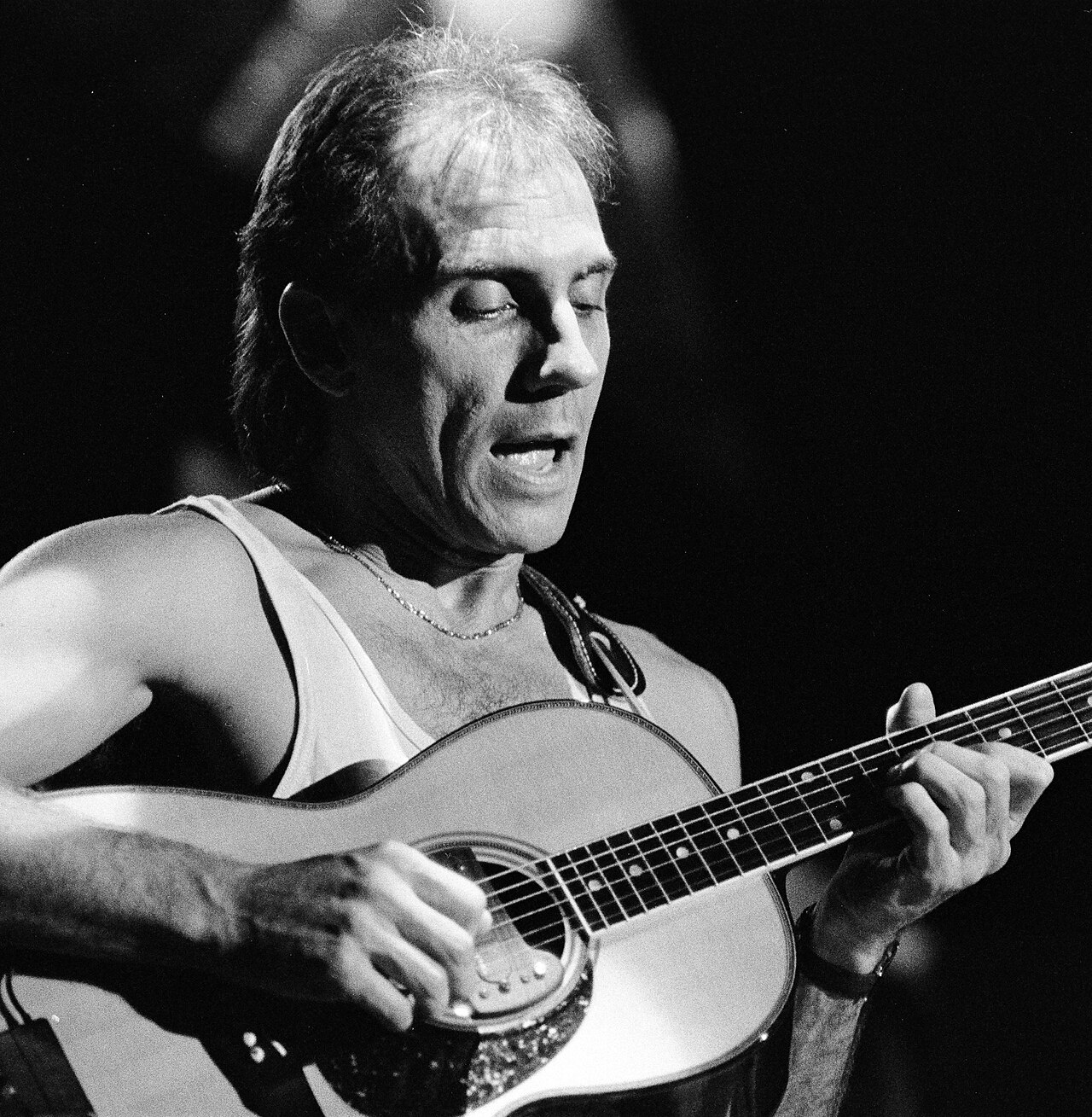
Gain Structure switch up. Volume at 9 o’clock (100W version — you don’t need much). Treble at 11, Middle at noon, Bass at noon. Deep at noon, Bright at 10. Contour at noon. FET off. Tone Stack Bypass engaged for the raw path. Reverb off. A Gibson Les Paul Standard through this position — particularly with humbuckers rolled back to 7 or 8 on the volume — produces a warm, complex clean tone with real body in the low mids. Think Larry Carlton’s studio work, or the clean tones on any Steely Dan record where you kept asking “what amp is that?”
Recipe 4: Pedal Platform (Position 1 or 2, any guitar, multiple drives)
Gain Structure switch 1 or 2. Volume very low — just enough to hear in the room. Treble at 11, Middle at 9 (scooped), Bass at noon. Contour at 1 o’clock (adds presence for pedals to push against). FET off. Tone Stack active. This is the configuration where the CRS becomes the most transparent pedal platform in its price class. The amp itself is quiet and characterful enough that the pedals’ characters come through accurately. Stack any two or three drives — a Tube Screamer into a Rat variant, for instance — and each one retains its identity rather than merging into mud. The passive effects loop makes it a rack-friendly option for more complex signal chains.
Recipe 5: Pushed Combo (40/20W version, small venue)
Gain Structure switch middle. High/Low Power Switch to Low (20W). Volume at noon. Treble at 1, Middle at 11, Bass at noon. Deep at noon, Bright at noon. Contour at 11. FET engaged, Gain at noon. Reverb Send at 11, Return at noon. At 20 watts the 6V6 version begins to soften naturally at stage volumes — not breaking up aggressively, but adding warmth and compression that the 100W version only produces at much higher volumes. This is the most “vintage” the CRS sounds: round, immediate, and singing at practical gigging levels. At this volume the all-tube reverb becomes particularly musical.
How It Compares
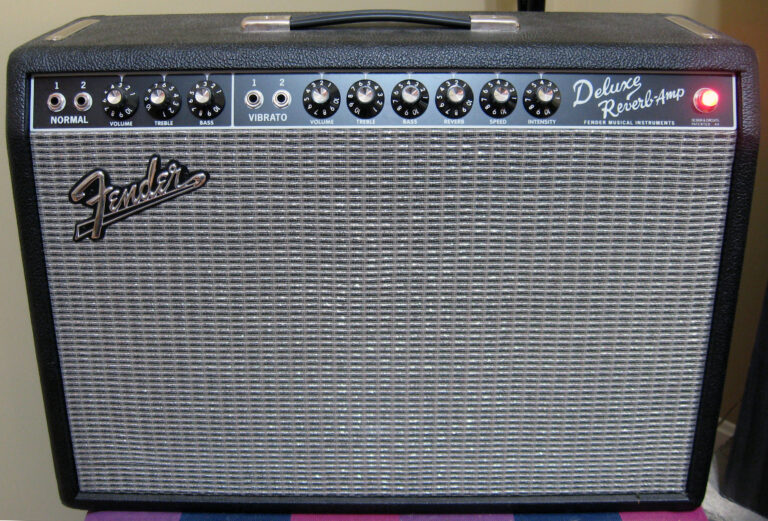
vs. Fender Deluxe Reverb
The Fender Deluxe Reverb is the cultural context the CRS emerged from and the amp that most of its players upgraded from. The Deluxe Reverb costs approximately $1,000–$1,200 new; the CRS 100/50W head costs $5,299 before you add a cabinet. What the additional $4,000 buys is substantially greater dynamic resolution, seven tone controls instead of three, three preamp voicings, better reverb architecture, the FET boost, and significantly higher headroom before the power section compresses. The Deluxe Reverb breaks up earlier and at lower volume — which can be a feature. The CRS stays clean until you specifically decide otherwise. For small-venue players who love Fender breakup, the Deluxe Reverb wins. For anyone chasing pristine, touch-sensitive clean through a variety of pedals and at band volume, the CRS is in a different category.
vs. Matchless DC-30
The Matchless DC-30 ($4,756 new) is the other elite boutique clean amp in this conversation — handbuilt in Los Angeles, EL84-driven, two channels, Class A cathode bias. Where the DC-30 is organic, slightly compressed, and built on EF86-driven warmth, the CRS is faster, more open, and more dynamically resolved. The DC-30 has a vocal, almost singing quality in the midrange; the CRS is more dimensional and transparent. Schofield players tend toward the CRS; Vox-adjacent players tend toward the DC-30. Both are investment-grade amps; neither is the wrong answer.
vs. Matchless Lightning
The Matchless Lightning ($2,791) is an EL84 15-watt single-channel amp with a Vox Top Boost-derived voicing and interactive bass/treble controls. It’s less than half the price, roughly one-seventh the power, and significantly more compressed by nature. The CRS has more headroom, more tone-shaping range, and more preamp flexibility. The Lightning is warm and soulful at low volumes; the CRS is crystalline and enormous at high headroom. Different tools for different situations.
vs. Dr. Z MAZ 18 Jr. NR
The Dr. Z MAZ 18 Jr. NR ($2,749 with its PPIMV) is the closest boutique clean competitor at half the price. It uses NOS Soviet 6N14N output tubes (EL84 equivalent), 18 watts, and a Cut control for midrange shaping. The MAZ 18 is excellent but smaller, simpler, and more constrained in its voicing range. The CRS has three times the preamp flexibility, twice the output tube count in most configurations, and a more sophisticated reverb. The MAZ 18 is the answer if you need a genuinely good boutique clean amp and can’t spend CRS money; the CRS is the answer if no other budget is imaginable.
vs. Morgan AC20 Deluxe
The Morgan AC20 Deluxe (around $2,500) is another hand-wired American boutique amp — EL84, 20W, Vox-adjacent with more clarity than an AC30. It’s warmer and more compressed than the CRS. Where the Morgan rewards players who want a classic British-American hybrid feel, the CRS is more analytically transparent and dynamically extreme. Both are superb. The Morgan is the value boutique choice; the CRS is the statement one.
Buying Guide
Three configuration decisions: tubes, wattage, and head versus combo.
The 100/50W 6L6 version is the flagship. 6L6 tubes produce the fuller, more American clean that Two-Rock’s Fender-Dumble lineage implies. The headroom is enormous — running at 50W is still substantial, and the impedance compensation means both modes sound consistent. This is the version most associated with the CRS’s reputation. The 50W tube-rectified 6L6 version is slightly warmer and more compressed by nature of the tube rectifier, which introduces a sag characteristic under transients. Some players prefer this for recording; it feels less “clinical” at lower volumes. The 40/20W 6V6 version has the sweetest, most vintage character of the three — 6V6 output tubes naturally run at lower power and have a different harmonic fingerprint than 6L6, closer to tweed-era Fender. It is also the only combo version that reaches the 40-watt ceiling rather than 50 or 100.
Head versus combo: the head without a cabinet is approximately $1,000 less expensive than the combo, and you choose your own speaker — giving you a meaningful tone shaping variable. The manufacturer’s matching 2×12 cabinet uses Celestion G12-65s, which are bright, clear speakers appropriate for a high-headroom clean amp. A 1×12 with an Alnico Blue or a Celestion Gold would move the character warmer. The combo ships with a proprietary 12″ speaker (Two-Rock does not publish the OEM spec on their product page) and is 55 lbs — a real consideration for solo gigging.
Used pricing: pre-Lester CRS heads (pre-2016) can appear for $2,000–$3,000. They are different amps — the output transformer, the gain structure switch, and the chassis material all changed in the 2016 redesign. The post-2016 Lester-era amps are the ones with the reputation. Used post-2016 heads sell for $3,500–$4,800 depending on condition and configuration. At $3,500 a post-2016 used 100/50W head is excellent value for what it is. If buying used, ask for a photo of the serial number and confirmation of the current transformer.
Finish and color: Two-Rock offers a wide range of covering options — brown ostrich, blonde, slate grey, suede in multiple colors, silverface and blackface panel options. Functionally identical. Prices between configurations are in the same range for the head; combos add approximately $350–$450. All finishes are built to the same standard.
Ownership Notes
Tube maintenance: the 6L6 100/50W version runs four output tubes. Two-Rock’s output stages are fixed bias in the high-power mode of the 100/50W version, meaning biasing is required when you replace output tubes. The 50W tube-rectified version switches to cathode bias in low-power mode (self-biasing). The 40/20W 6V6 version is handled by the power switch in the same way. A competent amp tech should do the bias set after any output tube replacement on the fixed-bias versions.
The passive effects loop is a series loop, which means it is dependent on the impedance of the devices inserted. High-impedance effects (most vintage-style rack units, quality boutique pedals) work well. Some digital processors may interact differently depending on their buffering. If you hear tone loss with the loop engaged but nothing in it, check the loop jack connections — passive loops can accumulate contact resistance.
Speaker impedance: the output section offers 4Ω, 8Ω, and 16Ω. Running the wrong impedance through any output transformer shortens transformer life and can affect bias stability. Match the load precisely, particularly when mixing speaker cabinets. Two-Rock’s proprietary output transformer is one of the most expensive single components in the amp; protect it.
Weight: the head is 43 lbs, the combo 55 lbs. Both are manageable but not trivial. The head into a 2×12 cab means moving two separate items. Roadworthy players should invest in quality flight cases — Two-Rock amps retain resale value and the chassis work on the thick aluminum is worth protecting.
The tube-driven spring reverb has separate Send and Return controls, which is an advantage in recording situations. Dialling Send low and Return high produces dense reverb from minimal signal contribution; Send high and Return low is the opposite — more input, shorter blend. Experiment with the Reverb Defeat switch while tracking to monitor how much you actually need versus how much sounds good in isolation. The all-tube reverb tank is almost always more flattering than it sounds at first because its harmonic content matches the amp’s own.
Frequently Asked Questions
What does the Gain Structure switch actually do, and which position should I use?
The three-position switch changes the front-end sensitivity and character of the preamp. Position one (down) produces a vintage black-panel feel — glassy, open, less compressed. Position two (middle) mirrors the Two-Rock Matt Schofield Signature’s front end with a hotter input stage — denser, more harmonically present clean. Position three (up) is Two-Rock’s traditional voicing — forward, sensitive, and the most “Two-Rock” of the three. Start with position one if you’re coming from a Fender background, position two if you play British blues or jazz, position three if you want maximum sensitivity to playing nuance.
Is this a Dumble clone?
No, and Two-Rock is explicit about this. Eli Lester has said directly: “We’re definitely inspired by his amps, and I’m honored that people put us in that same camp, but we don’t make Dumble clones.” The circuit shares general design philosophy — cascading gain stages, high headroom, touch sensitivity — but Two-Rock’s specific engineering choices, particularly the output transformer and preamp voicing, are their own. It sounds Dumble-adjacent the same way a Suhr Classic T sounds Fender-adjacent: the lineage is audible, the circuit is distinct.
Does John Mayer use the Classic Reverb Signature?
John Mayer uses Two-Rock amplifiers and is listed on Two-Rock’s official artist page. His specific amp, however, is a custom-voiced “JM Proto” circuit that Two-Rock built for him — not the production Classic Reverb Signature. His circuit eventually influenced the Two-Rock Bloomfield Drive, a production model in the current line. The connection to Two-Rock is genuine; the connection to this specific model is not documented in primary sources.
What is the difference between the 100/50W, 50W tube rectified, and 40/20W versions?
The 100/50W uses 4×6L6 output tubes with solid-state rectification — maximum headroom and the most American clean character. The 50W tube-rectified version uses 2×6L6 with a tube rectifier, introducing sag and warmth under transient peaks — warmer and more compressed. In the high-power mode it runs fixed bias; low-power mode switches to cathode bias. The 40/20W uses 4×6V6 — smaller, sweeter-sounding output tubes that saturate earlier and have a more vintage American character. Choose 6L6/100W for maximum headroom and pedal clarity; choose 50W TR for warmth in recording contexts; choose 6V6/40W for the most vintage and musical character at practical stage volumes.
Is Eric Gales a Classic Reverb Signature user?
Eric Gales was a genuine Two-Rock endorsee — he had his own Eric Gales Signature amp, which Two-Rock announced at NAMM 2011. His touring rig documented in Premier Guitar’s 2023 Rig Rundown uses DV Mark amplification. His connection to Two-Rock was real and historically significant; his connection to the Classic Reverb Signature specifically has not been documented in primary sources. See the Eric Gales Gear Guide for his broader tone history.
What speakers does Two-Rock recommend for the CRS?
Two-Rock doesn’t publish an OEM speaker spec for the combo on their product page. Their matching vertical 2×12 cabinet uses Celestion G12-65s — a vintage-voiced 65W speaker with characteristic British clarity. For the head, Eli Lester has discussed speaker selection in general terms: the CRS rewards speakers that don’t compress early, because the amp itself is doing the tone shaping. G12-65s, Celestion Gold Alnico, or EV-style speakers are all natural matches. High-efficiency speakers (98dB+) can make the 100/50W versions imposingly loud at low master settings.
Is this amp worth the price?
At $5,299 for a head (before a cabinet), the answer depends entirely on what you’re building. As a studio centrepiece or primary live rig for a working professional who needs the best transparent clean platform available in production, the argument is strong — the amp retains resale value, the tone quality is documented by hundreds of serious players, and it’s genuinely difficult to replicate what it does for less money. As a weekend player’s amp, there are excellent boutique options at $2,500–$3,000 that produce great clean tones. The CRS occupies the space beyond “great” — it’s for players who have exhausted that category and want to know what the ceiling feels like.
How does the all-tube reverb compare to spring reverb units or digital reverb?
The CRS reverb is genuinely all-tube driven with separate Send and Return controls. Compared to standard onboard spring reverb (Fender-style), it is more controllable and less spiky on the decay. Compared to Strymon or similar high-end digital reverb, it is less precise and less flexible — but it interacts with the amp’s own harmonic content in a way that digital units positioned after the amp don’t. It responds to playing dynamics because the drive circuit is in the same signal path as the amp. For most players who use reverb naturally (subtle ambience, not effect), the onboard unit is sufficient and coherent. Players who need programmable reverb or complex digital treatments should use the effects loop and run digital reverb post-amp.
Image credits
- Larry Carlton: Kenneth C. Zirkel, Wikimedia Commons, CC BY-SA 4.0.
- Eric Gales: Roberta, Wikimedia Commons, CC BY 2.0.
- Top image: GuitarGangsters AI-generated reference illustration, not a photograph.
- Fender Deluxe Reverb: DlxReverbFront, Wikimedia Commons, CC BY-SA 3.0.
Latest News
Related
On This Day
Monday 9 November
From this week: