The Turquoise King: Why the Tone King Imperial MKII Is the Boutique Amp the Rest of the World Caught Up To
Tone King Imperial MKII: 20W 6V6 combo, blackface and tweed channels, Ironman II attenuator, spring reverb. Honest player history, specs, tone recipes.
If you watched Mark Knopfler’s 2008 Get Lucky world tour from the front row, you noticed something sitting stage left — a compact, turquoise combo nestled beside the red Marshall cabinets. It wasn’t a Fender. It wasn’t a vintage find. It was a Tone King Imperial, built by hand in Baltimore by a one-man operation named Mark Bartel, and it was producing some of the cleanest, most dimensional electric guitar tones on a stadium stage that year. Knopfler’s tech Colin Barton had photographs. Guy Fletcher shared them. The forums lost their minds.
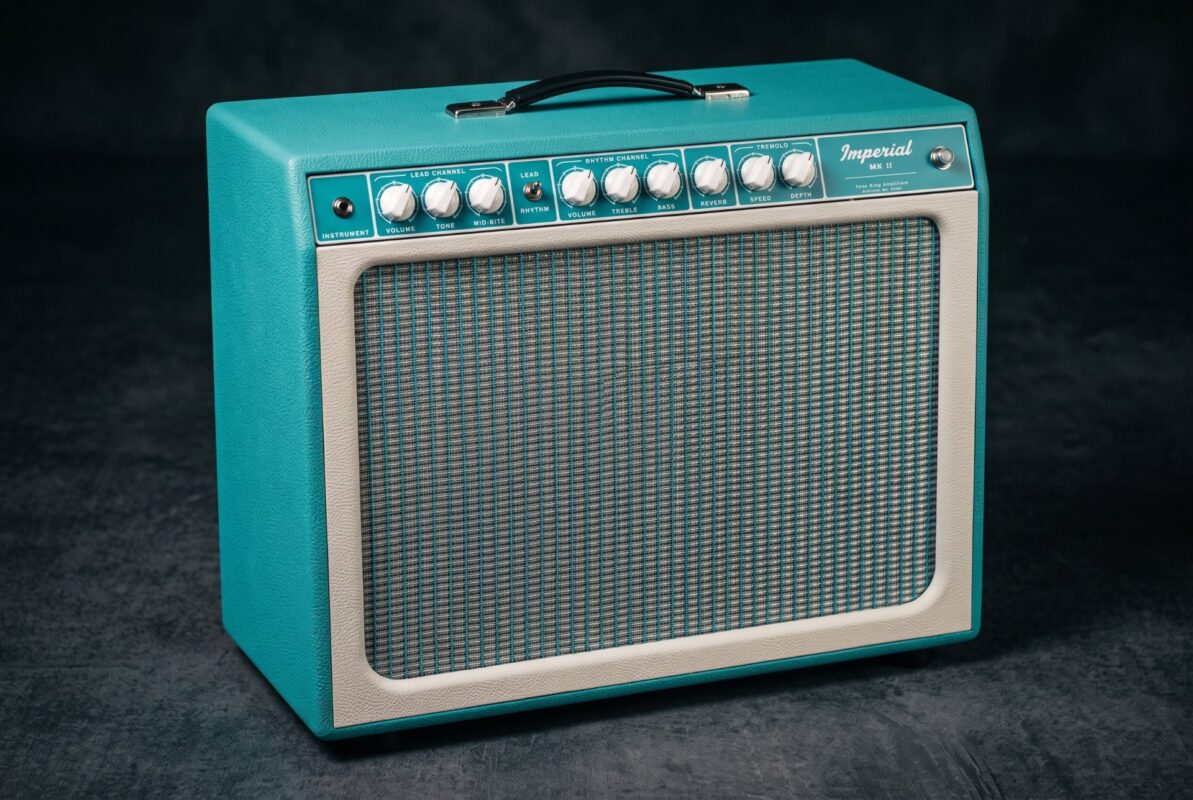
That was the original Imperial. The amp you’re reading about now — the Imperial MKII — is its successor: same bloodline, same two-channel philosophy of blackface clarity meeting tweed grit, but with a generation’s worth of refinements including a built-in Ironman II reactive power attenuator that makes this 20-watt, 6V6-powered 1×12 combo one of the most flexible single-cab solutions in boutique amplification. A Neural DSP plugin bearing its name has introduced it to tens of thousands of players who’ve never plugged into the real thing. Sweetwater keeps it on a lead time. The price is $2,695 — which is a number that makes some people flinch until they spend half an afternoon with one.
This is the full story: where it came from, what it does, who actually plays it, how to get the most out of it, and how it stacks up against the boutique competition that has proliferated around it.
Mark Bartel, Baltimore, and the Birth of Tone King
Mark Bartel started building amplifiers in 1993 in a basement in Kingston, New York. His focus from the outset was American tube tones — the Fender vocabulary of the 1950s and 1960s — studied carefully and built from premium components without the cost-cutting that mass production demands. He built roughly a dozen amps in Kingston before relocating the operation to Baltimore in 1994, where Tone King has remained ever since.
The original Imperial was the flagship from the beginning: a two-channel combo that addressed one of the central frustrations of vintage Fender ownership, which is that the great American amps of the 1950s and ’60s speak at volumes incompatible with most modern applications. A 40-watt blackface Vibrolux cranked to its sweet spot in a living room is a civil-disturbance call. Bartel’s solution was to build the tones players actually wanted into a 20-watt circuit with enough headroom for the Rhythm channel to stay clean across any reasonable stage application, while keeping the whole package in a portable 1×12 cabinet.
The MKII is the current production evolution of that original. Introduced around 2015, it refined the circuit with a Mid-Bite control on the Lead channel, improved the internal construction, and — critically — integrated the Ironman II compensated power attenuator directly into the chassis. What began as a separate outboard unit that Tone King also sold became a permanent feature of the amp itself, transforming the Imperial from a premium boutique combo into one of the most genuinely versatile studio and live tools in its class.
The current lineup is assembled in the USA using premium worldwide components. Tone King is explicit about this on their product pages: “Assembled in the USA using premium worldwide components.” The cabinet is Baltic birch. The speaker is custom-voiced by Eminence and branded ‘Tone King 33’. The tubes are sourced globally, as they are across the entire amplifier industry. This is not a criticism — it is the same supply chain logic that governs every reputable amp builder on earth — but it is worth stating plainly for buyers who conflate “boutique” with “entirely domestic.” What Bartel’s operation controls is the assembly, voicing, circuit design, and quality verification, which is where boutique value actually lives.
Specifications
The Circuit: Two Channels, Two Eras, One Amp
The Imperial MKII is not a channel-switching amp in the modern sense — it does not morph from one general-purpose circuit to another. It is better understood as two distinct vintage amp characters living inside one box, selectable by footswitch.
The Rhythm channel chases the mid-1960s Fender blackface sound: high headroom, crystal-clear response, exceptional bell-like top end, and a full low register that is impressive from a single 12″ cabinet. The control set is a straightforward three-knob arrangement — Volume, Treble, Bass — mirroring the spartan layout of the original Fender Deluxe Reverb. The response is touch-sensitive in the way that blackface amps are: pick harder and the tone opens up and brightens; dig in softly and it compresses into something glassy and almost polite. This is the channel Knopfler is documented using most frequently — clean, chimey, and capable of expressing everything his right hand communicates.
The Lead channel is a different animal: a 1950s tweed Fender voice with the spongy compression, pushed midrange, and early breakup character of amplifiers like the 5E3 Deluxe. The Volume, Tone, and Mid-Bite controls give it a slightly more assertive tone-shaping palette. The Mid-Bite is the key control: at low settings it softens the tweed character toward something warm and round; at higher settings it introduces a midrange peak that tightens the low end and hardens the attack, moving the overall feel toward something more aggressive — what MusicRadar’s Nick Guppy described memorably as “from Royal Scam-era Carlton to Tres Hombres Gibbons in a single twist.” Both channels share the reverb and tremolo controls. On a standard Fender blackface amp, the reverb is only active on the reverb channel; on the Imperial MKII, the spring reverb works on both channels, which is an improvement over the original design. The tremolo is bias-modulated: instead of interrupting the signal path (optical or cathode bypass methods), it modulates the output stage bias directly, producing a smooth, pulsing swell that is less choppy than optical tremolo at equivalent depth settings.
The output stage is 2×6V6GT, cathode biased, with no negative feedback (NFB). This circuit choice is critical to the amp’s character: cathode bias produces natural class-A-leaning operation and introduces pleasant even-order harmonics as the tubes saturate; no NFB means the amp’s output stage is not “corrected” for distortion, giving it a natural softness at the onset of clipping rather than the harder, controlled edge of NFB designs. The 5AR4 tube rectifier adds a small amount of sag — a slight voltage droop under heavy transient load — that contributes to the feel of touch-sensitivity and bloom that players associate with vintage American amps.
The construction, per MusicRadar’s 2015 review, is “mostly PCB based” — one large board carries most components including the valve bases, with a smaller board for the attenuator electronics. The front panel pots are hand-wired. This is a point that matters to some boutique buyers who equate hand-built with point-to-point construction; the Imperial MKII is not PtP (a distinction worth understanding before purchase). The PCB construction, however, contributes to consistent channel-to-channel performance across production runs and, arguably, to the amp’s exemplary low noise floor — MusicRadar noted “no audible hum or hiss,” which is unusual at any price point.
The Ironman II: Why the Attenuator Changes Everything
The Ironman II reactive power attenuator is the feature that separates the Imperial MKII from most of what it competes against at its price. Attenuation in six calibrated steps — 0 dB, -3 dB, -9 dB, -15 dB, -24 dB, -36 dB — allows the amp to operate with full power tube saturation and output transformer engagement at volumes that range from stage-ready to conversation-level. At full attenuation (-36 dB), the amp is approximately bedroom-viable.
The key engineering here is reactive load design. Most simple resistive attenuators reduce volume by absorbing power as heat, but they present a constant resistive load to the output transformer — which is not how a loudspeaker works. Speakers are reactive loads: their impedance varies with frequency, affecting how the output transformer and power tubes respond. A reactive attenuator mimics this variable impedance, preserving the interaction between the output stage and the load. The result is that the amp’s feel and character at -15 dB resembles the cranked amp, rather than feeling compressed and lifeless as it does through a resistive pad.
The HF Compensation switch trims the high-frequency “presence” as volume is reduced — addressing the Fletcher-Munson curve, which describes how human hearing perceives treble and bass as quieter at lower SPLs. Turn it on and the attenuated signal retains its perceived brightness; leave it off if you prefer the natural roll-off.
The Rhythm Channel Bypass Enable is an underappreciated operational feature: when selected, it automatically bypasses the attenuator when the Rhythm channel is engaged. This lets you set the attenuator for a driven, cranked-sounding Lead channel tone while retaining the Rhythm channel’s full headroom for clean passages — a live-performance workflow that the amp handles automatically without the player touching anything.
Famous Players: Honest Accounting
There is a documented artist picture worth building carefully from primary sources rather than brand association.
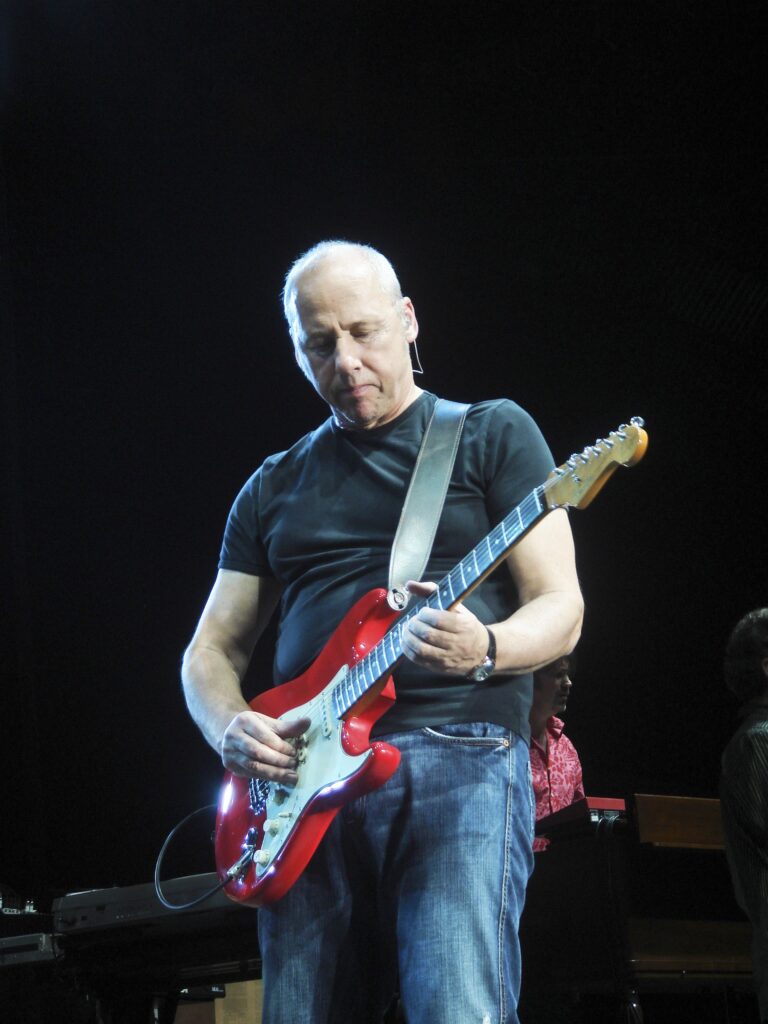
Mark Knopfler is listed on Tone King’s official artist page (toneking.com/artists/) and is undoubtedly the amp’s most significant association. The primary-source documentation, however, is for the original Tone King Imperial rather than the MKII specifically. Fan site mk-guitar.com published a detailed piece in February 2010 documenting Knopfler’s use of a turquoise Imperial on the 2008 Get Lucky tour — photographs by Guy Fletcher and tech Colin Barton confirmed it. Songs documented on the original Imperial include Cannibals, Our Shangri-La, Postcards from Paraguay, True Love Will Never Fade, and Hard Shoulder. His second guitarist Richard Bennett also used one. The MKII was not introduced until approximately 2015, so any claim that Knopfler specifically plays the MKII should be treated as probable but not confirmed from a dated primary source. Tone King lists him on their current artist page, which implies an ongoing relationship with their current production — but model-specific evidence is the original Imperial. Article treats him honestly as the defining player association for the Tone King Imperial lineage, with the MKII being the current production evolution of what he plays.
Read our guide to Mark Knopfler’s guitars and gear.
James Bay also appears on the Tone King artist page and is a genuine Tone King user — but Equipboard’s data and published rig documentation place him on the Tone King Sky King, not the Imperial MKII. The Sky King is a different model: higher wattage, two switchable voices, designed more explicitly for higher-gain applications. Bay’s use of the Sky King is documented. Using his name to sell the Imperial MKII is a brand-level association, not a model-level one.
R.J. Ronquillo is the strongest confirmed per-SKU user: Equipboard documents him on the Imperial MKII 20W 1×12 via a YouTube video titled “The MOST Interesting ‘Strat’ I’ve Ever Played,” in which he uses the amp to demo a Fender Custom Shop MVP 2-Step Stratocaster. Ronquillo is a respected guitar educator and working player, and his use is documented on video.
Jason Isbell appears on Equipboard’s Imperial MKII listing, attributed to Instagram posts from around 2015. His 2024 Premier Guitar Rig Rundown at the Ryman Auditorium documents a substantially different rig: Dumble Overdrive Special #22, 1964 Fender Vibroverb (with Diaz mod), twin Magnatone Twilighter Stereo combos, a 1959 Fender Twin, and multiple vintage Marshalls. No Tone King appears in his 2024 touring rig documentation. It is plausible that he owned or used the Imperial MKII in a studio or home context around 2015; it is not a documented touring instrument in his current setup.
Greg Koch is on the Tone King artist page and is genuinely associated with the brand through extensive Wildwood Guitars demo work — but Equipboard documents him on the Tone King Royalist MKIII, not the Imperial MKII.
Keith Nelson (Buckcherry) and several others appear on the Tone King artist page without model specification. Their relationship with the brand is real; which amp they use is not confirmed from a primary source.
The honest summary: this is an amp whose player reputation rests on association rather than documented touring use at the top tier. That association is real — Tone King is on Knopfler’s stage, the brand earned genuine musician respect — but the Imperial MKII specifically is more of a working-player and studio tool than a “spotted on stage at Madison Square Garden” amp. That is a legitimate market position, not a knock.
Tone Recipes and Settings
Mark Knopfler–Style Clean (Rhythm Channel)
The goal here is the glassy, fingertip-articulate clean tone Knopfler is known for — infinite sustain at low volume, dynamic response to pick attack, and that slightly hollow midrange presence. Set the Rhythm Volume to about 3, Treble at 6, Bass at 5. Use a Fender Stratocaster in position 2 or 4. Attenuate to -9 dB for home use. Reverb at 3 — just enough to add air without smearing transients. No overdrive pedal. This channel does the work through pick angle and touch. The key insight from Knopfler’s documented playing: he uses the Rhythm channel almost exclusively, preferring clean headroom that responds to his right hand over any channeled gain.
Tweed Lead — Pushed Blues-Rock (Lead Channel)
A medium-gain, warm overdrive setting for Gibson Les Paul or Stratocaster. Lead Volume at 5-6 (this channel is inherently louder than Rhythm — compensate with the attenuator), Tone at 5, Mid-Bite at 4-5. Attenuate to -15 dB for bedroom use; at -3 to 0 dB for stage. This is where the tweed Fender compression arrives: notes bloom and sustain, pick attack softens slightly, and power chords become satisfyingly thick. For additional bite, push with an Ibanez TS9 set to unity gain with tone at noon and drive minimal — the Tube Screamer’s midrange emphasis complements the Mid-Bite’s already present midrange focus for a smooth, focused overdrive that sings.
Blackface Clean with Tremolo (Rhythm Channel)
The tremolo section is one of the Imperial MKII’s most underrated features. Bias-modulated tremolo is smoother and more musical than optical methods, and it requires no additional pedals. Rhythm Volume at 4, Treble at 5, Bass at 4. Tremolo Speed at 4 (medium rate), Depth at 3. Reverb at 4. This setting replicates the classic Fender combo sound heard on thousands of early rock and country recordings — the pulse of the tremolo riding under a chiming single-note line is what surf rock, swamp blues, and country rhythm guitar are built on. Use a Telecaster. Hit the ‘speed’ and ‘depth’ interaction: higher speed with lower depth gives subtle, breath-like pulse; lower speed with higher depth gives the dramatic chopper of early Ventures records.
Studio Neutral — Recording at Conversation Volume
The Ironman II’s -24 dB setting reduces the Imperial MKII to roughly 0.5 watts of output — quiet enough to record in a room where someone is sleeping. The HF Compensation switch is essential here: engaged, it restores perceived brightness that the ear loses at lower SPL. Rhythm channel, Volume at 8, Treble at 6, Bass at 5, attenuator at -24 dB with HF Comp on. Mic the speaker close (an SM57 offset from the dust cap by an inch). The ultra-low noise floor documented by MusicRadar means the mic signal will be clean — no amp hum fighting the preamp gain. This is the setting for tracking in shared living spaces, apartment studios, or home offices. The reactive load means the power tubes and output transformer are still running at their thermally appropriate operating point; you are not starving the circuit of its natural behavior.
Larry Carlton / Robben Ford Smooth Lead (Lead Channel + Attenuator)
The MusicRadar review used the phrase “Royal Scam-era Carlton” for a reason. The Lead channel of the Imperial MKII, with the Mid-Bite positioned at 3-4 and the attenuator pulling to -15 dB, produces a smooth, warm lead tone with natural compression and enough touch-sensitivity to reward a clean jazz technique. Lead Volume at 6, Tone at 4, Mid-Bite at 3. Run a semi-hollow (335 or equivalent) or a neck pickup on a Stratocaster into this channel. The absence of NFB lets the circuit breathe with a natural sag that makes legato runs feel almost keyboard-like in their even response. Add reverb at 4 for a room-sound that suggests a studio rather than a spring tank.
How It Compares to the Boutique Competition
vs. Fender Deluxe Reverb (65 Reissue or Original Blackface)
The Deluxe Reverb is the spiritual ancestor — same 20-watt class, same 6V6 output stage, same single-12 format, same reverb. The Imperial MKII wins in two categories: it has a second distinct channel that the Deluxe lacks (the Deluxe is single-channel), and it has the Ironman II attenuator. A ’65 Deluxe Reverb reissue weighs 42 pounds and sounds extraordinary when cranked — and has no way to be cranked quietly. The Imperial MKII addresses both problems. The Deluxe wins on price (roughly $1,100 for the reissue vs. $2,695), on vintage character if you specifically want the original circuit, and on ubiquity — Fenders are serviced everywhere. The Imperial MKII is what you buy when you want the Deluxe vocabulary with modern useability. See also: Fender Deluxe Reverb.
vs. Matchless DC-30
The DC-30 is the EL84-driven British-meets-American boutique combo that started the boutique amp conversation in 1989. Its two-channel EF86/parallel-triode design is fundamentally different from the Imperial MKII’s 6V6 circuit — the DC-30 runs 30 watts Class A into a 2×12 cabinet and weighs 83 pounds. The DC-30 is louder, bigger, and more complex. Its EF86 second channel has a varitone character that the Imperial MKII’s Lead channel doesn’t try to replicate. The Imperial MKII is more portable, has the Ironman attenuator advantage, and is more at home in American tweed/blackface territory. The DC-30 occupies the Vox-inspired British-clean/complex side of boutique. At $4,756, the DC-30 also costs nearly $2,100 more. Both are exceptional; they are not interchangeable.
vs. Two-Rock Classic Reverb Signature
The CRS is a single-channel design in three wattage configurations (20–100 watts) with a sophisticated 7-knob tone stack including a 3-position Gain Structure switch. It is more expensive ($5,299 for the head), more wattage-flexible, and more tonally adjustable than the Imperial MKII. The Imperial MKII’s two channels, each voiced for a specific era of American tone, are simpler to operate — set it and forget it. The Two-Rock rewards deep exploration of its Gain Structure and tone stack; the Imperial MKII rewards playing. Both are cathode-biased 6V6 designs. The CRS has its own footswitchable FET boost; the Imperial MKII has its second channel and attenuator. For players who want one dialed-in voice with complex tone control options, the Two-Rock. For players who want two clearly differentiated vintage voices in a portable format, the Imperial MKII.
vs. Morgan AC20 Deluxe
The Morgan AC20 Deluxe is Joe Morgan’s AC30-inspired single-channel combo — EL84-powered, 20 watts, with a single channel that goes from blackface-adjacent sparkle to chimey breakup without any switching. The Morgan is slightly less expensive and, like the DC-30, operates in EL84 territory: more compressed at lower volumes, more immediately present in the upper midrange. The Imperial MKII’s 6V6 circuit is more relaxed in the midrange and more dynamic in the low end. The Morgan’s single-channel design means you manage clean-to-dirty through your volume and pick attack alone; the Imperial MKII’s two channels let you preset both registers and switch between them. For the classic AC30-esque voice, the Morgan. For the dual-register American flexibility, the Imperial MKII.
vs. Matchless Lightning
The Lightning is a 15-watt EL84 1×12 from Matchless — the cleaner, simpler sibling of the DC-30. At $2,791, it is comparably priced to the Imperial MKII and occupies a similar market position (20-ish watts, single 12, premium boutique). The core difference is again tubes and character: EL84 vs. 6V6. The Lightning’s interactive Top Boost-derived controls give it a range from American-clean to scooped-British; the Imperial MKII’s two channels address the same tonal latitude with a different philosophy — two preset voices rather than one continuous range. The Imperial MKII has the attenuator advantage (the Lightning has no built-in attenuation); the Lightning is tube-rectified like the Imperial MKII and shares the same organic sag characteristic. The Lightning is 15 watts (vs. 20) and slightly less loud. Both are elite single-12 combos; pick the circuit architecture that matches your workflow.
Buying Guide
New from Tone King, the Imperial MKII combo is $2,695 at authorized dealers. The head-only version is also available and pairs with the matching Imperial 112 cabinet. Color options — Black, Brown/Beige, Cream, and Turquoise — are all at the same price. The turquoise has become the most visually associated with the amp’s reputation (it is the color Knopfler was photographed with), but all color variants are tonally identical.
Tone King’s website notes a 3-10 day lead time due to high demand, which is consistent with a small-batch operation assembling amps in the USA. Plan accordingly if you need it for a specific date.
The used market exists but is thin. Imperial MKII units hold value well — they rarely depreciate more than 15-20% from new, and well-maintained examples sell in the $1,650-$2,200 range depending on color and condition. Used prices from reverb.com typically start around $1,660 for the combo. The amp has no model year distinctions or documented running changes to watch for on the used market; the current manual (v2, revised May 2021) is the authoritative reference for the current circuit.
One thing to verify on any used example: the Ironman II attenuator functions at all steps. The -3 dB and -9 dB steps are relatively infrequently used and easy to overlook in a brief test. Run through all six steps. Also verify the tremolo footswitch jack functions cleanly — bias-modulated tremolo circuits are not fragile, but the footswitch jack is a wear item over time.
Tube complement note: the stock 5AR4 rectifier tube is reliable but expensive to replace at boutique retail. JJ and Sovtek alternatives are available for less. The 6V6GT power tubes are cathode biased — no manual rebiasing required when you swap them, which is a practical ownership advantage over fixed-bias designs. Follow the manufacturer guidance on approved 6V6 types to ensure the bias modulation circuit for the tremolo functions correctly with any substitute.
Ownership Notes
At full power (0 dB attenuation), the Imperial MKII is loud enough for small-to-medium venue use without microphones — think seated jazz club or coffee shop stage. The 20-watt cathode-biased 6V6 circuit is genuinely loud in real-world use; 20 watts of cathode-biased Class A power is more than it sounds on paper. For rehearsal with a drummer, use -9 dB attenuation to stay in a useable practice volume range without killing the touch-sensitivity. For bedroom use, -24 dB to -36 dB puts the amp in apartment-safe territory.
The Rhythm Channel Bypass Enable is worth reading carefully in the manual: when engaged, switching to the Rhythm channel automatically bypasses the attenuator, restoring full clean headroom. If you are using the Lead channel’s drive at -15 dB and switch to Rhythm, the volume jumps to full 20 watts. This is a feature, not a bug — set it intentionally. Some players deliberately do not engage Bypass Enable, preferring to let the attenuator work on both channels for a more consistent stage volume.
The custom Eminence ‘Tone King 33’ speaker is a voiced component designed specifically for the amp’s circuit. Multiple forum users have replaced it with Weber 12F150 or other Fender-voiced speakers for different low-end character; this is a reversible modification and a legitimate route to tailoring the amp’s bottom-end response, which some users find slightly elevated at higher bass settings on the Rhythm channel. Keep the original speaker — it may find its way back in.
The spring reverb tank is a full-size 2-spring Accutronics unit — the same type used in Fender amplifiers. It is susceptible to mechanical shock from loud stage transients (typically manifested as a loud “crash” sound through the speaker). Handle the amp with standard tube-amp care: don’t tip it horizontally when the reverb is active, and don’t let it sit directly in front of loud stage monitors. The tube-driven reverb circuit has the same all-in voicing as a vintage Fender — that chamber-like decay that MusicRadar noted.
Baltic birch cabinet construction contributes to the amp’s tonal character: firmer, less resonant than softer plywoods, with more pronounced high-frequency projection. The downside is weight — lighter than most 2×12 boutique amps but denser than cheap pine-cabinet combos. At approximately 30 pounds (the original Imperial was documented at 30 lbs; the MKII is comparable), it is a carry-in-one-trip combo. The carry handle is black rather than matched to the cabinet color — a small cosmetic inconsistency MusicRadar noted in 2015 that Tone King has not changed in subsequent production.
Frequently Asked Questions
Is the Tone King Imperial MKII hand-wired?
Not in the traditional point-to-point sense. MusicRadar’s 2015 review confirmed that the Imperial MKII uses “mostly PCB construction” — one large board carries most components including the valve bases, and a smaller board holds the attenuator electronics. The front panel pots are hand-wired. PtP construction is sometimes assumed to mean boutique, but PCB construction executed carefully can be equally reliable and tonally excellent. The Imperial MKII’s near-silent noise floor supports this. If PtP construction is a priority for you, the amp to look at is the Matchless DC-30.
Can the Imperial MKII keep up with a live drummer?
At 0 dB attenuation (full 20 watts), yes — in a small-to-medium room without excessive stage volume from other instruments. The cathode-biased 20-watt output from two 6V6s is genuinely loud; it is not the same as a 20-watt fixed-bias amp that is more restrained in the same power rating. For louder rooms or wedge-monitored stages, the amp can also be mic’d — its low noise floor and consistent voice at all power levels make it an excellent recording/PA-feed source.
What is the difference between the Imperial MKII and the original Imperial?
The MKII integrates the Ironman II reactive attenuator directly into the chassis, whereas the original Imperial had no built-in attenuation. The MKII also adds the Mid-Bite control on the Lead channel. Construction refinements were made. Tonally, both are voiced for the same blackface/tweed dual-register American character; the MKII is the current production version with modern studio and stage flexibility built in. Original Imperials appear on the used market for significantly less — they lack the attenuator but retain the core circuit character.
Does the Tone King Imperial MKII take pedals well?
Exceptionally well. The Rhythm channel’s clean headroom makes it an ideal pedal platform — overdrives, boosts, fuzzes, and modulation all behave predictably in front of it. The Lead channel’s own natural break-up character works well with low-gain boosts and Tube Screamer-style pedals. The cathode-biased output stage and tube rectifier provide a small amount of natural sag that interacts musically with compressors and fuzzes. Effects loop is not present on the Imperial MKII; all effects go front-of-amp.
What guitars work best with the Imperial MKII?
Single-coil guitars — Stratocasters and Telecasters in particular — exploit the Rhythm channel’s clarity and sparkle most effectively. The amp’s sensitivity to pick attack makes it an unusually expressive tool for fingerpickers as well. Humbuckers work well on the Lead channel, where the mid-forward character and early compression suit them better than the high-headroom Rhythm channel. Semi-hollow body guitars (ES-335, Casino) sound excellent on either channel. The amp is voiced for guitar specifically and is not particularly useful for bass.
How does the Ironman II attenuator affect tone at deep attenuation?
At -36 dB — the deepest step — the output is approximately 0.05 watts, which corresponds to roughly 77 dB SPL at one meter (about the level of loud conversation). The reactive load design and HF Compensation circuitry preserve the tonal character better than resistive alternatives. At -15 dB and below, some players note a slight softening of the bottom end and a change in the amp’s feel under heavy string attack — this is inherent to any attenuation of a tube output stage rather than a flaw specific to this design. For detailed recording at -24 dB or deeper, engage the HF Compensation switch.
Is the Neural DSP Tone King Imperial MKII plugin an accurate representation?
Neural DSP’s plugin bears the Tone King Imperial MKII name under license and has been widely praised for capturing the tonal character of the amp’s two channels. It has introduced the amp’s circuit voicing to players who would not otherwise encounter it. Like all amp modelers, it lacks the physical interaction with a real speaker and the acoustic presence in a room. What it does accurately represent are the frequency balance, compression character, and gain structure of each channel — useful for auditioning whether the Imperial MKII’s voice suits your playing before committing $2,695 to the real thing.
Mark Knopfler is on the Tone King artist page — does he specifically play the Imperial MKII?
The primary-source documentation — photographs from Guy Fletcher, confirmation from tech Colin Barton, detailed reporting on mk-guitar.com — places Knopfler on the original Tone King Imperial during his 2008 Get Lucky tour. The MKII was introduced approximately 2015. Tone King’s current artist page lists Knopfler without model specification. Whether he has adopted the MKII specifically is not confirmed in any currently available primary source, though it is reasonable to assume the brand relationship and amp preference have continued through the current production version.
Image credits
- A drummer and guitarist on a small stage: Xi WEG from Poitiers, France, Wikimedia Commons, CC BY 2.0.
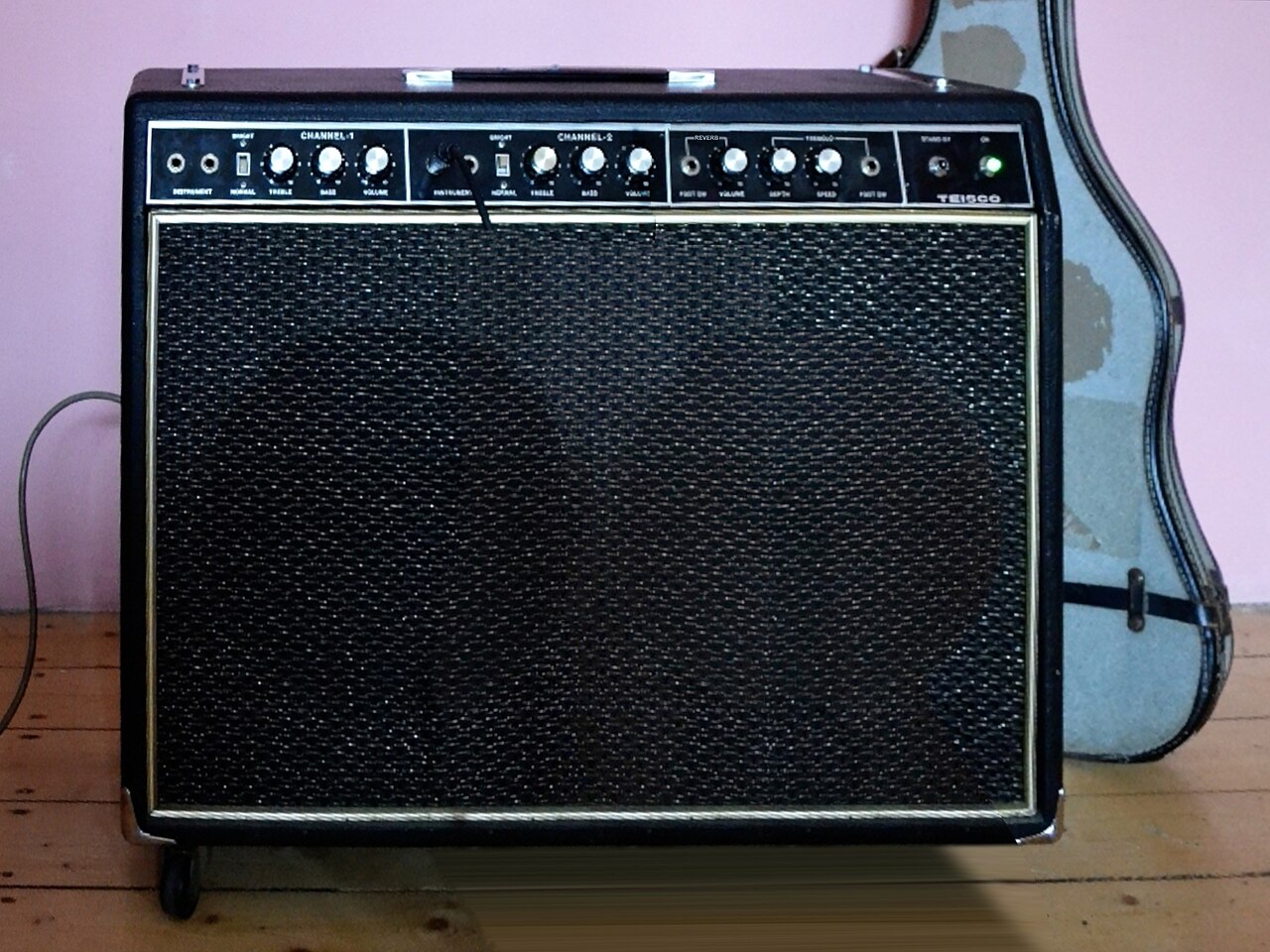
- A tube combo amp: Teisco & Framus.jpg: DeLerkim derivative work: User:Clusternote, Wikimedia Commons, CC BY-SA 3.0.
- Tone King Imperial MKII: AI-generated illustration by GuitarGangsters, based on the manufacturer’s product design (not a photograph).
- Mark Knopfler: Christopher Bowley, Wikimedia Commons, CC BY 2.0.
Latest News
Related
On This Day
Tuesday 10 November
From this week: