The Gremlin That Roars: Tone King’s 5-Watt Monster for the Tone-Obsessed Bedroom Player
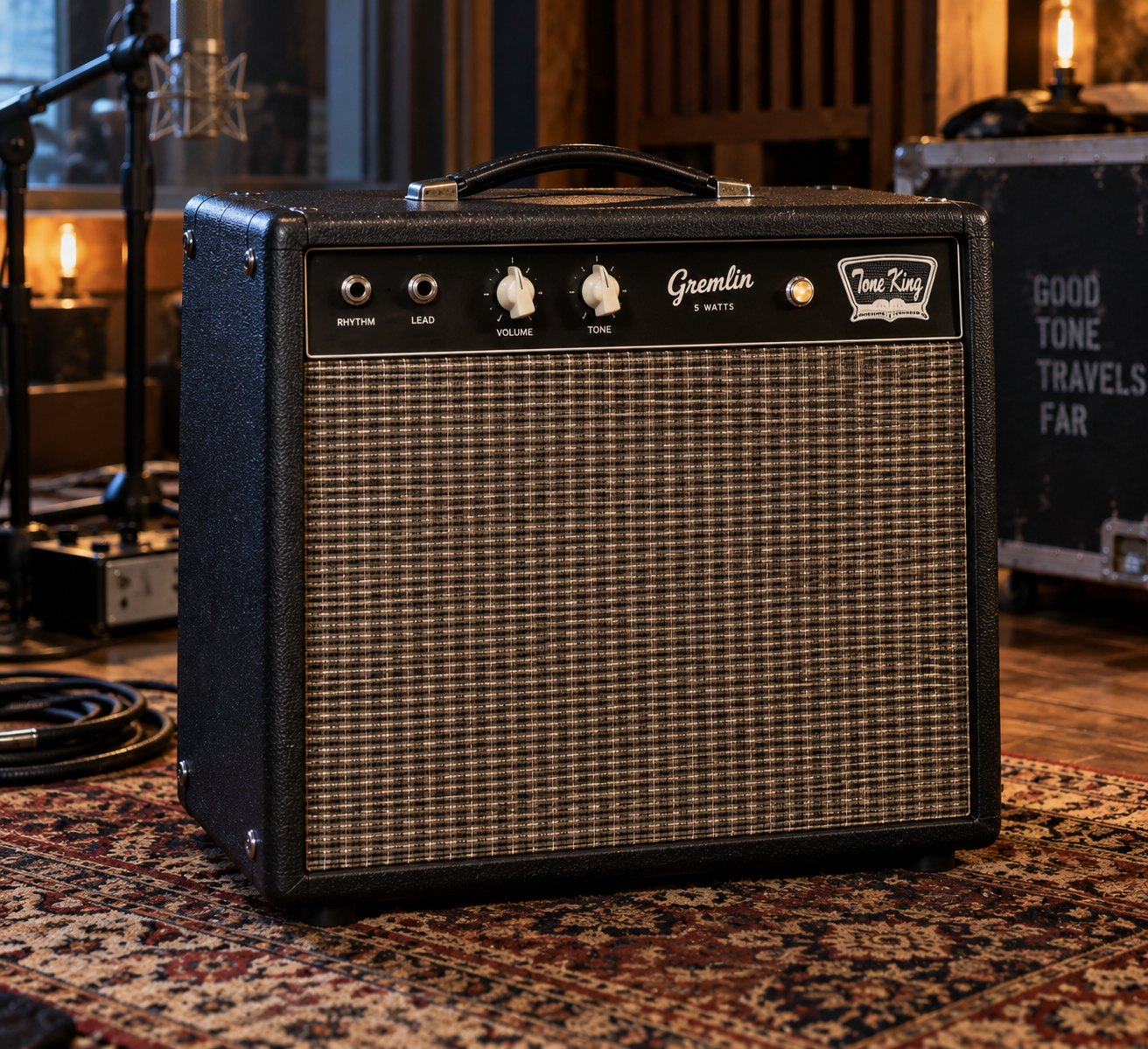
Tone King Gremlin. AI-generated reference illustration, not a photograph.
The Tone King Gremlin delivers cranked blackface and tweed tones at any volume. Full specs, verified artist info, tone recipes, and honest buying guide.
There are guitar amplifiers, and then there are declarations of intent. The Tone King Gremlin is unmistakably the latter. At five watts and twenty-nine pounds, it fits in a coat closet, plays nice with neighbours, and costs $1,395 — roughly the same as a mid-grade Stratocaster. What it delivers in return is a hand-wired, USA-built tube combo with an onboard reactive-load attenuator, a KT66 power tube, a custom Celestion speaker, and the kind of harmonic richness that forces you to put the phone down and just play.
It was designed by Mark Bartel, the same man who spent thirty-plus years making some of the most revered boutique amplifiers on earth. The Gremlin is his answer to a specific, modern question: how do you get the sound of a cranked vintage amp without driving your family out of the house? His answer is elegant. He built a great amp — not a great amp with compromises — and put the Ironman II reactive-load attenuator inside it. The result is a combo that lets you live at full-throttle tube saturation whether you’re playing alone at midnight or keeping up with a drummer at rehearsal.
This guide covers everything: where it came from, exactly how it works, who’s actually using it, what it sounds like with different guitars and pedals, how it compares to the obvious competition, and what to know before you buy one new or used.
Tone King: Baltimore to Baltimore and Never Anywhere Else
Mark Bartel founded Tone King Amplifiers in 1993 in Kingston, New York, moving the operation to Baltimore, Maryland in 1994. The founding philosophy was blunt: build the best vacuum-tube guitar amplifiers available, do the woodworking yourself, wind the transformers to your own spec, and never cut corners on the parts that actually shape tone. The first flagship, the Tone King Imperial, set the template — a two-channel, hand-wired combo with Tone King’s own custom transformers and speaker, built one at a time by Bartel himself in the early years.
For the better part of two decades the company was essentially a one-man boutique operation. That changed in the mid-2010s when the brand shifted to a team-built model under Eli Lester and Mac Skinner, who had acquired Tone King from its Premier Builders Guild ownership era (2010–2016) and rebuilt it from the ground up — new chassis, new transformers, new facility. Bartel returned as a design collaborator. The rebuild kept everything that mattered: the hand-wiring ethos, the custom components, the Baltimore address, and the obsessive attention to how a guitar amp should feel under a player’s hands.
The Gremlin entered the line as Tone King’s lowest-wattage offering — a purpose-built low-power combo for home players who refused to accept that “low wattage” had to mean “compromised tone.” The head variant followed in April 2021, announced in Premier Guitar, giving players the option to pair the circuit with their own cabinet. Both versions share the same fundamental circuit and the same Ironman II attenuator, though they use different power tubes — a distinction with real sonic implications, as we’ll get into below.
Specifications: What You’re Actually Getting
| Spec | Combo | Head |
|---|---|---|
| Output power | 5W | 5W |
| Configuration | 1×12″ combo | Head only |
| Power tube | 1× KT66 | 1× 5881 |
| Preamp tubes | 2× 12AX7 | 2× 12AX7 |
| Speaker | Custom Celestion 12″, 8-Ohm, ceramic magnet | — (use your own) |
| Inputs | Rhythm (blackface voicing) / Lead (tweed voicing) | Rhythm / Lead |
| Controls | Vol, Tone | Vol, Tone |
| Attenuator | Ironman II (reactive load, Fletcher-Munson comp., damping factor correction) | Ironman II |
| Optional footswitch | A/B/Y (not included) | A/B/Y (not included) |
| Cabinet | Baltic Birch, USA | Baltic Birch, USA |
| Colors | Black, Brown/Beige, Cream, Turquoise | Black, Brown/Beige, Cream, Turquoise |
| Dimensions | 10″(L) × 19″(W) × 17″(H) | 8″(L) × 15″(W) × 9.25″(H) |
| Weight | 29 lbs | 14 lbs |
| Street price (2026) | $1,395 | $1,095 |
| Assembly | Assembled in USA using premium worldwide components | |
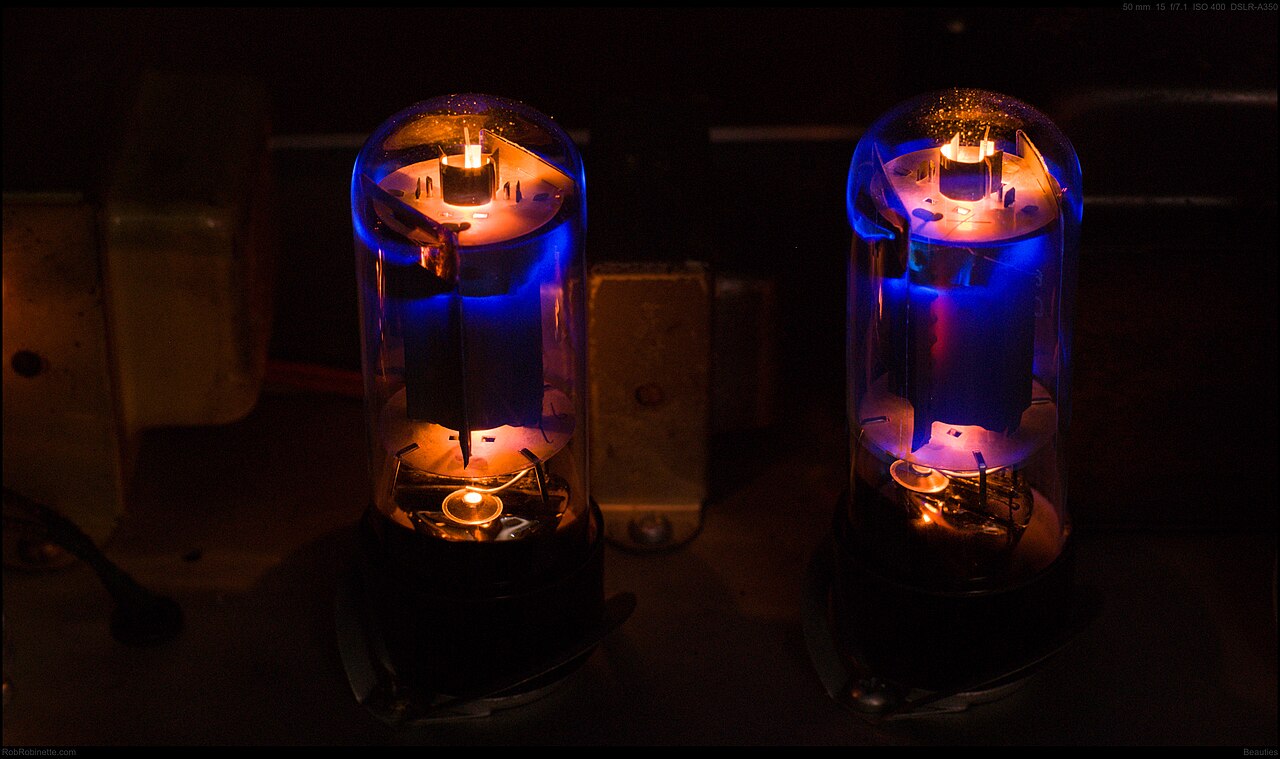
One spec that demands a paragraph of its own: the power tube difference. The combo runs a KT66. The head runs a 5881. These are not interchangeable flavours — they are meaningfully different tubes with different sonic characters. The KT66 is a British-designed output tube that found its most famous home in the original Marshall JTM45; it delivers a broad, harmonically saturated response with a touch of warm complexity in the midrange. The 5881 is the mil-spec version of the American 6L6GC — cleaner, with more headroom before breakup, glassier in the top end, and better suited to pairing with large external cabinets where you want the speaker to do more of the saturation work. Tone King’s choice is deliberate: the combo’s KT66 adds warmth and compression that suits the sealed 1×12″ cabinet; the head’s 5881 gives players using their own cab more flexibility and headroom to shape. If you A/B the two against each other through the same speaker, you’ll hear the difference immediately.
The Circuit: Two Inputs, One amp, Infinite Confusion Resolved
The Gremlin is frequently described as a “two-channel” amp. That’s technically imprecise and worth clarifying, because it shapes how you use the thing. The Gremlin has two inputs — one labelled Rhythm, one labelled Lead — not two channels in the modern sense of separate preamp paths with individual gain and EQ controls. There is one volume knob and one tone knob, shared across both inputs. What the two inputs give you is two different preamp voicings: the Rhythm input rolls off a touch of gain and opens up more clean headroom, approximating the feel of a blackface Fender — bell-like highs, touch-sensitive cleans that break up beautifully when you dig in. The Lead input is voiced with more drive, capturing the compressed, harmonically dense character of a cranked tweed-era Fender — a Bassman or tweed Deluxe pushed to the point where chords start to bloom and notes sing.
With a standard guitar cable you choose one input and stay there. Plug an A/B/Y footswitch between your guitar and both inputs simultaneously, and you can switch between the two voicings on the fly without touching the amp — essentially turning the Gremlin into a two-channel amp at the expense of one pedal board slot. This is an elegant solution that keeps the amp’s internal circuit dead simple while giving live players real flexibility. It’s also why the amp has no footswitch jack on the back panel — the footswitch lives in your signal chain, not the amp’s.
The Ironman II attenuator deserves a proper explanation because it’s the defining feature that separates the Gremlin from a standard low-wattage practice amp. A resistive attenuator simply dumps voltage into a resistor, which kills volume but also kills the interactive back-EMF relationship between the output transformer and the speaker — your amp starts to feel stiff and lifeless. The Ironman II uses a reactive load that mimics the impedance behavior of a real speaker at all frequencies. The result is that the amp “sees” a realistic load at any attenuation level, which preserves the sag, compression and dynamic feel of the power tubes working into a real cabinet. Tone King adds Fletcher-Munson volume compensation circuitry on top — this is a shelving EQ that boosts the bass and treble frequencies as volume decreases, compensating for the human ear’s reduced sensitivity to those frequencies at lower SPLs. The practical effect is that the Gremlin sounds genuinely full at bedroom levels rather than thin and honky. Damping factor correction rounds out the Ironman II’s feature set, maintaining the control relationship between the output stage and the speaker cone.
Famous Players: An Honest Assessment
The Tone King Gremlin is not a high-profile touring amp. At five watts with no reverb, no tremolo, and no effects loop, it’s not the tool that recording artists pack into a semi truck for a world tour. It’s a specialist instrument for a specific type of player, and the documentation reflects that.
The one confirmed pro user in the primary-source record is Paul Davids, the Dutch guitarist, educator, and YouTube creator whose channel has documented his exploration of minimalist guitar rigs with maximum tone. In his video “How less is more in the guitar world – Gibson Les Paul Junior & Tone King Gremlin,” Davids pairs the amp with a single-pickup Les Paul Junior and demonstrates exactly what the Gremlin is designed to do: strip away every layer of processing and let the guitar-to-amp relationship breathe. Davids is not a touring rock star in the conventional sense, but he is a legitimate professional guitarist with a following that dwarfs most signed artists’ audiences, and his endorsement carries weight precisely because he is known for honest assessments rather than paid placements. The Gremlin appears on Equipboard under his name, consistent with the video documentation.
More broadly, the Gremlin’s natural habitat is the serious home studio and the small rehearsal room. Players who own them tend to be the same people who own boutique pedal collections: tone-obsessed, patient, and willing to spend $1,395 on an amp that does exactly one thing — deliver vintage American tube tone at any volume — rather than $400 on an amp that does twelve things adequately. The Gremlin’s reputation on forums like The Gear Page and TDPRI is consistent: players who buy it rarely sell it. It is the kind of amp that stops the search.
For comparison, the rest of the Tone King artist roster — Mark Knopfler, the artists documented on the Imperial MKII — uses higher-wattage models. The Gremlin fills a different role in the lineup, and its player community reflects that. There are no A-list touring guitarists documented on the Gremlin because A-list touring guitarists need more watts, more features, and more volume. The Gremlin is honest about what it is.
The Tone: What to Expect from Each Input
The Rhythm input, voiced after a blackface Fender circuit, delivers the most transparent clean platform in the Tone King lineup. With the volume below 12 o’clock, single-coil guitars — a Stratocaster through the bridge pickup, a Telecaster’s neck position — produce the kind of crystalline, touch-sensitive clean tone that defined Nashville session playing and California country. There is real shimmer in the top end, solid-but-not-flabby low end (the KT66 contributes to this), and an immediate, alive quality that good amps have and modelling units almost universally fake. The Tone control interacts with the volume in the way a single-knob EQ does on a vintage amp: turn it up and you introduce brightness and presence, turn it down and the amp thickens and darkens. At Vol 12–2 o’clock, humbuckers start to compress into a singing sustain. Above that, the power stage begins to saturate and the KT66 starts adding its characteristic warmth.
The Lead input, tweed-voiced, is dirtier from the moment you plug in. With the volume set to match the Rhythm channel’s breakup point, you’re already in overdrive territory — the compressed, “everyone hitting together” bloom of a cranked tweed Bassman, where chords seem to squeeze into each other and sustain extends longer than the physics suggests it should. This is the input for playing alone at home, for recording riff tracks where you need the amp to feel like it’s being recorded in a room, for any situation where you want the guitar to push rather than sit. The Tone control on the Lead input does double duty as a brightness and harshness management tool: above 3 o’clock it starts to emphasise pick attack and harmonic edge in a way that can be fatiguing; most players land between 11 and 2 o’clock and find their sweet spot there.
The KT66’s characteristic warmth means the Gremlin never gets truly harsh or fizzy even when both the volume and the input gain are high. This is the tube’s principal advantage in a low-wattage format: where a cheap 6L6 clone might break up into grating digital-sounding clipping at full power, the KT66 saturates gracefully, producing the organic kind of overdrive that recording engineers love because it’s already somewhat mixed — it doesn’t need help sitting in a track.
Tone Recipes and Settings
1. Blackface Blueprint (Strat, Rhythm Input, Light Breakup)
Guitar: Fender Stratocaster, middle or neck position, tone rolled back slightly. Input: Rhythm. Vol: 1 o’clock. Tone: 12 o’clock. Attenuator: fully open (no attenuation). This is the tone of Nashville clean — precise, articulate, warm but not muddy. Your pick attack controls the dynamics. For a more open, glassy response, roll the Tone up to 1 o’clock. For a thicker, slightly darker shade, down to 11.
2. Tweed Crunch (Les Paul, Lead Input, Pushed Power Stage)
Guitar: Gibson Les Paul Standard, bridge pickup, volume at 8/10 on the guitar. Input: Lead. Vol: 2 o’clock. Tone: 12 o’clock. Attenuator: −3 to −6dB if needed for the room. This is the heart of what the Gremlin does best — a humbucker pushing a tweed-voiced preamp into a KT66 that’s working. The result is dense, compressed, harmonically alive. Roll the guitar’s volume back to 6/10 for a cleaner but still warm tone; push it to 10/10 for more saturation and sustain. This is where the Gremlin stops being a practice amp and starts being a recording weapon.
3. Pedal Platform (Fender Tele, Rhythm Input, Overdrives In Front)
Guitar: Telecaster bridge pickup. Input: Rhythm. Vol: 10 o’clock (just below power stage breakup). Tone: 1 o’clock. Run an Ibanez TS9 Tube Screamer in front — level at unity, drive at 9 o’clock, tone at 12 o’clock. The Rhythm input’s clean headroom makes it the better pedal platform of the two; the Lead input’s own dirt competes with overdrive pedals and can turn muddy. The TS9 thickens the midrange and adds sustain while the amp remains the fundamental tone source. Swap the TS9 for a Klon-type clean booster for more headroom with the guitar’s pick attack preserved.
4. Bedroom Blues (Midnight Attenuation, Lead Input)
Guitar: semi-hollow or humbucker solidbody. Input: Lead. Vol: 3 o’clock (amp fully cooking). Tone: 11 o’clock. Attenuator: −12 to −18dB. At this setting the power stage is saturating at full current, the KT66 is working, and the Ironman II’s Fletcher-Munson compensation is doing its job of pushing low and high frequencies to maintain the impression of full-range sound at low SPL. The result is a genuinely usable midnight tone — not a compromised shadow of the amp’s real voice, but a scaled-down version that still has the dynamics, the compression and the feel. This is the Gremlin’s party trick and the reason serious players pay the price premium.
5. Jump-Channel Hybrid (A/B/Y Footswitch, Both Inputs)
Connect an A/B/Y footswitch between the guitar and both Rhythm and Lead inputs simultaneously, with Y (both together) selected. Vol: 12 o’clock. Tone: 12 o’clock. The two voicings blend — some of the Rhythm input’s headroom and sparkle, some of the Lead input’s compression and drive. This is the Gremlin’s equivalent of jumping the channels on a vintage Bassman: slightly more character than either input alone, a hint of phase interaction that adds dimension. Use it as the default position and switch to Rhythm alone for a clean break or Lead alone for a dirt peak.
Comparisons: Where the Gremlin Sits in the Market
Tone King Gremlin vs. Fender Deluxe Reverb
The Deluxe Reverb is the most obvious point of comparison — both are American-voiced single-channel combo amps that live in the blackface / tweed tradition. The Deluxe Reverb is 22 watts vs. the Gremlin’s 5, which means it sounds better at full power in a live context and has built-in reverb and vibrato. The Gremlin wins on attenuated tone (the Ironman II outperforms any external attenuator on a Deluxe), on power tube character (KT66 vs. 6V6), and on portability. The Deluxe Reverb costs around $1,200 — essentially the same money. The choice is clean-headroom-and-effects-loop vs. low-watt-attenuated-saturation, not budget.
Tone King Gremlin vs. Tone King Imperial MKII
The Imperial MKII is the Gremlin’s bigger brother — 20 watts, two properly independent channels (with separate volume controls), tube reverb, bias-modulated tremolo, and the full Ironman II attenuator that descends all the way to −36dB. The MKII costs $2,695 — nearly double the Gremlin. The Gremlin wins on simplicity and price; the MKII wins on versatility, headroom, and stage-friendliness. If you know you need reverb and tremolo, the MKII is the answer. If you’re building your own reverb and tremolo via pedals and want maximum tonal transparency from the amp itself, the Gremlin is the call.
Tone King Gremlin vs. Vox AC4TV
The AC4TV is a 4-watt all-tube combo at around $300 — the budget entry point for low-wattage British tone. It uses an EL84 power tube vs. the Gremlin’s KT66, which gives it a more toppy, cutting response and a more pronounced midrange spike. The AC4TV does not have a reactive-load attenuator; its built-in wattage reduction is resistive, which costs feel and tone. The Gremlin costs nearly five times as much. The AC4TV is a legitimate starter amp. The Gremlin is what players buy when they’ve had the AC4TV for two years and decided they want the real thing.
Tone King Gremlin vs. Carr Raleigh
The Carr Raleigh is another boutique 5-watt USA-built combo designed explicitly for low-watt home and studio use — EL84-powered, with built-in tremolo. Street price is around $1,600. The EL84 gives the Raleigh a more immediately breakup-forward response; the KT66 in the Gremlin is warmer and thicker. Carr builds to an equally high standard. The Gremlin wins on attenuator sophistication and price; the Raleigh wins on tremolo and the distinctive EL84 chime. Both are the product of exceptional engineering. Which one fits depends on whether you want the American tweed/blackface tradition (Gremlin) or a more British sparkle (Raleigh).
Tone King Gremlin vs. Morgan AC20 Deluxe
The Morgan AC20 Deluxe is another USA-made boutique amp with EL84 power tubes, 20 watts, and a reverb circuit. At around $2,100 it’s in the same conversation as the Imperial MKII rather than the Gremlin, but players comparing low-wattage American boutiques will encounter both. The Morgan is more watts, more British in character, more stage-ready. The Gremlin is simpler, more affordable, and purpose-built for the attenuated home use case. The Morgan’s 20 watts can be used at full power in a rehearsal room without a separate attenuator; the Gremlin’s Ironman II makes it self-sufficient at any volume from stage to bedroom.
Buying Guide: New, Used, and What to Know
Buying new: The Gremlin ships from toneking.com at $1,395 for the combo and $1,095 for the head, with a 3-to-10-day lead time due to high demand (as of August 2026). The combo comes in Black, Brown/Beige, Cream, and Turquoise. The turquoise is the signature Tone King finish and resells better. All colours sound identical — the colour choice is entirely cosmetic. Sweetwater stocks it at the same $1,395 price and offers two-year coverage. The lead time is real: Tone King’s team-built but USA-assembled model means inventory is not deep. If you find one in stock, buy it.
Buying used: The Gremlin holds value unusually well for a modern boutique amp. Used prices on Reverb run $800–$1,100 for the combo, depending on condition and colour. There is no “era” distinction with the Gremlin the way there is with Two-Rock (pre-2016 vs post-2016) or vintage amps — the circuit has been consistent since launch, and Tone King’s component quality has not changed. The main used-market warning is the power tube: a KT66 that is past its service life will compress and sag more than intended. Ask the seller when they last re-tubed and whether the bias was set at the same time. A Gremlin with a fresh KT66 and fresh 12AX7s is as good as new.
What the Gremlin doesn’t have: No reverb. No tremolo. No effects loop. No footswitch included. If your signal chain depends on amp reverb or amp tremolo, the Gremlin is the wrong amp — consider the Imperial MKII, which has both. If you run reverb and modulation from pedals and want the amp to be as clean and transparent a platform as possible, the Gremlin’s stripped-down circuit is an advantage: there is no reverb tank to colour the dry signal, no tremolo LFO to add noise, no effects loop buffer in the signal path.
The head vs. combo question: The head is $300 cheaper and fourteen pounds lighter. Its 5881 power tube gives it a different sonic character from the combo’s KT66 — more headroom, slightly less warmth in the saturation. The head makes sense if you already own a good 1×12 or 2×12 cabinet, or if you want to pair it with a larger speaker for more low-end. The combo makes sense if you want a self-contained unit that sounds exactly like Tone King intended it to sound, including the custom Celestion speaker voice. Most players who are buying the Gremlin as their one bedroom/home studio amp should buy the combo.
Ownership notes: The Gremlin runs hot for a 5-watt amp — the KT66 is a bottle of glass running plate voltages higher than most EL84-based amps in this power bracket. Leave adequate ventilation above and behind the amp when it’s in a cabinet or corner. The 3-to-10-day lead time from Tone King applies to new stock only; once you have the amp, there are no service requirements beyond periodic re-tubing (every 1-2 years with regular play). The Baltic Birch cabinet is robust. The custom Celestion speaker is not a standard off-the-shelf model, so if it ever needs replacement, contact Tone King directly for a sourcing recommendation.
Frequently Asked Questions
Is the Tone King Gremlin loud enough to play with a drummer?
Yes — Tone King’s own marketing says so, and players confirm it. Five watts of all-tube power through an efficient Celestion speaker produces more actual SPL than the number suggests. The Gremlin can keep up with a drummer at moderate playing levels. At those volumes you’ll have the power stage working, which means you’ll be in saturation territory on the Lead input. If you need more clean headroom at drummer volumes, the Imperial MKII is the answer.
Does the Ironman II attenuator really preserve the amp’s tone?
Better than most alternatives at the same price point, yes. The reactive load technology and Fletcher-Munson compensation make a measurable difference compared to resistive pads. That said, no attenuator is sonically invisible — the Gremlin at −18dB does not sound identical to the Gremlin at full volume. What the Ironman II does is preserve the essential dynamic feel and tonal character far better than dropping voltage across a resistor. Players who have compared it to external resistive attenuators consistently note the difference in feel and sustain.
What is the difference between the Rhythm and Lead inputs?
The Rhythm input is voiced for blackface-style headroom — cleaner before breakup, more articulate, bell-like top end. The Lead input has more drive built into the voicing, producing tweed-style compression and harmonic saturation at lower volume settings. There is one shared volume and tone control for both. An optional A/B/Y footswitch lets you switch between them or run both simultaneously.
Can I run an overdrive pedal into the Gremlin?
Yes, and the Rhythm input is the better choice for pedals. Its cleaner voicing provides more headroom for overdrive pedals to operate before the preamp starts clipping, which gives the pedal’s own gain structure more room to breathe. The Lead input’s own drive can clash with heavy overdrive pedals and produce muddy results. Light drives and boosts work on either input.
Is the Gremlin hand-wired?
Humbucker Music’s product description describes it as hand-wired, and Tone King’s construction ethos has always prioritised hand-wired point-to-point assembly for its premium circuits. Tone King’s own website states it is “assembled in the USA using premium worldwide components.” This is consistent with team-built hand-wiring rather than printed circuit board construction. The Gremlin is not PCB-built — this is confirmed in multiple dealer descriptions and aligns with Tone King’s documented manufacturing approach.
What speaker does the Gremlin use?
A custom-voiced 12-inch Celestion speaker with a ceramic magnet, 8-ohm impedance. It is not a standard production Celestion model — it was designed to Tone King’s specification for use in the Gremlin’s cabinet dimensions and power rating. The specific voicing gives the amp’s top end its characteristic detail and vocal-like midrange. If the speaker needs replacement, contact Tone King for sourcing guidance rather than substituting a standard Celestion G12M or similar.
How does the KT66 in the combo compare to the 5881 in the head?
The KT66 is a British output tube — warm, complex, with a slightly compressed and harmonically dense breakup character. It was used in the original Marshall JTM45 and gives the combo a touch more warmth and midrange richness in saturation. The 5881 (a mil-spec 6L6GC) is the American counterpart — cleaner, with more headroom and a glassier top end before breakup. The combo’s KT66 suits the sealed 1×12 cabinet perfectly; the head’s 5881 gives players using large external cabs more flexibility and clean bandwidth. Both are excellent choices for different reasons.
Does the Gremlin have an effects loop?
No. The Gremlin is a pure front-end amp with no effects loop. All effects go in front of the amp’s input. This means time-based effects (delay, reverb) sit ahead of the preamp gain stage, which can change their character slightly when the amp is pushed into saturation. Players who need reverb after the preamp will need to use a room reverb in the recording chain, a DAW reverb on the monitor mix, or switch to the Imperial MKII, which has no effects loop either but does have built-in tube reverb.
The Tone King Gremlin is the amp you buy when you have decided, definitively, that you want the sound of cranked vintage American tubes and you want it available at any volume from 3am in an apartment to a drummer-attended rehearsal. It does not hedge its bets. It does not include reverb or tremolo to sweeten the deal. It gives you a KT66, a custom Celestion speaker, an Ironman II reactive-load attenuator, and the two most important voicings from sixty years of Fender history in a twenty-nine-pound Baltic Birch box. For $1,395, that is not a complicated value proposition. It is simply what the tone-obsessed end of the guitar market has been waiting for since someone decided that bedroom playing should not require a sacrifice of soul.
Image credits
- Two glowing power tubes in an amp: Rob Robinette, Wikimedia Commons, CC BY-SA 4.0.
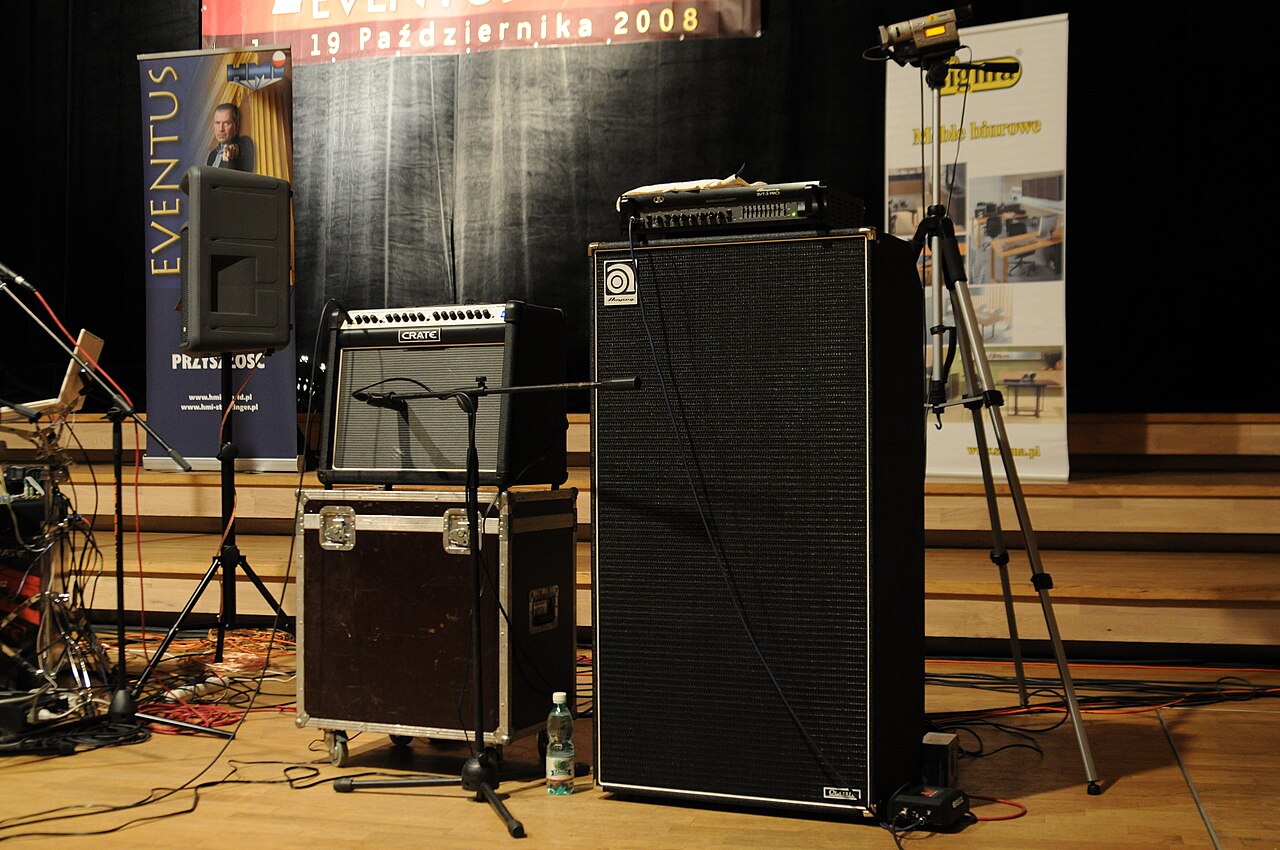
- A small band stage with amps and drums: Andy Rennie from Glasgow, Wikimedia Commons, CC BY-SA 2.0.
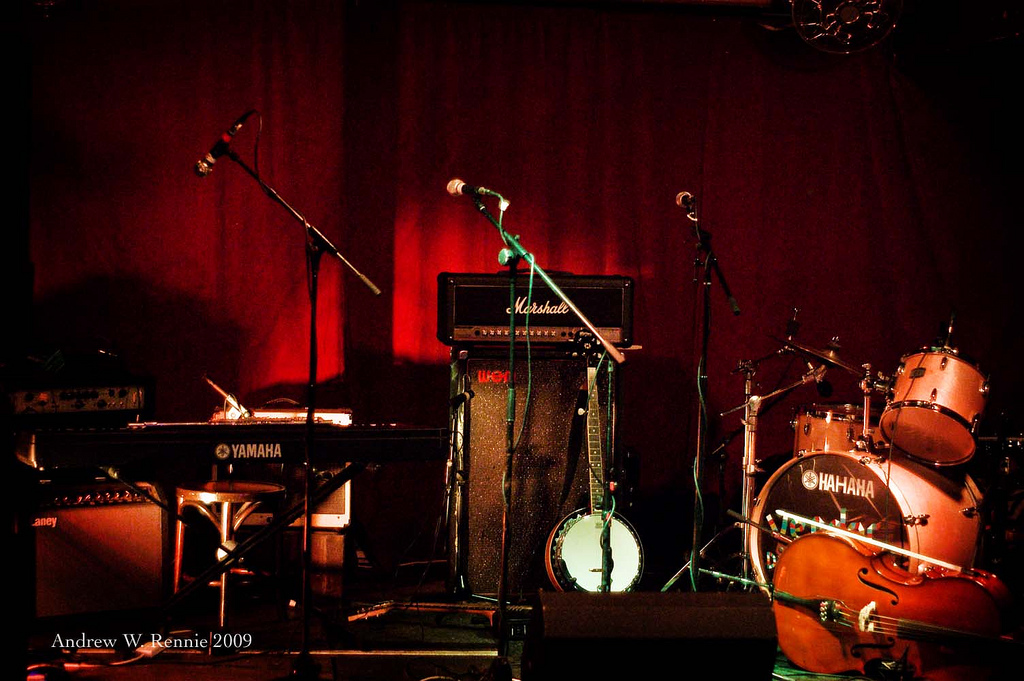
- Amplifiers and a speaker cabinet on a stage: Kuba Bożanowski from Warsaw, Poland, Wikimedia Commons, CC BY 2.0.
- Top image: GuitarGangsters AI-generated reference illustration, not a photograph.
Latest News
Related
On This Day
Monday 9 November
From this week: