The Flying Faders That Changed Everything: Chase Bliss Audio Automatone Preamp MKII
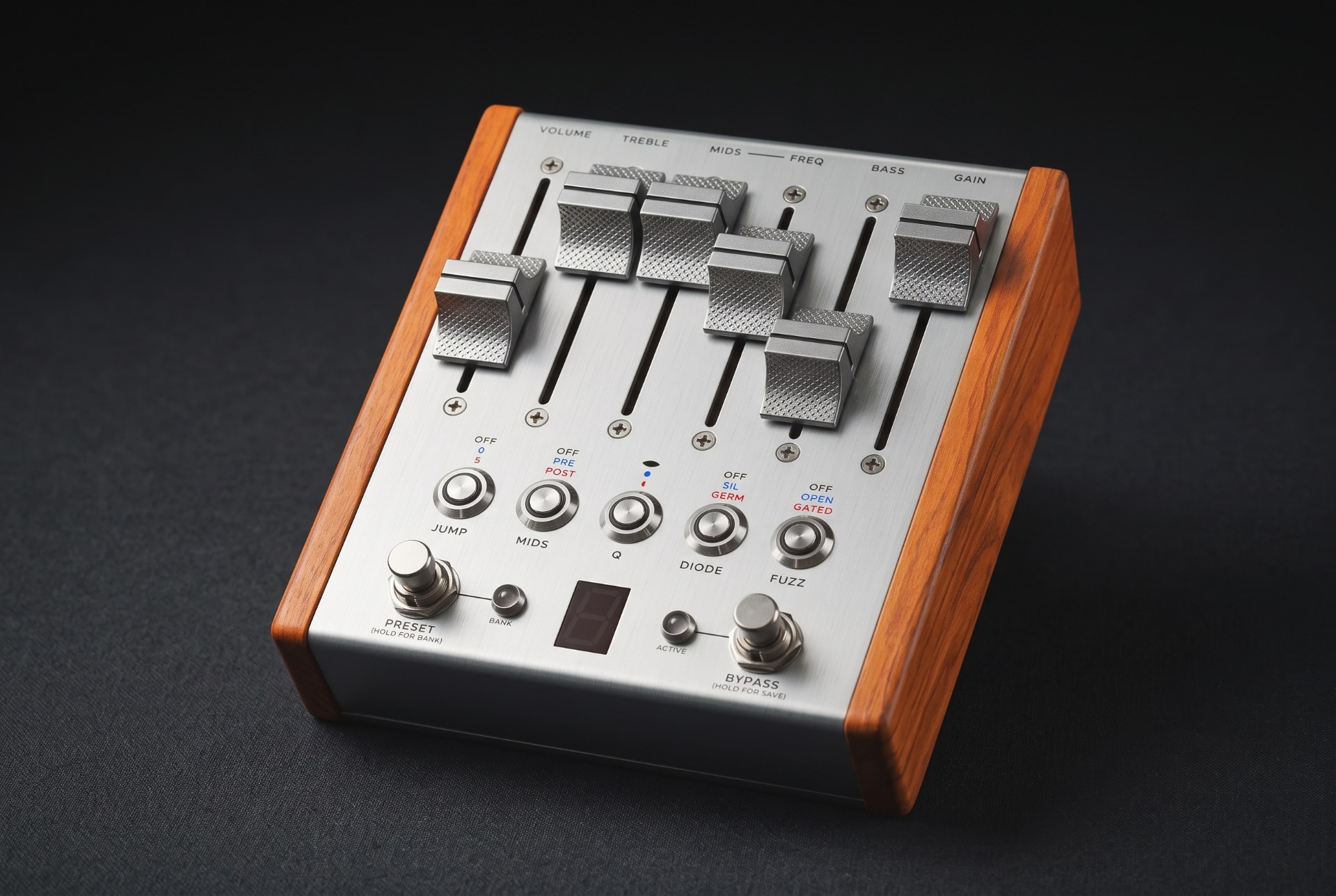
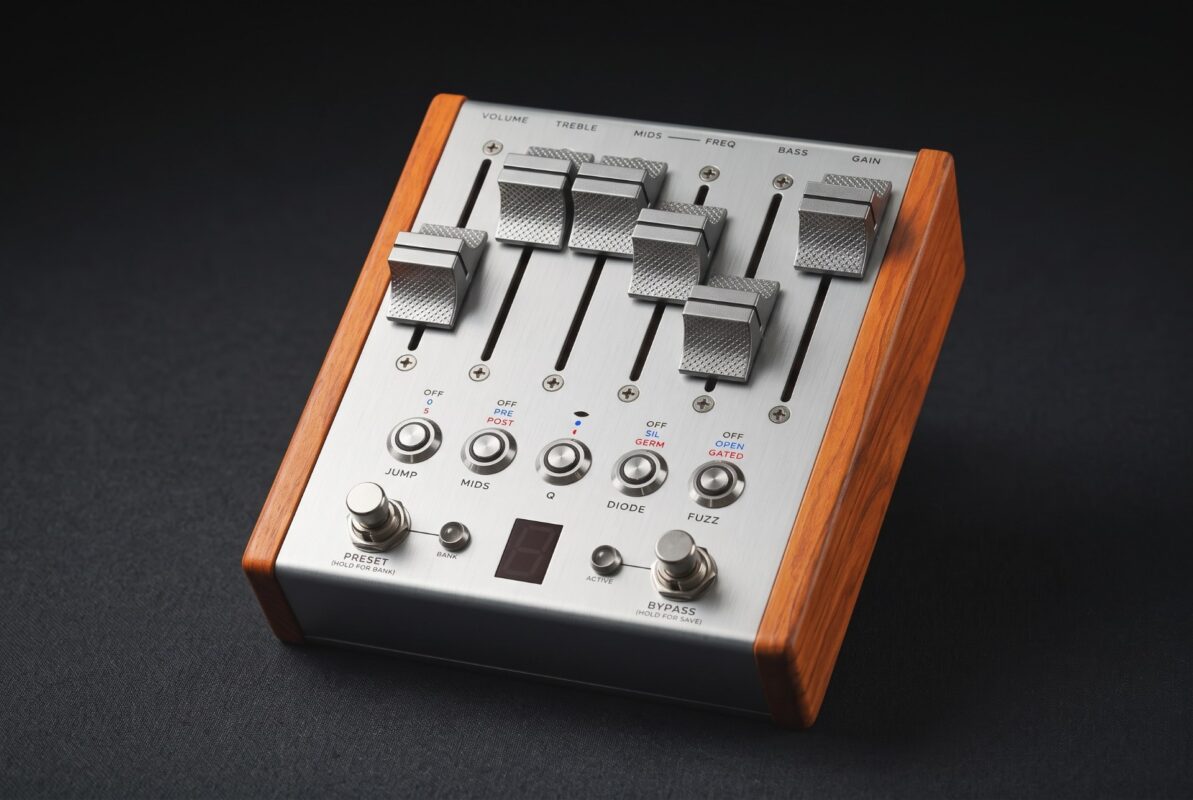
An AI-generated illustration of the Chase Bliss Audio Automatone Preamp MKII.
Benson Chimera circuit, motorized faders, dual fuzz, parametric mids. Everything you need to know about the Chase Bliss Automatone Preamp MKII.
In the summer of 2020, a pedal appeared on pedalboards that made other players stop mid-soundcheck and ask what the hell it was. Not because of its sound — though the sound was remarkable — but because of what it did when you hit a preset switch. The faders moved. Six motorized sliders physically repositioned themselves, adjusting your volume, treble, mids, frequency, bass, and gain in real time, right in front of you. It looked like something out of a studio console from 1978. It sounded like a Benson amp — one of the most coveted boutique names in American amplification — in a box that fit on your pedalboard. The Chase Bliss Audio Automatone Preamp MKII had arrived, and nothing quite like it existed before.
This is a machine that was discontinued before most players had a chance to hear it live. It never had a single dominant famous player — no one artist defined it the way a Tube Screamer is associated with Stevie Ray Vaughan or a Big Muff with David Gilmour. Instead it became something rarer: a reference standard. When players in the boutique gear community describe what a drive pedal could be — not just what it is, but what’s possible — the Preamp MKII is the name they keep coming back to. That’s the story we’re here to tell.
Chase Bliss Audio: Grief, ZVEX, and a Brother Named Chase
To understand the Preamp MKII, you need to understand Joel Korte. He founded Chase Bliss Audio in 2013 in Anoka, Minnesota, a small city north of Minneapolis. The company’s name is not a brand construction — it carries real weight. Chase Korte, Joel’s brother, was killed in 2007 when his car was struck by a drunk driver. The name “Chase Bliss” combines his brother’s name with a phrase Chase loved: “Follow Your Bliss,” the Joseph Campbell line that means pursuing what is most alive in you regardless of practical consequences.
After Chase’s death, Joel graduated from college — electrical engineering, focused on audio applications whenever the curriculum allowed — and found himself in a job he didn’t want to be in, grieving a person he couldn’t stop thinking about. He spent the next four years at ZVEX Effects, the Minneapolis boutique house responsible for the Fuzz Factory and the Seek Wah, learning how stompboxes actually work from the inside out. By 2013, he had enough: enough technical knowledge, enough saved capital, enough of a reason. He launched Chase Bliss Audio with the Warped Vinyl, a vibrato/chorus pedal that put analog circuitry under digital microprocessor control. The tagline that emerged from that first pedal — and has governed every subsequent one — is “Digital Brain, Analog Heart.”
The phrase isn’t marketing copy. It describes a genuine architectural commitment. Every Chase Bliss pedal passes your signal through a fully analog circuit. The microcontroller, the presets, the MIDI, the DIP switches, the expression control: none of them touch the audio path. They only control the analog components — set the positions of pots, configure switching, move the faders. The signal itself stays analog from input to output. This is unusual enough in the boutique world that it deserves stating plainly: Chase Bliss achieves deep programmability without touching your guitar signal digitally. That’s the trick.
Between 2013 and 2019, Chase Bliss released a succession of pedals that built them a reputation as the most technically ambitious boutique house in the United States: the Wombtone phaser, the Gravitas tremolo, the Spectre flanger, the Tonal Recall delay, the Brothers dual overdrive, the Thermae pitch-shifting delay, the Condor analog EQ, the Dark World reverb, the Mood looper. Each one applied the digital-brain-analog-heart approach to a different effect category, each one added more depth and programmability than anything at its price tier had previously offered, and each one found its way onto the boards of players like Tycho, Ed O’Brien, and John Mayer. Nine Inch Nails, A-ha, Soul Asylum, and Radiohead all used Chase Bliss pedals on tour or in the studio.
By 2019, Joel Korte was ready to do something different. Something bigger. Something that required a collaborator.
Benson Amps and the Chimera Circuit
Christopher Benson started Benson Amps in Portland, Oregon in 2012. He had apprenticed at Verellen Amps in Seattle and run repair and modification shops at Verellen and Old Town Music in Portland before striking out on his own. His design philosophy was unusual in the boutique amp world: rather than cloning vintage Fenders or Marshalls, Benson developed original circuits inspired by classic American and British amp traditions, emphasizing touch-sensitive clean tones that break into natural harmonics as picking dynamics increase. Each Benson amp requires approximately sixteen hours of skilled labor to build. The cabinets are constructed in-house, the chassis locally fabricated in Portland, every unit hand-wired and tested by a small team.
The flagship of his line is the Chimera — a 30-watt amp whose preamp circuit sits somewhere between a Fender Tweed Deluxe and a Vox AC30, with enough character of its own that neither comparison lands cleanly. It is musical, responsive, and expensive enough that most players who want that tone can’t park one on their pedalboard.
Joel Korte and Chris Benson had been talking for a while before the Automatone project took shape. The idea was simple in concept, nightmarishly complex in execution: take the front-end preamp circuit of the Chimera tube amp — the section that shapes gain structure, voicing, and harmonic content — and translate it into a stompbox, substituting JFET transistors for the 12AX7 triode stages that give the original amp its character. Then add Chase Bliss’s full programmability infrastructure: motorized faders, 30 presets, MIDI, CV, expression control. Then add the midrange module from the Condor EQ pedal, Chase Bliss’s most technically sophisticated tone-shaping tool. Then add a dedicated fuzz circuit at the front of the signal chain.
The result was announced at NAMM in January 2019. It took another eighteen months of development to ship. The Automatone Preamp MKII reached customers in July 2020.
Specifications
| Parameter | Specification |
|---|---|
| Manufacturer | Chase Bliss Audio × Benson Amps |
| Origin | Anoka, Minnesota, USA |
| Collaboration | Portland, Oregon, USA (Benson Amps) |
| Announced | NAMM, January 2019 |
| Released | July 2020 |
| Status | Discontinued |
| Original price | $749 USD |
| Circuit architecture | All-analog signal path, digital control |
| Core preamp | Benson Chimera front-end (JFET for 12AX7 substitution) |
| Faders | 6 motorized (Volume, Treble, Mids, Frequency, Bass, Gain) |
| Fuzz circuit | Pre-preamp, two modes: Open / Gated |
| Diode clipping | Transistor only / Silicon / Asymmetrical Germanium |
| Mids section | Parametric, routable (pre or post), 3 Q settings (Narrow/Standard/Wide) |
| Presets | 30 (3 banks of 10) |
| MIDI | PC and CC |
| CV control | Yes |
| Expression control | Yes |
| I/O | Mono |
| Input impedance | 1 MΩ (preamp mode); low impedance when fuzz engaged |
| Bypass | True bypass |
| Power | 9V DC, center-negative, ~500mA (not included) |
| Dimensions | 5.75″ × 6.5″ × 2.5″ (W × L × H) |
| Used market price | ~$500–650 excellent condition (2026) |
Three Circuits in One Chassis
The Preamp MKII isn’t a single effect with extra features. It’s three separate circuits stacked in a deliberate signal flow, each with its own character and set of controls. Understanding the architecture is the key to using it well.
The Preamp
This is the core of the pedal — the Benson Chimera front-end, translated from tubes to FETs. A JFET (junction field-effect transistor) behaves more like a triode vacuum tube than any other solid-state component: high input impedance, voltage-controlled gain, smooth soft-clipping characteristics, and a bias point that shifts with signal level in a way that produces natural dynamic compression and harmonic generation. Benson and Korte spent considerable time tuning the JFET bias points to match the feel of the original tube circuit rather than just its transfer function.
The Gain fader controls how hard you’re driving the preamp input. Low gain gives you a clean, harmonically rich platform — the pedal as a transparent preamp or buffer with tonal color. Push the gain up and you get breakup that starts asymmetric, becomes increasingly saturated, and never collapses into a hard-clipped wall. The Volume fader sets output level independently. Treble and Bass work as shelving controls. This is a Benson amp in terms of voicing: the low end is tight and articulate, the high end has chime rather than harshness, and the sweet spot for natural breakup sits somewhere between a Tweed Deluxe and a top-boost AC30 — a frequency range where chords ring open and single notes sustain with harmonic complexity.
The Diodes
The Preamp MKII gives you three clipping options for the preamp section. Transistor-only gives you the most dynamic, amp-like result: the signal clips in the JFET stages themselves, and the character tracks your picking attack closely. You can go from clean to crunch to full breakup within a single phrase by varying how hard you hit the strings. This is the most Benson-like setting.
Add Silicon diodes and you introduce a harder knee in the clipping curve — more compression, more sustain, more of the texture you associate with quality overdrive pedals. The frequency content shifts slightly toward the classic mid-pushed drive sound. Asymmetrical Germanium diodes give you a different flavor: softer even-order harmonics, a slight warmth in the upper mids, and an asymmetry in the clipping waveform that translates to a richer, more complex harmonic content. Players who grew up loving germanium fuzz and vintage germanium transistor circuits will recognize it immediately.

The Fuzz
The fuzz circuit sits at the very front of the signal path — before the preamp — which is exactly where a fuzz should sit. Fuzzes were designed to be the first thing in a signal chain, interacting directly with the guitar’s pickups and tone circuit. When you buffer a fuzz, you change its character; when you run it after other gain stages, you lose the interaction that gives it life. Chase Bliss built the Preamp MKII’s fuzz section correctly.
There are two modes. Open is classic, powerful, and massive — the kind of fuzz that fills a room at low volumes and becomes a roaring, sustaining wall at stage volumes. It has the input-impedance interaction of a traditional low-impedance fuzz: put it after a buffer and the character changes noticeably. The Preamp MKII’s input impedance switches to low impedance when the fuzz is engaged, replicating the guitar-to-fuzz connection that fuzzes need. Gated is a different animal: squished, zippy, and penetrating — the compressed, staccato character you hear on recordings from the late 1960s when germanium circuits were misbehaving in productive ways. It decays fast, attacks hard, and cuts through a dense mix in a way that open fuzz cannot.
The fuzz gain, level, and gate threshold are adjustable, but you need to open the pedal to access them. Chase Bliss documented this clearly and published a video guide. It’s a deliberate design choice: these are set-and-forget parameters that define your fuzz character, not something you tweak per preset.
The Mids
The parametric midrange section is borrowed directly from the Condor — Chase Bliss’s standalone EQ pedal — which established a reputation for the most musically useful midrange shaping available in stompbox format. The Mids fader sets the level of cut or boost. The Frequency fader sweeps the center frequency across the midrange spectrum. The Q control (toggled between three resonance shapes via switch) determines how wide or narrow the affected band is: Wide affects a broad swath of the midrange, Standard gives you a more surgical selection, and Narrow concentrates the cut or boost tightly around your chosen frequency.
The routing control is what makes this section genuinely powerful. You can place the mids section before or after the gain circuit. Pre-mids boosts a frequency band going into the preamp, which drives that range harder and produces asymmetric gain shaping — a mid-focused boost going into clipping rather than just added clarity on top of it. Post-mids applies the EQ to the already-processed signal, functioning more like a tone control on an amplifier. The difference is audible and significant. Players who spent years chasing specific tonal characters often find them by experimenting with mids routing in ways they couldn’t with conventional overdrive pedals.
The Motorized Faders
The visual drama of the Preamp MKII — the thing that made players stop mid-soundcheck — is the flying fader system. Six motorized sliders physically move to match the stored preset values when you change presets. You can watch your settings change in real time, see exactly where every parameter is at a glance, and reach down to manually adjust any fader while preserving the others. When you recall a preset, the faders visually confirm what’s happening to your signal. There’s no guesswork, no reading small dial positions from across a stage, no wondering whether you’re actually in the preset you think you’re in.
This isn’t just aesthetic. Expression and CV control move the faders physically when applied. Connect an expression pedal and you can sweep any combination of parameters across their range while watching the sliders track your foot movement. Automate via MIDI and you can program complex real-time changes in a DAW or MIDI controller that the pedal will execute mechanically. The faders become a kind of tactile visualization of everything happening to your signal.
The 30 presets are organized in three banks of ten, navigated via the Jump function for custom routing between presets that aren’t numerically adjacent. The pedal responds to MIDI Program Change and Control Change messages, making it fully automatable in any MIDI-equipped rig. CV control adds modular synthesis compatibility — patch an LFO from a Eurorack module and watch the faders oscillate in time.
Chase Bliss notes one practical consideration: when switching presets that involve multiple switches changing state simultaneously, brief audio interruptions can occur. The workaround — pause briefly between preset changes rather than rapid-firing them — is documented in the manual and is a minor constraint relative to the system’s capabilities.
Famous Players
The Preamp MKII never became someone’s signature sound in the way a Tube Screamer or a RAT did. The manufacturer never pursued a traditional endorsement programme around this product. What Equipboard documents is 20 professional artists, spread across rock, alternative, metal, jazz, and progressive genres — a genuinely diverse platform for a pedal that cost $749 and was discontinued within a few years of launch.
The most visually confirmed users include Andrew Bailey of DIIV, who provided a photo of his pedalboard to the DIIV Discord showing the Automatone Preamp MKII on the bottom left of his board. Joff Oddie of Wolf Alice had the pedal visible on his board in an Instagram post by @wolfaliceband, captured during a touring cycle in Ireland. Joe Langridge-Brown of Nothing But Thieves was photographed with it on his board in an Instagram post from May 22, 2026, preparing for BBC Radio 1’s Big Weekend.
Ray Toro, guitarist and co-founder of My Chemical Romance, appears on Equipboard’s list. Richie Faulkner, the lead guitarist of Judas Priest, is listed. Jason Isbell — the Alabama songwriter who makes some of the most carefully considered guitar tones in American roots music — is on the list. Sam Fender, the Newcastle singer-guitarist known for his Springsteen-indebted anthems and meticulous live sound, is listed. Joey Landreth, son of Sonny Landreth and an accomplished lap-steel and fingerstyle guitarist in his own right, is documented on the pedal. Tosin Abasi of Animals as Leaders — a player whose technical demands on signal chains are among the most extreme in contemporary guitar — appears on the list. Julien Baker, who verified her Chase Bliss connection through the Zoia, is listed here as well.
The honest framing is that Equipboard’s artist database is a secondary source — it aggregates photo evidence, forum posts, interview quotes, and community contributions rather than direct manufacturer claims. The level of photo verification varies. What the list does reliably communicate is that this pedal attracted players with genuinely diverse needs: alt-rock, heavy metal, singer-songwriter, instrumental, and ambient contexts all appear. No single genre owns it, which is consistent with a pedal built around the idea of parameter space rather than a fixed tonal character.
Notable Chase Bliss users from other models — Tycho (multiple CBA pedals), Ed O’Brien (Tonal Recall RKM), John Mayer (Tonal Recall, Warped Vinyl) — are associated with other pedals in the range and cannot be placed on the Preamp MKII without specific documentation. They are not claimed here.
Tone Recipes and Settings
1. Chimera Clean Boost
Set Gain low (30%), Treble at 60%, Bass at 50%, Volume to taste. Diodes set to Transistor only. Mids section set to a subtle boost (+3dB) around 1.2kHz, post-preamp routing, Standard Q. No fuzz. This is the Benson preamp as a transparent flavor enhancer — the way a great amp’s front end shapes a clean signal before it gets loud. Use this before a tube amplifier’s clean channel to add harmonic complexity without adding gain. The faders will sit in a satisfying mid-to-low visual cluster.
2. British Blues Crunch
Gain at 65–70%, Treble at 55%, Bass at 45%, Volume matched to bypass level. Diodes set to Silicon. Mids: +4dB at 800Hz, Wide Q, pre-preamp routing. No fuzz. This is the setting that puts the Preamp MKII in direct sonic competition with the best medium-gain overdrive pedals on the market. The Silicon diodes push the knee of the clipping curve toward a harder, more defined breakup; the pre-mids routing drives the 800Hz range harder into the gain stage, producing the nasal bark that mid-period Bluesbreakers and AC30 recordings share. For single-note lines, this setting sustains with musical compression and responds to dynamics across the whole picking range.
3. Open Fuzz + Clean Preamp
Enable fuzz, Open mode. Set fuzz gain at its factory level (internal trim). Preamp Gain at 20–25%, Transistor-only diodes, Treble at 50%, Bass at 40%, Volume set slightly above bypass. Mids bypassed. This setting uses the fuzz as the primary gain source and the preamp as a tone-shaping clean buffer after it. The Chimera preamp’s high-input-impedance character (switched to low-Z automatically when fuzz engages) ensures the fuzz sees a guitar-direct interaction. You get the organic, responsive breakup of a classic fuzz circuit with the tonal definition of the Benson preamp cleaning up behind it.
4. Gated Fuzz Lead
Enable fuzz, Gated mode. Preamp Gain at 50%, Silicon diodes. Mids: +5dB at 2.2kHz, Narrow Q, post-preamp routing. Treble at 65%, Bass at 35%. Volume boosted slightly for lead application. This setting produces the compressed, staccato fuzz character you hear on late-1960s recordings and modern post-rock and math-rock where staccato attack and fast decay are more expressive than sustained sustain. The narrow high-mid boost post-preamp cuts through dense band mixes. The gated fuzz stops immediately when you stop playing — silence between phrases is complete, not noisy.
5. Studio Reference Preamp (DI Application)
Gain at 40–55%, Transistor-only diodes, Treble at 55%, Bass at 50%, Volume balanced carefully to recording chain. Mids: slight cut of -2dB at 400Hz, Standard Q, post-preamp, to remove boxy build-up in the low-mids that all cabinet-less DI sources exhibit. No fuzz. Feed the output directly into an audio interface. This application was explicitly part of the design discussion around the Automatone line: the Benson Chimera preamp as a studio DI voicing that gives recorded direct guitar the harmonic complexity and dynamic response of a properly miked amplifier. Used this way, the Preamp MKII competes not with other drive pedals but with preamp DI units costing two to four times as much.
Comparisons
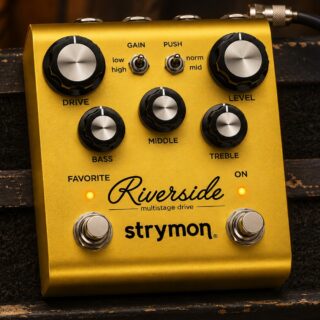
The Preamp MKII shares a philosophical category with several pedals in this series. The Strymon Iridium is the other Benson-amp-in-a-box contender — though where the Preamp MKII is an analog preamp with digital control, the Iridium is a fully digital amp model with IR cabinet loading and three amp characters. The Iridium is the tool for players who want a complete amp replacement including speaker simulation and multiple voicings; the Preamp MKII is for players who want a single, deeply characterized analog preamp front-end they can drive into their own amp or interface. They are not competing for the same use case.
The Eventide H90 and Empress Effects Zoia occupy the processing end of the signal chain that the Preamp MKII feeds. They’re peers in ambition and boutique pricing rather than direct competitors.
The JHS Colour Box V2 is the most direct competitor in concept: a preamp-and-DI pedal based on a vintage console preamp (the Neve 1073), mono I/O, boutique build quality, aimed at studio-quality DI tone. The Colour Box V2 is significantly simpler — three knobs, no presets, no motorized faders — and costs around $200 less. For players who want a fixed, great-sounding preamp DI and don’t need programmability, the Colour Box is the easier tool. For players who need recall across multiple different tones within a set, the Preamp MKII’s preset system makes it a different category of instrument.
The JHS Clover is a simpler preamp-and-EQ pedal at a lower price point, designed for players who want studio-quality tone-shaping without boutique complexity.
For players considering the broader amp-modelling world, the Line 6 Helix, Neural DSP Quad Cortex, Kemper Profiler, and Fractal Audio Axe-Fx III offer hundreds of amp models with cabinet simulation, at various price points and with digital signal paths. The Preamp MKII’s answer to all of those is simple: its signal path is fully analog. Some players consider that non-negotiable; others consider it irrelevant. Both positions are defensible.
Buying Guide
The Preamp MKII is discontinued. Chase Bliss Audio confirmed this on their website, where the product page now notes “Preamp MKII has been discontinued and is no longer for sale.” Stock the company holds has sold through. Your only sources are the used market.
Reverb.com is the primary venue. Excellent-condition units with original packaging, manual, and Fadershield (the protective cover for the motorized faders) trade in the $500–650 range as of 2026. Units without the Fadershield trade slightly lower. The Fadershield is a significant consideration: the motorized fader mechanism is the Preamp MKII’s most fragile component. Sliders exposed to aggressive gigging, dropped pedals, or impacts on the fader housing can develop mechanical problems that Chase Bliss Audio’s repair shop can address but that add cost and turnaround time. Always ask for photos of the faders from a seller before buying — each slider should sit flush with the housing, and the fader cap material should be intact.
Power requirements are strict: 9V DC, center-negative, minimum 500mA. This is higher current draw than the majority of standard drive pedals and more than most entry-level pedalboard power supplies provide on a single output. The Cioks DC7, Strymon Zuma, or Truetone CS12 all handle it comfortably. Using an undersized power supply — or incorrectly polarity-reversed supply — can cause damage the manual describes plainly as “you fried it.” Check your power supply before plugging in.
The low-impedance fuzz input matters for how you position the pedal in your signal chain. When fuzz is engaged, the pedal wants to be the first thing after your guitar — no buffers, no other high-output-impedance pedals in front of it. When fuzz is off, the 1 MΩ input impedance is buffer-friendly and chain-flexible. If your board runs a buffer at the front, be aware of this interaction and test with fuzz engaged before finalizing your signal chain layout.
Chase Bliss published a PDF manual and a separate MIDI manual, both of which remain available from their website and widely mirrored in the community. The MIDI implementation is comprehensive and documented clearly — if you want to automate the Preamp MKII from a DAW, a MIDI controller, or an expression-heavy live rig, the documentation supports it.
Ownership Notes
The motorized faders require some care. Don’t put a heavy pedal on top of the Preamp MKII in a bag — fader caps can be bent or broken. The Fadershield is a worthwhile investment if you find one without it; they occasionally appear on Reverb separately. If a fader feels sticky or sluggish, Chase Bliss Audio’s support documentation has guidance before the problem becomes a repair.
Preset switching with the Jump function enables custom preset navigation — you can map a preset change to jump to a non-sequential bank and position. This is worth configuring during initial setup: the default sequential stepping through 30 presets is impractical live, but a properly mapped Jump setup makes the pedal as fast as a multi-switch rig. Read the MIDI manual section on preset management before writing off the preset system as too complex. The complexity has structure to it.
The pedal’s internal fuzz trims — gain, level, gate threshold — are accessible by removing four screws from the bottom panel. Chase Bliss published a video guide. The adjustment range is meaningful: the factory settings are a moderate starting point, and both a cleaner, lower-gain fuzz setting and a more extreme, higher-gain setting are available within the trim range. Worth exploring once you’re comfortable with the pedal’s standard controls.
For studio use: the Preamp MKII’s true bypass means that in bypass mode, your signal passes through unaltered. This is relevant when tracking: you can keep the pedal in bypass while setting recording levels, engage it when tracking begins, and trust that the bypass and engaged signals are genuinely separated rather than blended by a buffered bypass circuit.
Frequently Asked Questions
Is the Chase Bliss Automatone Preamp MKII discontinued?
Yes, Chase Bliss Audio discontinued the Preamp MKII and it is no longer in production. Their product page states this directly. The used market through Reverb.com is the only current source. Pricing has stabilized in the $500–650 range for excellent-condition examples with original accessories.
What makes it different from a normal overdrive pedal?
Three things. First, the preamp circuit is derived from a real amplifier — the Benson Chimera — rather than being a drive topology designed from scratch as a pedal. You’re getting an amp front-end in a box, with the voicing decisions that Benson Amps spent years developing. Second, the motorized faders give you visual and tactile feedback on every parameter’s position, with 30 recallable presets accessible via MIDI, CV, and expression. Third, the integrated parametric mids section with routable placement — before or after the gain circuit — gives you a level of tonal sculpting that no conventional overdrive offers.
What is the Automatone series?
The Automatone is Chase Bliss Audio’s larger-format pedal line, introduced in 2020 starting with the Preamp MKII. The format replaces the standard Chase Bliss knob-and-DIP-switch layout with motorized sliders (flying faders) that physically respond to preset changes and external control. It represents a different design philosophy: instead of encoding complex parameter states invisibly in preset memory, the Automatone makes every parameter’s value physically visible at all times. The Preamp MKII was the first Automatone product. A second Automatone — the CXM 1978 reverb, a collaboration with Meris — followed and remains available.
Can I use the Preamp MKII as a studio DI?
Yes, and this is one of its strongest applications. The Benson Chimera preamp circuit adds the harmonic content and dynamic response of an amplifier front-end to a direct signal. Run the output into a DI box or directly into a high-impedance instrument input on your interface, and the recorded signal has the kind of character that typically requires a miked cabinet to achieve. The parametric mids section lets you trim the cabinet-less sound by cutting the low-mid boxy buildup that DI guitar signals typically exhibit. This use case is documented in Chase Bliss’s own materials.
What power supply does it need?
9V DC, center-negative, minimum 500mA. The power supply is not included. This is a higher current draw than most standard stompboxes — ensure your pedalboard power supply has an isolated output rated for at least 500mA. Using a daisy-chained or undersized supply risks damage. Recommended supplies: Cioks DC7, Strymon Zuma, Truetone CS12, or equivalent isolated high-current outputs. The polarity is standard center-negative — the same as most pedals — but the current requirement distinguishes it from average board supplies.
Why does the fuzz behave differently when there’s a buffer before it?
The Preamp MKII’s fuzz is a low-input-impedance circuit — the same class as germanium and silicon fuzz designs from the 1960s that require a direct guitar connection. When a buffer precedes these fuzzes, the buffer’s low output impedance interacts with the fuzz’s low input impedance in a way that reduces the dynamic character and changes the clipping behavior. Chase Bliss solves this by automatically switching the Preamp MKII’s input impedance to low when fuzz is engaged, replicating the guitar-direct interface that the fuzz circuit expects. The pedal still responds to buffers placed before it, but the interaction is managed within the design rather than left as a problem for the player to solve.
How does it compare to the original Benson Preamp pedal?
Benson Amps makes its own Preamp Pedal — an FET-based stompbox voiced after the Chimera, without the motorized faders, MIDI, CV, expression control, preset system, fuzz circuit, or parametric mids. The Benson Preamp Pedal is simpler and costs significantly less. If you want the Chimera tone without the Chase Bliss control infrastructure, the Benson Preamp Pedal is the direct answer. The Preamp MKII is for players who need that tone plus deep programmability — who want to store twenty-nine other Chimera-derived sounds alongside it and recall any of them instantly, with full MIDI automation support.
Is the signal path truly analog?
Yes. The Preamp MKII’s signal path is fully analog from input to output. The digital microprocessor controls the faders, switches, and routing components but does not process the audio signal. This is the foundational design commitment of all Chase Bliss Audio products — “Digital Brain, Analog Heart” — and the Preamp MKII applies it to a larger, more complex system than any previous Chase Bliss pedal. Your guitar signal passes through JFET transistors, through the Benson Chimera preamp topology, through analog clipping components, through the analog parametric EQ, and out to your amplifier or interface without at any point being converted to digital.
Image credits
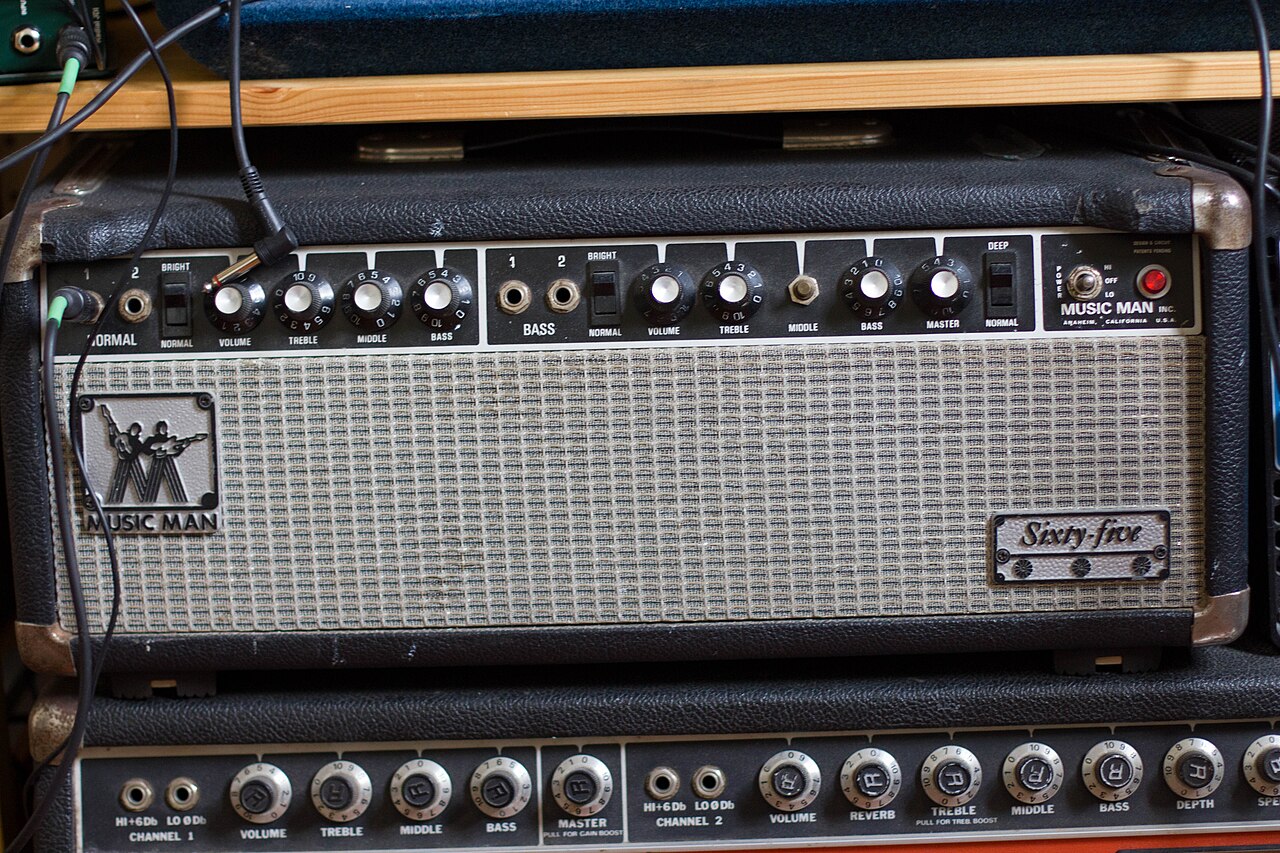
- A tube amp head: David Hilowitz from San Antonio, USA, Wikimedia Commons, CC BY 2.0.
- A band playing outdoors with an orange amp: Fekist, Wikimedia Commons, CC BY-SA 4.0.
- Control knobs and switches on an amplifier: Shixart1985, Wikimedia Commons, CC BY 2.0.
- Top image: GuitarGangsters AI-generated reference illustration, not a photograph.
- Chase Bliss Audio Automatone Preamp MKII: AI-generated illustration by GuitarGangsters, based on the manufacturer’s product design (not a photograph).
Latest News
Related
On This Day
Monday 9 November
From this week: