Chase Bliss Thermae: The Analog Delay That Learned to Sing — and Then Got Legislated Out of Existence
Chase Bliss Thermae: four MN3005 chips, a sequencer, 32-second delays. Full specs, verified players, tone recipes and honest used-buying advice.
There is a particular kind of pedal that arrives, rearranges what a category is allowed to mean, and then quietly disappears. The Chase Bliss Thermae is one of those. It was an analog delay built around four reissued MN3005 bucket-brigade chips — the same class of component that made the Boss DM-2 and the Deluxe Memory Man sound the way they do — except Joel Korte put a microcontroller in charge of the delay time and told it to move in musical intervals. The result was not a delay with a pitch shifter bolted on. It was a delay whose pitch shifting was the delay, because on a bucket-brigade chip those are the same physical event.
Chase Bliss called it an “Analog Timeshifter.” Premier Guitar’s Joe Gore, reviewing it in October 2018, called it a “brilliant bastardization” that “boldly goes where no analog delay has gone before.” Both descriptions are accurate, and neither quite prepares you for the experience of playing one note and hearing the pedal build a three-step melody out of it while the repeats slowly turn into weather.
And then, in August 2024, Chase Bliss discontinued it — not because it stopped selling, and not because the company lost interest, but because the light-dependent resistors inside it contain cadmium sulphide, and the EU and UK exemption that permitted CdS photoresistors in audio applications expired. The Thermae is now a finite object. That fact changes how you should think about buying one, and it is the reason this article exists in the form it does.
This is a feature, not a review. What follows is where the Thermae came from, what is actually happening inside it, who has been genuinely documented playing one, how to set it up, and what to know before you buy a discontinued pedal on the used market.
The Origin: A Bath House, Four Chips, and a Company Motto
Chase Bliss Audio’s motto is “digital brain, analog heart,” and no pedal in the catalogue argues the case more literally than the Thermae. Joel Korte founded the company in Minneapolis and built its reputation on a specific and slightly perverse idea: take a purely analog signal path, then hand every parameter to a microcontroller, and give the player MIDI, CV, expression, presets and internal modulation over circuitry that was never designed to receive any of it.
The Thermae, released in 2018, is the fullest expression of that idea. Its signal path is entirely analog — four reissued MN3005 bucket-brigade delay chips, the same architecture that defined 1970s and early-’80s echo. What the digital side does is not process the audio. It manipulates the clock that drives those chips, in precise musical increments.
Why the Name
Thermae were Roman public bath houses. Chase Bliss named the pedal after one and then, in a gesture that tells you a lot about the company’s sense of humour, went and filmed a mini documentary in an actual bath house to explain the choice. The manual signs off with “Dry off, get some rest.” The metaphor is not decorative: the pedal’s core behaviour is immersion — you put a note in and it comes back warmer, softer, less distinct, and eventually unrecognisable.
The Manual That Tells You Not To Read It
Joe Gore flagged something in his review that has become a small piece of pedal folklore: the Thermae manual may be the first piece of gear documentation to use the acronym TLDR about itself. Korte urged users to skip the manual and instead watch a demo by Knobs, the effects and modular-synth demo artist who collaborated with Chase Bliss on the pedal’s presentation. Gore’s verdict: “It’s good advice.”
It is also a genuine tell about the pedal’s design philosophy. The 2022 manual runs 51 pages and includes a page headed “Intermission / Caution” that literally warns you before it goes deeper: “A little mystery is nice sometimes, and your ears know what they like.” A manual that tells you it is optional is a manual for a device that rewards experimentation over comprehension.
Time Shifting 101: What Is Actually Happening
This is the concept the whole pedal rests on, and it is worth getting right, because it explains every strange behaviour the Thermae exhibits.
A bucket-brigade chip creates an echo by passing your signal through a long chain of capacitors, one stage per clock tick. Change the clock rate and you change the delay time. But the audio already sitting inside the chain gets sped up or slowed down along with it — the same way dragging your finger on a record changes pitch. Anyone who has swept the time knob on an analog delay while repeats were ringing knows this sound. David Byrne made it a signature move in Talking Heads’ Stop Making Sense. Until 2018 it was a happy accident.
The Thermae makes it deliberate. It changes delay time by exact ratios, so the pitch shifts land on real musical intervals — fourths, fifths, octaves, up to two octaves in either direction. And because pitch and delay time are the same parameter, every interval carries its own texture with it:
- Shift down and you slow the chips. The repeats get further apart, grittier, noisier, more degraded.
- Shift up and you speed them up. The repeats get tighter, cleaner, clearer, more bell-like.
Chase Bliss describes this as “a sequence with built-in variance.” Every step in a Thermae melody has a different pitch, a different rhythmic spacing and a different fidelity, all at once, without you doing anything. No conventional pitch shifter — not a DigiTech Whammy, not an EHX Pitch Fork, not a POG2 — behaves this way, because they all shift pitch without touching time.
The Invisible Interval
Here is the detail that confuses most new owners, and the manual devotes two pages to it. The Thermae has two interval knobs, INT 1 and INT 2. But the sequence has three steps, because after running through both intervals it always returns to the base delay time set by tap tempo. That return is itself a pitch shift.
Set both intervals to drop an octave, and the pedal must jump two octaves up to get back to base. You programmed only downward motion and the pedal is throwing high notes at you. That is not a fault. It is the base step doing its job, and once you understand it you can compose with it.
Stacking
The second interval is relative to the first, not to the base. Set both to a fifth down and you do not get two identical steps — you get a fifth down, then another fifth down from there, and then an octave-and-a-second leap back to base. That final interval is one you could not dial in directly. Stacking is how you reach beyond the pedal’s nominal range, and it is the reason two knobs with identical settings can produce a lopsided, asymmetric melody.
Regeneration Changes the Harmony
With REGEN at minimum, each note gets shifted once. Turn REGEN up and the same note is fed back through and shifted again on the next step, and again after that. Older repeats have travelled further than newer ones, so the echo tail becomes a stack of different intervals sounding simultaneously. Chase Bliss are blunt about the trade-off: for tight, harmonious sequences, keep REGEN down; for rich and complex results, turn it up and accept the dissonance.
Specifications
The Controls, One by One
MIX
Balance between dry and delayed signal, exactly as you would expect — until you engage ramping, at which point this knob stops being a mix control and becomes the speed control for the automated movement. That dual purpose catches people out. If your mix knob has stopped doing anything sensible, check whether a ramp dip switch is on.
LPF
A resonant low-pass filter on the repeats, with an audible bump at the cutoff frequency. Fully clockwise lets the noise and artefacts pour through; roll it back and the tail mellows into something closer to tape. It is highly interactive with REGEN — the two together determine whether the pedal sits, sings or screams.
REGEN
Feedback. Set carefully it repeats almost indefinitely; a hair further and it self-oscillates. As covered above, it also determines how many times a single note gets pitch shifted, which makes it a harmonic control as much as a decay control.
GLIDE
Portamento between steps. At minimum, transitions are instant. Turn it up and the pedal slurs between intervals. At high settings the glide may not finish before the sequencer moves on, producing what the manual charmingly calls “a bendy soup that never quite reaches the intended destination before being redirected elsewhere.” This is one of the best knobs on the pedal and the one most responsible for its liquid, seasick character.
INT 1 and INT 2
The interval knobs. Counter-clockwise shifts down (slower, grittier, wider), clockwise shifts up (faster, cleaner, tighter). Noon is off — set both to noon and the Thermae becomes a straightforward analog delay. With the Modulation dip switch engaged, these two knobs become Speed and Depth for the modulation section instead.
The Step-Length Toggles
Three toggles, one per step, each offering quarter note, dotted eighth or eighth. The dotted eighth setting is there specifically to add swing and crookedness. These are the rhythmic composition tools — you can leave the intervals alone and completely rebuild a sequence just by moving these. When both intervals are off, the leftmost toggle reverts to a plain tap-tempo subdivision switch.
The Footswitches
Left is bypass; holding it triggers a momentary blast of runaway oscillation, as though REGEN were slammed clockwise. Right is tap tempo in sequencer mode and step advance in Step mode. Holding both engages Slowdown Mode, halving the sequence speed while keeping the delay time — the tap LED turns green to confirm. That is a genuinely clever feature: it lets you tap in a fast, clean delay time and still sequence at a slow, deliberate pace.
The Four Mode DIP Switches
- Trails — repeats fade naturally after bypass, and the pedal switches to buffered bypass. Note the warning in the manual: with Trails on, the Thermae will keep self-oscillating even when bypassed.
- MoToByp — momentary bypass. The effect is only live while you hold the switch down.
- Step — pauses the internal sequencer so you advance manually with the left footswitch.
- Modulation — repurposes INT 1, INT 2 and their toggles as a nine-flavour pitch modulation section.
All dip switch settings are saved with presets, which is the single most useful thing to know when programming the two preset slots.
Famous Players: What Holds Up
There is no arena-headliner Thermae anthem. What there is instead is a very specific kind of player: the texturalist with a large, MIDI-switched board and a taste for controlled accidents.
Ariel Posen — Confirmed, January 2023
Posen’s Rig Rundown, filmed by Chris Kies at Nashville’s Basement East and published 11 January 2023, lists the Thermae explicitly among the additions to his board. The company it keeps is instructive: a TC Electronic PolyTune 3 Noir, a Morningstar MC3 MIDI controller, an Eventide H9, a Mythos Argonaut Mini Octave Up, a KingTone miniFUZZ Ge, a custom Keeley Hydra with Headway artwork, an Old Blood Noise Endeavors Black Fountain oil can delay, and the KingTone Duellist that Posen calls his most-used pedal.
Posen plays slide on a steel-bodied Mule Resophonic baritone with .017–.064 strings, usually in B standard, and a Fender Custom Shop Masterbuilt ’60s Jazzmaster with the treble bleed removed so the guitar warms up as you roll back. Everything about that setup — heavy strings, low tunings, a slide, a Two-Rock run “clean and loud” — describes a player who needs an effect that adds motion without adding attack. The Thermae, which has no transient of its own, fits that brief exactly.
Joey Landreth — Confirmed, June 2023
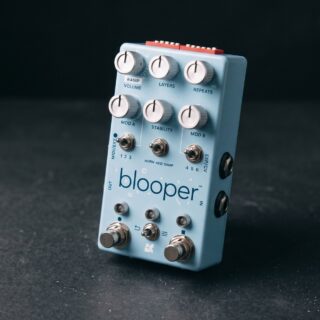
The strongest single case, because Landreth does not own one Chase Bliss pedal, he owns six. John Bohlinger’s Rig Rundown, published 13 June 2023 ahead of a Bros. Landreth show at Nashville’s Riverside Revival, documents an all-wet loop containing an Empress Echosystem, the Thermae, a Chase Bliss Blooper, a Chase Bliss MOOD MkII, a Chase Bliss Generation Loss and a Chase Bliss CXM 1978 — with a Chase Bliss Condor elsewhere on the board, its expression input fed by a Shnobel Tone VPJR tuner mod.
The routing is worth describing because it explains what a Thermae is for at the professional end. Everything goes into a GigRig G3; the wet effects all run into a Morningstar ML10X under the board, which allows per-preset custom routing and lets Landreth collapse all wet effects into a single stereo loop. That loop hits a GFI Duophony acting as a parallel mixer with per-loop gain, which Landreth uses as a master wet volume on an expression roller he built himself. Three amps: a signature Two-Rock carrying only the dry signal, and two Two-Rock Studio Signatures carrying only wet.
In other words, the Thermae never touches Landreth’s dry tone at all. It is a parallel sound-design device with its own volume ride. That is arguably the single best way to run this pedal, and it comes from a player who has clearly thought about it harder than most. (A note to head off a common mix-up: Joey Landreth is a Winnipeg-born slide player and no relation to Louisiana’s Sonny Landreth, who does not use one.)
Dave Harrington (Darkside) — Confirmed, April 2025
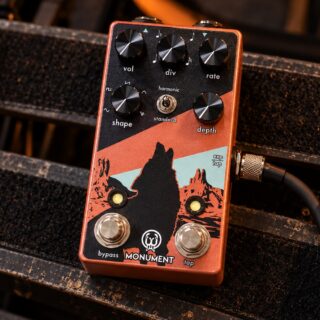
The most recent sighting, and the one that places the Thermae in genuinely experimental territory. Chris Kies filmed Harrington at Nashville’s Brooklyn Bowl on the tour behind Darkside’s Nothing, published 23 April 2025. His floor board alone: a Chase Bliss Habit, Mu-Tron Micro-Tron IV, Eventide PitchFactor, Eventide H90, Hologram Microcosm, Hologram Chroma Console, Walrus Monument, the Thermae, Chase Bliss Brothers AM, JHS NOTAKLÖN, two HexeFX reVOLVERs and an Amped Innovations JJJ Special Harmonics Extender, powered by a Strymon Ojai.
A hip-level second board adds a ZVEX Mastotron, EHX Cathedral, EHX Pitch Fork, Xotic EP Booster, two EHX 45000 loopers, a Walrus Slöer, an Expedition Electronics 60 Second Deluxe and a second Microcosm. Underneath sits the Line 6 DL4 that Harrington calls his desert-island pedal, controlled by a knob his tech installed behind the bridge of a mid-2000s Gibson SG. Three Fender amps, each carrying one signal so loops and live playing never fight for frequency space. Harrington’s own summary of his approach — he never gives up on a pedal — is why the board looks like that.
What Does Not Hold Up
A widely repeated claim links Wes Borland to the Thermae, sourced to an Instagram post via gear-aggregator listings. That may well be true, but a social post surfaced through an aggregator is not the same standard of evidence as a photographed, dated, print-published board, and this article will not treat it as such.
Similarly, the Thermae is frequently discussed in the lineage of delay-as-instrument playing — The Edge‘s rhythmic dotted-eighth architecture, Jonny Greenwood‘s use of delay as compositional material, David Byrne’s time-knob abuse in Stop Making Sense. Those are references for what the Thermae is descended from conceptually. None of those three players uses one. Lineage is not usership, and conflating the two is the most common failure mode in gear writing.
Eight Tone Recipes
1. Friendly Fifths (the safe starting point)
INT 1 to a fifth down, INT 2 off, REGEN at minimum, MIX around 40 percent, LPF at two o’clock, GLIDE off. A clean two-step alternation between your note and a fifth below. Chase Bliss themselves call this the pedal’s most agreeable sequencing setting, and it is the one to use when you want the Thermae to be musical rather than interesting.
2. Birdfeeder
INT 1 an octave down, INT 2 an octave up, REGEN around eleven o’clock. A playful three-step figure that, with REGEN up, turns into an ascending chorus of chirps. Genuinely usable in a song, not just a demo trick.
3. Call and Response
Both intervals an octave down, REGEN low to moderate, step lengths mixed. The sequence descends into textural abstraction, then snaps back up on the base step. Play a phrase, wait for the pedal to answer, play the next one. This is the setting that makes the Thermae feel like a duet partner rather than an effect.
4. Decimator
Step mode on, INT 1 two octaves down, INT 2 two octaves down again, LPF fairly open. Stacked downward shifting into a churning mass of analog degradation. The correct way to use this is sparingly: sit on the base step for normal delay during the song, then stomp down into the collapse to end it.
5. Hackertronics
Step mode, both intervals an octave down, REGEN parked at the exact point just before oscillation. Find that spot and your notes neither fade nor blow up — they hang there degrading gently, and each step press stretches the loop further out. A looping delay that is slowly dying. Add GLIDE for the melting version.
6. Running Water
Step mode, both intervals an octave up, LPF fully clockwise, fast tap tempo. Pushing the BBDs faster than they were built for produces sounds somewhere between birdsong, dial-up modem and a stream. Keep the LPF open — rolling it back filters the whole effect away.
7. Rolling Clouds (ramping)
Both intervals off, MIX cranked before engaging the dip switches, REGEN at minimum, very fast tap tempo, then Bounce assigned to LPF. You now have a real-time modulated resonant filter that has nothing to do with delay at all. The Thermae as a filter pedal is one of its most under-used identities.
8. Generative Sequencing
INT 1 to a fifth down, Bounce assigned to INT 1, ramping speed slow. The pedal continuously varies one step of its own sequence, so the figure stays recognisable but never quite repeats. Set the ramp speed too fast and it becomes chaos; slow is the whole point. This is the closest a guitar pedal gets to a generative patch.
How It Compares
Thermae vs. a conventional analog delay
Against the MXR Carbon Copy, the Boss DM-2W, the EHX Deluxe Memory Man or the Maxon AD999, the Thermae is not obviously better at being an analog delay — it is more expensive, noisier by design, and has no dedicated time knob, only tap tempo. Set both intervals to noon and it does the job perfectly well, with a genuinely lovely dark BBD voice and a resonant filter none of those pedals offer. But nobody spends $499 for that. Buy a Thermae for the sequencing; enjoy the plain delay as a bonus.
Thermae vs. Chase Bliss MOOD MkII
The closest sibling and the more common purchase. The MOOD MkII is a micro-looper and granular device — it captures and mangles fragments of what you played. The Thermae never captures anything; it operates continuously on whatever is passing through. MOOD is about recall and recontextualisation, Thermae is about transformation in real time. Joey Landreth runs both, which tells you they are not alternatives.
Thermae vs. Eventide H9 / H90
The H9 and H90 will give you clean, diatonic, key-correct harmonies and forty other algorithms besides, all editable from a phone. They are the sensible professional tools. The Thermae does one thing they cannot: it makes the pitch shift and the delay time the same gesture, so the harmony arrives with a corresponding change in grit and spacing. Both Posen and Harrington run an Eventide and a Thermae, which is the clearest possible statement that these are different jobs.
Thermae vs. a modern DSP flagship
Against a Strymon TimeLine, a Meris LVX, an Empress Echosystem, a Source Audio Collider or a Nemesis, the Thermae loses on every spec sheet metric: fewer presets, mono only, no stereo, no reverb, no screen. What it has is a physical constraint the DSP boxes lack. The MN3005 chips genuinely resist being driven to a 32-second delay time, and the sound of that resistance is the sound of the pedal. Modelled degradation is a choice; real degradation is a consequence.
Thermae vs. tape-echo emulations
El Capistan and Volante also let you warp time by hand, and Volante’s mechanics-based approach gets closer to Thermae territory than most. But those pedals model a machine that already existed. The Thermae models nothing. There has never been an analog delay that sequenced itself in intervals, so there is no reference point for whether it sounds “right.”
Thermae vs. a looper-plus-pitch rig
You can approximate some of this with a Freeze into a Whammy, or a DL4 with an expression pedal on the time parameter. Harrington, notably, does all three. The approximation gets you the sounds; it does not get you the two-footswitch, one-enclosure immediacy, and it certainly does not get you presets.
Buying Guide: The Discontinued-Pedal Problem
What actually happened
On 23 August 2024, Guitar.com reported that Chase Bliss was discontinuing five pedals — the Condor, Warped Vinyl HiFi, Thermae, Dark World and Automatone Preamp MkII — because a component inside them, the LDR (also called a vactrol), is not compliant with UK and EU market access requirements. LDRs commonly rely on cadmium sulphide, a restricted substance under RoHS. An exemption previously covered CdS in audio applications; that exemption expired.
Chase Bliss sold remaining stock in the US only, through a dedicated storefront, after which the pedals became unavailable new worldwide. The company also extended the warranty on all five to a full lifetime warranty and committed to paying postage both ways for repairs, with the stated reasoning that they want the pedals “working and making music with you, not in landfills.”
Is it dangerous?
No — and Chase Bliss addressed this directly. Cadmium sulphide is toxic, but the photoresistors containing it are sealed in an airtight plastic or epoxy package, which is itself inside a metal enclosure. The company’s position is that exposure risk is negligible and owners should continue using their pedals. This is a market-access regulation, not a product safety recall.
What that means for buying one
The original street price was $499. Used prices have generally sat below that, in a band roughly between the mid-$300s and mid-$400s, though a discontinued pedal with a cult following and a finite production run is exactly the kind of item that appreciates over time. If you have wanted one, waiting is not obviously a winning strategy.
Used checklist
- Confirm all four dip-switch modes respond. Trails, MoToByp, Step and Modulation are the four you can verify in thirty seconds, and they exercise most of the microcontroller.
- Test both presets. Save to left and right slots using the footswitch-hold procedure and confirm the middle LED blinks. Preset storage is where a failing unit will show itself.
- Check it self-oscillates. Hold the left footswitch. If the runaway oscillation is weak or absent, the most likely cause is not a fault at all — it is an underpowered supply.
- Listen for the LDR-driven behaviour. Since the vactrols are the reason the pedal was discontinued, they are also the component most worth confirming works.
- Ask for the box and any Midibox. MIDI requires a separate Chase Bliss Midibox to convert to TRS; without one you have no MIDI, no clock sync and no CC control.
- Registration and warranty. The lifetime warranty is a real asset on a discontinued pedal. Confirm with Chase Bliss support how it transfers before assuming it does.
Ownership Notes
Power is the number one support issue
The figures do not agree with each other, and both are official. The Chase Bliss spec sheet lists “9V Center Negative ~150 mA.” The manual’s own header says “~180 mA.” The FAQ then tells you to supply at least 200 mA. Premier Guitar’s review says you need at least 180 mA. Treat 200 mA as the working minimum and do not daisy-chain it. Chase Bliss’s own first FAQ answer — for “why won’t my pedal self-oscillate, or why is the wet signal quiet?” — is that the pedal is not getting enough power. Note also that this is a standard 2.1mm centre-negative supply, unlike the centre-positive Eventide Factor series.
There is no battery
There is no room for one, and as Joe Gore observed, a circuit this parts-dense would drain a 9V block in record time anyway.
“Why won’t it stop pitch shifting?”
The second most common support question, and the fix is three steps: turn the Modulation dip switch off, set INT 1 to noon, set INT 2 to noon. You now have a normal analog delay, and you can re-engage Modulation afterwards if you want. Worth knowing before you conclude something is broken.
Trails plus high REGEN is a trap
With Trails engaged, the Thermae keeps self-oscillating even when bypassed. If you leave a high REGEN setting stored in a preset and switch away from it, the pedal will happily continue screaming into your amp. The manual warns about this explicitly. Keep REGEN down in any preset you plan to bypass.
Drift and MIDI clock
The sequencer runs on tap tempo, and tap tempo drifts. For anything with a click track or a backing track, sync to MIDI clock — which needs the Midibox — or use Step mode and advance manually. Step mode is genuinely the more musical solution in a band context, because it also lets you play through changing time signatures without the pedal fighting you.
Where it goes on the board
Late, after drive, and ideally in a parallel or wet-only path if your rig supports one. Landreth’s approach — everything wet into a mixer with its own volume ride — is the gold standard. Failing that, keep MIX conservative and let the dry signal carry the song.
Frequently Asked Questions
Is the Chase Bliss Thermae analog or digital?
Both, in the specific Chase Bliss sense. The audio path is entirely analog — four reissue MN3005 bucket-brigade chips, no conversion, no DSP touching your signal. The control layer is digital: a microcontroller sets the clock rate driving those chips, which is what produces the sequencing, the intervals, the presets and the MIDI functionality. Digital brain, analog heart, as the company’s motto has it.
Why was the Thermae discontinued?
Regulatory, not commercial. The pedal contains light-dependent resistors made with cadmium sulphide, a substance restricted under UK and EU RoHS rules. The exemption that had previously allowed CdS photoresistors in audio applications expired, so Chase Bliss could no longer legally sell the pedal into those markets. Rather than maintain a US-only product, the company discontinued it — along with the Condor, Warped Vinyl HiFi, Dark World and Preamp MkII — in August 2024.
Is it safe to keep using a Thermae I already own?
Chase Bliss’s position is yes. The cadmium sulphide is inside sealed epoxy or plastic photoresistor packages, inside a metal enclosure. The company’s guidance to owners was that everyone with one of these pedals “can — and should — continue to use and enjoy it,” and it extended the warranty to lifetime with free shipping both ways for repairs.
How long can the Thermae’s delay actually get?
Up to roughly 32 seconds, but not by turning a time knob to maximum. You get there by shifting the delay time down in stacked intervals, which slows the bucket-brigade clock far past what the chips were designed for. At those settings you are no longer hearing an echo — you are hearing a heavily degraded, stretched, noisy artefact of what you played. That is the intended effect, not a malfunction.
Can the Thermae do normal analog delay?
Yes, and it is good at it. Set both INT knobs to noon and you have a dark, warm BBD delay with tap tempo, subdivisions from the leftmost toggle, a resonant low-pass filter, and trails. Chase Bliss even suggest storing this as a preset so you can get back to a plain delay instantly. You can also engage the Modulation dip switch to turn the now-idle interval knobs into chorus-style modulation controls for the repeats.
What is the difference between Sequencer mode and Step mode?
In Sequencer mode the pedal advances through its steps automatically at the tapped tempo. In Step mode — engaged via a dip switch — the sequencer pauses and you advance manually with the left footswitch. Step mode separates sequence speed from delay time, which lets you tap in short echoes but move through the steps slowly, and it eliminates tempo drift in a band setting.
Does the Thermae need a MIDI box?
For MIDI, yes. Program change, CC and clock sync all require a Chase Bliss Midibox to convert standard MIDI to the pedal’s TRS jack. CV (0–5V only — higher voltages can damage it), expression and external tap all work directly from the pedal’s own jacks with no accessory. Budget for a Midibox if clock sync matters to you, and check whether a used listing includes one.
Who actually plays a Thermae?
Three players are documented in dated, published Premier Guitar Rig Rundowns: Ariel Posen (January 2023), Joey Landreth of the Bros. Landreth (June 2023) and Dave Harrington of Darkside (April 2025). All three are texturalists running large, MIDI-managed boards, and Landreth runs his in a wet-only parallel loop alongside five other Chase Bliss pedals. There is no stadium-rock Thermae signature sound, and any list that offers you one is guessing.
Latest News
Related
On This Day
Tuesday 10 November
From this week: