Chase Bliss Audio Mood MkII: The Micro-Looper That Rewrites Time
Chase Bliss Audio Mood MkII: micro-looper specs, tone recipes, signal chain tips, and everything you need to know about this ambient pedal.
Some pedals do one thing perfectly. The Chase Bliss Audio Mood MkII does something closer to alchemy — it takes the briefest fragment of your playing, loops it before you even realize you’ve played it, and hands it back transformed through a cloud of reverb, delay, and spectral shimmer. The result sounds less like a guitar effect and more like a conversation between your instrument and some parallel-dimension version of itself.
That description sounds like marketing. But the Mood MkII has earned its reputation the hard way: through word of mouth among players who discovered that it solves a creative problem they didn’t know they had. You can dial it for near-invisible textural augmentation, or you can push it until your single-note melody becomes a shimmering ambient orchestra playing alongside you in real time. No two settings sound the same. No two performances produce the same result. That unpredictability is the point.
This is not a delay pedal. It’s not a reverb pedal. It’s not a looper in any traditional sense. The Mood MkII is its own category, and understanding what it does — and why it does it — is the key to unlocking one of the most creatively fertile pieces of hardware in contemporary guitar effects.
Joel Korte, ZVEX, and the Birth of Chase Bliss Audio
The story of Chase Bliss Audio begins with grief. Joel Korte’s brother Chase died in 2007 when his car was struck by a drunk driver. The company Joel founded in 2013 carries Chase’s name — and Chase’s favorite quote, the Joseph Campbell line “Follow Your Bliss,” which gives the brand both halves of its name. It’s a detail that matters because it explains why Chase Bliss Audio consistently makes pedals that feel like personal artistic statements rather than commercial products optimized for the widest possible market.
Joel earned his B.S. in Electrical Engineering in May 2007 and spent the years that followed developing an obsession with guitar electronics. From 2008 until early 2013 he worked at ZVEX Effects in Minneapolis, learning from one of the most creative and idiosyncratic boutique builders in the business. Zachary Vex’s approach — taking circuit design seriously as artistic expression, refusing to make boring tools — clearly left a mark. When Joel launched Chase Bliss Audio in Anoka, Minnesota in December 2013, he brought the same philosophy: analog signal path with digital parameter control, which the company calls “Digital Brain, Analog Heart.”
Early Chase Bliss pedals like the Warped Vinyl and the Gravitas built a following among players who wanted vintage-feeling modulation effects with modern flexibility. The DIP switches and MIDI implementation that became Chase Bliss signatures meant you could access the same warm, analog sounds whether you were a simple knob-twiddler or a MIDI-programming control freak. The company stayed small by design. Joel runs Chase Bliss as a deliberately intimate operation — the kind of company where the founder personally thinks through every design decision and where customer trust is treated as the most valuable asset.
The Original Mood and a Three-Way Collaboration
The original MOOD pedal launched on June 20, 2019, and it was unusual from the start for a reason beyond its sound: it was a genuine three-way collaboration. Chase Bliss Audio designed the overall architecture and handled the hardware and digital control system. Drolo FX — the Belgian boutique builder run by Drolland Brunner — designed the Micro-Looper channel. Old Blood Noise Endeavors, the Oklahoma City experimental effects company founded by Brad Sarno and Seth Donahue, designed the Wet Channel. Three different creative visions, unified into one piece of hardware.
That collaboration model was bold. Boutique pedal companies are usually solo or small-team operations where a single design voice shapes everything. The Mood required three parties to agree not just on sonic goals but on how their circuits would interact with each other inside a single enclosure. The result validated the approach: the Mood became one of the most critically admired boutique releases of its era, selling out repeatedly and spawning a genuine cult following among ambient, experimental, and forward-thinking players across genres.
The Mood MkII arrived in late April 2023, carrying every lesson learned from four years of the original in the wild. Joel described the update as a response to user requests and to capabilities that better technology had made possible. The headline addition was stereo. Everything else followed from understanding how players actually used the original, what they wished it could do, and how to make the hidden functions less hidden.
How the Mood MkII Actually Works
The Mood MkII divides itself into two channels that are, as Chase Bliss puts it, “aware of each other and work together.” Understanding each channel separately is the first step to understanding the pedal as a whole.
The Micro-Looper Channel (Drolo FX)
The Micro-Looper is always listening. It records continuously in the background whether you’ve activated it or not, like a black box flight recorder for your guitar signal. When you engage the channel, you capture whatever just happened — the last fraction of a second to several seconds of your playing, depending on the Loop Length setting. This is the “fishing” metaphor that Chase Bliss uses in their materials: the channel is the line, always in the water, and when you engage it you see what you caught.
In the MkII, the micro-loops can be twice as long as the original. You can overdub onto existing loops, adding layers in real time. You can freeze a loop and hold it indefinitely. The loops are preserved in memory, so you can stack new content onto what you’ve already built. The Modify knob controls what happens to the loop — pitch, speed, direction, and degradation effects that Drolo FX built into the channel. The Time knob primarily controls the sample rate of the Micro-Looper (shared with the Wet Channel via the Clock), affecting loop length and audio quality simultaneously.
The Wet Channel (Old Blood Noise Endeavors)
The Wet Channel is where Old Blood Noise Endeavors’ spatial sensibility lives. It offers three main effect types: Reverb, Delay, and Slip (a granular pitch-shifting shimmer effect). What makes it unusual is its relationship to the Micro-Looper: the Wet Channel can process the micro-loop’s output, the live input signal, or both simultaneously, creating relationships between looped and live material that no other pedal architecture produces.
The Modify knob on the Wet Channel adjusts effect character — the flavor of reverb, the feedback of delay, the density of the slip effect. The Mix knob balances dry and wet within the channel. The Length knob controls reverb tail length and delay time, or slip density depending on mode.
The Clock: Everything’s Conductor
The Clock knob is the Mood MkII’s single most important control, and it’s the one that makes the pedal behave most unlike anything else. It controls the sample rate of both channels simultaneously and shifts everything in musically harmonized steps. Turn it down and the loop plays back at half speed — and the reverb that’s processing it also shifts proportionally. Push it up and everything brightens and accelerates together. Because the steps are harmonized rather than continuous, the Clock produces musical pitch relationships rather than random pitch smear. A half-speed setting doesn’t just make things slower; it makes things an octave lower in a musically coherent way.
This is the feature that most surprises players who approach the Mood MkII expecting a conventional looper-with-reverb combo. The Clock creates a unified sonic universe where the loop and its spatial processing live in the same harmonic space and shift together as a unit. It’s the difference between a collage of separate elements and a painting where everything belongs to the same light.
MkII Additions: Stereo, Overdubbing, and Hidden Depths
The MkII upgrades over the original are substantial. Stereo I/O was the most requested feature — the original Mood was mono only, which limited its use in stereo rigs. The MkII spreads the Wet Channel across the stereo field, and the Routing control lets you configure how the two channels relate to the stereo output, including a Solo mode for isolating individual channels.
Overdubbing was the other major user request. The original Mood captured loops but couldn’t layer onto them — each new capture replaced the last. The MkII lets you build loops incrementally, adding passes until you have the texture you want. This makes it viable as a genuine compositional tool rather than just a happy-accident texture generator.
The freeze function is new: both channels can now be frozen, holding their output as an indefinite pad while you play over the top. The Wet Channel frozen creates an ambient bed from whatever reverb or delay was active. The Micro-Looper frozen holds a loop as a static loop regardless of what you play next.
Classic Mode preserves the original Mood’s sonic character — slightly more lo-fi, with the particular digital granularity of the MkI algorithm — for players who prefer the original’s “dents and dings” sound quality.
The hidden controls, accessed by holding both footswitches, give access to Stereo Width, Ramping Waveform, Fade, Tone, Level Balance, Direct Micro-Loop mode, Clock Sync, Spread Solo, and Loop Length. These are not frequently-adjusted parameters — they’re configuration-level settings that you dial in for a specific sound and leave alone. But their existence means the Mood MkII has significant depth beyond what’s visible on the surface.
Specs at a Glance
| Feature | Chase Bliss Mood MkII | EHX Deluxe Memory Man | MXR M169 Carbon Copy |
|---|---|---|---|
| Type | Micro-looper + spatial effects | Analog delay + reverb + chorus | Analog delay |
| Stereo | Yes (full stereo I/O) | No (mono) | No (mono) |
| MIDI | Yes (note, PC, CC, clock sync) | No | No |
| CV/Expression | Yes (any parameter) | No | Expression (delay time only) |
| Presets | 2 | None | None |
| Bypass | Buffered (trails) | True bypass | True bypass |
| Power | 9V DC ~270mA | 9V DC 100mA | 9V DC 35mA |
| Price (new) | ~$399 USD | ~$299 USD | ~$149 USD |
Famous Players: An Honest Assessment
The Chase Bliss Mood MkII occupies a particular niche in the guitar world: it’s beloved by adventurous players across genres, but its artist roster is built on individual discovery rather than high-profile endorsements. This is partly a function of Chase Bliss Audio’s boutique nature and partly a reflection of the pedal itself — it rewards exploration over conventional playing, which means its champions tend to be experimentally-inclined players rather than mainstream figures.
Mike Stringer, guitarist for Spiritbox, was confirmed as a Mood MkII user in a Premier Guitar Rig Rundown for the band. Stringer’s board places the Mood alongside a Chase Bliss Generation Loss MkII, a Line 6 DL4 MkII, an EarthQuaker Devices Sunn O))) Life, and a pair of EarthQuaker Rainbow Machines — a board that reveals a player deeply invested in textural and experimental effects as compositional tools rather than occasional color. For Spiritbox, whose music ranges from crushing djent-adjacent metal to ethereal clean passages, the Mood provides the spatial complexity that makes the dynamic contrasts between their heaviest and most delicate moments land with maximum impact.
Joey Landreth — half of The Brothers Landreth and a guitarist with a reputation for innovative tone-building built on a foundation of roots music — has been documented using the Mood MkII across multiple verified sources, including a 2026 That Pedal Show episode showcasing his rebuilt touring board for the “Dog Ear” album tour, and a Riff City Guitar feature specifically on his use of Chase Bliss pedals. Landreth’s context is completely different from Stringer’s: where Stringer uses the Mood for atmospheric intensity in a modern metal environment, Landreth uses it to expand the sonic palette of guitar-forward roots music, adding depth and dimension to slide playing and fingerpicking in ways that feel organic rather than electronic.
Mike Gordon, the bassist from Phish, has been documented using the Mood MkII, demonstrating that the pedal’s appeal extends well beyond guitarists. The Mood’s ability to transform any instrument’s output through its micro-looping and spatial effects means it works equally compellingly on bass, piano, synthesizer, or any other signal source with dynamic content worth sampling. Andy Othling, an influential ambient guitarist who provided preset suggestions for the original Mood pedal, helped establish early best-practices for how to integrate the Mood into an ambient workflow — his contributions to the Mood community documentation predated the MkII but shaped how a generation of ambient players approached the original.
The Mood MkII’s community is less about individual star endorsements and more about a specific kind of player: the one who uses Instagram to document pedalboard exploration, who watches that Pedal Show and Loopy Demos, who views a guitar rig as a compositional instrument in its own right. The Mood has become a signal within that community — seeing one on a board tells you something about the player’s priorities and approach.
Tone Recipes: What the Mood MkII Actually Sounds Like in Practice
Textural Underpinning (Clean Ambient Bed)
Wet Channel set to Reverb mode, Mix at noon, Length pushed to the upper third of travel for long tails. Micro-Looper channel at low mix level with Clock at 12 o’clock. Play a chord progression. Every few bars, engage the Micro-Looper to capture a fragment and let it dissolve into the reverb bed. The result is a constantly-evolving ambient texture that responds to your playing rather than looping mechanically. Works perfectly over a clean Fender Stratocaster into a clean Vox AC30 Top Boost.
The Infinite Layer (Overdub Building)
Start with Loop Length at its shortest setting. Engage the Micro-Looper and overdub repeatedly — each trigger adds a new layer to the previous capture. Clock pushed slightly counterclockwise from noon for a slight pitch-down warmth. Wet Channel in Slip mode adds granular shimmer to each new layer. The result builds from a single note into a shimmering, pitch-shifted drone cluster. This is the Mood MkII functioning as a composition tool rather than an effect.
Octave-Down Atmosphere (Clock as Pitch Tool)
Capture a clean guitar phrase into the Micro-Looper. Then pull the Clock all the way counterclockwise until the loop drops a musical step. The harmonized step structure means you land on an octave below (or a fifth below, depending on position), not on a random pitch. The Wet Channel in Reverb mode processes the pitched-down loop. Wet Channel frozen at that point creates a deep, sub-octave ambient pad. Particularly effective with single-coil guitars for a fat low-end texture that single coils don’t normally achieve.
Glitch and Stutter (Experimental Territory)
Micro-Looper at maximum Modify setting. Clock swept rapidly while looping — the pitch and sample rate instability creates deliberate glitch artifacts. Wet Channel in Delay mode with high Modify feedback creates echoes of the glitching loop. This is the Mood operating at its most deliberately chaotic. Not a “usable” live texture for most contexts, but a rich source of material for recording or experimental performance.
Subtle Always-On Shimmer
Wet Channel only, Reverb mode, Mix very low (7-8 o’clock), Length at noon. Micro-Looper channel off. Stereo Width hidden control set wide. Clock at 12 o’clock. In this configuration the Mood adds barely-perceptible spatial depth — a slight three-dimensionality and room-feel that makes the guitar sit differently in a mix. The kind of “it’s missing something when it’s off” pedal usage that the Fender Telecaster and clean amp players particularly appreciate.
The Mood MkII resists conventional “tone recipe” descriptions because its outputs are fundamentally non-repeatable — but certain configurations produce reliably identifiable textures that are worth naming.
How the Mood MkII Fits in a Signal Chain
The Mood MkII almost always belongs at the end of the signal chain, after drives, modulation, and most other effects. This is because it’s processing the sum of everything before it — the micro-looper captures the total signal with all its drive and tone-shaping applied, which is usually what you want. Placing it before drives would mean the drives are processing the looped output, which creates interesting but often muddy results.
The exception is when using it as a textural substrate — in that case, some players place the Mood in a parallel loop or after the amp’s send/return effects loop, so the dry guitar signal runs clean through the front of the amp while the Mood’s loops and reverbs run through the power amp section. This preserves the amp’s natural dynamic response for the dry signal while adding the Mood’s spatial content through a separate path.
The buffered bypass with trails means the Mood’s reverb and loop content continues to decay naturally after you disengage it — unlike true bypass pedals that cut abruptly. In ambient and studio contexts this is essential. The 270mA current draw is the only practical caveat: it requires a high-current output from your power supply, and older or budget supplies may not provide it reliably. Dedicated outputs capable of at least 300mA are the safe choice.
The Mood MkII pairs naturally with pedals that precede it in the experimental/ambient signal chain. The Electro-Harmonix Deluxe Memory Man before the Mood creates echo trails that the Mood then captures and transforms — the Deluxe Memory Man’s warm, slightly colored analog delay becomes source material for the Mood’s granular processing. The MXR M169 Carbon Copy, with its warmer and darker analog character, feeds the Mood in a complementary way: the Carbon Copy thickens the guitar signal before it reaches the Micro-Looper, so what gets captured already has depth and character.
For the platform: the Vox AC30 Top Boost‘s natural compression and chimney clean tone make it an ideal host for the Mood MkII. The AC30’s slight midrange emphasis and natural bloom give the Mood’s captures more character than a more transparent amplifier would. The Fender Stratocaster‘s single-coil clarity means every Micro-Looper capture retains attack and articulation, making overdubbed layers stay distinct rather than blurring into mud. The Fender Telecaster‘s bridge pickup, with its characteristic bite and presence, produces particularly interesting Slip-mode textures — the high-frequency content gives the granular shimmer something sharp and defined to work with.
Comparing the Mood MkII to Other Spatial and Experimental Pedals
The Electro-Harmonix Deluxe Memory Man is a classic long-delay unit with reverb and chorus. It creates repeats — precise, rhythmic echoes that relate to your playing in a defined temporal way. The Mood MkII creates fragments — brief captured moments that it transforms and loops independently of your ongoing performance. The Memory Man is reactive; the Mood is generative. Both are essential tools, but they solve different problems. At roughly $299, the Memory Man is also significantly cheaper, and for players who want traditional delay capabilities it remains the more practical choice. The Mood makes sense when you specifically want to work with micro-looped and spatially transformed fragments.
The EarthQuaker Devices Afterneath approaches the same creative space from a different angle — its resonant algorithm creates cave-like reverb textures with unusual spatial motion, but it doesn’t capture and loop your playing. It reacts to your input in real time rather than preserving it. The Hologram Electronics Microcosm is the closest competitor to the Mood MkII in terms of conceptual territory: granular, time-stretching, loop-based, with a similarly exploratory character. The Microcosm is arguably deeper in pure granular processing; the Mood MkII’s edge is the three-way collaboration that gives its two channels genuinely distinct sonic identities, and the Chase Bliss control system’s MIDI and CV depth.
The original Chase Bliss Mood (MkI) remains excellent and available used at lower prices. The core architecture is the same. The MkII’s additions — stereo, overdubbing, improved sound quality in standard mode, Classic Mode for original character, freeze function, expanded MIDI — are significant enough that for players building from scratch, the MkII is the clear choice. For existing MkI owners, the upgrade calculus depends on how important stereo and overdubbing are to your specific workflow.
Buying Guide and Practical Considerations
The Chase Bliss Audio Mood MkII retails at $399 USD direct from Chase Bliss Audio’s website, which includes free shipping, 30-day returns, and a 50% discount on import fees for international orders. Used examples in excellent condition typically sell in the $280-340 range on Reverb, though availability can be limited since Mood users tend to keep their pedals.
Limited edition variants exist — the Light Bright Edition was a 2,000-unit run with cosmetic differences and identical internals. Limited Chase Bliss editions command premiums on the secondary market; the standard black version is the smart purchase for anyone who wants the sound rather than the collectible.
The 270mA power requirement is the most important practical consideration. Most modern isolated power supplies have at least one or two high-current outputs; verify your supply before purchasing. The Cioks DC7, Strymon Zuma, and Eventide PowerMax all handle the Mood’s current draw without issue. Budget and older power supplies may not.
The two-preset limitation is the Mood MkII’s most commonly cited frustration among experienced users. With a pedal this deep, two saved states feels restrictive. MIDI preset recall through an external MIDI controller expands this considerably — the Mood’s MIDI implementation is its most powerful feature for players who invest in learning it, allowing instant recall of any configuration during live performance.
The learning curve is real. The Mood MkII rewards patience and play-based exploration over reading the manual front to back. Chase Bliss’s video manual on YouTube (linked from the product page) is the most efficient introduction. Expect to spend several hours just getting familiar with how the Clock interacts with both channels before you reach the hidden controls. This is a pedal for players who want a long-term creative relationship with a piece of hardware, not a plug-and-play texture button.
Ownership Notes
Place the Mood MkII at the end of your chain, after drives and modulation but before only the amplifier (or after the amp’s effects loop return in four-cable setups). The buffered bypass means it’s always present in your signal even when bypassed — this is appropriate for trail preservation and generally positive, but worth understanding if you’re troubleshooting signal chain issues.
The Classic Mode hidden setting is worth engaging for players who find the standard MkII sound slightly cleaner than they expected — the original Mood’s more lo-fi character was part of its charm, and Classic Mode returns it. Set it once and leave it until you want to compare.
The Stereo Width hidden control (accessed via the Time knob position when holding both footswitches) is the first hidden parameter worth exploring. Setting it wide before anything else gives you the full stereo image that the MkII was designed around. Running the Mood in mono without exploring the stereo output is like owning a widescreen television and watching everything in a small center window.
Factory reset: holding both footswitches during power-up resets all hidden parameters to defaults. If you’ve explored deeply and want to start fresh, this is the fastest path back to baseline.
Frequently Asked Questions
Is the Mood MkII a looper pedal?
Not in the traditional sense. Standard loopers record full phrases and play them back on demand. The Mood MkII captures micro-loops — brief fragments of one to several seconds — and processes them through the Wet Channel’s spatial effects. Think of it less as a looper and more as an ambient texture generator that uses your playing as source material.
Can you control how long the micro-loops are?
Yes. The Loop Length hidden parameter (Modifiers-L knob position when holding both footswitches) sets the maximum loop length. The Time knob then controls where within that maximum range the loop falls. Shorter loops create granular, glitchy textures; longer loops preserve more melodic or harmonic context.
What does the Clock knob do exactly?
The Clock controls the sample rate of both channels simultaneously and shifts them in musically harmonized steps. Turning it counterclockwise slows and pitch-drops everything in musical intervals (octave, fifth, fourth, etc.) rather than random pitch smear. Turning it clockwise speeds and pitch-raises everything proportionally. It’s tone, length, quality, and pitch all in one control — the most important single knob on the pedal.
Does the Mood MkII work on instruments other than guitar?
Yes. Its micro-looping and spatial processing work on any signal source. Bass players (notably Mike Gordon of Phish), synthesizer players, and even vocalists with appropriate interface equipment have used the Mood MkII. The Wet Channel’s effects are tuned around guitar tonality but perform well across the full audio frequency range.
What’s the difference between the original Mood and the MkII?
The MkII adds stereo I/O, overdubbing on the Micro-Looper, twice the maximum loop length, freeze functions on both channels, level balance between channels, improved standard sound quality, Classic Mode (for original sound character), expanded MIDI implementation including note and clock sync, and the Routing/Spread/Solo stereo controls. These are substantial additions rather than minor refinements.
Is 270mA a concern? My power supply might not handle it.
Yes, it’s the primary practical caveat. The Mood MkII requires a dedicated high-current output. Budget power supplies rated at 100-150mA per output can’t reliably power it. Modern isolated power supplies with labeled high-current outputs (Cioks, Strymon, Eventide, Truetone) handle it without issue. Verify your supply’s spec sheet before purchasing the pedal.
Can I use it live or is it just a studio pedal?
Very much live-viable. Mike Stringer uses it touring with Spiritbox; Joey Landreth tours with it. The buffered bypass with trails means graceful exit from effects without abrupt cuts. The two-preset system is the live limitation — MIDI control from a board controller (Morningstar, Chase Bliss MIDI box) resolves this for players who want rapid preset changes during performance.
Is it worth $399 compared to simpler reverb or delay pedals?
That depends entirely on what you’re trying to do. For conventional echo and reverb tasks, the MXR M169 Carbon Copy at $149 or the EHX Deluxe Memory Man at $299 are superior choices — more predictable, more immediately usable for traditional applications. The Mood MkII’s $399 is justified only if you specifically want its micro-looping and the generative, non-repeatable ambient textures it produces. For that specific use case, nothing else does it quite the same way.
Image credits
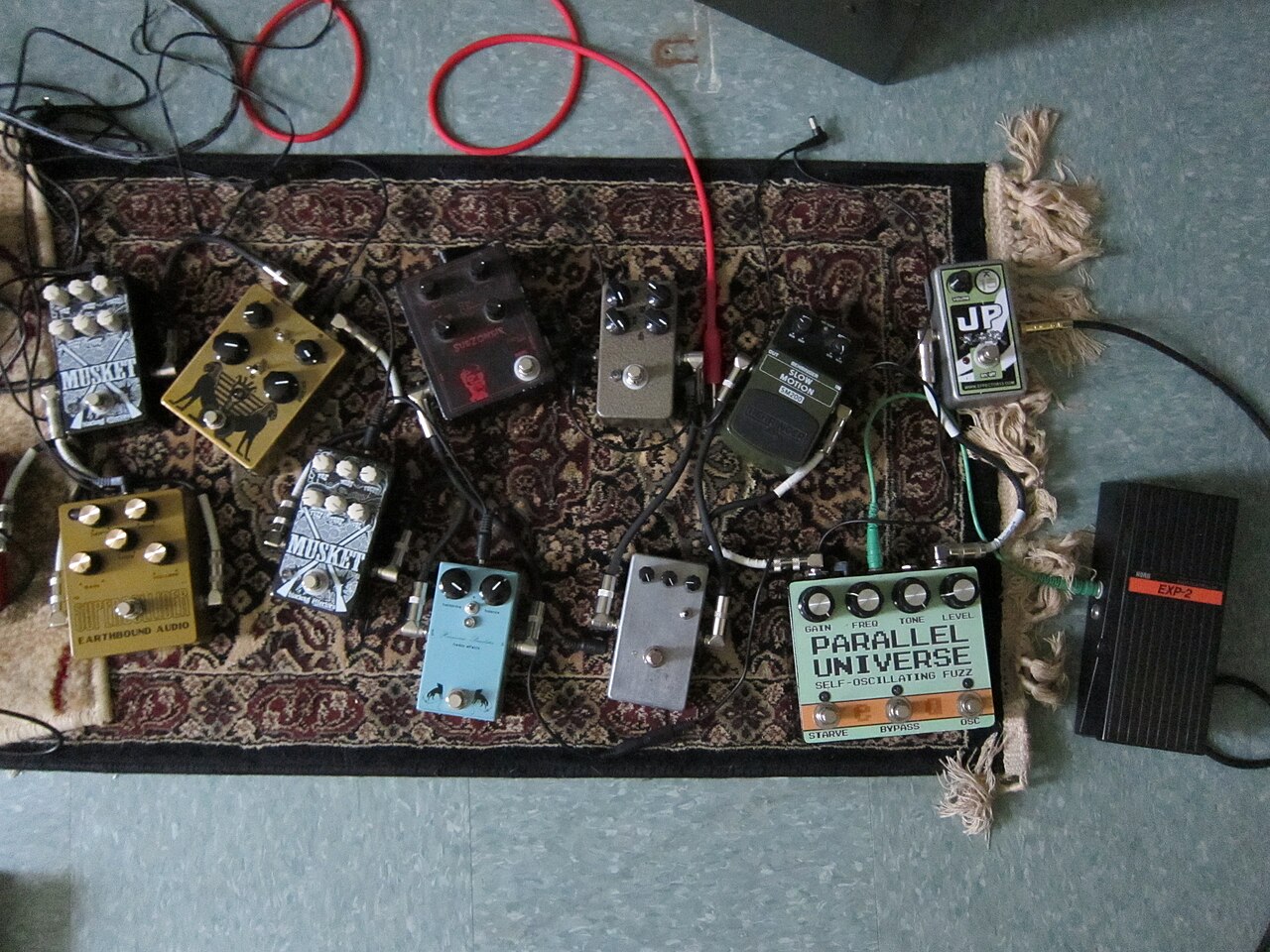
- Guitar pedals on a rug: Oldangelmidnight from Northampton, MA, Wikimedia Commons, CC BY-SA 2.0.
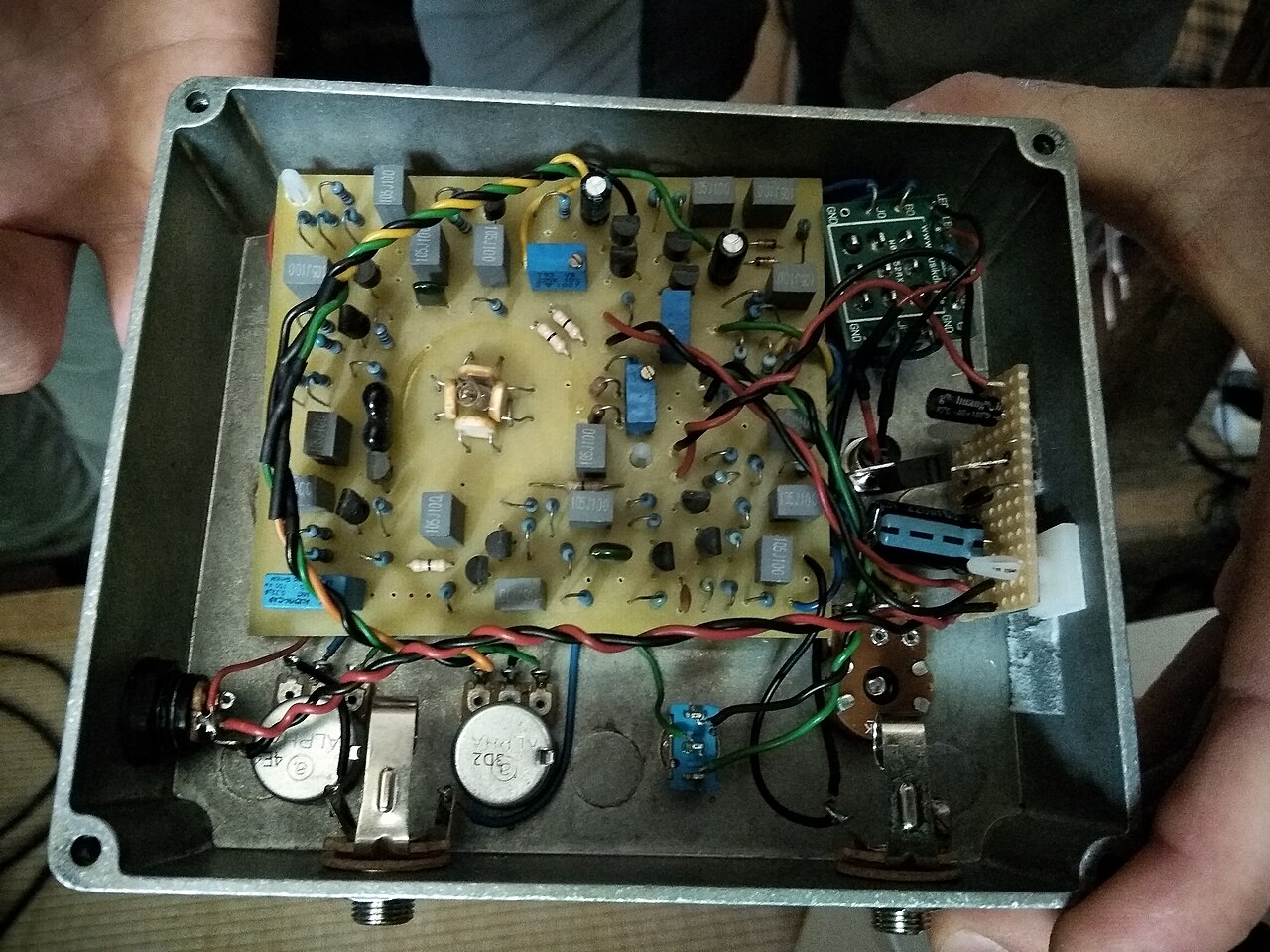
- Inside a DIY pedal showing the circuit board: Skimel, Wikimedia Commons, CC BY-SA 4.0.
Latest News
Related
On This Day
Tuesday 10 November
From this week: