The Pedal That Broke the Rules: How a Sleepless Night in Minneapolis Gave Birth to the ZVEX Fuzz Factory
The ZVEX Fuzz Factory explained: two germanium transistors, the Stab knob myth corrected, every 2026 variant priced, tone recipes and verified players.
It was designed in a single feverish night by a man shaking with panic, built from transistors he had almost given up on, and named while he was painting the enclosure. The ZVEX Fuzz Factory is not what you expect from a guitar pedal. It squeals. It oscillates. It refuses to behave. And for three decades, the musicians who understand it best have used that refusal as a weapon.
Matt Bellamy had Manson build the circuit directly into his guitar bodies and constructed some of Muse’s most recognisable riffs around its throttled, gated crunch. Nels Cline calls it “really strange, and intense, and uncontrollable” and reaches for it anyway. Bill Frisell — one of the most tasteful guitarists alive — keeps one for the moments when taste is not the point. Trent Reznor uses it for noise sculpture. Kevin Parker built psychedelic textures out of it. Courtney Barnett was given one by Kurt Vile and uses it, in her own words, for “just a special moment.”
The Fuzz Factory is not a friendly tool. In the right hands it is one of the most creative devices ever bolted to a pedalboard. This is the story of what it is, how it actually works, who genuinely uses it, and where the folklore around it is wrong.
One Night in Minneapolis: The Origin of the Fuzz Factory
Zachary Vex has been building effects in Minneapolis since 1995 — the date ZVEX itself puts on the company. His first product was an octave fuzz called the Octane, taken to a local shop called Willie’s American Guitars, whose owner Nate Westgor bought the first batch without hearing them, on the strength of Vex’s reputation as a sound engineer. They sold out. Nate ordered more. Then the demand stopped, and Westgor told Vex he did not need any more Octanes.
Vex’s response to that news was to panic. “My world kind of broke apart at that moment,” he later told Guitar World. “Somehow it had felt like things were going to keep growing and suddenly it felt like it was all gone in one day: a strange sensation.” So he went home and worked through the night on something new.
His raw material was a pile of surplus germanium transistors bought from an Axe Man surplus store in Minneapolis — a shop that acquired components from bankrupt companies and sold them off cheap. The transistors looked unusual: oversized, odd, interesting. Vex bought all of them. The plan was a Fuzz Face-style circuit. It did not work. There was no gain, no fuzz, no fun. “No matter what I did the circuit sounded like mush,” he recalled.
Then he put a booster in front of the circuit, and everything changed at once. The pedal went haywire — squealing, oscillating, generating sounds no guitar pedal was supposed to make. A sensible engineer scraps that. Vex did the opposite: he replaced the fixed resistors with potentiometers so he could steer the chaos rather than eliminate it. He ended up with five knobs, three of which he could not easily explain the function of. He stayed up until eleven the next morning, writing down settings and giving them names like “Ripping Velcro.”
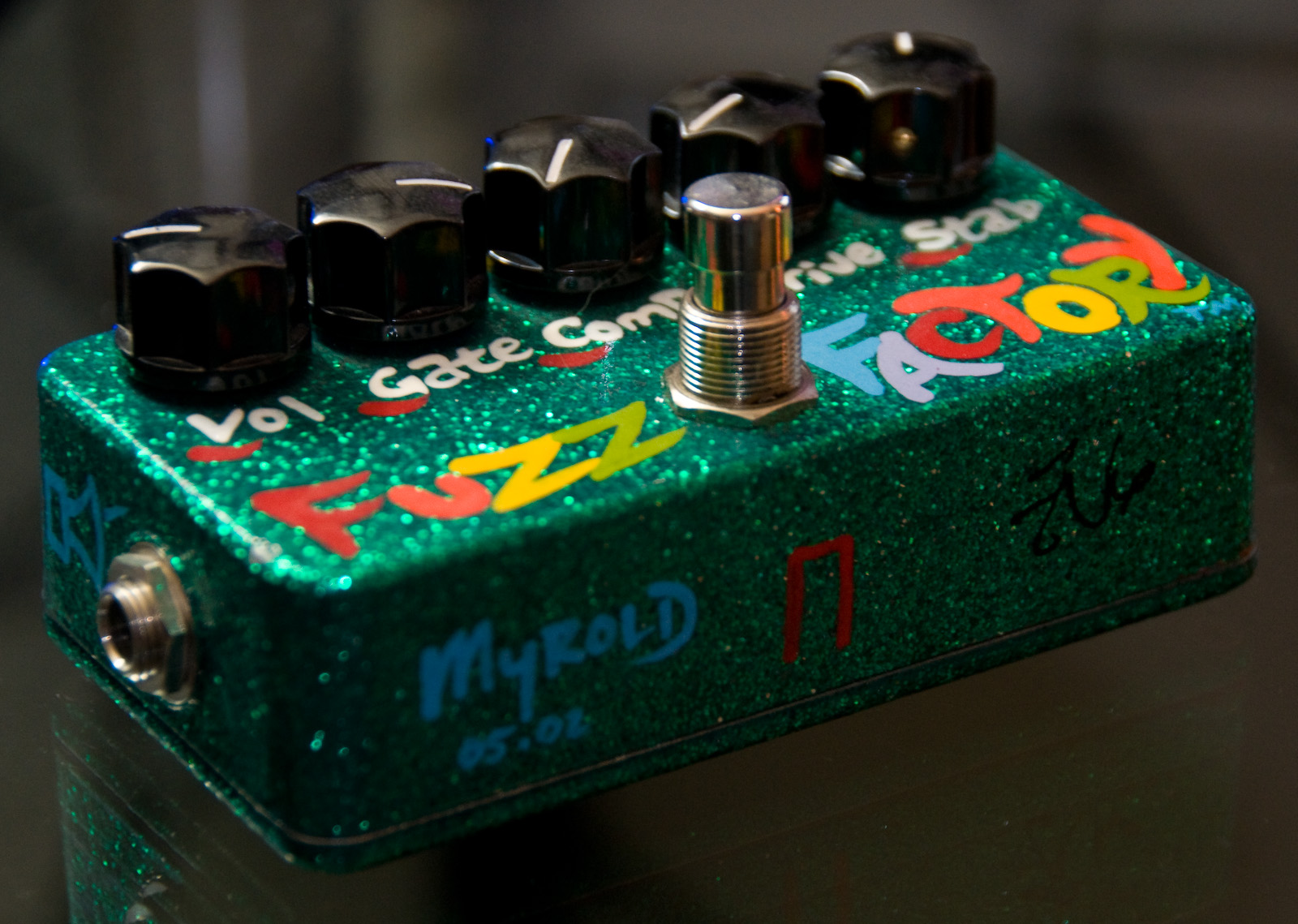
When he woke that afternoon and played through it again, it sounded as good as it had at four in the morning — arguably better. The name arrived while he was painting the enclosure: Fuzz Factory, because it was a factory of fuzz, “a way of manufacturing your own tone — something unique to yourself.”
The local dealer objected to the layout. Five knobs, several of them undescribable, would confuse customers. Vex’s counter-argument became the founding philosophy of the entire boutique era: confusion is the point, because it means buyers can find sounds nobody else has. The Fuzz Factory was the second pedal ZVEX ever made. It became the one that defined the company.
An honest note on the date
You will see 1994, 1995 and 1996 all quoted as the birth year of the Fuzz Factory, and they cannot all be right. ZVEX’s own site dates the company to 1995. Guitar World published its retrospective feature “25 years of the Z.Vex Fuzz Factory” in November 2020, which points at 1995. ZVEX and Chase Bliss both ran 25th-anniversary Fuzz Factory products in 2020–21, which points at 1995–96. Wikipedia’s distortion-pedal entry states the pedal was “designed overnight in 1994.” We have not found a primary source that settles it to the day, so this article says mid-1990s and leaves the exact year open rather than picking one and pretending it is documented.
The Correction That Matters Most: Stab Goes to the Right
Before anything else, one piece of misinformation needs killing, because it appears constantly in forum posts, settings blogs and even in published gear writing: the Stab knob does not create oscillation when you turn it clockwise. It creates oscillation when you turn it counter-clockwise.
ZVEX’s own instruction sheet is blunt about it. Under Stab (Stability) it reads: “Use all the way right. Do not attempt to adjust this control below 2:00, unless you like your fuzz soft and squishy.” Fully clockwise is the stable, well-behaved position — the setting where the Fuzz Factory acts like a fuzz pedal. Rolling Stab anti-clockwise progressively starves the circuit until it loses control of itself and starts generating its own pitch.
This is not a trivia point. It is the difference between a player who gets a usable fuzz sound in ten seconds and a player who concludes the pedal is broken. If your Fuzz Factory is howling and you cannot make it stop, your Stab is too far left. Turn it right. Everything else on the pedal becomes legible once that one control is in the correct half of its travel.
The reason the error propagates is that the pedal’s reputation runs ahead of its manual. Everyone knows the Fuzz Factory oscillates, so writers reach for the most dramatic phrasing available — “turn it up and it goes wild” — without checking which direction “up” is on a control labelled Stability. The knob is named for what you get when you have it, not for what you get when you lose it.
The Circuit: Two Transistors, Five Interactive Controls
ZVEX is consistent about this across every product page in the family: the Fuzz Factory is built around two new-old-stock 1960s germanium transistors. Not three. The current Fuzz Factory 7 specifies them exactly — two NOS 1960s GT308 germanium transistors, sourced from Ukraine — and describes the standard circuit as sharing that two-transistor heart.
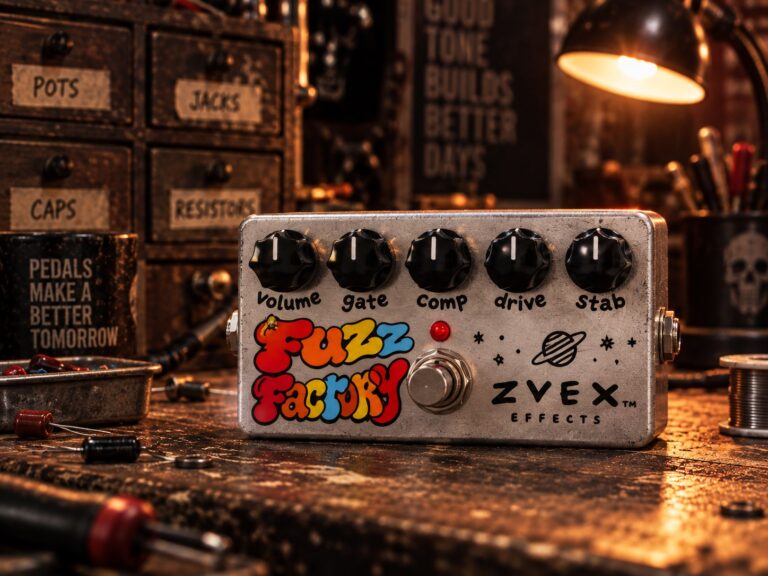
That is the same headline architecture as a Dallas Arbiter Fuzz Face, and it is worth understanding why the two pedals behave so differently despite it. In a Fuzz Face, the feedback around the transistor pair is fixed at the factory and the two knobs sit outside the sensitive part of the circuit; the pedal is biased once and stays put. In the Fuzz Factory, the potentiometers reach inside that biasing and into the operating levels themselves. ZVEX’s own manual is candid about it: the knobs are named after the parameter each seems to affect most, but they are really controls for various operating levels and biases, shaping a personalised fuzz rather than adjusting discrete parameters.
That is why the controls interact so violently. You are not adjusting five effects. You are moving five points on a circuit that is deliberately being run near the edge of what it can do.
Volume
Output level, and the only genuinely simple control on the pedal. Worth keeping a hand on: some settings produce almost no usable output and others produce far more than you expected, so the Fuzz Factory is not a pedal you set to unity once and forget.
Gate
ZVEX describes it as squelching noise after the end of sustain. Turn it right to eliminate squeals, hiss and buzz, stopping just as they vanish — or push past that point to tune in an exact feedback pitch. Turning left opens the gate and lets the pedal sustain and hiss freely. In practice, moderate clockwise settings give the tight, choppy, dying-battery character the pedal is famous for; extreme clockwise settings give near-zero sustain, where notes appear and immediately disappear.
Comp (Compression)
Not a compressor in any conventional sense. Per the manual, it adds an attack characteristic when turned left, softens as you move right, and suddenly pinches the tone when it is all the way right. That last detail is the one most write-ups omit, and it is a sound in its own right — a strangled, choked-off attack that is genuinely useful for percussive parts. The manual also flags it as a way to tune in fat, feedback-heavy fuzz once you are working in unstable territory.
Drive
Increases distortion when the pedal is used as a normal fuzz. Once Stab is backed off and the circuit is oscillating, Drive changes function entirely: it adjusts feedback pitch and tonal thickness. Two jobs, one knob, depending on which side of stability you are operating on.
Stab (Stability)
The knob that separates the Fuzz Factory from everything else ever made — and, as covered above, the one most often described backwards. All the way right for normal use. Below roughly 2 o’clock the fuzz turns soft and squishy; keep travelling anti-clockwise and the circuit loses control entirely, self-oscillating at a pitch that exists independently of what you play. The most interesting territory on the pedal is not at either extreme but in the narrow band where it is barely holding itself together.
Specifications
The sub-3 mA current draw deserves a moment. It is one of the lowest figures of any fuzz pedal in production, which means the Fuzz Factory will run for an absurdly long time on a battery and will not upset even a modest daisy chain. For a pedal with a reputation for being difficult, it is remarkably easy on your power supply.
The Family Tree: Every Fuzz Factory Variant
This is where most published information about the Fuzz Factory has gone stale. Prices quoted around the web — “about $199 for a Vexter,” “around $349 for a Fuzz Factory 7” — reflect a market that no longer exists. The figures below are ZVEX’s own current direct pricing as of September 2026, including which models the factory currently shows as sold out.
| Model | ZVEX direct price | What makes it different |
|---|---|---|
| Fuzz Factory (hand-painted) | $349.00 — currently sold out | The original format. Every enclosure individually hand-painted, so no two are identical. Lifetime warranty. |
| Fuzz Factory Vexter | $229.00 | Identical circuit, printed artwork instead of hand-painting. The sensible buy. |
| Fuzz Factory Vertical | $229.00 | Same five controls in a vertical enclosure — 4.3125″ × 2.625″ × 2″. The pedalboard-friendly footprint. |
| Fat Fuzz Factory | $399.00 — currently sold out | Adds a three-position sub toggle: position 1 is the standard Fuzz Factory, positions 2 and 3 add progressively more low end by increasing a coupling capacitor value. ZVEX labels them “Woof!” and “Look Out!!” |
| Fat Fuzz Factory Vexter (25th Anniversary) | $249.00 — currently sold out | Printed-art version of the Fat. |
| Fuzz Factory 7 | $499.00 | Where the Fat has a three-position toggle, the FF7 has a nine-position rotary switch spanning earthshaking lows to dog-whistle highs, plus a passive tone control with its own switch. Two NOS 1960s GT308 germanium transistors from Ukraine. 4.80″ × 3.64″ × 2.10″. |
| Fuzz Factory 7 USA Vexter | $429.00 | UV-printed art, hand-painted GT308 transistors. ZVEX states the parts inside are identical to the hand-painted model. |
| Fuzz Probe | $269.00 (Vexter) | Fuzz Factory circuit with a theremin-style proximity antenna replacing a knob. A different pedal, not a Fuzz Factory with a lid on. |
| Bliss Factory (Chase Bliss × ZVEX) | Limited run, 2021 — secondary market only | Two-germanium-transistor Fuzz Factory with digital control over every knob and switch, a resonant lowpass filter and MIDI. Guitar signal stays 100% analog throughout. |
Two corrections buried in that table
First, the Fuzz Factory 7 does not add “Voltage and Tone” controls, which is the description you will find repeated across the web. It adds a nine-position rotary frequency switch and a passive tone roll-off with its own bypass switch. That is a much more interesting proposition than a voltage-starve knob, because it means the FF7 is the Fat Fuzz Factory’s sub-switch idea expanded from three positions to nine.
Second, the Fat Fuzz Factory is not a different-sounding pedal. Position one of its toggle is the standard Fuzz Factory. It is a superset, not an alternative — which changes the buying calculus considerably if you find one at a sane price.
The Bliss Factory’s hidden connection
The 2021 Chase Bliss collaboration is more than a novelty. Joel Korte, the founder of Chase Bliss Audio, worked as an engineer at ZVEX before starting his own company in 2013 — so the Bliss Factory is not two strangers shaking hands, it is a designer returning to the circuit he once built for a living, with fourteen years of digital-control research in his pocket. It was released in support of Reverb’s feature-length documentary The Pedal Movie, in a limited run, and now trades well above its original price.
Famous Players: Who Actually Uses One
Attribution around the Fuzz Factory is unusually messy, because ZVEX makes a lot of pedals with similar names and the internet is not careful about which is which. What follows separates players by evidence quality, and it does not credit anyone the sources do not support.
Tier one: players who have said it themselves
Nels Cline (Wilco) gives the single best first-person endorsement the pedal has. Speaking to Premier Guitar, he says: “I always use the Zvex Fuzz Factory, which most people recognize at being really strange, and intense, and uncontrollable.” Note the tension in that sentence — he names the pedal’s reputation and then says he uses it anyway, always. It is also a small case study in why brand pages are weak evidence: ZVEX’s own artists page credits Cline with the Box of Metal and does not mention the Fuzz Factory at all. The player’s own words outrank the manufacturer’s roster.
Bill Frisell is the name that should make anyone reconsider what this pedal is for. Frisell’s public identity is restraint, space and touch — and in Guitar Player he says that if he wants to “go completely haywire,” he reaches for the Z.Vex Fuzz Factory. It is a precision instrument for imprecision, and one of the most controlled players in modern guitar keeps one for exactly that.
Courtney Barnett is documented twice over: the Fuzz Factory appears on her 2018 pedalboard per Guitar Center, and in a 2018 Noisegate interview she explains both how she got it and how sparingly she uses it — “And then a Fuzz Factory, but I only use that a little bit because on the record for one or two solos. Kurt (Vile) got me one as gift, and so it’s fun to have it as just a special moment.” That is an unusually honest account of how most people actually use this pedal, and worth more than a dozen boards it merely sits on.
Matt Bellamy (Muse) is the most comprehensively documented user in rock, and the only one whose relationship with the pedal changed the instrument itself. ZVEX’s artists page states it directly: “Muse: Matthew Bellamy plays a guitar with a built in Fuzz Factory.” Hugh Manson built the circuit into a series of Bellamy’s guitars alongside a Fernandes Sustainer, a MIDI pickup, a Kaoss Pad X-Y controller set into the body, LED side dots, a killswitch and a proximity-controlled wah. One documented example, the Manson Mirror, carried both a Fuzz Factory and an MXR Phase 90 on board and was used to record “MK Ultra.” On the guitar-mounted versions, two of the five controls sit on the front face where Bellamy can reach them mid-song; the rest are mounted internally and set once.

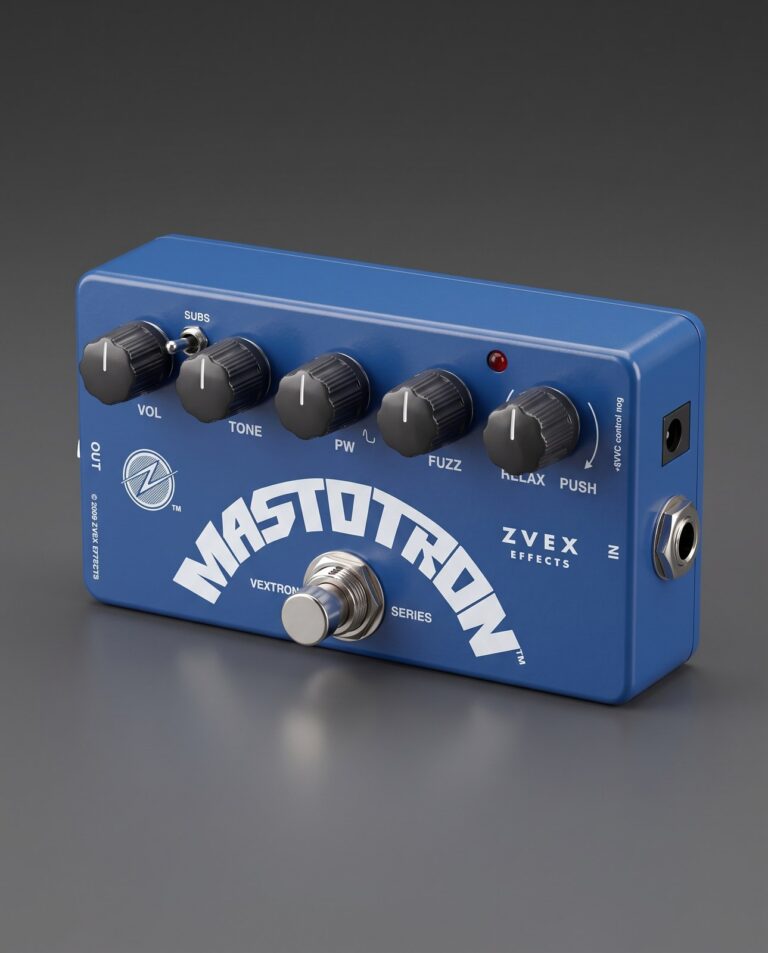
The Fuzz Factory’s fingerprints run through Muse’s Origin of Symmetry and Absolution eras. It defines the opening of “Plug In Baby” — that precisely throttled, almost sputtering crunch that sounds like it is being strangled into existence. Bellamy also owns the pedal in conventional form: Equipboard’s evidence for him includes a video sighting at 1:01 of a Fuzz Factory Vexter USA sitting next to a Keeley Fuzz Head. For the full picture across every era, see the Matthew Bellamy gear guide. Worth noting for completeness: bandmate Chris Wolstenholme is on ZVEX’s roster too, but for a Mastotron, not a Fuzz Factory.
Tier two: documented rigs and manufacturer confirmation
Trent Reznor (Nine Inch Nails) — ZVEX’s artists page lists him with the Fuzz Factory, Machine and Woolly Mammoth, and notes he owns a Nano Head. The grinding, unstable, metallic frequencies that run through the Nine Inch Nails catalogue are exactly what this circuit produces in its less-stable regions, and Reznor’s approach to guitar as compositional raw material rather than performance instrument fits a pedal that generates its own pitches.
Kevin Parker (Tame Impala) — confirmed on ZVEX’s artists page. Parker’s dense, layered, frequency-warped production has an obvious use for a fuzz that can be nudged into pitch instability without going fully into noise.
Stephen “Stef” Carpenter (Deftones) — ZVEX lists him with a Ringtone, Instant Lo-Fi Loop Junky, Seek Wah, Machine and Fuzz Factory, and there is independent corroboration: a detailed signal-flow diagram of his 2011 guitar rig published on GuitarGeek includes the Fuzz Factory.
Butch Vig (Garbage) — ZVEX confirms both a Fuzz Factory and a Woolly Mammoth. Equipboard additionally lists the Fuzz Factory as heard on Garbage’s 2025 album Let All That We Imagine Be The Light, which makes this one of the pedal’s most current credits rather than a 1990s relic.
John Frusciante — ZVEX’s page states plainly that he uses a Fuzz Factory, and he discussed it in an April 2004 Guitarist interview around his solo record Shadows Collide with People, describing the alien harmonic sounds at the end of “Water” as finger harmonics run through the pedal. That is the clearest account anyone has given of using the Fuzz Factory as a transformer of technique rather than a distortion box.
Andy Summers (The Police) — a genuinely surprising one, and a reminder that this pedal escaped the alt-rock ghetto early. Guitar Player’s documentation of his 2007–08 Police reunion rig lists a Z.Vex Fuzz Factory among the stompboxes feeding a Bob Bradshaw switching system, alongside a Klon Centaur, a Maxon SD9 and a Red Witch Empress Chorus.
Julien Baker (boygenius) — demonstrates the pedal on camera in a Premier Guitar Rig Rundown. Josh Klinghoffer — his Fuzz Factory appears in the gear listing of Premier Guitar’s 2014 Dot Hacker feature. Rivers Cuomo (Weezer) — documented as having used one during the recording of “Photograph.” Adam Hann (The 1975) — photographed on his stage pedalboard via Instagram.
Ian D’Sa (Billy Talent) deserves a special mention as the only player on ZVEX’s roster confirmed across the whole family: Woolly Mammoth, Fat Fuzz Factory, Fuzz Factory and Fuzz Factory 7. If you want evidence that the variants are meaningfully different from one another rather than cosmetic reshuffles, a player owning all three is it.
Justin Pearson (The Locust, Dead Cross, Head Wound City) is listed by ZVEX as using a modded Fuzz Factory — an important distinction we are not going to smooth over, since a modified unit tells you nothing reliable about the stock pedal. Two studio names round out the roster: producer/engineer John Agnello (Fuzz Factory plus half the ZVEX catalogue) and Brent Paschke, the guitarist behind Pharrell, N.E.R.D. and Snoop Dogg sessions, who is credited with a Seek Wah, SHO, Woolly Mammoth, Fuzz Factory and Jonny Octave. The Fuzz Factory’s presence on pop and hip-hop records is one of its least-discussed legacies.
Honest corrections: who does not use one
Several very famous names get attached to this pedal in online discussion and do not survive contact with the sources.
Jack White is a ZVEX user — ZVEX’s own page credits him with a Tremolo Probe and a Woolly Mammoth. Not the Fuzz Factory. The Woolly Mammoth is a separate circuit with a more aggressive, more controlled character, and the two get conflated constantly.
Jonny Greenwood uses the ZVEX Fuzz Probe, per ZVEX directly. The Probe is built on Fuzz Factory architecture but replaces a control with a proximity antenna, and it is its own product with its own price and its own artist list. Crediting Greenwood with a Fuzz Factory is a bit like crediting a talkbox player with a wah.
Billy Corgan appears on the ZVEX artists page as owning and using “various ZVEX pedals” — no specific model named. His documented primary fuzz across the Smashing Pumpkins catalogue is the Electro-Harmonix Big Muff Pi, in its Op-Amp incarnation. Kevin Shields is listed the same way — “various ZVEX pedals,” nothing specific. Both belong in a ZVEX article; neither belongs in a Fuzz Factory user list.
The Black Keys connection is real but specific: ZVEX lists them for the Octane III and the Fat Fuzz Factory. The Fat is a superset of the standard, so this is closer than most — but it is still not the same product, and the same goes for Garrett T. Capps, also listed on the Fat.
Tone Recipes and Settings
Recipe 1: Straight germanium fuzz (start here)
Volume at unity, Stab fully clockwise, Gate at 7–8 o’clock (open), Comp at noon, Drive at 1–2 o’clock. This is the Fuzz Factory behaving itself: warm, slightly loose, dynamic germanium fuzz with no self-oscillation anywhere in sight. If you have just bought one and it is screaming at you, this is the setting that proves it is not faulty.
Recipe 2: The gated “Plug In Baby” crunch
Volume at unity, Stab still well clockwise (3 o’clock or above), Gate at roughly 2 o’clock, Comp at noon, Drive at 3 o’clock. Full, heavy fuzz with the sustain chopped into a percussive, mechanical texture. Humbuckers get there most easily; with single coils, back the Gate off slightly or the notes will vanish before they finish. Into a clean, high-headroom amp — never a distorted channel.
Recipe 3: Velcro stutter
Volume at noon, Stab clockwise, Gate fully clockwise (4–5 o’clock), Comp at 10 o’clock, Drive at maximum. Almost no sustain at all: notes appear and immediately disappear. This is the sound Vex was writing down as “Ripping Velcro” at four in the morning. It rewards aggressive picking and drops into abrupt silence between strums.
Recipe 4: The pinch
Volume at noon, Stab clockwise, Gate at noon, Comp fully clockwise, Drive at 2 o’clock. The manual’s “suddenly pinches tone when all the way right” is a distinct voice, not a warning — a strangled, choked attack that sits beautifully under a vocal and cuts through a mix without occupying much space. Badly underused.
Recipe 5: Feedback pitch oscillation
Volume low (9 o’clock — the oscillation is loud), Stab at 8 o’clock (well into unstable territory), Gate at 7 o’clock (open), Comp at 10 o’clock, Drive at 2 o’clock. The pedal now produces a continuous pitch of its own. Use Drive to tune that pitch and a volume pedal — or your guitar’s volume knob — in front of the fuzz to bring the guitar in and out over the top of it. This is the Reznor and Frusciante region.
Recipe 6: Tuned feedback with the gate
Same as recipe 5, but instead of leaving the Gate open, use it as ZVEX suggests: creep it clockwise past the point where hiss disappears and use it to tune in an exact feedback pitch. The Gate stops being a noise control and becomes a second pitch control working against Drive. This is the most musical of the unstable settings and the hardest to reproduce twice.
Recipe 7: Psychedelic bloom
Volume at noon, Stab at 11 o’clock (slightly unstable, warbling rather than oscillating), Gate at 8 o’clock, Comp at 3 o’clock for a soft attack, Drive at 1 o’clock. The fuzz blooms slowly after each pick attack with just enough pitch instability to make it swim. Neck pickup, single-note lines, and a room reverb — the woozy end of the pedal’s range.
Treat the five knobs as one system rather than five parameters. Small moves on Stab change what every other control does. These are starting points; the pedal responds so strongly to pickup output and guitar volume that no two rigs will land in exactly the same place.
How the Fuzz Factory Compares
The Dunlop JH-F1 Jimi Hendrix Fuzz Face is the obvious comparison, since Vex set out to build something Fuzz Face-adjacent and ended up somewhere else entirely. Both are two-transistor designs. The difference is that the Fuzz Face’s bias is a factory decision and the Fuzz Factory’s bias is a performance parameter. If the Fuzz Face is a German shepherd, the Fuzz Factory is a wolf — same lineage, different rules.
The Electro-Harmonix Big Muff Pi comes at fuzz from the opposite philosophy. Its cascaded gain stages produce enormous, sustaining, mid-scooped fuzz that is the same every time you step on it, which is precisely why entire careers have been built on it. The Fuzz Factory has less sustain, more dynamics, and no interest in consistency. Put another way: the Big Muff gives you a sound, and the Fuzz Factory gives you a machine for finding one. If you want the sustain but with more control over the mids, the Green Russian Big Muff is a better shopping trip than a Fuzz Factory.
The Way Huge Swollen Pickle Jumbo Fuzz is the closest thing to a philosophical rival in the mainstream: a Muff-derived circuit with five external knobs plus two internal trimmers, deliberately over-provisioned with controls. The difference is the destination. The Swollen Pickle’s controls all point at variations on a huge, scooped fuzz; the Fuzz Factory’s point at the edge of the circuit’s stability. Both reward patience, but only one of them will start generating pitches at you.
Against modern boutique germanium fuzzes, and against factory offerings like the Boss FZ-1W or the JHS 3 Series Fuzz, the Fuzz Factory’s unique contribution remains what it was in the mid-1990s: it makes the circuit’s instabilities available to the player instead of engineering them out. Thirty years of competitors have not seriously challenged that. The Keeley Fuzz Bender comes closest among current production pedals in terms of hybrid weirdness, but it is a far more polite device.
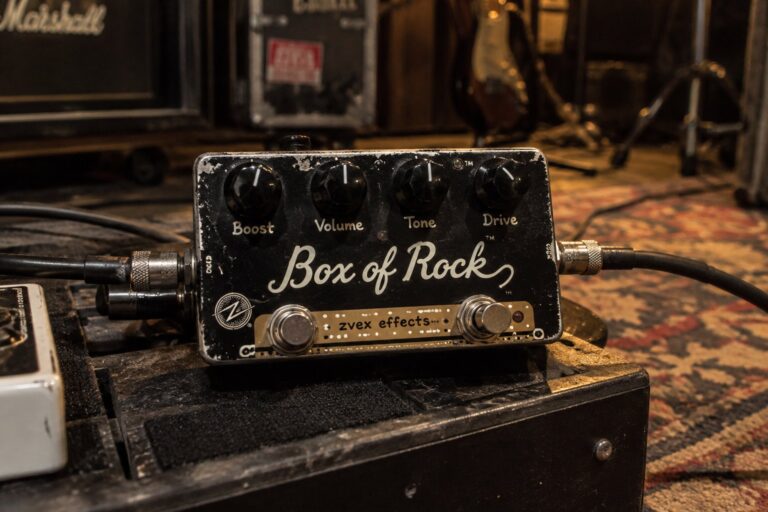
Within ZVEX’s own catalogue, the decision tree is short. Want bottom end? Fat Fuzz Factory or FF7. Want the oscillation under your hand instead of under a knob? Fuzz Probe. Want a Marshall-in-a-box rather than a fuzz? That is the ZVEX Box of Rock, a completely different proposition and arguably the most conventional pedal the company makes.
Buying Guide
The Fuzz Factory Vexter at $229 is the correct purchase for almost everybody. The circuit is identical to the hand-painted version; you are paying less because the artwork is printed. The Fuzz Factory Vertical, also $229, is the same circuit again in a vertical enclosure — if your pedalboard is tight, take the Vertical and lose nothing.
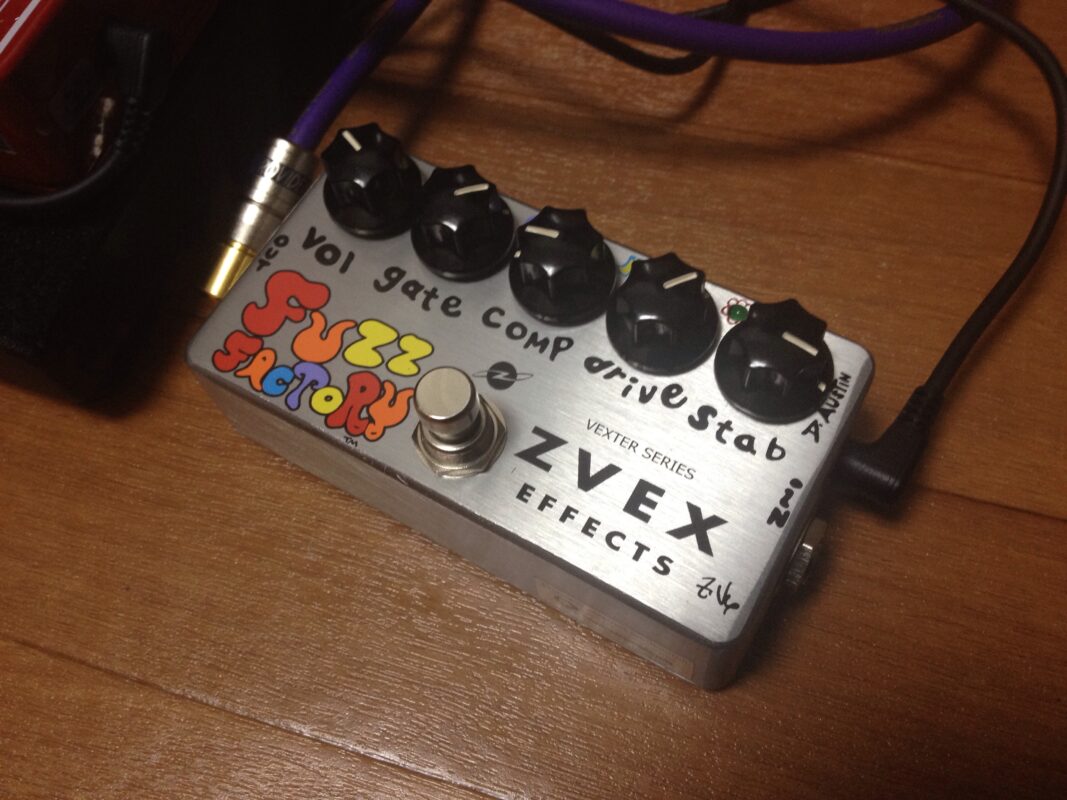
The hand-painted Fuzz Factory at $349 is currently sold out at ZVEX, which is worth knowing before you assume a used listing at that price is a bargain. You are buying a one-off painted enclosure and a lifetime warranty that Zachary Vex has phrased as lasting as long as he is on the planet — and which ZVEX has in fact honoured on pedals going back to the 1990s. That is a real component of the value, not marketing.
The Fat Fuzz Factory ($399, sold out) and Fat Fuzz Factory Vexter ($249, sold out) are the sleepers. Since sub position one is the standard Fuzz Factory, a Fat at a fair used price is strictly more pedal than a standard at the same money. Check the toggle works through all three positions.
The Fuzz Factory 7 at $499 hand-painted or $429 as a USA Vexter is a serious outlay, and it is not a first Fuzz Factory. It is the right buy if you already know the standard pedal and specifically want the nine-position frequency rotary and the tone roll-off — most obviously for players who perform with the oscillation and need to place its pitch deliberately. ZVEX states the Vexter’s internals are identical to the hand-painted model, so the $70 difference is purely finish.
Buying used, check three things. Pots first: Stab and Gate get turned constantly by people who use this pedal properly, and worn pots on an interactive circuit are more disruptive than on a conventional one. Then the transistors — these are NOS germanium parts, and a unit that has been modded (there are plenty) is no longer the pedal reviewed here. Then artwork provenance on hand-painted units, since ZVEX’s custom-painting programme means genuinely unusual finishes exist alongside less genuine ones.
Ownership Notes
Budget an hour before you form an opinion. The Fuzz Factory is genuinely difficult to dial in quickly, and that is by design; the knobs interact in ways that resist description. What it is not is unreliable — with Stab clockwise it will sit still and behave for as long as you want it to.
Put it first in the chain. Germanium input stages are highly sensitive to what is in front of them, and a buffer ahead of the Fuzz Factory will change its character, sometimes dramatically. First in line, straight from the guitar, or inside a true-bypass loop.
Play the guitar volume knob. Rolling back tightens the response and will clean up oscillation you did not intend. Near the instability threshold, the guitar’s volume control effectively becomes a sixth knob on the pedal, and it is the most expressive one.
Expect temperature drift. All germanium circuitry shifts with temperature, and a pedal deliberately biased near its limits will show it more than most. A Stab setting that was perfect in a warm room may need nudging on a cold stage. This is characteristic, not faulty.
Power is a non-issue. 9V DC centre-negative, 2.1mm, under 3 mA. It will run on a battery almost indefinitely and will not induce noise on a shared supply.
Write your settings down. This sounds trivial and is not. Because the controls interact, a great Fuzz Factory sound is genuinely hard to find again by ear. Vex himself was writing settings down at four in the morning on the night he invented it, and thirty years later that is still the correct method.
FAQ
Which way do I turn the Stab knob to stop the squealing?
Clockwise. ZVEX’s instructions say to use Stab “all the way right” and warn against going below 2 o’clock unless you want soft, squishy fuzz. Anti-clockwise is the direction that produces oscillation. This is the single most commonly reversed piece of information about the pedal.
How many transistors does the Fuzz Factory have?
Two germanium transistors, new old stock from the 1960s. ZVEX specifies GT308 types on current Fuzz Factory 7 production. Some accounts claim a third transistor for the input booster Vex added on the original night of development; ZVEX’s own published descriptions consistently say two, and that is what this article follows.
Is the Vexter the same sound as the hand-painted version?
Yes. Same circuit, same components, printed graphics instead of hand-painted ones. ZVEX says this explicitly of the Fuzz Factory 7 pair — the parts inside the USA Vexter are identical to the hand-painted model — and the same logic applies down the range. The price gap buys artwork, not tone.
What does the Comp knob actually do?
It shapes the attack. Turned left it adds a sharp attack characteristic; moving right softens it; all the way right it suddenly pinches the tone into a choked, strangled voice. It is not a compressor and it will not level your dynamics. ZVEX also recommends it as a way to tune in fat, feedback-heavy fuzz once you are working with Stab backed off.
What is the difference between the Fuzz Factory and the Fat Fuzz Factory?
A three-position sub toggle. Position one is the standard Fuzz Factory; positions two and three progressively increase a coupling capacitor’s value to add low end, which ZVEX cheerfully labels “Woof!” and “Look Out!!” The Fat contains the standard voicing rather than replacing it.
Is the Fuzz Factory 7 worth the extra money?
Only if you know what you want from it. It replaces the Fat’s three-position toggle with a nine-position rotary switch spanning very low to very high frequency territory, and adds a passive tone control with its own switch. That makes it the version for players who perform with the oscillation and need to place its pitch deliberately. As a first Fuzz Factory it is overkill; the $229 Vexter teaches you the circuit for less than half the money.
Does Jack White use a Fuzz Factory?
No. ZVEX’s own artists page credits him with a Tremolo Probe and a Woolly Mammoth. The attribution appears constantly in online discussion and is not supported by any primary source we can find. The Woolly Mammoth is a different circuit with a more aggressive, more controlled character.
What is the Fuzz Probe, and is it just a Fuzz Factory?
It is built on Fuzz Factory architecture with a theremin-style proximity antenna in place of a knob, so you control the parameter by moving your hand near the pedal rather than bending down to it. Jonny Greenwood of Radiohead is its best-known user, per ZVEX directly. Sonically related, operationally a different instrument, and priced separately at $269 for the Vexter version.
Can I use a Fuzz Factory with bass?
Yes, with caveats. The Gate control thins low end considerably, so keeping it anti-clockwise preserves more of the bottom. The Fat Fuzz Factory and the Fuzz Factory 7 are the better choices for bass because their sub switches exist specifically to add low-frequency content — ZVEX’s own bass-focused fuzz, the Woolly Mammoth, is a different and arguably more appropriate pedal for the job.
What amp should I use it with?
Something clean with headroom. A Fender-style clean platform or a Marshall JCM800 kept on the edge of break-up. Adding amp distortion on top of the Fuzz Factory muddies the interactions and makes the Stab and Gate behaviours much harder to hear, which defeats the point of owning one. Pickup choice matters too: humbuckers push the circuit harder into gating, while a Telecaster bridge pickup keeps more of the note’s front edge intact.
Image credits
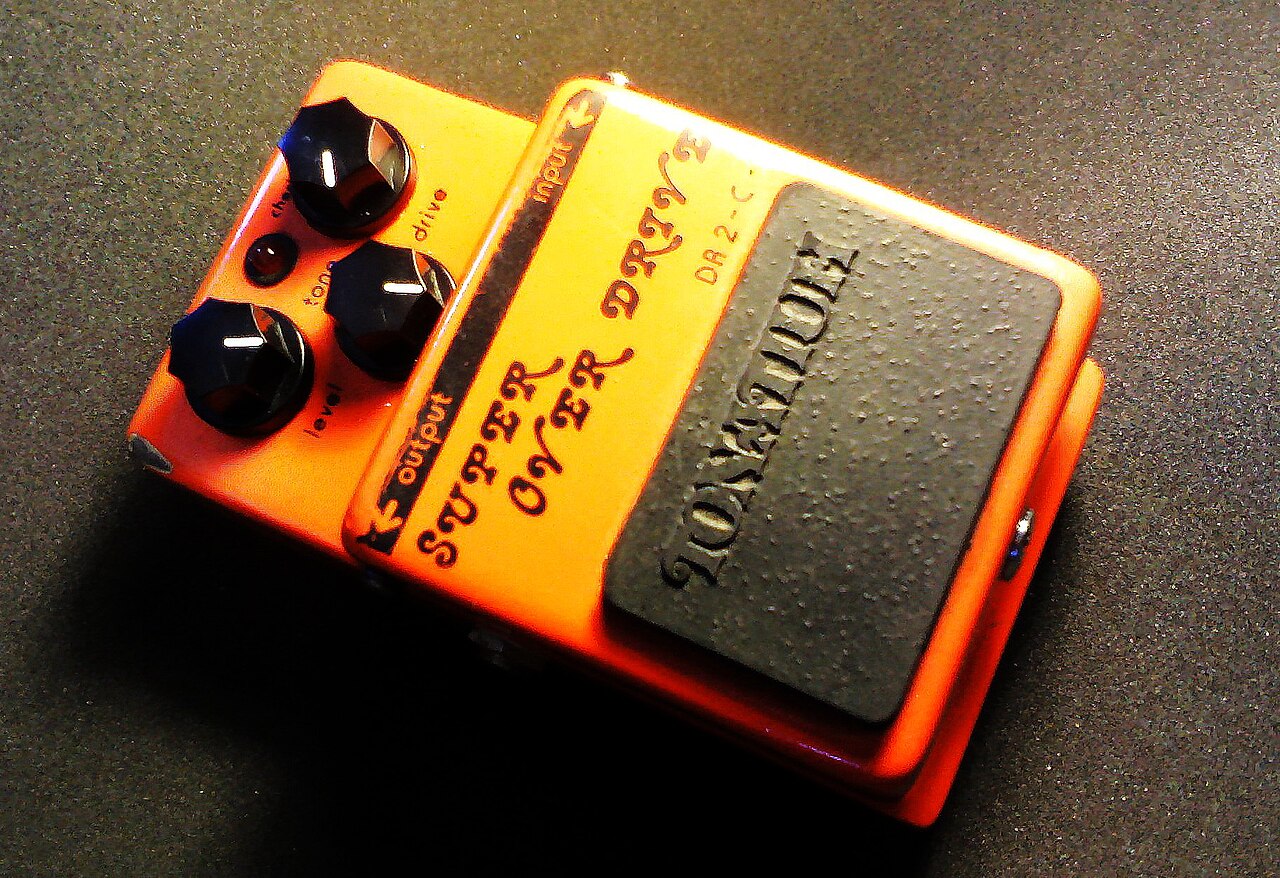
- An orange overdrive pedal: Andrés Galeotti, Wikimedia Commons, CC BY 2.0.
- Matt Bellamy: Rev Stan, Wikimedia Commons, CC BY 2.0.
- Top image: Z-Vex Fuzz Factory, photographed 17 September 2008. Photo: Art Bromage. Source photograph · CC BY-SA 2.0. Source image unchanged by GuitarGangsters. © Art Bromage.
- ZVEX Fuzz Factory (Vexter Series): photo by Mekkjp, via Wikimedia Commons, CC BY-SA 2.0.
- ZVEX Fuzz Factory: GuitarGangsters AI-generated reference illustration, not a photograph.
Latest News
Related
On This Day
Monday 9 November
From this week: