One Pedal, Infinite Possibilities: Inside the Boss RC-5 Loop Station
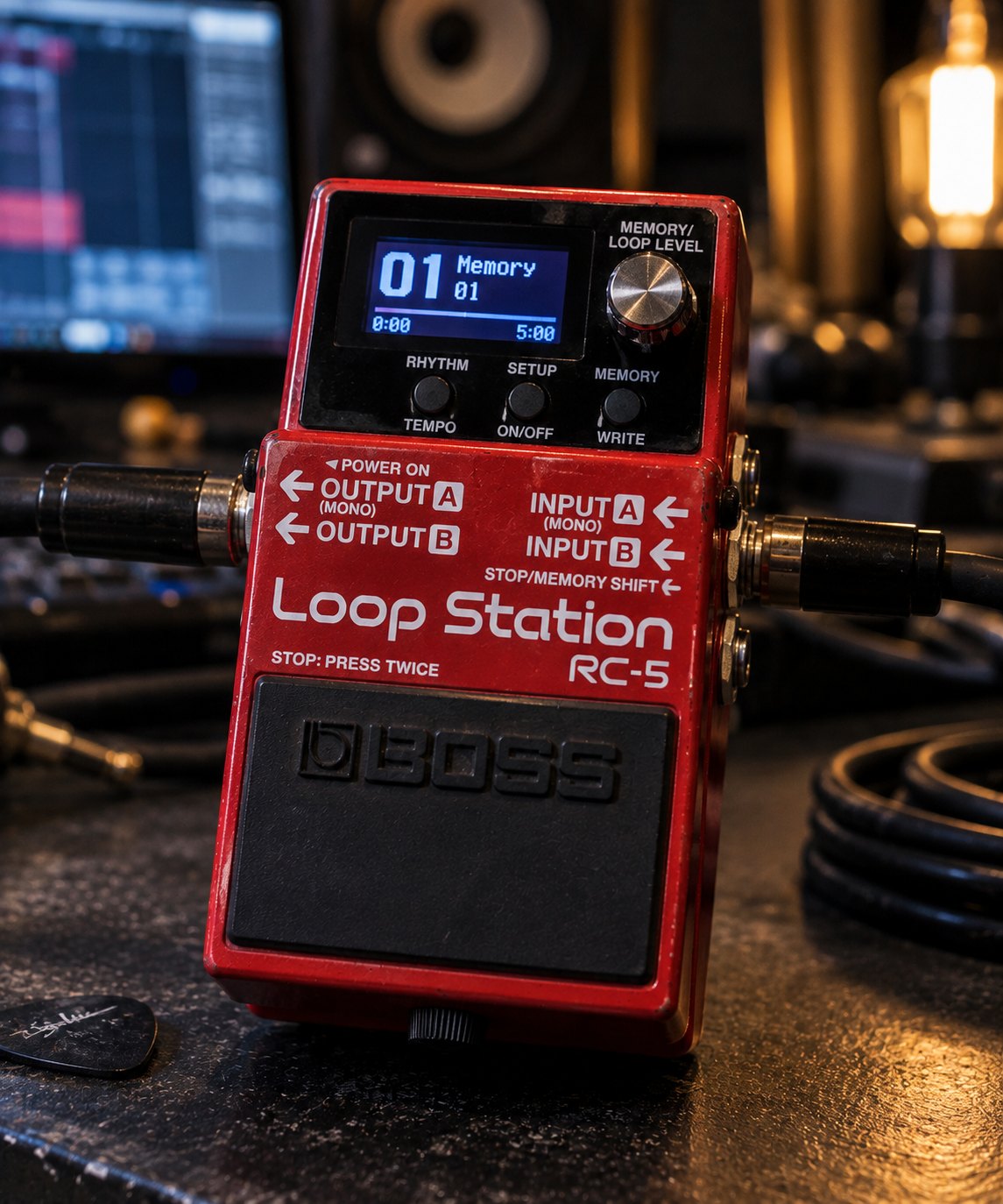
Boss RC-5 Loop Station. AI-generated reference illustration, not a photograph.
The Boss RC-5 Loop Station packs 99 memories, 57 rhythms, MIDI I/O, and 13 hours of recording into a compact Boss pedal. Specs, players, and settings.
There’s a moment every guitarist knows — you’ve just landed on a riff so good you don’t want to lose it, but your hands are busy playing it. The loop pedal exists to solve exactly that problem, and the Boss RC-5 Loop Station is arguably the most complete solution ever jammed into a standard Boss compact footprint. When it arrived in October 2020 alongside the larger RC-500, the RC-5 raised the bar for what a single-footswitch looper could do: 99 phrase memories, 57 built-in rhythms, full MIDI I/O, and an RGB backlit LCD display that lets you read loop status at a glance from across a dark stage. All of it in the same chassis that holds your chorus and delay pedals.
This isn’t a review — it’s a gear guide. The RC-5 isn’t for everyone, and understanding exactly what it does and where it sits in the Loop Station hierarchy is the difference between buying the right tool and buying something you’ll trade away in six months. Let’s get into it.
A Brief History of Boss Loopers and Where the RC-5 Fits
Boss launched the Loop Station concept in 2001 with the RC-20, a floor unit that gave guitarists their first taste of real-time phrase looping without a reel-to-reel machine. The RC-20XL followed in 2004 with expanded recording time — notably the model that made looping accessible to a generation of street performers and bedroom composers, including a young Ed Sheeran who picked one up at age 14. The compact RC-2 arrived in 2006, shrinking looping to a standard Boss stompbox. The RC-3 (2011) added 99 memories and USB backup to the compact format for the first time. The RC-1 (2014) went the opposite direction — stripping everything away to the bare essentials for maximum simplicity.
The RC-5 represents the mature answer to a question the RC-3 first posed: how much can you actually fit into a compact looper before it needs a bigger box? The answer, in 2020, was more than ever before. Better A/D conversion (32-bit vs. the older 24-bit in the RC-3), a proper LCD display where the RC-3 had only a basic LED setup, MIDI I/O that the RC-3 lacked entirely, and 57 rhythms compared to the RC-3’s 46. The RC-5 isn’t a tweak of its predecessor — it’s a generational jump.
What the RC-5 Actually Does in Your Signal Chain
The RC-5 is a single-track, stereo looper. “Single-track” means you’re building one composite loop — you record an initial phrase, then overdub additional layers on top of it, all merging into one audio stream. This is distinct from multi-track loopers like the RC-500, which let you run two independent layers simultaneously with separate stop/start control. For most guitar applications — practice, songwriting sketches, solo live performance, and backing track playback — single-track looping is all you need and the simplicity of one footswitch managing everything (record, overdub, play, stop) means zero cognitive overhead mid-performance.
In the signal chain, the RC-5 typically sits at the end — after all your drive, modulation, and time-based effects — so that whatever tone the rest of your board produces gets captured cleanly into the loop. That’s the standard configuration. You can run it in a parallel effects loop if your amp has one, which is useful when you want your reverb or delay to continue processing after the loop plays back, rather than baking the wet signal into the recording. And because it handles stereo natively, players running dual-amp rigs or stereo pedal setups can preserve the full width of their sound on both in and out.
The STOP/MEMORY jack (1/4″ TRS) accepts up to two external footswitches or an expression pedal, unlocking functions like direct memory select, loop fade, and rhythm control without touching the pedal’s main switch. Full MIDI I/O via mini TRS jacks lets the RC-5 sync to external clock from a drum machine or DAW, trigger loop start/stop/record remotely, and change memories from a MIDI controller — which is where this pedal crosses from hobbyist tool to genuine pro gigging rig component.
Specifications
The LCD: The Feature That Changes Everything
Compact loopers before the RC-5 were essentially flying blind. The RC-1’s circular LED ring tells you loop progress but nothing else. The RC-3’s segmented display shows memory number and basic status. The RC-5’s RGB backlit LCD is in a different league entirely — a 96×32-dot graphic display that shows memory number, loop status, rhythm type, tempo, and remaining time simultaneously. More importantly, the backlight color changes states: red for recording, yellow for overdubbing, green for playback. You can read this from the back of a stage in near-darkness without leaning down.
This matters enormously in live contexts. The single biggest source of looper errors — accidentally triggering overdub when you meant to stop, or stopping when you meant to trigger the next memory — comes from uncertainty about the pedal’s current state. The RC-5’s visual feedback eliminates that uncertainty. It’s the kind of feature that sounds like a minor ergonomic nicety until you’ve used it for three gigs and realized you’ve stopped making state-confusion mistakes entirely.
Famous Players: Honest Verification
Ed Sheeran built his looping technique on the RC-20XL from 2005 and later used the RC-30 for his main-stage work; the RC-5 wasn’t released until 2020, and there is no primary-source confirmation connecting him to it. KT Tunstall’s famous looping moment — “Black Horse and the Cherry Tree” on Later… with Jools Holland in 2004 — used an Akai E2 Headrush, not a Boss product at all. Keller Williams is a documented looping enthusiast but no primary-source confirmation places him on a specific RC-5 unit. None of these three are credited in this article as RC-5 users, because they aren’t confirmed as such.
The players who are confirmed for the RC-5 are a different, more current generation.
Madison Cunningham carries an RC-5 on her touring pedalboard, clearly visible in Premier Guitar’s “Rig Rundown: Madison Cunningham” video filmed at Third Man Records in Nashville (the pedal appears at the 15:12 mark). Her setup positions the RC-5 alongside a JHS Milkman, Hologram Chroma Console, and Universal Audio Galaxy ’74 Tape Echo — a board built for textured, layered indie folk-rock. The RC-5 gives her the ability to build looped foundation parts during extended song sections without needing to program arrangements in advance. Her presence in this board context speaks to the RC-5’s appeal to modern singer-guitarist performers who need reliable, compact looping that integrates cleanly with a curated effects chain.
AJ Ghent discusses his RC-5 in a Premier Guitar Rig Rundown guitar gear tour (at 13:12 in the video), where he demonstrates how he uses the looper within a modern R&B and soul context. Ghent’s technique leans into the RC-5’s rhythm section integration — building a loop over a drum kit backing, then layering rhythm guitar and melody on top. His use of the RC-5 is a textbook demonstration of how the pedal’s built-in rhythms change the creative process. Instead of looping over silence, you’re looping in relationship to a groove, which fundamentally changes how you construct layers.
Equipboard documents the RC-5 in the rigs of approximately 7 professional artists as of August 2026, including Alexandr Misko, a fingerstyle guitarist who uses it for live looping in performances of his compositions “Rain & Thunderstorm” and “Absence.” These are community-documented rather than primary-source confirmed from manufacturer or publisher interviews, but the visual evidence on Equipboard’s platform is consistent with direct RC-5 pedal identification. Misko’s fingerstyle work demonstrates the RC-5’s utility in contexts far removed from rock — intricate acoustic layers built in real time, with the LCD giving him clear visual status without disrupting performance concentration.
Eric Gales has been documented in connection with the RC-5 via Equipboard community sources. Gales is a Memphis-rooted blues-rock guitarist whose playing style naturally suits looping — his live improvisational energy and technique extend readily into loop-based performance. This is Equipboard-level documentation rather than a primary-source rig rundown confirmation, so it should be treated accordingly: likely accurate, not definitively confirmed.
Tone Recipes and Settings
1. Solo Acoustic One-Man-Band
Pick a rhythm pattern from the Folk or Bop sections (Patterns 30–42 range well for acoustic work). Set tempo with the Rhythm Tempo button, engage the rhythm, then record a four-bar chord progression. Loop it, then use your second and third overdubs for a bass-register riff and a melodic counter-line. The RC-5’s 32-bit capture keeps the acoustic transient clean across multiple overdub layers where older 16/24-bit units would start to muddy. Keep the Loop Level knob around 11 o’clock to leave headroom for the live playing on top.
2. Electric Rhythm Foundation for Improv
Plug into your drive pedal chain — Ibanez TS9 into a Fender Deluxe Reverb works beautifully here. Record a clean rhythm chord loop (8 bars), then switch the TS9 on for the overdub pass of the lead melody. The dry/wet contrast between the clean chords and driven lead creates instant apparent production depth. The RC-5’s stereo I/O preserves the natural spread of a Deluxe’s reverb tail in both channels.
3. MIDI-Synced Drum Loop Composition
Connect a drum machine or DAW via TRS MIDI (using the BMIDI-5-35 adapter). Sync the RC-5 to external clock. Set up an 8-bar loop in Memory 01, a 16-bar variation in Memory 02. Use MIDI program change from a floor controller to flip between memories during a live set without touching the pedal. This is the RC-5 functioning as a one-guitarist-replaces-a-band live rig component, and it’s where the MIDI implementation earns its place.
4. WAV Backing Track Playback Hub
Import pre-produced WAV backing tracks into the RC-5 via BOSS Tone Studio. Load tracks 01–10 with your setlist order. On stage, Memory 01 triggers track one, Memory 02 triggers track two — footswitch advances to the next, or use an FS-6 for dedicated next/previous control. This is the use case that separates the RC-5 from every simple looper below it: it becomes a playback device for produced material, not just a recording/overdub tool.
5. Bending Accuracy and Vibrato Practice
Record a clean drone chord with no vibrato. Loop it. Play lead lines over the top, listening critically to intonation against the fixed reference. The RC-5’s fidelity at 44.1/32-bit means the reference doesn’t degrade — a limitation that plagued older lower-quality loopers where the sample audibly degraded after a few minutes of playback, making intonation comparison less reliable.
6. Ambient Texture Building
Use a Cry Baby wah in the heel position for a dark filtered tone. Record a long-bow (volume swell or slow pick attack) chord. Let it loop, then add reversed or sustained layers. The RC-5’s reverse function flips the playback of any recorded loop, creating evolving ambient textures from simple source material. Chain this after a reverb pedal into a Marshall JCM800 running clean at bedroom volume and you have a surprisingly atmospheric result.
7. Multi-Part Song Demo Sketching
Use each of the 99 memories as a distinct song section: verse loop in Memory 01, chorus in Memory 02, bridge in Memory 03. Export via USB after a practice session. BOSS Tone Studio allows backup so you don’t lose the material. This workflow is legitimately useful for songwriters who want to capture and recall structural ideas without committing to a DAW session.
RC-5 vs. The Competition
Boss RC-5 vs. Boss RC-1
The Boss RC-1 is the stripped-down baseline: single loop, no memories, no rhythms, no LCD, no MIDI, 12 minutes stereo, 95mA current draw, ~$93. The RC-5 costs more than twice as much and draws 170mA — nearly double the current — in exchange for 99 memories, 57 rhythms, a full LCD, MIDI I/O, USB backup, and WAV import. Battery life also drops from the RC-1’s ~4.5 hours to the RC-5’s ~2 hours, which is the meaningful cost of the additional electronics. The RC-1 wins on simplicity, price, and battery performance. The RC-5 wins on almost everything else. The choice is genuinely about workflow — if you only ever want to lay down a single loop and play over it, the RC-1 does it better for less money. If you want to store ideas, sync to a drum machine, import backing tracks, or build a more structured live looping performance, the RC-5 is the right tool.
Boss RC-5 vs. TC Electronic Ditto X2
The Ditto X2 is a two-track looper in a relatively compact pedal: independent loop tracks, true bypass, reverse and half-speed functions, simple LED-based interface, no memories, no rhythms, no MIDI. The X2’s two-track capability is genuinely useful if you want to run independent bass and melody loops. The RC-5 counters with 99 phrase memories, rhythm backing, MIDI sync, a usable display, and USB WAV import — none of which the Ditto X2 has. True bypass vs. buffered bypass is a preference issue rather than a quality one. For players who want to layer complex arrangements with rhythm backing and recall stored ideas, the RC-5 is the stronger tool. For players who want simple two-track looping with minimum interface friction, the Ditto X2 competes well.
Boss RC-5 vs. Boss RC-500
The RC-500 is the RC-5’s sibling from the same October 2020 announcement — a two-track looper in a larger enclosure with more dedicated controls, independent track faders, more footswitches, and deeper routing options. Price new: approximately $299 vs. $199 for the RC-5. The RC-500 wins decisively on two-track simultaneous looping, which genuinely changes what you can do live (kick pattern on Track 1, chord loop on Track 2, fully independent start/stop). The RC-5 wins on footprint, simplicity, and integration into a standard compact pedal chain. If your board is built around Boss compact-format pedals, the RC-5 fits without rethinking the layout. The RC-500 requires dedicated real estate and a different approach to power supply planning.
Boss RC-5 vs. EHX 720 Stereo Looper
The EHX 720 offers six loops, 12 minutes per loop, and true bypass in a compact format at a lower price point. It lacks rhythms, memories (in the persistent sense), MIDI, LCD, or USB. The 720’s advantage is looping simplicity and true bypass; the RC-5’s advantage is everything described in this guide. Different tools for different workflows.
Ownership Notes
The 170mA current draw is significant — more than twice the RC-1’s 95mA. On an isolated power supply with standard 100mA outputs, the RC-5 needs its own 250mA+ port. Plan for this before it arrives. The included 9V alkaline battery gives approximately 2 hours of continuous use — adequate for rehearsal, marginal for a full club gig. An AC adaptor (PSA-S series, sold separately) is the practical recommendation for regular stage use.
The mini TRS MIDI jacks are a space-saving choice that requires the BMIDI-5-35 adapter cable (sold separately) to connect to standard DIN-5 MIDI equipment. Budget $10–20 for each adapter needed. Players using TRS-native MIDI controllers (many modern MIDI footswitches output TRS natively) can patch directly without adapters.
The RC-5 uses buffered bypass. Its output buffer is clean and transparent at unity gain and will actually improve signal integrity for long cable runs following the pedal. Players with extremely vintage or high-impedance pickups should test the buffer’s interaction with their specific signal chain before committing; most players will notice no issue.
Firmware updates (currently v1.10 as of August 2026) are applied via USB with free Windows/Mac software from Boss. The update process takes under five minutes and has historically improved stability and added minor feature enhancements. Worth running before first serious use.
FAQ
What’s the main difference between the RC-5 and the RC-1?
The RC-1 is the simplest possible looper: one loop, no memories, no rhythms, no display beyond an LED ring, and no MIDI. The RC-5 adds 99 phrase memories, 57 rhythm patterns with 7 drum kits, a full RGB LCD display, MIDI I/O, USB backup, and WAV import. It draws nearly double the current (170mA vs. 95mA) and costs roughly twice as much. The RC-1 is for pure, frictionless looping; the RC-5 is for building a full looping workflow.
Can the RC-5 sync to an external drum machine or DAW?
Yes. The RC-5 has full MIDI I/O (mini TRS jacks, adapter required for DIN-5 equipment) and supports MIDI clock sync. It can receive MIDI clock to match tempo, receive program change messages to select memories remotely, and receive note or CC messages to trigger recording, playback, and stop. This makes it fully integrable into MIDI-controlled live rigs.
How do I import WAV files into the RC-5?
Download BOSS Tone Studio (free, Windows and Mac) from boss.info. Connect the RC-5 via USB B cable. In Tone Studio, use the import function to load standard WAV files (stereo, 44.1kHz) into specific phrase memories. The pedal will then play them back on the appropriate memory slot. Useful for pre-produced backing tracks, click tracks, or reference loops for practice.
Why is the battery life only about 2 hours if I paid this much?
The RC-5’s 170mA current draw reflects the power needed for the graphic LCD, RGB backlight, MIDI I/O circuitry, and higher-resolution A/D converters — all absent in simpler loopers. The RC-1 uses 95mA and lasts ~4.5 hours precisely because it has none of that circuitry. The practical solution for gigging is an AC adaptor (Boss PSA-S series). The included battery is adequate for transport and home practice; it is not designed to be the primary power source for professional use.
Does the RC-5 support stereo recording and playback?
Yes. Plug into INPUT A/MONO and INPUT B for stereo input; OUTPUT A/MONO and OUTPUT B for stereo output. The internal record format is stereo WAV at 44.1kHz/32-bit float. Single-cable mono operation uses INPUT A/MONO and OUTPUT A/MONO, which works identically to a standard mono signal chain.
Does the RC-5 have true bypass?
No — the RC-5 uses buffered bypass. The output buffer is clean and transparent, and for most signal chains (especially with longer cable runs) it actually benefits signal integrity. True bypass purists can place a true-bypass loop switcher after the RC-5 if complete signal path isolation is required, though in practice the RC-5’s buffer is exceptionally quiet and neutral.
What external footswitches work with the RC-5?
The STOP/MEMORY jack accepts the Boss FS-5U (single, unlatching), FS-6 (dual latch/momentary), and FS-7 (dual latching). An expression pedal (FV-500H, FV-500L, EV-30, Roland EV-5) can be connected to the same jack for continuous parameter control. Functions assignable to external footswitches include loop stop, memory select, rhythm start/stop, and undo/redo — configurable via the RC-5’s Setup menu.
How does the RC-5 compare to the RC-500?
The RC-500 is the RC-5’s bigger sibling from the same 2020 launch. It offers two independent loop tracks with dedicated footswitches and faders, more nuanced routing options, and deeper performance control — at approximately $100 more and in a larger enclosure. The RC-5 is a single-track looper in the standard Boss compact format. If two simultaneous independent tracks are essential to your live approach, the RC-500 is the tool. If single-track looping with 99 memories, MIDI, and rhythm backing covers your needs, the RC-5 does it at a smaller size and lower price.
Image credits
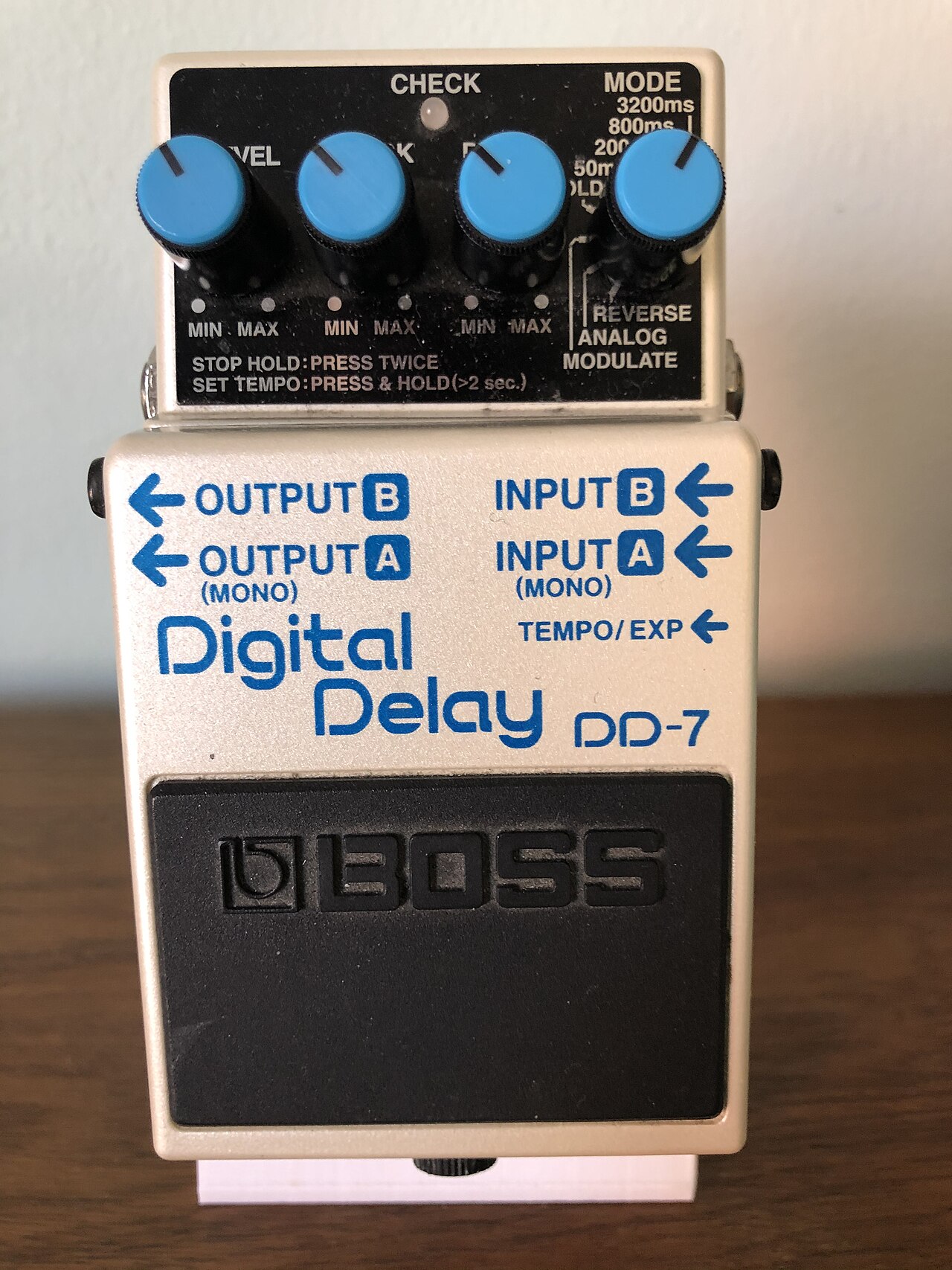
- A Boss DD-7 Digital Delay pedal: Kuriosatempel, Wikimedia Commons, CC BY-SA 4.0.
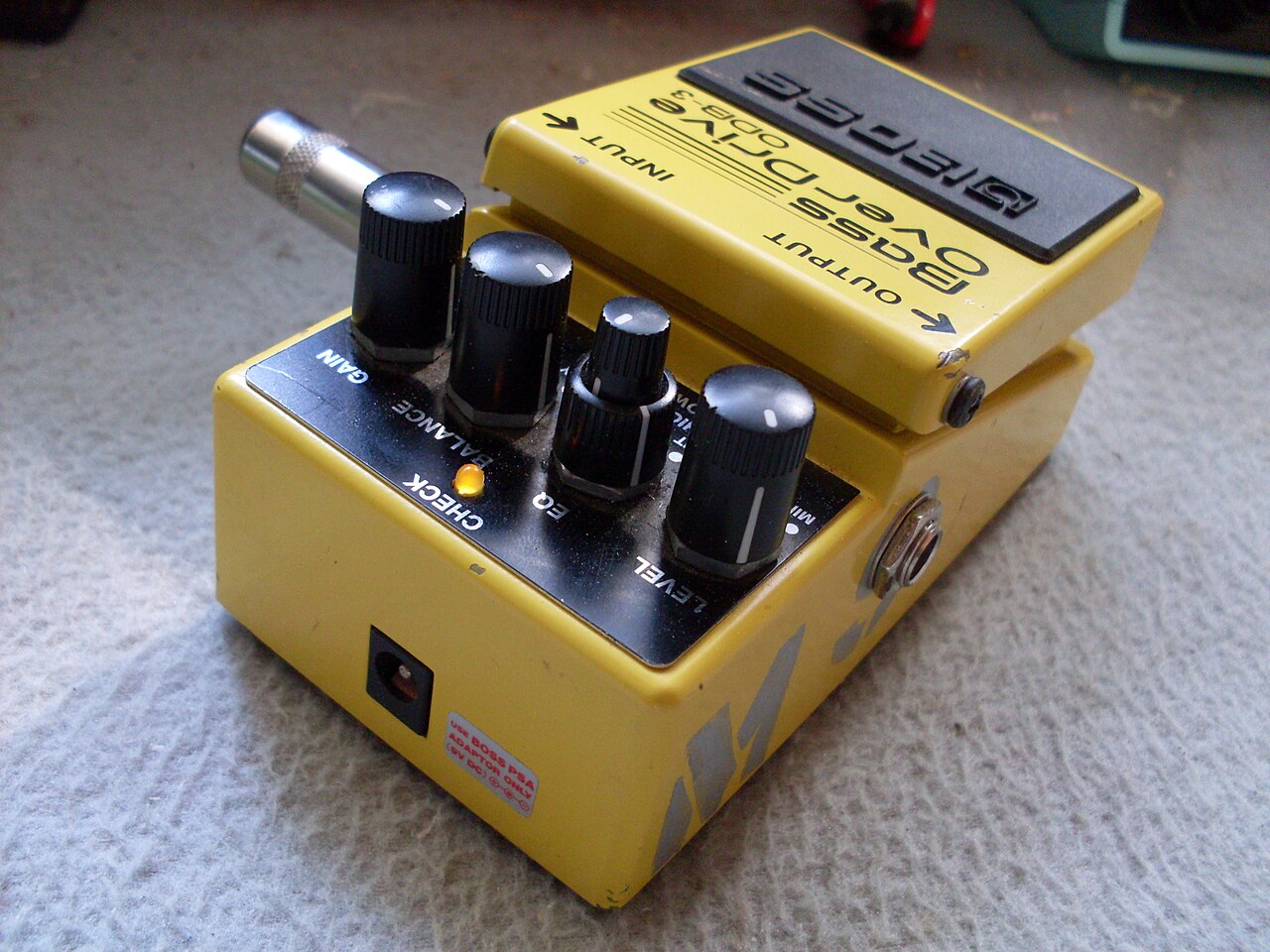
- A Boss ODB-3 bass overdrive pedal seen from the rear: Roadside guitars, Wikimedia Commons, CC BY-SA 2.0.
- Top image: GuitarGangsters AI-generated reference illustration, not a photograph.
Latest News
Related
On This Day
Monday 9 November
From this week: