Meris Enzo Synthesizer: The Pedal That Won 2018 by Refusing to Be a Guitar Pedal
The Meris Enzo was voted 2018's best pedal. Full specs, all four modes, ten tone recipes, verified artist users and how it compares to the Enzo X.
In January 2019, the pedal-news aggregator Delicious Audio did something no single magazine can do: it collected every credible year-end “best pedals of 2018” list it could find — Reverb.com, The Pedal Zone, BestGuitarEffects.com, Popular Mechanics, Pedals and Effects, JHS Pedals, Thomann, Vintage King and videographer Dennis Kayzer — assigned points by chart position, and added them up. The pedal that came out on top was not a fuzz, not a reverb, not an overdrive. It was a $299 box from a four-year-old Los Angeles company that turned your guitar into a two-oscillator synthesizer.
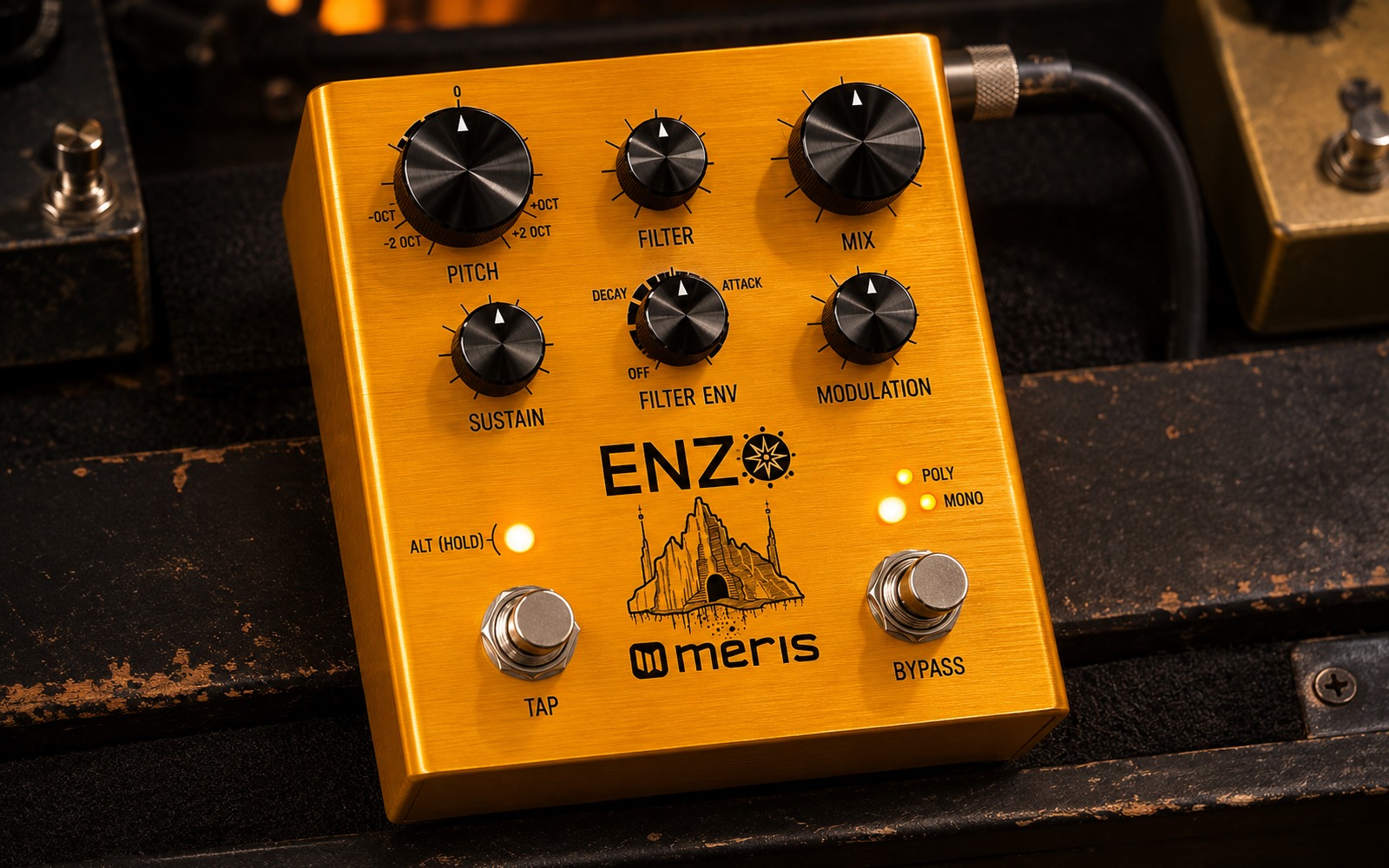
The Meris Enzo beat the Red Panda Tensor, the Chase Bliss Dark World, the EarthQuaker Devices Pyramids, the Chase Bliss Thermae and the Boss Metal Zone MT-2W in that aggregate. It did it with six knobs, two footswitches, one Alt button and absolutely no display. And it did it because, for the first time, a guitarist could buy a genuinely good-sounding polyphonic synthesizer without installing a hex pickup, buying a MIDI converter, or accepting the tracking latency that had made guitar synthesis a punchline since the 1970s.
Eight years later, in September 2026, the Enzo is still in the Meris catalogue at $299 — sitting directly beneath its own $599 successor, the Enzo X — and the used market still refuses to let it go cheap. This is the story of how a pedal that most guitarists cannot fully operate became one of the most quietly influential stompboxes of its decade.
Where the Enzo Came From
Meris: a studio company that wandered onto pedalboards
Meris was founded in 2013 in Los Angeles by Terry Burton, one of the original Strymon engineers, and Angelo Mazzocco, who came out of the DSP department at Line 6 — the same department that produced the Strymon founders. That lineage matters, because it is the reason the Enzo does not sound like a novelty.
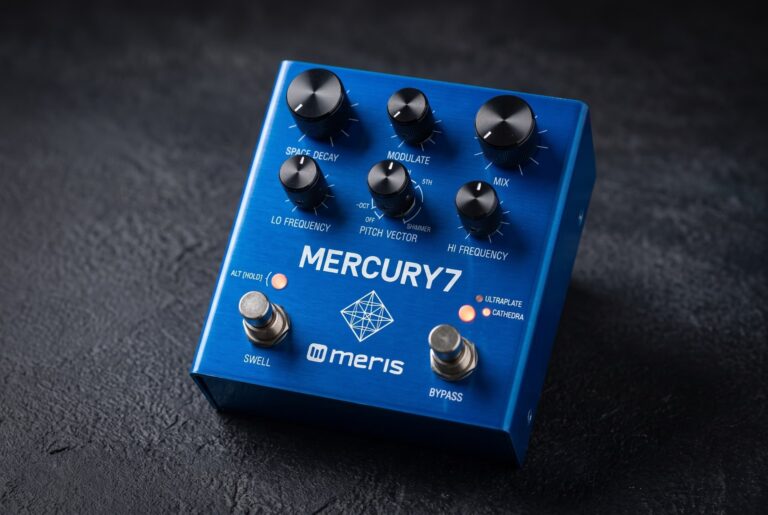
Crucially, Meris did not start as a pedal company at all. It started building 500-series rack modules for professional studios: the 440 Mic Preamp, the Ottobit bitcrusher, the Hedra pitch shifter and the Mercury7 Reverb. The stompboxes only arrived in 2017, and they inherited the studio DNA wholesale — a premium Analog Devices JFET input section, a digitally controlled analog mix control, 24-bit converters feeding 32-bit floating-point DSP, and switchable instrument-or-line headroom on both input and output. That last item is the giveaway. Meris assumed from day one that a synthesist might plug into the Enzo before a guitarist did.
The fourth stompbox
The Enzo was Meris’s fourth pedal, following the Mercury7 reverb, the Ottobit Jr. bitcrusher/sequencer and the Polymoon delay. It was unveiled on 4 September 2018 and shipped from mid-to-late September at $299 in the U.S. and £319 in the U.K. Guitar.com’s launch piece ran under the headline “Meris launches the Enzo, the Ferrari of synth pedals”, and noted with some amusement that the box “has more voices than Billy West.”
It shared the exact form factor of the first three — a compact 4.25 x 4.5 x 2-inch enclosure — which is a large part of why it was so startling. Meris had already trained the market to expect an absurd amount of DSP behind six knobs and an Alt button. The Enzo simply pushed that expectation to breaking point.
MusicTech’s Richard Purvis, reviewing it in January 2019 and awarding it the magazine’s MT Choice badge, framed the ambition precisely: “while we’ve come across plenty of guitar-synthesiser pedals before, this one might just take six-stringers further away from traditional plank-plucking sounds — and in more different directions — than anything that’s come before it.”
Meris Enzo — Full Specifications
The Four Modes, and Why the Fourth One Matters Most
Mono Synth
A dual-oscillator single-voice synthesizer. This is the mode most people expect and the one that tracks best. Single notes in the lower register — or anything played on a bass — track essentially perfectly. As MusicTech put it, once you start moving the mix, sustain and modulation controls, “a whole world of Moog-style sounds — from buzzy square waves to giddy bleeps — begins to emerge.” The two oscillators can be detuned against each other via the Modulation knob, which is where the thickness lives.
Poly Synth
Multi-voice polyphonic tracking that follows actual chords, with no hex pickup and no pickup installation. In 2018 this was the headline. It still mostly works, and it is genuinely disorienting in the best way — warped church organ, Blade Runner pads, something close to a 1990s house synth stab. It is also where the Enzo’s limits show: tracking gets vaguer as you move up the neck, and low-register chords, particularly on bass, can confuse it into dissonance.
Arp Synth
An arpeggiated synthesizer locked to the tap tempo. Reviewers consistently called the arpeggiator intuitive, which is unusual for a pedal with no screen. The catch, reported by owners as often as the praise, is that programming precise arpeggiator speeds via the tap footswitch is imprecise; you get close, not exact.
Dry — the mode that sells the pedal to people who don’t want a synth
Dry mode disables the oscillator section entirely and turns the Enzo into something else: a pitch shifter with the full six-mode filter, the ring modulator, the compressor and the two-tap delay still live on your unprocessed guitar signal. This is where the Enzo functions as a multi-effects unit rather than a synth — auto-wah, filtered delay drones, subtle chorus-like thickening, octave doubling.
It is also, in practice, the mode that most Enzo owners live in. The envelope-follower filter in Dry mode is repeatedly described in owner reviews as best-in-class auto-wah. And it produced the single most reproducible artist setting we found, from Yvette Young of Covet, posted on 2 February 2019: “I found a magical sounding setting on the Meris Enzo that really inspired me to make a loop. I have it set on dry mode with the pitch set to a 4th and then the mix knob about a quarter up.”
Famous Players: What the Evidence Actually Shows
The Enzo occupies an unusual position. It has no signature artist, no Meris endorsement roster and no Premier Guitar Rig Rundown built around it. What it does have is roughly twenty documented users on Equipboard, and unlike most crowd-sourced rosters, a large share of them come with a photograph, a video timestamp or a first-person quote attached. We have graded them by evidence quality rather than fame, and we have flagged what is thin.
Tier 1: filmed, timestamped or quoted
Nick Reinhart (Tera Melos, Death Grips, Disheveled Cuss) is the strongest advocate on record. In a pedal-focused video at the 24:08 mark, he declares the Enzo his favourite pedal and demonstrates several distinct sounds from it. Reinhart is a well-known pedal obsessive whose endorsement of any single box carries real weight precisely because he owns so many.
Yvette Young of Covet not only used it but published her settings, quoted above — Dry mode, pitch at a fourth, mix a quarter up — along with a photograph of the knob positions. That is the rarest artefact in gear journalism: a reproducible artist patch.
James Dean Bradfield of the Manic Street Preachers is shown with the Enzo on his live rig at 39:26 in his own filmed guitars-and-gear interview. This is the most mainstream-rock placement the pedal has, and it is a properly documented one.
Bad Snacks, the producer, violinist and YouTube composer, listed the Enzo (plus a MIDI footswitch) among the pedals in an August 2020 video, alongside a Critter & Guitari Organelle, an NS Design NXT5 electric violin, a Walrus Audio Iron Horse and an Empress ParaEq. The Enzo is also credited on her 2020 album Neat Tape 2.
Andrew Huang — producer, multi-instrumentalist and one of the most-watched music-education channels on the internet — has the Enzo visible in his November 2019 home studio tour at 8:37, and it is credited on his albums Lo-Fi (2017 material) and Alabaster (2019).
Tier 2: photographs from the artists themselves
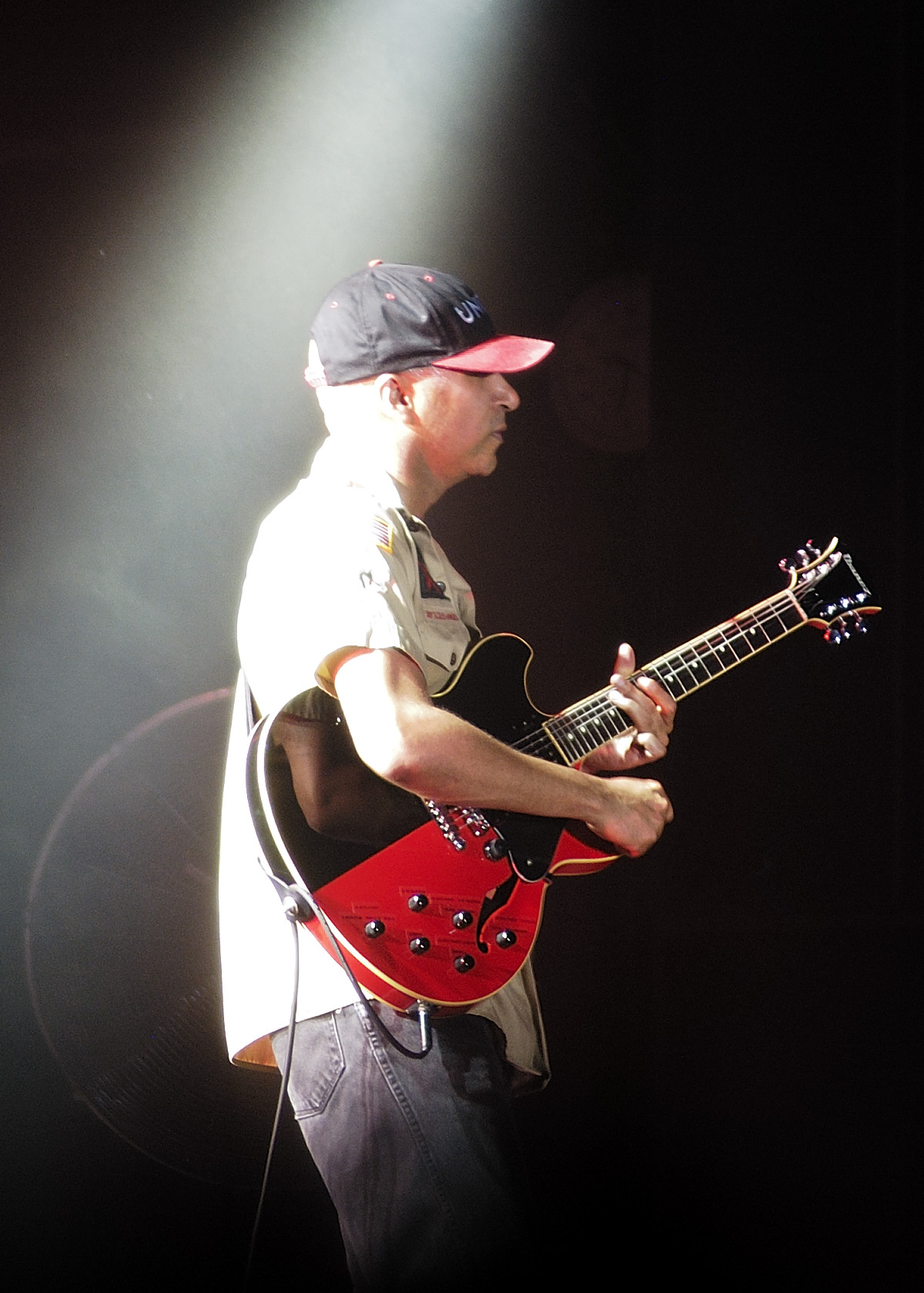
Tom Morello posted an Instagram photo including the Enzo captioned “Spring tryouts. #NewHotJamsPercolating”. This is genuine first-party evidence that the pedal passed through his hands, and it is by some distance the biggest name attached to the Enzo. It is also, we should be honest, a photograph of an audition, not evidence that the pedal made a record or a tour. Anyone reading a Tom Morello gear list should treat the Enzo as a documented experiment rather than a signature tool — his career-defining sounds come from a DigiTech Whammy, a wah and a delay, not from a synth pedal.
Sarah Lipstate, who records as Noveller, explicitly credited the Enzo on Instagram as the source of the synth sounds in a recent piece of music, describing it as an extremely powerful multi-voice synth pedal. Given that Lipstate’s entire body of work is built on turning a guitar into something orchestral, this is a meaningful endorsement from exactly the right kind of player.
Wata of Boris posted the Enzo to her Instagram stories on 24 March 2020. Mike Dawes, the fingerstyle player, has it in a pedalboard photo on his official Instagram. Tycho — Scott Hansen’s project — has an Enzo visible in the foreground of a livestream DJ setup photo. Jean F. of the French psych band SLIFT has one on the pedalboard photographed during their KEXP session. Danish jazz guitarist Jakob Bro has one on his Pedaltrain in a photo circulated by Jazz Pedalboards.
The Enzo is also credited on Love of Lesbian’s 2021 album V.E.H.N. (Viaje épico hacia la nada).
What the roster tells you
Count the roles rather than the names and the picture sharpens. Of the documented users, roughly half are not conventional rock guitarists at all: a producer/DJ, a violinist-producer, a YouTube composer, a fingerstyle acoustic player, a jazz guitarist, an ambient guitar composer. The Enzo’s genre distribution on Equipboard reads Rock 40, Electronic 25, Metal 15, Alternative Rock 13 — but the individually documented users skew far more electronic and experimental than that raw count suggests.
This is the honest editorial conclusion: the Enzo is a guitar pedal that found its real constituency among people who use guitars as sound sources rather than as guitars. If you want a synth pedal to play synth parts in a rock band, the Enzo will do it, but you will be fighting its interface. If you want a texture generator, you are its target customer, and roughly twenty documented artists agree with you.
Tone Recipes and Settings
1. The Yvette Young loop patch (Dry mode)
Mode: Dry. Pitch set to a fourth. Mix roughly a quarter up (around 9 o’clock). Everything else near neutral. This is the artist-published setting and it is deliberately restrained — the shifted fourth sits under the dry signal as a harmonic shadow rather than an effect. Excellent into a looper.
2. Classic Moog-style mono lead
Mode: Mono. Mix full clockwise (synth only). Filter around 11 o’clock, Filter Envelope around 1 o’clock for a percussive opening sweep on each note. Sustain around 10 o’clock. Modulation around 9 o’clock for slight oscillator detune. Play single notes on the neck pickup, below the 12th fret, with the tone rolled back — the cleaner and rounder the input, the better the tracking.
3. Endless synth pad hold
Mode: Poly. Sustain fully clockwise (endless hold). Filter around 10 o’clock, low-pass mode. Alt + Mix to bring in delay. Play a chord, let it bloom, mute the strings — the pad continues. This is the trick that lets a solo guitarist play over their own held chord with no looper, and it is one of the Enzo’s genuine party pieces.
4. Best-in-class auto-wah (Dry mode)
Mode: Dry. Mix at zero synth. Filter around 10 o’clock. Filter Envelope set to a positive, sensitive setting. Choose a state-variable band-pass filter mode via Alt + Filter. Play funk sixteenths. Owner reviews single this out repeatedly as the finest envelope filter they own, and it costs you nothing to use the Enzo as a very expensive Q-Tron on the nights you don’t want a synth.
5. Sci-fi arpeggio bed
Mode: Arp. Tap the tempo in with the tap footswitch. Sustain low so notes are short and staccato. Filter Envelope high for per-step filter movement. Alt + Mix to add delay, Alt + Modulation to set feedback around 11 o’clock. Play triads high on the neck. Add reverb after — a Meris Mercury7 or Walrus Audio Slö both work beautifully in the loop of the same board.
6. Ring-modulated bell chaos
Mode: Poly. Alt + Sustain to bring up the ring modulator. Set a mid-range carrier rate and assign envelope over rate. Filter high-pass. Modulation up. This is inharmonic, atonal and completely uncontrollable in a good way — the sound MusicTech reached for the word “disorientating” to describe.
7. Synth bass (mono, played on a bass)
Mode: Mono. Switch input headroom to instrument level. Filter low-pass around 9 o’clock, resonance moderate. Sustain low. Play single notes, no chords. Owners are consistent: the Enzo tracks bass beautifully in mono and badly in poly, and it lacks the punch of a dedicated analog synth-bass box, so use it for pads and slow lines rather than aggressive funk.
8. Filtered delay drone (Dry mode)
Mode: Dry. Alt + Mix to raise delay level, Alt + Modulation to push feedback close to self-oscillation. Filter sweeping slowly by hand or via expression pedal. Play one note, then stop playing. The two-tap delay at 530 ms with heavy modulation becomes an instrument on its own.
9. Expression-pedal morph wah
Set one full sound with the expression pedal heel-down, a second with it toe-down. MusicTech’s advice here is the important part: “This often works best if the two sounds you’ve selected aren’t too different: changing only the filter settings, for example, results in some radical wah tones.” Morphing between two wildly different patches sounds like a malfunction; morphing between two filter positions sounds like the best wah you have ever used.
10. Split wet/dry to two amps
Configure Split mode in global settings and send the dry signal to one amp and the synth to the other. Owners rate this as the single biggest upgrade to the Enzo’s live usability — it lets the synth voice be mixed independently at the desk instead of fighting your guitar tone in one speaker.
The Enzo has no display and no factory-preset browsing without accessories, so recipes matter more here than on almost any other pedal. All settings assume the six primary knobs unless Alt is specified. Clock positions are starting points, not gospel.
How to Get Into the Deep Settings
Every Enzo knob has a second function accessed by holding the Alt button. There is a third layer beneath that: hold Alt while powering the pedal up and you enter global settings configuration mode, which is where you set stereo behaviour, choose relay true bypass or buffered bypass, and — most importantly — decide what the single TRS jack on the back does.
That jack is the Enzo’s great compromise. It can be an expression pedal, an external tap tempo, the four-button Preset Switch, or MIDI in/out. It cannot be two of those at once. You cannot use an expression pedal and the Preset Switch together, and you cannot swap between them without unplugging the pedal to re-enter global settings. MusicTech flagged this as the pedal’s clearest design compromise and then asked the question that Meris would spend the next seven years answering: “it does make you wonder what a bigger version of this unit could do. Imagine it with a built-in expression pedal and a screen for scrolling through 200 presets…”
The Enzo Versus the Alternatives
Meris Enzo vs Meris Enzo X
The Enzo X, announced in January 2025 at $599, is the answer to that MusicTech question. It brings six-voice polyphony, five modes (Poly Synth, Mono Synth, Dry Poly, Dry Mono, Arp Synth), a colour screen, onboard preset banks, and processing elements borrowed from the Meris LVX and MercuryX. Meris called it “the highest quality and most flexible polyphonic synthesizer ever created in a pedal format.” It is unambiguously the better instrument. It is also twice the price and twice the footprint, and it does not make the original obsolete — the small Enzo remains in the catalogue for a reason, and its Dry mode still does a job the X does not do more cheaply.
Meris Enzo vs Boss SY-1
The Boss SY-1 is the direct opposite philosophy: 121 sounds on a rotary switch, three knobs, plug in and go, no learning curve, roughly a third of the price. It tracks fast and it sounds good, and for a guitarist who wants a synth sound on one song per set, it is the more sensible purchase by a wide margin. The Enzo wins on depth, on the quality of its filter, on stereo operation, on Dry mode and on the ability to build a sound that nobody else has. The Boss SY-200 splits the difference with 171 sounds and onboard memories.
Meris Enzo vs Electro-Harmonix Synth9 and Mel9
The EHX Synth9 and Mel9 are emulation boxes: they aim at specific famous instruments and nail them. Nine presets, two knobs, done. They are far easier to use and considerably cheaper. They are also fixed — you cannot build a sound that isn’t already in the box. Choose EHX for the sound of a named vintage synth; choose Enzo to design something that doesn’t exist yet.
Meris Enzo vs the octave and pitch camp
If what you actually want is a fat sub-octave or a shimmering upper octave rather than a synth, the EHX POG2 or Nano POG track more reliably and cost less. The DigiTech Whammy 5 owns real-time pitch bending outright. The Enzo’s pitch shifting is competent but was repeatedly described by owners as mediocre beyond about five semitones, especially on chords — it is a synth pedal with pitch shifting attached, not a pitch-shifting specialist.
Meris Enzo vs a multi-effects unit
A Line 6 HX Stomp or Eventide H90 will produce synth sounds among a thousand other things, with proper preset management and a screen. Neither has a synth engine as musically satisfying as the Enzo’s, and neither has that six-mode filter. A meaningful number of Enzo owners run it inside the HX Stomp’s effects loop precisely so they can compress both before and after it. That is a signal about which box does which job better.
Meris Enzo vs the Enzo’s own siblings
The Enzo shares its enclosure, its Alt-button interface and its accessory ecosystem with the Mercury7 reverb, the Ottobit Jr. bitcrusher/sequencer and the Polymoon delay. Owners who buy one Meris pedal buy more, which is why the Mercury7 is the single most common pedal on Equipboard boards that also contain an Enzo. The Preset Switch and MIDI I/O interface both work across the range, and the MIDI box handles four pedals at once — the accessory cost only stings once.
Buying Guide
Who the Enzo is for
Buy the Enzo if you are a texture player, a soundtrack or ambient composer, a looper-based solo performer, or a producer who wants a hardware synth voice that responds to a guitar, a bass, a drum machine, a vocal or another synth. The switchable line-level headroom means it is a legitimate studio processor, not a guitar-only device. If your reference points are Sarah Lipstate, Nick Reinhart or Bad Snacks rather than a conventional rock rig, this is your pedal.
Who should think twice
Do not buy the Enzo if you need one synth sound reliably, on cue, in a set, night after night. Without the Preset Switch or a MIDI controller you cannot recall a sound — you have to dial it back in by hand from an unlabelled knob position, and the Alt layer makes that genuinely hard. Owners have gone so far as to recommend printing a transparent overlay to keep track of the alt functions. If that sentence sounds like a chore rather than a hobby, buy an SY-1.
The accessory maths
This is the Enzo’s most-criticised aspect and it deserves plain numbers. The pedal has 16 presets built in and no way to reach them from the pedal itself. The Meris Preset Switch (four presets, around £115) or a MIDI controller plus the Meris MIDI I/O box (around £99) unlocks them. Budget accordingly: a fully functional Enzo rig is closer to $400–450 than $299. Owners are near-unanimous that MIDI control transforms the pedal, and equally near-unanimous that it is irritating to have to pay for it.
Price and availability, September 2026
The Enzo remains a current Meris product, listed alongside Enzo X, Ottobit X, MercuryX, LVX, Hedra, Mercury7, Ottobit Jr. and Polymoon. New street price sits at $299, with Equipboard’s multi-store scan showing a range of $299 to $322 across seven retailers and a stated average of $285. That is the same $299 it launched at in 2018 — eight years of zero price inflation, which is becoming a recognisable pattern across boutique American pedal brands. Stock is intermittent at some dealers, with pre-order backlogs; that reflects small-batch manufacturing, not discontinuation. Used examples hold value stubbornly and rarely dip far below new pricing, which tells you the pedal is still wanted.
Ownership Notes
Power
9V DC centre-negative, under 150 mA, no battery compartment, and no adapter is included in the U.S. package. Use an isolated supply output — a digital pedal of this complexity on a daisy chain is asking for noise. Note also that the relay true bypass means an unpowered Enzo passes no signal at all, so a dead supply output kills your chain rather than merely disabling the effect. If the Enzo lives mid-board, that is worth knowing before a gig, not during one.
Volume management is the real-world issue
The Enzo has no master boost/cut level control, and the synth voice can swing roughly ±10 dB relative to your dry guitar depending on mode and filter selection. Owners report uncontrollable volume spikes, particularly with the Mix knob past noon, and the standard fix is a compressor after the pedal for live use. Different filter modes also have noticeably different output levels, which means any patch change is potentially a level change. Plan for this in your rig rather than discovering it at soundcheck.
Tracking realities
Clean input, neck pickup, tone rolled back slightly, no distortion in front. The Enzo tracks single notes superbly and chords well within reason, but it will produce dissonances on ambiguous input. On bass, mono mode works, poly mode does not, and owners recommend an EQ or octave pedal before the Enzo to shape the input into something the tracker can read cleanly.
Placement in the chain
Early — before dirt if you want the synth to sound clean and be distorted afterwards, after dirt if you want the tracker fed a compressed, sustaining signal. Most owners put it first or near-first, with delay and reverb after it. The Enzo is stereo out, so if it is going to be your stereo split point, everything after it needs to be stereo too.
Frequently Asked Questions
Do I need a special pickup to use the Meris Enzo?
No. That is the entire point of it. The Enzo tracks pitch from a standard 1/4-inch instrument signal, with no hex pickup, no 13-pin cable and no installation of any kind. It works on guitar, bass, keyboards, drum machines, vocals and other synthesizers.
How many presets does the Enzo have, and can I use them?
Sixteen — but not from the pedal itself. Reaching them requires either the optional Meris Preset Switch, which gets you the first four, or MIDI control via the Meris MIDI I/O box or another TRS-MIDI source. An expression pedal can also morph between two settings, which functions as a crude two-preset system. This is the pedal’s most-criticised limitation and the main argument for the Enzo X.
Is the Meris Enzo good for bass?
In mono mode, yes — tracking on single low notes is excellent and it makes convincing synth pads and slow lines. In poly mode, no; it struggles with bass chords, particularly on the low strings. Owners also note it lacks the aggressive punch of a dedicated analog bass synth pedal, so treat it as an ambient and textural tool on bass rather than a funk machine.
Can the Enzo be used as an effects pedal rather than a synth?
Yes, and many owners primarily do. Dry mode disables the oscillators and leaves you a pitch shifter, a six-mode filter with envelope, a ring modulator, a compressor and a 530 ms modulated two-tap delay working on your clean signal. The envelope-follower auto-wah in this mode is widely rated as best-in-class.
Is the Meris Enzo hard to use?
Honestly, yes, at first. Six knobs each have a second function under the Alt button, there is no display, and there is a third layer of global settings you reach by holding Alt while powering up. Most owners report it becomes intuitive after a genuine learning period, and the most commonly recommended way in is to set Arp mode with full sustain and turn one knob at a time to learn what each does.
What is the difference between the Enzo and the Enzo X?
The Enzo X, launched January 2025 at $599, adds six-voice polyphony, five modes including dedicated Dry Poly and Dry Mono, a colour screen with onboard preset navigation, and processing elements pulled from the LVX and MercuryX. The original Enzo is smaller, half the price, three synth modes plus Dry, and requires accessories for preset access. The X is the better instrument; the original is the better value for anyone who mostly lives in one or two sounds.
Does the Enzo have true bypass?
Yes — relay true bypass by default, switchable to buffered bypass in the global settings menu. Because the bypass is relay-based, the pedal passes no signal at all when unpowered, so it is not a “fails safe” device in a chain.
Is the Meris Enzo discontinued?
No. As of September 2026 it remains listed in the current Meris pedal range at $299 alongside the Enzo X, Ottobit X, MercuryX, LVX, Hedra, Mercury7, Ottobit Jr. and Polymoon. Intermittent dealer stock and pre-order waits are a function of small-batch production, not a sign the product has been dropped.
Which famous guitarists actually use a Meris Enzo?
The best-documented users are Nick Reinhart of Tera Melos, who calls it his favourite pedal on camera; Yvette Young of Covet, who published her exact settings; James Dean Bradfield of the Manic Street Preachers, filmed with it on his live rig; Sarah Lipstate (Noveller), who credited it by name for her synth sounds; and producers Andrew Huang and Bad Snacks, who have it on released records. Tom Morello has posted a photo of one, Wata of Boris and Mike Dawes have both shown one on their boards, and Tycho, Jakob Bro and Jean F. of SLIFT all appear in photographs with one. There is no signature artist and no endorsement roster — this is a pedal that spread by word of mouth among sound designers.
Image credits
- Top image: GuitarGangsters AI-generated reference illustration, not a photograph.
- Tom Morello: deep ghosh, Wikimedia Commons, CC BY 2.0.
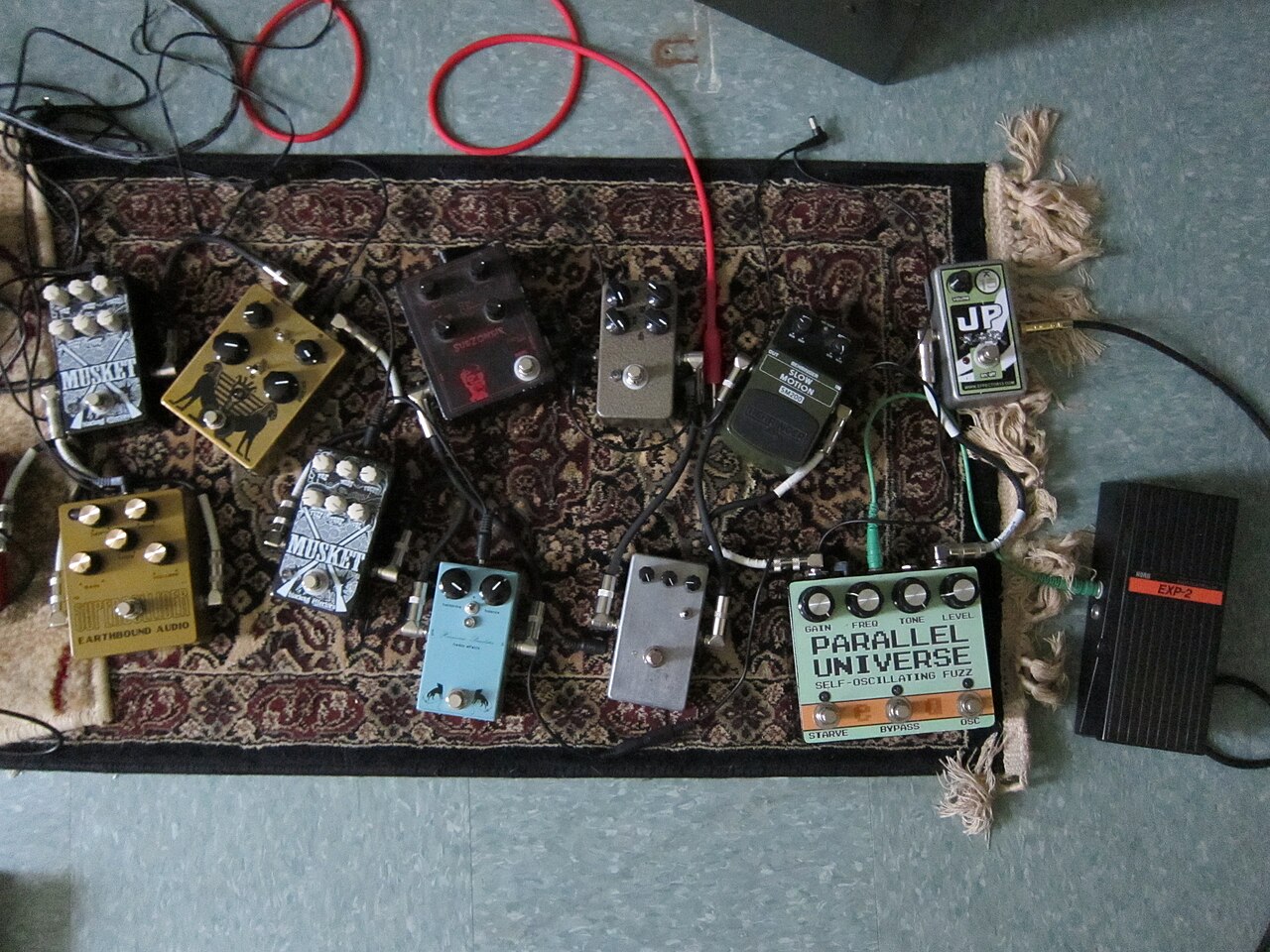
- Guitar pedals on a rug: Oldangelmidnight from Northampton, MA, Wikimedia Commons, CC BY-SA 2.0.
Latest News
Related
On This Day
Monday 9 November
From this week: