Strymon Compadre: The Compressor That Replaced Strymon’s First Pedal
The Strymon Compadre dual voice compressor explained: VCA circuit, Studio vs Squeeze, full specs, honest player check, settings and buying advice.
Every pedal company has an origin story, and most of them are told in the past tense. Strymon’s origin story had a part number. In July 2009, a small outfit in Westlake Village, California — a division of an amp-modelling company called Damage Control Engineering — released a single grey-and-orange box called the OB.1 Optical Compressor & Clean Boost. It was the first thing they ever sold under the Strymon name. Some of the very first Strymon customers in the world were people who bought a compressor.
Then, on 13 March 2020, Strymon published a short and slightly mournful blog post announcing that the OB.1 was dead. Not because it had stopped selling. Because they could no longer reliably buy the part it was built around. The light dependent resistor — the little photocell-and-lamp assembly that gives optical compressors their soft, unhurried squeeze — had become impossible to source in consistent quantities. Strymon could not build the pedal in regular numbers any more, so they stopped building it at all.
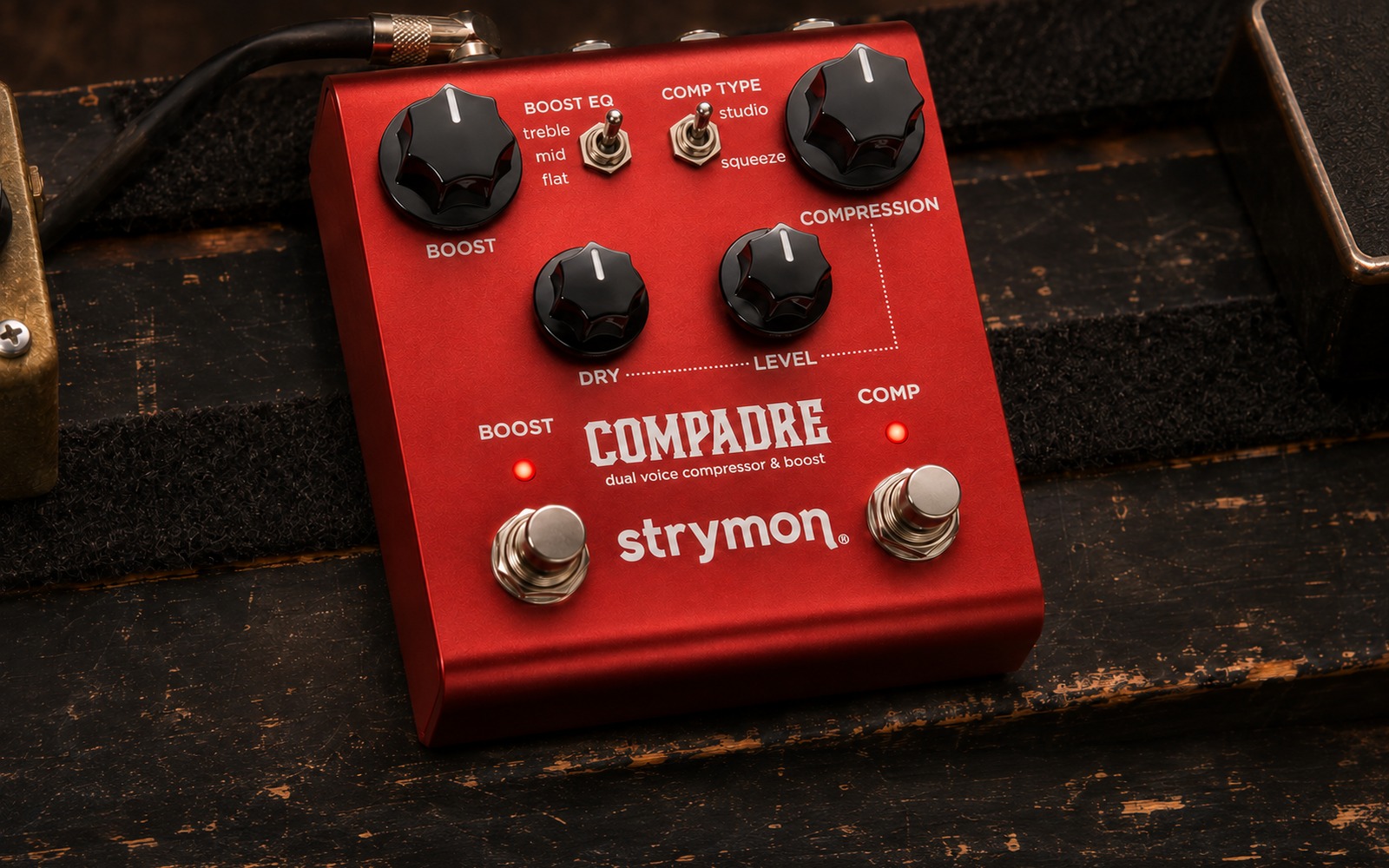
Six weeks later, in late April 2020, the Compadre Dual Voice Compressor & Boost arrived at $299. It occupies the same conceptual space as the OB.1 — compression plus boost, front of chain, always on — and shares almost nothing with it electrically. Where the OB.1 was optical, the Compadre is VCA-based. Where the OB.1 had one compression character, the Compadre has two. Where the OB.1 was a single-footswitch pedal, the Compadre splits compression and boost onto independent switches and then, in a move nobody saw coming from an all-analog stompbox, adds MIDI and 300 preset locations.
Six and a half years on, in September 2026, it is still on Strymon’s site at the same $299, still listed in stock, sitting in a Drive & Compression category alongside the Sunset, the Riverside, and the newer Canoga and Fairfax. That is a long run for a compressor pedal in a market that turns over fast.
Where the Compadre Came From
The OB.1 Problem
It is worth understanding why the OB.1 had to die, because it explains most of what the Compadre is.
Optical compression works by turning the audio signal into light. A lamp or LED brightens as the signal gets louder; a photoresistor sitting next to it drops in resistance as the light hits it; that changing resistance pulls the signal level down. The reason players love optical compressors is that this whole process is physically lazy. The lamp takes time to brighten and longer to dim, and it does not respond in a straight line. The result is a compressor with a soft knee and a naturally sagging release that nobody had to program — it is simply how the parts behave. Transparent, forgiving, never quite catching the transient.
The problem is that this behaviour lives in a component that is not really a standard part. LDRs are not something a manufacturer can order from three interchangeable suppliers. They vary between batches, they have to be matched, and by the late 2010s the global supply had thinned out considerably. Strymon’s post was blunt about it: they were unable to maintain a consistent supply, and so they could not build the pedal in regular quantities.
That is a supply-chain story, not a design story, and Strymon’s engineering response was to stop chasing the part and go after the behaviour instead.
Choosing the VCA
The Compadre is built around a voltage controlled amplifier. A VCA is a gain block whose gain is set by a control voltage rather than by a knob or a photocell. Feed it a control voltage derived from the signal’s own level and you have a compressor — and, crucially, you have a compressor whose attack, release, knee and ratio are all decided by the designer rather than by the physics of a lamp.
This is the same family of circuit that sits inside a great deal of classic studio hardware: the bus compressors on large-format consoles, the rack units that engineers reach for on drums and vocals. Strymon have said the Compadre project began with a study of some of the finest analog compressors ever made, and that using a VCA is what let them tune the exact response and dynamics they wanted for each voicing. That is the trade they made. They gave up the happy accident of the optical circuit and bought back total control.
The signal path is entirely analog from input to output — Class A JFET input, VCA compression, analog boost, diode clipping, no conversion to digital at any point. The digital part of the pedal exists purely to generate control voltages. Digital control messages become analog control voltages, which is how you get recallable presets and MIDI on a pedal whose audio never touches a converter. It is an unusual bit of engineering, and it is the single thing that separates the Compadre from every other well-regarded compressor at its price.
Two Voices, One Reason
Strymon did not build one compressor. They built two and gave you a toggle.
Studio is the mode aimed at the sound of vintage rack compression and console bus compression — smooth, musical, transparent, the effect you notice mainly when you switch it off. It is the closest thing on the pedal to the OB.1’s character, and it is the reason a lot of Compadre owners never move the switch.
Squeeze is the pedal compressor. Harder, more obvious, more sustain, the classic stompbox effect with a compressed attack and a long tail. Strymon paid particular attention to the decay in this mode — the detection circuit was tuned specifically so that heavy compression could be applied without the pumping and breathing artefacts that give cheap compressors away.
Guitar Player, reviewing it, landed on the compliment that most accurately describes what a good always-on compressor does: they called it adept at that “didn’t know I couldn’t live without it until I turned it off” thing. That is a fair summary of Studio mode with the Compression knob at nine o’clock.
Specifications
Famous Players: An Honest Accounting
This is the part of the article where a gear feature normally lists four or five household names and moves on. The Compadre does not support that, and pretending otherwise would be dishonest, so here is what the record actually shows.
Four names are suggested: Brent Mason, Brad Paisley, John Mayer and Lowell George. Every one of them is a legitimate compressor player. Not one of them is a documented Compadre user.

The Lowell George entry is the clearest case. George died in June 1979. The Compadre was released in April 2020, forty-one years later. His famous compressed slide tone came from a very different world — an early stompbox compressor into a Dual Showman, plus the physical compression of a heavy-gauge string under a Sears socket wrench. He could not have played this pedal and no source claims he did.
Brent Mason, Brad Paisley and John Mayer are all associated with compression in a much more real way, but with specific and well-documented boxes that are not this one. Mason’s Nashville session tone is welded to a particular vintage stompbox compressor that has been part of his chain for decades. Paisley’s board has been photographed repeatedly and its compression comes from elsewhere. Mayer’s compressor choices have changed several times across his signature-pedal era and have been covered in detail by interviewers, and the Compadre has not appeared among them.
What the crowd-sourced gear databases actually return for the Compadre, as of this writing, is a single confirmed artist entry — the Japanese player Ejima Harushi. One. For a pedal that has been in continuous production for six and a half years and is widely praised by reviewers, that is a striking number, and it is worth explaining rather than hiding.
Why a Great Compressor Has No Famous Users
There is a structural reason, and it applies to almost every compressor ever made.
Rig rundowns and pedalboard photos capture what is visible and what is talked about. A guitarist will happily spend five minutes of an interview on a fuzz pedal, because the fuzz is the sound. Nobody spends five minutes on the compressor at the front of the chain, because the compressor is not a sound — it is a condition. It changes how the amp responds. It sits under everything. When it is working properly it is inaudible as an effect, and when the player describes their tone they credit the amp, or the pickups, or the drive pedal that the compressor is quietly making sound better.
Add to that the fact that the Compadre is an enclosure with no visual drama — a plain box in a sea of plain boxes at the top left corner of a board — and you have a pedal that is used far more than it is documented. Compare the situation with the MXR Dyna Comp, which has an enormous documented user list. That is not because the Dyna Comp is better. It is because it has been in production since 1972 and has had five decades of interviews to accumulate mentions.
The honest conclusion is this: the Compadre has no famous-player story, and buying it on the strength of one would be buying a story that does not exist. What it has instead is an unusually consistent press record. Guitarist praised the way the boost and compression sections mesh into a front end that brings out the best in an amp. Premier Guitar noted that it balances classic compression formulas without overwhelming you with options. MusicRadar called it an ideal one-box solution and an obvious candidate for always-on duty. Reviewers who use pedals professionally rate it highly. Interview transcripts simply do not talk about compressors.
Tone Recipes and Settings
1. The Always-On Amp Upgrade
The setting most Compadre owners land on and never leave.
- Comp Type: Studio
- Compression: 9 to 10 o’clock
- Dry: 11 o’clock
- Level: Noon (unity), or a hair above
- Boost: Off
This is barely compression at all in the audible sense. What it does is even out pick attack, add a small amount of sustain, and let the Class A JFET input do its work on the front end of the amp. Switch it off mid-phrase and the amp sounds like someone put a blanket over it — that is the whole point. Into a blackface-style clean channel or a low-wattage combo, this is the setting that makes people say the amp sounds different without being able to say why.
2. Nashville Squeeze
The chicken-pickin’ and country hybrid-picking sound, and the one place where Squeeze earns its name.
- Comp Type: Squeeze
- Compression: 1 to 2 o’clock
- Dry: Fully counter-clockwise, or 9 o’clock at most
- Level: Noon
- Boost: On, Clean, Treble EQ, Boost at 9 o’clock
Squeeze mode plus a treble-shaped clean boost gives the compressed pop and long bloom that this style lives on. Keep Dry low here — the whole effect depends on the compressor actually controlling the transient rather than letting the dry signal punch through it. Roll Compression back a little if you play with a lot of right-hand dynamics and want them back.
3. Parallel Compression for Heavy Playing
The Dry knob is the Compadre’s most underused control, and it exists for exactly this.
- Comp Type: Squeeze
- Compression: 2 to 3 o’clock
- Dry: 1 to 2 o’clock
- Level: Noon to 1 o’clock
This is the studio technique of blending a heavily compressed signal back underneath the untouched original. You get the sustain and body of extreme compression with the attack of an uncompressed signal sitting on top, which is what stops palm-muted riffing from going soft. Strymon put this on the front panel deliberately — most pedal compressors at this price do not give you a blend at all, and it is one of the strongest arguments for the Compadre over a simpler box.
4. Solo Lift Without a Second Drive Pedal
- Comp side: Studio, Compression at 10 o’clock, Dry at noon, Level at noon
- Boost Type (rear): Dirty
- Boost EQ: Mid
- Boost: 11 o’clock to 1 o’clock
Because the boost is post-compression and on its own footswitch, this gives you a genuine lead lift rather than just more compression. The Dirty setting introduces diode soft clipping — not a lot of it, but enough that into an already-breaking amp you get the mid-forward push people usually reach for a Tube Screamer to get. With Mid EQ selected it sits in roughly the same tonal territory, minus the tight low-end squash.
5. Clean Volume Pedal, No Tone Loss
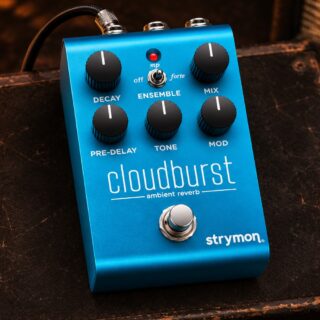
Plug a TRS expression pedal into the Volume jack and you get full-time VCA-based volume control. This deserves more attention than it gets: a passive volume pedal loads your signal and changes your top end as you sweep it, and even good ones need careful impedance matching. A VCA does not have that problem, because the audio is being attenuated by a gain cell rather than by a potentiometer in the signal path. If you do swells — into a BlueSky or Cloudburst, say — this is one of the cleanest volume-pedal implementations available at any price, and it is essentially free with the pedal.
6. Bass
Strymon list the Compadre for guitar and bass, and it is genuinely good on bass. Studio mode at 11 o’clock with Dry around 1 o’clock keeps the fundamental intact while controlling the string-to-string level variation that plagues DI recording. Flat boost EQ with the Clean setting gives a level lift that does not change the voicing.
The Compadre is easier to dial than most compressors because two of the hardest parameters — threshold and makeup gain — are handled automatically. You are not balancing four interacting controls. You are choosing a voice, choosing how much, and deciding how much dry signal to leave alone.
How It Compares
Compadre vs the Simple Stompbox Compressors
Against a Dyna Comp, the Compadre is not really competing. The Dyna Comp is a one-sound pedal and that sound is a strong, coloured, noisy squash that has been on more hit records than anyone can count. Buy it for the character. The Compadre’s Squeeze mode is aimed at similar territory but is cleaner, quieter and blendable, which some players will read as an improvement and others as the point being missed.
The Xotic SP Compressor is the closer comparison in intent — small, high-quality, has a blend control, aimed at always-on use. It is also a fraction of the size and roughly half the money. If your requirement is genuinely just “good transparent compression with a blend”, the SP does it and costs less. The Compadre’s case is everything around the compressor: two voices, an independent boost with three EQ curves and two clipping options, the expression volume, and the presets.
The Keeley Compressor Plus and the Wampler Ego are the two most direct rivals in the boutique bracket, both offering blend and both very well regarded. Neither offers a second compression voice, a footswitchable boost, or MIDI. Both are cheaper. This is a genuine three-way choice rather than a clear win, and it comes down to whether the boost section and the switching matter to you.
Compadre vs a Separate Compressor and Booster
The alternative to the Compadre is two pedals: a compressor of your choice plus a dedicated boost like the Xotic EP Booster or the Keeley Katana. Two pedals will usually cost less than $299 combined and will give you a wider choice of flavours.
What you lose is board space, one power outlet, one patch cable, and the ability to recall both at once from a MIDI controller. The Compadre’s boost is also specifically voiced to work with its own compressor and to sit after it, which is not something you can guarantee with a generic booster in a generic position. Whether that integration is worth $299 depends entirely on how tight your board is.
Compadre vs the Rest of the Strymon Line
The Compadre is one of only three all-analog pedals in the current Strymon catalogue, alongside the Canoga and the Fairfax. Everything else the company is famous for — the TimeLine, the BigSky, the El Capistan, the Flint, the Mobius — is DSP. That makes the Compadre something of an outlier: the same MIDI ecosystem, the same build standard, the same industrial design language, but with a signal path that never leaves the analog domain.
If you are already running Strymon time-based effects and a MIDI controller, the argument for the Compadre gets considerably stronger, because it slots into a system you have already paid for. If it would be your only MIDI-capable pedal, you are paying for a feature you will not use, and one of the cheaper rivals above is the more rational purchase.
Compadre vs the OB.1 It Replaced
Used OB.1 prices have held up well, and the pedal has a devoted following — there are people who will tell you flatly, years later, that it is the best compressor ever made. They are describing a specific optical behaviour that the Compadre does not attempt to imitate. Studio mode is the closest approach and it is smoother and quieter than the OB.1, but it is not the same effect. If you specifically want optical compression, buy an optical compressor. If you want a well-designed, very quiet, very flexible front-end box, the Compadre is the better tool by a wide margin.
Buying Guide
New
$299 direct from Strymon and from authorised dealers, unchanged since launch, which after six years of general price inflation across the pedal market is effectively a price cut. Availability is good; this is not a limited or rotating product. A power supply is not included, and this matters — see below.
Used
Used Compadres turn up regularly and typically trade at a meaningful discount to new. Because the enclosure is a standard Strymon medium box with no moving parts beyond two switches, three toggles and six pots, there is very little to go wrong. Check the two footswitches for reliable engagement, check that both toggles seat firmly in each position, and check the rear Boost Type switch specifically, since it is the least-used control and therefore the most likely to have been ignored by the previous owner.
Who Should Buy It
The Compadre makes most sense for three kinds of player. First, anyone building a permanent always-on front end and wanting compression and boost handled properly in one enclosure. Second, anyone already running a MIDI pedalboard who wants their compression settings to change with the rest of the rig. Third, players who need genuinely different compression characters in the same set — a transparent Studio setting for rhythm and a hard Squeeze setting for a clean lead section — without carrying two compressors.
Who Should Not
If you want a specific vintage compressor character, buy that character. If you have no board-space constraint and no MIDI, cheaper pedals will get you most of the way. And if you are shopping for a compressor because a famous player’s name is attached to it, the Compadre is the wrong pedal — there is no such name here, and that is the honest answer.
Ownership Notes
Power is not optional and not casual. Minimum 150 mA at 9V DC centre-negative, standard 5.5 mm x 2.1 mm barrel. There is no battery compartment, so the pedal simply does not function without a supply. A daisy chain shared with several other pedals will very likely leave it short of current, and an under-powered Compadre can behave erratically rather than failing cleanly. Give it its own isolated output.
Placement. The compressor wants to be early — typically first, or immediately after a wah or tuner. The Class A JFET input is a high-impedance front end designed to see your guitar directly, and putting drives or fuzzes before it changes what the detection circuit is reacting to. The boost, notably, is fixed post-compression inside the pedal, which is the correct order and one less thing to think about.
Fuzz users, one caveat. Germanium fuzzes want to see a guitar pickup, not a buffered low-impedance output. If you run a vintage-style fuzz, it needs to go before the Compadre, which means the fuzz is no longer being compressed. This is a general truth about buffered pedals rather than a Compadre flaw, but it catches people out.
The Favorite switch is cheap flexibility. A MiniSwitch on the Fav/MIDI jack gives you one-button recall of a stored setting without needing a MIDI rig at all. For most players this is the practical version of the preset feature and costs far less than a controller.
Level is not makeup gain. Because makeup gain is automatic, the Level control is a final trim, −6 to +6 dB, with unity at noon. If you find yourself needing to push it hard to keep volume consistent when switching the compressor in and out, the fix is usually to reduce Compression or raise Dry, not to keep turning Level up.
Frequently Asked Questions
Is the Strymon Compadre digital?
No, not in the audio path. The signal is fully analog from the Class A JFET input through the VCA compressor and the boost circuit to the output, and is never converted to or from digital. The digital section exists only to turn control messages into analog control voltages, which is what allows MIDI and preset recall on an otherwise analog pedal.
What is the difference between Studio and Squeeze mode?
Studio is smooth, transparent compression modelled on the behaviour of vintage rack units and console bus compressors — you notice it mainly by its absence. Squeeze is a harder, more obvious compression with heavier gain reduction and maximum sustain, in the tradition of classic guitar stompbox compressors. Studio for always-on duty; Squeeze for country picking, funk and sustained clean leads.
How much boost does the Compadre give?
Approximately 14 dB at maximum, measured with the flat EQ and clean boost settings. The Treble and Mid EQ curves change the frequency distribution rather than adding to that ceiling, and the Dirty setting substitutes soft clipping for some of the available headroom.
Does the Compadre replace an overdrive pedal?
Partly. The Dirty boost uses diode soft clipping and, with the Mid EQ curve selected, gets into recognisably Tube Screamer-adjacent territory when it is pushing an amp that is already close to breakup. It is not a substitute for a dedicated drive with its own gain and tone controls, and it will not do high-gain. As a lead lift on a clean or edge-of-breakup amp, it does the job.
Can I use the Compadre on bass?
Yes. Strymon list it explicitly for guitar and bass, and the combination of a high-impedance JFET input, automatic makeup gain and a front-panel dry blend makes it well suited to bass, where preserving the fundamental while controlling level variation is the whole task.
Does the Compadre need a special power supply?
It needs 9V DC centre-negative at a minimum of 150 mA, which is more than many nine-volt pedals draw and more than a shared daisy chain will typically deliver. No battery operation is possible. An isolated output on a decent supply is strongly recommended.
Which famous guitarists use the Strymon Compadre?
Very few are documented, and this article does not claim any that cannot be verified. Public gear databases list essentially one confirmed artist, Ejima Harushi. Names sometimes associated with the pedal in listings and search results — Brent Mason, Brad Paisley, John Mayer, Lowell George — are compressor players in general but not verifiable Compadre users, and Lowell George died in 1979, four decades before the pedal existed. Compressors are systematically under-reported in rig rundowns because they are heard as a condition rather than as an effect.
Is the Compadre still being made in 2026?
Yes. As of September 2026 it remains listed on Strymon’s own site at $299 with in-stock availability, alongside the Canoga and the Fairfax in the analog pedal category. There is no discontinuation notice, which is worth checking directly before any purchase, since Strymon do post them clearly — as they did for the OB.1 in March 2020.
Image credits
- Top image: GuitarGangsters AI-generated reference illustration, not a photograph.
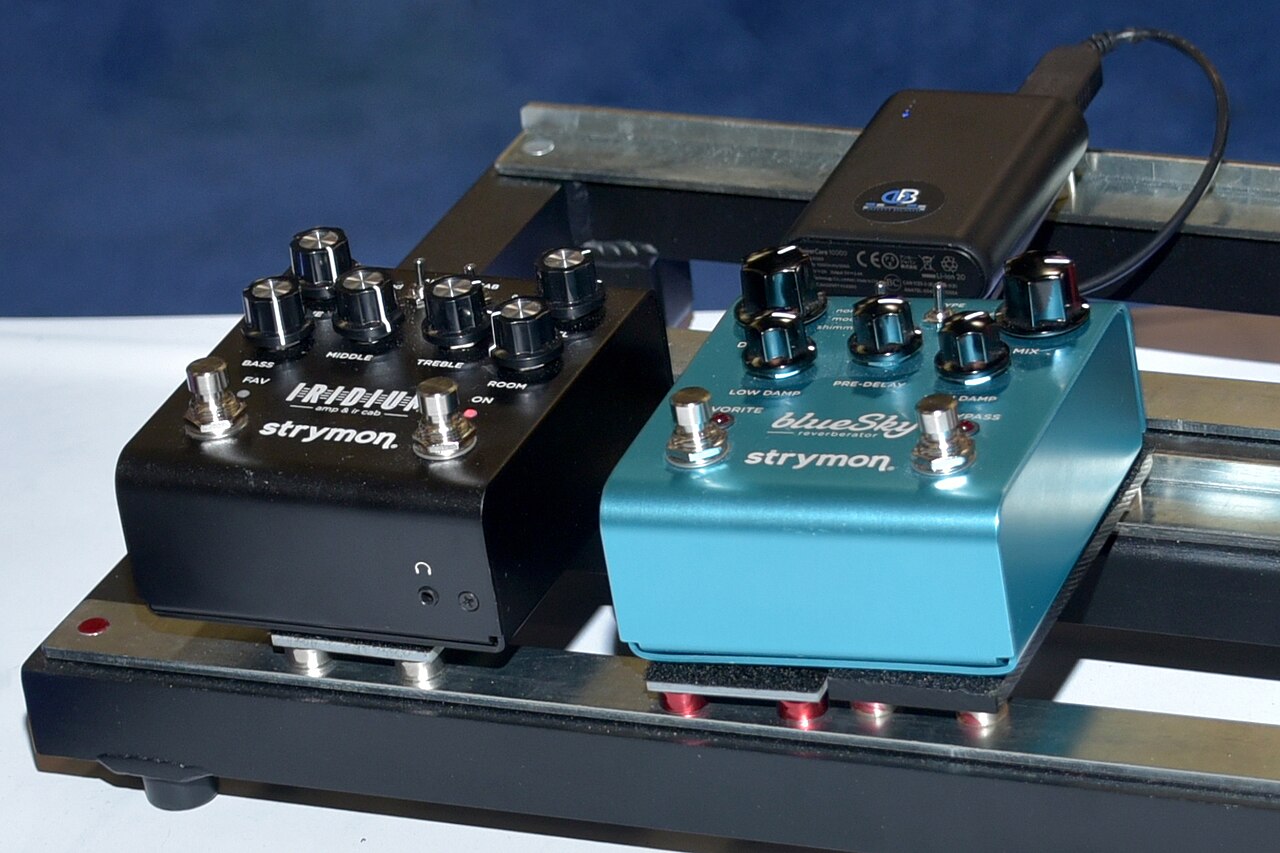
- Strymon effects pedals on a pedalboard: Toglenn, Wikimedia Commons, CC BY-SA 4.0.
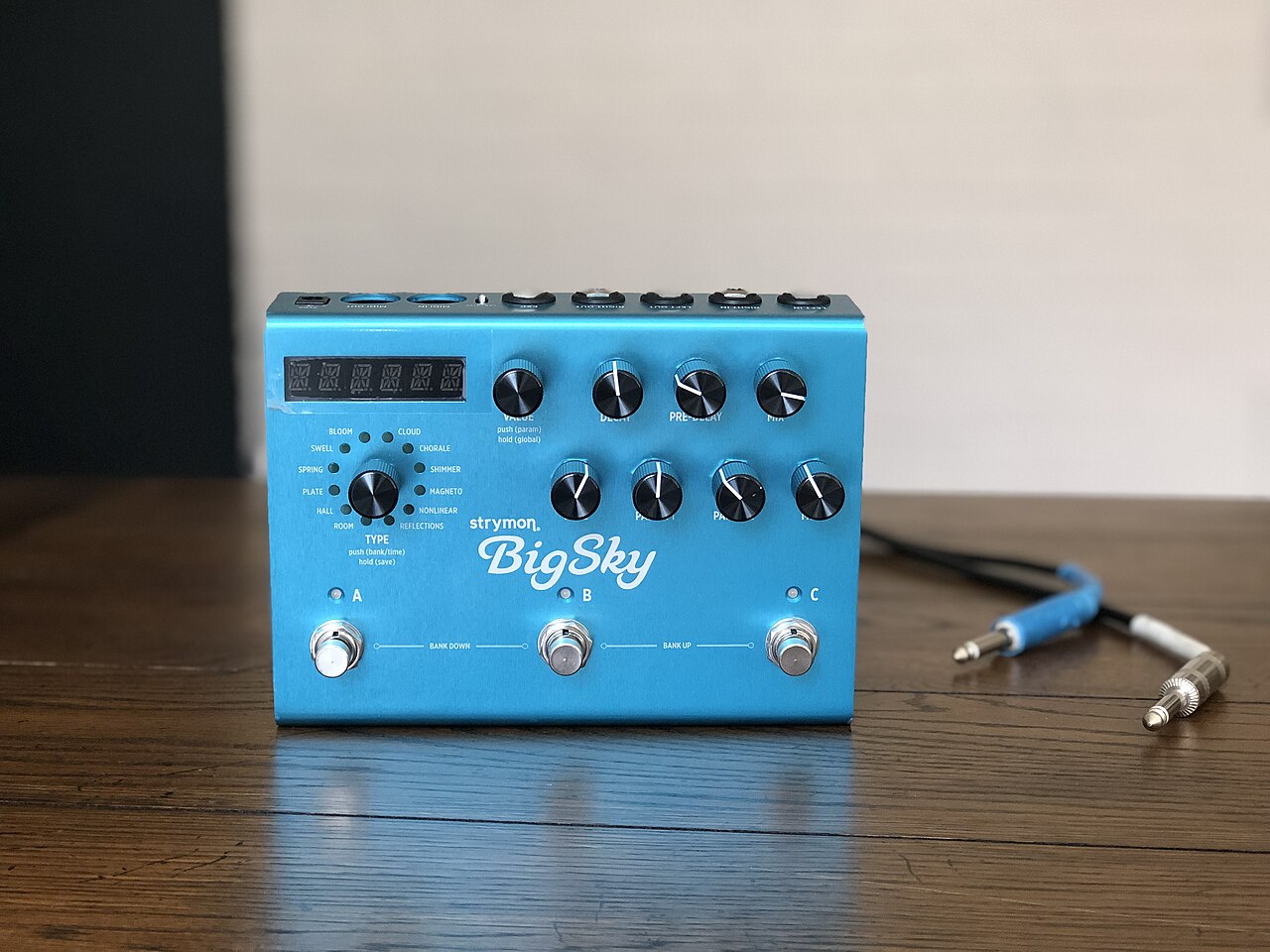
- A Strymon BigSky reverb pedal on a table: Guitar Chalk, Wikimedia Commons, CC BY 2.0.
- Brad Paisley: RFdeRooij, Wikimedia Commons, CC BY 2.0.
Latest News
Related
On This Day
Monday 9 November
From this week: