Empress Compressor MKII: The Studio Rack That Learned To Live On A Pedalboard
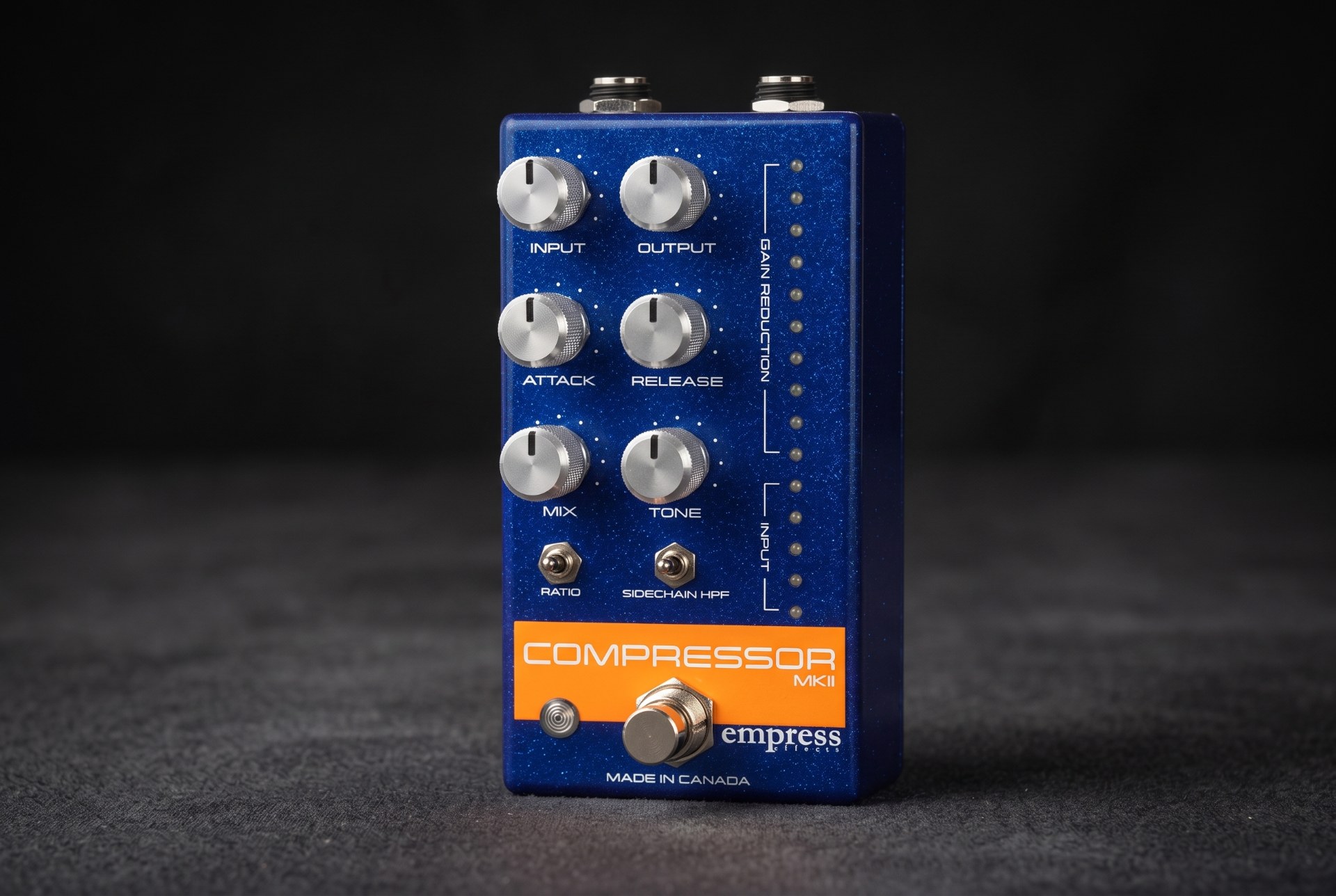
An AI-generated illustration of the Empress Compressor MKII.
The Empress Compressor MKII explained: FET circuit, tilt EQ, sidechain filter, full specs, verified players, nine tone recipes and buying advice.
There is a particular kind of guitarist who has never owned a compressor and never understood why anyone would. The pedal does not make a noise. It has no wet signal you can point at. You switch it on, and if it is doing its job properly, nothing appears to happen — and then you switch it off, and the whole rig sounds like it has been kicked down a flight of stairs.
The Empress Effects Compressor MKII is built for the moment that penny drops. It is an all-analog FET compressor from a five-person shop in Ottawa, Ontario, and it does something almost no other stompbox compressor was willing to do when its ancestor arrived in 2011: it hands you the actual controls. Not “sustain” and “level.” Not one knob labelled “comp.” Ratio. Attack. Release. Input. Output. Mix. A tilt EQ. A sidechain high-pass filter. A sidechain send and return so you can key the thing off a completely different signal. Ten segments of gain-reduction metering and ten more of input metering, in LEDs bright enough to read on a dark stage.
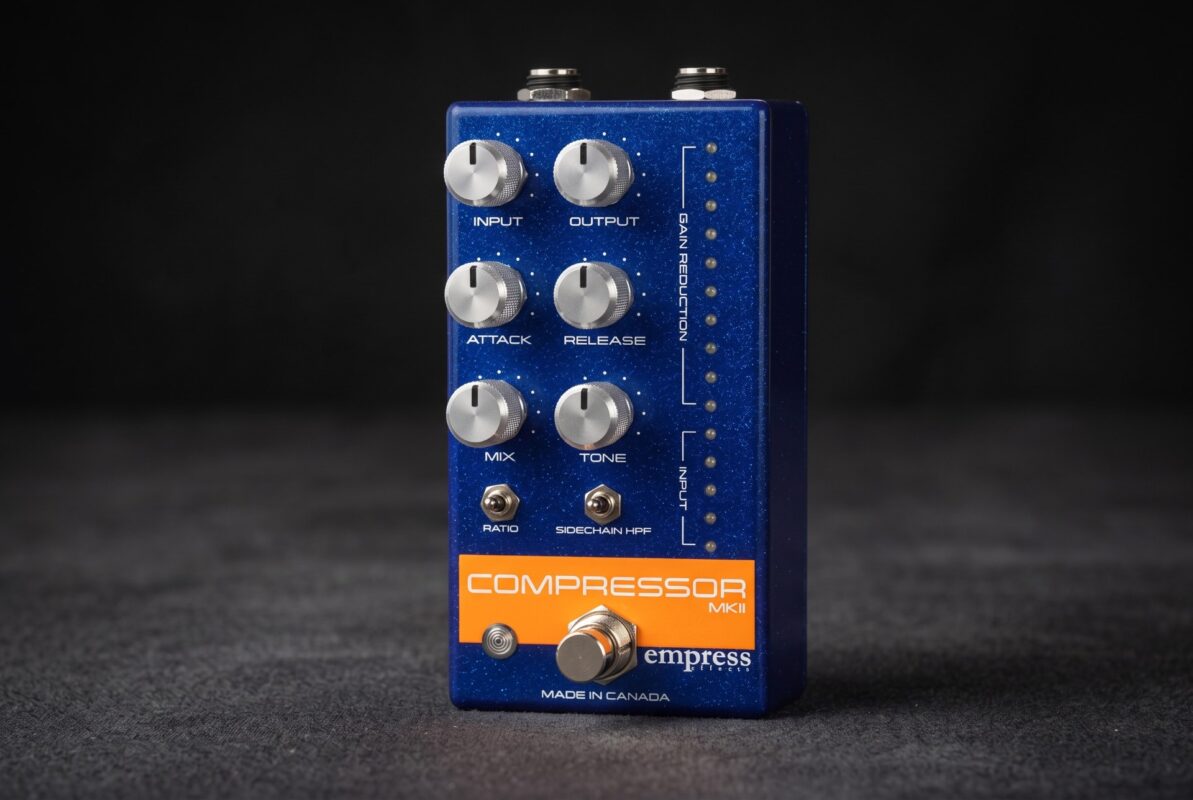
It is, in other words, a rack compressor with a footswitch bolted to it. And in 2026, sixteen years after the original prototype was first spotted, it is still in production at $274 USD direct from Empress, with essentially no cheaper way to get the same feature set.
This article is a feature, not a review. Here is where the MKII came from, exactly what every control does, who genuinely uses it, what it will and will not do for your sound, and how it stacks up against the compressors it is actually competing with — including a few uncomfortable facts about the artist claims floating around the internet.
Where The Compressor MKII Came From
Ottawa, 2011: The Original
Empress Effects is the work of founder and electronics designer Steve Bragg, running a small outfit in Ottawa, Ontario. By 2011 the company already had a cult following on the strength of the Superdelay, the Phaser and the Multidrive — pedals with a reputation for doing one thing with an obsessive, almost engineering-lab level of control.
On 27 July 2011, Empress announced the Compressor, shipping in the first week of August at a street price of $249. The press release made one claim that told you exactly what the company was aiming at: “Fast attack times (down to 50 microseconds) allow for 1176-like compression that has been unavailable in a pedal until now.”
That reference matters. The Universal Audio 1176 is a FET limiter from 1967, and its whole personality comes from being violently fast — attack times measured in microseconds rather than milliseconds, fast enough to catch the leading edge of a pick attack before it happens. Almost no pedal compressor of the era could do that. Most stompbox compressors are optical or OTA designs with a lazy, forgiving response, which is precisely why they sound the way they do. Empress went the other way and built a FET circuit that could genuinely be set fast enough to behave like studio hardware.
Premier Guitar reviewed the original in October 2011 (Jordan Wagner, November 2011 issue), scored it 4.5 out of 5 and called it, flatly, “one of the best on the market today.” Wagner’s most useful observation was about note separation rather than sustain: at 4:1 through a Fender Blacktop Telecaster into a ’65 Twin Reverb reissue, the compressor “yielded a discernible yet subtle improvement without spoiling the magical Telecaster-meets-Twin tone,” and switching to 10:1 left him “floored at some of the poppin’ country tones.” His verdict on the Attack and Release pair — that they are “the real treat” of the pedal and that their effect is subtle until you learn what to listen for — still describes the MKII exactly.
The catch in 2011 was the box. The original Compressor was a full-width enclosure with side-mounted jacks and no battery option, and it ate pedalboard real estate at a time when boards were getting more crowded, not less.
NAMM 2020, Then A Nine-Month Wait
Prototypes of a new, much smaller Empress compressor were spotted at the Empress booth at NAMM in January 2020. Then the world did what it did in 2020, and the pedal did not appear.
The announcement finally landed on 12 November 2020, with both the Compressor MKII and a separate Bass Compressor going on sale on 25 November 2020 at $249 each — the same number the original had launched at nine years earlier. Empress’s own framing was straightforward: “based on our users’ valuable feedback, we’ve taken everything great about our original Compressor and made it even better.”
What actually changed, in order of how much it matters:
- The tilt EQ. A genuinely new tone control the original did not have at all.
- The internal sidechain high-pass filter. Previously you needed an external EQ in the sidechain loop to do this. Now it is a three-position switch.
- The enclosure. Roughly half the size of the original, with top-mounted jacks and top-mounted power.
- The sidechain jack. Moved from 1/4″ to a 3.5mm TRS send-and-return.
- The metering. Same ten-segment concept, smaller and better-looking LEDs.
- The finishes. Blue sparkle or silver sparkle, replacing the original’s single blue.
Everything else — the FET topology, the 2:1/4:1/10:1 ratio switch, the attack and release ranges, the parallel mix knob, the transparency — carried straight over. This is a refinement, not a redesign, and Empress has never pretended otherwise.
Full Specifications
Every Control, And What It Actually Does
Input
This sets the level going into the compression engine, and it is the most misunderstood knob on the pedal. It is not a volume control. Because the MKII has a fixed internal threshold, Input is how you set sensitivity: drive the circuit harder and more of your signal crosses the threshold, so you get more compression. A Strat with vintage-output single-coils and a Les Paul with hot humbuckers will want noticeably different Input settings for the same amount of squeeze, and this is the knob that reconciles them.
Set Input by watching the input meter, not by ear. That is what it is there for.
Attack
How fast the compressor clamps down once the signal crosses the threshold. Counter-clockwise is fast, clockwise is slow, and the full sweep runs from 50 microseconds to 50 milliseconds — a thousand-fold range.
Fast attack catches the pick transient and flattens it: this is where you get the smooth, even, almost pedal-steel quality that country and worship players want. Slow attack lets the transient through before the compression arrives, which preserves and can even exaggerate your pick attack — more percussive, more aggressive, better for funk and for anything where the rhythmic edge is the point. Most players who complain that “compressors kill my attack” have simply never moved this knob off fast.
Release
How fast the compressor lets go. Range is 50 milliseconds to 1 second. Short release settings can pump audibly if you push the ratio, which is either a defect or a feature depending on the record you are trying to make. Long release settings sound smoother and more continuous but can leave the signal sounding slightly held down between phrases.
Attack and Release are the two controls that make this pedal worth its price and also the two that make it intimidating. They interact. Nothing about the MKII teaches you compression — it just refuses to make the decisions for you.
Ratio
Three positions, no more:
- 2:1 — gentle, largely transparent, an evening-out rather than an effect. This is “always-on” territory.
- 4:1 — the general-purpose setting. Obvious compression that still sounds like your guitar. The rest of the controls become audible here.
- 10:1 — heavy. Country squash, synth-flattening, palm-mute levelling.
Worth being honest about: even at 10:1 the MKII is not a true limiter. If you need a brick wall, this is not the box, and the reviewers who work exclusively with compressors say so plainly.
Mix
Blends the compressed signal against the untouched dry signal — parallel compression, or “New York style,” lifted straight from studio practice. Fully clockwise is 100% wet, fully counter-clockwise is 100% dry.
The trick that makes parallel compression so useful: dial in an amount of compression that would be far too much on its own, then blend the dry signal back until the dynamics return. You get the sustain and density of heavy compression with the feel and transient detail of no compression at all. On the MKII this is a knob, not a menu, and it is the single fastest route to a setting that sounds good.
Output
Make-up gain. It has no effect on the compression circuit at all — it only compensates for level lost to gain reduction. There is a great deal of gain available here, enough that people genuinely use the MKII as a clean boost into an already-cooking amp.
Tone (Tilt EQ)
The headline addition over the original. A tilt EQ is a single control that pivots the whole frequency response around a fixed point — here, 500Hz. Clockwise boosts treble and cuts bass; counter-clockwise boosts bass and cuts treble. There is a detent at noon so you can find flat by feel.
The reason this matters on a compressor specifically: heavy compression tends to reveal top end that was previously masked by transients, and can make a guitar sound thin or brittle. A tilt control lets you correct that in one move rather than reaching for a separate graphic EQ. It is a very small amount of EQ doing a very targeted job, and it stays remarkably transparent for something that is, definitionally, colouring the signal.
Sidechain High-Pass Filter
The other genuine upgrade. A compressor’s detection circuit hears everything, and low frequencies carry the most energy — so a low E hit hard triggers far more gain reduction than a high note played at the same perceived volume. The result is the low end dragging the whole signal down every time you touch it.
The three-position switch filters the low frequencies out of the detection path only, not out of your actual signal. Left is 120Hz, centre is off (full range), right is 240Hz. Set it to 240Hz on a heavy palm-muted riff and the compressor stops flinching every time the low string speaks.
This is the feature that turns the MKII from a good compressor into a good compressor for high-gain playing, and it is the reason players in styles that traditionally avoid compressors entirely have started buying them.
Sidechain Send/Return
A 3.5mm TRS jack that breaks out the detection path so you can insert something else into it. Put an EQ pedal in the loop and you have a fully custom detector curve. Feed it a completely different instrument and you have classic ducking — the guitar pulling back automatically whenever the kick or the vocal hits.
Almost nobody uses this. It costs nothing to have and it is the sort of thing you either need desperately or never think about once.
The Footswitch And The Power-On Trick
The MKII uses a soft-touch relay switch with a white LED, and it is true bypass. It also has a genuinely thoughtful configuration option: you can set whether the pedal powers up bypassed or already engaged. Hold the footswitch while applying power; the first red gain-reduction LED flashes to indicate advanced configuration mode; press the footswitch again to toggle. Gain-reduction LED 1 means “bypassed at startup,” LED 2 means “engaged at startup.”
For anyone who runs a compressor as an always-on device — which is most people who own one — this removes an entire category of “why does my rig sound wrong tonight” moments.
Famous Players: What Holds Up And What Does Not
Compressors are the most systematically under-documented pedals in guitar. They do not appear in isolated audio, they rarely get name-checked in interviews, and half the time they are only identifiable because someone paused a rig rundown video and squinted. That makes them a magnet for recycled and unverifiable artist claims, and the Compressor MKII has attracted a specific batch of them.
The Claims That Do Not Survive Contact
Four names circulate attached to this pedal in product listings and aggregated data: Brent Mason, Brad Paisley, John Mayer and Lowell George.

The list falls apart on inspection. Lowell George died in 1979 — forty-one years before this pedal existed. He was one of the great users of compression in rock guitar, and his slide tone on Little Feat records is a compression tone, but he could not possibly have used a pedal released in 2020. Brent Mason and Brad Paisley are both genuinely canonical compressed-Telecaster players; neither appears in Empress’s own artist roster or in any first-party documentation for this SKU. John Mayer likewise.
What that list actually is, is a set of generic “famous compressor players” attached to a compressor. It is worth flagging because the exact same four names have been attached to at least one other unrelated compressor pedal in the same data set — it is a template, not research.
The Claims That Hold Up
Steve Stevens is the strongest verified case, and it comes from video. In Premier Guitar‘s rig rundown covering his board for Billy Idol’s “It’s A Nice Day To… Tour Again!”, the Compressor MKII is visible and identified on the pedalboard. Stevens is a useful data point precisely because he is not who you would guess — a player known for enormous, processed, high-gain arena tones with a studio-grade transparent compressor sitting in the chain.
Adrian Belew appears on Empress’s own artist page for the pedal. Given a career built on King Crimson, Talking Heads, Bowie, Nine Inch Nails and some of the most deliberately unnatural guitar sounds ever recorded, a compressor with a sidechain insert and ten segments of metering is entirely in character. Belew has spent forty years treating the guitar as a signal to be processed rather than an instrument to be amplified, and this is a processor’s compressor. (His long-time King Crimson counterpart went a different route entirely, but that is another article.)
Justin Meldal-Johnsen — bassist and producer for Beck, Nine Inch Nails, M83, and producer of records for Paramore and Wolf Alice — is also on the Empress roster. A producer choosing this pedal is a meaningful endorsement of the metering and the parallel mix rather than of any particular tone.

John Jeffers and Cody Tate of Whiskey Myers both run one, confirmed on video in Premier Guitar‘s rig rundown with Chris Kies — Tate’s visible at the 30:35 mark. Two guitarists in the same Southern rock band independently landing on the same compressor is a stronger signal than one endorsement.
Josh Hager (Devo), Kim Mitchell, Andrew Huang, Dave Nugent (Sam Roberts Band), Bryce Jacobs and Ben Whiteley are listed on Empress’s own artists page for the MKII. Alan Duggan of Gilla Band and Bradley Will Simpson of The Vamps are photograph-confirmed, and Hazuki is documented in a Japanese Young Guitar gear feature.
The pattern in that list is worth noticing. It is not a country roster, despite compression’s country reputation. It is Devo, Gilla Band, Belew, Nine Inch Nails-adjacent producers, a Canadian rock institution and a YouTube-native multi-instrumentalist. This is a compressor that got adopted by people who think about signal chains, not by people chasing a specific genre sound.
A Note On The Original Versus The MKII
Be careful with any list that says simply “Empress Compressor.” The original ran from 2011 to 2020 and turns up on a lot of boards from that decade — God Is An Astronaut’s Pedaltrain Classic and Sammy Boller’s board among them. Those are not automatically MKII sightings, and any article that treats them as one is guessing. Empress lists Boller under the MKII on its own site; the rig rundown footage predates the MKII’s existence. Both things can be true, and the honest version is to say which source says what.
Tone Recipes And Settings
1. Invisible Always-On
Ratio 2:1 · Attack 12:00 · Release 1:00 · Mix 2:00 · Tone 12:00 · Sidechain off · Output to unity
The setting most MKII owners actually live on. You should barely hear it engage; you should absolutely hear it disengage. Gain reduction meter flickering into the second or third LED on hard notes and nowhere near that the rest of the time. Set Output by A/B-ing bypass until the level matches, then leave it.
2. Nashville Telecaster Pop
Ratio 10:1 · Attack 9:00 (fast) · Release 10:00 · Mix full clockwise · Tone 2:00 · Sidechain off · Output up
Fast attack flattens the pick, short release recovers in time for the next note, and the tilt EQ pushed clockwise adds the spank. This is the setting that made Premier Guitar‘s reviewer describe being “floored” by the country tones on the original. Bridge pickup, clean amp, no drive.
3. Funk Attack Preservation
Ratio 4:1 · Attack 3:00 (slow) · Release 11:00 · Mix 1:00 · Tone 1:00 · Sidechain 120Hz
The counter-intuitive one. Slow attack deliberately lets the transient through before the compression lands, so the pick attack survives — and because everything behind it gets levelled, the attack actually stands out more. The sidechain filter stops the low strings from over-triggering during muted sixteenths.
4. High-Gain Rhythm Tightening
Ratio 4:1 · Attack 11:00 · Release 12:00 · Mix 1:00 · Tone 12:00 · Sidechain 240Hz · placed before the dirt
This is the setting the sidechain HPF exists for. Palm mutes stop dragging the whole signal down, the riff stays even, and note definition through a saturated amp improves audibly. One documented owner uses precisely this approach as an always-on for playing high-gain at low volume, to replace the amp-and-guitar interaction that disappears when you attenuate.
5. Clean Tapping And Legato Lift
Ratio 10:1 · Attack 10:00 · Release 2:00 · Mix 2:00 · Tone 1:00 · Output well up
Heavy ratio, long release, plenty of make-up gain: quiet tapped and hammered notes get dragged up to the same level as picked ones. The long release keeps it from breathing between phrases.
6. Parallel Sustain Without Squash
Ratio 10:1 · Attack 9:00 · Release 11:00 · Mix 11:00 · Tone 12:00
Deliberately over-compress, then blend most of it away. What comes back is a note that rings noticeably longer while still feeling completely unrestricted under the fingers. If you have ever found compressors “squishy,” this is the setting that fixes the objection.
7. Acoustic And Piezo Levelling
Ratio 4:1 · Attack 12:00 · Release 1:00 · Mix 1:00 · Tone 11:00 · Sidechain 120Hz
Acoustic pickups have a dynamic range that is brutal for a front-of-house engineer. Gentle levelling plus a small counter-clockwise tilt to take the edge off piezo quack. The MKII’s transparency is a real asset here — it is not adding a character an acoustic does not want.
8. Fretless Bass Mwah
Ratio 4:1 · Attack 1:00 · Release 1:00 · Mix 1:00 · Tone 12:00 · Sidechain 120Hz
The one bass application where the specialist reviewers preferred the MKII over Empress’s own dedicated Bass Compressor: the 500Hz tilt centre happens to sit exactly where fretless “mwah” lives, and the compressor enhances the sustain without imposing a character.
9. Squashed Synth And Keys
Ratio 10:1 · Input high · Attack fast · Release 10:00 · Mix full wet
Owners report running the MKII on synths at 10:1 with the input driven hard for a deliberately over-compressed, pumping analog-synth character. It also does good work on plucked and pad sounds, where fast compression gives a more convincing acoustic-instrument envelope.
All of these assume Input set by meter first — get the input LEDs lighting into their middle range on your hardest playing, then set everything else. Knob positions are given as clock face.

How It Compares
vs. Origin Effects Cali76
The comparison that comes up more than any other, because both are FET designs chasing 1176 territory. The consensus among owners who have run both: the Cali76 is the one you buy for a warm and fat coloured tone, and the Empress is the one you buy for transparency, control and metering. If you want the compressor to be part of the sound, Cali. If you want the compressor to fix the sound and disappear, Empress.
vs. Keeley Compressor Plus
The Keeley is the friendlier pedal by a wide margin — fewer controls, a single-coil/humbucker voicing switch, a lower price and a sound that flatters immediately. The Empress does more and asks more. The honest split: the Keeley Compressor Plus is the better first compressor, and the MKII is the better second one, bought by the player who has learned exactly what they want and found the simpler pedal will not give it to them.
vs. MXR Dyna Comp
Different universes. The Dyna Comp is a two-knob OTA compressor from 1972 whose entire appeal is its colour — the squash, the noise, the way it fattens and thickens. Nobody has ever called a Dyna Comp transparent, and nobody buying one wants it to be. The Empress is the anti-Dyna-Comp. If your reference for “compressor sound” is a Dyna Comp, the MKII will initially sound like it is doing nothing, because it is doing everything the Dyna Comp does without the accent.
vs. Wampler Ego
The closest philosophical relative at a lower price. The Ego was one of the first pedal compressors to put a blend knob on the front panel and market it properly, and it covers a lot of the same transparent-with-a-dry-blend ground. What it does not have is the ratio switch, the independent attack and release ranges, the tilt EQ, the sidechain filter or the metering. If the Ego does what you need, buy the Ego and save the money. The MKII is what you buy when it doesn’t.
vs. Xotic SP Compressor
The SP is a tiny Ross-style optical-flavoured box with a blend control and internal DIP switches, and it is beloved for being small, quiet and easy. It is also a fixed character. The MKII costs roughly twice as much, takes up more space and offers you a laboratory. Board space is a real consideration here, and the MKII’s half-size enclosure narrowed that gap considerably compared to the original.
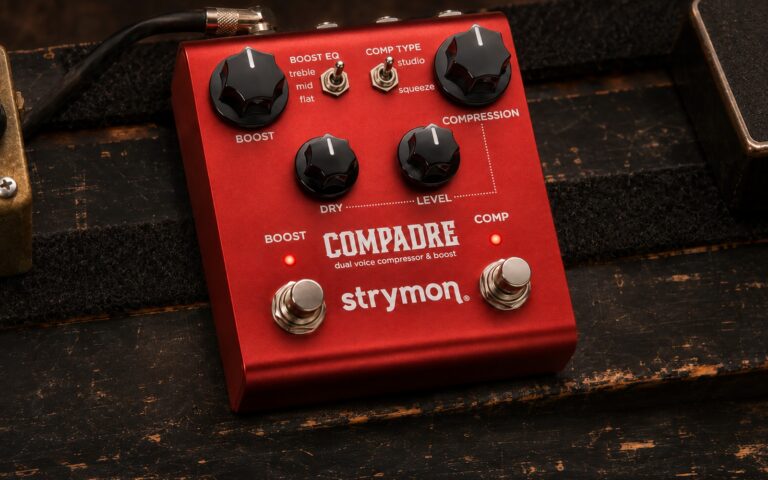
vs. Strymon Compadre
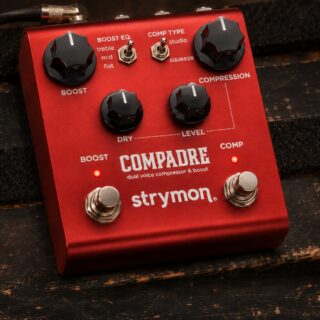
An instructive comparison because they solve the same problem in opposite directions. The Compadre is VCA-based, gives you two voiced presets (“Studio” and “Squeeze”) plus a separate boost footswitch and MIDI, and makes most of the decisions for you. The Empress is FET-based, gives you no voicings and no presets, and makes none of them. The Compadre is $299, the MKII $274. Choose based on whether you want a compressor with opinions.
vs. The Empress Bass Compressor
Empress released both on the same day, and the overlap is enormous — the same core circuit, the same ratios, the same metering, the same mix knob. Two differences separate them. The Bass Compressor has a fully variable sidechain high-pass filter (20Hz–400Hz) where the MKII has a three-position switch, and it swaps the tilt EQ for a two-position “Tone + Colour” circuit that adds gentle harmonic distortion along with the EQ shift. A reviewer who owns both put it precisely: with the Bass Compressor’s Tone+Colour centred and the MKII’s tilt at noon, and all other controls matched, the two pedals sound identical.
So: guitarists want the tilt EQ, bassists generally want the variable filter and the harmonic colour. Note that this distinction is frequently mangled online — “Tone + Colour” is a Bass Compressor feature and does not exist on the MKII, despite being attributed to it in more than one gear database. The MKII’s Tone knob is a tilt EQ and nothing else.
Buying Guide
Price In September 2026
Empress sells the MKII direct at $274 USD, in blue sparkle or silver sparkle, with free shipping in Canada and the continental US on orders over $99. Aggregated retail pricing across roughly six merchants sits at an average of about $267, with the cheapest listings around $272. Retail prices are, in other words, remarkably flat — this is not a pedal that gets discounted.
That is $25 above the 2020 launch price, a nominal increase of ten percent over six years, which in real terms means the pedal is meaningfully cheaper now than it was at launch.
Ways To Pay Less
Empress runs a Scratch & Dent collection on its own site, and owners consistently report that the cosmetic flaws on these units are hard or impossible to find. If you do not need the box to be perfect, this is the single best value route into the pedal, and it comes direct from the manufacturer rather than from a marketplace.
Used prices hold up well, which is a mixed blessing — good if you sell, less good if you are hunting a bargain. That price stability is itself a signal: compressor pedals that owners bail on inside a year show up cheap and plentiful. This one does not.
Who Should Buy It
- Players who have owned a simpler compressor and hit its limits.
- Anyone who needs a compressor to work across radically different instruments — electric, acoustic, bass, synth — without swapping pedals.
- High-gain and metal players who have been told compressors are not for them. The sidechain HPF is aimed directly at that objection.
- Anyone who has ever wanted to see what a compressor is doing rather than guess.
- Studio-literate players who already think in ratios, attack and release and find “sustain/level” pedals frustrating.
Who Should Not
- Anyone who wants a compressor sound — the vintage squash, the audible pump, the colour. Get a Dyna Comp or a Ross clone.
- Anyone unwilling to spend an evening with the manual. Empress ships a good full-colour multi-page manual with starting settings, and it repays reading, but a pedal that needs one is a pedal some people will never enjoy.
- Bass players who want obvious low-end fattening. The MKII tightens the low end rather than thickening it; the Bass Compressor or a Diamond is the better call.
- Anyone who needs true limiting. Even 10:1 is not a brick wall.
Ownership Notes
Power
9V DC, centre negative, 2.1mm barrel, roughly 100mA — standard Boss-style polarity, unlike some boutique pedals, and comfortably within any isolated supply’s capability. No adapter is included. The power jack is top-mounted along with the audio jacks, which is a real practical win on a crowded board.
One point of genuine ambiguity worth flagging: at least one detailed hands-on review states there is room for a 9V battery inside the enclosure, while Empress’s own specification page and the major retail spec sheets list a 9V DC supply only and make no mention of a battery. The original 2011 Compressor definitely required a wall wart. If battery operation matters to you, check with a dealer before buying rather than trusting either source.

Placement In The Chain
Front of chain, before drives, is the standard and correct answer — the compressor wants to see your raw pickup dynamics, and everything downstream benefits from a consistent input level. Behind a tuner like a Boss TU-3 or a PolyTune 3 Mini and ahead of the dirt is where the vast majority of owners run it.
Two documented exceptions worth knowing. Some owners run it after a dirt pedal specifically to control the output of a fuzz or wah, and owners report it pairs particularly well with RAT-style distortion for a fuller sound. And the “always on before an attenuated high-gain amp” use case documented above is placement-agnostic — it is about restoring feel, not shaping tone.
Noise
Consistently reported as quiet, which is not a given for a compressor — the entire job description involves turning quiet things up, including the noise floor. The published figure is 101dB. Owners specifically cite low noise as a reason they leave it on permanently. That said, any compressor will amplify hum from single-coils and from a noisy overdrive placed in front of it; that is physics, not a fault.
Learning Curve
The most consistent owner complaint is not about sound, it is about time. Multiple owners report the MKII takes patience to dial in perfectly. The counter-report, equally consistent, is that the LED metering shortens that process dramatically because you can see the gain reduction happening rather than trying to hear something designed to be inaudible. If you are new to compression, the meters are the teaching tool.
Build And Support
Die-cast aluminium, made in Ottawa, two-year warranty that doubles to four when you register the pedal, and a 45-day returns window on direct purchases. Manuals are published in English, French, German and Spanish. Empress has been in business since the mid-2000s and supports old products — the original Compressor’s documentation is still live.
The Empress Context
It helps to understand where this pedal sits in the company’s catalogue, because Empress is an unusual builder. The same shop makes the ZOIA — a modular synthesiser and effects environment in a pedal enclosure that is arguably the most complex stompbox ever put into production — alongside the Echosystem delay, the Superdelay, the ParaEQ, the Multidrive and the Tremolo2.
Empress gear tends to show up on the same boards as other Empress gear, and the MKII is most often documented alongside the Echosystem, the ZOIA, the Superdelay and the Multidrive. It also turns up next to Strymon TimeLine and BigSky units, Boss ES-8 switchers and Strymon Ojai power supplies — which is to say, on boards belonging to people who take signal routing seriously enough to own a switcher.
There is a consistent thread through the whole catalogue: Empress builds the version of a pedal that assumes you know what you are doing. Sometimes that is a liability. On a compressor, it is the entire point.
FAQ
Is the Empress Compressor MKII worth the extra money over a cheaper compressor?
It depends entirely on whether you will use what you are paying for. The premium over a Xotic SP or a Keeley Compressor Plus buys you the ratio switch, the full attack and release ranges, the tilt EQ, the sidechain filter and the metering. If you would leave all of those at default, you are buying a very expensive transparent compressor. If you would use even three of them, nothing else at the price offers the same feature set.
What is the difference between the Compressor MKII and the original Empress Compressor?
The MKII adds a 500Hz tilt EQ, adds a built-in three-position sidechain high-pass filter, halves the enclosure size, moves the jacks to the top, and switches the sidechain insert from 1/4″ to 3.5mm TRS. The core FET circuit, the ratios, the attack and release ranges and the parallel mix knob are the same. Owners consistently report the sound quality is nearly identical between the two — the improvements are in form factor and control, not in tone.
Is the MKII good for bass?
Yes, but with a caveat. It handles bass cleanly and the sidechain filter helps considerably, but the specialist verdict is that it is more about adding presence than weight. If you want obvious low-end fattening, Empress’s own Bass Compressor — released the same day, with a fully variable sidechain filter and a harmonic “Tone + Colour” circuit — is the better tool. The exception is fretless, where the 500Hz tilt centre works unusually well.
Does the Compressor MKII colour my tone?
Less than almost anything else in its category, which is the whole design brief. Frequency response runs 20Hz to 20kHz within 3dB, distortion is under 0.1%, and the signal path is fully analog with true bypass. The most common criticism of the pedal, in fact, is that it may be too transparent for players who want a compressor to have a personality.
Can I use it as a boost?
Yes. The Output control is pure make-up gain with no effect on the compression circuit, and there is a lot of it available — enough that reviewers have specifically named the MKII as a candidate for a boost pedal. Set the ratio to 2:1, Input low so almost nothing is being compressed, and Output well up, and you have a clean level boost that happens to catch peaks.
What does the sidechain high-pass filter actually do?
It removes low frequencies from the compressor’s detection circuit, not from your signal. Low notes carry more energy and would otherwise trigger disproportionate gain reduction, pulling the whole signal down every time you hit a low string. Filtering the detector at 120Hz or 240Hz makes the compressor respond more evenly across the neck. Your low end is unaffected — only the compressor’s opinion of it changes.
Which artists actually use the Empress Compressor MKII?
Verified cases include Steve Stevens (visible in a Premier Guitar rig rundown for Billy Idol), John Jeffers and Cody Tate of Whiskey Myers (both on video in a Premier Guitar rig rundown), Alan Duggan of Gilla Band and Bradley Will Simpson of The Vamps (photograph-confirmed), plus Adrian Belew, Justin Meldal-Johnsen, Josh Hager of Devo, Kim Mitchell, Andrew Huang, Dave Nugent, Bryce Jacobs and Ben Whiteley on Empress’s own artist roster. Names such as Brent Mason, Brad Paisley, John Mayer and Lowell George appear in aggregated listings but are not supported by any first-party source, and Lowell George died in 1979.
Is the Compressor MKII still in production in 2026?
Yes. As of September 2026 it remains listed and purchasable direct from Empress at $274 in both finishes, with no discontinuation notice, and it is stocked across the major retail channels. Empress also maintains a Scratch & Dent collection where it appears periodically at a discount.
Image credits
- Brad Paisley: Crisco 1492, Wikimedia Commons, CC BY-SA 4.0.
- Adrian Belew: Kevin Dooley, Wikimedia Commons, CC BY 2.0.
- Steve Stevens: Stefan Brending (2eight), Wikimedia Commons, CC BY-SA 4.0.
- Brad Paisley: U.S. Navy, Toiete Jackson, Wikimedia Commons, Public domain.
- Top image: GuitarGangsters AI-generated reference illustration, not a photograph.
- Empress Compressor MKII: AI-generated illustration by GuitarGangsters, based on the manufacturer’s product design (not a photograph).
Latest News
Related
On This Day
Monday 9 November
From this week: