
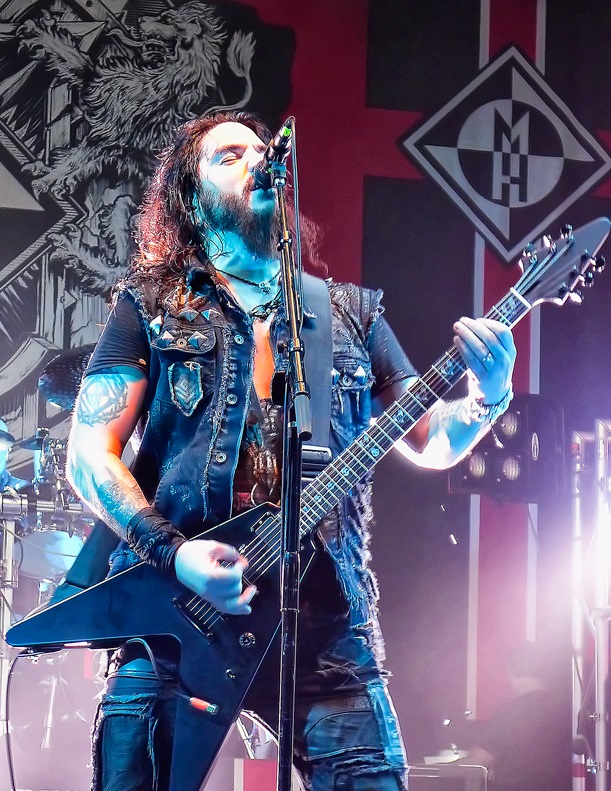
Gear Timeline
“I have a [Peavey] 5150 amp that I’ve used forever. I’ve had him for 14 years and call him ‘Bubba.’ I literally have him in a high-security storage area. He comes out to record and then he goes right back in. He never goes on tour.” Robb Flynn said this to Guitar World — and the specific relationship he describes with his Peavey 5150 is both practical and philosophical. “Bubba” is not just an amplifier but a collaborator with a name and a security clearance. High-security storage. He comes out to record. He goes right back in. He never goes on tour. The amplifier’s vulnerability — the risk of theft, damage, or failure on the road — outweighs the benefit of consistency; a different amplifier tours, and Bubba stays safe. His Guitar World assessment of the most crucial piece of gear: “The Electro-Harmonix Electric Mistress [flanger], which is a big old hunking, 9-inch-wide pedal.” Not the 5150. Not the Flying V. The Electric Mistress flanger. The accidental technique that produced one of Machine Head’s most recognizable sonic signatures — the natural harmonic used where feedback was expected — is his other essential gear-adjacent biographical fact: “I didn’t even know what feedback was. At some point, I stumbled on hitting the harmonic and I thought that was feedback… Over time I realized I had learned it wrong. But as I became a songwriter, I still thought it sounded cool, so I started bringing that into my style. At this point it has become the trademark sound of Machine Head.” Learning it wrong. Rolling with the accident. The harmonic instead of feedback. The trademark sound of a heavy metal band born from a mistake. He once said “I want us to be the Grateful Dead of metal.” Burn My Eyes (1994). The Blackening (2007). The harmonic. Bubba. The Electric Mistress. Machine Head.
Robert Conrad Flynn — born Lawrence Matthew Cardine on July 19, 1967, in Oakland, California — was adopted after being abandoned by his birth parents. He has not sought to find his birth parents; the Machine Head song “Left Unfinished” describes his feelings about them. He played in Forbidden (originally Forbidden Evil) between 1985 and 1987, then briefly in Vio-lence, before forming Machine Head in Oakland in 1991 with bassist Adam Duce, guitarist Logan Mader, and drummer Tony Costanza. Machine Head’s debut Burn My Eyes (1994, Roadrunner Records) established the specific groove metal sound that defined the band’s identity: the combination of Bay Area thrash metal’s aggression with the rhythmic groove of Pantera’s approach and Flynn’s specific natural harmonic technique. The Blackening (2007) is widely considered the band’s masterpiece and one of the most acclaimed metal albums of the 2000s — included on multiple “greatest metal albums” lists. He is the only member to appear on every Machine Head album. He is fifty-eight years old. Bubba is in storage.
Background: Oakland California, Adopted, Black Sabbath Primary Influence, Vio-lence, Machine Head 1991, Burn My Eyes, The Blackening, Natural Harmonic as Trademark
Flynn’s specific formative context — Oakland, California, the Bay Area thrash scene of the mid-1980s that produced Metallica, Exodus, Testament, Death Angel, and Vio-lence — is the specific creative environment that produced his guitar approach. His primary influence: “Flynn cited Black Sabbath as his biggest influence and the reason he plays guitar.” Black Sabbath as the reason one plays guitar is the specific heavy metal formation story — the moment of hearing “Iron Man” or “Paranoid” and understanding that this is what guitar can be. Other influences: “Bay Area thrash metal bands like Exodus, Metallica, Slayer and hardcore punk/crossover thrash groups such as Dead Kennedys, DRI and Suicidal Tendencies.” The specific combination of Sabbath’s crushing riff heaviness, Bay Area thrash’s speed and aggression, and hardcore punk’s stripped-back directness is precisely the combination that Machine Head’s early music synthesizes.
The natural harmonic story is the most specifically humanizing gear-adjacent biographical fact in his career. He was learning guitar from recordings, tried to play the feedback he heard on Celtic Frost’s “Morbid Tales,” hit the natural harmonic instead (because he didn’t know what feedback was), thought it sounded cool, and incorporated it into his style. “At this point it has become the trademark sound of Machine Head.” A mistake that became a trademark. The accidental discovery, retained and developed, that defines a band’s sonic identity. This is one of the most specific accounts of how technique develops: not from deliberate practice but from productive misunderstanding.
The “Grateful Dead of metal” quote — “When we were first starting out, I used to say, ‘I want us to be the Grateful Dead of metal'” — is the most specifically vision-oriented self-characterization in this section. The Grateful Dead’s specific qualities: longevity, community-building, the specific relationship with the audience that involves showing up and growing together over decades rather than exploiting a commercial moment. Machine Head’s career arc — the commercial breakthrough of Burn My Eyes, the mid-career stumble of the nu-metal experiment, the critical and commercial comeback of The Blackening — reflects exactly the kind of career that a band needs to sustain to become “the Grateful Dead of metal.”
The Rig: Robb Flynn’s Guitars, Amps, and Effects
Guitars
Flynn’s primary guitar for the period from the late Burning Red era through the early Blackening era (approximately 2002-2007) was a custom ESP Flying V with specific baritone scale length and configuration. The Equipboard documentation: “This is a custom ESP Flying V made for Robb by the company. It’s got a black finish, white pick guard, mahogany body, baritone scale neck (27″ I believe), 24 fret rosewood fretboard with dot and Machine Head diamond inlays, black hardware, and an EMG 81 in the bridge and EMG HA in the neck. This guitar was used heavily from 2002-2007, starting with the end of ‘The Burning Red’ era, until the early ‘The Blackening’ era until he switched back to Gibson in 2008.” The 27-inch baritone scale — longer than standard 25.5-inch Fender or 24.75-inch Gibson scale — provides additional string tension at lower tunings, giving the lower-tuned machine Head material the specific tightness and definition that would be difficult to achieve on a standard-scale guitar. The EMG 81 (the same active humbucker documented for Jeff Hanneman, Devin Townsend, and multiple other metal guitarists) provides consistent output regardless of the lower tuning’s reduced string tension.
The Equipboard documentation: “Robb used this as one of his main guitars from 2007-2013. It can be seen frequently live during that time and in the videos for Now I Lay Thee Down and Halo.” His transition to the Gibson Flying V from the ESP custom model reflects the specific attraction of the Gibson’s specific tonal character — the mahogany body and set neck’s warmth and sustain — for The Blackening’s specific musical approach. The Wikipedia documentation confirms: “Flynn preferred Gibson guitars for The Blackening period.”
The Equipboard documentation of his own video quote: “In this video, Robb Flynn discusses his signature model Flying V guitar made by Epiphone. He says, ‘…it’s taken a beating, it’s held up f***ing awesome. It’s a big solid hunk of mahogany, it’s got a 27 inch scale baritone neck, it’s got EMG-81s for super crunchy metal tone.'” The Epiphone Love Death Baritone Flying V — the production version of his custom ESP baritone Flying V — makes his specific baritone instrument design accessible at a production price point. The “Love/Death” name reflects the Machine Head aesthetic, and the 27-inch baritone scale with EMG-81s maintains the specific technical requirements of his approach.
The Equipboard documentation: “Robb is seen using a Jackson Soloist during this Dynamo 1995 gig, specifically for the songs tuned to C# Standard. It is heavily stickered, and is HSS. One of the few guitars used by Robb that had a Floyd Rose on it.” The Jackson Soloist (high-performance superstrat with Floyd Rose locking tremolo) appearing in the 1995 Dynamo Festival documentation places it in the early Machine Head touring period, used specifically for the C# Standard tuning passages — the multiple-tuning live challenge that multiple instruments were carried to address.
The UberProAudio documentation lists “ESP SP120 V-Shaped baritone prototype with EMG pickup” as one of his primary instruments — the prototype that preceded the production Epiphone Love Death Baritone V. The ESP SP120 prototype documents the specific development process of his signature instrument from custom ESP build through production Epiphone model.
The most important sonic element in Flynn’s playing is not a pedal or a guitar model but a technique — the natural harmonic used as an accent in riff construction. “I didn’t even know what feedback was. At some point, I stumbled on hitting the harmonic and I thought that was feedback… Over time I realized I had learned it wrong. But as I became a songwriter, I still thought it sounded cool, so I started bringing that into my style. At this point it has become the trademark sound of Machine Head.” The natural harmonic (produced by lightly touching the string at a specific node point without pressing to the fretboard) produces a bell-like, floating pitch that cuts through the dense low-tuned distortion of Machine Head’s typical guitar sound. Its use as a rhythmic and melodic accent in riff construction — the specific “ping” of the natural harmonic against the heavy low-tuned rhythm guitar — is the defining sonic trademark of the Machine Head sound.
Amps
The Guitar World quote is the most specifically affectionate gear description in this guide: “I have a [Peavey] 5150 amp that I’ve used forever. I’ve had him for 14 years and call him ‘Bubba.’ I literally have him in a high-security storage area. He comes out to record and then he goes right back in. He never goes on tour.” The Peavey 5150 “Bubba” is Flynn’s primary studio recording amplifier for Machine Head — the specific 5150 (the same amplifier documented for Devin Townsend, Mille Petrozza, and others) that has defined the sound of the Machine Head studio recordings. His characterization of it as having less gain than expected: “There is a lot less gain on it than you’d think, and that’s part of how we get the clarity and picking definition.” This is the standard professional metal revelation: high gain does not equal good metal tone; controlled gain with precise picking produces better clarity and definition than maximum gain with less-precise technique. The UberProAudio documentation confirms: “Peavey 5150 (Robb named the best head ‘Bubba’ and used it for recording).”
The Gemtracks documentation: “If you’re a guitarist looking for a high-quality and powerful amp head, the Peavey 6505 is definitely worth considering” — in the context of Flynn’s gear, the Peavey 6505 (the production name for the 5150 after Eddie Van Halen’s departure from Peavey) is documented as his standard live touring amplifier. The 6505’s specific character — essentially the same circuit as the 5150 — provides the same tight, high-gain American tube sound without the risk of touring with the irreplaceable “Bubba.”
The Guitar World quote: “I use that [the 5150] and a Marshall.” For live contexts: the Peavey 6505 (as the studio 5150 substitute) alongside a Marshall head for the specific tonal variety of the two-amp approach. The Marshall’s British EL34 character adds harmonic warmth and a slightly different saturation character to the Peavey’s tighter American high-gain response.
The Guitar World interview quote: “We both had those little Roland Cubes, which I think are the best thing ever; those little battery-powered amps sound killer.” This characterization of the Roland Cube (the small, battery-powered, digital modeling combo) as “the best thing ever” for hotel rehearsal reflects the specific practical quality of the Roland Cube for road musicians: it runs on batteries, it sounds good, it is small enough to carry in luggage, and it allows rehearsal in a hotel room at low volume. The Roland Cube’s specific application — not as a performance amp but as a working tool for the specific logistical context of professional touring — is the most practical gear recommendation in this section.
Effects
The Guitar World quote is unambiguous: “Q: Robb, what piece of gear is the most crucial to your sound and why? FLYNN: The Electro-Harmonix Electric Mistress [flanger], which is a big old hunking, 9-inch-wide pedal.” The EHX Electric Mistress is the classic analog flanger pedal from Electro-Harmonix — known for the specific sweeping, jet-plane character of its bucket-brigade delay-based flanger circuit. Flynn’s characterization — “big old hunking, 9-inch-wide pedal” — reflects the specific physical reality of the original EHX Electric Mistress housing (unusually large compared to most guitar effects pedals, with the distinctive blue/silver color scheme). Its role as the “most crucial” piece of gear — above even the 5150 “Bubba” or the baritone Flying V — reflects its specific contribution to the Machine Head sound: the flanger’s sweeping modulation adds the specific dimensional quality to Machine Head’s distorted rhythm guitar that distinguishes it from straight-ahead heavy metal guitar.
As documented above — the natural harmonic used where feedback was expected, retained because it sounded good, developed into the defining Machine Head sonic signature. This is the most important “effect” in his arsenal, and it is not an effect pedal at all but a playing technique that emerged from misunderstanding and was retained through the specific quality of what it produces.
The Epiphone Love Death interview quote: “it’s got EMG-81s for super crunchy metal tone.” Active EMG 81 humbuckers appear in his ESP custom Flying V, the Epiphone Love Death signature, and other primary instruments — the same pickup documented for Jeff Hanneman, Devin Townsend, and multiple other extreme metal guitarists. His specific description — “super crunchy metal tone” — reflects the EMG 81’s specific tight, defined, high-output character that suits his precise rhythm guitar approach.
Playing Style & Tone Philosophy
Robb Flynn’s playing style is the most groove-focused in the extreme metal tradition — the approach of a guitarist whose primary creative identity is as a heavy riff writer whose rhythmic precision and the natural harmonic’s specific accent create the distinctive Machine Head texture. His Guitar World description of his own picking approach: “There is a lot less gain on it than you’d think, and that’s part of how we get the clarity and picking definition. A lot of it has to do with my right hand and just being cognizant of my playing. I play all the rhythms, so that really makes it tighter overall.” The right-hand emphasis — picking precision rather than maximum gain — is the foundational professional truth about extreme metal rhythm guitar: technique produces tightness, not gain level.
His tone philosophy is the “Bubba philosophy”: find the specific amplifier that sounds magical, protect it, record with it, and tour with a substitute. The 5150 “Bubba” comes out to record, goes back to storage, and the Peavey 6505 covers the live work. The Electric Mistress is the most crucial piece of gear — the specific flanger character that adds dimensional width to the Machine Head rhythm guitar. The natural harmonic was learned wrong and kept because it sounded right. The Roland Cube is the best thing ever for hotel practice. This is the pragmatic, road-hardened gear philosophy of a musician who has been touring and recording for thirty-plus years.
How to Sound Like Robb Flynn
Guitar: Epiphone Love Death Baritone Flying V (27-inch scale, EMG-81 bridge, 24 frets, mahogany body) for the primary Machine Head tone. Gibson Flying V (standard scale) for the Blackening-period character. The essential element: 27-inch baritone scale with active EMG-81 for down-tuned heavy rhythm guitar, providing the specific string tension and definition at lower pitches.
Amp: Peavey 5150/6505 (the tight, high-gain American tube character) for the primary Machine Head sound. Marshall alongside for harmonic variety. Peavey 6505+ or equivalent for live reproduction of the 5150 “Bubba” studio sound.
Amp Settings (Peavey 5150/6505 — Machine Head Groove Metal):
| Control | Setting (0–10) | Notes |
|---|---|---|
| Lead Gain | 6–7 | “There is a lot less gain on it than you’d think” — controlled gain |
| Bass | 5–6 | Present — the baritone scale’s low fundamentals need bottom support |
| Mid | 5–6 | Natural — the Machine Head rhythm sound lives in the midrange |
| Treble | 6–7 | Bright — clarity and picking definition require treble presence |
| Presence | 6 | Attack definition — “cognizant of my playing, right hand tightness” |
Essential effects: EHX Electric Mistress flanger — “the most crucial piece of gear.” Set for moderate depth and rate, the flanger’s sweep adds the specific dimensional width to the rhythm guitar. Natural harmonics — at the 5th, 7th, and 12th fret positions — used as accents in riff construction. Practice hitting them cleanly (lightly touch the string at the node without pressing to the fretboard, pick, release) until they ring clearly through the high-gain amp. That’s the trademark.
Influence & Legacy
Robb Flynn’s influence on groove metal and the broader extreme metal spectrum is foundational for Burn My Eyes (1994) and The Blackening (2007) — two albums that represent different moments in metal’s evolution and both of which are among their respective periods’ most influential. Burn My Eyes established the specific groove metal sound that influenced a generation of 1990s metal bands; The Blackening demonstrated that extreme metal could sustain its power and creative quality across long-form, compositionally sophisticated album-length statements.
His connection to Phil Demmel as the essential Machine Head lead guitar partner whose technical facility complemented Flynn’s rhythmic precision and riff-writing creates the specific Machine Head dual-guitar identity of the Blackening era. His connection to Mille Petrozza as a fellow groove/thrash metal guitarist whose primary amp is a Peavey 5150-family head and whose Studio approach parallels Flynn’s Bubba philosophy reflects the shared amplifier tradition of modern extreme metal production. His connection to Jeff Hanneman as a fellow Bay Area extreme metal guitarist whose foundational influence on the genre parallels Flynn’s later contribution reflects the shared regional tradition.
Frequently Asked Questions: Robb Flynn Machine Head Guitars & Gear
What guitar does Robb Flynn play?
Flynn’s signature guitar is the Epiphone Love Death Baritone Flying V — “a big solid hunk of mahogany, it’s got a 27 inch scale baritone neck, it’s got EMG-81s for super crunchy metal tone.” Previous primary instruments: custom ESP Flying V baritone (EMG 81 + HA, 2002-2007), Gibson Flying V (2007-2013 Blackening era). He also used a Jackson Soloist (Floyd Rose, HSS, C# Standard) in the early 1995 touring period.
What is the “Bubba” amp?
“I have a [Peavey] 5150 amp that I’ve used forever. I’ve had him for 14 years and call him ‘Bubba.’ I literally have him in a high-security storage area. He comes out to record and then he goes right back in. He never goes on tour.” Bubba is Flynn’s primary studio recording amplifier — a specific Peavey 5150 that has been the primary amp on Machine Head’s studio recordings for over a decade. It is too valuable/special to risk on tour; the Peavey 6505 serves as the touring substitute. “There is a lot less gain on it than you’d think, and that’s part of how we get the clarity and picking definition.”
What is the most important piece of gear to Robb Flynn?
Guitar World: “Q: What piece of gear is most crucial to your sound and why? FLYNN: The Electro-Harmonix Electric Mistress [flanger], which is a big old hunking, 9-inch-wide pedal.” The vintage EHX Electric Mistress analog flanger is his most essential effect — above the 5150 “Bubba” and the baritone Flying V. The Electric Mistress’s specific sweeping, dimensional flanger character adds width to Machine Head’s rhythm guitar sound.
How did the natural harmonic become a Machine Head trademark?
“I didn’t even know what feedback was. At some point, I stumbled on hitting the harmonic and I thought that was feedback. So when the feedback part came along on a song like Celtic Frost’s ‘Morbid Tales,’ I would just hit the harmonic. Over time I realized I had learned it wrong. But as I became a songwriter, I still thought it sounded cool, so I started bringing that into my style. At this point it has become the trademark sound of Machine Head.” The natural harmonic — produced by touching the string at a node point without fretting — was substituted for feedback by accident, retained because it sounded good, and became the defining sonic signature of Machine Head’s riff style.
What is Robb Flynn’s background before Machine Head?
Flynn was born Lawrence Matthew Cardine in Oakland, California in 1967. He was adopted after being abandoned by his birth parents. He played in Forbidden (originally Forbidden Evil) between 1985 and 1987, then in Vio-lence (the Bay Area thrash band that also featured future Exodus guitarist Gary Holt) before founding Machine Head in Oakland in 1991 with bassist Adam Duce. His primary influence: “Flynn cited Black Sabbath as his biggest influence and the reason he plays guitar.”
What is the significance of the baritone scale length in Flynn’s guitars?
The 27-inch baritone scale provides additional string tension at lower tunings compared to standard 25.5-inch or 24.75-inch scale guitars. Machine Head frequently uses down-tuned settings (C# Standard and lower) that would produce unacceptably floppy, poorly-defined low strings at standard scale. The baritone scale’s extra tension gives the lower-tuned strings the specific definition and tightness needed for the percussive, precise picking approach that creates Machine Head’s rhythm guitar clarity.
What does Robb Flynn mean by “the Grateful Dead of metal”?
Guitar World: “When we were first starting out, I used to say, ‘I want us to be the Grateful Dead of metal.'” The Grateful Dead’s specific qualities that Flynn aspired to: longevity, community-building, the specific relationship with the audience that involves sustained creative growth over decades rather than exploiting a commercial moment. Machine Head’s career arc — from Burn My Eyes through the nu-metal experiment to The Blackening’s critical comeback — reflects this long-game approach to building a metal band.