
In this guide
Most signature guitars are exercises in cosmetics — a famous name on the headstock, a custom color, maybe a slightly different pickup wind. The Squier J Mascis Jazzmaster is a rarer thing: a signature model built by a working musician who identified a genuine, decades-old design flaw in his favorite guitar and simply had it fixed. J Mascis didn’t just lend his name to a Jazzmaster. He handed Squier a list of mechanical grievances collected over thirty years of touring and recording, and the resulting instrument solved problems that vintage Jazzmaster owners had been quietly living with since 1958.
From Deep Wound to Dinosaur Jr.: The Man Behind the Signature
J Mascis emerged from the ashes of the Massachusetts hardcore band Deep Wound to found Dinosaur Jr. in 1984, and over the following decades built one of alternative rock’s most instantly recognizable guitar voices. Albums like You’re Living All Over Me (1987), Bug (1988), and Green Mind (1991) established a sonic template that’s been imitated constantly ever since: gorgeous, ringing melodic hooks buried under walls of gloriously distorted, effects-drenched guitar, typically erupting into extended, cathartic soloing that split the difference between Jimi Hendrix and My Bloody Valentine. Mascis became known not just for volume — though his live shows are genuinely, famously loud — but for a specific, instantly identifiable tone: thick, saturated, and melodic even at maximum distortion.
Central to that sound for decades has been the Fender Jazzmaster, an instrument Mascis gravitated toward for reasons that had little to do with its original surf-rock or jazz-adjacent marketing. He found in the Jazzmaster’s semi-loose construction, long scale, and complex switching a platform that could handle both delicate melodic passages and full-throttle noise without losing character in either direction. In 2011, Squier formalized that relationship with the J Mascis Jazzmaster — a signature model built not around a famous finish or a marketing gimmick, but around a genuine mechanical upgrade Mascis had wanted for years.
The Bridge Fix Heard Round the Offset World
Ask any longtime Jazzmaster or Jaguar owner about the guitar’s original floating bridge and vibrato system, and you’ll likely hear a familiar complaint: strings occasionally popping out of the shallow bridge saddles, tuning instability under aggressive playing, and a low break angle that some players felt sapped sustain and tone. This isn’t a myth or internet exaggeration — it’s a known characteristic of the original 1958 design that decades of players have worked around with mods, replacement bridges, and careful setup technique.
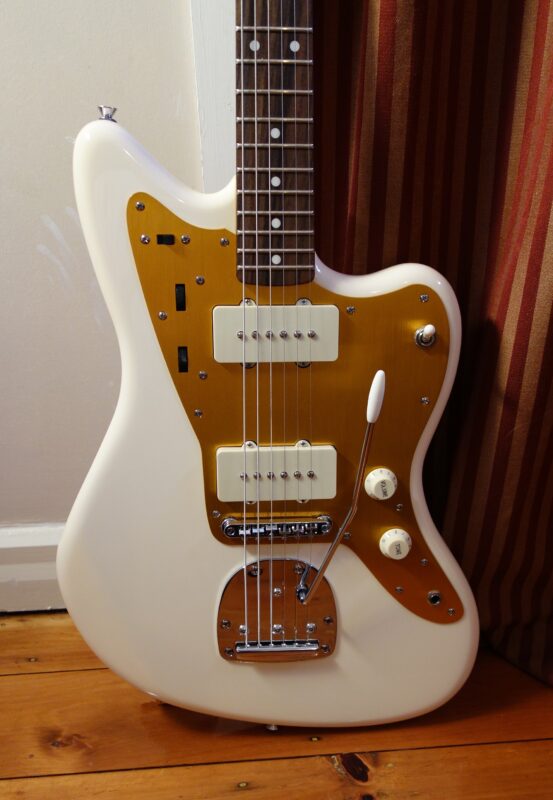
Mascis’s solution, built directly into the signature model’s specification, replaces the stock Jazzmaster bridge with a Gibson-style Adjusto-Matic (Tune-o-matic-style) bridge and repositions the tailpiece closer to it, increasing the string break angle significantly. The saddles are more secure, the tuning stability under hard playing improves, and the whole system holds up better to the kind of aggressive, physical performance style Mascis is known for. It’s a genuinely clever piece of design thinking: rather than trying to preserve vintage authenticity at the expense of playability, Mascis and Squier prioritized solving a real problem that had bothered Jazzmaster players for over fifty years.
A Player Known As Much for Volume as for Melody
It’s worth spending a moment on just how central volume is to understanding Mascis’s relationship with his gear. His live rig has become something of a running joke and a point of genuine pride within the guitar community — massive walls of Marshall stacks, often cranked to levels that have prompted opening acts and sound engineers alike to reach for earplugs. But the volume was never an end in itself; it’s a tool Mascis uses to access a specific kind of harmonic richness and sustain that only emerges when an instrument, amp, and pedal chain are pushed hard enough to start interacting with each other in unpredictable ways. A Jazzmaster played quietly and a Jazzmaster played through a wall of cranked tube amps are, in a meaningful sense, two different instruments — and Mascis has spent decades exploring what the second version can do.
That context matters for understanding why the bridge redesign wasn’t a minor cosmetic request but a genuine functional necessity for Mascis specifically. A standard Jazzmaster bridge, already known for occasional string slippage and tuning drift under normal playing, becomes considerably less reliable under the kind of sustained high-volume, high-gain punishment Mascis’s live shows are built around. The Adjusto-Matic conversion wasn’t just an improvement — for his specific playing style, it was close to a requirement.
Specifications
Signature Guitar, Signature Player: Why This Article Centers on One Artist
When a guitar carries an artist’s name on the headstock, the entire point of the instrument is that one player’s specifications, preferences, and career define it. A standard famous-players section here would dilute the actual story: this is J Mascis’s guitar, engineered to his mechanical specifications, and its entire reason for existing traces back to one musician’s decades of hands-on experience with the format.
That said, the broader Jazzmaster lineage this signature model descends from is genuinely rich — Elvis Costello, Kevin Shields, Nels Cline, and Thurston Moore all helped define the instrument’s post-surf cultural identity, and Mascis himself has cited that same lineage as part of what drew him to the Jazzmaster in the first place. But their relevance here is contextual, not a claim that any of them played this specific model.
Tone Recipes
1. Dinosaur Jr. Wall of Fuzz
Bridge pickup, guitar volume maxed, into a fuzz pedal stacked with an overdriven amp. Push everything into the red — this guitar and its bridge redesign were built specifically to hold up under exactly this kind of treatment without falling out of tune mid-song.
2. Melodic Clean Passages
Neck pickup, rhythm circuit engaged via the slide switch, into a clean amp with light reverb. This is where the ringing, melodic side of Mascis’s writing lives — quiet verses that explode into the chorus.
3. Sustained Lead Runs
Bridge and neck pickups combined, moderate-to-high gain, into an amp pushed to natural breakup. The increased break angle from the Adjusto-Matic bridge genuinely improves sustain over a stock Jazzmaster bridge — useful for extended, singing lead lines.
4. Overdriven Rhythm Crunch
Bridge pickup into an Ibanez TS9 Tube Screamer for midrange push, feeding a Fender Deluxe Reverb on the edge of breakup.
5. Controlled Feedback Freakouts
Bridge pickup, high volume, standing close to the amp, gradually building sustained feedback into a solo climax — a signature Mascis live move that the guitar’s improved tuning stability makes far more reliable to execute night after night.
Competitor Comparisons
Against a standard Fender Stratocaster, the J Mascis Jazzmaster offers a wider, more complex tonal palette and a genuinely different playing feel thanks to its offset body and dual-circuit design, at the cost of some of the Strat’s immediacy and simplicity.
Against a humbucker-driven rock guitar like a Gibson Les Paul Standard, this Jazzmaster sits at a different tonal extreme entirely — brighter and more prone to harmonic complexity under distortion, versus the Les Paul’s thick, compressed sustain. Mascis’s own tone splits the difference, using pedals and amp gain to push the Jazzmaster’s naturally bright voice into thicker territory without losing its underlying character.
Within Fender’s own signature Jazzmaster lineup, the closest comparisons are the Elvis Costello and Thurston Moore/Lee Ranaldo signature models — each built around a different player’s specific mechanical and cosmetic preferences, illustrating just how personalized signature-model design has become within this particular guitar family. Compared to a standard Fender Telecaster, the J Mascis Jazzmaster represents an entirely different design philosophy: complexity and tonal versatility over simplicity and reliability.
Buying Guide
New from Squier: The current production model is the most consistent way to get Mascis’s exact bridge redesign, pickup specification, and cosmetic details in a single, well-built package. Given the bridge fix alone addresses a genuine long-standing design issue, this is a strong recommendation even for players not specifically chasing Mascis’s tone — it’s arguably one of the more practically improved signature models in the Fender/Squier catalog, rather than a purely cosmetic exercise.
Used units: A solid value option, particularly for players comfortable with a used instrument’s minor cosmetic wear. Check the Adjusto-Matic bridge and tremolo assembly for proper function, and inspect the gold anodized pickguard for scratching, which shows more visibly on this finish than on a standard plastic pickguard. Also test the slide switch between lead and rhythm circuits, which can develop wear on well-used examples.
The Fender-branded, Made-in-Japan version: A higher-end alternative exists in Fender’s own catalog, featuring a purple sparkle finish and Fender Vintage Reissue pickups rather than the Squier’s standard pickups, at a significantly higher price point while sharing the same basswood body and bridge redesign. Players chasing the most refined version of this specific guitar, rather than the most affordable, should look here.
Modding a standard Jazzmaster instead: Players who already own a standard Jazzmaster and want the bridge improvement without buying a whole new guitar can source an Adjusto-Matic conversion kit separately — though buying the Mascis model outright is often more cost-effective than sourcing and installing the parts individually, and comes with the added benefit of a guitar built around the conversion from the factory rather than retrofitted.
Why This Signature Model Set a Different Standard
Most artist signature guitars, even good ones, lean heavily on cosmetics: a distinctive finish, a name on the headstock, maybe a slightly hotter pickup wind to match a player’s general reputation. The J Mascis Jazzmaster’s central selling point is different in kind, not just degree — it’s a documented mechanical fix to a problem that had existed, largely unaddressed at the factory level, for over five decades. That distinction matters for how the guitar should be evaluated. A player skeptical of signature-model marketing gimmicks in general has a genuinely different case to consider here: this isn’t paying extra for a name, it’s paying for an engineering decision that happens to have Mascis’s name attached because he’s the one who pushed for it.
It’s also worth noting how the model reflects a broader shift in how working musicians engage with signature-guitar design. Rather than simply lending an image to a marketing campaign, Mascis functioned closer to a product consultant — someone with genuine, hands-on mechanical grievances who used his signature-model leverage to solve them. That’s a template other artist-collaboration guitars have followed since, but the J Mascis Jazzmaster remains one of the clearer, more well-documented examples of the format actually working as intended.
Practical Ownership Considerations
- The Adjusto-Matic bridge conversion is the single biggest practical advantage of this model over a stock Jazzmaster — expect noticeably better tuning stability under aggressive playing right out of the box.
- The gold anodized aluminum pickguard is a distinctive cosmetic touch but shows scratches and wear more visibly than a standard plastic guard — handle with slightly more care if pristine appearance matters to you.
- The basswood body keeps the guitar lightweight and affordable but produces a slightly different tonal character than the alder or ash bodies found on higher-tier Jazzmasters — generally described as warmer and less bright, which pairs well with Mascis’s own thick, saturated tone.
FAQ
What makes the J Mascis Jazzmaster different from a standard Jazzmaster?
The primary difference is the bridge and tailpiece redesign — an Adjusto-Matic bridge repositioned closer to the tailpiece for increased break angle and improved tuning stability, addressing a well-known weakness of the original 1958 Jazzmaster bridge design.
Was J Mascis actually involved in designing this guitar?
Yes — Squier and Fender materials consistently describe the pickups, hardware, and bridge redesign as specified directly by Mascis based on his decades of touring and recording experience with Jazzmasters.
How does the Fender-branded version differ from the Squier version?
The Fender, Made-in-Japan version features a purple sparkle finish and Fender Vintage Reissue pickups, at a substantially higher price, while sharing the same basswood body construction and bridge redesign as the Squier model.
Is this guitar good for genres beyond alternative rock?
Yes — the improved tuning stability and dual-circuit switching make it a capable instrument for indie, shoegaze, country, and clean pop contexts, not just Mascis’s own high-gain style.
Does the Adjusto-Matic bridge change the guitar’s tone significantly?
It primarily affects sustain and tuning stability rather than fundamentally altering the pickup tone, though some players note a slightly firmer, more focused low end compared to a stock Jazzmaster bridge.
Is this a good first guitar for a beginner?
It’s a genuinely well-built, playable instrument with fewer of the setup headaches associated with vintage-spec Jazzmasters, making it a reasonable choice for a motivated beginner, though its switching complexity may still reward some prior playing experience.
Image credits
- Squier J Mascis Jazzmaster: photo by Interested Bystandr, via Wikimedia Commons, CC BY 2.0.
