Vinnie Vincent (KISS) Guitars & Gear: The Complete Guide to the Egyptian Ankh Warrior’s Rig
Gene Simmons called Vinnie Vincent “by far” KISS’s best guitar player. This is a remarkable statement from a man who managed Ace Frehley, Bruce Kulick, and Tommy Thayer — three professional guitarists of acknowledged quality. Simmons meant it specifically: Vincent brought a technical virtuosity to KISS that the band had not previously had and has not had since. The Guitar World documentation of the March 12, 1984 concert at the Colisée de Québec captures what Simmons was describing: “frenzied guitar solos that grew increasingly outlandish as his time with the band went on.” The solos became outlandish enough that “they drove Gene Simmons and Paul Stanley mad” — the same solos that Simmons was privately calling “by far the best.” This is the specific paradox of Vinnie Vincent: technically extraordinary, professionally unmanageable, the best guitarist KISS ever had and the one who lasted the shortest time. He recorded the Creatures of the Night album (1982) with a custom Charvel he had built himself, inspired by Eddie Van Halen’s instrument — specifically using it on “I Love It Loud,” “Killer,” “War Machine,” “Keep Me Comin’,” and “Saint and Sinner.” The guitar still has its original strings from the Creatures sessions. He is known as “the Wiz.” He is from Bridgeport, Connecticut. He is seventy-three years old. He claims to have a new record that rivals Zeppelin, Hendrix, and the Beatles but won’t release it unless people buy the single for $300 apiece. The Creatures Charvel remains.
Vincent John Cusano — known professionally as Vinnie Vincent — was born on August 6, 1952, in Bridgeport, Connecticut. Before KISS, he worked as a session guitarist for Dan Hartman, Treasure, Laura Nyro, and others — building professional credentials that gave him the technical facility that would later produce the “frenzied solos” of the KISS era. He joined KISS in 1982, initially as an uncredited session player on Creatures of the Night, before being formally named as Ace Frehley’s replacement in December 1982. He appeared on Lick It Up (1983) — the first KISS album recorded and released without the band members in makeup — and was fired in mid-1984. He subsequently formed the Vinnie Vincent Invasion (1984) with Robert Fleischman (later replaced by Mark Slaughter) and Dana Strum, releasing two studio albums (Vinnie Vincent Invasion, 1986; All Systems Go, 1988). He made a brief 2018 comeback appearance before retiring from the industry. His Egyptian Ankh Warrior makeup character in KISS was the most visually distinctive of any KISS-era guitarist. He is “the Wiz.” The solos are on record. They are extraordinary.
Background: Bridgeport Connecticut, Session Guitarist, KISS 1982, Creatures and Lick It Up, “Frenzied Solos,” Vinnie Vincent Invasion
Vinnie Vincent’s role in KISS history is as the musician who injected the highest level of technical guitar virtuosity the band had ever featured into their specific arena rock context. KISS’s previous guitarists — Ace Frehley’s beloved but technically modest playing, the subsequent placeholder work before Vincent was formally named — had defined the band’s guitar identity as being about feel, charisma, and memorability rather than technical display. Vincent reversed this: he brought the shred vocabulary of the early 1980s neoclassical metal tradition into a band whose music had not previously demanded it, and the specific combination of KISS’s arena rock production with Vincent’s frenzied technical lead work produced a brief but productive creative period.
The Creatures of the Night album (1982) was in some ways the most technically advanced KISS album in terms of guitar playing — Vincent’s contributions (on all but three tracks) bringing a contemporary aggression and technical facility to a band that had previously been more characterized by memorable riffs and hooks than by guitar hero pyrotechnics. The guitar-driven nature of Creatures — heavier, more aggressive, and more technically demanding than the preceding Dynasty and Unmasked pop albums — reflected both Vincent’s influence and the band’s attempt to reconnect with the heavy metal audience they had lost during the disco-influenced period.
The Lick It Up (1983) solo on “A Million to One” — Guitar World’s identification of it as “one of the finest six-string moments in the KISS catalog that don’t feature Frehley” — is the most celebrated single document of his KISS-era playing. It reflects the specific combination of shred technique (the speed, the sweep-picking arpeggios, the scalar runs) with the melodic sensibility of the pop-metal context (the solo serves the song, is accessible, and has a memorable arc rather than being purely display) that was Vincent’s specific contribution to KISS’s music.
The Rig: Vinnie Vincent’s Guitars, Amps, and Effects
Guitars
Custom Charvel Strat (Creatures of the Night Recording Guitar, EVH-Inspired): Vinnie Vincent’s most historically significant guitar is the custom Charvel Stratocaster-style instrument he built himself, inspired by Eddie Van Halen’s Charvel. The Equipboard documentation captures the specific story: “A Vinnie Vincent Charvel Strat electric guitar built with hand-chosen components by Vincent. Vincent was inspired to build the guitar after trying Eddie Van Halen’s Charvel. Van Halen explained that he had built his guitar with custom parts, which included neck, pickup and body. Vincent tried Van Halen’s guitar and liked it so much he spent the next few months customizing a similar guitar to Ed Van Halen’s. The result was this one of a kind Charvel. The guitar was used by Vincent to record KISS’ Creatures of the Night album in 1982.” The specific tracks recorded on this Charvel: “I Love It Loud,” “Killer,” “War Machine,” “Keep Me Comin’,” and “Saint and Sinner,” among others. The most remarkable detail: “The guitar, which still has its original strings from the Creatures album.” A guitar whose strings have never been changed since the 1982 recording sessions. This is either the most historically preserved musical artifact documented in this guide or the most dramatic demonstration of a guitar never being played again after a specific recording — either way, it is extraordinary documentation.
The EVH-inspired Charvel construction reflects the specific moment in 1981-82 when the “superstrat” concept — a Stratocaster body with a Floyd Rose tremolo, a single high-output bridge humbucker, and a fast, thin maple neck — was the cutting-edge of hard rock guitar technology. Eddie Van Halen had developed this approach for his own playing; Vincent recognized it as the ideal tool for the technical metal approach he was bringing to KISS and built his own version. The single-humbucker configuration (high-output in the bridge position, optimized for the specific saturation and sustain of lead guitar) was the standard for the technically demanding playing of the early 1980s shred tradition.
Jackson Double-V (KISS Era and Vinnie Vincent Invasion): The Equipboard documentation confirms the Jackson Double-V — “a Double-V designed in conjunction with Jackson Guitars as a VV evolution of the Jackson Rhoads.” The Double-V is a guitar design based on the KISS-era ankh symbol that Vincent used as his stage character’s defining visual element — a V-shaped guitar modified to echo the ankh’s cross-and-loop design. Jackson Guitars’ collaboration with Vincent to create the Double-V produced a signature instrument that reflected both his technical requirements (Jackson’s fast necks, Floyd Rose tremolo, high-output pickups) and his specific visual identity. The Jackson Double-V became one of the more visually distinctive signature instruments of the 1980s glam/metal era.
B.C. Rich Paul Stanley “Jewel” Mockingbird Custom (Early Creatures Tour, Later Replaced): The Equipboard Creatures of the Night album page documents: “Vinnie Vincent used the B.C. Rich Paul Stanley ‘Jewel’ Mockingbird Custom during the early stages of the ‘Creature of the Night / 10th Anniversary’ tour. This guitar was later replaced by the gold flake Randy Rhoads custom model from Jackson Guitars, circa 1982.” Using Paul Stanley’s own B.C. Rich signature guitar during the early KISS touring period is one of the more specifically interesting equipment choices documented in this guide — using a bandmate’s signature guitar before acquiring his own Jackson signature instruments.
Gibson Les Paul Heritage Standard 80 (Honey Sunburst, Early Creatures Tour): “Vinnie was also seen playing a tobacco-sunburst Les Paul early during Creatures of the Night tour. From the picture it looks like a Gibson Les Paul Heritage Standard 80 in honey sunburst finish.” The Gibson Les Paul Heritage Standard 80 — Gibson’s 1980 attempt to recreate the classic 1950s and 1960s Les Paul specifications with historically accurate appointments — provided a tonally distinct alternative to the superstrat Charvel during the early tour period. The Les Paul’s mahogany/maple construction and humbucker configuration gives it a warmer, more compressed character than the Charvel’s more aggressive single-pickup approach.
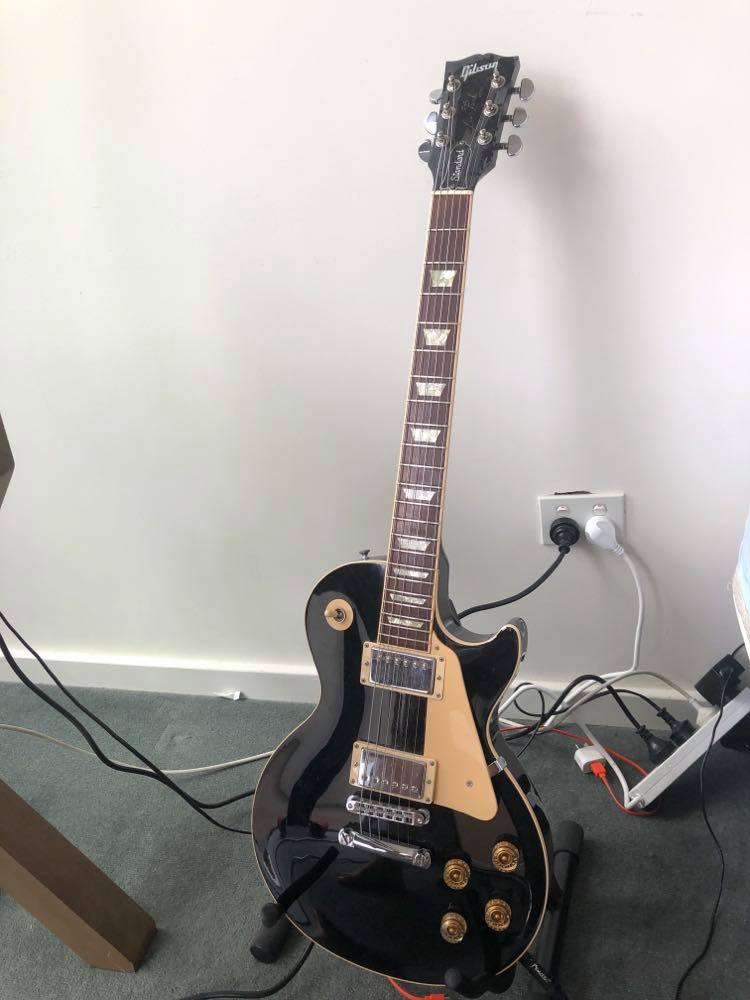
Custom Charvel Guitar Built for KISS (Original Strings Intact, Historical Artifact): The fact that the Creatures Charvel’s original 1982 recording strings remain on the guitar — combined with its auction documentation when it appeared in the marketplace — makes it one of the most specifically preserved primary documents in KISS guitar history. The guitar’s current location and ownership status is not confirmed in available sources, but its documentation is complete and specific.
Amps
Marshall Amplifiers (KISS Era Primary, Hard Rock Standard): The Harmony Central forum and general documentation of Vinnie Vincent’s KISS-era rig confirms Marshall amplifiers as the primary amplification — the standard arena rock amplification of the early 1980s that KISS used across their career. The specific Marshall models used during the KISS period are not documented with the precision of some other guitarists in this guide, but the Marshall JCM800 family (the dominant professional hard rock amplifier of 1982-1984) represents the most likely primary amplification. Running the custom Charvel’s high-output single humbucker through a high-gain Marshall head produces the specific aggressive, compressed lead tone of Vinnie Vincent’s KISS recordings.
Amplifier Evolution for Vinnie Vincent Invasion: For the Vinnie Vincent Invasion’s recordings (1986, 1988), the specific amplification is not documented in the available primary sources with the same precision as the KISS-era gear. The mid-1980s hard rock/glam metal context typically involved Marshall heads (JCM800 series), Mesa Boogie amplifiers, or comparable high-gain tube amplifiers through 4×12 cabinets — consistent with the genre’s sonic requirements.
Effects
KissFAQ Documentation — Chorus, Delay, Effects for “Lick It Up”: The KissFAQ forum provides the most specific effects documentation for the Vinnie Vincent KISS period — derived from a “guitar for the practising musician” article: “For ‘Lick it up’: gain: 75% tone at 45%, with a chorus with the delay at 50% the depth at 50% and the speed off (to give the sound separation at the bridge and fadeout, it requires two amps). Boost the EQ frequencies during the bridge, particularly 800Hz and 1.6 kHz.” This provides the specific signal chain approach of the Lick It Up era: high gain, moderate tone, chorus with delay for spatial separation, two amplifiers for the stereo effect in specific sections. The 800Hz and 1.6kHz EQ boost during the bridge represents the specific frequency emphasis that gives Vincent’s rhythm guitar its particular presence and aggression in the mix.
Floyd Rose Tremolo (Both Charvel and Jackson Instruments): The single most important “effect” in Vincent’s guitar approach is the Floyd Rose tremolo system — present on both the custom Charvel and the Jackson Double-V. The Floyd Rose’s double-locking tremolo design (locking at both the nut and the saddles) maintains pitch stability through aggressive tremolo use, allowing the specific dive bombs and pitch variations that are part of the 1980s shred vocabulary. Vincent’s “frenzied solos” — which grew “increasingly outlandish” during the KISS tours — included extensive use of the tremolo arm for the specific pitch manipulations that characterize early 1980s technical metal lead playing.
High-Output Bridge Humbucker (Technical Metal Foundation): The Charvel’s single high-output bridge humbucker — the EVH-inspired configuration that provided maximum sustain and saturation for the single-coil-positioned pickup — was the foundational tone source. Combined with the Marshall’s high-gain preamp, the single bridge humbucker produced the specific compressed, sustaining lead tone that the shred vocabulary of the early 1980s required: enough sustain to hold notes through fast scalar runs, enough attack definition to make individual notes of sweep-picked arpeggios distinct.
Playing Style & Tone Philosophy
Vinnie Vincent’s playing style was the most technically extreme in the KISS context — a style built on the shred vocabulary of the early 1980s (speed, sweep-picking, hammer-ons, pull-offs, Floyd Rose dive bombs) deployed within the arena rock framework of KISS’s music. His “frenzied solos that grew increasingly outlandish” captured by the Quebec City 1984 concert footage represent the specific challenge of a technically obsessed guitarist within a band context that valued other qualities: the solos were extraordinary as technical demonstrations and problematic as components of arena rock showmanship.
His tone philosophy was the single-humbucker-into-Marshall philosophy — the simplified, high-gain approach of the early 1980s technical metal tradition, built on maximum sustain and minimum circuit complexity. The custom Charvel’s single high-output bridge humbucker, straight into a Marshall head at high gain, produced the specific aggressive, sustaining lead tone that his playing required. The Floyd Rose’s pitch stability made the technical passages achievable in a live context; the single-pickup simplicity made the tone consistent and reliable.
His legacy — the “by far the best guitarist KISS ever had” characterization from Gene Simmons, sitting alongside the reality that his technical obsessiveness and professional difficulties made his tenure in the band the shortest and most turbulent of any KISS guitarist — is the specific paradox that defines his story. He was technically extraordinary. He was professionally impossible. The music he made during his KISS tenure is among the best guitar playing on any KISS album. The guitar still has its original strings from the Creatures sessions.
How to Sound Like Vinnie Vincent
Guitar: A superstrat-style guitar with a single high-output humbucker in the bridge and Floyd Rose tremolo — the EVH-inspired configuration of the Charvel. The Ibanez RG series, Jackson Soloist, or any comparable superstrat provides the foundational configuration. For the KISS-era authentic approach: the single-humbucker configuration is specific — no neck pickup, maximum focus on the bridge position for the saturated, sustaining lead tone.
Amp: Marshall JCM800 or comparable high-gain British tube head — the standard arena rock amplifier of the early 1980s. High gain, driven hard, with the pickup’s output pushing the preamp into saturation.
Amp Settings (Marshall JCM800 — Early 1980s Hard Rock Lead):
| Control | Setting (0–10) | Notes |
|---|---|---|
| Preamp Gain | 7–9 | High — the single bridge humbucker into a driven Marshall = sustain |
| Bass | 5 | Controlled — not excessive; lead guitar needs definition |
| Mid | 6–7 | Forward — “boost 800Hz and 1.6kHz” for the specific presence and attack |
| Treble | 6 | Present — attack definition for fast scalar runs |
| Presence | 5–6 | Moderate — adds cut without harshness |
Effects (for “Lick It Up” character): Chorus (depth 50%, speed low for subtle spatial width) with delay (time 50%, depth 50%) — the specific combination documented in the KissFAQ settings. EQ boost at 800Hz and 1.6kHz for the bridge sections. Floyd Rose tremolo for dive bombs in the solos. Keep the chorus subtle enough that the lead lines remain focused and the speed of the scalar passages remains clear and defined.
Influence & Legacy
Vinnie Vincent’s influence on hard rock and glam metal guitar is specifically the influence of a technical guitarist who brought a higher level of lead guitar sophistication to KISS’s catalog than the band had previously featured. The specific combination of KISS’s commercial context and Vincent’s shred vocabulary produced two albums (Creatures and Lick It Up) whose guitar playing remains among the most technically demanding in the KISS catalog. His role in establishing the visual and technical vocabulary of 1980s glam/shred metal — the Double-V guitar design, the Egyptian Ankh persona, the combination of theatrical showmanship with technical virtuosity — was absorbed into the broader glam metal tradition that dominated American hard rock in the mid-to-late 1980s.
His connection to Buck Dharma of Blue Öyster Cult as a fellow classic rock guitarist whose technical virtuosity was underappreciated within the genre’s commercial context reflects the broader challenge of technical excellence in arena rock. His connection to Phil X as a fellow technically gifted guitarist who has filled a high-profile guitarist role in an established band reflects the specific career trajectory of the extraordinary guitarist who joins an existing successful band.
Related reading:
- Buck Dharma of Blue Öyster Cult, a fellow classic rock guitarist of the same era whose technical virtuosity was underappreciated
- Phil X of Bon Jovi, a fellow technically gifted guitarist who joined an established band
- Rick Springfield, a fellow classic rock musician of the same early 1980s era
- Bill Kelliher of Mastodon, a next-generation technically demanding guitarist in the tradition Vincent helped establish
Frequently Asked Questions: Vinnie Vincent KISS Guitars & Gear
What guitar did Vinnie Vincent use on Creatures of the Night?
Vincent used a custom Charvel Stratocaster-style guitar he built himself, inspired by Eddie Van Halen’s Charvel. “Vincent was inspired to build the guitar after trying Eddie Van Halen’s Charvel. Van Halen explained that he had built his guitar with custom parts, including neck, pickup and body. Vincent tried Van Halen’s guitar and liked it so much he spent the next few months customizing a similar guitar.” The guitar was used on “I Love It Loud,” “Killer,” “War Machine,” “Keep Me Comin’,” and “Saint and Sinner,” among others. Remarkably, the guitar still has its original strings from the 1982 recording sessions.
Why did Gene Simmons call Vinnie Vincent KISS’s best guitarist?
Gene Simmons stated that Vinnie Vincent was “by far” KISS’s best guitarist — reflecting Vincent’s technical virtuosity and the specific quality of his guitar contributions to Creatures of the Night and Lick It Up. Vincent brought a technical sophistication to KISS that the band had not previously featured: faster, more complex lead work derived from the early 1980s shred/neoclassical tradition. His “A Million to One” solo on Lick It Up has been identified by Guitar World as “one of the finest six-string moments in the KISS catalog that don’t feature Frehley.” Despite this technical quality, his increasingly outlandish live solos drove Simmons and Paul Stanley “mad,” and he was fired in mid-1984.
What is the Jackson Double-V guitar?
The Jackson Double-V is a signature guitar design created by Vinnie Vincent in conjunction with Jackson Guitars — “a Double-V designed in conjunction with Jackson Guitars as a VV evolution of the Jackson Rhoads.” The design is based on the Egyptian ankh symbol associated with Vincent’s KISS makeup character (the “Egyptian Ankh Warrior”), creating a V-shaped body modified to echo the ankh’s visual form. It became one of the more visually distinctive signature instruments of the 1980s glam/metal era and continues to be produced and sought after by collectors.
What was Vinnie Vincent’s role in KISS?
Vincent played uncredited lead guitar on most of Creatures of the Night (1982) while Ace Frehley was still technically a band member, before being formally named as Frehley’s replacement in December 1982. He was the official KISS guitarist from the Lick It Up era (1983) through mid-1984, when he was fired. He was the first KISS guitarist seen publicly without makeup (Lick It Up was the first unmasked KISS album). His makeup was an Egyptian ankh design, and his nickname was “the Wiz,” referring to his guitar virtuosity.
What happened to Vinnie Vincent after KISS?
After leaving KISS in 1984, Vincent formed the Vinnie Vincent Invasion — a glam metal band that featured Robert Fleischman (later replaced by Mark Slaughter) and Dana Strum. The band released two studio albums (Vinnie Vincent Invasion, 1986; All Systems Go, 1988) before dissolving. Vincent was active in the music industry until 1998. He made a brief comeback in 2018, including a concert appearance, before withdrawing from the industry again. As of recent interviews, he claims to have recorded music that he won’t release without specific commercial conditions being met.
What were the effects settings for Vinnie Vincent’s “Lick It Up” tone?
From a contemporary “guitar for the practising musician” article documented on KissFAQ: “For ‘Lick it up’: gain: 75% tone at 45%, with a chorus with the delay at 50% the depth at 50% and the speed off (to give the sound separation at the bridge and fadeout, it requires two amps). Boost the EQ frequencies during the bridge, particularly 800Hz and 1.6 kHz.” This combination of high gain, moderate tone, chorus and delay for stereo spatial separation, and mid-frequency boost at specific Hz values produced the particular presence and aggression of his rhythm guitar sound on the album.
What KISS album did Vinnie Vincent record?
Vinnie Vincent appeared as an uncredited session guitarist on Creatures of the Night (1982) and as the official KISS guitarist on Lick It Up (1983). He also appeared on the Killers compilation. His most celebrated solo moment in the KISS catalog is the lead guitar work on “A Million to One” from Lick It Up. Guitar World cited it as “one of the finest six-string moments in the KISS catalog that don’t feature Frehley.” During the touring cycle for these albums (1982-1984), his live solos became increasingly technical and increasingly controversial.
Image credits
- Gibson Les Paul Standard: DonnyBurger1974, Wikimedia Commons, CC BY-SA 4.0.