One Year, Three Thousand Amps, and a Sound That Defined an Era: The Marshall 2555 Silver Jubilee 100W
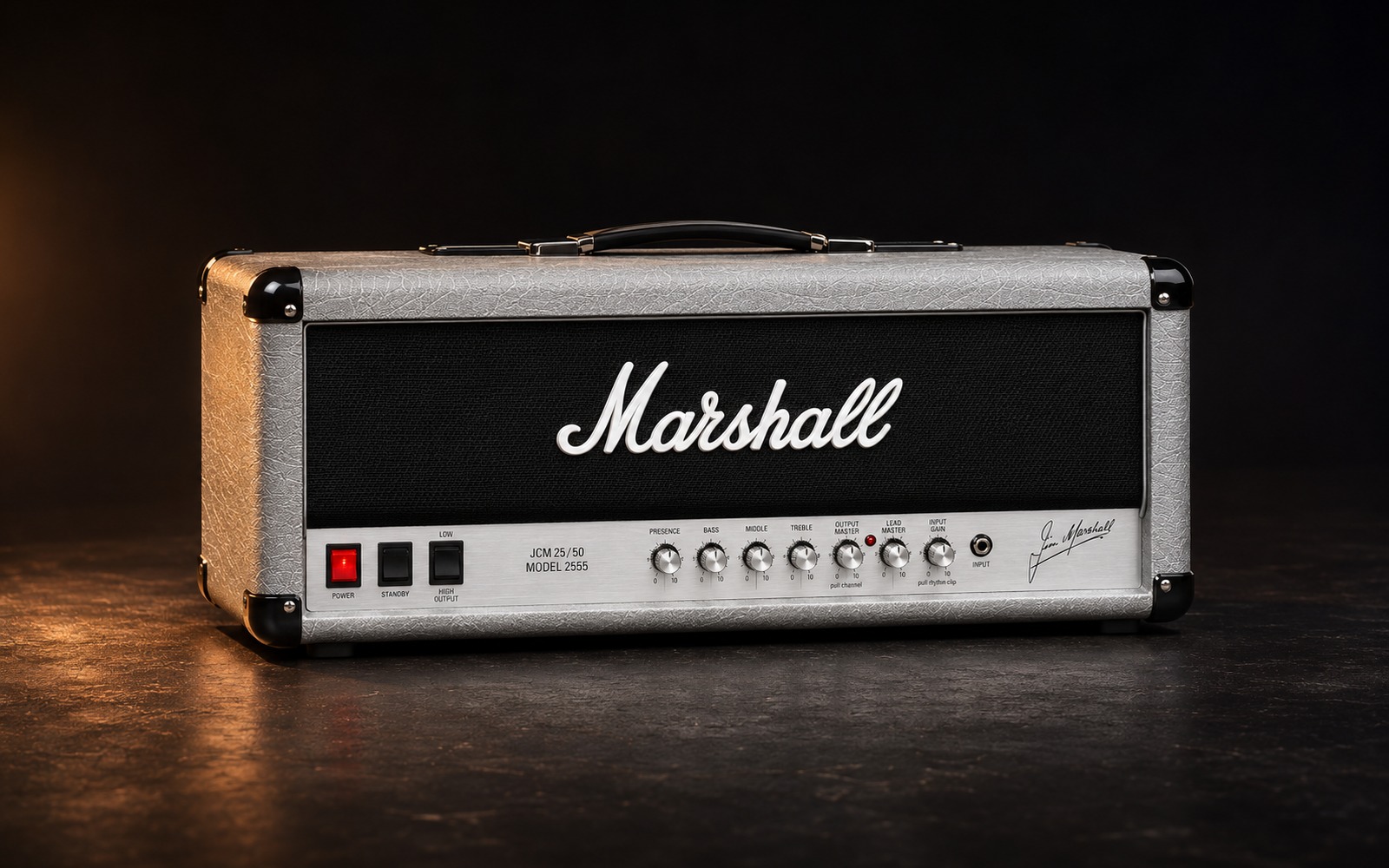
The original 1987 Marshall 2555 Silver Jubilee 100W — three-stage preamp, Slash's live backbone, one of the most sought-after vintage amp heads ever built.
There is a pawn shop story that circulates in every city with a functioning music scene. A guitarist walks in sometime in the early 1990s, sees a silver-wrapped Marshall head on the shelf with a hand-written price tag — three hundred, maybe four hundred dollars — and either buys it or doesn’t. The ones who didn’t are still talking about it. The ones who did are still playing it thirty-five years later, nursing their investment through three recaps and two transformer rebuilds, and refusing to sell it for less than four thousand dollars. The amp is the Marshall 2555 Silver Jubilee, and the pawn shop story is true for roughly three thousand people because that is approximately how many 100-watt 2555 heads were built.
Marshall produced the Silver Jubilee series for a single production run in 1987 to celebrate two anniversaries simultaneously: the company’s 25th year in the amplifier business and Jim Marshall’s 50th year working in music. The “JCM25/50” designation on the front panel is not a wattage rating — it is a double anniversary banner, the kind of marketing flourish that ages poorly except when the underlying product is extraordinary enough to outlive it. The 2555 is extraordinary enough. It was discontinued by 1989 and replaced by the JCM900 in 1990, and it sat on pawn shop shelves and in rehearsal rooms for most of the following decade at prices nobody bragged about paying. Then the Slash association fully crystallized, then Joe Bonamassa started building a wall of originals on stage and explaining exactly why in interviews, and then the price went up and kept going.
This article is about the original vintage 2555 — not the 2555X reissue, which is an excellent amp in its own right and is covered separately. The original has a specific production context, a specific circuit topology, a specific buying landscape, and a specific argument for why a player would choose it over the reissue or over any of the other Marshall head options in its price range. All of that is worth knowing before you spend four thousand dollars on an amplifier that is older than most streaming platforms.
A Brief Anniversary, A Long Shadow
Marshall’s 25th anniversary in 1987 was not a foregone reason to celebrate. The company had been through a difficult patch commercially in the mid-1980s — the JCM800 was everywhere, but “everywhere” had produced its own backlash, and the incoming generation of technically proficient players was reaching for Mesa/Boogie combos, rack systems, and multi-channel preamp setups that offered what the JCM800’s single-channel architecture could not. Marshall needed something that extended the JCM800’s legacy while admitting that the world had changed.
What designer Steve Grindrod and the team at Bletchley produced was a circuit that kept the JCM800’s fundamental character — British EL34 grunt, that specific midrange density, the way a Les Paul sits in it — while adding a third cascaded gain stage, a diode clipping circuit for the rhythm channel, and a separate lead channel with its own volume control. The result was an amp that could do everything the JCM800 did and then go further into gain and compression territory that the two-stage JCM800 preamp could not reach without a pedal in front of it. It was also an amp that came in silver vinyl with a chrome control panel, which looked unlike anything else Marshall had built and immediately read as a limited-edition object.
The full Silver Jubilee family included four models: the 2553 (50W head), the 2555 (100W head), the 2550 (50W combo), the 2554 (1×12 combo), and the 2558 (another combo variant). All shared the same preamp architecture, the same pull-switch voicing options, and the same silver cosmetic package. The heads — 2553 and 2555 — are the models that survived into the collector market in quantity; the combos are rarer because fewer were built and they are harder to transport.
Production ran from 1987 into 1988 and possibly 1989, with the 100-watt 2555 reportedly totalling around 3,000 examples. That number is widely cited but has never been officially confirmed by Marshall; what is confirmed is that the Silver Jubilee was an anniversary product, not a standard catalogue entry, and Marshall’s distribution infrastructure meant it did not reach every market in equal numbers. By 1990, the JCM900 arrived and the Silver Jubilee was quietly discontinued. The 900 introduced channel switching without pull pots, a new gain structure, and modern features the 2555 lacked by design. What the 900 did not have was the 2555’s circuit. They sound nothing alike, and once players figured that out — which took most of the 1990s — the Jubilee’s reputation reversed from “old stock” to “that amp you can’t find anymore.”
Marshall issued the 2555SL Slash Signature in 1996 — 3,000 units, US-only, built to the exact specifications of Slash’s own original 1987 2555, with cosmetic changes including a silver chassis and Slash’s signature plate. The 2555SL is tonally identical to the 2555; used units sell in the same $3,000–5,000 range as the original, sometimes higher because of the signature association. Then came the 2555X full reissue in the mid-2010s, followed by the more affordable 2525H Mini Jubilee in 2016, and the Studio Jubilee 2525H. The vintage original 2555 now sits at the top of this hierarchy not as the cheapest way to get the Jubilee sound but as the specific thing players who already have the reissue sometimes sell the reissue to buy.
Specifications: The Original 1987–1989 2555
One important distinction from the JCM800 2203 that the 2555 replaced in many players’ rigs: the original Silver Jubilee 2555 came with a series effects loop as standard. The JCM800 2203 famously did not — an FX loop was added to the 2203X reissue but was absent from the entire 1981–1990 original production run. The 2555’s loop is a series design that interrupts the signal path completely; anything left plugged into the send jack at low impedance will change the sound even when no effect is in use, so run the loop clean if you’re effects-free or use a proper effects switching system.
Famous Players: Who Actually Ran One
The list of claimed 2555 users that circulates on gear forums is the usual mixture of confirmed facts, plausible associations, and names recycled from other Marshall articles. The four players on Marshall’s own radar — Slash, Joe Bonamassa, John Frusciante, Alex Lifeson — are each worth addressing individually, because three of them tell a clean story and the fourth tells a useful lesson about reading model numbers carefully before you buy.
Slash — The Live Backbone (Verified)
Slash is the reason most players know the Silver Jubilee exists, and the story is verified from multiple primary sources including Marshall’s own published history of the relationship. In 1987, Slash was playing local shows around Los Angeles with a band that had not yet broken nationally. He acquired a Silver Jubilee 2555 and ran it as his primary live amp from the Appetite for Destruction tour onward. It has been his live backbone ever since — through Use Your Illusion, through the Velvet Revolver years, through every Guns N’ Roses reunion and solo outing since. Marshall eventually built the 2555SL signature (1996, 3,000 units) to the exact specifications of his original 1987 unit, which is about as direct an endorsement of a specific instrument as the industry produces. His live rigs run all his Jubilee heads into Marshall 1960A and 1960B full-stack 4×12 cabinets loaded with 70W Celestion Vintage speakers.
There is a necessary nuance that anyone chasing the Appetite for Destruction guitar sound needs to understand: the album was not recorded through the Silver Jubilee. The studio amp was a modified Marshall 1959T Super Lead — S.I.R. rental stock #36, documented by amp historian Tony McKenzie — not the 2555. The Super Lead Plexi has its own article. Slash switched to the Jubilee for the Appetite TOUR, and that transition is the reason the 2555’s association with Appetite is so durable: the tour reached far more people than the studio sessions did, and the live footage from 1988 and 1989 established the visual and sonic signature of Slash with a silver Marshall head that happened to be a 2555. If you are dialling in the Appetite studio tone, the Super Lead is the correct starting point. If you are dialling in the Appetite tour tone — the slightly rounder, more compressed live lead sound from that era — the 2555 is the right amp.
Joe Bonamassa — Four Original Heads, Two at a Time (Verified)
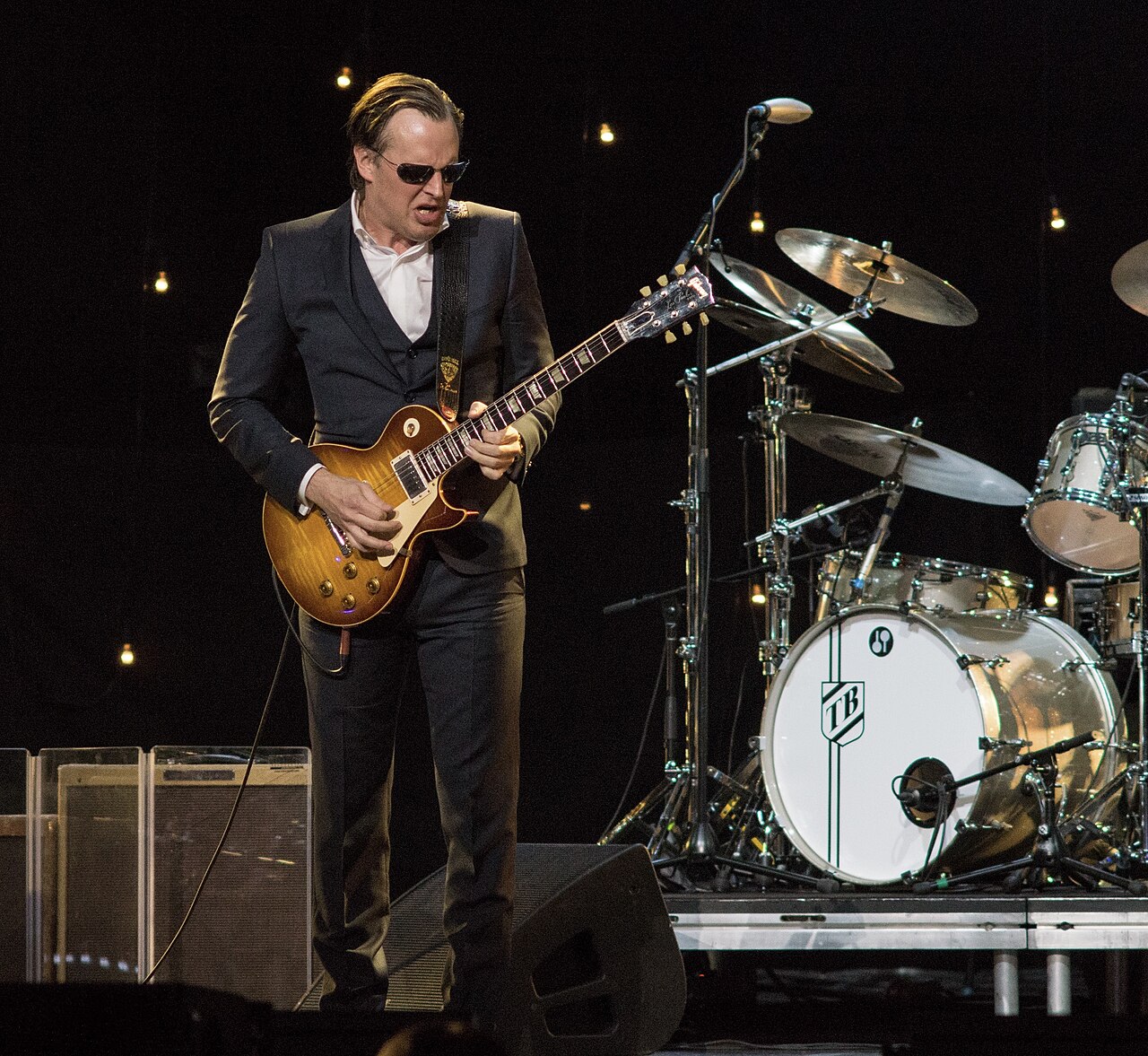
Joe Bonamassa is the most useful verification for anyone evaluating an original 2555 versus the reissue, because Bonamassa is one of the most obsessive amp collectors in professional music and he has been explicit in interviews about why he continues to use originals. He runs four original 1987 Silver Jubilee 2555 heads, two at a time, into a Van Weelden 4×12 loaded with EV EVM12L speakers. He has toured with this configuration for over fifteen years, on record saying of one particular unit: “This particular amp has been on tour with me for 15 years and it’s never broken down.” The EV EVM12L speakers are a deliberate choice — they handle low-end transients more tightly than Celestion Greenbacks and allow the bass on the amp to be pushed further without breakup, giving Bonamassa’s high-gain sustained lead tones a cleaner foundation than the traditional Jubilee + Greenback pairing would produce.
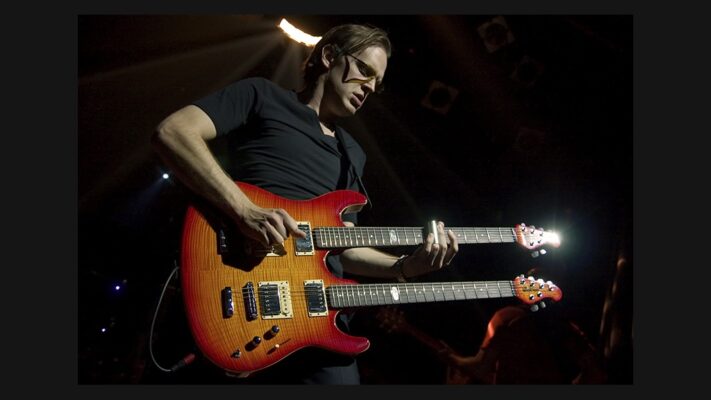
Bonamassa’s documented preference for the originals over the reissue is cited in the collector community as evidence that something tonally relevant distinguishes them. This is a genuine debate that does not resolve neatly from published A/B test data — blind comparisons don’t consistently favour the original — but the practical point is that a collector of his calibre and resources, who has access to any Marshall ever produced, has not replaced his four original 1987 heads with reissue units. Make of that what you will; it is the most honest frame available.
John Frusciante — From the Californication Tour Onward (Verified)
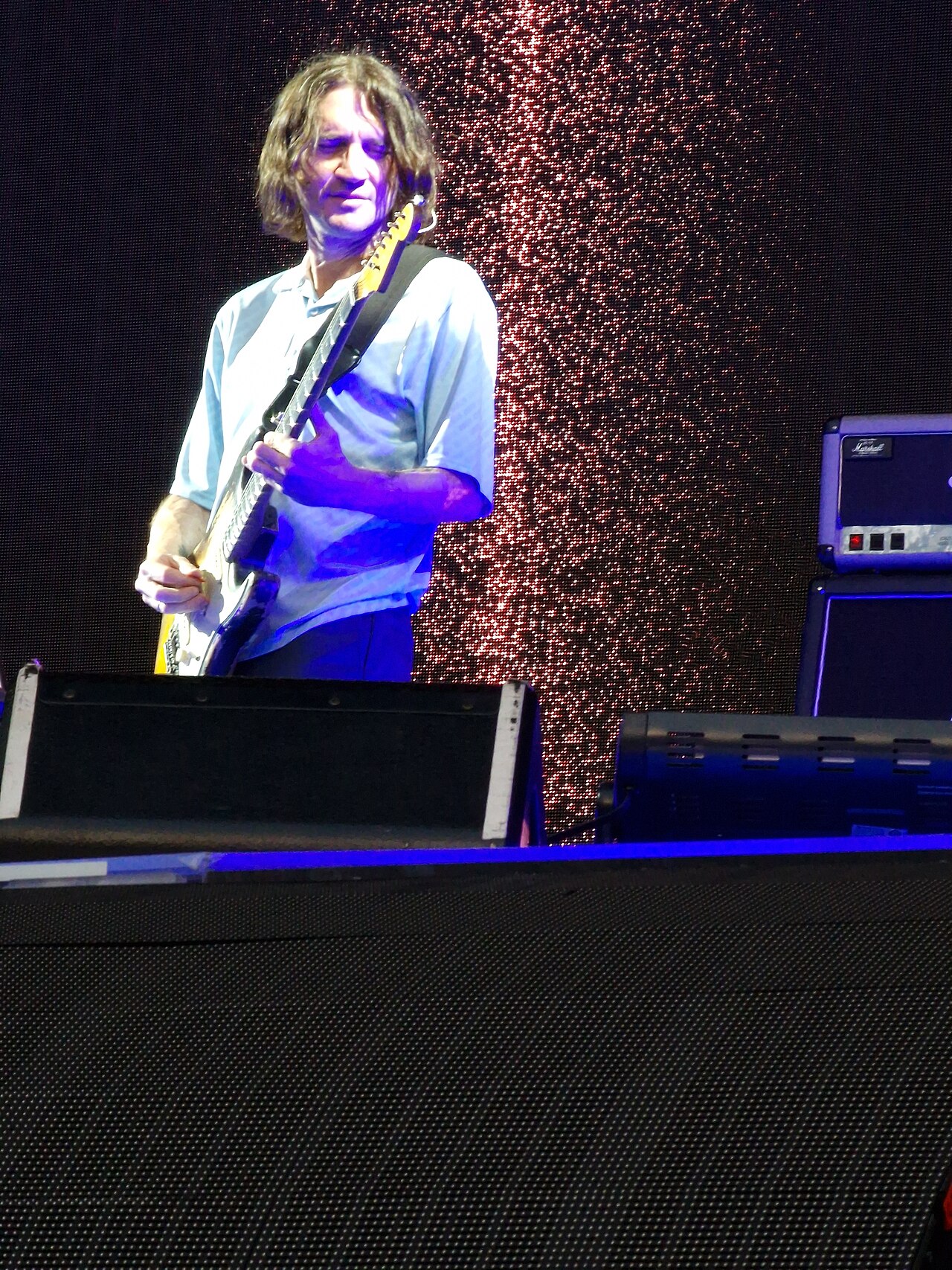
John Frusciante‘s relationship with the Silver Jubilee begins at the Californication TOUR in 1999, not the studio sessions. The Californication album was recorded through a different set of Marshalls — a JTM-45, a Super Bass, and a Fender Showman, confirmed by studio photographs and Frusciante’s own quotes referencing “a real old ’65 Marshall.” The 2555 appears in his rig from the 1999 arena tour onward, where it operated as one half of a layered two-amp dirty setup. Guitar tech Dave Lee confirmed in a 2016 interview that Frusciante ran a second Silver Jubilee as a stand-alone overdriven “Slash Rig,” dedicated to his black Les Paul, run at high gain independently of his primary amp. Concert footage from Slane Castle (2003) shows two Jubilee heads plus a Super Bass in Frusciante’s backline, which is the definitive visual document of how he deployed the amp during its primary touring years with the Chili Peppers.
Frusciante’s use matters because it documents the amp in a very different musical context from Slash’s. Slash uses the Jubilee for a specific sustained, compressed lead tone that sits above a two-guitar band mix. Frusciante ran it as part of a sonically adventurous stadium rig where the 2555’s three-stage gain structure provided the density and sustain needed to fill a large space, but where the amp’s ability to compress without losing articulation suited his melodic solo style. These are two different demonstrations of the same amplifier’s range, and both are independently verifiable from video sources rather than secondhand accounts.
Alex Lifeson — The 2553, Not the 2555 (Verified on Wrong Model)
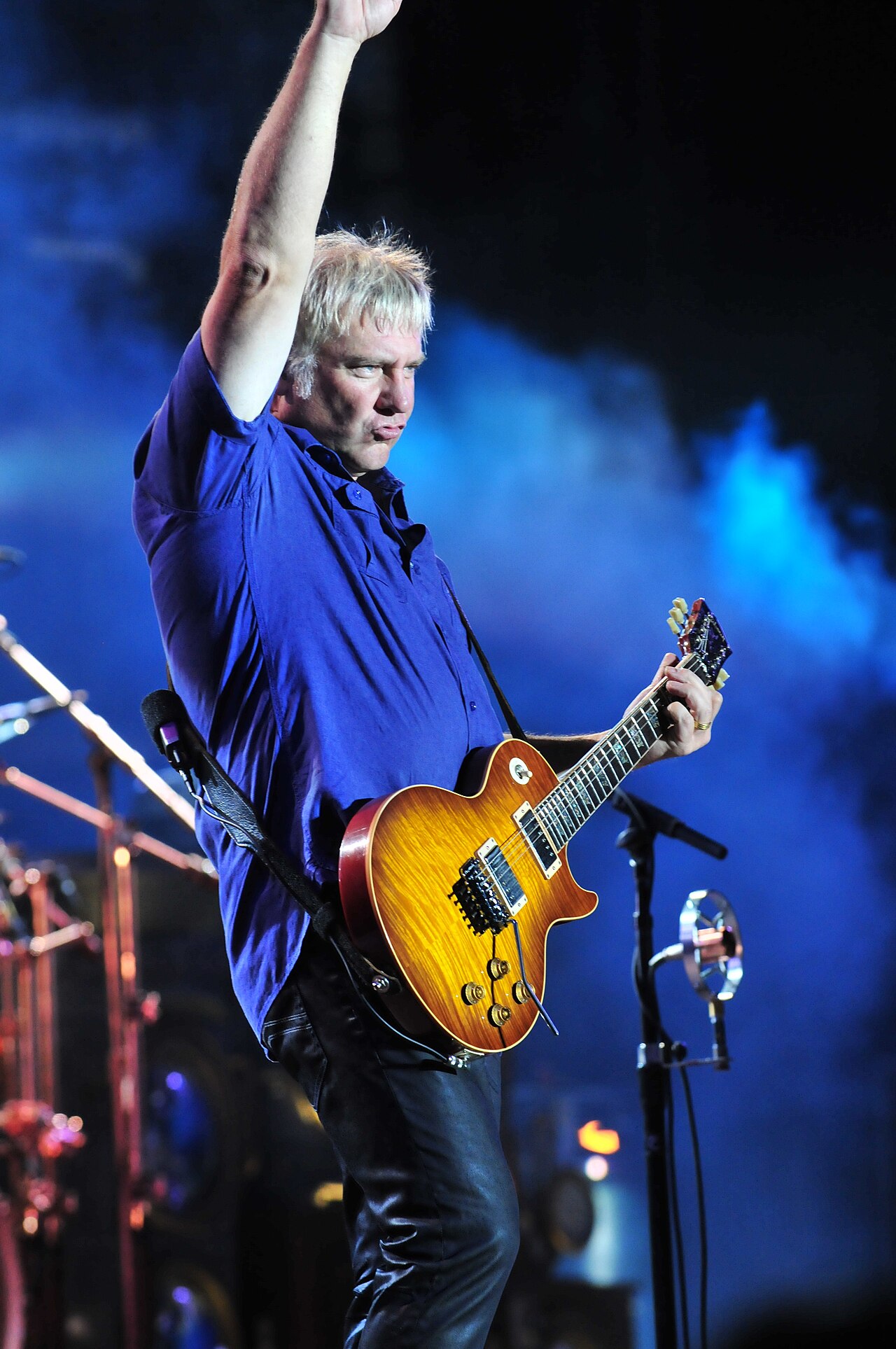
Alex Lifeson genuinely used a Silver Jubilee for the Clockwork Angels album and tour (2012), and his Lerxst Omega signature amp is derived directly from the Jubilee circuit. These facts are documented from multiple primary sources including Guitar Player and Rush fan wiki equipment pages. The necessary correction is that Lifeson’s Jubilee was the 2553 — the 50-watt version — not the 100-watt 2555. The Clockwork Angels dirty tones ran through the 2553 alongside a Mesa Boogie Mark Five (clean) and a Fractal AxeFX II (effects). The 2553 and 2555 share the same preamp circuit, tone stack, and pull-switch voicing options; the difference is the output section — two EL34s in the 2553 versus four in the 2555 — and the resulting power and headroom characteristics.
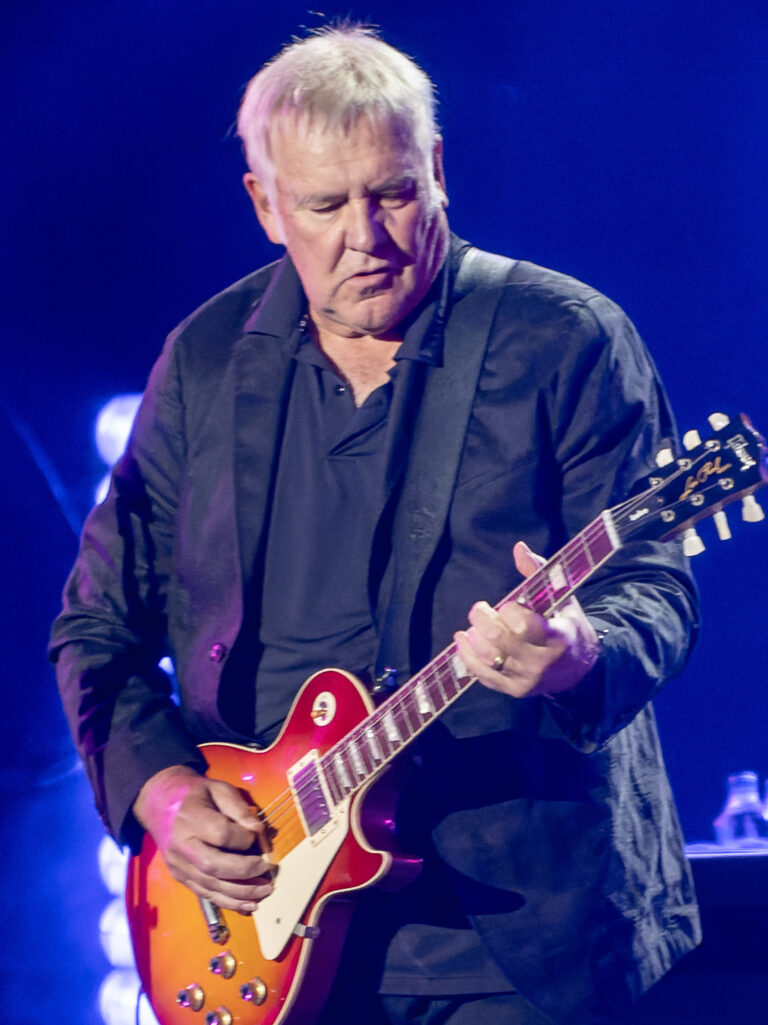
Including Lifeson without noting the wattage difference would be dishonest, and the distinction is not pedantic. A 50W head and a 100W head behave differently in the power section at live volumes, and Lifeson’s documented choice of the 2553 specifically is part of the Clockwork Angels tone story. The Lerxst Omega, built by Mojotone to Lifeson’s specifications, is based on the 2553 circuit. None of this diminishes the Silver Jubilee story overall; it means Lifeson’s primary association is with the 2553 article rather than this one, and stating that plainly is more useful than listing him and hoping nobody checks the model number.
The Circuit: Why It Sounds Like Nothing Else Marshall Built
Three Cascaded Gain Stages
The most fundamental difference between the Silver Jubilee 2555 and the JCM800 2203 that preceded it is the preamp stage count. The JCM800 2203’s preamp runs two cascaded gain stages — the signal passes through the first triode of a 12AX7 for the input gain stage, through the second triode of the same tube for the second gain stage, then into the tone stack. Two stages produce the JCM800’s characteristic fast, focused, midrange-forward distortion that cleans up well when the guitar’s volume knob is rolled back, but that requires the master volume to be elevated to get the power section audibly involved.
The 2555 adds a third cascaded gain stage before the tone stack. Three stages produce more gain, more harmonic complexity, and a compression character that sits between the JCM800’s open quality and the tighter, more controlled sound of the rack preamp systems that were fashionable in 1987. The three-stage architecture is also why a Silver Jubilee at gain noon, with the Rhythm Clip switch pulled, sounds roughly like a JCM800 at gain maximum. Past noon on the 2555 with Rhythm Clip engaged, you are in gain territory the JCM800 cannot reach without a pedal or modification. This is not a marginal difference — it is a different preamp design that produces a different family of tones, and players who A/B-ed them in 1987 describe the experience as immediately clarifying about what each amp is optimised for.
Rhythm Clip: The Pull Switch That Changes the Register
The Input Gain pot has a pull function: pulled outward, it engages the Rhythm Clip circuit — a simple anti-parallel two-diode network placed between the second and third preamp gain stages. When the diodes are engaged, they clip the peaks of the waveform and shunt a portion of the signal to ground, adding distortion and compression on top of the tube gain stages. A small capacitor across the diode network rounds the clipped waveform edges to soften the solid-state character, moving the result closer to a tube-saturated sound while retaining the diode’s gain-on-demand quality.
The practical result: the Rhythm Clip gives the 2555 hard-rock saturation at moderate master volume settings without needing the power section pushed. This is the core practical advantage of the 2555 over the JCM800 for live use in venues that cannot accommodate a Marshall at stadium levels. The Rhythm Clip is also the feature that most modelling implementations handle accurately — a clipping diode circuit translates well to software, and the clip voicing on a 2555 model is generally close to the original.
Output Stage: Pentode and Triode
The Output Master pot has a pull function that toggles the EL34 power tubes between Pentode mode (standard Marshall, full 100W) and Triode mode (approximately 50W, different harmonic character). This is not an attenuator. In Pentode mode, the EL34s operate at full output in their standard push-pull configuration. In Triode mode, the tube’s screen grid is connected to the plate, fundamentally changing the transfer characteristics: output power drops by roughly half, the compression becomes softer, the harmonic content shifts toward more even-order harmonics, and the top end darkens slightly.
At apartment-level volumes, Triode mode is the only way to get the power section meaningfully involved in the tone. The power-tube saturation that defines Marshall’s character at volume requires the tubes to be working hard, and at low master settings in Pentode mode the EL34s are barely warm. Triode mode closes that gap. This is also the feature that most modelling implementations get wrong — the Sag parameter approximates some of the behaviour, but the harmonic shift of physically rewiring a push-pull EL34 pair from Pentode to Triode mode is not captured by adjusting a sag or compression parameter. If the Triode sound matters to you, the real amp is meaningfully different from the model.
Lead Channel and Lead Master
The Lead channel is engaged via the footswitch or by the Output Master pull switch. Unlike the Rhythm Clip, which adds a switchable diode pair, the Lead channel uses a more complex diode network: two LEDs and three standard rectifier diodes in a series/anti-parallel configuration. This network is always active in the Lead channel — you cannot turn it off. The Lead channel therefore always runs with diode-assisted saturation layered on the three-stage tube preamp.
The Lead Master is a separate volume control for the Lead channel, independent of the main Output Master. This means you can balance a clean or light crunch Rhythm setting against a higher-gain Lead setting and switch between them at performance level without changing the overall room volume. It is a simple feature absent from the single-channel JCM800 2203, and it made the 2555 a practical two-voice live amp without requiring an external switching system.
Five Tone Recipes
1. Slash Live: Appetite for Destruction Tour Lead
This is the documented starting point for the Slash 2555 live tone, confirmed across multiple sources. Input Gain at noon, Rhythm Clip pulled. Lead Master at 1–2 o’clock. Bass at 1 o’clock — less than you might think; the three-stage preamp adds low-end weight and too much bass becomes muddy quickly. Middle at 2 o’clock. Treble at 10 o’clock — the three-stage saturation adds upper harmonics, so cut the treble to compensate. Presence at 9 o’clock. Output Stage in Pentode for full character. A Les Paul with the neck pickup, no pedal in the chain, into the input at guitar volume 10. The Rhythm Clip diode is doing most of the gain work; the Lead Master is controlling volume, not gain quantity. This tone fills a room and compresses like a freight train — it is not a subtle setting.
2. Frusciante Stadium Grind: Californication Tour Lead
Frusciante ran his Jubilee as a dirt source in a layered amp rig, which means his individual amp settings were dialled to contribute a specific frequency window rather than to sound complete on their own. For players using the 2555 as a sole amp, the approximation is: Lead channel active. Input Gain between noon and 1 o’clock, Rhythm Clip pulled. Lead Master around noon. Bass at 10 o’clock — Frusciante’s tone lives in the mids and upper mids. Middle at 3 o’clock. Treble at 10 o’clock. Presence at noon. A Stratocaster with the tone rolled slightly back. This setting has less low-end density than the Slash recipe and more midrange articulation — it separates note-by-note during melodic lines where the Slash setting sustains through them.
3. Bonamassa Blues-Lead: High-Noon Saturation
Bonamassa drives his Jubilees hard with EV EVM12L speakers, which handle low-end transients more tightly than Greenbacks and allow more bass on the amp itself. Input Gain at 2–3 o’clock, no Rhythm Clip. Lead Master at 2 o’clock. Bass at 2 o’clock. Middle at 2 o’clock. Treble at 11 o’clock. Presence at 10 o’clock. Output Stage in Pentode, master volume loud enough to warm the power section. A fat-neck Les Paul with the bridge pickup. This gets you into the Jubilee’s natural three-stage tube saturation without the diode clipping — the result is slightly more open and touch-sensitive than the Rhythm Clip setting at the same apparent gain level, and the pick attack reads more clearly through the compression.
4. Bedroom Volume: Triode Mode After Dark
The Jubilee at bedroom level in Pentode mode is a well-designed preamp section driving a cold power section — it does not sound bad, but it does not sound like the amp. Triode mode changes the equation. Input Gain at 1 o’clock, Rhythm Clip pulled. Lead Master at 9 o’clock. Bass at 11 o’clock — the Fletcher-Munson curve means you need less bass at low SPL to perceive the same low-end weight. Middle at 2 o’clock. Treble at noon. Presence at 10 o’clock. Output Stage pulled (Triode). Master at 9 o’clock. The Triode compression compensates meaningfully for the absence of power-section involvement, and at these settings the 2555 is the most liveable 100W Marshall at domestic volumes.
5. Clean Crunch: Rhythm Channel Without Clip
The 2555 is not primarily a clean amp, but its Rhythm channel with the Clip pushed in and the Input Gain below 10 o’clock produces a firm, touch-responsive crunch that cleans up when the guitar volume is rolled back to 6 or 7. Input Gain at 9 o’clock, Rhythm Clip NOT pulled. Output Master at 2 o’clock. Bass at 11 o’clock. Middle at 1 o’clock. Treble at noon. Presence at 8 o’clock. A Telecaster or semi-hollow into this setting at guitar volume 7 gets close to the medium-gain Marshall rhythm tone that appears on countless 1980s and 1990s rock records where the producer needed grit without chaos. This is the least-discussed voice of the 2555 because it is not the voice people buy it for — but knowing it is there gives you a second working character without touching the amp.
How the 2555 Compares to Other Options
At $3,500–6,000 for a clean original 2555, the comparison set is no longer new production amps. The relevant questions are: original versus reissue, and original versus other vintage heads in this price range.
The 2555X reissue at approximately $2,349 new (or $1,400–1,900 used in excellent condition) is the first and most honest comparison. Marshall’s modern manufacturing produces a reissue that captures most of the original’s character. Most careful A/B comparisons between a healthy original 2555 and a 2555X reissue find them tonally close — sometimes indistinguishable — which is what the reissue is supposed to achieve. The argument for the original over the reissue comes down to collector value, the specific quality of transformer iron and capacitors from the 1987 production run, and the provenance of owning the specific amp the circuit was designed on. If you want the sound and not the provenance, the reissue is the correct purchase. The price difference buys a lot of guitar or pedals.
The JCM800 2203 original trades in the $2,000–4,000 range, meaningfully cheaper than the 2555 for an equivalent vintage specimen. It is a different amp — two preamp gain stages versus three, no Rhythm Clip, no Triode mode, no Lead Master, no FX loop — but the JCM800’s two-stage preamp at the right master volume settings produces a more revealing, touch-sensitive tone than the 2555’s more saturated design. If your primary use is AC/DC-style rhythm, Clapton-era blues, or any application where clean-up response matters more than gain quantity, the JCM800 2203 is the correct choice and costs less. The 2203X reissue at $2,899 new adds the series FX loop absent from the original 2203 and offers the circuit at new-production prices.
The 1959 Super Lead Plexi in vintage original form sits in the $4,000–8,000+ range depending on year and condition, making it the most expensive comparison but also the amp that defined British rock before the JCM800 changed the conversation. The Plexi’s preamp saturation has a different character from both the JCM800 and the Jubilee — earlier breakup, more bloom in the low mids, less focused but arguably more musical at moderate gain settings. The 1987X 50W reissue at $2,299 offers that circuit at current production prices.
The JTM45 is the ancestor the 2555 looks most unlike on paper — lower gain, KT66 tubes in the original formulation, the foundational British amp tone from which everything else evolved — but players who own both sometimes describe the JTM45 as the better amp for recording and the Jubilee as the better amp for live use. That framing, while reductive, captures something real about where each amp’s design is optimised.
At the practical end of the Marshall family, the DSL40CR at around $850 new offers modern channel switching, onboard effects, and a current-generation Marshall gain structure in a combo. It shares the brand and some tonal DNA; it does not share the Silver Jubilee’s circuit architecture. Comparing them is mostly a question of whether the specific Jubilee topology matters to the player versus a modern dual-channel Marshall at a fraction of the vintage price.
Vintage Buying Guide: What to Look For in an Original 2555
Buying an original 1987–1989 Marshall 2555 is different from buying a current-production amp. The unit is nearly forty years old, and forty years of gigging, storage, and varying levels of maintenance have produced a wide spectrum of condition. The following points separate a safe purchase from an expensive mistake.
Serial number and dating. Original 2555 serial numbers follow the JCM-era format with a date code. The manufacturing year should be 1987 or 1988; 1989 is plausible at the extreme end of the run. A unit claiming 1990 or later production should be treated with scepticism — the JCM900 was in production by then, and the Silver Jubilee anniversary run was complete. Marshall’s repair division can verify a serial number against their production records for a modest fee.
Transformer originality. The output transformer is the single most sonically consequential component in a vintage amp, and the hardest to evaluate without test equipment. Ask the seller directly whether the transformers are original. A professionally replaced transformer is not necessarily a problem — boutique transformer winders such as Heyboer and Magnetic Components build quality replacements — but it is a different amp tonally, and original transformers command a premium. Request documentation of any transformer work if it exists.
Recap status. The electrolytic capacitors in a 38-year-old Marshall are overdue for replacement by any standard maintenance schedule. A professionally recapped amp is safer to own and may sound more open in the low frequencies than an uncapped original — some players prefer the slightly darker sound of degraded original capacitors, but that preference should be a conscious choice, not a default. An amp that has never been recapped should be evaluated by a qualified technician before purchase, and the cost of a professional recap ($150–300 depending on the tech and market) should factor into price negotiation if the caps are original and untouched.
Power tube condition and bias. The original EL34 tubes from 1987 are not present in any amp that has been played. Power tubes in a 100W Marshall running at full output last approximately two to five years under regular use; any amp this old will have had multiple tube changes. What matters is whether the current tubes are well-matched, properly biased to the correct operating point for the Jubilee circuit, and from a reputable manufacturer. Mismatched or incorrectly biased EL34s are a common cause of tonal imbalance and early failure in vintage Marshalls. A technician bias check is a reasonable request before completing any purchase.
FX loop integrity. The Silver Jubilee’s series FX loop can develop noise and tonal degradation through oxidised jack contacts over decades of use. If the buyer does not plan to use the loop, this is irrelevant; if the loop is required, test it at purchase by connecting a known-working effect and verifying that bypassing it returns the amp to its unlooped signal. Running nothing through the loop jacks does not tell you whether the circuit is functioning correctly.
The Triode and Rhythm Clip pull switches. Both switches are integrated into potentiometer shafts rather than being separate toggle switches. These mechanisms can wear over time and eventually fail to engage or disengage cleanly. Test both pull switches during any evaluation — pull and release each pot shaft and verify the tonal change. A switch that sticks, crackles, or fails to engage is a repair job rather than a reason to walk away, but it should be priced accordingly.
Cosmetics versus tone. Silver vinyl ages poorly and the chrome panel tarnishes. Tolex tears at the corners. These are cosmetic issues that affect collectability significantly but tone not at all, and the price difference between a cosmetically distressed player-grade example and a clean collector unit is often substantial. A distressed original at $3,500 may offer a better tone-per-dollar proposition than a pristine original at $5,500 if both have been properly maintained. Know which you are buying and price accordingly. For reference, a full stack with original matching Silver Jubilee 4×12 cabinet in period-correct silver vinyl commands a premium above the head-only price — original cabs in good condition trade at $800–1,500 separately.
Ownership Notes
The Silver Jubilee 2555 runs four EL34 power tubes at a 100W operating point. Tube longevity depends on the bias setting and output stage stress; a correctly biased set of well-matched EL34s in a properly maintained Jubilee should last two to five years in regular gigging use. Preamp ECC83 tubes are less stressed and typically last ten years or more in non-output positions; the phase splitter tube (one of the three ECC83s, operating at the highest signal level in the preamp chain) should be checked first if the amp develops tonal imbalance in the low frequencies or unusual distortion behaviour.
The Triode mode switch and the Rhythm Clip are both pull-pot mechanisms. Test them periodically; they can develop crackle or intermittent connection as the pot shaft wears at the switching contact. Both are repairable with pot replacement by a competent tech — it is a soldering job, not a structural repair, but it requires someone familiar with vintage Marshall layouts.
The series FX loop jacks are a routine maintenance point. Oxidation on the contact surfaces causes signal degradation that can be easily mistaken for a tube problem in an amp of this age. Applying Deoxit D5 contact cleaner to the FX loop jacks and working plugs in and out several times to clean the contact surfaces is a reasonable first step when investigating any unexplained tonal change in an amp that has been in storage or low use.
Volume in a room. The 2555 at 100W Pentode into a loaded 4×12 at output levels sufficient to engage the power section is an extremely loud amplifier. Venues that cannot accommodate this SPL without feedback or front-of-house management issues are not well suited to using the Pentode mode for its designed purpose. The Triode switch and Lead Master give the 2555 more low-volume flexibility than the JCM800 2203 in comparable situations, but the authentic Silver Jubilee experience at full character is a stage tool. Players who need the Jubilee sound primarily at home or studio levels are better served by the 2555X reissue paired with an external reactive load attenuator — or by the 2525H Mini Jubilee, which runs 20W and retains the three-stage preamp character — rather than by paying original-vintage prices for a 100W head they will not be able to run correctly.
Frequently Asked Questions
What makes the original 2555 different from the 2555X reissue?
The circuit is intentionally identical — Marshall built the 2555X reissue to duplicate the original’s specifications. The practical differences are production era components (original capacitors, transformer iron, and tube quality from 1987 versus current-production equivalents), age-related condition variability in the original, and price. A healthy original 2555 trades at $3,500–6,000; the 2555X reissue is approximately $2,349 new. Most careful blind A/B comparisons find the two amps tonally close. The original carries collector value and provenance; the reissue carries a warranty and component freshness. If you want the sound and not the history, the reissue is the correct purchase.
Did Slash record Appetite for Destruction through the Silver Jubilee?
No. The studio amp for the Appetite for Destruction recording sessions was a modified Marshall 1959T Super Lead, S.I.R. rental stock #36, documented by amp historian Tony McKenzie. Slash switched to the Silver Jubilee for the Appetite for Destruction TOUR that followed the album. The live sound of Slash from 1987 onward is the 2555; the studio sound of the Appetite album specifically is the Super Lead. Both are separate verifiable facts, and conflating them leads to tone-chasing exercises that cannot succeed because the guitar and amp are different instruments.
How many original Silver Jubilee 2555 heads were built?
Approximately 3,000 units of the 100-watt 2555 head, by the most widely cited estimate. This figure has never been officially confirmed by Marshall from published production records, so treat it as a reasonable approximation rather than a hard number. The 50-watt 2553 head and the combo variants (2550, 2554, 2558) were built in smaller quantities, making them rarer on the used market. The Silver Jubilee was an anniversary product — not a regular catalogue line — which is the structural reason the production was limited and the subsequent used market became expensive.
What is the Rhythm Clip switch, and should I use it?
The Rhythm Clip is a pull function on the Input Gain pot that engages an anti-parallel two-diode clipping network between the second and third preamp gain stages. Pulled out, it adds a harder, more compressed distortion character on top of the three-stage tube gain. Whether to use it is straightforward: for the Jubilee’s classic high-gain lead tone at moderate master volume, pull it. For a cleaner, more touch-sensitive response with the amp’s natural tube saturation, push it in and raise the Input Gain instead. Both are original-design voices and both are useful in different live contexts.
What is Triode mode, and is it just an attenuator?
The Triode mode — engaged by pulling the Output Master pot — is not an attenuator. It changes the operating mode of the four EL34 power tubes from standard Pentode wiring (full 100W) to Triode wiring (approximately 50W), which physically changes the tube’s transfer characteristics: softer compression, more even-order harmonics, slightly darker top end. The result is a power section that becomes audibly involved in the tone at lower master volume settings. A standard attenuator placed at the speaker output reduces volume without changing the tube operating mode; the Triode switch changes the operating mode and produces a genuinely different sound. It is the feature most software modellers get wrong in the Jubilee emulation.
How does the 2555 compare to the JCM800 2203?
The JCM800 2203 has a two-stage preamp; the 2555 has three stages. The 2555 reaches higher gain levels without pedals, adds a Rhythm Clip diode option, a Triode output stage switch, a Lead Master, and an FX loop (the original 2203 had no loop). The JCM800 2203 is more open and touch-sensitive at moderate gain settings and responds more dramatically to guitar volume rollback. A Tube Screamer in front of a JCM800 gets you toward the Jubilee’s gain quantity but not the harmonic complexity of three actual cascaded tube stages — they are different paths to overlapping results with measurably different harmonic content. For AC/DC-style rhythm and anything where clean-up response matters more than sustained lead gain, the JCM800 is the correct amp. For Appetite-tour leads and Frusciante-style stadium grind, the Jubilee is.
What cabinets should I pair with a vintage 2555?
The original Silver Jubilee era matching cabinet was a 4×12 loaded with Celestion G12M Greenbacks or G12T-75 speakers in period-correct silver vinyl. The standard current recommendation is a 4×12 with 65-75W Celestion speakers — Vintage 30s, G12T-75s, or the EV EVM12L that Bonamassa uses for tighter low end and more headroom under a hot amp. Impedance match is non-negotiable: set the 2555’s impedance selector to the nominal impedance of the cabinet. Mismatched impedance on a high-powered valve amp causes output transformer stress that accelerates failure in a unit already approaching forty years old. Get it right before the first power-on.
Is the 2555SL Slash Signature the same as the 2555?
Tonally, yes. Marshall built the 2555SL (1996, 3,000 units, US-only) to the exact specifications of Slash’s original 1987 2555, with cosmetic differences: silver chassis, Slash signature plate. The circuit is identical. Used 2555SL units sell in the same $3,000–5,000 range as the original 2555, sometimes higher because of the signature association. If you find a well-maintained 2555SL at a fair price relative to an original 2555, you are buying the same amp with different aesthetics and a different backstory. Neither is tonally superior to the other by design.
Image credits
- Top image: GuitarGangsters AI-generated reference illustration, not a photograph.
- John Frusciante: Hel Davies, Wikimedia Commons, CC BY-SA 2.0.
- Alex Lifeson: Adrian Buss, Wikimedia Commons, CC BY-SA 3.0.
- Joe Bonamassa: Dmileson, Wikimedia Commons, CC BY-SA 4.0.
- Joe Bonamassa: Raúl Ranz, Wikimedia Commons, CC BY 2.0.
- Alex Lifeson: by Raph_PH, Wikimedia Commons, CC BY 2.0.
Latest News
Related

On This Day
Monday 9 November
From this week: