The Amp That Chose the Stage Over the Living Room: Vox AC30 Hand-Wired Head
Vox AC30 Hand-Wired Head: 30W EL84, turret board, tube spring reverb, bypassable master volume. Specs, honest player facts, and tone recipes for the AC30HWRH.
Every guitarist who has ever lifted an AC30 combo up a flight of stairs understands the fundamental injustice of the situation. One of the most beautiful amplifier circuits ever designed — Dick Denney’s cathode-biased quartet of EL84s, the phase-inverter distortion that happens nowhere else on earth, the chime that cuts through any mix like a lighthouse through fog — has always been trapped inside a cabinet that weighs roughly the same as a German shepherd. For six decades, the only way to own the true AC30 sound was to accept that you would also own a very heavy piece of furniture.
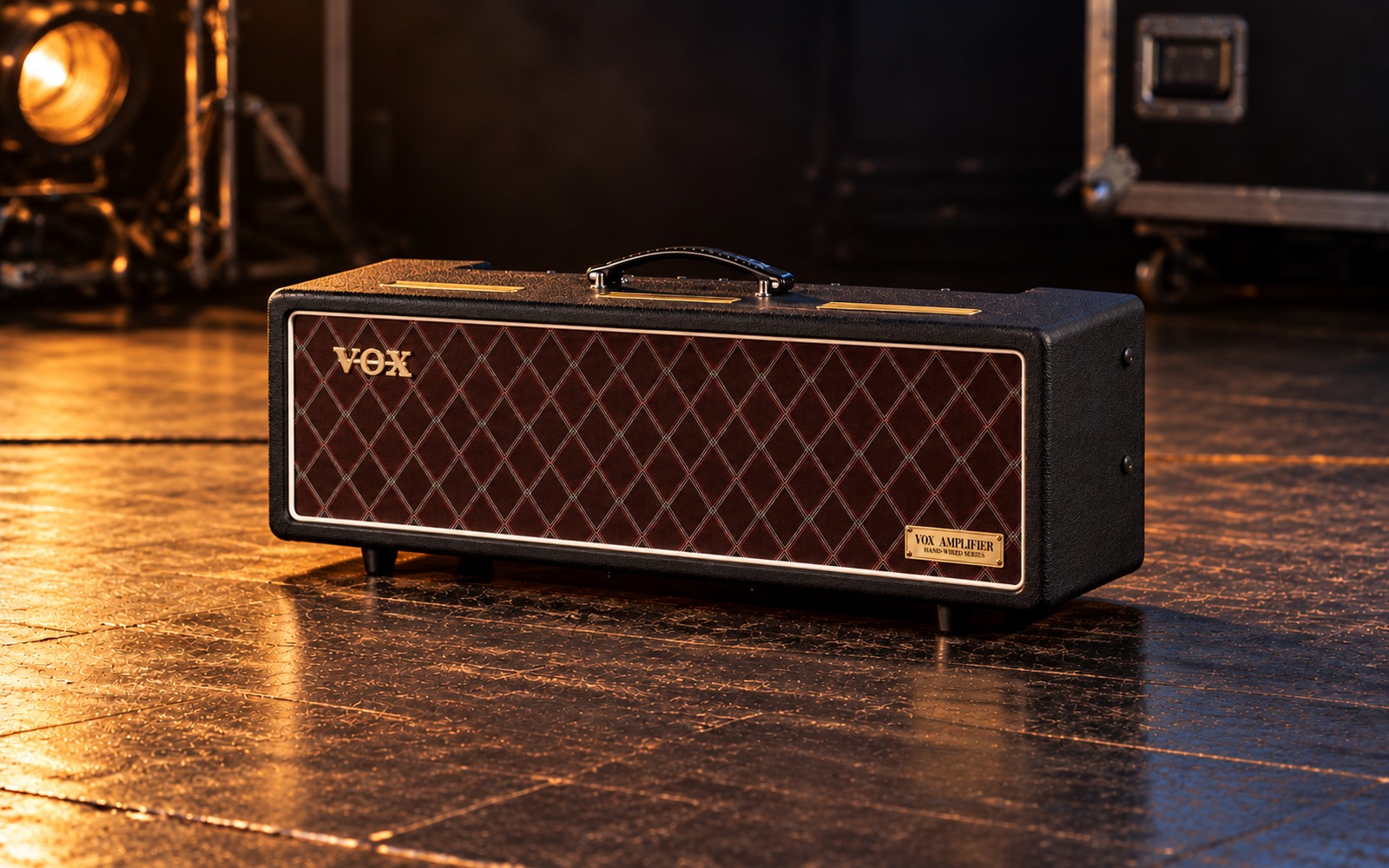
The Vox AC30 Hand-Wired Head changes that equation without flinching on a single circuit value. Same turret board construction. Same tube complement. Same transformer topology derived from the analysis of an original 1963 copper-panel AC30. Same Normal and Top Boost channels. Now housed in a head enclosure that weighs 43.43 pounds instead of 70, and liberated from any speaker that came in the box. You choose the cabinet. You choose the speakers. You decide whether tonight calls for Alnico Blue shimmer or Greenback punch. The amp is your circuit, and the circuit is the AC30.
What follows is a complete account of that circuit, its history, the players who put it on stages (and which of those claims hold up under scrutiny), and everything you need to know before buying the head format over the far more common combo.
From a Garage in Dartford to a Turret Board in Vietnam: The AC30 Story
The AC30’s origin is one of those rare cases in guitar history where the product was created by demand rather than design. Tom Jennings had founded Jennings Musical Industries in Dartford, Kent in 1958 and was already selling the fifteen-watt AC15 — a compact, cathode-biased tube amplifier that Hank Marvin of The Shadows was using on sessions and touring dates. Marvin came back to Jennings with a request: same amp, more volume. The Shadows were playing increasingly larger halls, and fifteen watts was no longer enough.
Dick Denney, JMI’s chief designer, doubled the power stage — two matched pairs of EL84 power tubes instead of one, a larger output transformer, a bigger cabinet to move more air — and the AC30/4 Twin debuted in 1959. Hank Marvin got his volume. The rest of the guitar world got one of the defining sounds of the twentieth century.
The amp evolved quickly through the early 1960s. The original AC30 had no built-in equaliser on its primary channel, which came to be known as the Normal channel. In approximately mid-1961, JMI added what it called the Top Boost unit — an active cathode-follower tone stage using a full 12AX7 preamp tube, providing independent treble and bass controls on a second input. The Top Boost circuit was derived conceptually from the Gibson GA77, adapted to EL84 sensibilities. Initially sold as an add-on module, it was integrated into the chassis by late 1963 on the “copper panel” variants, which are the reference point for every serious hand-wired Vox recreation since.
That copper panel matters specifically because of what happens inside it. The 1963 AC30 runs its EL84 quartet in cathode bias with no global negative feedback — a configuration that produces primarily even-order harmonics rather than the odd-order stack associated with fixed-bias EL34 amplifiers like the Marshall Plexi. The phase inverter stage, when pushed hard, contributes its own harmonic layering in a way that is distinct from preamp saturation. You cannot get this texture by running a pedal into a clean amp. It requires the specific interaction of the cathode-biased power stage, the particular transformer windings, and the voltage sag characteristics of the GZ34 rectifier tube. The 2026 AC30 Hand-Wired Head is built on a measured electrical analysis of one of those original copper-panel instruments, with a newly designed power circuit that recreates the voltage sag behaviour and a custom-wound output transformer developed through iterative prototyping to match the bell-like high-frequency response and complex harmonic layering of the 1963 original.
JMI sold the Vox brand to the Thomas Organ Company in 1964. Subsequent ownership passed through Norlin and Rose-Morris before Korg acquired the brand in 1992. UK manufacturing closed in Wellingborough in 1993. The current Hand-Wired series is designed in the UK and manufactured in Vietnam — the same arrangement that applies to the AC30C2 combo and every other current Vox tube amplifier.
The first hand-wired head in the modern era was the AC30HWH, announced in September 2010 alongside the AC30HW2 combo at the same MSRP launch of $2,200. That original HWH was a point-to-point turret board design without spring reverb and without the deep copper-panel reconstruction work of the 2026 model. In January 2026, Vox announced the AC30HWRH at NAMM — the current production head, with tube-driven spring reverb, a FET-buffered effects loop, a bypassable master volume, copper control panel, and brass vent grills, based on the same 1963 copper-panel analysis that underpins the AC30HWR2X combo.
Head vs. Combo: What You Actually Gain and Lose
The argument for a head is more specific than it might appear. It is not simply about weight, though the 27-pound difference between the head (43.43 lbs) and the AC30HWR2X combo (70.55 lbs) is the difference between a lift you can do alone and one you cannot. The head format offers three things the combo cannot: speaker flexibility, impedance choice without interior modification, and the ability to run the circuit at its best without being acoustically coupled to a fixed-position cabinet.
Speaker choice is the most significant variable in the AC30 sound after the circuit itself. The original 1963 copper-panel AC30s used Celestion Alnico Blue speakers — the same 12-inch drivers that appear in the V212HWRX companion cabinet Vox designed alongside the new Head. But the relationship between the AC30 circuit and the Greenback is equally storied: the G12M’s ceramic ferrite magnet holds back early breakup slightly, tightens the low end, and pushes the 800Hz–2kHz range with more presence. Both are legitimate historical choices, and the Head lets you make that choice deliberately rather than accepting whatever came installed.
The dual speaker outputs on the AC30HWRH include an 8/16Ω switch, meaning you can run either a single 16Ω cabinet or a pair of 8Ω cabinets without rewiring anything. For players who want to experiment across multiple cab configurations — a 1×12 for recording, a 2×12 for stages — the head makes this trivially easy. The combo requires you to physically reconnect internal wiring to change impedance on most configurations.
What you lose in a head format: the integrated cabinet resonance that JMI built into the original AC30. The birch-ply combo cabinet is part of the instrument’s acoustic personality, and the specific interaction between the Alnico Blues and the 12mm birch box creates part of the three-dimensional spread that AC30 players describe as “bloom.” Run the head into a modern closed-back cab and you will get a different character — tighter, more focused, with less of the ambient diffusion. Neither is wrong; they are different tools.
Specifications
| Parameter | Detail |
|---|---|
| Model (current production) | Vox AC30HWRH (AC30 Hand-Wired Head) |
| Output Power | 30W RMS into 8/16Ω |
| Power Tubes | 4× EL84 (cathode-biased, class A) |
| Preamp Tubes | 4× ECC83/12AX7, 1× ECC81/12AT7 |
| Rectifier | 1× GZ34 |
| Channels | Normal (Volume, Bright switch, High/Low inputs) + Top Boost (Volume, Treble, Bass, High/Low inputs) |
| Master Section | Tone Cut (power-stage), Master Volume (bypassable — removed from circuit when fully engaged) |
| Reverb | Tube-driven spring reverb (Level + Tone controls, footswitchable) |
| Effects Loop | FET-buffered (fully bypassable), -10dB/+4dB switch on combo |
| Inputs | Normal Hi/Lo (2×¼”), Top Boost Hi/Lo (2×¼”), Footswitch (¼”), FX Return (¼”) |
| Speaker Outputs | 2× ¼” jacks with 8/16Ω switch |
| FX Send | 1× ¼” jack |
| Dimensions (W×D×H) | 27.76″ × 10.35″ × 11.89″ |
| Weight | 43.43 lbs / 19.7 kg |
| Construction | Turret board hand-wired, copper control panel, brass vent grills |
| Made in | Vietnam (UK-designed) |
| Based on | 1963 “copper panel” AC30 (measured electrical analysis) |
| Included | Power cable, owner’s manual, VFS1 footswitch, speaker cable |
| Street Price (2026) | $1,999.99 |
| Recommended cabinet | Vox V212HWRX (2× Celestion Alnico Blue) |
| Original 2010 HWH (AC30HWHD) | No spring reverb; 3× ECC83 preamp; 705×260×250mm; ~$2,200 new (2010); $900–$1,400 used (2026) |
Famous Players: Who Actually Used the Hand-Wired Head
Of Brian May, The Edge, George Harrison, Tom Petty, and Rory Gallagher, three can be dismissed by calendar alone before any additional research is required.

George Harrison died in November 2001. Rory Gallagher died in June 1995. The first AC30 Hand-Wired Head was not announced until September 2010. Harrison was nine years dead and Gallagher fifteen years dead before this specific model existed. Both were genuine, historically documented AC30 users in their own era — Harrison with the early Beatles before the band outgrew the AC50 and AC100, and Rory Gallagher as one of the most celebrated examples of the Normal channel + Rangemaster treble booster combination. Neither has any connection to the Hand-Wired Head.
Tom Petty died in October 2017. The original 2010 AC30HWH was in production during his lifetime, and Petty was a documented Vox AC30 user — he mentioned “an old, brown AC30” in a 1999 Guitar Player interview, and Mike Campbell also used the platform in the Heartbreakers’ live rig. Whether Petty or Campbell ever played the HWH specifically is not documented in any primary source we could verify. The window is plausible (2010–2017) but the evidence is absent. Petty remains an AC30 family reference point, not a confirmed HWH user.
Brian May‘s relationship with the AC30 is both genuine and precisely documented: he drives the Normal channel at maximum volume through a Dallas Rangemaster treble booster, uses the Tone Cut control set at 8–9 to pull back brightness in the power stage, and keeps the Master Volume low to control room level. This approach has defined his tone since Queen’s debut album recording sessions in 1972. It is fully compatible with the AC30HWH and the new AC30HWRH — both share the Normal channel topology of the original JMI circuit. However, no primary source places Brian May on this specific head model. Vox’s signature products for May are the MV50-BM NuTube head and the AC30 series in general. He is AC30 family context, not a documented HWH user.
The Edge is similarly documented as an AC30 devotee across his career — per Premier Guitar’s U2 Rig Rundown, his primary touring amplifiers include vintage 1964 AC30TBs handwired by Dave Clarke, plus two 2016 Vox AC30s modified by Clarke. The Head format in principle suits a rig builder of his complexity (running multiple signal paths into different cabinets). But no Rig Rundown or credible primary source documents him on the AC30HWH or AC30HWRH specifically, as opposed to the vintage or modified combo instruments. He is, like May, genuine AC30 lineage without confirmed Hand-Wired Head attribution.

The single confirmed, documented player on Equipboard’s AC30HWH listing is Grace Potter. Her direct quote: “The VOX AC30 and my flying V, that is my signature sound.” Potter — singer-guitarist of Grace Potter and the Nocturnals and solo career since — runs the AC30HWH into the Vox V212HWX cabinet, a combination that delivers the Alnico Blue speaker character in a separate enclosure. Her sound sits in the rock-soul crossover territory where the Top Boost channel’s high-mid emphasis and tactile EL84 compression are particularly effective: enough chime for clean arpeggios, enough dynamic response to turn a digging pick attack into controlled grind. Her use of the HWH is among the most clearly documented and directly stated of any artist in the AC30 Hand-Wired family.
Peter Buck of R.E.M., who is in the guitarist database (peter-buck.html), is one of the most celebrated AC30 users in alternative rock — the “jangle” of R.E.M.’s early output is largely defined by Rickenbacker and Vox AC30 interacting — but his documented instruments are AC30 combos of the period, not the Hand-Wired Head specifically. He serves as the clearest proof of what the Top Boost channel does to a Rickenbacker 12-string, and that proof transfers directly to the circuit under review here.

Tone Recipes and Settings
Recipe 1: Copper-Panel Clean (Normal Channel + Treble Boost)
This is Brian May’s approach applied to the Head format. Set the Normal channel Volume to maximum or near-maximum. Run a treble booster — a Dallas Rangemaster clone, a Vox Treble Booster, or an EHX LPB-1 set bright — into the Normal Hi input. Set the Tone Cut at 8–9 (rotating clockwise darkens the power stage). Use the Master Volume to control room level from whisper to thunder. The result is harmonic saturation coming from the power stage rather than the preamp — a compressed, complex sustain with even-order harmonics dominating. Works best with a brighter-voiced humbucker guitar; a Les Paul or ES-335 into this configuration approaches the “Bohemian Rhapsody” solo tone via architecture rather than mystery.
Recipe 2: Jangle Top Boost (Single-Coil)
Top Boost channel: Volume at 10–11 o’clock (just beginning to open). Treble at 2 o’clock. Bass at 9–10 o’clock (lower than you’d expect). Master Volume at whatever level the room permits. Bright switch off. This is the Peter Buck approach — the Rickenbacker-through-Top-Boost tone that defines R.E.M.’s “The One I Love” and “It’s the End of the World.” The Top Boost’s active cathode-follower EQ has highly interactive treble and bass controls; reducing the bass below noon creates apparent brightness enhancement without the harshness that comes from raising the treble above noon. Run through a 2×12 with Alnico Blues, this produces the classic “chime” — an upper-mid emphasis centred around 3–4kHz with a soft compressing attack and a long, sweet decay.
Recipe 3: Pushed Top Boost (Humbucker)
Top Boost channel: Volume at 1–2 o’clock. Treble at 1 o’clock. Bass at 10 o’clock. Tone Cut at 6 (noon). Master Volume reduced to control output. An ES-335 or a Firebird into this setting produces the controlled crunch that Dave Hunter described in the Premier Guitar review: “it rewards with extra chime and jangle, and high-end sparkle that no other amp quite matches,” with humbuckers pushing into “the hot-lead zone.” At this setting the phase inverter begins to contribute harmonic texture — the overdrive sounds fizzy compared to fixed-bias EL34 saturation but cuts through a full band with ease.
Recipe 4: Reverb + Top Boost Clean (Grace Potter Approach)
Top Boost channel: Volume at 9–10 o’clock (clean headroom). Treble at 12 o’clock. Bass at 11 o’clock. Spring Reverb: Level at 11 o’clock, Tone at noon. Master Volume as needed. With the Alnico Blue cabinet this combination produces the warm-bright balance that makes the AC30 one of the few amps that can back a voice without competing with it. Potter’s rock-soul register benefits from the EL84 compression under a hard pick attack: dynamically, the amp responds to how hard you hit the strings, giving the illusion of having two channels within a single setting. Add a clean boost (e.g., an Ibanez TS9 with Drive at 0 and Level above noon) to push into singing overdrive for lead sections.
Recipe 5: Head Into Greenbacks (The Alternative Cabinet)
Run the AC30HWRH into a 2×12 with Celestion G12M Greenbacks instead of the Alnico Blues. The Greenbacks’ ceramic magnet and 25-watt rating produce slightly delayed breakup compared to the 15-watt Alnico Blues, tighten the low end, and push the 800Hz–1.5kHz presence peak more aggressively. Top Boost channel: Volume at 12 o’clock. Treble at 1 o’clock. Bass at 10 o’clock. Tone Cut at 4 (just above noon). Master Volume moderate. This is the AC30C2 combo character through a different enclosure — same circuit, different speaker voice. If the Alnico Blue Top Boost is a telegraph wire in sunlight, the Greenback Top Boost is a freight train on the same track.
How the Hand-Wired Head Compares to the Rest of the Vox Line
The AC30 Hand-Wired family sits at the top of Vox’s current production range, and understanding where the Head fits requires understanding what the other models in the lineup are and are not.
The Vox AC30C2 ($1,799.99) is the standard current-production AC30 — 4× EL84, 2× Celestion G12M Greenback, spring reverb, tremolo, and an FX loop, but built on a PCB rather than a turret board. The circuit honors the original topology without the point-to-point construction philosophy of the Hand-Wired series, and without the deep copper-panel reconstruction work of the new AC30HWRH. The AC30C2 weighs 32.2kg (70.99 lbs) as a combo. The Hand-Wired Head at 43.43 lbs is lighter than the standard combo despite being built to a far higher construction spec. That is the head format’s structural argument in a single comparison.
The Vox AC30HW2 ($2,199.99, discontinued) was the previous generation of the hand-wired combo — turret board construction, 2× Celestion G12M Greenback, no spring reverb, no FX loop. The 2026 AC30HWR2X combo and AC30HWRH head are deeper reconstructions that add tube-driven spring reverb, a FET-buffered effects loop, the bypassable master volume, copper panel, and brass vents. The circuit changes (heavier power-stage filtering in the HW2, copper-panel voltage behaviour in the HWRH) are real and audible. If you have an original HW2, it is not the same circuit as the current hand-wired models.
The Vox AC30S1 ($999.99) is the single-12 version — a single Top Boost channel, no Normal channel, digital reverb rather than spring, no tremolo, one Celestion VX12 in a semi-closed-back cabinet. Half the price and half the AC30. The AC30HWRH at $1,999.99 is not a small incremental step up from the S1 — it is a completely different design philosophy. The S1 is a portability tool; the Hand-Wired Head is an attempt to reconstruct a specific historical instrument.
The Vox AC15C1 ($649.99) gives you 2× EL84, one Celestion VX12, Top Boost only, spring reverb, no master volume — the AC15 circuit in a 37-pound combo. For players who need AC tone in a lower-wattage format, the AC15 Hand-Wired ($999.99) offers the turret board construction approach at 15 watts. The AC30 Hand-Wired Head occupies a completely different niche: full-powered hand-wired construction in a format that lets you choose your cabinet and control your speaker system independently.
For a broader British-tube comparison: a Marshall 1987X Plexi runs 50W through EL34s in fixed bias — an entirely different power-tube behaviour (odd-order harmonics, later breakup, harder, more aggressive saturation). The EL84-versus-EL34 distinction is not subtle. The Vox is compressed, round, and even-order; the Marshall is aggressive, angular, and odd-order. Run either through the same Greenback cabinet and you will hear exactly why they have remained complementary rather than interchangeable for sixty years.
Buying Guide
The AC30 Hand-Wired Head is available in two generations: the current-production AC30HWRH at $1,999.99 new, and the original-generation AC30HWH (also catalogued as AC30HWHD) on the used market at approximately $900–$1,400.
The choice between them is not straightforwardly “new is better.” The original 2010 HWH is a genuine hand-wired turret board AC30 with the same core EL84/GZ34 topology; its absence of spring reverb and effects loop is a practical limitation but not a tonal one. If you plan to use external reverb — a vintage-style spring unit, a high-quality digital reverb pedal, or an amp with reverb in a parallel rig — the 2010 HWH gets you the hand-wired construction at significantly lower cost. Budget for a professional setup and bias check when buying used, as EL84 quads should be matched and GZ34 rectifiers have a finite lifespan that correlates with hours played rather than calendar years.
The new AC30HWRH makes sense if you want the tube-driven spring reverb (which the Premier Guitar review describes as “lush and three-dimensional, sitting nicely even in heavy doses, without washing out the amp’s character”), the bypassable master volume for lower-volume practice, and the deeper copper-panel circuit reconstruction. The master volume on the current model is specifically designed to be removed from the circuit when turned all the way up, meaning a player who wants the full 30-watt, no-master-volume character of the original JMI circuit can have it simply by opening the Master Volume control fully — a thoughtful implementation that the HW2 combo series did not achieve.
The V212HWRX companion cabinet at approximately $699–799 adds 2× Celestion Alnico Blue speakers in a 12mm birch-ply enclosure — the closest current-production match to the original 1963 combo acoustic environment. If you already own a quality 2×12 Greenback cabinet (or a vintage cab), pair accordingly. The AC30HWRH includes a speaker cable in the box, which is a small but genuinely useful touch that many boutique head manufacturers omit.
The one serious ergonomic caution the Premier Guitar review flagged applies to both generations: accessing the tubes requires removing ten screws from the back panel to slide out the chassis, then four additional screws to reach the tube sockets. This is inconvenient for routine tube checks and significantly inconvenient for mid-tour replacements. Carry a spare matched EL84 quad and a GZ34, and know which amplifier tech in each city you travel through has experience with the HWH chassis. It is not an impossible service situation, but it is not the ease of a Marshall JCM head either.

Ownership Notes
The AC30HWRH ships with a VFS1 single-function footswitch for the reverb. The reverb bypass is the only footswitchable function — there is no channel switching footswitch because the Normal and Top Boost channels share a single master section and are intended to be used simultaneously (through the Hi and Lo inputs) or switched manually at the amp. Players who want to switch between Normal warmth and Top Boost chime mid-song need either a custom routing solution or a second amplifier in a wet-dry or A/B configuration.
The FX loop’s -10dB/+4dB switch (on the combo’s loop; verify on the head model against the current manual) allows matching to consumer-level pedals as well as professional rack gear. The FET-buffered design keeps the loop transparent even when the amp is pushed to the point of power-stage saturation — a meaningful difference from passive loops, which can change character as output impedance varies under load.
The master volume implementation deserves special mention: it is specifically designed so that when fully clockwise, it is electrically removed from the signal path. This is not the case on the AC30C2’s master volume, which remains in-circuit at maximum and introduces a small amount of tonal interaction. For players who alternate between full-volume operation and attenuated practice, the HWRH’s implementation is cleaner. For players who only ever use the full 30 watts, the distinction is academic.
Impedance: the Head outputs dual ¼” jacks with an 8/16Ω switch. Running a single 8Ω cabinet (the common option with most modern 2×12 and 1×12 enclosures) requires setting the switch to 8Ω and using one output jack. Running two 8Ω cabs in parallel creates a 4Ω load — do not do this without verifying that the output transformer secondary supports 4Ω, which the current spec sheet does not indicate. When in doubt, run a single 16Ω cab and confirm impedance matching with a qualified tech.
The copper control panel and brass vent grills are aesthetic features derived from the 1963 original but they serve a function: the brass vents improve chassis airflow around a tube complement that runs hot. Even so, the JMI design philosophy always prioritised compact packaging over generous tube ventilation. The amp gets warm. Leave at least two inches of clearance above and beside the chassis when the amp is in a rack or cabinet, and do not cover the rear panel ventilation during use.
FAQ
What is the difference between the AC30HWH and the AC30HWRH?
The original AC30HWH (also marketed as AC30HWHD) was released in 2010 alongside the AC30HW2 combo as Vox’s first modern hand-wired head. It used turret board construction and a simplified preamp tube complement (3× ECC83), but lacked spring reverb and an effects loop. The current AC30HWRH, announced at NAMM 2026, is a more ambitious project: it is built on a measured analysis of an original 1963 “copper panel” AC30, features a custom-wound output transformer, a newly designed power circuit that recreates vintage voltage sag, tube-driven spring reverb with Level and Tone controls, a FET-buffered bypassable effects loop, an increased preamp complement (4× ECC83 + 1× ECC81), a bypassable master volume, copper control panel, and brass vent grills. The 2026 model is a deeper reconstruction of the original circuit, not simply a refresh of the 2010 design.
Does the AC30 Hand-Wired Head work at lower volumes?
Better than the original JMI circuit, because of the bypassable master volume. With the Master Volume at lower settings, you can access some of the power-stage behaviour at significantly reduced room volume. However, the AC30’s true character — the phase-inverter saturation, the GZ34 sag, the EL84 class-A compression — only fully manifests when the output stage is working hard. For apartment-level practice, a power attenuator (such as the Boss Waza TAE or the Universal Audio OX) is the preferred solution: it loads the output transformer correctly while reducing speaker volume to manageable levels. The AC30’s transformers are large enough that most quality attenuators work well with this circuit.
Can I use the AC30HWH Head with any speaker cabinet?
Yes, provided the cabinet is rated for 30 watts or more at 8Ω or 16Ω. Celestion Alnico Blues are rated at 15 watts each — two in a 2×12 cab give you 30 watts total, which exactly matches the head’s rated output. Under hard driving at full 30 watts, you are at the thermal limit of the Alnico Blue speakers; most players find the amp’s natural compression keeps peaks below the rated limit in practice, but it is the correct risk to be aware of. Celestion Greenbacks (G12M, 25W each) give more thermal headroom. Celestion Gold (50W) or Creamback (65W) give the most headroom while retaining alnico or ceramic character respectively.
Is the hand-wired construction genuinely audible compared to the PCB AC30C2?
This is a question that generates more heat than light in online discussion. The circuit topology between the AC30HWR2X/HWRH and the AC30C2 is not identical — the component values differ in the power stage (the HWRH has revised filtering to better approximate 1963 behaviour), and the transformer windings differ (the HWRH uses a custom-wound transformer designed to match the 1963 AC30’s high-frequency response). Whether the wiring method itself — point-to-point turret board versus PCB — creates an audible difference, independent of component value and transformer differences, is genuinely disputed. What is not disputed: turret board wiring is substantially easier to repair, more mechanically robust under road vibration, and reflects the original design intent of the instrument. Players who care about long-term serviceability have a clear preference regardless of any sonic argument.
Why doesn’t the AC30 Hand-Wired Head have a tremolo like the AC30C2?
The original 1963 “copper panel” AC30 — the reference instrument for the HWRH — had tremolo, not reverb. Vox made a deliberate choice for the 2026 reconstruction: spring reverb rather than tremolo, on the grounds that tube-driven spring reverb is more universally useful in current stage and studio contexts. This trades one period-correct feature for one modern-useful feature. Players who specifically need AC30 tremolo — the distinctive vibrato rate characteristic of the vintage circuit — should look at the AC30C2 or the vintage-spec AC30 Top Boost reissues rather than the Hand-Wired Head.
What speakers does the companion V212HWRX cabinet use?
The Vox V212HWRX uses two 12-inch Celestion Alnico Blue speakers — the historically authentic pairing for the 1963 copper-panel AC30 circuit. Each Blue is rated at 15 watts, giving a combined 30-watt cabinet rating that matches the Head’s output exactly. The Alnico Blue’s magnet material produces earlier breakup onset, a warmer high-frequency response, and the compression character that defines the classic “Vox chime.” The cabinet itself uses birch-ply construction to match the resonance characteristics of the original AC30 combo enclosure. Vox also offers the V212HWGX variant loaded with Celestion Greenbacks if you prefer the ceramic ferrite character.
How does the GZ34 rectifier affect the sound of the AC30HWRH?
Directly and meaningfully. The GZ34 is a tube rectifier — it converts AC mains current to the DC that the power stage requires, but unlike a solid-state rectifier diode, it introduces a small amount of voltage sag under heavy current draw. When you strike a chord hard, the GZ34 briefly reduces B+ voltage to the EL84 power tubes, causing a transient compression — a slight dip in attack that then releases as the note sustains. This is the “sag” that guitarists describe as the amp “breathing” with the performance. It is fundamentally different from compression produced by limiting circuits: it responds to the actual energy demands of the signal rather than its amplitude. The 2026 HWRH adds a purpose-designed power circuit specifically tuned to recreate the sag behaviour of the 1963 original, making the GZ34 interaction a deliberate design variable rather than a residual characteristic.
What is the “Bright” switch on the Normal channel?
It is an addition that the original JMI circuit did not have. The Normal channel of the vintage AC30 had only a single volume control — no equalisation at all. The Bright switch on the AC30HWRH adds a high-shelf boost in the Normal channel preamp stage, approximating the top-end presence of a well-matched capacitor in the vintage circuit. Turn it off for the most authentic Normal channel character: warm, thick, midrange-forward, excellent for the Rangemaster-into-Normal combination. Turn it on if you are using the Normal channel without a treble booster and find the top end lacks air. The switch does not affect the Top Boost channel.
Image credits
- Top image: GuitarGangsters AI-generated reference illustration, not a photograph.
- Hank Marvin: Jpmawet, Wikimedia Commons, CC BY-SA 3.0.
- Peter Buck: Joe Mabel, Wikimedia Commons, CC BY-SA 3.0.
- The Edge: iinchicore, Wikimedia Commons, CC BY-SA 4.0.
- Rory Gallagher: Heinrich Klaffs, Wikimedia Commons, CC BY-SA 2.0.
Latest News
Related

On This Day
Monday 9 November
From this week: