The Amp That Killed the Multi-Head Backline: Marshall JVM410H
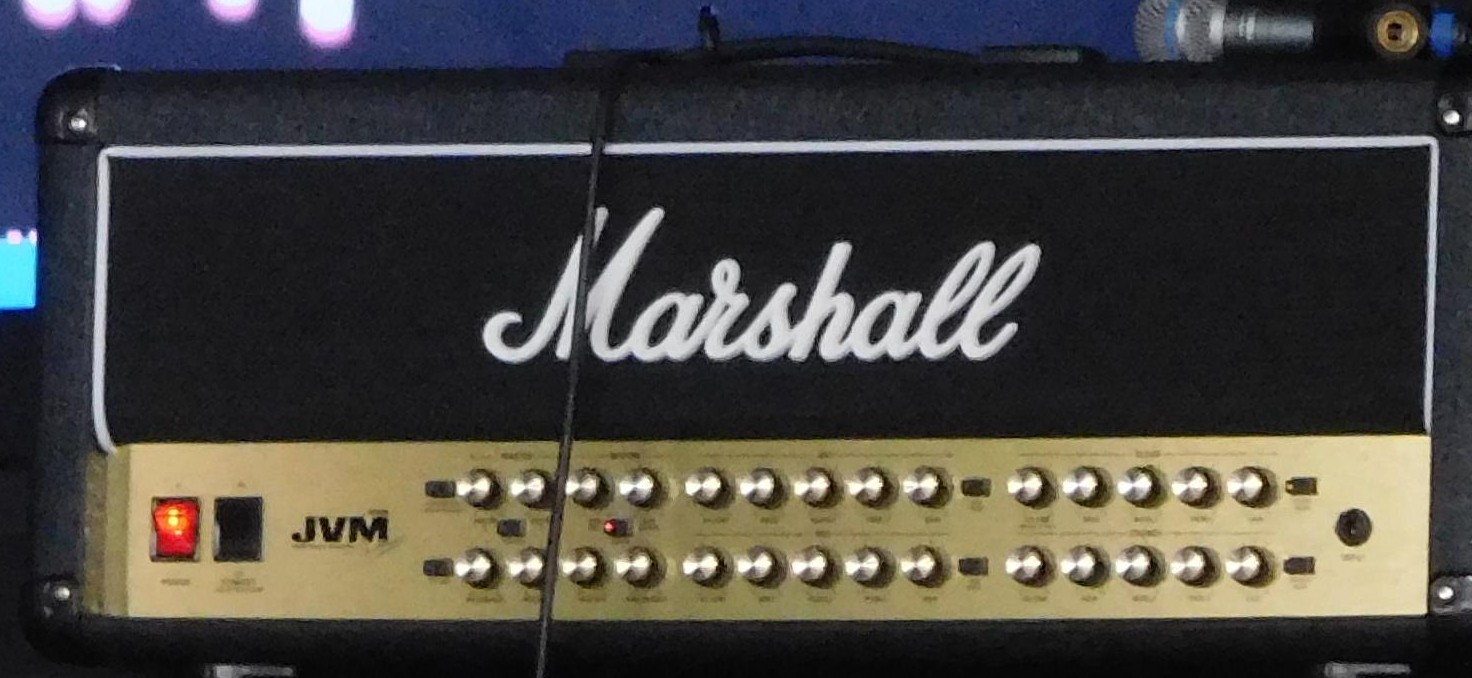
A Marshall JVM410H amplifier head, shown as a representative example of the model. Photo: Cjp24, CC BY-SA 4.0. Source: Wikimedia Commons.
Four channels, three modes each, 12 voices — the Marshall JVM410H puts every iconic Marshall tone under one roof. The definitive buyer's guide.
Picture the touring guitarist’s eternal nightmare: three heads bolted into a rack, two switching units, a spaghetti of audio cables linking your JCM800 to your DSL to your clean Fender, and a tech backstage whose sole purpose is stopping the whole machine from exploding mid-song. For decades, getting a full palette of Marshall tones onstage meant hauling a small warehouse. Then, in February 2007, Marshall released the JVM410H and quietly made that problem obsolete.
Four channels. Three gain modes per channel. Twelve distinct voices, each fully programmable, all accessible via a six-button footswitch plugged in with a standard two-conductor cable. One amp head, one set of EL34s, one bill from the trucking company. The JVM410H did not merely update the Marshall line — it redrew what a single amplifier head could be expected to do. That it did so while sounding genuinely great, rather than merely adequate across its range, is what has kept it in production for nearly two decades and planted it in studios and on stages across every genre where a Marshall tone matters.
This is the definitive guide to the Marshall JVM410H: where it came from, what it does, who actually uses it, and whether it belongs in your rig.
Why the JVM Was Born: The Problem with Marshall’s Flagship Series
By the early 2000s, Marshall’s flagship modern range was the TSL (Triple Super Lead) series — a three-channel amp that was intended to be the brand’s all-in-one solution. It was capable, loud, and very much a Marshall, but guitarists found its channels sonically uneven: the clean was considered a weak link, the gain staging felt compressed in ways that veteran Marshall players found frustrating, and the switching was less intuitive than it needed to be for a professional touring rig. The DSL (Dual Super Lead) series, aimed slightly lower in the range, had a devoted following for its two-channel approach but by definition left half the tonal range uncovered. Professional players who needed clean, crunch, mid-gain lead, and modern high-gain in one evening were still stacking heads or accepting compromise.
Marshall’s engineering team spent several years developing what would become the JVM — and the name they chose for it is significant. JVM stands for Jim and Victoria Marshall: company founder Jim Marshall and his daughter. Naming your flagship product after the boss and his daughter is either an act of extraordinary confidence or extraordinary pressure. Given the result, it looks like confidence was warranted.
The JVM410H launched at NAMM 2007 and hit the market the same year. It was Marshall’s first genuinely all-valve, four-independent-channel design — meaning each of the four channels had its own entirely separate circuit path, not a shared preamp with switched characteristics bolted on. The follow-up JVM410C combo (loaded with a Celestion Vintage 30 and a Celestion Heritage G12H in a closed-back cabinet) arrived shortly after the head, giving players the same power in a more portable format. In 2008, the JVM2 series arrived with a simplified two-channel layout — Clean/Crunch and OD, available in 50W or 100W as both heads and combos — for players who wanted the JVM voice without the full four-channel complexity. The JVM410H sat at the top of the range as Marshall’s unambiguous flagship, a position it has never relinquished.
Circuit Architecture: What “12 Voices” Actually Means
The mode selector is the design decision that defines the JVM410H. Every other multi-channel amp on the market at launch had discrete channels that you switched between. The JVM does that too — but each of its four channels (Clean, Crunch, OD1, OD2) can also be internally switched between three gain modes: Green, Orange, and Red. These are not simply gain boosts. They are distinct circuit topologies within each channel, adding or rerouting gain stages, changing the clipping character, and altering where the EQ sits in the signal chain relative to the gain structure.
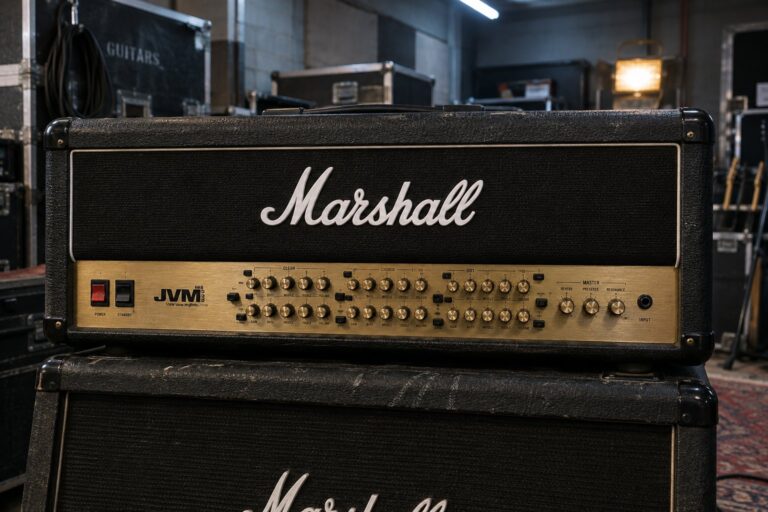
In the Clean channel, Green mode bypasses the volume control entirely, putting the gain knob in sole charge of level — a high-headroom path designed for pristine jazz or studio direct work. Orange and Red mode add gain stages post-EQ, an arrangement that is unusual in a Marshall and produces an unusually musical range of mild breakup tones that interact beautifully with picking dynamics. The clean channel in Red mode, with the gain cranked, gives you a full, complex overdrive that does not sound like a clean channel being pushed — it sounds like a different animal entirely.
The Crunch channel in Green mode delivers the JTM45 and Plexi territory that Marshall built its reputation on: warm, harmonically complex, sensitive to pick attack, the sound of classic British rock from the 1960s through the early 1970s. Orange and Red modes advance through JCM800 tonality — the tightening of the mids, the increase in gain density, the shift from vintage warmth toward modern aggression. If you need to cover Clapton’s Bluesbreaker tone and Angus Young’s early school days tone from the same head without touching the EQ knobs, the Crunch channel does it.
OD1 and OD2 are the high-gain channels. OD1 in Green mode picks up roughly where the Crunch channel in Red mode leaves off — a JCM900 or DSL-style modern rock lead tone. Advance through Orange and Red and it covers the full range of gain that the JCM2000 TSL offered across its entire range. OD2 escalates further still: it is the channel where the JVM410H leaves Marshall’s classic repertoire and enters genuinely modern high-gain territory, capable of articulate modern metal tones in Green and Orange mode and a wall of carefully EQ’d saturation in Red. MusicRadar’s original 2007 review noted that “OD2 with the gain control maxed out will be more than enough for any distortion blend,” and also made an observation that many players have echoed since: “Mind-blowing overdrive capability is matched by impressively low background noise.”
That last point matters more than it might appear. PCB-based amplifiers — and the JVM410H is PCB throughout, a design choice Marshall made deliberately for consistency and manufacturability — have historically been associated with higher noise floors than point-to-point wired amps. The JVM’s designers built individual noise gates into each channel (though in the standard JVM410H these require adjustment from the rear panel rather than the front — an issue the Joe Satriani JVM410HJS signature later addressed by moving them to the front panel). The result is that the JVM410H is quiet enough to use in professional recording studios with high-gain settings, a capability that was genuinely rare among 100W all-valve heads at its price point in 2007.
Specifications at a Glance
| Feature | Specification |
|---|---|
| Power output | 100 watts |
| Channels | 4 (Clean, Crunch, OD1, OD2) |
| Modes per channel | 3 (Green / Orange / Red) = 12 total voices |
| Preamp tubes | 5× ECC83 |
| Power amp tubes | 4× EL34 |
| Channel controls | Gain, Volume, Bass, Middle, Treble, Reverb (each channel independent) |
| Global controls | Presence, Resonance, Master Volume A, Master Volume B |
| Master volumes | Two switchable and programmable master volumes |
| Reverb | Digital reverb, independent level per channel |
| FX loops | Series loop (hardware bypass) + parallel loop (with return level) |
| DI output | Balanced XLR with speaker emulation (silent recording via standby switch) |
| Speaker outputs | 5× ¼” jacks (4Ω, 8Ω, 16Ω) |
| MIDI | MIDI IN + MIDI THRU |
| Footswitch | 6-button LED footswitch included; uses standard 2-conductor cable |
| Dimensions | 740 × 310 × 215 mm |
| Weight | 22 kg |
| Made in | UK (Bletchley, Buckinghamshire) |
| Price (new, 2026) | $1,385 Thomann; $1,949.99 Sweetwater |
| Available since | February 2007 |
Famous Players: What the Evidence Actually Shows
The standard five-name Marshall roster is Slash, Zakk Wylde, Kerry King, Gary Moore, and Tom Morello, and it is unverified for this model. Slash is a Silver Jubilee player; Zakk Wylde’s primary live amp has been the JCM800 2203; Kerry King is also a JCM800 2203 user; Tom Morello plays a JCM800 2205; and Gary Moore died in February 2011 — the JVM410H launched in February 2007, so the calendar does not falsify Gary Moore the way it does for genuinely post-2011 Marshall models. Moore was theoretically alive for four years alongside the JVM. A Reverb listing describes a “Gary Moore Son Owned” Dave Mustaine JVM410HCF signature stack — but “son owned” means owned by Gary Moore’s son after Moore’s death, not by Gary Moore himself. No photograph, interview, or studio session places Gary Moore personally behind a JVM410H. The claim is unverified.
The genuinely verified JVM410H users are more interesting and more varied than the recycled five-name list suggests.
Joe Satriani — The Definitive JVM410H Endorser
Joe Satriani is the artist whose relationship with the JVM410H is most thoroughly and cleanly documented. Beginning in 2012, after years of road testing and prototyping with Marshall’s engineering team, Satriani partnered with the company to create the JVM410HJS — a signature version of the JVM410H refined specifically for his requirements. The changes he specified are revealing: noise gates moved to each channel’s front panel for live access; EQ revoiced toward what he called a more organic rock tone; digital reverb removed entirely (Satriani prefers outboard reverb); voicing matched specifically to the Marshall 1960A cabinet. The result is the same 4-channel, 12-mode architecture as the standard JVM410H, adapted for a player who had spent years behind that circuit on the road and knew exactly what he wanted to change. Satriani’s own published statement on the collaboration is unambiguous: “I can honestly say that I’ve never had this much fun or derived this much inspiration from an amp before. It offers me total Rock ‘n’ Roll freedom.”
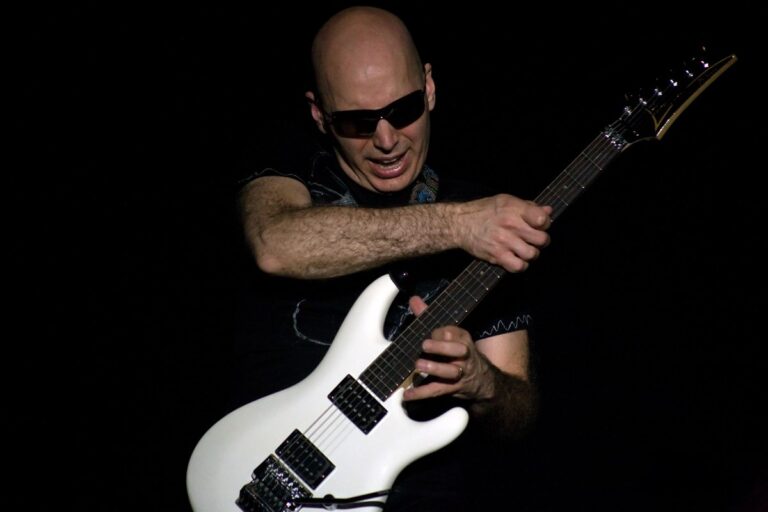
It is worth being precise about the relationship: Satriani’s signature is the JVM410H circuit, with defined modifications. Buying the standard JVM410H gets you the same four channels and twelve modes, without the noise gate placement changes or EQ revoicing. It is the closest thing in Marshall’s history to a celebrity endorsement backed by a genuine engineering collaboration rather than a reissue with different cosmetics.
Dave Mustaine — Marshall’s Documented JVM User, With a Timeline Caveat
Dave Mustaine of Megadeth is named directly on Marshall’s official history page for the JVM series as a JVM user. He also had a signature edition — the JVM410HCF — distinguished by a carbon fiber tolex exterior (a cosmetic change only; the circuit is standard JVM410H inside). A limited edition of reportedly ten units, the JVM410HCF has become a collector piece. Equipboard lists Megadeth’s 2011 album Th1rt3en among recordings made with the JVM410H, though independent research suggests the studio amp situation for that record was more complex, with some sources pointing to producer Johnny K’s Diezel VH4 and Bogner Uberschall on rhythm tracks.
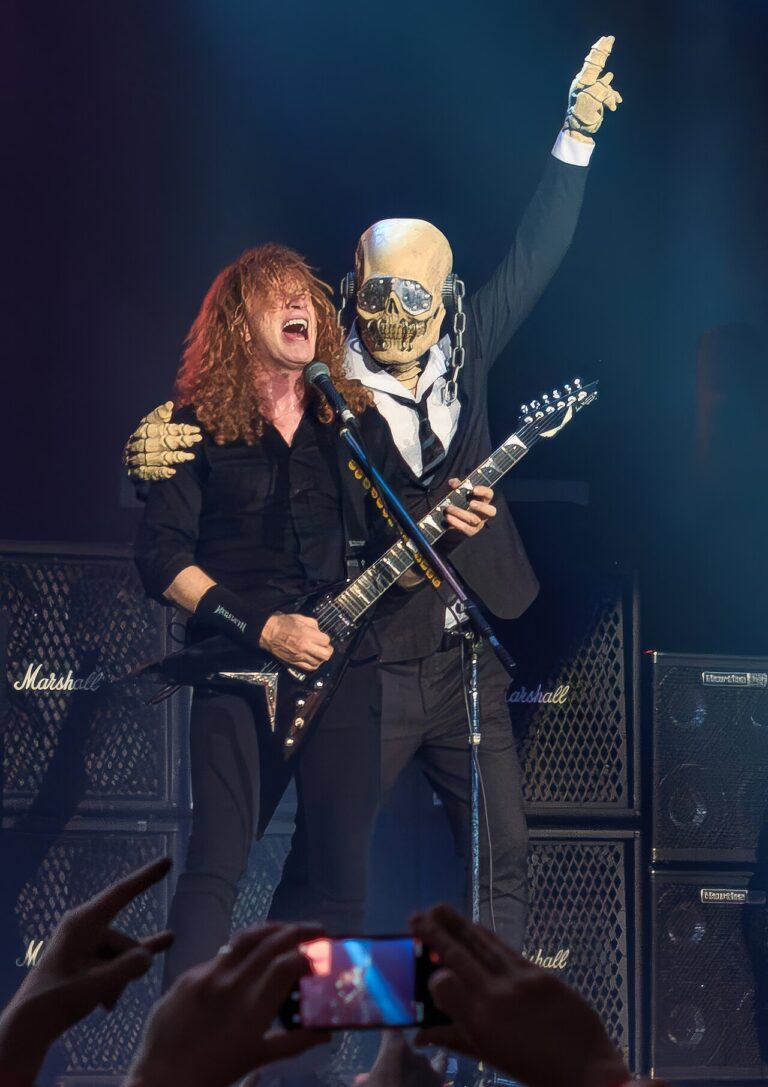
The important timeline caveat is the 2022 Premier Guitar Rig Rundown of Megadeth’s world tour. That article, published August 17, 2022, confirmed that Mustaine had transitioned from his Fractal Axe-Fx to a Neural DSP Quad Cortex for the 2022 run, using the Quad Cortex to power both direct-to-FOH and his Marshall Dave Mustaine Signature 1960B-DM cabinets. By 2022, the amp head on Mustaine’s rider was the Quad Cortex, not the JVM410H. The JVM period in Mustaine’s rig was real and documented — it simply was not current at that point. Any article that presents Mustaine as an active, present-tense JVM410H touring player would be misleading. He was. The cabs remain Marshall DM signature models. The head has moved on.
Mikael Åkerfeldt (Opeth) — Heritage and the JVM
Mikael Åkerfeldt of Opeth is listed on Equipboard as a JVM410H user, with the connection tied to the 2011 album Heritage. This is plausible: Heritage is the album on which Opeth made a hard left turn away from death metal into pure progressive rock, and Åkerfeldt’s amp choices on that record were in flux as he explored cleaner, more complex tones. The JVM410H’s clean and crunch channels are among the most sophisticated in any Marshall’s history, which makes it an interesting choice for a player navigating that transition. As with all Equipboard listings, photo or interview confirmation would be more authoritative — but the timing and context align.
George Lynch — Seamless (2021)
George Lynch (Dokken, Lynch Mob) is listed on Equipboard as a JVM410H user in connection with his 2021 solo album Seamless. Lynch has historically been an eclectic gear explorer — he played EVH’s Frankensteins and Marshall JCMs in the Dokken years, but his solo work has ranged widely. A JVM410H for a 2021 studio record fits his documented pattern of using whatever tool serves the song.

While She Sleeps and ‘Freaky’ Rob Gueringer
Marshall’s own official history page for the JVM series names two contemporary users: Sheffield metalcore band While She Sleeps and “Freaky” Rob Gueringer, who serves as touring guitarist for both Eminem and Kendrick Lamar. The inclusion of Gueringer is the most striking of these — the JVM410H in a hip-hop superstar touring rig is an unusual application of the amp’s flexibility, and it speaks to the OD2 channel’s ability to deliver tight, modern high-gain tones that hold together under rapid rhythmic articulation. That Marshall chose to highlight Gueringer on their own platform makes it one of the better-sourced JVM user claims available.
The Sound: What the JVM410H Actually Does in a Mix
The JVM410H’s strength is tonal range without tonal compromise. In the Clean channel, the amp delivers a degree of clean headroom that Marshall’s previous flagship amps — the TSL and even the DSL — never quite achieved. EQ’d with the mid control lowered slightly, it is clean, glassy, and authoritative enough to hold its own against a Fender Twin. In OD2 Red mode with the gain approaching noon, it delivers crushing modern high-gain with genuine definition — not the muddy mass of gain that cheaper amps produce when they saturate too hard, but a gain structure where individual notes retain their attack envelope even inside the wash.
The EQ architecture deserves a dedicated comment. Each channel has its own Bass, Middle, and Treble controls — 12 individual EQ sections across the head. The global Presence and Resonance controls sit outside the channel EQs and shape the power amp’s high-frequency and low-frequency response respectively. Resonance is essentially a low-end control for the output transformer and power stage — rolling it back tightens the bottom on the high-gain channels, a critically useful adjustment when running the JVM through a large 4×12 cabinet in a small room. Presence behaves like a high-frequency emphasis control in the power stage: add more for bite and attack on clean and crunch work; reduce it for a softer high-end response on the high-gain channels when playing at stage volumes.
MusicRadar’s 2007 review — still the canonical primary source for the JVM410H’s original critical reception — made a pointed observation about the clean channel that stands up nearly two decades later: “This channel’s volume control is bypassed [in Green mode], so the gain takes over as a single volume control, giving you a very pleasant, high-headroom clean sound that can be either fat and juicy or crystalline.” The reviewer also noted something that users on Thomann still echo in 2024: “With the clean channel selected, it’s hard to tell the amp is actually on until you hit the strings” — a level of noise performance that distinguished the JVM410H from its immediate predecessors in the Marshall lineup.
One characteristic that sets the JVM410H apart from both the vintage Marshall designs and the cheaper modern heads is the way its programmable switching interacts with the dual master volumes. The two master volumes (A and B) can be assigned to any channel/mode combination and switched by the footswitch — which means you can programme a rhythm setting with Master Volume A at a lower level and a solo boost with Master Volume B at +3dB, and execute the change with one foot tap that simultaneously switches channel and applies the boost, with no click or pop in the signal. In a live context, this is a significant practical advantage over external boost pedals or multi-amp switching systems.
Tone Recipes and Settings
Recipe 1: British Blues-Rock (Clean to Crunch Green)
Classic British blues-rock in the Bluesbreaker/Free tradition. Clean channel, Green mode: Gain 4, Volume 6, Bass 6, Middle 7, Treble 5, Reverb 2. Switch to Crunch Green for the lead: Gain 5, Volume 7, Bass 5, Middle 7, Treble 6, Resonance 5, Presence 6. Let the guitar volume knob do the fine gain shading. The Crunch channel in Green mode has the exact topology that made the Clapton-era JTM45 Bluesbreaker legendary — it is not a recreation, it is a derivation from the same engineering ancestry. Run with a Tube Screamer in the serial loop for leads.
Recipe 2: Classic Hard Rock (Crunch Orange)
Crunch channel, Orange mode: Gain 6, Volume 7, Bass 5, Middle 8, Treble 6, Resonance 6, Presence 7, Reverb 2. This is the JCM800 reference setting as close as the JVM can approximate it — the gain staging has the same topology as the classic 2203, tight and forward-mid, the high-end presence control adding the pick-attack cut that makes Marshall recognisable in a dense band mix. A Boss SD-1 in the loop adds the treble cut and slight compression that pushes the channel into AC/DC territory.
Recipe 3: Modern Thrash/High-Gain (OD2 Orange)
OD2 channel, Orange mode: Gain 9, Volume 7, Bass 6, Middle 7, Treble 5, Resonance 4, Presence 6, Reverb 0. The key discovery from experienced JVM users (documented in multiple Thomann reviews) is that gain past noon in OD2 thickens toward mud — the sweet spot is 9 to 11 o’clock. Orange mode at gain 9 gives a tone tight enough for thrash rhythm and articulate enough for lead work. Resonance rolled back to 4 prevents the low end from bloating through a 4×12. This is the register where the JVM410H has been used on actual metal records — dense, controlled, defined even at high gain. A ProCo RAT in front adds a specific mid-cut/low-saturation combination that Mustaine-era players favour.
Recipe 4: Joe Satriani-Style Melodic Lead
OD1, Green mode: Gain 7, Volume 8, Bass 5, Middle 6, Treble 7, Resonance 7, Presence 7, Reverb 3. This is the channel/mode combination that most closely approximates the tone Satriani specified for his JVM410HJS — a warm, vocal high-gain lead with enough presence to cut through a full band without the ice-pick high end of the red-mode settings. Satriani’s own version removes the internal reverb in favour of outboard, but the standard JVM410H’s digital reverb is flattering on lead tones: the review noted that “the reverb tail isn’t chopped off when you change channels, it’s left to decay naturally,” which is specifically relevant here — kick the reverb up to 4 or 5 and let the notes bloom into it between phrases. A Les Paul with PAF-style humbuckers is the ideal pairing.
Recipe 5: Edge-of-Breakup Classic Clean
Clean channel, Red mode: Gain 7, Volume 6, Bass 7, Middle 5, Treble 6, Resonance 6, Presence 5, Reverb 2. Clean Red is the JVM’s hidden gem for chord-work in a rock context — it is not clean in the Fender sense but a saturated, complex breakup that responds to picking dynamics with unusual sensitivity. A Strat in the neck pickup position approaches vintage ES-335 country. A Les Paul approaches Neil Young’s high-gain “Ragged Glory” open-chord character. Dialling the guitar volume back to 6 returns it to clean, giving you a two-pickup/two-volume-knob switching system that costs nothing extra beyond the initial amp purchase.

Comparisons: How the JVM410H Sits in the Marshall Landscape
The Marshall JVM410H versus the JCM2000 DSL100 is the comparison most buyers face first. The DSL is cheaper, simpler, and sonically more focused: two channels (clean/crunch and lead), the lead channel genuinely excellent in its own right. The DSL cannot touch the JVM’s clean channel quality, but for players who need principally a high-gain Marshall and want a simpler interface, it is the more practical choice. The JVM410H is a better amp across its full range; the DSL100 is a better amp if you only plan to use two-thirds of it.
Against the JCM2000 TSL100, the JVM410H’s superiority is more direct. The TSL was the JVM’s predecessor in the three-channel flagship role, and virtually every professional who has used both finds the JVM significantly better in every channel: cleaner clean, more musical crunch, more gainy and more controlled high-gain. The TSL is available used at a significant price discount, but buyers should understand they are getting the amp the JVM was designed to replace.
The Marshall DSL100HR is the current production alternative at roughly half the price. It is a two-channel, 100W head with a similar EL34 power section and modernised features. It lacks the JVM’s four-channel architecture and cannot match the clean channel quality, but for players who need one great clean and one great high-gain channel, the DSL100HR is genuinely difficult to dismiss on value grounds.
Against the Marshall 1987X Plexi reissue, the JVM410H is in a completely different category. The 1987X does one thing — the authentic Plexi sound — with a directness and physical rightness that the JVM cannot replicate (nor tries to). The 1987X has no master volume, no channel switching, no effects loops, no MIDI. If you need the real Plexi experience at stage volume, the 1987X is irreplaceable and the JVM is not the answer. If you need the Plexi experience plus a clean channel plus a modern high-gain channel plus MIDI switching, the JVM410H is the answer and the 1987X is the wrong question.
The Marshall Studio Classic SC20H — the 20W JCM800-circuit Studio Series head — is worth considering for players whose need for the JCM800 channel covers 90% of their gigs. The SC20H at $888 against the JVM410H at $1,385 is a compelling value proposition if the specific JCM800 2203 circuit is the target tone. The JVM410H wins on versatility; the SC20H wins on directness, authenticity to the source circuit, and ease of use at low-volume settings.
Outside the Marshall catalogue, the JVM410H competes most directly with the ENGL Powerball II and the Peavey 6505+ in the professional all-valve head market. Both of those are more single-mindedly high-gain designs; neither has a clean channel of comparable quality to the JVM410H’s. The JVM is the better choice for players who genuinely need the full clean-to-high-gain range. The ENGL and Peavey are the better choices for players who want high-gain, maximum-aggression British or American valve tones and do not expect to use a clean channel above 40% of their playing time.
Buying Guide: New, Used, and Variants
New in 2026, the JVM410H lists at $1,385 at Thomann (Item 108990, 4.9/5 from 219 ratings) and $1,949.99 at Sweetwater — the Thomann price is the global reference and reflects genuine availability rather than a promotional anomaly. The JVM410H has been in continuous production since 2007, making it one of the longest-running current-production Marshall heads; availability is not a concern.
Used prices in good condition typically run $700 to $1,000. Excellent condition examples from 2015 onward hold closer to $900 to $1,100. The main pitfall of used JVM410H purchasing is the tube situation: ECC83 preamp valves are, as MusicRadar’s original review noted, “fiddly to replace” due to their recessed position in the chassis. Budget for a tube check (and potentially a full retube) when buying used, particularly if you cannot hear the amp first. Scratchy or intermittent pots are the second most common used-market complaint — usually resolved with contact cleaner, but worth factoring into negotiation.
Be clear about which JVM variant you are purchasing. The standard JVM410H is what this article covers. The JVM410HJS is the Joe Satriani signature — revoiced EQ, front-panel noise gates, no built-in reverb — and commands a moderate premium used; it is a materially different amp despite sharing the same channel architecture. The JVM410HCF (Dave Mustaine signature, carbon fiber tolex) is a collector piece with standard JVM410H circuitry in limited-edition cosmetics; the premium on these reflects rarity rather than tonal difference. The JVM410C combo is the same head in a closed-back cabinet with Celestion speakers — useful if you need the head/cab to travel as a single unit and do not need to choose your speaker cabinet separately.
The JVM2 series (JVM210H, JVM205H) is a two-channel design from 2008 with the same gain-mode concept applied to a Clean/Crunch and OD format. It is available at significantly lower used prices than the JVM410H and suits players who find four independent channels excessive. The OD channel on the JVM2 models is broadly comparable to OD1 on the JVM410H; players who specifically need OD2’s extended high-gain range should stick with the 410 variant.
Ownership Notes: Living with a 100-Watt Four-Channel Marshall
Twenty-two kilograms. That is the weight of the JVM410H, and while it is not unusual for a 100W all-valve head, it is worth acknowledging that the JVM410H is a large, heavy, two-rack-space object that will require a proper flight case for touring. The Thon Amp Case Marshall Head (Article 227873 at Thomann) is the standard recommendation and fits correctly. The Marshall Amp Cover C08 (Article 150488) handles rehearsal room and studio transport at minimal cost.
The JVM410H runs on 230V power as shipped from European stock. US buyers purchasing through Thomann should confirm the voltage configuration before first use; Marshall does ship 120V versions for the North American market, and the amp should have the correct voltage clearly marked on the rear panel. Running a 230V amp on 120V without a transformer will not produce usable results.
Tube maintenance deserves specific attention given the preamp valve accessibility issue. The five ECC83s are deeply recessed in the chassis — more so than in a typical Marshall head — and swapping them requires care and a narrow-head screwdriver. Power amp EL34s are accessible from the rear and are standard service. A full retube with matched EL34 quads (current-production JJ, Tung-Sol, or EH are the common recommendations) and fresh ECC83s every two to three years of regular use is the standard maintenance interval; mark the tube change date inside the chassis when you do it. Budget the tube cost against the $700 to $1,000 used price and the JVM410H’s long-term cost of ownership remains well below a comparable boutique amp.
MIDI integration is one of the JVM410H’s differentiating features that many owners never fully explore. The MIDI IN and MIDI THRU allow a MIDI controller or DAW to recall any of the 12 channel/mode combinations plus the reverb states and master volume selection — meaning the JVM410H can be programmed into a digital rig where a single MIDI program change sets the amp, the pedal board, and any outboard effects simultaneously. Guitarists who incorporate the JVM into a Quad Cortex or Axe-Fx signal chain as a physical power amp and speaker stage (running the modeller into the JVM’s FX return, bypassing the preamp entirely) also report strong results — though this uses the amp’s EL34 power section and speaker impedance, not the JVM’s own channel voicing.
The parallel FX loop — a feature often overlooked in discussion of the JVM410H — is worth programming deliberately. Unlike the series loop, the parallel loop blends dry and wet signal, preserving the amp’s natural response while adding reverb or modulation at a controllable mix level. For time-based effects at high gain, the parallel loop prevents the “sucking” quality that series loop delays can introduce.
Frequently Asked Questions
What is the difference between the JVM410H and JVM210H?
The JVM410H has four independent channels (Clean, Crunch, OD1, OD2), each with three modes, giving 12 total voices. The JVM210H, introduced in 2008, has two channels — a Clean/Crunch channel and an OD channel — also with three modes each, giving 6 voices. The JVM210H is also 100W with the same EL34 power section. It is simpler, lighter, and available at a lower price used. The JVM410H is the choice if you need the full clean-to-OD2 range; the JVM210H suits players who work primarily in the crunch-to-OD register.
Can the JVM410H run at lower wattage for home use?
No — unlike the DSL series, the JVM410H has no wattage reduction switch. It runs at 100W or, via the silent mode (where the power stage is bypassed and only the preamp feeds the emulated DI out), at zero stage volume. There is no 50W or 25W intermediate mode. For home use, the emulated DI out is the practical solution; for stage use at lower volume, the dual master volumes allow you to set a lower overall level without affecting the gain structure. Players who specifically need a lower-wattage option with similar channel architecture should consider the Studio Series heads, which operate at 20W/5W.
Is the JVM410H point-to-point wired or PCB?
PCB throughout. Marshall made this choice deliberately for manufacturing consistency — PCB construction eliminates the unit-to-unit variation that hand-wired amps can exhibit. The MusicRadar review noted the benefit: “gone are the days when you could tweak a Marshall just by repositioning a few wires inside the chassis.” The trade-off is that major internal service is less field-repairable than point-to-point construction, and the recessed preamp valve placement makes ECC83 changes slightly awkward.
What is the JVM410HJS and should I buy it instead?
The JVM410HJS is the Joe Satriani signature variant, created in collaboration with Satriani from 2012. Its changes versus the standard JVM410H are: noise gates on each channel moved to the front panel for live access; EQ revoiced toward a more organic rock tone; digital reverb removed; voicing optimised for Marshall 1960A cabinet. If you use outboard reverb and need per-channel noise gate control onstage, the JJS is the more refined tool. If you want the built-in reverb or prefer the standard voicing, stay with the JVM410H. The JJS commands a used premium of typically $100 to $200 over the standard head — not a large difference for a material improvement in the relevant features.
What cabinet should I pair with the JVM410H?
Marshall’s own recommendation for the JVM410H is the 1960A or 1960B 4×12 cabinet, loaded with Celestion G12T-75 or G12M-25 speakers depending on the version. The 1960A (straight front) is the standard touring choice. For high-gain applications, the G12T-75 provides the characteristic Marshall upper-mid presence; for cleaner and crunch tones, the Celestion Vintage 30 (as fitted to the JVM410C combo) produces a more open, complex response. The JVM410H also responds well to 2×12 configurations — a 2×12 with a pair of Celestion V30s is a popular studio choice that maintains the full EL34 power section without the physical bulk of a 4×12.
How does the MIDI switching work in practice?
The JVM410H receives standard MIDI program change messages on any MIDI channel and maps them to channel/mode/reverb/master volume combinations that you programme via the front panel. The included six-button footswitch can also be programmed in non-MIDI operation to recall complete channel presets (not just toggle individual switches) — so you can have button 1 recall Clean Green, button 2 recall Crunch Orange, button 3 recall OD1 Red with Master Volume B engaged, and so on. Any two-conductor cable works for the footswitch — no proprietary cable required. Full MIDI integration with a Quad Cortex or similar MIDI controller allows the JVM’s 12 voices to be recalled as part of larger preset changes that include pedalboard states and outboard effects.
Is the JVM410H still made in the UK?
Yes. The JVM410H is made at Marshall’s Bletchley, Buckinghamshire facility — the same UK production site as the Studio Series heads and the JCM800 vintage reissues. This is a meaningful point of differentiation from Marshall’s lower-priced DSL series, which is made overseas. The UK manufacturing is part of what justifies the JVM410H’s position at the top of Marshall’s all-valve range.
How many presets can the JVM410H store?
With MIDI, the JVM410H can store and recall an effectively unlimited number of presets — one per MIDI programme change, up to the capacity of your MIDI controller. Without MIDI, using the six-button footswitch in programmable mode, you can store up to six complete channel/mode/reverb/master-volume combinations. Each stored state remembers the full channel configuration as it was set when you saved it. The programming procedure involves holding the desired footswitch button while in the target channel/mode — described step-by-step in the included manual, and summarised in several YouTube tutorial videos that serve as a clearer practical guide than the manual itself.
Image credits
- Joe Satriani: livepict.com, Wikimedia Commons, CC BY-SA 3.0.
- Top image: Cjp24, Wikimedia Commons, CC BY-SA 4.0.
- Dave Mustaine: Justice for the Beholder of the Harvester of Blackened Straw, Wikimedia Commons, CC BY-SA 4.0.
- George Lynch: Glenn Francis, Wikimedia Commons, CC BY-SA 3.0.
- Joe Satriani: Wikimedia user ‘Vtpeters’, Wikimedia Commons, CC BY-SA 3.0.
- Marshall JVM410H: GuitarGangsters AI-generated reference illustration, not a photograph.
Latest News
Related
On This Day
Monday 9 November
From this week: