The Vox AC15CH Custom Head: 15 Watts, a Reactive Attenuator, and the Chime That Started British Rock
The Vox AC15CH Custom Head delivers 15W of EL84-driven British chime in a head format with reactive attenuator. Specs, tones, and honest player history.
The story starts not in a guitar factory but in an electronics workshop on Fenton Street, Dartford, in 1957. Tom Jennings and Dick Denney were trying to build a louder, cleaner amplifier for the emerging skiffle and beat-group scene — something that wouldn’t distort before the room went deaf. What they built instead was an amplifier that distorted beautifully, in a way no one had quite heard before: glassy, harmonically rich, with a midrange warmth that made a Rickenbacker or Gretsch hollow-body ring like a bell. They called it the AC15.
Within five years, that amplifier was the default choice of British pop — The Beatles, The Shadows, The Kinks, The Who’s early recordings all run through Vox circuitry. When John Lennon walked into a music shop in 1962 holding a brand-new Vox AC15 Twin, it was essentially the sound of the British Invasion being handed its weapon.
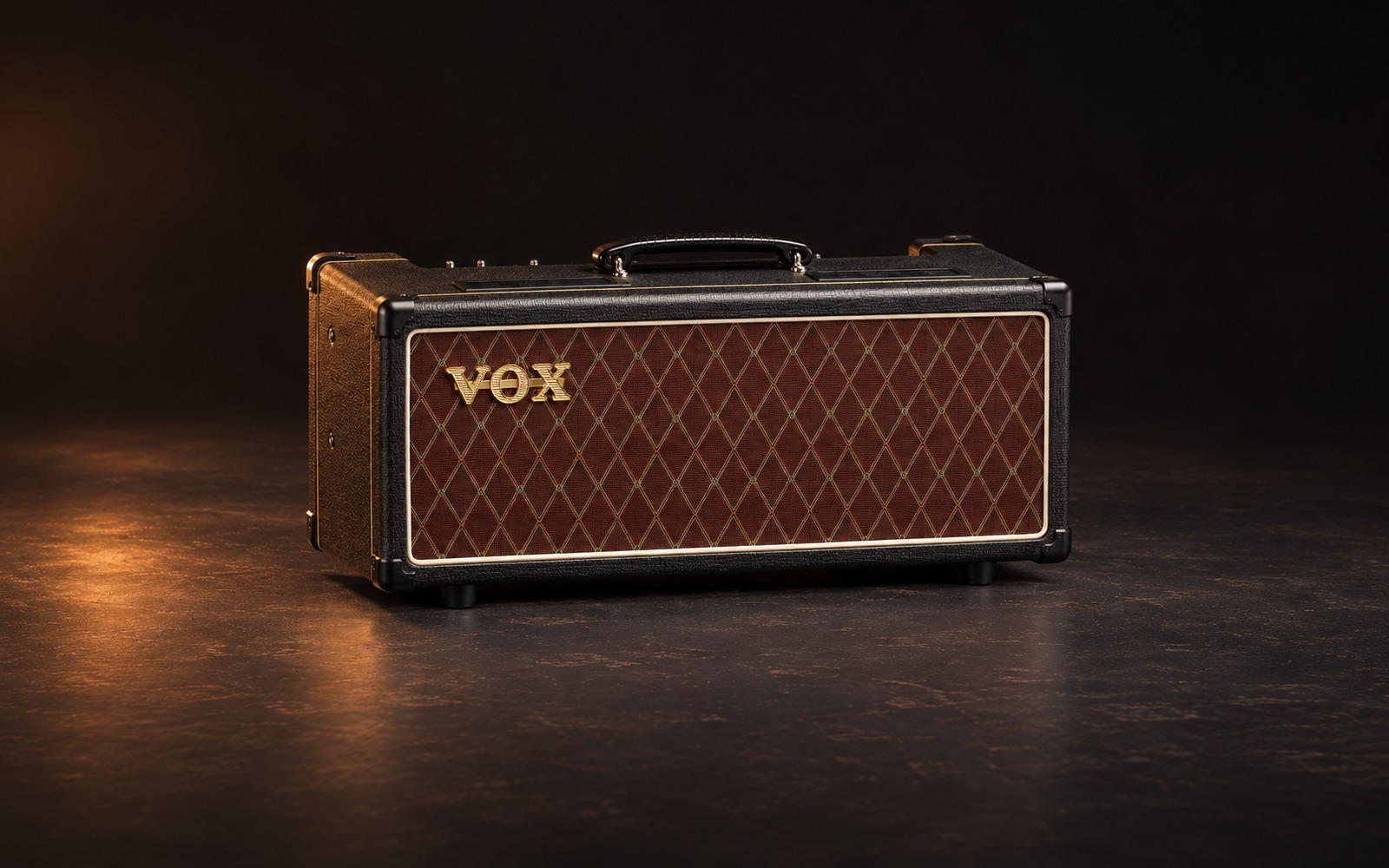
The Vox AC15CH Custom Head, announced at NAMM 2016 alongside its bigger sibling the AC30CH, is the head-format version of the long-running AC15 Custom combo line. It is not the original 1958 AC15. It is not hand-wired. It is made in China on a printed circuit board. But it is an EL84-driven, cathode-biased, spring-reverb-equipped, 15-watt all-tube amplifier that genuinely reproduces the character of those early Vox circuits — and it adds something those originals never had: a built-in reactive attenuator that lets you run it cranked at bedroom volume.
This is the honest guide to what the AC15CH is, who actually plays one, and whether it belongs in your rack.
From 1958 to 2016: The Custom Series Context
Vox’s Custom Series — the AC15C1 combo, the AC15C2 Twin, the AC30C2 — has been the backbone of the brand’s all-tube lineup since the early 2000s. These amps take the basic architecture of the original Vox designs (Normal and Top Boost channels, EL84 power section, cathode-biased output stage, Tone Cut control) and build them on modern PCB platforms with Chinese manufacturing under Korg’s quality control. They are reliable, repeatable, and considerably cheaper than the Hand-Wired series.
The AC15CH and AC30CH were the Custom Series’ first dedicated head units. Before 2016, if you wanted an AC Custom in head format, your options were limited to the Hand-Wired HW1/HW2 range at roughly twice the price. The NAMM 2016 announcement changed that: the AC15CH gave players access to AC15 tone in a head that could drive any 16Ω or 8Ω speaker cabinet, while also incorporating Vox’s new Reactor Technology attenuator — a feature absent from both the AC15C1 combo and the hand-wired HW1.
The companion cabinet is the V212C, a 2×12 open-back enclosure loaded with two Celestion G12M Greenbacks. The AC15C1 combo uses a single Celestion G12M Greenback; the head-plus-V212C combination effectively turns the 15-watt circuit into a significantly bigger-sounding rig, with the two speakers’ combined cone area improving low-end response and the open-back design maintaining the airy, complex Vox high-frequency character.
Why a Head? The AC15CH Proposition
The obvious question is: if the AC15C1 combo already exists and costs less, why buy the head? There are three real answers.
The first is speaker flexibility. The C1 is permanently coupled to its single 12″ Greenback. The CH can drive whatever you point it at — a 4×12, a 1×12 extension loaded with an Alnico Blue, a vintage Vox 2×12 from the 1960s with whatever cone it happens to have. This matters if you’re splitting rigs, running the AC15 as a secondary amp into a shared cab, or collecting vintage speakers.
The second is the Reactive Attenuator. The AC15C1 combo has no attenuator of any kind. The AC15CH has a rear-panel chickenhead rotary switch offering three power settings: full 15 watts, 1.5 watts, and approximately 0.15 watts. The key word in Vox’s description is “reactive” — conventional resistive attenuators change the impedance the power stage sees, which alters the amp’s character at low volumes. Vox’s Reactor Technology is designed to maintain the speaker/amp interaction at reduced power settings, so the amp behaves tonally at 0.15 watts the way it would at 15. Whether it completely achieves this is a matter of debate in online forums, but the principle is sound and the practical effect is real: you can set the Master Volume near maximum and run the attenuator at its lowest setting without waking the neighbours.
The third is transport and ergonomics. At 15.3 kg / 33.73 lbs, the head is not light — it’s actually heavier than many 30-watt heads due to the transformer weight relative to the cabinet size. But a head-plus-separate-cab rig is easier to stage-manage than a heavy combo: load in the cab first, drop the head on top, done.
Specifications
Note on attenuator wattage figures: The Sweetwater listing describes the three settings as “1/6W, 1.5W, and 15W” (i.e., ~0.167W at minimum). Equipboard’s spec table gives 0.15W, 1.5W, 15W. MusicRadar’s 2016 review described “15 watts to seven to one fifth of a watt,” which appears to be a reviewer paraphrase — the “seven watts” figure is inconsistent with every other published spec; the other two sources consistently give 1.5W for the middle setting. The Vox spec sheet itself lists power settings as selectable without giving wattage figures. Practically: the lowest setting gets you well under half a watt, which is bedroom-quiet.
Famous Players — and the Calendar Problem
Consider five names: Brian May, The Edge, George Harrison, Tom Petty, and Rory Gallagher. It is a list that, on examination, mostly describes Vox’s broader artist identity rather than anyone who has been documented using an AC15CH specifically.

George Harrison died in November 2001. The AC15CH was announced in January 2016 — fifteen years after his death. The association is real at the brand level: Harrison played Vox AC30s extensively in the early 1960s, most famously on the first US Ed Sullivan appearance in February 1964. But he never used an AC15CH. Any listing claiming otherwise is brand-level marketing recycled into a product page.
Rory Gallagher died in June 1995 — twenty-one years before the AC15CH existed. His AC amps were AC30s from the 1960s and early 1970s (a specific 1960 AC30/6 Twin appears in his documented rig). The connection to Vox is genuine and historically important, but the connection to this particular product is impossible.

Brian May is one of the most documented AC30 users alive. His rig through the Queen years was multiple AC30 Normal channels driven by a Dallas Rangemaster treble booster, with the Tone Cut set between 8 and 9 o’clock. He has a Vox signature product — the MV50-BM NuTube head — and Vox features him prominently in marketing for the AC30 range. No primary source — Premier Guitar Rig Rundown, Guitar World, his own documentation at brianmayworld.com — places him on an AC15CH. He is AC30 family context, not AC15CH-specific.
The Edge is similarly documented on AC30s: specifically, a set of 1964 hand-wired AC30s re-choked and serviced by technician Dave Clarke, and some modified 2016 AC30 combos. His elaborate delay and modulation rigs run into AC30 Top Boost channels, not AC15s of any kind.
Tom Petty (d. October 2017) technically had a theoretical window between the January 2016 NAMM announcement and his death — but no primary source, interview, or rig documentation places him specifically on an AC15CH. His documented Vox connection is primarily the AC30, shared with most of the British Invasion players he took as reference points.
So who actually plays an AC15CH?
Equipboard lists two pro artists as documented users: Stewart Copeland and Nate Esquite. Stewart Copeland is primarily known as the drummer of The Police — but he also plays guitar, and Equipboard documents him as an AC15CH user. His other documented guitar amp is the Roland JC-120 Jazz Chorus. There is no independently cross-confirmed primary source (manufacturer page, video, interview) placing Copeland specifically on an AC15CH; the Equipboard listing is taken on its documentation but is not further cross-verified here. Nate Esquite appears to be a working musician not widely covered in guitar press.
The honest picture: the AC15CH is an instrument for working guitarists, not a headline touring amp. It is too expensive relative to the AC30C2 to be the volume-budget choice, and too PCB-constructed to attract players who want the prestige of a hand-wired rig. Its audience is the serious gigging or recording player who wants speaker cabinet flexibility and a genuine reactive attenuator built in, without spending Hand-Wired money. That is a real audience, and it is substantial — it just does not produce a roster of recognisable names.
How It Sounds
Nick Guppy reviewed the AC15CH for MusicRadar in June 2016 at the launch price of £586. His verdict: “a worthy addition to the Vox Custom range.” Key findings from the review that hold up as primary-source descriptions:
The midrange emphasis is the dominant sonic characteristic. The phrase “chime and jangle” implies a thin, trebly amplifier, but both AC15 and AC30 designs push energy hard into the 1–4 kHz midrange band. That’s what gives single-coil guitars their vocal character through Vox circuits — and it’s why a humbucker through an AC15 sounds quite different from the same pickup through a Fender. The mids fill out. A Les Paul through the Top Boost channel with both channels at three-quarter volume produces what Guppy calls “a particularly vocal overdrive with just a hint of fuzz” that sits equally well with both pickup types.
The Top Boost channel’s character through the V212C cabinet is described as “articulate pop-rock chord and solo stuff” — the open-back 2×12 adds air and complexity to the high-frequency response that the closed-back designs common in American amps do not produce. The Celestion G12M Greenback is the canonical speaker pairing for this circuit, and it is the right choice: ceramic magnet, paper cone, 25W per driver, with a characteristic push around 1–2 kHz that reinforces the amp’s midrange signature.
The clean headroom is limited by Vox design intent. Guppy notes “not quite enough clean headroom for stuff that demands it, like country picking or funk.” This is not a criticism of the AC15CH specifically — it is a description of what cathode-biased EL84 output stages do at 15 watts. The amp begins to compress and distort at moderate playing levels, and it is precisely this characteristic that makes Vox circuits so responsive: the difference between picking lightly and digging in is audible in the texture of the note, not just its volume.
The spring reverb received no specific criticism in the review and is described as working. At 15 watts into a 2×12, the amp at full power is, per the review, “plenty loud enough for most pub gigs” — meaning it will keep up with a drummer in a medium venue without the attenuator engaged.
Five Tone Recipes
Recipe 1: British Invasion Jangle (Clean Single-Coil)
Channel: Top Boost. Volume: 3–4. Treble: 7. Bass: 4. Master Volume: 5. Tone Cut: 8. Reverb: 2. Tremolo: off. Attenuator: 15W. Guitar: Rickenbacker 360/12 or Stratocaster (bridge or middle pickup). This is the Ed Sullivan 1964 sound — glassy, clean, with enough gain to produce pick attack without breaking up. The Tone Cut at 8 rolls off the power-stage high end without losing the Top Boost’s sparkle. Works equally well with a Rickenbacker 360/12 twelve-string for that specific jangle or an offset Telecaster for a slightly grittier British take on the same territory.
Recipe 2: Mod Rock Crunch (Pushed Single-Coil)
Channel: Top Boost. Volume: 7. Treble: 6. Bass: 5. Master Volume: 4. Tone Cut: 6. Reverb: 1. Tremolo: off. Attenuator: 1.5W (for small-room use) or 15W live. Guitar: Strat or Casino-style semi-hollow. This is early Kinks and The Who territory — the amp is past its clean threshold, producing a saturated mid-crunch with the natural compression of EL84 cathode bias. The Master Volume at 4 controls the overall level; the channel volume at 7 does the work of loading the preamp. Add a Epiphone Casino and you are in John Lennon’s “Paperback Writer” territory.
Recipe 3: Indie/Britpop Bite (Jonny Greenwood-Adjacent)
Channel: Top Boost. Volume: 5–6. Treble: 5. Bass: 6. Master Volume: 6. Tone Cut: 5. Reverb: 3. Tremolo: off. Attenuator: 15W. Guitar: Telecaster (neck pickup) or semi-hollow. Peter Buck‘s R.E.M. jangle and Greenwood’s early Radiohead crunch both live in this range — the Top Boost with moderate treble and bass produces a warm, slightly compressed rhythm sound that sits in a mix without fighting a bassist. Add a light overdrive pedal (TS-style, input gain low, output high) in front for lead tones that maintain the amp’s midrange character. The Big Muff Pi is architecturally wrong here (too woolly for Vox mids) but works for textural density on sustained chords.
Recipe 4: Home Studio (Attenuated Full Drive)
Channel: Top Boost. Volume: 8. Treble: 5. Bass: 6. Master Volume: 7–8. Tone Cut: 7. Reverb: 2. Tremolo: off. Attenuator: ~0.15W. Guitar: anything. This is the attenuator’s headline use case. The preamp and power stage are both running hard — the EL84s are saturating, the output transformer is seeing real load, the spring reverb is getting driven from a pushed output — but the Reactor Technology is keeping the actual cabinet volume below conversation level. Mic the cabinet close (SM57, 2–3 cm off-axis on the G12M Greenback dust cap) and you have a cranked-AC15 recording track without the 11pm complaint.
Recipe 5: Tremolo Shimmer (60s Surf/Psych)
Channel: Normal. Volume: 4. Master Volume: 5. Tone Cut: 6. Reverb: 5. Tremolo Depth: 6. Tremolo Speed: 5. Attenuator: 15W. Guitar: Stratocaster (neck pickup, tone rolled to 6). The Normal channel’s darker character is perfect for tremolo-heavy playing — Top Boost’s treble presence can make fast tremolo feel piercing. The combination of spring reverb at 5 and tremolo at these settings produces a wash that sits between the Ventures and the 13th Floor Elevators: wet, pulsing, distinctly non-modern. The Electro-Harmonix Deluxe Memory Man running into the front for slapback delay completes the picture.
How the AC15CH Compares
The most direct comparison is the Vox AC15C1 combo. The C1 costs roughly $200 less, comes with its own Celestion G12M Greenback in an open-back pine-and-hardwood combo cabinet, and is otherwise the same circuit without the reactive attenuator. If you have a permanent speaker setup and do not need attenuator functionality, the C1 is the smarter purchase. MusicRadar’s review noted that “price is arguably only reason to buy this over the AC30” — a backhanded way of saying the AC15CH’s value proposition rests largely on the wattage-and-price difference from the larger amp, not on unique features absent from the combo.
The Vox AC15C2 Twin is the 2×12 combo version — same circuit, same power rating, but PCB construction in an MDF cabinet with two G12M Greenbacks. At $1,099.99 it is nearly identical in price to the AC15CH, and it comes with its own speakers. The C2 advantage: no separate cab to transport, complete plug-and-play. The CH advantage: speaker flexibility and the reactive attenuator. Choose based on whether your speaker configuration is fixed or variable.
The Vox AC15HW1 Hand-Wired (now superseded by the 2025 AC15HWR1X) is the construction-quality step up — true point-to-point turret board, birch-ply cabinet, EZ81/GZ34 rectifier, Vietnam manufacturing. Used HW1s run $500–800 on Reverb; new HWR1X runs $1,799.99 at Sweetwater. The HW1 has no reverb (the HWR1X adds it), and neither has the reactive attenuator. If construction purity and tonal nuance matter more than attenuator convenience, a used HW1 is a compelling alternative at the same price as a used CH.
The Vox AC30C2 is the AC15CH’s bigger sibling. At $999.99 new on promotion (list ~$1,249.99), it offers 30 watts, 2× G12M Greenbacks in an integral combo cabinet, and substantially more clean headroom. MusicRadar’s point about the price argument is legitimate: the AC15CH and AC30C2 are close enough in price that the headroom, volume, and speaker count advantages of the AC30 are worth considering. The AC15CH wins on portability (33 lbs head vs ~67 lbs AC30 combo) and on the reactive attenuator feature, which the AC30C2 lacks.
Against the Fender Blues Junior ($749 street), the AC15CH is a completely different tonal philosophy: EL84 cathode-biased midrange warmth vs EL84 fixed-biased American-voiced circuit (the Blues Junior uses EL84s too, but voiced quite differently — more scooped, less vocal). The Blues Junior is lighter, cheaper, and includes a speaker. The AC15CH has two channels, a reactive attenuator, and the specific Vox midrange character. This is not a comparison of equivalent products.
Buying Guide
New, the AC15CH lists for approximately $1,099–$1,149 USD depending on retailer (Sweetwater, Guitar Center, Musician’s Friend). Equipboard’s pricing data (updated August 2026) shows a range from $803 to $1,149, with an average of $1,008. The lower-end listing likely reflects inventory clearing or open-box units. Used Reverb pricing (August 2026) runs from approximately $500 for well-played examples to $750 for near-mint units with original box.
The V212C companion cabinet (2× Celestion G12M Greenback, open-back) is the intended pairing and runs approximately $449–$499 new. It is a reasonable cabinet but not exceptional; players who already own a quality 2×12 or 4×12 can skip it. The G12M Greenback in the V212C is the same driver used in the AC15C1 combo and is well-matched to the AC15CH’s EL84 output stage in both power handling (25W per speaker, 50W combined vs 15W from the head) and tonal character.
Used buying checklist: confirm the reactive attenuator rotary switch on the rear panel operates smoothly and produces a clear volume reduction at each setting (pots can crack with age); verify the spring reverb tank hasn’t detached (it runs open-frame inside the cabinet and can come loose if the amp has been transported carelessly); check all three attenuator positions for clean operation; confirm the tremolo runs at consistent speed across the Depth range. Tube replacement is straightforward — a wooden panel on the underside fastened by woodscrews provides access to the 12AX7s and EL84s without chassis removal.
Ownership Notes
The AC15CH runs hotter than a combo of equivalent wattage because the head cabinet has less thermal mass and less ventilation surface area. Allow 15–20 minutes of warm-up before hard playing, and do not store it in an enclosed space immediately after a high-volume set.
The VFS2A footswitch (two-button, controls reverb and tremolo independently) is sold separately and is not included in the box. Budget approximately $49–69 for it if you need live reverb/tremolo switching. The footswitch jack is on the rear panel.
Speaker cable is required separately to connect to the cabinet — a ¼” TS speaker cable (not an instrument cable; speaker cables are unshielded and lower-impedance), minimum 14 AWG. The rear panel has two output jacks: one labelled for 16Ω loads, one for 8Ω. Match your cabinet’s impedance to the correct jack. Running the V212C (two 8Ω Greenbacks in series = 16Ω) into the 16Ω jack is the correct configuration for the V212C pairing.
Background hum: EL84 cathode-biased circuits are generally quiet, but any all-tube 15-watt amp will have some noise floor at full volume in a quiet room. At gig volumes with a band, this is inaudible. For close-mic studio recording with the attenuator at minimum, a noise gate (or the attenuator’s natural volume reduction) keeps the noise below acceptable thresholds.
The Tone Cut is a passive high-frequency rolloff in the power stage — it is not an EQ control, and it works in the opposite direction from what most players expect: fully counter-clockwise is the brightest setting, fully clockwise rolls off the most treble. This surprises new Vox owners regularly. The useful range is roughly 8 o’clock to 3 o’clock depending on speaker and room.
Frequently Asked Questions
Can I jumper the Normal and Top Boost channels on the AC15CH?
No. Unlike some vintage AC30 configurations where a jumper cable between the unused Hi inputs of each channel blends both simultaneously, the AC15CH’s circuit does not support this. The two channels are distinct signal paths that cannot be combined. If you want both channels simultaneously, you need an A/B/Y pedal and two inputs.
What speaker cabinet should I use with the AC15CH if I don’t want the V212C?
Any 16Ω or 8Ω guitar cabinet will work — select the corresponding rear-panel output jack. Popular pairings include 1×12 cabs with Celestion Alnico Blues (the Blue was Vox’s original speaker and produces a softer, more compressed breakup than the Greenback), 2×12 open-back cabs with G12H-30s for more low-end weight, or even vintage Vox cabinets from the 1960s if you can find one in working condition. Avoid 4Ω loads — the AC15CH’s output section is not rated for it.
Is the reactive attenuator the same as a load box?
No. A load box replaces the speaker entirely, presenting a dummy impedance load and often sending a signal to a DI or headphone output. The AC15CH’s Reactor Technology is an impedance-maintaining power attenuator — it reduces the signal reaching the speaker rather than replacing the speaker, and it still requires a connected speaker cabinet to function. You cannot run the AC15CH without a connected speaker, regardless of the attenuator position.
How does the AC15CH compare to the AC15C1 combo in actual sound?
The circuit is essentially identical. The practical differences are speaker configuration (V212C 2×12 vs C1 1×12), cabinet construction, and the reactive attenuator. The V212C pairing generally sounds larger and airier than the single-12 combo because of the increased cone area and the two-speaker’s effect on the room. The attenuator adds low-volume capability the C1 lacks entirely.
Why does the Vox spec sheet not list the exact attenuator wattage steps?
Vox’s official spec page describes the feature as “selectable output power” without enumerating the wattage steps. Third-party sources (Sweetwater, Equipboard, retailer listings) list the settings as approximately 15W, 1.5W, and ~0.15W (Sweetwater describes the lowest as “1/6 watt”). MusicRadar’s 2016 review described different intermediate figures, likely due to reviewer rounding. The practical takeaway: the lowest setting produces under 0.2 watts, which is inaudible without a speaker cab in a quiet room even at maximum Master Volume and channel volume settings.
Can the AC15CH be used without a cabinet for silent recording?
No. The AC15CH must have a speaker connected at all times when powered. Running a tube amp head without a speaker load damages the output transformer. For truly silent recording without a speaker, you would need a separate speaker emulator or load box between the head and your interface.
What is the preamp tube complement and does replacing them dramatically change the sound?
Three 12AX7/ECC83 tubes handle the preamp and phase inverter duties (two EL84s handle the output). The 12AX7 is the most common preamp tube type in production, available from multiple manufacturers at a wide range of price points. The sonic differences between 12AX7 brands are real but subtle in this circuit; the most significant variable is the V1 (first tube in the signal chain, typically positioned closest to the input jack). A NOS (new-old stock) 12AX7 in V1 can tighten the low end and add harmonic complexity to the top end. EL84 rolling makes a larger difference: matched JJ or Mullard reissues work well in the AC15CH’s cathode-biased output stage, and unlike fixed-bias designs, no re-biasing is required after EL84 replacement.
Is there an effects loop on the AC15CH?
No. The AC15CH has no effects loop. Time-based effects (delay, reverb, modulation) go in front of the amp, which means they run through the preamp’s gain structure. For applications where effects-loop placement matters — primarily buffered delays and reverbs that need to stay clean regardless of amp drive — the AC15CH is not the right choice. For traditional pedal-board-before-amp setups, the absence of an effects loop is not a constraint.
Image credits
- Top image: GuitarGangsters AI-generated reference illustration, not a photograph.
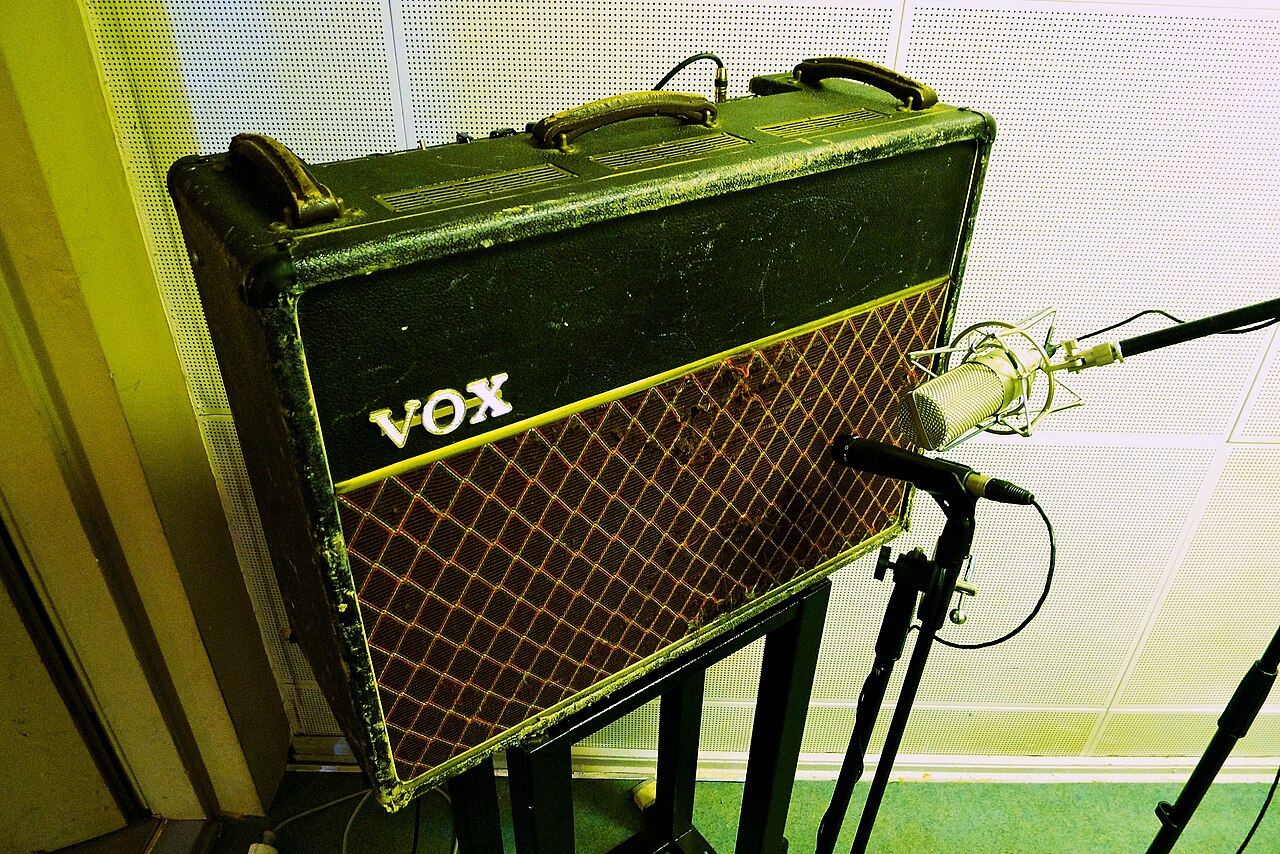
- A Vox AC30 with a ShinyBox microphone and a Shure SM57 in a studio: Marc Wathieu from Huy, Belgium, Wikimedia Commons, CC BY 2.0.
- Rory Gallagher: Heinrich Klaffs, Wikimedia Commons, CC BY-SA 2.0.
- The Edge: iinchicore, Wikimedia Commons, CC BY-SA 4.0.
Latest News
Related

On This Day
Tuesday 10 November
From this week: