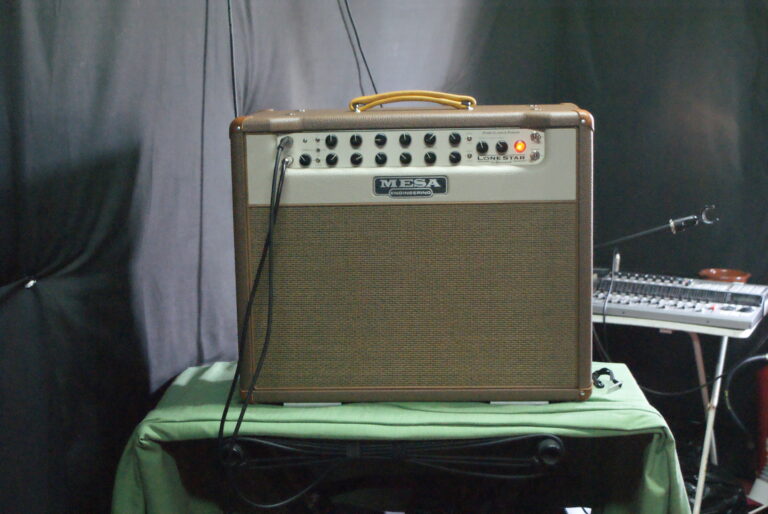
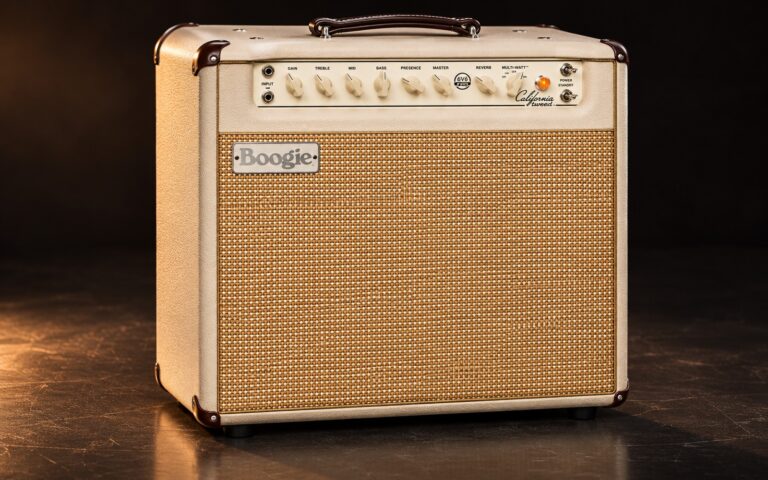
The Compact Recto That Brought Back the Spring: Mesa/Boogie Recto-Verb 25 Combo
Mesa/Boogie Recto-Verb 25 Combo: EL84 Rectifier tones plus all-tube spring reverb in 41 lbs. Specs, verified players, 5 tone recipes, buying guide.
The Mesa/Boogie Mini Rectifier Twenty-Five had been turning heads since its release — a lunchbox head that somehow delivered the essential DNA of the Dual Rectifier at a fraction of the size and weight. Players loved it. But the requests poured in: put it in a combo. Put a speaker in the box. And while you’re at it, give it reverb. Mesa engineers complied, and the result was the Recto-Verb Twenty-Five.
It sounds simple enough — Mini Rectifier plus long-spring reverb plus a 1×12 cabinet. But the Recto-Verb 25 earned its own identity the moment players discovered what the all-tube transformer-coupled spring reverb did to those four iconic Rectifier voices. A surf-style shimmer on the clean channel. A haunted, dimensional quality draped over the Vintage high-gain voice at 10 Watts Triode. A reverb that doesn’t just follow the amp’s tone, it participates in it. As MusicRadar’s Nick Guppy put it in his 2014 review, “This amp is proof that nobody can match Mesa when it comes to maximum tone from minimum dimensions.”
This is the story of Mesa’s most versatile compact combo — a discontinued EL84 workhorse that still turns up in rehearsal rooms, small stages, and studio racks wherever guitarists need genuine Recto weight in a 41-pound box.
From Mini Rectifier to Recto-Verb: The Origin Story
To understand the Recto-Verb 25, you need to understand the Mini Rectifier. The Mini Rec was introduced as the compact head version of the Rectifier concept — not a stripped-down toy, but a genuinely hand-wired, Petaluma-built amplifier with the full Dual Rectifier preamp circuit (five 12AX7s, the same configuration used in the flagship heads) and a purpose-built EL84 power stage running at 10 or 25 Watts depending on the Triode/Pentode switch selection. It weighed 12 pounds and fit in a gig bag pocket.
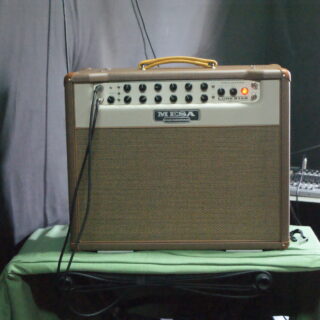
The Recto-Verb 25 was the natural evolution: slightly larger to accommodate a long-spring reverb tank (in both the head and combo versions) and, in the combo format, a 1×12 cabinet loaded with a Celestion Vintage 30. Mesa’s own product page describes the Recto-Verb as “the Reverb-endowed, fraternal-twins of our little Mini Rectifier lunchbox.” The architecture is genuinely fraternal — same preamp circuit topology, same Multi-Watt power stage, same four modes — but the reverb transforms the personality of the amp in meaningful ways beyond a simple add-on.
A word on the naming history, because it’s confusing and worth sorting out. The name “Recto-Verb” evokes the older Rect-O-Verb, Mesa’s 1990s reverb-equipped companion to the Dual and Triple Rectifier heads. The original Rect-O-Verb (Series 1) was a 50-Watt combo using 6L6 power tubes and a Dual Rectifier circuit with spring reverb built in. The Rect-O-Verb Series 2 was a 50-Watt head, again 6L6-powered, with the same Raw/Vintage/Modern high-gain voicings found on the full-size Rectifiers plus reverb. Despite the similar name, the Recto-Verb 25 is not a successor to either of those products. It shares the Rectifier family branding and some of the circuit DNA but it is built around EL84 power tubes and the compact Mini Rectifier platform — a completely different amp architecture. Do not mistake the old Rect-O-Verb at used market for the Recto-Verb 25; they are different animals that happen to share a root word.
Under the Hood: Specs and Construction
The Recto-Verb 25 is hand-wired in Petaluma, California, in the same facility where Mesa has built amplifiers since the early 1970s. The combo uses marine-grade Baltic birch for the cabinet — a real structural material, not the particle board or MDF found in budget combos — covered in Mesa’s standard vinyl finishes with a choice of black or custom-colour options. The physical dimensions are compact by combo standards: 17 inches tall, 19 inches wide, 11 inches deep, and 41 pounds on the scale. That last number matters: at 41 pounds, this is a two-hand carry to the stage but not a chiropractor’s appointment.
The Rectifier That Carries the Dual Rectifier Name (but Just One Rectifier)
A recurring honest angle in this Rectifier sub-series: the Recto-Verb 25 carries a “Dual Rectifier” logo on its control panel — something MusicRadar’s Nick Guppy explicitly flagged in his 2014 review, noting that “the control panel’s Dual Rectifier logo is slightly misleading, as there is only one rectifier in this amp.” The amp uses silicon diode rectification only. There is no tube rectifier option, no Spongy mode, no Bold/Spongy toggle. The “Dual” in Dual Rectifier refers to the full-size head’s ability to select between two rectification types (tube or solid state, per channel). The compact Rectifier family — the Mini Rectifier, the Single Rectifier, and the Recto-Verb 25 — all carry the Rectifier family name and branding but none offer tube rectification. What you get instead is the silicon-diode tightness that defines the “modern” Rectifier character: fast attack, immediate note definition, controlled low-end that doesn’t bloat at high gain settings.
The EL84 power section is the other key differentiator from the full-size Rectifiers. Where the Dual, Triple, and Single Rectifier heads use 6L6 (or optionally EL-34) power tubes, the Recto-Verb 25 runs two EL84s — the same tubes found in British classics like the Vox AC30 and early Marshall 18-Watts. Mesa’s engineering team chose EL84s deliberately for this platform: their natural clip characteristic produces a rounder, warmer compression than the more linear 6L6, and the harmonic content of an overdriven EL84 sits slightly higher in the frequency spectrum, which gives the lead tones a more vocal, present quality. This is the mechanism behind what Mesa calls the “10-Watt Triode” voice — the 10-Watt setting doesn’t just reduce the volume, it rewires the power stage from Pentode to Triode operation, fundamentally changing the character from punchy and authoritative to rounded, touch-sensitive, and bloom-heavy. The two power levels on each channel are genuinely different voices, not just a volume knob in the power stage.
The Four Modes: What They Actually Do
Channel One’s Clean mode is the Recto-Verb’s most underrated voice. Mesa’s own description calls it capable of “sparkling, big-headroom rhythm sounds that breathe with rich, warm air on the bottom end.” In practice it’s the most genuinely clean voice Mesa has produced in the Rectifier line — not because the circuit is different but because the EL84 power section’s headroom behaviour rewards clean playing more graciously than the more muscular 6L6-based heads. Pushed into the 10-Watt setting and driven to clip, it transitions into what Mesa accurately calls “real attitude” — a furry, urgent crunch that sits closer to British rhythm territory than American metal. This is the mode where the spring reverb earns its keep: a medium reverb decay on Clean mode at lower volume settings produces a sound that wouldn’t be out of place behind a vintage Californian surf riff.
Channel One’s Pushed mode adds drive while stripping the EQ slightly for a more focused midrange. At 25 Watts Pentode it’s a classic rock crunch machine — tight, defined, with enough gain for rhythm work without tipping into high-gain territory. The Pushed mode rewards chord players who want articulation under their fingers: each string stays separately audible even on five-note barred chords, which is more than most crunch channels can claim.
Channel Two’s Vintage mode is the Recto-Verb’s signature. Mesa describes the Vintage voice as producing “an elastic feel and a broad harmonic spread” with “a looser, more organic sound” where “the overdrive drapes itself around the notes creating a huge, three-dimensional image.” In the 10-Watt Triode position this assessment is no marketing hyperbole. The Vintage mode at 10 Watts on an EL84 combo produces some of the most expressive single-note lead tones the Rectifier name has ever been attached to — the kind of tone where you vary your picking attack and the amp responds with a range of harmonic character from singing sustain to aggressive bite. It is, as Mesa’s copy says, “a new and exciting face of Recto.”
Channel Two’s Modern mode is the aggressive face of the amp — the mid-scooped, high-gain Recto character that defined American metal in the 1990s. On a 25-Watt EL84 combo it is objectively less powerful than the 150-Watt Triple Rectifier, but the character is recognisably the same: percussive attack, tracking low-end definition, compressed sustain, and the characteristic harmonic blur above 4kHz that makes Rectifier distortion so immediately identifiable. The EL84 power section removes some of the sub-bass weight of the 6L6 Rectifiers — which for many players is an improvement rather than a compromise; less low-end mud in a small-room or rehearsal context, better note separation in dense tunings.
The Reverb: Mesa’s Secret Weapon
The “Verb” in Recto-Verb carries more weight than a three-letter suffix. Mesa’s spring reverb technology has a specific design philosophy: transformer-coupled output from the reverb driver tube into the tank, which produces what engineers call a “larger, more natural decay” than the direct-coupled approach used in most guitar amplifiers. Independent channel controls are accessed via the rear panel — a design choice Mesa made so that the reverb depth doesn’t share front-panel real estate with the main controls, keeping the layout clean and making it possible to set dramatically different reverb depths per channel without compromise.
MusicRadar’s Nick Guppy went as far as saying in his 2014 review that the reverb on the Recto-Verb Twenty-Five is “probably the best you’ll ever hear” in a combo amplifier of this type — “Mesa does spring reverb better than anyone, even the company that first used it.” That’s a pointed reference to Fender, which popularised tank reverb in guitar amplifiers in the early 1960s. Whether you accept that ranking or not, the reverb in the Recto-Verb 25 behaves unlike most onboard reverb: it doesn’t thin the low-end, doesn’t push the treble, and remains musical at all gain levels rather than becoming the washy noise problem that most reverb units are when added to a high-gain circuit.
The Speaker Question
One spec discrepancy worth noting for prospective buyers: Mesa’s product overview page consistently described the Recto-Verb 25 combo as loaded with a Celestion Vintage 30 — the speaker that has been synonymous with the Rectifier line since the early 1990s, and the same driver used in the Mini Rectifier’s matched extension cabinets. However, the official combo specification page on the legacy Mesa site lists the speaker as “1 – 8 Ohm Mesa Fillmore 75.” The Fillmore 75 is Mesa’s house-branded driver, built to Mesa’s specifications and bearing their name. It is possible that the Celestion Vintage 30 was the original spec and the Mesa Fillmore 75 was substituted in later production runs — a running change of the kind that appears across Mesa’s product line without public announcement. If you are buying used and the speaker matters to you, pull the grille and check the driver cone stamp before committing. Both speakers are capable performers in this cabinet; neither is a downgrade, but they are genuinely different voices.
Famous Players — Honest Assessment
James Hetfield, John Petrucci, Mark Tremonti, Dave Grohl, and Wes Borland all need to be cleared up before anything else is said, because all five are well-documented on other Mesa amplifiers — but not the Recto-Verb 25.
James Hetfield is a Triaxis preamp and Triple Rectifier player (the Triaxis-plus-Strategy-400 rig is his documented studio and touring anchor, with Triple Rectifiers in the live mix). He has no documented connection to the Recto-Verb 25, a compact EL84 combo that simply isn’t in his operational register.
John Petrucci used the Triaxis from 1992 to approximately 2014, then transitioned to the Mesa/Boogie JP-2C — a Mark-circuit head with his name on the panel. There is no documented Recto-Verb 25 in his rig at any point.
Mark Tremonti is a documented Triple Rectifier player (Mesa’s own artist page, FRET12 artist-owned sales, and Premier Guitar Rig Rundowns all confirm this). He is a 150-Watt artist; a 25-Watt EL84 combo is not his stage instrument.
Dave Grohl uses a Dual Rectifier — documented by GroundGuitar and Reverb News with specific reference to the 100-Watt head. No Recto-Verb 25 appears in his documented setups.

Wes Borland built his early Limp Bizkit sound on Triple and Dual Rectifiers, then moved to the EVH 5150 III (covered at Rank 478 and Rank 479). A 25-Watt combo does not appear in any documented Borland rig configuration.
The pattern is consistent across the compact Rectifier sub-series: the big names associated with the Rectifier brand are associated with the full-size 6L6-powered heads, not the compact EL84 variants. This is expected — those artists have stage requirements that a 25-Watt combo cannot meet. The Recto-Verb 25 serves a different player, in a different context.
The actual verified players on the Recto-Verb 25 are a more interesting group than the recycled roster above.
Nick Steinhardt (guitarist of Los Angeles post-hardcore band Touché Amoré) is confirmed via Mesa/Boogie’s own legacy artist page, which features his photo alongside the Recto-Verb 25 1×12 Combo. Touché Amoré operate at a different sonic register from the full-size Rectifier bands — their music uses aggressive dynamics, textural clean sounds, and controlled high-gain in a way that suits the Recto-Verb 25’s range of voices. Steinhardt’s documented amp usage is consistent with someone who actually plays all four modes, not just the Modern setting.
Daryl Stuermer, touring guitarist for Genesis and Phil Collins since 1978, documented his adoption of the Recto-Verb 25 on his own website’s Gear Talk section, describing “two Mesa Recto-Verb 25 amps” as “perfect combo amps for most situations that pack a lot of power while being fairly lightweight at about 40 lbs.” Stuermer is a professional who has toured at the highest level for decades; his choice of the Recto-Verb 25 as a practical touring tool says something specific about the amp’s real-world usefulness as a high-quality, portable, self-contained rig. He used two units simultaneously — a stereo pair — to achieve the width and depth his parts require.
DeWayne ‘Blackbyrd’ McKnight, Parliament-Funkadelic veteran and cross-genre collaborator (Herbie Hancock, Sonny Rollins, Warren Zevon, Red Hot Chili Peppers), stated in a 2025 interview that he “mostly uses a Mesa Boogie Recto-Verb 25 or a Mesa Boogie Mark Five” for local and studio work. McKnight is a player whose identity crosses the boundary between funk, psychedelic rock, and jazz — the Recto-Verb 25’s Clean and Pushed modes, especially with the spring reverb, serve that range in a way a pure high-gain amp cannot.
These three players represent a more honest picture of who the Recto-Verb 25 actually serves: working professionals who need a portable, versatile, genuinely high-quality combo that covers clean, crunch, and high-gain in a single box without requiring a crew to carry it.
Tone Recipes and Settings
Recipe 1: Channel 1 Clean, 25W Pentode — Studio Bloom
Gain around 9 o’clock. Treble at noon, Mid at 1 o’clock, Bass at noon, Presence at 11 o’clock. Master at working volume. Reverb (rear panel) at around 10 o’clock. This gives you the classic high-headroom clean that the EL84 power stage handles with particular grace — not the scooped, crystalline Fender approach but a warmer, slightly mid-present clean that handles chord inversions and jazz voicings without harshness. Works beautifully with a neck pickup single-coil or a warm humbucker in a PAF-type guitar. Push the Gain to 10 o’clock and you cross into light Pushed-mode territory with the same EQ starting point.
Recipe 2: Channel 1 Pushed, 10W Triode — The Crunch Hour
Pushed mode selected. 10 Watts Triode. Gain at 11 o’clock. Treble at noon, Mid at 1 o’clock, Bass at 11 o’clock, Presence at noon. Master as needed. Reverb minimal — around 8 o’clock. This is the Recto-Verb at its most British — the EL84 Triode wiring and the Pushed voicing combine to deliver a rhythm tone that sits in the zone between AC30 top-end chime and Marshall brown-sound bark. Classic rock rhythm, aggressive indie, and clean-to-crunch pedal platforms all work here. The reduced wattage means every picking nuance translates directly; light touches stay clean, hard hits crunch. A dynamic player’s best friend.
Recipe 3: Channel 2 Vintage, 10W Triode — The Liquid Lead
Vintage mode. 10W Triode. Gain at 1 o’clock. Treble at 11 o’clock, Mid at 1 o’clock, Bass at 11 o’clock, Presence at 11 o’clock. Master at stage volume. Reverb at 9–10 o’clock. This is the recipe that made the Recto-Verb 25 famous among players who actually own them: the Vintage mode at low wattage produces a lead tone with genuine vocal quality, the kind that allows note-by-note dynamic expression rather than uniform compression. The mid-forward EQ placement lets single notes cut through a mix without the ear-fatigue that high-presence heavy settings create. Sustained notes bloom and breathe. Add the reverb lightly to give notes a three-dimensional tail without washing the definition.
Recipe 4: Channel 2 Modern, 25W Pentode — Classic Recto Chug
Modern mode. 25W Pentode. Gain at 2 o’clock. Treble at 11 o’clock, Mid at 9 o’clock (classic mid scoop), Bass at 2 o’clock, Presence at 1 o’clock. Master at stage volume. Reverb off or at absolute minimum (8 o’clock). This is the full Rectifier high-gain experience in a 25-Watt format: percussive attack, defined low-end chunk for downtuned rhythm, harmonic saturation that tracks power chords with mechanical precision. The EL84 power section removes some of the sub-60Hz weight of the big Rectifier heads — which in this context is a benefit, preventing the kind of low-end smear that plagues small rooms when 6L6-powered 100-Watt heads are cranked. Palm-muted eighth-note riffs on a tuned-down guitar through this setting occupy the mix cleanly rather than fighting the kick drum for the same frequency territory.
Recipe 5: Channel 1 Clean, 10W Triode — The Reverb Special
Clean mode. 10W Triode. Gain at 8 o’clock (barely above unity). Treble at 11 o’clock, Mid at noon, Bass at noon, Presence at 9 o’clock. Master low. Reverb at 2–3 o’clock. This is the Recto-Verb doing what neither the Mini Rectifier nor the full-size Rectifier heads can do: a surf-style, almost indefinite reverb decay on a guitar tone that stays fundamentally musical rather than collapsing into noise. Mesa’s all-tube reverb circuit stays coherent even at high reverb levels because the transformer coupling separates the reverb driver’s harmonic character from the raw amplifier signal. Think Dick Dale, think Duane Eddy’s television themes, think Johnny Marr chord shapes in a reverb fog. The 10-Watt Triode mode’s rounded top end keeps the reverb from going glassy and unpleasant even as the tank fully saturates.

Comparisons
The most direct point of comparison is the Mesa/Boogie Mini Rectifier Twenty-Five Head . Same preamp circuit, same EL84 power stage, same four modes, same Multi-Watt architecture. The Recto-Verb adds the all-tube spring reverb, increases the tube count to accommodate the reverb driver, and wraps the electronics in a 1×12 cabinet with a speaker already installed. The Mini Rectifier weighs 12 pounds; the Recto-Verb 25 combo weighs 41 pounds. If you don’t need the reverb and want maximum portability, the Mini Rec is the amp. If you want a complete self-contained rig and the reverb is part of your sound, the Recto-Verb 25 is the better choice. Both are discontinued; on the used market, the Recto-Verb 25 combo typically commands a slight premium over an equivalent Mini Rec plus extension cab because of the reverb and the convenience factor.
Against the Dual Rectifier Solo Head , the comparison is really about context and power requirements. The Dual Rectifier at 100 Watts through a 4×12 cabinet occupies entirely different physical and sonic space — it can clear a medium venue without a PA and has the low-end authority that comes from running four 6L6 power tubes at full tilt. The Recto-Verb 25’s EL84 power section produces a genuinely different character: warmer, more compressed, more harmonically complex in the power stage itself. For recording, rehearsals, and small-to-medium venues mic’d through a PA, the Recto-Verb 25 is not a compromise relative to the Dual Rectifier — it is a different instrument that happens to share four of the same voicings.
The Triple Rectifier is the opposite end of the Mesa power spectrum — 150 Watts, six 6L6 power tubes, selectable tube or diode rectification, the amp that defined the nu-metal era. The Recto-Verb 25 shares none of the Triple Rectifier’s mechanical authority but offers something the Triple cannot: nuance. At 10 Watts Triode into a single 12-inch speaker, the Recto-Verb responds to touch, breath, and fingernail angle in ways that 150 Watts of Class A/B operation into a 4×12 cabinet never will. They are tools for different jobs.
The Mesa/Boogie Mark V: 25 Head is the same wattage class but a fundamentally different circuit family. The Mark V: 25 draws from the Mark series lineage — the Boogie circuit that traces back to Santana’s modified Princeton in 1969, with its characteristic midrange push, the five-band graphic EQ option, and the Simul-Class power architecture. The Mark V: 25 has ten modes across three channels; the Recto-Verb 25 has four modes across two. The Mark circuit’s characteristic voice is forward, present, and cutting — John Mayer territory, fusion territory, progressive rock territory. The Recto-Verb’s character is more balanced, less aggressive in the midrange, more obviously American-metal in the Ch.2 modes. For clean and crunch versatility, the Mark V: 25 has more range. For players who want recognisable Recto character in a small package with reverb, the Recto-Verb 25 is the only option in Mesa’s discontinued catalogue.
Against non-Mesa competition, the Fender Blues Junior is the obvious size and weight comparison — around 15 Watts of EL84 power, onboard spring reverb, 1×12 cabinet, roughly 31 pounds. The Blues Junior costs significantly less and is genuinely excellent in its lane: clean and pushed-clean American sounds, simple single-channel operation, real spring reverb. But it is a single-channel amplifier without the Rectifier’s high-gain modes and without any equivalent to the Vintage or Modern voicings. Players who need rock and metal alongside their clean sounds will find the Blues Junior reaches its limits quickly. The Recto-Verb 25 covers the Blues Junior’s territory and then extends well past it; the Blues Junior does not cover the Recto-Verb’s territory at all.
Buying Guide
The Recto-Verb 25 was discontinued around 2021 following Gibson’s acquisition of Mesa/Boogie, along with the Mini Rectifier and the rest of the discontinued compact Rectifier line. New-old-stock units appear occasionally at dealers; used prices on the 1×12 combo sit in the approximate range of $800 to $1,200 depending on condition and location, though collector interest in discontinued Mesa products has pushed prices upward from their initial post-discontinuation floor.
There are three formats to distinguish: the 1×12 Combo, the Head (same circuit, no speaker, approximately 12 pounds — identical to the Mini Rectifier form factor but with the reverb circuit), and the Rackmount Head (2U rackmount, same circuit, designed for rack rigs). The combo is the most common format on the used market; the rackmount head is the rarest. If you are buying the head format, note that it can be connected to any 8-Ohm or 4-Ohm external cabinet — the speaker outputs on the rear panel provide one 8-Ohm jack and two 4-Ohm jacks.
When evaluating a used Recto-Verb 25, run both channels through all four modes and both power settings. Check the reverb at multiple depths from both channels — the reverb tank can develop rattles or lose signal integrity over time, and replacement tanks are available but require disassembly. Listen for inconsistent EL84 performance: a single weak or noisy EL84 will produce audible imbalance at lower power levels. Ask for the original footswitch (the 1-button unpainted alloy unit); it is a simple device but finding a replacement that matches the original is slightly harder than it should be.
The speaker question is addressed above. Vintage 30 vs Fillmore 75 is a genuine tonal difference; the Vintage 30’s upper-mid presence peak (around 3–4kHz) will sound brighter and more cutting than the Fillmore 75’s smoother, more balanced response. Neither is better; they are different voices. Verify which you have before buying if the speaker character matters to your application.
Ownership Notes
The reverb tank in the Recto-Verb 25 occupies physical space inside the combo cabinet, and all spring reverb tanks are mechanically sensitive. Transport the combo in its upright position — the same orientation it sits on stage — whenever possible. Transporting it on its back or upside down is technically survivable but repeated mechanical shock to the spring tank in an unusual axis shortens its service life. Mesa included a fitted slip cover with the combo; use it. Baltic birch is more robust than most combo cabinet materials but it is still wood and still vulnerable to impact at corners and edges.
The fixed-bias EL84 power stage is maintenance-free in the sense that it does not require the user to set a bias point when changing power tubes. However, EL84 tubes do wear and will eventually need replacement. Mesa’s fixed-bias circuit is designed around matched pairs; buy matched EL84s when the time comes and the amp will restore to factory operating conditions without an adjustment procedure. Preamp tube replacement follows the same logic as any six-12AX7 preamp: the first tube in the chain (typically V1) has the most influence on noise floor and gain character; working from V1 outward when chasing noise or tonal changes is the correct diagnostic sequence.
The all-tube buffered effects loop is series-wired, which means unity-gain time-based effects (reverb, delay, chorus) pass through it cleanly. Overdrive and distortion pedals in the loop will interact oddly with the existing gain structure; they belong in front of the amp. Mesa’s buffered loop design means it does not degrade tone even when empty — the buffer actively drives the loop send rather than relying on the signal to pass through passive connections.
FAQ
Is the Recto-Verb 25 really a Mini Rectifier in a combo cabinet?
Essentially yes, but with additions. The preamp circuit and Multi-Watt EL84 power stage are shared between the Mini Rectifier and the Recto-Verb 25. The Recto-Verb adds an all-tube long-spring reverb with independent channel controls and packages everything in a 1×12 combo cabinet (in the combo format) or a slightly larger head enclosure (in the head format). The weight goes from 12 pounds (Mini Rec head) to 41 pounds (Recto-Verb 25 combo), which is the price of the added components and the cabinet. If you need reverb built in and want a self-contained combo, the Recto-Verb 25 is the better choice. If you want absolute maximum portability, the Mini Rectifier wins.
Does the Recto-Verb 25 have a tube rectifier? The name says “Recto.”
No. Despite carrying the Rectifier family name and a Dual Rectifier logo on the control panel, the Recto-Verb 25 uses silicon diode rectification only. There is no tube rectifier, no tube rectifier socket, and no Spongy/Bold mode switch. The “Recto” in the name refers to the Rectifier voicing family — the preamp modes that produce the characteristic Dual Rectifier sound — not to the rectification type used in the power supply. This is the same situation as the Mini Rectifier and the Single Rectifier: Rectifier-voiced amps that use diode rectification only.
Can it handle a small gig without a PA?
Yes, and MusicRadar confirmed it in their 2014 review, noting “plenty of volume to handle most small-to-medium unmic’d gigs.” The 25-Watt Pentode setting is substantially louder than the wattage suggests — EL84 amplifiers tend to have an efficiency and projection that outperforms the raw wattage rating when compared to their 6L6 counterparts at equivalent power ratings. You will not compete with a full-size Rectifier stack in an unmic’d room, but small bars, rehearsal spaces with drum kits, and medium-sized stages with a PA all fall within the Recto-Verb 25’s operational range.
What is the 10W Triode mode doing differently from the 25W mode?
It’s not just turning down the volume. The Multi-Watt switch physically rewires the EL84 power stage from Pentode operation (full-power, more efficient, wider frequency response) to Triode operation (lower-power, less efficient, a fundamentally different load on the output transformer that produces rounder attack, compressed sustain, and more harmonic complexity in the power-stage distortion itself). The 10-Watt Triode mode is a genuinely different sonic character — warmer, rounder, more vintage in feel — rather than a simple volume reduction of the 25-Watt Pentode voice. Mesa’s engineers specifically tuned the Vintage and Clean modes to benefit most obviously from the Triode power setting.
The Mini Rectifier is cheaper on the used market. Why would I buy the Recto-Verb 25 combo instead?
Two reasons: the spring reverb and the self-contained format. The Mini Rectifier head requires a separate cabinet and a separate reverb pedal (or reverb tank) to match what the Recto-Verb 25 combo delivers out of one box. Mesa’s all-tube reverb is significantly better than most reverb pedals in the under-$200 range and competitive with pedals at $300–$400; buying the Recto-Verb 25 combo used and adding no other gear gives you a rig that a Mini Rectifier plus budget reverb pedal plus cabinet cannot replicate at equivalent quality. If your setup already includes a quality reverb pedal and a preferred cabinet, the Mini Rec head makes more sense financially.
Are the artists (Hetfield, Petrucci, Tremonti, Grohl, Borland) actually connected to this amp?
None of them. All five are documented Mesa users, but all five are documented on full-size Rectifier or Mark-circuit heads — not on the Recto-Verb 25 compact combo. James Hetfield uses Triaxis preamps and Triple Rectifiers; John Petrucci used the Triaxis then the JP-2C; Mark Tremonti is a Triple Rectifier player; Dave Grohl is a Dual Rectifier player; Wes Borland used Triple and Dual Rectifiers in his peak period. The recycled name-dropping common to Rectifier marketing materials attaches big-name Rectifier users to every product in the family regardless of specific SKU. Verify per-SKU before writing any connection as fact.
Is the Recto-Verb 25 good for genres outside metal?
Genuinely yes, and the verified player list makes this point better than any product description can. Daryl Stuermer plays progressive rock and pop with Genesis and Phil Collins. DeWayne McKnight plays funk, psychedelic rock, and jazz. Nick Steinhardt plays post-hardcore. The Clean and Pushed modes on Channel 1, especially with the spring reverb engaged, produce sounds that serve country, Americana, indie rock, blues, and classic rock convincingly. The Recto-Verb 25’s versatility comes from its four distinct modal voices plus two genuinely different wattage/power-class settings — that is eight distinct operating points without counting EQ or reverb variations, which is more tonal range than most two-channel amplifiers at any price point.
What should I set the rear-panel reverb controls to as a starting point?
Start both channels at about 9–10 o’clock (roughly one-quarter of the available throw). This gives a room ambience that fills the dry sound without pushing the reverb into its “wet” character. From there, increase the Ch.1 reverb if you are using the clean channel for single-note work or rhythm playing where space helps, and decrease the Ch.2 reverb if you are using Modern mode for heavy rhythm work where reverb reduces note definition. The key advantage of the rear-panel placement is that you can set dramatically different reverb depths per channel — a fully wet clean channel and a completely dry high-gain channel are possible simultaneously, which is not achievable on amplifiers with a single front-panel reverb control.
Image credits
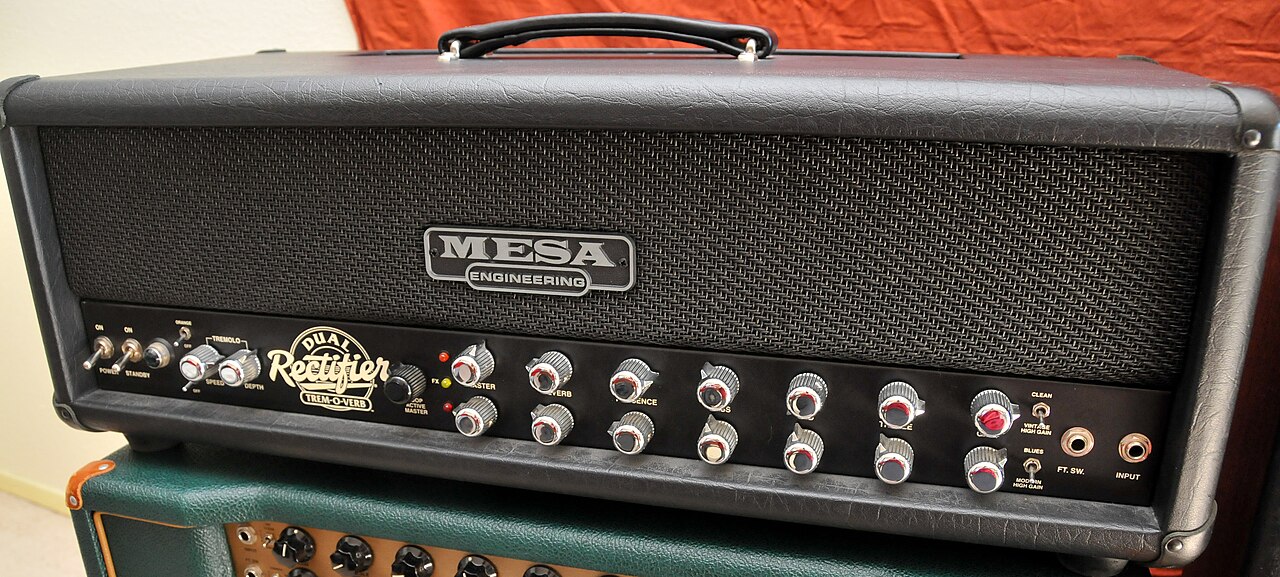
- A Mesa Boogie Dual Rectifier Tremoverb 100 watt head: ArtBrom from Seattle, Wikimedia Commons, CC BY-SA 2.0.
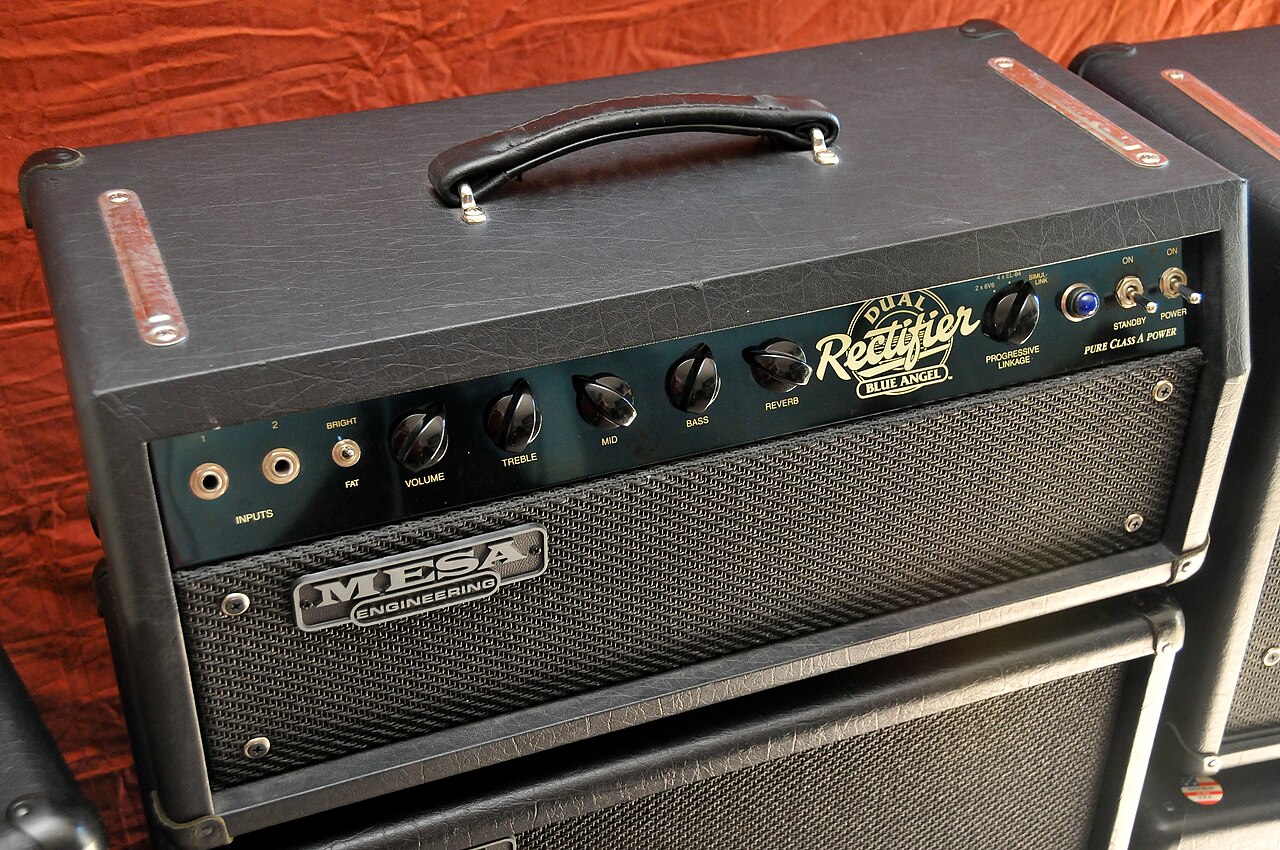
- A Mesa Boogie Blue Angel head: ArtBrom from Seattle, Wikimedia Commons, CC BY-SA 2.0.
- Dave Grohl: flimsical (Lindsay), Wikimedia Commons, CC BY 2.0.
- Wes Borland: Antje Naumann (AllSystemsRed), Wikimedia Commons, CC BY-SA 3.0.
Latest News
Related
On This Day
Monday 9 November
From this week: