The Amp That Gave Nu-Metal Its Spine: Mesa/Boogie Triple Rectifier Solo Head
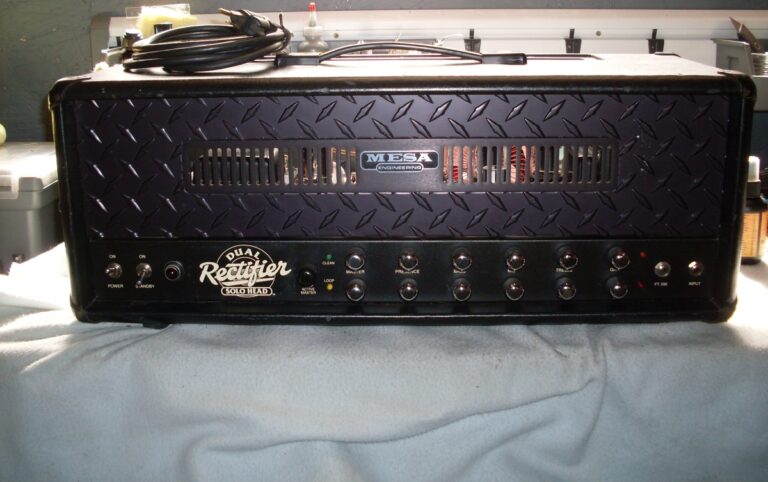
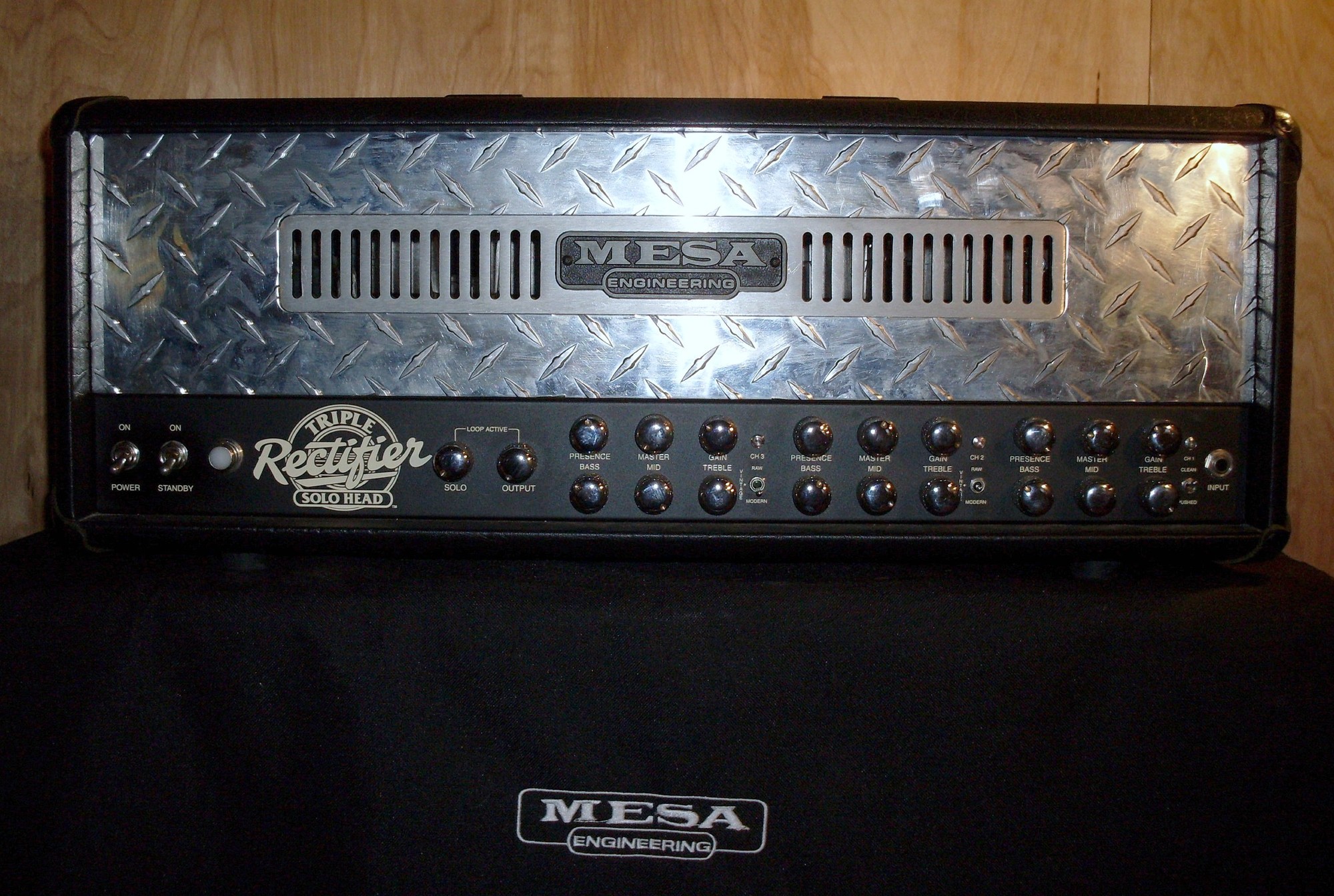
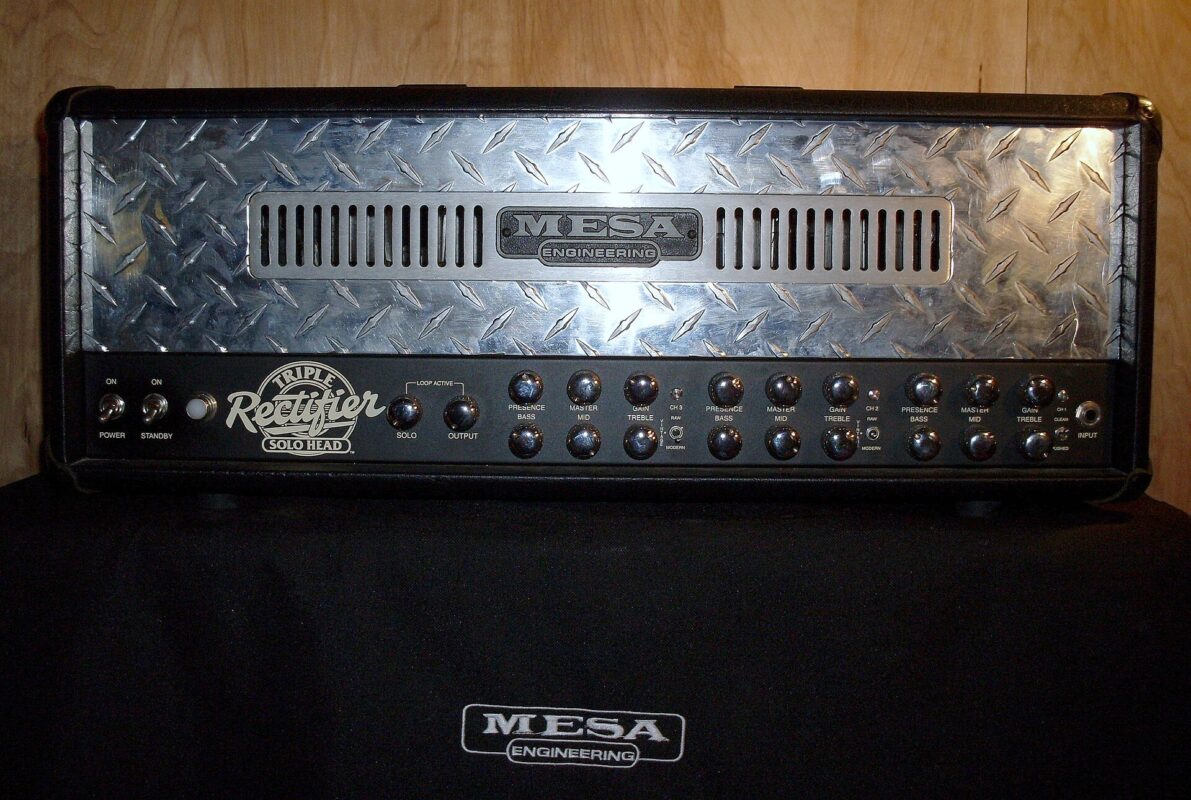
A Mesa/Boogie Triple Rectifier Solo Head, shown as a representative example of the model. Photo: Roadside Guitars, CC BY-SA 2.0. Source: Wikimedia Commons.
150 watts of hand-wired Petaluma tube muscle: the Triple Rectifier Solo Head is the amp that gave nu-metal its spine and still rules modern high-gain.
There is a specific shade of sonic violence that defined guitar tone from 1993 through the early 2000s — a crushing, scooped-out, palm-muted low-end avalanche with enough harmonic saturation to make your chest cavity vibrate like a kicked oil drum. You have heard it on Significant Other, on the heaviest passages of Creed’s arena run, on a hundred records where the production budget was large, the downtuning was aggressive, and the drummer looked like he wanted to kill the kit. That sound came from a cathode and a coil and six hot 6L6 power tubes built by hand in a small factory in Petaluma, California. It came from the Mesa/Boogie Triple Rectifier Solo Head.
The Triple Rectifier is not the most prestigious amplifier Mesa/Boogie ever made — that argument belongs to the Mark IIC+ — and it is not the most sonically diverse, a title the Triaxis programmable preamp holds comfortably. What the Triple Rectifier is, without serious contest, is the most physically imposing amplifier Mesa/Boogie ever put in full production: 150 watts, three channels, eight mode voicings, three rectifier tubes, and 48 pounds of marine-grade Baltic birch and aviation-aluminium chassis that looks like it was designed for people who found regular amplifiers insufficiently serious.
Understanding the Triple Rectifier means understanding the name first, because the name is systematically misread in almost every online conversation about this amp. The “Triple” does not refer to three channels. For the first eight or nine years of production, the Triple Rectifier had exactly two channels — the same two channels as its sibling, the Dual Rectifier. The “Triple” refers to the rectifier tube complement: three 5U4 rectifier tubes, versus the Dual’s two, because three rectifier tubes are what it takes to manage 150 watts of power-amp demand. More tubes, more wattage, more headroom, more physical weight — the Triple Rectifier is, at its simplest, what happens when you build a Dual Rectifier that refuses to break a sweat at a stadium volume.
From Petaluma with Prejudice: The History of the Triple Rectifier
The story begins not with the Triple Rectifier but with the Dual Rectifier, which debuted publicly in February 1992 priced at $1,195 in a climate where the Seattle grunge movement had just dismantled the hair-metal infrastructure the amp was originally designed to serve. Mesa/Boogie’s development team had been working on the Rectifier circuit since 1989, originally targeting the late-1980s shred and stadium-rock market; by the time the amp reached production, Nirvana had already released Nevermind and the musical landscape had pivoted hard toward lo-fi rawness and dynamic extremity. The Rectifier arrived just as those trends created a new appetite for amplifiers capable of producing enormous saturation without the compression and midrange scoop of the classic British stack. It found its audience immediately.
The first publicly available revision — Revision C, in early 1992 — was a 100-watt two-channel head with a chrome or black chassis and a clean channel that, by the manufacturer’s own acknowledgement, required the master volume to be pushed toward the high end of the dial before it became usable. Revisions D and E followed in quick succession through 1992, refining the clean circuit and tightening the overall character. The amplifier that most people associate with the first era of the Rectifier sound, however, is Revision F.
Revision F, which ran from 1992 through 1994 across approximately serials 643–3,180, did two significant things. First, it rebuilt the clean channel architecture, using half-stages of each preamp tube position to create improved dynamics, clarity, and reduced background noise. Second, and relevant here, it introduced the Triple Rectifier itself — a physically larger, heavier, 150-watt version built on the same circuit with the rectifier tube complement expanded to three 5U4s to handle the additional power demand. The Triple was so named at this moment, and it has carried that name through every subsequent revision regardless of channel count.
Revision G, the production variant that ran from 1994 through late 1999 (approximately serials 3,181–16,480), is the version that most comprehensively defined the Rectifier’s legacy. Guitar World described its sound as “massive, tight low end, throaty mids, and super-saturated gain,” a description that remains accurate and which captures why the amp became ubiquitous. By 1994 you could not listen to rock radio without hearing a Rectifier within a few songs; by 1999, as nu-metal expanded into the dominant commercial genre in heavy music, the Rev G had become essentially the default high-gain amplifier for anyone with a recording budget. Linkin Park, Disturbed, Limp Bizkit, Creed — all of them built their guitar tones on Revision G Rectifiers.
Around 1999–2000, after extensive prototyping, Mesa introduced the three-channel Rectifier series. The third independent channel — Channel 1, dedicated to clean tones — was added alongside the two original gain channels, now designated Channels 2 and 3. Each gain channel gained three voicing modes: Raw, Vintage, and Modern. The new architecture also introduced channel-assignable rectifier switching, allowing players to independently choose tube or silicon-diode rectification per channel rather than globally across the amp.
The final major update is the Multi-Watt system, which added channel-assignable power selection. Each channel can now independently operate at 50 watts (two power tubes) or 150 watts (all six), allowing a player to, for instance, run Channel 1 clean at 50 watts for manageable studio volume and Channels 2 and 3 at full 150-watt power for live work. This is the current production architecture, and the one documented in Mesa/Boogie’s specifications for the contemporary Triple Rectifier Solo Head.
Specifications
| Feature | Spec |
|---|---|
| Build Location | Hand-wired, Petaluma, California |
| Channels | 3 (Clean/Pushed, High Gain × 2) |
| Mode Voicings | 8 total — Ch. 1: Clean / Pushed; Ch. 2 & 3: Raw / Vintage / Modern |
| Wattage | 50W or 150W, channel-assignable (Multi-Watt) |
| Power Amp Class | Class A/B |
| Power Tubes | 6× Mesa 6L6 (EL-34 compatible with bias select switch) |
| Rectifier Tubes | 3× Mesa 5U4 |
| Preamp Tubes | 5× Mesa 12AX7 |
| Rectifier Type | Selectable tube or silicon diode, channel-assignable, with Recto Tracking™ |
| Power Switches | Bold / Spongy (variac-style power supply switching) |
| Controls per Channel | Gain, Treble, Mid, Bass, Presence, Master, 50/150W switch, Mode switch, Rectifier switch |
| Effects Loop | Fully buffered series FX loop, footswitchable, channel-assignable, or true bypassable |
| Solo Function | Yes — global solo level control, bypassable |
| Outputs | One 16Ω, two 8Ω, two 4Ω speaker outputs; slave output with level control; tuner output |
| Footswitch | 6-button (Ch. 1 / Ch. 2 / Ch. 3 / Tuner Mute / FX Loop / Solo) |
| Cabinet Material | Marine-grade Baltic birch |
| Weight | 48 lbs |
| Dimensions | 10″ H × 25½″ W × 9⅞″ D |
| New Price (2026) | ~$2,999 |
| Used Price — 2-ch Rev G | ~$1,400–$2,000 |
| Used Price — 3-ch (2000–2009) | ~$1,200–$1,800 |
| Used Price — Multi-Watt | ~$1,800–$2,500 |
| Production Status | Currently in production (new in 2026) |
The Recto Tracking System and What It Actually Means
The Recto Tracking™ system (US Patent 7,193,458) warrants a dedicated explanation because it solves a specific engineering problem that most players never think about and yet directly determines how the amp feels under the fingers. When you switch from 150 watts to 50 watts by taking four of the six power tubes out of the equation, the rectifier demand drops significantly. Without some form of automatic compensation, the rectifier circuit would be over-serving the load and the sag characteristics would change in a way that makes the lower-watt mode feel different — sloppier, or differently compressed — from what you dialed in at full power. Recto Tracking automatically adjusts the rectifier complement to match the number of power tubes in use, preserving the feel and compression behaviour regardless of the watt setting. It is the kind of problem-solving that Mesa/Boogie’s engineering culture has consistently applied to engineering questions other manufacturers leave as an exercise for the player to work around.
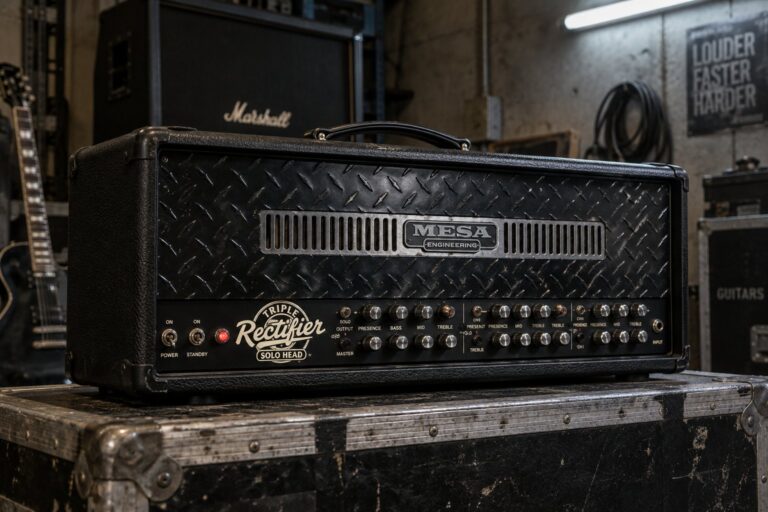
The Bold/Spongy power switch operates on a related but distinct principle. Bold mode routes power through silicon diodes, providing a fast, stiff power supply with immediate response and modern tightness — the sound you want for percussive palm-muted playing where definition in the low end is paramount. Spongy mode routes through the tube rectifiers, introducing the power-supply compression and voltage sag that characterises vintage amp behaviour: attack is slightly softened, sustain is warmer and more complex, and the amp responds to pick attack dynamics differently. Both modes are available independently on each channel, meaning a player can have the clean channel running Spongy for vintage feel while the high-gain channels run Bold for modern tightness.
Famous Players: Verified, Partially Verified, and Corrected
James Hetfield, John Petrucci, Mark Tremonti, Dave Grohl, and Wes Borland are named for the Triple Rectifier. Honest assessment of these five produces different levels of confidence.
Mark Tremonti is the clearest, strongest Triple Rectifier connection in this list. Mesa/Boogie’s own official artist page documents his use of Triple Rectifiers throughout his career, framing the amp as a constant from his early Creed years through Alter Bridge and his solo project. FRET12, the authenticated artist-gear marketplace, has sold his personal Triple Rectifiers directly — actual instruments from his rigs, documented with provenance. The 2012 Premier Guitar Rig Rundown from the Creed reunion tour shows a Mesa/Boogie Dual Rectifier as his anchor amp for that specific configuration, which illustrates that he moves between the Dual and Triple according to the production context; but across his career, the Triple Rectifier is consistently documented in his live rig. Mark Tremonti is a genuine, thoroughly documented Triple Rectifier player.
James Hetfield is more nuanced. His primary documented studio and live rig for the Load, Reload, Garage Inc., and St. Anger period was two Mesa/Boogie Triaxis programmable preamps (one set to LD2 IIC+ mode, one to RHY Clean) feeding a Strategy 400 power amp — a configuration confirmed by Mesa/Boogie’s own Amplitudes blog and documented in detail in this publication’s earlier article on the Triaxis. However, photographs from the Load/Reload era show Rev F and Rev G blackface Triple Rectifiers present in or around his stage setup, and the official Metallica website has listed the Triple Rectifier as part of his live rig during the 2010 touring cycle. It seems likely that the Triple Rectifier occupied a secondary role in his live rig — as a supplementary or backup head — during the period when the Triaxis was his primary signal source. Hetfield has a documented connection to the Triple Rectifier, but it was a supporting player in his rig rather than the centrepiece that it was for Tremonti or Borland.
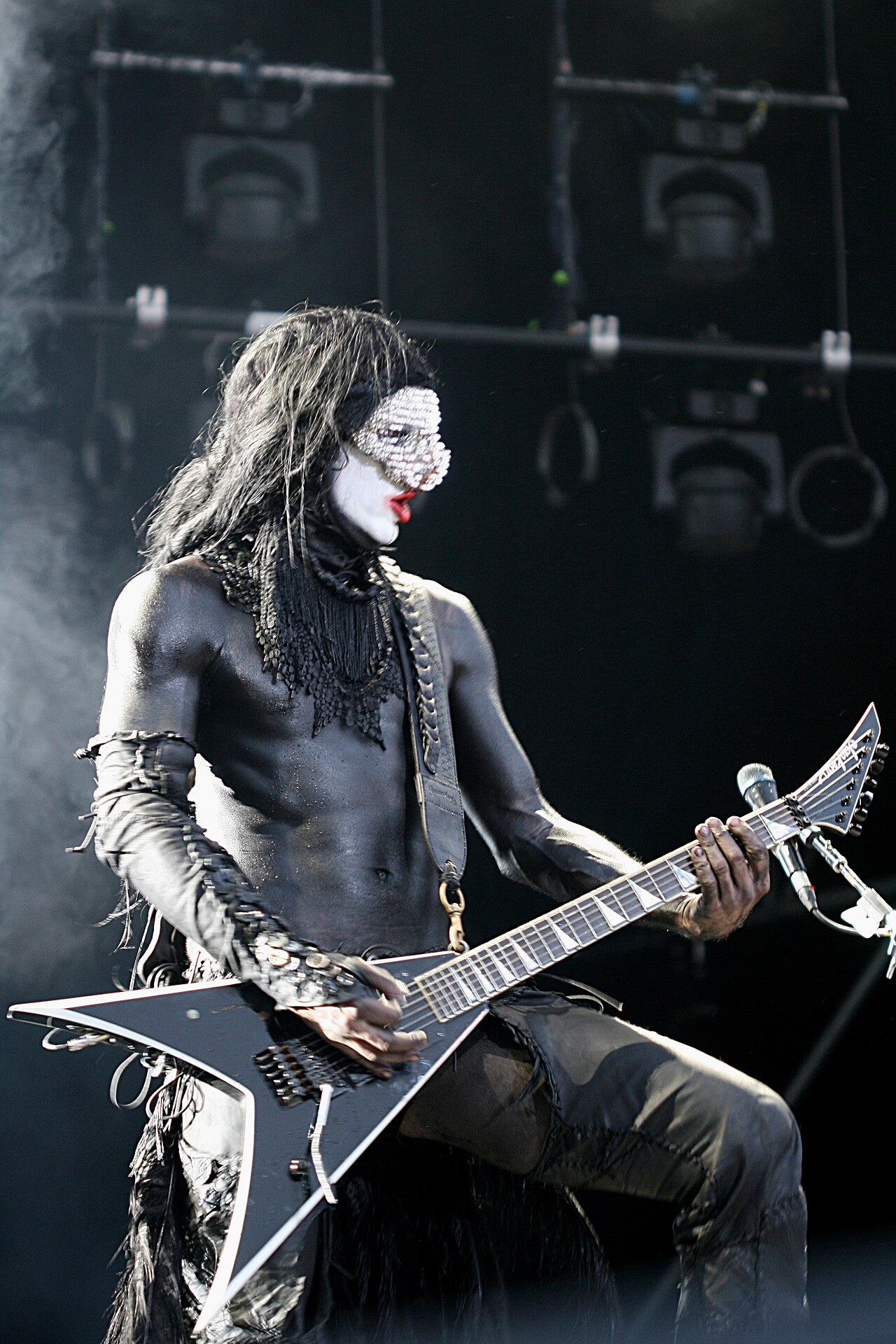
Wes Borland is verified. The Triple Rectifier (alongside a Dual Rectifier) was documented as his primary amp setup for Limp Bizkit’s first three albums — Three Dollar Bill, Y’All (1997), Significant Other (1999), and Chocolate Starfish and the Hot Dog Flavored Water (2000). Bizkitfans.com and multiple gear retrospectives confirm the Mesa Rectifier rig as the core of his studio and touring setup in that era, before a Diezel VH4 was added around 2000 and his rig began evolving toward different platforms. Wes Borland is a genuine Triple Rectifier player, and the specific albums on which that tone appears are among the biggest-selling hard rock records of the late 1990s.
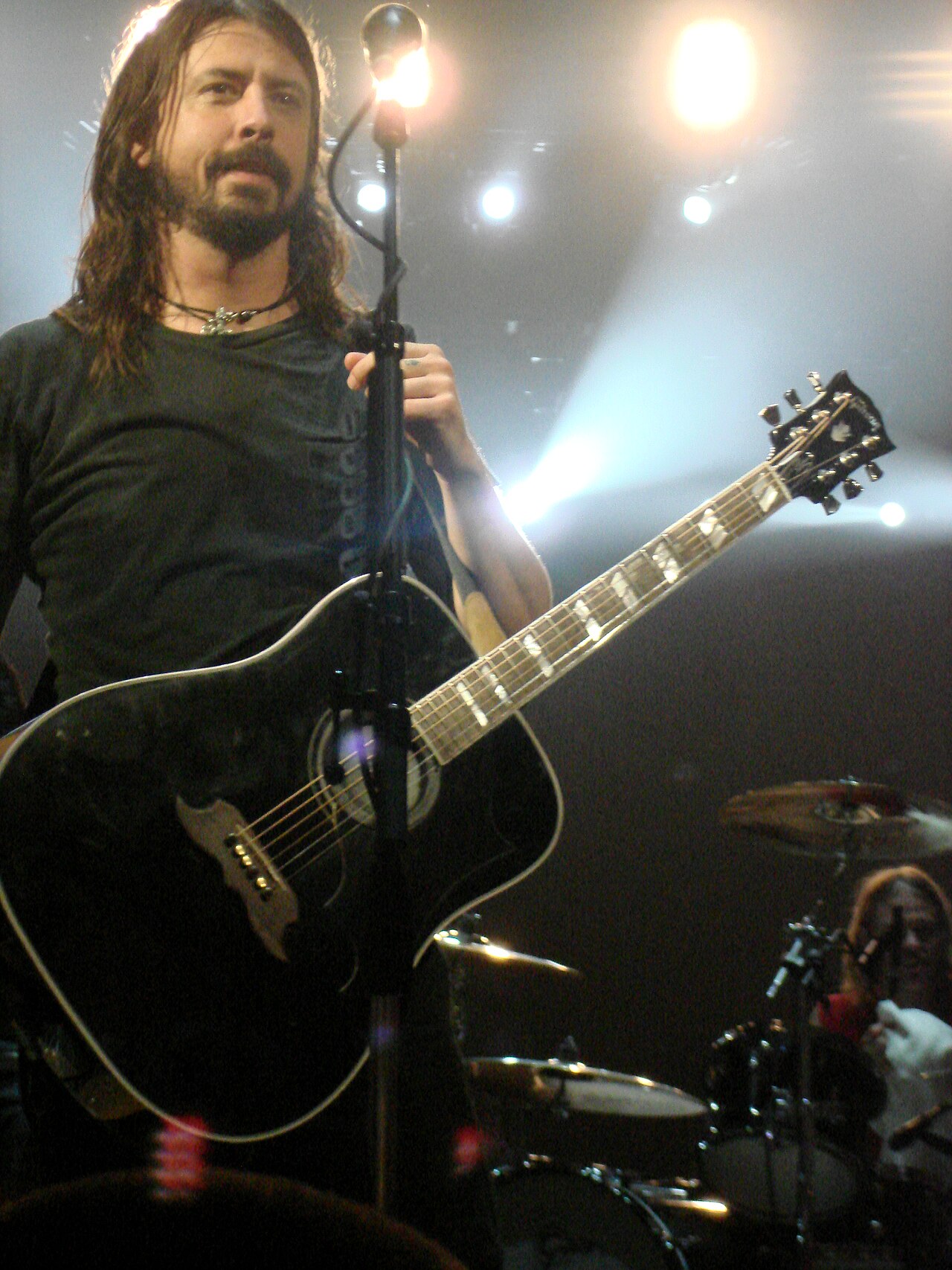
Dave Grohl is the subject of a specific and worth-correcting misattribution. The GroundGuitar documented biography of Grohl’s gear lists his Mesa/Boogie instrument specifically as a Dual Rectifier, and the Reverb News gear feature on Foo Fighters consistently describes “the Mesa/Boogie Dual Rectifier head and cab” as his heavy-sound anchor around 2000. The Dual Rectifier, not the Triple, is Grohl’s documented Mesa instrument. The confusion arises from some secondary sources using “Dual/Triple” interchangeably when describing the general Rectifier sound without specifying the model; in Grohl’s case, the primary source documentation points clearly to the Dual. The Triple Rectifier article does not legitimately include him as a verified player of this specific model.
John Petrucci is also a correction. As established in this publication’s article on the Triaxis and confirmed across his career documentation, Petrucci’s primary touring amplifier from 1992 through 2014 was the Mesa/Boogie Triaxis preamp, not the Triple Rectifier. He subsequently moved to the Mesa/Boogie JP-2C John Petrucci Signature Head, which is a re-engineered Mark IIC+ circuit voiced specifically to his specifications — still not a Rectifier-circuit amplifier. Petrucci’s documented tone comes from the Mark circuit family; attributing him to the Triple Rectifier conflates Mesa/Boogie brand loyalty with specific amp-model use.
The Revision G era produced a roster of documented users that is genuinely impressive in its reach: Korn (Brian “Head” Welch and James “Munky” Shaffer built the standard for seven-string Recto tone on Follow the Leader and Issues), Soundgarden (Kim Thayil’s stage rig in the mid-to-late 90s included Rectifiers), and Sublime (the distorted guitar textures on Robbin’ the Hood). These are genre-defining records; the Rev G Triple and Dual Rectifiers appear across all of them in configurations that the rectifierguide.com documentation has traced with serial-number precision.
The Rectifier Sound: What It Is and Why It Works
The Rectifier sound has a specific frequency signature that becomes clearer when you describe it in terms of what the amp emphasises and what it softens. The trademark is a concentrated low-end density centred around 80–150 Hz — not the flabby sub-bass of a poorly designed amp, but a structured, heavily saturated thump that translates directly through a PA system and gives downtuned riffs their physical impact. Above that is a pronounced mid-scoop: the 400–800 Hz range where most acoustic energy in a guitar’s fundamental tone sits is relatively recessed in the Rev G voicing and in the Modern mode of the three-channel version. Above the scoop, the amp recovers in the upper mids and presence frequencies, giving single-note lead lines a hard, glassy attack that cuts through a dense mix without requiring much EQ assistance.
This frequency profile is part of why the Triple Rectifier became the defining amp of nu-metal specifically rather than classic hard rock. In classic hard rock — Zeppelin, AC/DC, early Van Halen — the amp’s midrange is the hero: the midrange push is where the rawness and character live, and EQ choices consistently bring it forward. In nu-metal and the wave of post-grunge heavy music that followed it, the production aesthetic pushed toward a scooped, larger-than-life heaviness where the guitar’s role was more about texture and rhythmic impact than melodic presence. The Rectifier’s natural voice suited that production philosophy perfectly without modification.
The voicing modes offer three distinct flavours within the Rectifier circuit family. Raw is the most transparent and least saturated — closest to a Marshall-style breakup character, with more mid-range presence and a faster, more responsive feel. Vintage pushes more saturation and a more classically “Recto” saturated character, adding warmth and compression while retaining note-to-note definition for moderate-gain playing. Modern is the full-frequency-scooped, high-saturation mode that defines the nu-metal application — maximum gain, deepest mid-scoop, heaviest low-end density. Most players who have used the Triple Rectifier for heavy rhythm work have spent the majority of their time in Modern mode, but Raw and Vintage are genuinely useful voices for players who want the Triple’s power-amp authority without its most aggressive gain voicing.
Five Tone Recipes for the Triple Rectifier
1. The Nu-Metal Chug (Wes Borland / Creed-era Tremonti)
Channel 3, Modern mode, Rectifier: Bold, Wattage: 150W. Gain at 6–7 o’clock from noon (high but not maxed — maxing the gain on a Recto muddies the note separation). Treble 5, Mid 3 (the classic scooped configuration), Bass 6, Presence 5. Master at performance level. Run a tubescreamer-style pedal (TS9 or TS808, gain at minimum, level at maximum) in front to tighten the low-end further and push the front end of the preamp harder. For guitar, use humbuckers with the volume knob at 8–9 rather than 10 to preserve pick dynamics. Palm-muted playing in drop-D or C standard produces the defining riff tone of the era.
2. Vintage High-Gain Lead
Channel 2, Vintage mode, Rectifier: Spongy, Wattage: 150W. Gain at 5 (noon). Treble 5, Mid 6 (bring the mids back up — the Vintage mode has less natural scoop than Modern, and a mid push adds singing sustain on single notes). Bass 4–5, Presence 6. Use the Solo boost (+3 to 5dB above the Channel Master) for lead passages. This voice is closer to the classic late-90s lead tone: less compressed than Modern, more responsive to pick dynamics, with a warm sustain character on longer notes that benefits from a Tube Screamer in Vintage mode.
3. Rectifier Clean (Ch. 1 Pushed)
Channel 1, Pushed mode, Rectifier: Spongy, Wattage: 50W. Gain at 3 (nine o’clock). Treble 6, Mid 5, Bass 5, Presence 5. The Pushed mode on Channel 1 is a lightly overdriven clean — think early-break clean/crunch rather than full headroom crystal. At 50W in Spongy mode with the power supply introducing some compression, this can produce a warm, pushed single-coil or P-90 breakup character that recalls a vintage tweed or early Fender clean-to-crunch transition. Useful as a dynamic clean contrast to the high-gain channels in a multi-channel rig.
4. Modern Metal, 50-Watt Studio Version
Channel 3, Modern mode, Rectifier: Bold, Wattage: 50W. Same EQ as Recipe 1 but at half power. The 50W setting at full stage volume produces more power-tube saturation than 150W at the same volume level — the tubes are working harder, adding a softer, creamier texture to the attack of each note. For close-mic studio recording through a 4×12 with Celestion V30s, this can improve the harmonic complexity of the recorded signal compared to 150W, where the power tubes are running with more headroom. It is not the live-performance choice, but for tracking it is worth A/B-ing.
5. Hybrid Rectifier Rig (Two-Channel Split)
This is a signal-split approach: Channel 1 in Clean or Pushed to a stereo power amp or separate cabinet for the clean foundation; Channel 3 in Modern to the main 4×12 for the heavy signal. Use the channel-assignable wattage to run Channel 1 at 50W and Channel 3 at 150W. Blend the two signals at the board. This is essentially the two-amp approach within a single head: the clean foundation prevents the scooped Modern mode from losing the audience in the mid-frequency wash that full-stage triple-recto rigs can produce if not mixed carefully. Tremonti used variations of this approach in his multi-amp Creed setup.
How the Triple Rectifier Compares
The most important comparison is with its own sibling: the Mesa/Boogie Dual Rectifier Solo Head. The Dual is 100W with two rectifier tubes; the Triple is 150W with three. Circuit-wise, the two share the same gain architecture in the 3-channel versions, which means the fundamental voice is identical. The practical differences are headroom, weight, and cost. The Triple’s extra 50W of headroom means it reaches its power-tube saturation point less quickly at high volume — at a 1,500-capacity club or arena level, the Triple has more clean headroom in its power amp before the tube saturation starts softening the attack. At bedroom or studio volumes, the two amplifiers are sonically interchangeable. Used Triple Rectifiers command roughly 10–20% more than comparable Dual Rectifier units because of the larger transformer spec, and they weigh significantly more. For most players at most venues, the Dual Rectifier is the more practical choice; the Triple’s extra wattage only reveals itself at sustained high volume.
Against the Triaxis programmable preamp — the rack alternative that Hetfield and Petrucci used as their primary rigs — the Triple Rectifier is less versatile but more immediate. The Triaxis offers eight distinct circuit modes, 90 user presets, and MIDI programmability; the Triple Rectifier offers three channels and eight modes with no MIDI, no presets, and manual switching only. For a touring player who uses the same three sounds every night and wants to grab them without a MIDI controller, the Triple Rectifier’s front-panel simplicity is a functional advantage. For a player who switches frequently between contrasting sounds within a set, the Triaxis is the more practical instrument.
The EVH 5150 III is the comparison players reach for most often when debating high-gain amplifiers in this wattage class. Eddie Van Halen’s original 5150 used a similar gain philosophy but with a mid-heavy, British-influenced character that contrasts with the Rectifier’s default mid-scoop. The 5150 III is a tighter, slightly more compressed amplifier at high gain — less of the loose, elastic low-end bloom that characterises the Recto in Spongy mode. Wes Borland moved toward the EVH 5150 III in later Limp Bizkit configurations, and the two amplifiers represent genuinely different high-gain philosophies: the Triple Rectifier is broader and more open in its low end; the 5150 III is more focused and percussive.
The Peavey 6505+ (formerly known as the 5150) operates in the same general tonal space as the Triple Rectifier but at a significantly lower price point, both new and used. The 6505+ lacks the Recto’s voicing flexibility and the Multi-Watt power options, and it is not hand-wired. For players who want the general aesthetic of the Triple Rectifier’s high-gain character at roughly one-third to one-half the price, the 6505+ is the standard alternative; players who have used both consistently describe the Triple Rectifier as having greater note definition at extreme gain settings and better dynamic responsiveness from the guitar’s volume control.
The Bogner Uberschall occupies a premium niche adjacent to the Triple Rectifier — higher price, higher gain in its lead channel, more pronounced low-end density even than the Triple. The Uberschall’s design ethos is maximum saturation and minimum complexity; it does one thing (extremely high gain) with fewer voicing options but arguably more extreme low-end weight. Tremonti has used a Bogner alongside his Mesa rig, treating the two amplifiers as complementary voices rather than competing alternatives.
Buying Guide: 2-Channel vs 3-Channel, Rev G vs Multi-Watt
The Triple Rectifier has three broadly distinct used-market generations, and each suits a different buyer.
The 2-channel Revision G (1994–2000, identifiable by the two-channel layout with Orange and Red channel designations on the front panel) is the amp that recorded most of the defining late-90s heavy records and the one that commands significant collector interest. A fully functional Rev G Triple in clean cosmetic condition trades on Reverb in the $1,400–$2,000 range depending on the specific serial range and condition. The Rev G’s transformers (the 562105 output and 561140 power transformers introduced mid-Rev F) are still available from Mesa/Boogie service, and the circuits are well-documented on the Boogie Forum. Buy this version if you want the historical tone on the recording in question and are prepared to service a vintage amp.
The 3-channel version (2000–2009) added the independent clean channel and the per-channel mode and rectifier switching that the 2-channel lacks. This is the version that most working players who reference the Triple Rectifier describe — three channels, no global settings that link channel tone together, maximum independent control. Used 3-channel Triples from this era typically trade at $1,200–$1,800. This is the version most commonly available on the used market.
The Multi-Watt version (current production, identifiable by the three 50/150W switches on the front panel, one per channel) adds the channel-assignable wattage to the 3-channel architecture. New examples are $2,999; used examples typically trade at $1,800–$2,500 depending on condition and age. This is the most flexible of the three versions and the choice for a player who wants the full current specification.
When buying used, inspect the rectifier tubes first — 5U4s are not exotic, but worn tubes in a Triple Rectifier introduce hum, inconsistent power-supply behaviour, and altered compression character. Bias the power amp tubes at purchase if you cannot confirm when it was last done; Mesa’s fixed-bias architecture is maintenance-free in normal operation but benefits from professional verification if the amp has had no service history. The chassis should show no signs of leaking capacitors or burned resistors around the power supply board. Play through all three channels and all mode switches — channel switching is mechanical on earlier versions and relay-based on later ones; dirty contacts in a mechanical switch can cause crackling or channel bleed that is easily fixed but worth knowing before purchase.
Ownership Notes: Living with 150 Watts
The Triple Rectifier’s 48-pound weight is a real consideration for regular transport. It is heavier than the Dual Rectifier (which runs closer to 40 pounds) and heavier than most British-style heads of similar wattage, partly because of the larger transformer spec and partly because of the marine-grade Baltic birch cabinet construction. If you are loading and unloading the amp yourself at every show, a proper wheeled amp dolly or a dedicated roadcase with casters is not optional equipment — it is the difference between managing the amp comfortably and injuring your back twice a year.
The fan cooling system is audible at low volumes. Mesa/Boogie’s fan is quieter than many competitors’, but in a studio environment where the amp is miked in the same room as the recording desk and performer, you will hear it on a sensitive condenser microphone. The standard approach is to close-mike the cabinet with a dynamic microphone (SM57 or equivalent) placed directly at the speaker cone, which captures the cabinet output with minimal room and fan noise contamination. Direct recording from the speaker outputs through a loadbox and IR loader is increasingly common with this amp, as it produces a convincingly heavy DI tone while eliminating the fan issue entirely.
The FX loop send level control deserves specific mention. Mesa’s fully buffered series loop has a level control that significantly affects how effects processors interact with the amp. Set too low, effects units see an insufficient signal and their noise floor becomes audible. Set appropriately, the loop is exceptionally clean and quiet for an amp in this gain class. The true-bypass option (which removes the loop, output level, and solo controls entirely from the signal path) is useful for direct A/B comparison between loop-in and loop-out signals; players who are not actively using an effects loop should engage this setting.
The EL-34 option, via the bias select switch on the rear panel, is the most underused capability of the Triple Rectifier. The standard 6L6 configuration provides the American-voiced, dense-bottomed character of the canonical Recto sound. Switching to EL-34 power tubes — after confirming the bias select switch is moved to the EL-34 position — shifts the character toward a more midrange-present, British-influenced voice that is brighter, slightly more compressed, and better suited to players coming from a Marshall background who want the Triple’s wattage and features without the 6L6’s specific tonal signature. EL-34s in a Rectifier are not well-publicised but they are factory-supported, and they represent a genuinely different amplifier.
FAQ: Mesa/Boogie Triple Rectifier Solo Head
Q: Why is it called the Triple Rectifier if the 2-channel version has only two channels?
A: The “Triple” refers to the three 5U4 rectifier tubes in the power supply, which handle the demands of the 150-watt output stage. The Dual Rectifier uses two rectifier tubes and produces 100 watts. Channel count and rectifier tube count are unrelated in the naming convention. The 3-channel Triple Rectifier has three channels and three rectifier tubes; the 2-channel version has two channels and three rectifier tubes.
Q: Does the current Triple Rectifier have reverb?
A: No. Neither the current Multi-Watt version nor any previous production Triple Rectifier includes onboard reverb. If you want reverb, you will need an outboard unit in the effects loop. The Solo boost, output level control, and buffered FX loop are the amp’s built-in signal management tools; reverb is not among them.
Q: What is the difference between Bold and Spongy modes?
A: Bold mode routes the power supply through silicon diodes, producing a fast, stiff response with tight low end and immediate pick attack — the modern, percussive character most associated with the contemporary Triple Rectifier sound. Spongy mode routes through the tube rectifiers, introducing power-supply compression and voltage sag: the attack is slightly softened, sustain becomes warmer and more bloom-heavy, and the amp compresses dynamically as you play harder. Both modes are channel-assignable on the current version.
Q: Can you run this amp at 50 watts on every channel?
A: Yes. The Multi-Watt system is fully channel-assignable, so you can run all three channels at 50W, or mix — for instance, Channel 1 at 50W and Channels 2 and 3 at 150W. The Recto Tracking system automatically adjusts the rectifier configuration to match the power tube count in use on each channel, preserving the feel characteristics regardless of watt setting.
Q: Is the Triple Rectifier difficult to dial in?
A: It has a reputation for being unforgiving, and that reputation is partly earned. The mid control in particular is sensitive — small movements produce large tonal changes, especially in Modern mode where the mid is already scooped. The standard advice, confirmed across years of Boogie Forum discussion, is to set mid lower than you think you need (around 3–4 on the dial) and let the bass (5–6) and treble (5–6) frame it rather than trying to boost mids into a high-gain Modern voice. The Presence control shapes the high-frequency sparkle above what Treble covers; pushing Presence past 6–7 in Modern mode can introduce harsh fizz.
Q: What cabinets did most famous players pair with the Triple Rectifier?
A: The standard pairing in the nu-metal era was the Mesa/Boogie Traditional 4×12 cabinet loaded with Celestion Vintage 30 speakers, run in two-cabinet configurations (straight and slant stacked vertically). Tremonti ran four Mesa 4×12 cabinets in an upside-down “T” arrangement. The Vintage 30’s upper-mid presence peak (around 3–5 kHz) specifically complements the Triple Rectifier’s mid-scoop by reintroducing some upper-mid clarity at the speaker level, which is part of why the pairing became standard — they tonally complement each other in a way that the same amp through a flat-response speaker does not reproduce.
Q: How does the Triple Rectifier hold up against modern high-gain modellers?
A: Modern modellers — the Fractal Axe-FX, Neural DSP Quad Cortex, Kemper with Triple Rectifier profiles — capture the Triple Rectifier’s frequency response and dynamic character convincingly enough that experienced players use profile-based systems live without audience complaint. The argument for the actual amplifier centres on two things: the way a real 150-watt power amp interacts physically with the speakers in the cabinet (the air movement, the room response, and the physical feedback between the player and the instrument), and the fact that the amp’s dynamic response to playing nuance is still, in the opinion of many working guitarists, slightly more organic than even the best digital capture. The practical advantage of modellers — weight, consistency, headphone output — is real. Whether it outweighs the physical experience of a real Triple Rectifier stack depends entirely on what you are using the amplifier for.
Q: When is the 2-channel Rev G worth more than the current 3-channel?
A: When the specific recording you are trying to reproduce was made with a Rev G. The three-channel architecture is more flexible for live use — the independent clean channel is genuinely useful. But the 2-channel Rev G’s mid-gain-channel character is subtly different from the three-channel version’s equivalent modes, and players who have compared them describe the Rev G as having a slightly more cohesive, less complex character at high gain — which is occasionally exactly what a specific session requires. The Rev G also represents a direct connection to the records where this tone was established. The premium for a clean, serviced Rev G Triple Rectifier reflects both the scarcity of well-maintained examples and the historical significance of the circuit.
Image credits
- Dave Grohl: flimsical (Lindsay), Wikimedia Commons, CC BY 2.0.
- Wes Borland: Antje Naumann, Wikimedia Commons, CC BY-SA 3.0.
- Top image: Roadside Guitars, Wikimedia Commons, CC BY-SA 2.0.
- Mesa/Boogie Triple Rectifier Solo Head: photo by Roadside Guitars, via Wikimedia Commons, CC BY-SA 2.0.
- Mesa/Boogie Triple Rectifier Solo Head: GuitarGangsters AI-generated reference illustration, not a photograph.
Latest News
Related
On This Day
Monday 9 November
From this week: