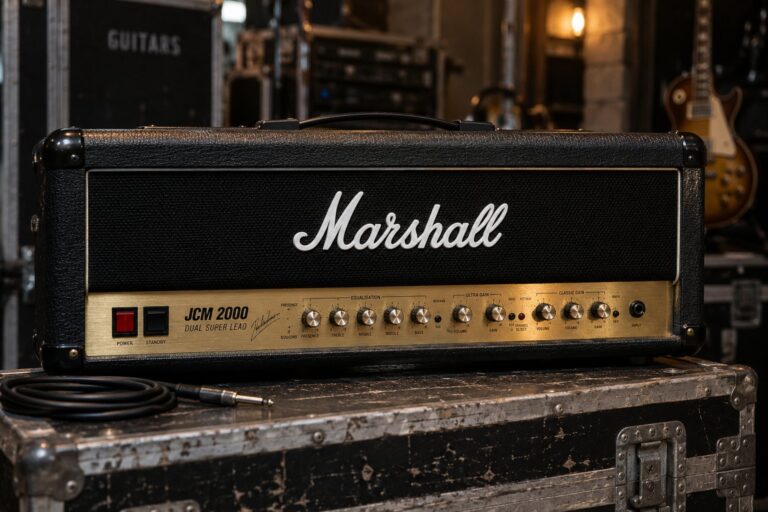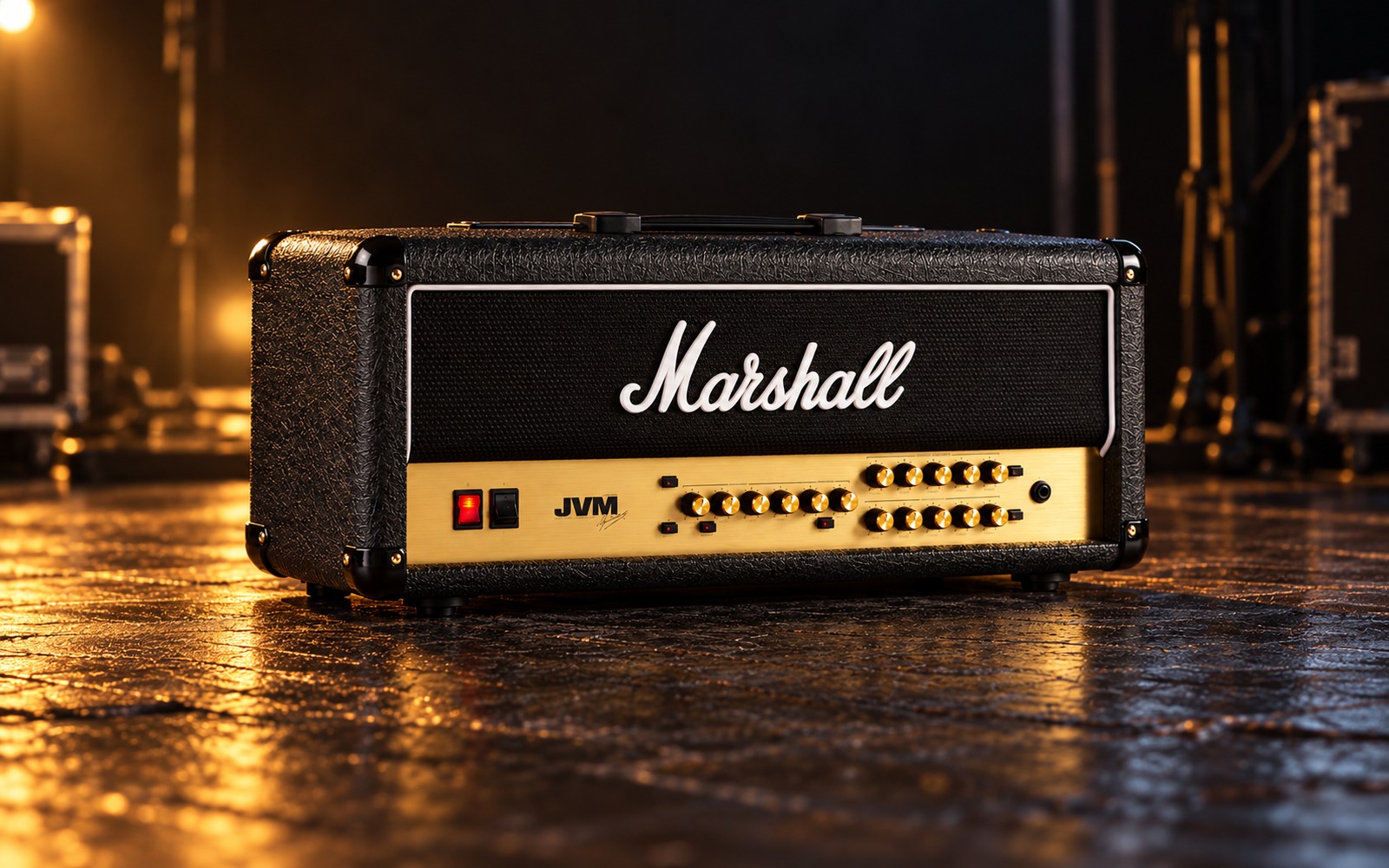
Six Voices in One Head: The Marshall JVM205H Is Everything You Need and Nothing You Don’t
Marshall JVM205H: six all-tube voices in a 50-watt head—clean to full-tilt lead—with dual FX loops, MIDI, reverb, and a 4-button footswitch for stage control.
There’s a specific kind of frustration that comes with owning a single-channel amp. You dial in the perfect crunch for the verse, and then the chorus needs something bigger, something that breathes and sings at the top of the fretboard, and you’re stuck stomping a boost pedal and hoping the front-of-house engineer doesn’t notice you’ve just doubled your treble. The Marshall JVM205H was built to end that negotiation. Fifty watts of all-EL34 British power, two fully independent channels, and three footswitchable modes per channel — six distinct voices before a single pedal hits the chain. It’s the JVM4’s younger sibling, stripped of two channels and half the power tubes, and priced to fit the serious working guitarist who doesn’t need twelve presets but absolutely needs more than two.
The JVM205H arrived in 2008 as the 50-watt, 2-channel member of Marshall’s JVM2 family, designed to slot neatly between the four-channel, MIDI-controlled JVM410H flagship and the elegantly minimal, old-school Vintage Modern series. It hit a gap in the market that Marshall had arguably left open for too long: a modern all-valve head with enough flexibility for the road and the studio, a genuine DI output for silent recording, and programmable MIDI switching, all wrapped in the kind of build quality that suggests the chassis is one of the more durable objects in any given tour bus. The JVM205H has been quietly earning its keep on backlines and in studios ever since — verified by the guitar tech of Avenged Sevenfold’s Synyster Gates among others — while the better-publicised JVM410H got most of the press.

This is the 50-watt version. It doesn’t do everything the 410H does. It doesn’t need to. Here’s what it actually is, what it actually sounds like, and whether it’s the right Marshall for you.
The JVM2 Arrives: Marshall’s Pivot from One-Trick to All-Rounder
To understand the JVM205H, you need to understand what Marshall was trying to solve in the mid-2000s. The JCM800 had been the definitive Marshall for two decades, and it was unimpeachable on its own terms — a single-channel, fixed-bias, EL34-powered statement of intent. But the gigging reality of the era had shifted. Players wanted reverb built in. They wanted clean sounds. They wanted to switch between a crunch rhythm and a searing lead without kicking a pedal. The JCM2000 DSL and TSL series had tried to address this, introducing two and three channels respectively, but critics found the preamp gain stages less organic than the classic circuits, and the TSL in particular was widely considered a compromise too far.
The JVM series — Jim and Victoria Marshall, the founder’s family — was announced as the answer: a ground-up redesign that committed fully to multiple channels without sacrificing the all-valve signal path that defined Marshall’s reputation. The JVM410H launched in February 2007, drawing immediate attention with its four-channel, twelve-mode architecture and full MIDI control. The JVM205H followed in 2008 as a deliberately more compact proposition: two channels instead of four, two EL34 power tubes instead of four, 50 watts instead of 100. The difference isn’t just cost. The 50-watt EL34 configuration runs the output section at a higher percentage of its capability at manageable stage volumes, which is why many players — particularly those who’ve had the 410H on a stage and kept the master volume below 3 — find the 205H delivers more power-amp saturation in a real-world context.
The JVM2 range also includes the JVM210H, a 100-watt, 2-channel variant that uses four EL34s for those who want the 2-channel layout with full 100W headroom. The JVM205H is the 50-watt option, the one that gets genuinely loud in a small-to-medium room without requiring an attenuation solution just to find the sweet spot. Marshall builds it in Bletchley, UK, on the same production line as the rest of the JVM range.
Six Voices, One Head: How the JVM205H Actually Works
The concept is simple and the execution is clean. Two channels — conventionally called Channel 1 (Clean/Crunch) and Channel 2 (OD/Lead) — each with three switchable modes accessed from front-panel push buttons or the included footswitch. Each mode is colour-coded: Green, Orange, and Red, moving from the cleanest setting to the most gained in each channel. The result is six distinct voices mapped to two physical channels, and because every switch position remembers its last settings for gain, EQ, volume, and reverb independently, a working guitarist can store six completely different sounds and recall any of them with a single footswitch tap.
Channel 1, Green: this is the JVM’s clean voice. Genuinely clean at moderate gain settings — the kind of clean you’d run a transparent boost into for a slightly pushed Strat sound. At unity gain levels it sits in the vintage-American territory: glassy top end, articulate picking response, minimal compression. Not a Fender-clean — there’s always a subtle British midrange warmth in the low-mids — but clean enough for jazz comping, funk, and country if you’re running a clean-output single-coil.
Channel 1, Orange: the mode where Channel 1 starts to breathe. This is the crunch territory — JCM45-era chime transitioning into classic JCM800-era grind. For most classic-rock rhythm work this is the home base: AC/DC crunch, Zeppelin-era grunt, Stonesy strut. The amp responds dynamically to your pick attack here in a way that the high-gain modes don’t, softening slightly when you play lightly and opening up when you dig in. A boost pedal in front of this mode is the path to classic British lead tone.
Channel 1, Red: crunch pushed to the edge of what this channel was designed to do. It tips into lead territory but retains the harmonic character of Channel 1’s voicing. Some players use this as their default rhythm in a metal context and leave Channel 2 exclusively for solos.
Channel 2, Green: where the overdrive channel begins, and in this mode it’s arguably the finest single sound in the whole amp. MusicRadar, reviewing the JVM205C combo version in July 2008 (same circuit, same preamp as the head), noted that “you could easily cut an entire album with the lead channel’s green mode alone — it’s that good.” That’s not hyperbole. This mode is a perfectly calibrated high-gain lead voice with enough compression to sustain indefinitely and enough clarity in the upper midrange to cut through a band mix. Blues-rock to classic metal in one knob-turn.
Channel 2, Orange: the gain is serious now. Modern rock, arena metal, anything that needs a wall of saturated midrange at stage volume. Still coherent on fast runs; the note definition holds together better than you’d expect at this saturation level, largely because Marshall’s EQ circuit on this channel is voiced to cut some of the muddiness that kills definition in high-gain preamps.
Channel 2, Red: full-tilt. This is where the JVM205H reaches the limit of what its preamp stages can do cleanly, and MusicRadar was honest about it: “high gain on the lead channel’s red mode tends to turn mushy and lose dynamic response, but this applies to practically all high-gain amplifiers.” The caveat is real. If you’re chasing the ultra-compressed, massively saturated extreme-metal sound — the sound of a fully cranked amp into a Tube Screamer-style boost — the Red mode benefits from the JVM’s built-in noise gate (yes, the JVM205H has an onboard noise gate, a detail buried in most reviews) to control the noise floor. But for 95% of rock and metal applications, Red is genuinely usable.
What’s Under the Hood: Full Specifications
A note on the MIDI implementation: the JVM205H’s MIDI control is limited to front-panel switch states — channel selection, mode selection, reverb on/off, effects loop switching, and master volume A/B selection. It does not recall pot positions (gain, EQ, volume) via MIDI, and Marshall has always been upfront about this by design. The reasoning, as MusicRadar put it in 2008, is valid: “full MIDI control is often a pain to set up and self-defeating in use — you end up playing with presets, not music.” The six switch-based presets are stored in the amp’s memory and recalled instantly via the footswitch or a MIDI program change; the EQ and gain remain where you physically left them. This is a feature, not a bug, for most gigging players who set their tones once and play them.
The two effects loops deserve separate attention. The series loop interrupts the signal path completely — everything you put in it sits between the preamp and the power amp, and it can be assigned to Channel 1 only, Channel 2 only, or both via the front panel. The parallel loop mixes your effects with the dry amp signal at an adjustable blend level and is always active. Running time-based effects (delay, reverb, chorus) in the series loop while keeping a dirt pedal or EQ in the parallel loop is a common professional configuration that this amp handles natively, without a complicated re-patch.
Famous Players and Honest Verification: Who Actually Uses a JVM205H
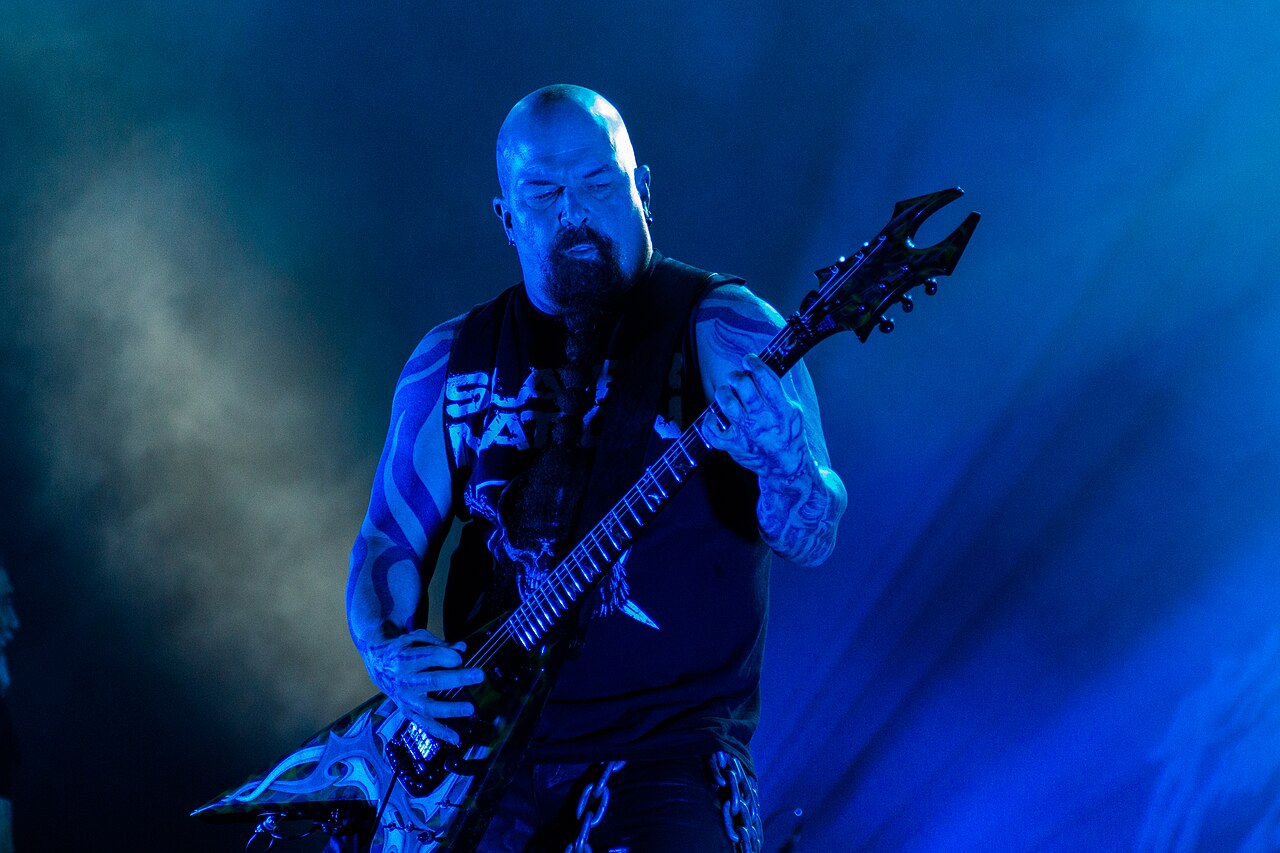
The list of Slash, Zakk Wylde, Kerry King, Gary Moore, and Tom Morello has not improved with age. These are Marshall brand ambassadors whose real rigs are well-documented: Slash plays the 1959SLP Silver Jubilee and the AFD100; Zakk Wylde‘s live amp is the JCM800 2203; Kerry King has used the JCM800 2203 and more recently the KK’s Marshall signature; Gary Moore — who died in February 2011 and therefore post-dates the JVM2’s 2008 launch by only three years — has no documented JVM205H connection in any interview or rig rundown from that window; and Tom Morello‘s live amp has been the JCM800 2205, not the JVM series. None of these attributions holds up to per-SKU verification. They’re brand associations, not SKU confirmations.

The Equipboard page for the JVM205H lists 12 verified professional users, with three names prominent:
Synyster Gates of Avenged Sevenfold is the cleanest verification on this instrument. Gates’s guitar tech, Za, stated on camera in a DunlopTV video: “Gates plays through a 50W Marshall JVM205H. I like it — it’s pretty versatile. You can crank them and you can get a lot of gain out of them. Because they are using in-ears, they don’t have to be super loud on stage.” A guitar tech confirming the specific model number in their own words, explaining the setup rationale, is as close to primary verification as you get without a manufacturer press release. The 50-watt rating aligns with the JVM205H’s spec, not the 410H. This is confirmed.

Gary Holt of Exodus appears on the JVM205H’s Equipboard page with less granular documentation. Holt’s primary touring amps across his documented rig rundowns have been the JCM800 (the foundational Exodus/thrash-metal tone source), and more recently the Marshall 2555X Silver Jubilee. The JVM205H has been described in secondary sources as a backup option that Holt had on hand during his Kemper-transition period — one source specifically identifies it as a high-gain backup for cases where a more flexible tube amp was needed. There is no Premier Guitar Rig Rundown frame that clearly shows a JVM205H as his primary head; the Silver Jubilee is his documented live rig. Gary Holt in front of a JVM205H is plausible and has a credible Equipboard backing — but the level of verification is one tier below the Gates/Za video. The article names him as an Equipboard-documented user while being specific about what that means.
Björn Gelotte of In Flames is the third name on the Equipboard page. A 2014 Metal Assault interview captures him saying: “All I really want to have is a Gibson, a wah and a Marshall. I’ve played the Gibson Les Paul Customs for many years now and I play them through a Marshall amp, which I think is the most classic and the best-sounding combination you can get.” That’s a brand association, not a model-specific confirmation. “A Marshall amp” in 2014 could mean any number of things. The honest framing is: documented Marshall user since the In Flames heyday, plausible JVM205H connection via Equipboard, not independently verified on this specific SKU.
The JVM205H’s practical niche goes a long way to explaining its player base. At 50 watts through two EL34s, it runs hotter relative to its power ceiling than the 100-watt JVM410H at typical stage master-volume settings. For in-ear monitor users — which Gates’s tech explicitly cited as the reason for the 50-watt rating — this means you can run the power section at a higher percentage of saturation without stage-volume bleed. The JVM205H is therefore disproportionately popular among touring professionals using IEMs, where the 410H’s extra headroom is counterproductive. You’ll find more JVM205H heads in touring racks than its sales figures alone would suggest.
Six Modes, Six Tone Recipes: Getting the Most Out of Every Voice
Tone Recipe 1: The Blue-Chip Clean (Channel 1, Green Mode)
Set Channel 1 Gain to 3, Volume to match unity, Bass 6, Middle 5, Treble 5, Presence 6, Resonance 4, reverb to taste. Run a high-output Stratocaster or a P-90-equipped semi-hollow. This setting delivers the JVM’s cleanest voice with the natural warmth of the British voicing sitting in the low-mids at around 400Hz. If you want the Hendrix/Clapton-adjacent clean — not Fender, but the Marshall-clean that defined British studio recordings of the late 1960s — this is where you start. Boost with a Boss SD-1 or Ibanez TS9 for the transition into classic-rock lead territory without switching channels.
Tone Recipe 2: Classic British Crunch (Channel 1, Orange Mode)
Gain 5–6, Volume matched, Bass 5, Middle 6, Treble 6, Presence 7, Resonance 5, no reverb. This is the 1969-to-1975 British rock tone in its most direct form — the same voicing that drove the recording chain on Black Sabbath’s first two albums, on Zeppelin’s “Whole Lotta Love,” on Free’s “All Right Now.” At these settings the amp responds to dynamics: pick lightly and it cleans up noticeably; dig in hard and it growls. A Les Paul Standard with PAF humbuckers is the reference pairing. Switch to Red if you need the rhythm crunch to sit deeper in the band mix without changing the EQ balance.
Tone Recipe 3: The Sweet Spot (Channel 2, Green Mode)
Gain 5, Volume to match your Channel 1 level, Bass 5, Middle 7, Treble 6, Presence 6, Resonance 5, reverb light. As noted above, MusicRadar called this mode alone worth the purchase — and the reason is that the gain staging in Channel 2 Green sits at the intersection of compression and clarity. There’s enough sustain to hold a note on the high E string for four bars without fading; there’s enough top-end definition to stay articulate on a triplet-picked run at 180bpm. This is the JVM205H’s signature voice. Most players who own one will have this as their default lead tone. For most rock contexts, no boost pedal is needed. For extra harmonic complexity, engage the series FX loop and stack a mild overdrive at low gain after the preamp.
Tone Recipe 4: Modern Metal Rhythm (Channel 2, Orange Mode)
Gain 6–7, Volume at performance level, Bass 7, Middle 4, Treble 6, Presence 7, Resonance 6, noise gate engaged. Drop-tuned 7-string or heavy-gauge six-string (0.011–0.052 or heavier). This is where the JVM205H earns its place on metal stages — the Orange mode’s voicing prioritises fundamental string definition and controlled low-mid saturation over the compressed smoothness of the Red mode, which actually makes it more practical for tight, palm-muted downstroke playing in a live band context. A Pro Co RAT 2 in the parallel loop at low distortion and low volume adds harmonic density without muddying the pick attack.
Tone Recipe 5: Stadium Lead (Channel 2, Red Mode + Boost)
Gain 5 (not cranked — this mode compresses quickly), Volume at lead level (+3 to +6dB above rhythm), Bass 4, Middle 6, Treble 7, Presence 7, Master Volume B at +3dB relative to Master Volume A. Stack a TS9 at Gain 0, Level 6 o’clock forward, Tone 11 o’clock into the front of the amp. This is the contemporary-metal lead setup: the Tube Screamer’s midrange push combines with the Red mode’s preamp saturation to produce the focused, singing, infinite-sustain lead tone heard on modern-era metal and hard rock records. The mid-scooped EQ on the amp itself (Bass 4, Treble 7) keeps the tone cutting through a dense mix without sounding ice-pick. This is also the configuration where the onboard noise gate becomes essential — engage it and set the threshold conservatively (too aggressive and it clamps the trailing end of sustained notes).
The JVM205H rewards deliberate setup across all six modes rather than defaulting to a single channel and treating the others as emergency backups. Here are five approaches that cover the range of what this amp can do.
How the JVM205H Compares to Its Nearest Competitors
The JVM205H occupies a specific position in the Marshall catalogue and in the broader tube-amp market. Understanding where it sits relative to its siblings and its competitors helps clarify whether it’s the right tool.
Marshall JVM410H is the direct sibling above. Four channels, twelve voices, 100 watts, 4×EL34, 6-button footswitch, ~$1,385 Thomann (currently listed lower than the 205H on some platforms due to stock pricing dynamics). The 410H’s two extra channels (a second crunch channel and a second OD channel) give you genuine tonal separation that the 205H approximates through its two channels’ three modes. The 100W power section has more clean headroom but requires higher master-volume settings to find power-amp character. If you need all twelve voices independently stored and recalled via MIDI in a large-venue context, the 410H is the correct tool. If you need six voices and want the power amp to saturate a little more readily at sane stage volumes, the 205H delivers more of that quality per dollar.
Marshall JCM2000 DSL100 — the predecessor of the modern Marshall two-channel concept. The DSL100 is 100 watts with two channels (Ultra Gain and Classic Gain), two modes per channel, no MIDI in the original version, and a simpler feature set. The DSL100’s preamp has a rawer character that some players prefer to the JVM’s more refined gain staging — there’s more “hair” on the DSL100’s overdrive tones, more of the old-school feel. The JVM205H is cleaner, more controlled, more versatile on paper, and more DI-recording-capable. The DSL100 is cheaper used and sounds more immediately like a classic Marshall.
Marshall DSL100HR — the current-production evolution of the DSL concept. Modern PCB design, resonance and presence controls, USB for firmware updates, four speaker outputs. At ~$1,000 new, it undercuts the JVM205H significantly. The JVM205H’s advantage: two proper separate effects loops, full MIDI control, six modes vs four, and the heritage of being built on the same platform as the flagship JVM410H. The DSL100HR is the choice if budget is the primary driver. The JVM205H is the choice if features and flexibility take priority.
Marshall Studio Classic SC20H — the 20-watt JCM800-circuit reissue, the head that does exactly one thing extraordinarily well: the classic JCM800 sound at attenable volumes. If you’ve decided that the 1984 JCM800 tone is the sum total of what you need from an amp, the SC20H outperforms the JVM205H on that single dimension. The JVM205H’s advantage is everything else: clean sounds, multiple gain stages, reverb, loops, MIDI, DI. These are fundamentally different tools for fundamentally different briefs.
Bogner Ecstasy 20th Anniversary / Friedman BE-100 — the boutique equivalents. Both offer multi-channel architecture in the JVM205H’s price range (or above it). The Friedman BE-100 in particular is the amplifier that most-cited JVM205H users eventually consider as a step up. It trades the JVM’s six-mode programmable flexibility for a more focused but more organic gain structure; many guitarists who’ve played both describe the Friedman as sounding more “alive” at extreme gain but less versatile at lower gain levels. The JVM205H’s MIDI recall is a practical advantage in a professional live context that boutique amps often can’t match at any price.

Buying Guide: New, Used, and What to Watch For
The JVM205H is a current-production Marshall made at the Bletchley UK factory, so new stock is available. Sweetwater lists it at $1,799.99; Equipboard’s lowest current price is $1,362 from various authorized dealers; the used market starts around $650–$700 for player-condition examples and climbs to $850–$1,100 for excellent-condition heads with original footswitch and documentation.
When buying used, check these specifically:
The power tubes. EL34s have a finite lifespan measured in playing hours. Ask when they were last replaced. A used JVM205H with original tubes from 2010 is a re-tube job factored into the price; expect $80–$120 for a matched pair of EL34s plus $40–$80 for a tech’s biasing service. Fixed-bias designs like the JVM205H require professional biasing after tube replacement — unlike cathode-biased amps, you cannot drop in new power tubes and plug in. Budget for this if the tubes are more than four years old.
The preamp tubes. Five ECC83s sit in the preamp section. These last longer than power tubes but the first position (V1, closest to the input) is the most microphonic position and the first to show noise or microphonics under vibration. A single JJ ECC83 or Mullard reissue at V1 costs ~$15 and fixes 80% of tube-related noise problems in used JVMs.
The footswitch. The JVM205H ships with a 4-button proprietary programmable footswitch. Replacements are available from Marshall but cost more than you’d expect. A used JVM205H without the original footswitch is manageable — the amp’s front-panel buttons still work — but you lose the onstage switching that makes this amp practical. Verify the footswitch is included and working.
The effects loop jacks. The series loop uses three rear-panel jacks (Send, Return, and a Bypass/switch jack). On heavily used touring heads, these jacks can develop intermittent contact issues from repeated connection and disconnection. Plug a cable into Send and Return with the loop engaged and wiggle gently — any crackling suggests the jacks need cleaning or replacement.
PCB condition. The JVM205H uses PCB-mounted valve bases, which means the boards are under some mechanical stress from the weight of the tubes. On amps that have seen heavy road use, check for cracked solder joints around the valve bases. This is a known failure mode on the JVM range in general and is repairable — factor in a full solder-joint inspection if you’re buying a clearly well-travelled head.
Channel switching delay. The JVM205H has a brief relay-based channel switching delay (typically 30–50ms) to prevent pops and clicks during live switching. This is by design and not a fault. If you’ve played amps with instantaneous mechanical switching, the JVM’s delay is initially noticeable. Most players adapt to anticipating it within a few rehearsals, but it’s worth knowing before you commit.
Living With the JVM205H: Ownership Notes
The JVM205H is one of the more fully-featured amps in its class, and that feature density comes with a short learning curve that catches some buyers by surprise. The programmable footswitch in particular works differently from any standard A/B/C switching pedal. Each button can be configured to recall a complete amp state (channel + mode + loop + master volume selection + reverb) stored in the amp’s memory, or it can be used in real-time switching mode to toggle individual functions. The owner’s manual is not optional reading; the amp’s feature set rewards the 90 minutes it takes to understand the MIDI and footswitch programming properly.
The built-in noise gate is a frequently overlooked asset. On high-gain Red mode, which produces the most preamp noise, the gate’s threshold control allows you to set a clean floor without artefacts on sustained notes. The key is setting the threshold conservatively — just above the amplified room noise floor — rather than aggressively, which cuts sustain. A small amount of headphone or IEM monitoring while adjusting the threshold level in the rehearsal room is the fastest calibration method.
The speaker-emulated XLR DI output has become more relevant as home and studio recording workflows have evolved. The JVM205H produces a cabinet-simulated signal at line level on the XLR output regardless of what’s connected to the speaker outputs — including with the amp in silent mode via the speaker standby. This means you can record at 2am into your DAW without a microphone, a speaker cabinet, or a separate load box, and the resulting signal has Marshall’s own voicing baked in. It is not the final word in DI amp tone, and many players use a third-party IR loader (Two Notes Torpedo, OX, UAFX series) after the preamp output jack for more speaker-simulation control. But as a zero-latency direct recording solution that requires no extra gear, the built-in XLR output is more capable than it’s usually given credit for.
Impedance matching matters on the JVM205H as on any tube amp with a transformer-coupled output stage. The five speaker output jacks are labelled by impedance (4, 8, 8, 16, 16 Ω — three are shared positions). Running the amp with no speaker load connected and the standby in play position will damage the output transformer. The silent-recording DI mode requires the amp to be in standby before disconnecting the speaker cabinet. If you’re using the XLR output for recording while keeping the speaker disconnected, read the output routing section of the manual to ensure the amp’s protection circuit is correctly engaged.
FAQ: Marshall JVM205H
What is the difference between the JVM205H and the JVM410H?
Power rating and channel count. The JVM205H is 50 watts with 2 channels (6 modes total) and 2 EL34 power tubes. The JVM410H is 100 watts with 4 channels (12 modes total), 4 EL34 power tubes, and a 6-button footswitch. Both share the same circuit architecture and are built in the same UK factory. The 205H runs the power amp at a higher percentage of its capacity at moderate volumes, which many players find produces more power-amp character in a live context. The 410H offers independent tonal voicing across four channels rather than three modes per two channels, giving greater separation between the clean and rhythm sounds.
Is the JVM205H loud enough for live use without a PA?
Fifty watts through EL34s is substantially louder than 50 watts through EL84s or 6V6s due to the output transformer design and valve characteristics. In a band context with a drummer and a bass player, the JVM205H at moderate master volume settings is loud enough for small-to-medium venues without PA reinforcement. For large venues, the DI output into the FOH desk extends its reach indefinitely. The amp will not run out of stage volume before your bandmates ask you to turn down.
Does the JVM205H have a half-power mode?
No. Unlike the DSL series or the Studio Classic range, the JVM205H does not have a built-in power reduction switch. It runs at 50 watts continuously. If you need lower volumes with power-amp saturation, an external attenuator (Suhr Reactive Load, Two Notes Torpedo Reload, Boss Waza Tube Amp Expander) is the solution. The 50-watt rating means it already reaches its sweet spot at lower volumes than the JVM410H, which is one reason the 205H is often recommended for players who find the 410H’s clean headroom excessive.
Can I use the JVM205H without the proprietary footswitch?
All front-panel switching functions work manually without any footswitch connected. For live use, the 4-button proprietary footswitch (included) is required for hands-free channel and mode changes. Standard TRS or TS footswitches are not compatible with the JVM205H’s footswitch jack. Marshall also sells a separate MIDI controller option for players who already have a MIDI floor unit in their rig — the MIDI IN connection accepts program change commands for all switchable functions.
What is the warranty on a new JVM205H?
Marshall covers the JVM205H with a standard 1-year manufacturer warranty in most markets. Sweetwater and other authorised US dealers offer their own extended coverage options. The tubes are typically warranted for 90 days as consumable items. Note that bias changes caused by power tube replacement require a technician and are not covered under warranty — this is standard across fixed-bias tube amp manufacturers.
How does the JVM205H compare to a Mesa/Boogie Mark V or Dual Rectifier?
The Mark V and Dual Rectifier are the most common alternatives players consider alongside the JVM205H at a similar feature level. The Mesa amps have more channel separation (the Dual Rectifier’s three channels are more tonally distinct than the JVM205H’s six modes across two channels) and the Rectifier in particular has a more scooped, American-voiced midrange that sits differently in a band mix. The JVM205H’s British EL34 voicing is more forward in the upper mids (2–4kHz), which cuts through better in most live band contexts without additional EQ. The Mark V is arguably more complex and sonically flexible, but it requires more time to learn. The JVM205H is the cleaner, more immediately gig-ready choice for players who’ve grown up in the Marshall tradition.
Is the JVM205H suitable for home recording?
Better than most tube heads, because of the speaker-emulated XLR DI output. You can record direct from the DI at full preamp saturation without requiring a speaker cabinet, a microphone, or an attenuation solution. The cab simulation is Marshall’s own voicing — not as customisable as a third-party IR loader, but functional and zero-additional-cost. For players who want full speaker simulation control, the preamp output jack feeds external load boxes and IR units. The amp also accepts signals on the power amp input jack with the preamp section bypassed, which is the correct routing for a full modeller (Kemper, Fractal, Neural DSP) through the JVM205H’s EL34 power section into your own cabinets.
Which Marshall cabinet pairs best with the JVM205H?
Marshall’s own 1960A (angled) and 1960B (straight) 4×12″ cabinets loaded with Celestion G12T-75 or G12 Vintage speakers are the traditional pairings and remain the reference combination for the JVM205H. The 1960A’s angled top row directs some of the sound toward your ears rather than the floor, which is useful at lower stage volumes. For smaller venues, the 1960AX and 1960BX cabinets with Celestion Vintage 30s have a warmer, compressed character that suits the JVM205H’s voiced midrange. Some players running the JVM205H through Celestion Creamback-loaded 2×12″ cabs (Marshall 1936 or third-party equivalents) find it more manageable in rehearsal without losing the amp’s core tone.
Image credits
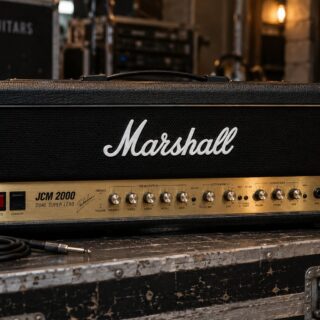
- Top image: GuitarGangsters AI-generated reference illustration, not a photograph.
- Zakk Wylde: Joanna Corwin (jmcorwin AT verizon DOT net), Wikimedia Commons, CC BY-SA 3.0.
- Kerry King: Alfred Nitsch, Wikimedia Commons, CC BY-SA 3.0 AT.
- Synyster Gates: LazyBuckets, Wikimedia Commons, CC BY-SA 2.0.
- Tom Morello: deep ghosh, Wikimedia Commons, CC BY 2.0.
- Zakk Wylde: Joanna Corwin, Wikimedia Commons, CC BY-SA 3.0.
Latest News
Related
On This Day
Monday 9 November
From this week: