Two Tiny Terrors in One Box: The Orange Dual Terror DT30H Story
The Orange Dual Terror DT30H packs two channels and 30W of EL84 valve tone into a compact head. Specs, circuit history, famous players, and tone recipes.
Ade Emsley was standing in front of a prototype he hadn’t been asked to build. The year was 2009, the Tiny Terror had already rewritten the rules of what a gigging amp could weigh and cost, and Orange’s Technical Director had a new idea burning a hole in his workbench. “I thought it would be nice to have two Tiny Terrors in one box,” Emsley told Orange’s own blog years later, “so you could switch between channels. You could have one cranked more than the other like the level for leads, so we did the Dual Terror.”
Simple concept. Devastating execution. The Orange Dual Terror DT30H arrived at NAMM 2009 and immediately solved the one complaint the guitar world had levelled at its legendary predecessor: the Tiny Terror was a single-channel, 15-watt marvel, but if you wanted more power and a switchable lead voice without adding three pedals and a cable spaghetti situation, you were stuck. The Dual Terror gave you 30 watts, four EL84s, two independent channels, and — in what turned out to be an Orange first — a genuine 4-to-2 tube switch that altered the amp’s character rather than just muffling it.
It also introduced something even simpler: the ability to run the Tiny Terror’s beloved circuit at stage-ready volume while having a fatter, rounder voice waiting on a footswitch. That’s the sell. That’s the whole thing. And fourteen-plus years after launch, dealers still move them, pro engineers still love recording them, and Primus’s guitar maniac Ler LaLonde liked his so much he had Orange build him a pair of custom ones.
The Tiny Terror Legacy: Why the Dual Terror Exists
To understand the Dual Terror you have to go back to a dinner at NAMM — the same one that gave birth to the Tiny Terror. Emsley had sketched the concept on whatever napkins were available: an amp that would fit inside an A4 piece of paper. His sales colleague told him he was being ridiculous. A week later, Emsley plugged in the prototype and let it speak for itself. In the first year of production, Orange sold 10,000 Tiny Terrors. The lunchbox amp trend that now defines a significant sector of the market traces its DNA directly to that restaurant conversation.
By 2008 the chorus of guitarist requests was getting louder: something like the TT but with more wattage, more versatility, a second channel. Emsley heard it. “People had been asking for something similar to the Tiny Terror but with more power,” he confirmed. The design brief wrote itself — two Tiny Terror circuits in one chassis, sharing a power section scaled up from two to four EL84s, giving 30 watts instead of 15. The “Fat Channel” arrived as the second voice: not a completely different beast, but a warmer, more bottom-heavy version of the same core character, voiced with extra low end, additional gain, and a slightly chunkier crunch response.
At NAMM 2009 Orange announced the Dual Terror alongside the Hard Wired Terror (a handbuilt UK limited edition of the Tiny Terror) and the Terror Bass. The Dual Terror DT30H landed in music shops at around £493 in the UK at launch. Premier Guitar covered the announcement; MusicRadar’s Stuart Williams reviewed it in November 2009 and declared that “the majority of players looking at the Dual Terror will be staring their new amp squarely in the eye.”
For context, the Dual Terror was also the first Orange amplifier ever to feature the 4-to-2 power tube switching mechanism — a design innovation that would become a cornerstone of the later Terror series and beyond. That switch doesn’t just cut headroom; it changes the amp’s operating point and compression character. More on that below.
Specs at a Glance
Three things jump off this spec sheet. First: four ECC83s in the preamp is more than you’d expect for an amp with only three controls per channel. Orange is putting that preamp real estate to work in the gain staging and voicing rather than wasting it on a multi-band EQ you’d never fully use. Second: no effects loop. This is a genuine design choice and a genuine limitation depending on what you want to put in front of or behind this amp. Third: the padded gig bag is included in the box, which at this price tier matters — the Dual Terror is explicitly designed to travel.
Two Channels, Two Personalities
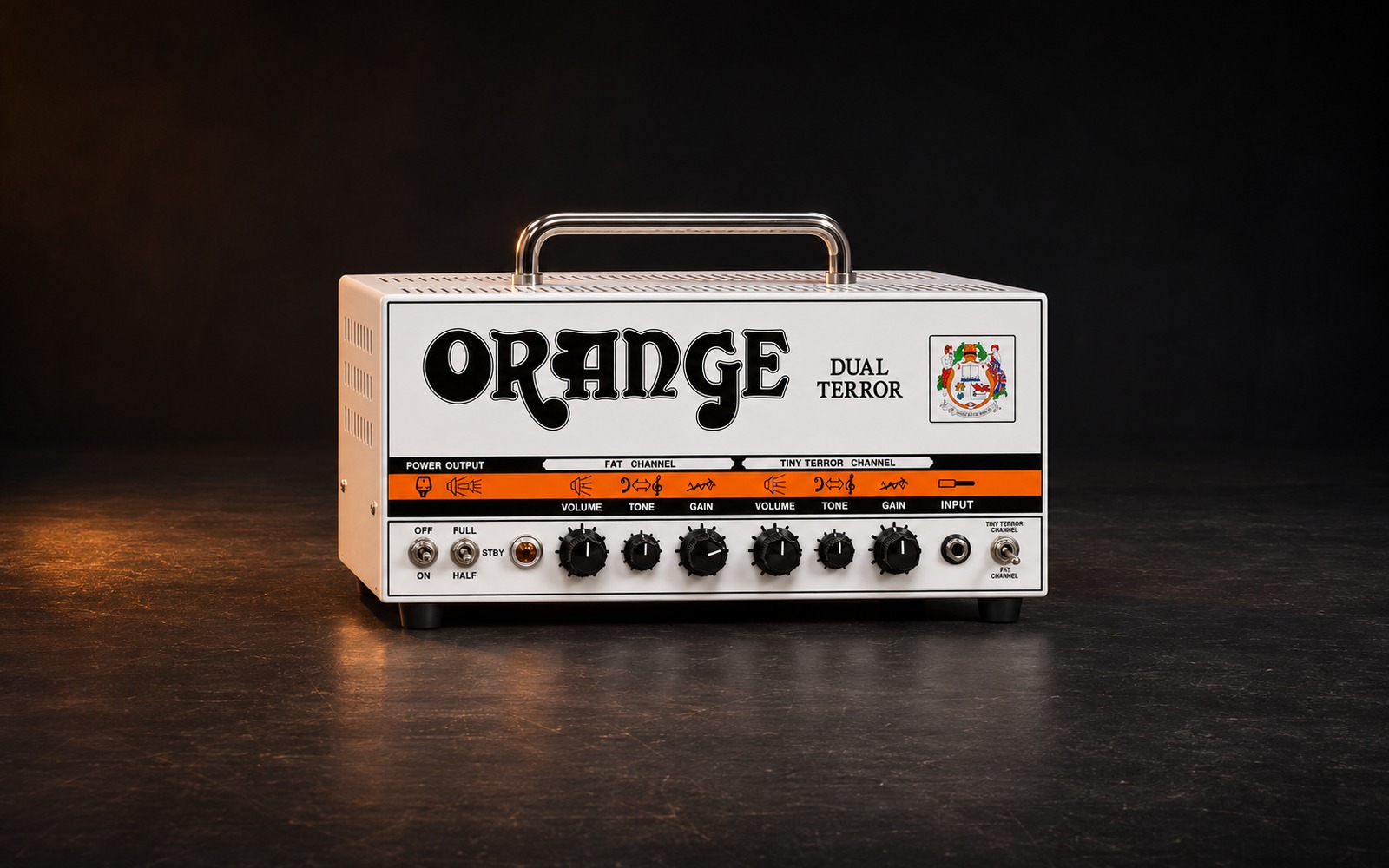
The Dual Terror gives you two independent voices, each with its own Gain, Tone, and Volume controls — the same stripped-back control philosophy Emsley applied to the original Tiny Terror, but doubled. There’s no shared EQ section, no bleeding between channels; each one is its own circuit with its own character.
The Tiny Terror Channel
This recreates the gain structure of the iconic single-channel original. The Gain knob in the lower range (up to about 9 o’clock) delivers spanking clean tones with the glassy, slightly compressed character of cathode-biased EL84s. As you climb past 10 o’clock you’re into the chimey British crunch that made the TT famous — what Emsley described as “1980s AC/DC territory” when cranked. Push the Gain further and the single-Tone control becomes your sculpting tool: a clockwise sweep adds bite and glassiness (think jangly indie chord ringing at the top); counter-clockwise warms and thickens. The circuit is built around the same unique dual-gang gain pot topology as the Tiny Terror, where one gang pushes the first stage toward heavy compression while the other adjusts the second stage’s impedance — effectively running a four-stage gain structure through just two preamp valves’ worth of circuitry.
MusicRadar’s 2009 review captured the TT channel’s range well: “Start off with the channel volume at about 12 o’clock and the gain between 10 and 11 o’clock and you get a chiming clean sound with just a subtle hint of dirt. Boosting the tone gives a little extra glassiness, which is perfect for ringing indie-style chords.” Conversely, lowering the volume and pushing the Gain delivers “a solid rock crunch tone with added punch and attack to your notes.”
The Fat Channel
The Fat Channel is where Orange added the extra beef the market demanded. It’s voiced warmer and wider than the TT channel — more low-end mass, a slight additional gain increase built into the circuit, and a crunch character that sits closer to a humbucker-equipped rhythm beast. Orange describes it as “a rounder, more full-bodied voice that’s ideal for lead lines and thicker rhythms.”
MusicRadar’s review was honest about the degree of difference: “The difference between the two channels is quite subtle (to our ears), but this is no bad thing.” That’s an accurate assessment. These aren’t the dramatically different clean/drive channel voices you’d find on a modern high-gain amp. Both channels are fundamentally in the same tonal universe — warm, mid-forward, EL84-flavoured British rock. The Fat Channel is more of a complementary shade than a total contrast. The practical onstage application is exactly what Emsley described: run the TT channel as your base rhythm tone, boost the gain and low end slightly on the Fat channel for lead work, and you have a complete gigging rig in a 9.75-kilogram head.
The 4-to-2 Tube Switch: Orange’s First
The three-position wattage switch (30/15/7W) is the Dual Terror’s single most important technical differentiator from the amp it was built to follow. And it carries a piece of Orange history that most owners don’t know: the DT30H was the first Orange amplifier ever to implement this tube-bypass switching mechanism.
At 30 watts all four EL84 power tubes are running. Dropping to lower settings bypasses two of the four tubes, running the remaining pair differently — with different compression characteristics, earlier saturation onset, and a slightly different dynamic feel under pick attack. This is not an attenuator. An attenuator takes the amp’s full output and converts excess power to heat before it reaches the speaker. The 4-to-2 tube switch changes how the amp itself produces power. The resulting tone at 7W is not a quieter 30W sound — it’s a different sound, more compressed, earlier to bloom, with a creamier edge on the breakup. The tradeoff is headroom: at 30W the Dual Terror stays cleaner longer before the power stage contributes saturation; at 7W it’s singing with power-amp compression at lower volumes.
For context on why this matters: bedroom players often buy low-watt amps and then find them surprisingly loud even at low settings. The Dual Terror’s 7W mode was genuinely intended as a usable practice and home-recording option, not just a marketing tick box. Players who have run it through a 1×12 or 2×12 at 7W confirm it delivers real, pleasing valve tone without waking the neighbours — provided the speakers themselves are reasonably efficient.
One practical caveat: the Dual Terror has no onboard effects loop. Players who rely on time-based effects (delay, reverb, chorus) in the loop rather than in front of the amp will need to run those effects through the front end. At mild gain settings this is rarely a problem. At the higher gain settings some players use, the absence of an effects loop means modulation and reverb can feel slightly muddier than they would behind the preamp. This is not a flaw — it’s a circuit philosophy — but it’s worth knowing before you build your rig around one.
Famous Players: The Verified List (and One Important Debunk)
The Dual Terror’s Equipboard page lists 35 pro artists, which is a solid number for a mid-tier amp head. As always with Orange’s broader artist ecosystem, some of those connections require examination before you repeat them on stage or in a demo video. Here’s what holds up.
Larry “Ler” LaLonde (Primus) — Verified
The strongest documented connection to the Dual Terror in any professional touring context belongs to Larry LaLonde, the genuinely singular lead guitarist of Primus. If you don’t know Primus, the short version is this: a San Francisco trio built on Les Claypool’s bass-as-lead-instrument philosophy, with LaLonde providing guitar textures that range from atonal noise to jazz-adjacent weirdness to downright heavy riffing — all while somehow backing one of the tightest bass grooves in rock. They’ve been active since 1984 in various forms, hit mainstream awareness in the early 1990s with albums like Frizzle Fry and Sailing the Seas of Cheese, and wrote the South Park theme song. They have never sounded like anyone else.
LaLonde’s relationship with the Dual Terror goes well beyond “I own one of those.” Orange produced a YouTube documentary video titled The Making of Ler Lalonde’s Custom Dual Terrors (published October 2013), which documents the construction of a pair of custom DT30H heads built specifically for his live rig. He is also listed on Orange’s own official artist roster — not just community-catalogued on Equipboard. He blends those custom Dual Terrors with a Fractal Audio Axe-Fx unit for the complex, spatially unusual sounds that define his live tone. The DT30H provides the analogue foundation; the Axe-Fx adds modulation, pitch manipulation, and effects processing. That combination explains the simultaneously raw and textured quality of Primus’s live guitar sound in their later touring years.
The connection is among the most solidly documented in this amp’s player history.
Laura Cox — Verified (Early Career)
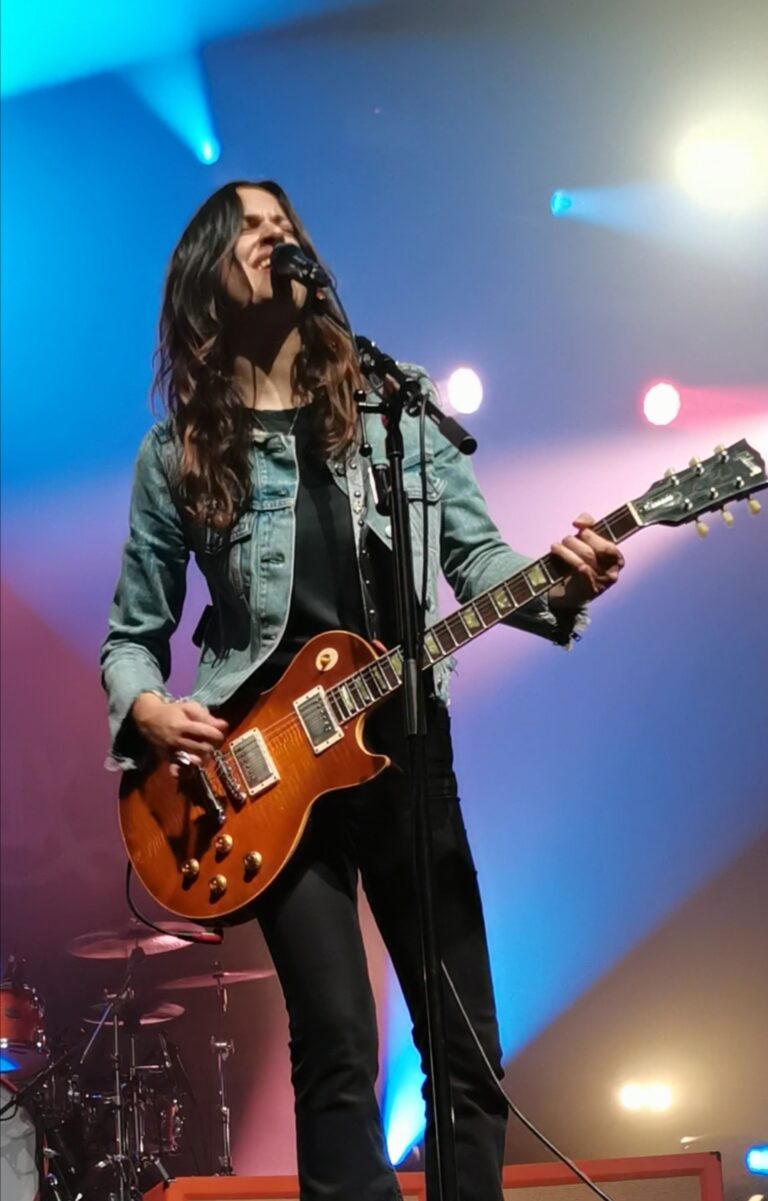
Laura Cox is a French guitarist and YouTube content creator who became one of Orange’s genuine European endorsees after establishing a large following with her classic-rock and blues cover videos. Her path to the Orange brand started with a Dual Terror purchase — she bought one specifically for its lightweight and compact form factor, wanting a proper valve head she could actually carry. The Dual Terror served as her primary amp during her formative years as a YouTube guitarist and helped build the Orange relationship that eventually led to her being listed on Orange Amps France’s artist roster and later using the Rockerverb 50 MKIII as her main touring head.
Her connection to the DT30H is genuine but worth contextualising: the Dual Terror was her entry point, not her final destination. For professional gigging purposes she outgrew it once the Rockerverb’s additional headroom and tonal palette matched her needs. The Dual Terror did its job — it proved the case for Orange to someone who went on to be a working touring musician and brand ambassador.
The Recycled Orange Roster: Matt Bellamy
Matt Bellamy of Muse appears on the Dual Terror’s Equipboard page. Orange and Muse have a real historical relationship — Bellamy used Orange’s Vox AC30-adjacent lineage during his early career and Orange’s brand energy fits the theatrical scale of Muse’s productions. But Bellamy’s documented primary amplifiers throughout Muse’s main touring and recording work are a vintage Vox AC30, a MIDI-controlled Diezel VH4 (often blended), and assorted Marshall heads including the DSL100 and 1959HW. The Matt Bellamy gear guide on this site confirms the AC30/Diezel combination as the foundation of his core live tone. No primary source — not a Premier Guitar rig rundown, not a Guitar World feature, not his own documented quotes — places a Dual Terror in an active role in his rig. This appears to be a community cataloguing association rather than a verified primary-source connection. Apply the standard filter: Equipboard listing alone does not constitute documentation.

Chino Moreno of Deftones is similarly listed. His Orange history is real and thoroughly documented — he ran four Orange AD140HTC heads on stage in the mid-2000s — but his connection to the Dual Terror specifically adds nothing that his AD140HTC history doesn’t already cover, and no primary source identifies the DT30H as a significant part of his active rig.
Tone Recipes and Settings
The Classic TT Crunch
Channel: Tiny Terror | Gain: 6 | Tone: 6 | Volume: to taste | Watts: 30W
This is the sound Emsley described when pitching the original Tiny Terror: “Volume on ten and the gain on about six — suddenly you’re into 1980s AC/DC territory.” On the DT30H at 30W, the TT channel at these settings gives you classic British rock crunch with the chimey, responsive quality that made the EL84 power section famous. Works brilliantly with a PAF-style humbucker. Single coils in the same position deliver a snappier, more strident character. Use the guitar’s volume knob to clean up — the TT channel cleans beautifully as you roll off the guitar.
The MusicRadar Chimey Indie Clean
Channel: Tiny Terror | Gain: 10–11 o’clock | Tone: 7–8 | Volume: 12 o’clock | Watts: 15W
Based directly on MusicRadar’s 2009 review: “A chiming clean sound with just a subtle hint of dirt. Boosting the tone gives a little extra glassiness, which is perfect for ringing indie-style chords.” Drop to 15W to get the power amp working slightly harder at this volume. A Telecaster or Strat neck pickup is ideal here. Arpeggio patterns ring like bells.
Channel-Switch Lead Boost
Rhythm: TT channel, Gain 6, Tone 6, Vol balanced to Fat channel | Lead: Fat channel, Gain 7, Tone 6, Vol slightly louder | Watts: 30W
This is the rig Emsley built the amp for: “You could have one cranked more than the other like the level for leads.” Set the TT channel as your rhythm foundation — crunch, slightly tight, mid-forward. Set the Fat channel with a touch more gain and low-end warmth, and bump the volume slightly so switching to it lifts you in the mix. The footswitch (sold separately) gives you a hands-free A/B between them. This is the simplest, most effective two-amp impersonation in a single 9.75-kilogram box.
7W Bedroom Burn
Channel: Tiny Terror | Gain: 7–8 | Tone: 5–6 | Volume: 10 | Watts: 7W
The 4-to-2 tube switch kicks in here. Two of the four EL84s are now doing the work, running at a different operating point with earlier compression onset. This setting gives you proper power-amp saturation — the creamy, responsive bloom of a valve amp working hard — at volumes that won’t get you evicted. Into a 1×12 at 7W the Dual Terror sounds noticeably more compressed and vocal than the same settings at 30W. Good cabinet choice matters more at this wattage; an inefficient box will kill the tone before it starts.
Stoner/Psych Riff (The LaLonde Zone)
Channel: Fat | Gain: 7 | Tone: 4–5 | Volume: to taste | Watts: 30W
The Fat channel at these settings produces a wide, dark, slightly scooped crunch that suits angular, complex riffing in the Primus/psych/stoner-rock tradition. Dial the Tone down to reduce the upper-mid glassiness and lean into the low-end warmth the Fat channel builds in. Pair it with an outboard fuzz or octave pedal run into the front end and you’re in LaLonde’s textural orbit. A bridge humbucker with the guitar’s tone rolled back to about 7 adds additional darkness without muddying the note definition.
All settings below are guides — starting points to reach with your own ears, not gospel.
How the Dual Terror Fits the Orange Terror Family
By 2009, “Terror” had become Orange’s vocabulary for a specific breed of compact, stripped-back valve head. Knowing where the Dual Terror sits within that family helps you buy the right one for your actual needs.
The Orange Tiny Terror TT15H is the Dual Terror’s single-channel ancestor — 15W maximum, one set of controls, simpler circuit, lighter weight. If you genuinely only need one tone and want it as portable as possible, the TT15H makes more sense. The Dual Terror is the step up for players who need two voices and 30 watts of headroom for stage volume.
The Orange OR15H is a different animal despite superficially similar specs. Where the TT channel uses the Tiny Terror’s unique gain structure, the OR15H runs a 4-stage cascaded gain preamp derived from the Rockerverb’s Dirty channel — effectively a modified JCM800-style preamp in Orange livery. The OR15H is more immediately aggressive and tighter in the mids; the Dual Terror is warmer and more musical on the clean-to-crunch spectrum. Single-channel vs two-channel is the practical decider.
The Orange Rocker 15 Terror gives you two channels but with different character: its Natural channel is explicitly not clean (already crunching by 10 o’clock with humbuckers), and the Dirty channel has a more aggressive voiced character than the Dual Terror’s Fat channel. The Rocker 15 Terror also has a built-in series FX loop and 0.5W/1W bedroom settings — genuine advantages over the DT30H if you need those features.
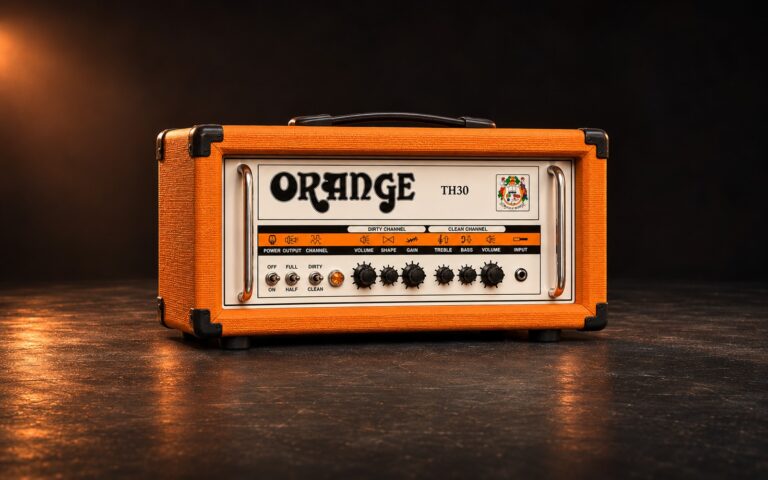
The Orange TH30H is the closest two-channel comparison in this guide: 30W, two channels, EL84-powered. But the TH30H’s Dirty channel runs a 4-stage cascaded gain preamp with a Shape EQ control — it targets harder rock and modern-tone territory more deliberately. The Dual Terror stays more vintage and EL84-focused in character throughout. If you want the authentic Tiny Terror DNA scaled up to a two-channel head, the Dual Terror is your amp. If you want sharper gain tones and a tone-shaping EQ, the TH30H is the better choice.
Outside the Terror family, the Vox AC30 Top Boost is the Dual Terror’s natural spiritual competitor — also EL84-powered, also mid-forward, also associated with British rock history. The AC30 is louder (30W in a fixed Class A configuration that feels louder than spec), deeper sounding, and vastly more expensive. The Dual Terror captures a significant share of the EL84 chime and crunch at a fraction of the price and a quarter of the weight. For studio use where the AC30’s sheer volume is inconvenient, the DT30H’s three wattage modes are a practical advantage.
For maximum Orange tonal authority at proper stage scale, the Rockerverb 50 MKIII is the head Laura Cox moved to after establishing herself on the Dual Terror — a comparison that tells you where the DT30H sits in the real-world professional hierarchy: excellent for studio, rehearsal, and most live situations; not quite the full-size stage beast its bigger sibling is.
Buying Guide
The Dual Terror is a current production amp at around £599 in the UK and $1,089 in the US. Orange has kept it in the lineup consistently since 2009, which is itself a statement about the market’s appetite for it. There are no major known production variants within the DT30H line — unlike some Orange models, you’re unlikely to encounter significant spec differences across production runs on the used market.
Used prices typically sit in the £350–£500 / $450–$700 range depending on condition and included accessories. The padded gig bag is worth confirming — it should come with the amp when new and is often included with used examples. The footswitch for channel switching is sold separately; factor that in if you’re buying for live use.
When buying used, check tube condition. Orange’s spec says no rebiasing is required when replacing power tubes, which suggests a fixed-bias or self-biasing configuration — verify this with whoever you’re buying from, or budget for a tube refresh if the amp has seen heavy use. EL84s are affordable and widely available. The four ECC83 preamp tubes are equally easy to source.
Check the speaker output impedance matching before plugging in. The Dual Terror gives you 8Ω or 16Ω output options (single) or 2×16Ω for a stereo/dual-cabinet configuration. Running into a mismatched impedance won’t blow the amp immediately but will stress the output transformer over time and potentially affect tone and tube life. Orange’s standard recommendation: match the impedance — don’t approximate it with a mismatched cab.
The lack of an FX loop is the most commonly cited limitation. If your signal chain includes time-based effects (reverb, delay, chorus) that you prefer to run in a loop to avoid gain-stage interaction, the DT30H is not your amp. This is a genuine design constraint, not user error. The amp is built for players who run simple chains — guitar, maybe a drive pedal or two, straight into the front end.
Ownership Notes
The padded gig bag is genuinely useful. At 9.75 kilograms the DT30H is heavier than the Tiny Terror but lighter than almost any comparable 30W valve head. Combined with the carry handle it’s a real one-trip load-in amp — take it to the venue in the bag, remove it, plug in the cab, done.
The wattage switch warrants some attention in rehearsal or home contexts. At 30W through any efficient cabinet the Dual Terror is genuinely loud for a domestic environment. The 7W mode is the usable practice mode — but “usable practice” still means an open-back 1×12 or 2×12 producing real sound pressure. This is not a bedroom whisper amp. Plan your monitoring accordingly.
The 4-to-2 tube bypass at lower wattage settings means the remaining tubes run at a different operating point. This contributes to tube wear being slightly uneven across sets if you spend the majority of your time in 7W mode. It’s not a catastrophic issue — EL84s are inexpensive — but a periodic full tube inspection is wise regardless of the “no rebiasing required” spec.
The channel-switching footswitch is not included. Orange makes their own footswitch for this; it’s a simple two-switch unit. Third-party alternatives exist but always verify pin-out compatibility before buying to avoid sending the wrong signal and causing issues. The DT30H’s footswitch socket accepts a standard TRS connection.
A cosmetic note: Orange’s finish on the DT30H is robust by design. The orange tolex is relatively resistant to road wear compared to some boutique alternatives, and the steel chassis underneath can take the knocks a working musician’s gear inevitably accumulates. The rubber feet on the base are worth inspecting periodically — they can detach on older used examples and the amp isn’t as stable without them.
Frequently Asked Questions
Does the Orange Dual Terror have an effects loop?
No. The DT30H has no effects loop of any kind. All effects processing must run through the front-end input. This is a deliberate design choice reflecting the same stripped-back philosophy as the Tiny Terror. Players who rely on time-based effects in a loop should consider the Rocker 15 Terror, which includes a series FX loop.
What is the difference between the Tiny Terror channel and the Fat channel?
The Tiny Terror channel reproduces the gain structure of the original Tiny Terror TT15H — responsive, chimey, EL84-flavoured British crunch. The Fat channel adds more low-end mass, a slight additional gain increase, and a warmer, rounder voice suited to lead playing or heavier rhythm work. MusicRadar noted the difference is “quite subtle,” which is accurate — both channels share the same EL84 power section and Orange’s fundamental sonic identity. Think of it as two shades of the same colour rather than two completely different palettes.
Do I need to rebias the Orange Dual Terror when I change power tubes?
According to Orange’s own specifications, no rebiasing is required when replacing power tubes in the DT30H. Bring a fresh matched quad of EL84s, swap them, and you’re done. This is one of the amp’s practical advantages for working musicians who don’t have easy access to a valve tech.
What speaker impedance do I need with the Dual Terror?
The DT30H offers three speaker output configurations: a single 8Ω jack, a single 16Ω jack, or two 16Ω jacks for a dual-cabinet setup. Match your cabinet’s impedance rating to the correct output. Running a 16Ω cabinet into the 8Ω jack (or vice versa) will affect tone and may put additional stress on the output transformer. When in doubt: match.
Does the Dual Terror come with a footswitch?
No. The padded gig bag is included, but the channel-switching footswitch is sold separately. If you plan to use the amp for live performance and want hands-free channel switching, budget for the footswitch from the start. Check compatibility if you plan to use a third-party unit.
How does the Dual Terror compare to the original Tiny Terror?
The Tiny Terror TT15H is single-channel, 15W maximum, and lighter. The Dual Terror adds a second channel, doubles the wattage to 30W, adds two more EL84s, and introduces the three-position wattage switch. If you only ever need one tone and value maximum portability, the Tiny Terror’s simplicity is its strength. If you need two voices, stage-ready volume, and the flexibility of three power modes, the Dual Terror solves all three problems at once.
Is the Dual Terror loud enough for gigging?
At 30W through a 2×12 or 4×12 cabinet, yes — the Dual Terror is loud enough for most live contexts where the stage volume is kept at a sensible level. MusicRadar confirmed in their 2009 review that “the 30-watt output means it’s loud enough for most regular sized gigs.” The caveat is the same one that applies to any lunchbox head: large outdoor or PA-less venues where you’re entirely reliant on stage volume may expose the limits of 30W, but those are the same venues where a 50W amp can struggle too. Most club and pub gigs are comfortably within range.
What makes the Dual Terror historically significant for Orange?
Beyond its commercial success, the DT30H was the first Orange amplifier to feature the 4-to-2 power tube switching mechanism — now a standard feature across much of the Terror series and a design approach that influenced how Orange approached wattage flexibility across their later product range. It was also proof of concept that the lunchbox amp market could sustain a two-channel, 30W offering at a price point that made it genuinely accessible, not a boutique luxury. The Tiny Terror started a movement; the Dual Terror expanded it.
Image credits
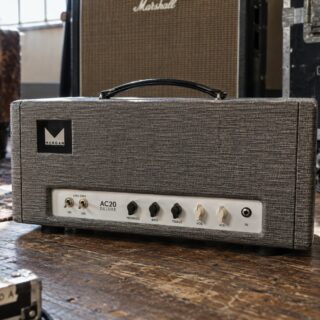
- Top image: GuitarGangsters AI-generated reference illustration, not a photograph.
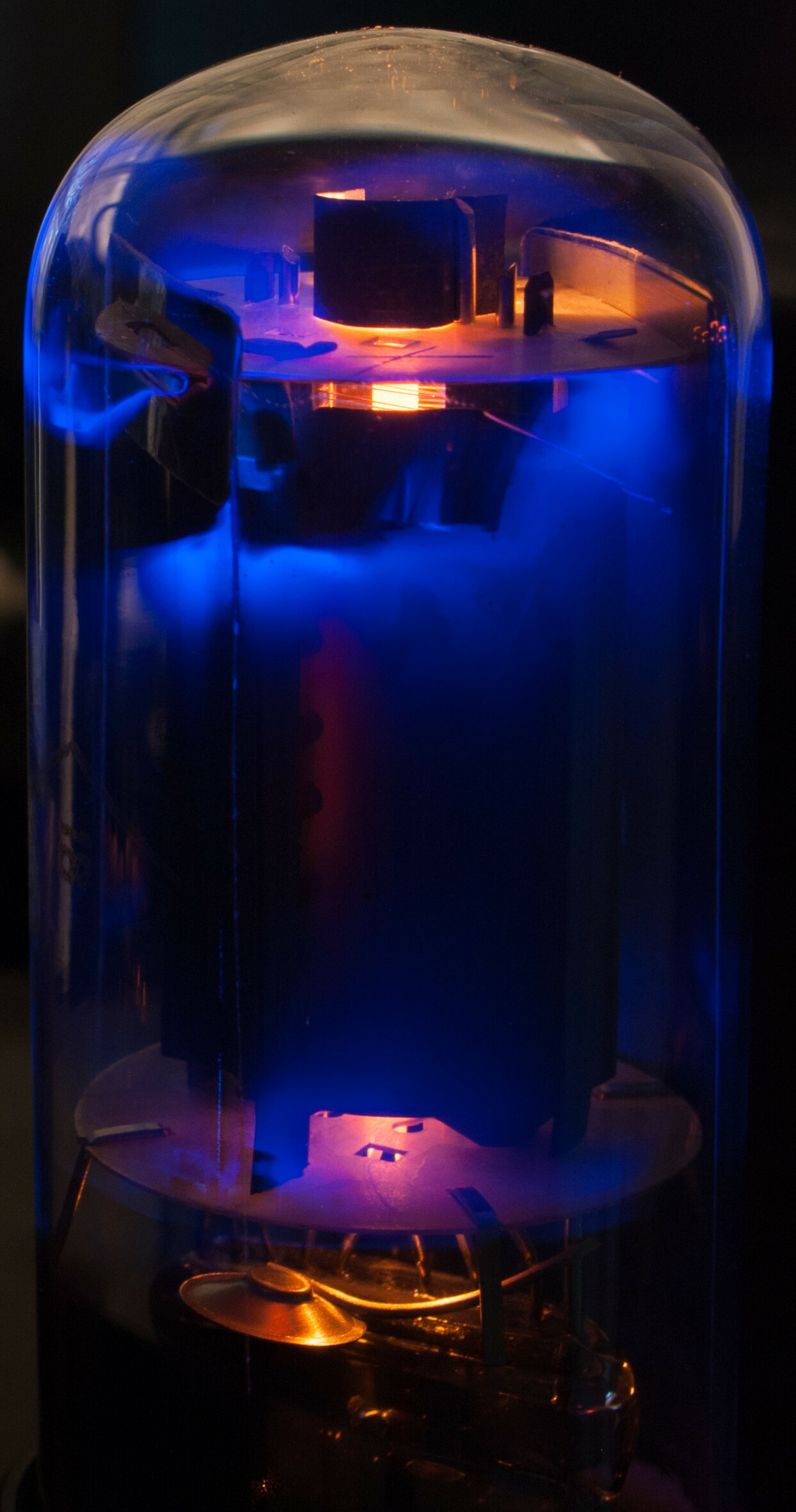
- A glowing power tube: Rob Robinette, Wikimedia Commons, CC BY-SA 4.0.
- Matt Bellamy: Scott Penner, Wikimedia Commons, CC BY-SA 2.0.
- Laura Cox: A.A.L.0510, Wikimedia Commons, CC BY-SA 4.0.
Latest News
Related
On This Day
Tuesday 10 November
From this week: