The Amp That Matchless Built Twice: Inside the Bad Cat Cub
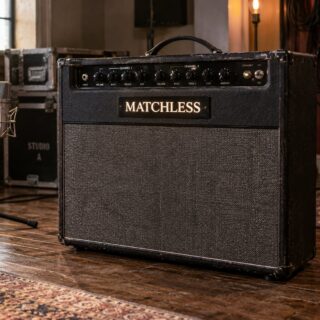
Bad Cat Cub. AI-generated reference illustration, not a photograph.
From the Matchless Lightning lineage to the hand-wired Cub V—full specs, EF86 vs 12AX7 tones, honest artist connections, and buying guide for the Bad Cat Cub.
There is a thread of DNA that runs from a Vox AC30 through the Matchless Lightning, into the very first Bad Cat amplifier to roll off a workbench in Costa Mesa, California, and straight into the hand-wired Cub V sitting on dealer shelves today. Pull on that thread and you end up holding one of the most coherent stories in boutique amp making: a circuit philosophy born in the early 1990s boutique revolution that has refused, across a quarter century and three separate company chapters, to die or be diluted into something ordinary. The Bad Cat Cub is not a famous amp in the way a Marshall JMP or a Fender tweed Deluxe is famous. It does not appear on canonical album sleeves. It has no single artist whose name is synonymous with the sound the way Eric Clapton defined the plexi or Stevie Ray Vaughan claimed the blackface Super Reverb. What it has instead is a reputation built entirely on playing—on what players who buy one discover after a month of daily use and never bring themselves to replace. That is a harder reputation to manufacture, and a more honest one to have.
Origin Story: From Matchless to Bad Cat
The story starts with Mark Sampson, co-founder of Matchless Amplification. In the early 1990s, Sampson helped create the market for hand-built boutique tube amplifiers aimed at players who wanted British chime and harmonic complexity but found the original Vox factory output inconsistent. The Matchless DC-30 and Lightning became studio and touring standards for players with money and ears. When Matchless went through a period of financial turbulence and temporary closure, Sampson left. The amplifier world noticed the gap.
James Heidrich noticed it too. Heidrich was not an amp builder by trade—he was an entrepreneur who saw a hole in the boutique market and had the taste and instincts to know what should fill it. He founded Bad Cat Tube Amplifiers in 1999 in Costa Mesa, California, on the explicit principle that the best guitar amplifiers required point-to-point wiring and the highest-quality components available from resistors to transformers to speakers and cabinets. He debuted the company at the 2000 NAMM show to an industry that was primed to love it. To anchor the range’s credibility, he brought in Sampson himself as chief designer.
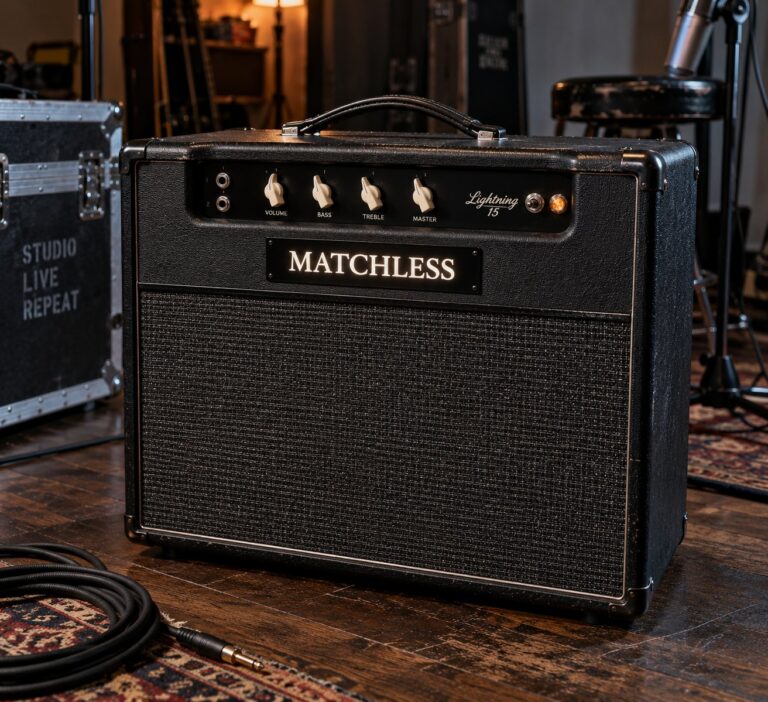
Sampson’s tenure at Bad Cat ran from approximately summer 2000 through December 2003. During that period, the early Bad Cat line was built directly from Matchless circuit architecture—some units reportedly contained Matchless-branded components. The Black Cat 30 mapped directly to the Matchless DC-30. The Cub was a descendant of the Matchless Lightning: a smaller, single-ended-feeling amp built on the same Vox Top Boost-inspired topology that gives that family its characteristic chime, harmonic complexity, and touch-responsiveness. The Lightning became the Cub. The circuit stayed. The name changed. The California sun gave it a new address.
After Sampson left in late 2003, Bad Cat’s own engineering team continued developing the range, introducing the Cub III (which added the EF86/12AX7 preamp switching architecture that defines the modern Cub character), the PCB-based USA Player Series (a more affordable production path launched around 2016), and various head and combo configurations across the 15-watt EL84 and 40-watt EL34 power sections. James Heidrich sold the company in 2011. He passed away unexpectedly on February 11, 2023, at 64 years old, from a pulmonary embolism—a loss the amp community felt quietly but acutely, acknowledging a founder whose taste had given a generation of boutique players something worth chasing.
The Cub V, launched in late 2024, brought the story full circle. Mark Sampson returned to work with Bad Cat on the new generation. The Cub V goes back to fully hand-wired, point-to-point construction, built in Bad Cat’s current Irvine, California facility. The circuit that Sampson seeded in 2000 has now been tended by its original gardener again, 25 years on.
What the Cub Family Covers
Before going into the Cub V specs, it is worth mapping the family clearly, because “Bad Cat Cub” covers a range of instruments that feel and perform differently despite sharing a name and a circuit philosophy. The Sampson-era original Cubs (roughly 2000–2003) are now vintage finds on the used market and command prices reflecting their lineage. The Cub III—the most widely available generation—introduced the dual-preamp-tube switching that is now the Cub’s defining feature. The USA Player Series (circa 2016–2023) switched to PCB construction with solid-state rectification and digital reverb to make the Cub accessible at a lower price point without moving production offshore; these were still hand-assembled in California, with the same component philosophy. The Cub V (2024–present) returns to the full hand-wired PTP standard of the Sampson originals, now with tube-driven spring reverb in place of the Player Series digital tank. When you see a “Bad Cat Cub” on a stage or a used-market listing, the generation matters—and the price difference between a Cub III head and a Cub V head is substantial.
Specs: Bad Cat Cub V (2024–Present)
| Spec | Cub V EL84 | Cub V EL34 |
|---|---|---|
| Power | 15 watts | 40 watts |
| Power Tubes | 2× EL84 | 2× EL34 |
| Preamp | Switchable EF86 / 12AX7 (footswitchable) | Switchable EF86 / 12AX7 (footswitchable) |
| Construction | Hand-wired point-to-point, Irvine CA | Hand-wired point-to-point, Irvine CA |
| Reverb | Tube-driven spring | Tube-driven spring |
| Controls | Gain, Depth (5-way), Bass, Treble, Cut, Reverb, Master Vol 1, Master Vol 2 | Gain, Depth (5-way), Bass, Treble, Cut, Reverb, Master Vol 1, Master Vol 2 |
| Master Volumes | Dual (footswitchable) | Dual (footswitchable) |
| Effects Loop | Buffered | Buffered |
| Footswitch | 2-button (preamp tube + master vol) | 2-button (preamp tube + master vol) |
| Speaker (combo) | 12″ Bad Cat Custom (Celestion-made) | 12″ Bad Cat Custom (Celestion-made) |
| Price (head, USD) | ~$2,590 | ~$2,999 |
| Format | Head or 1×12 combo | Head or 1×12 combo |
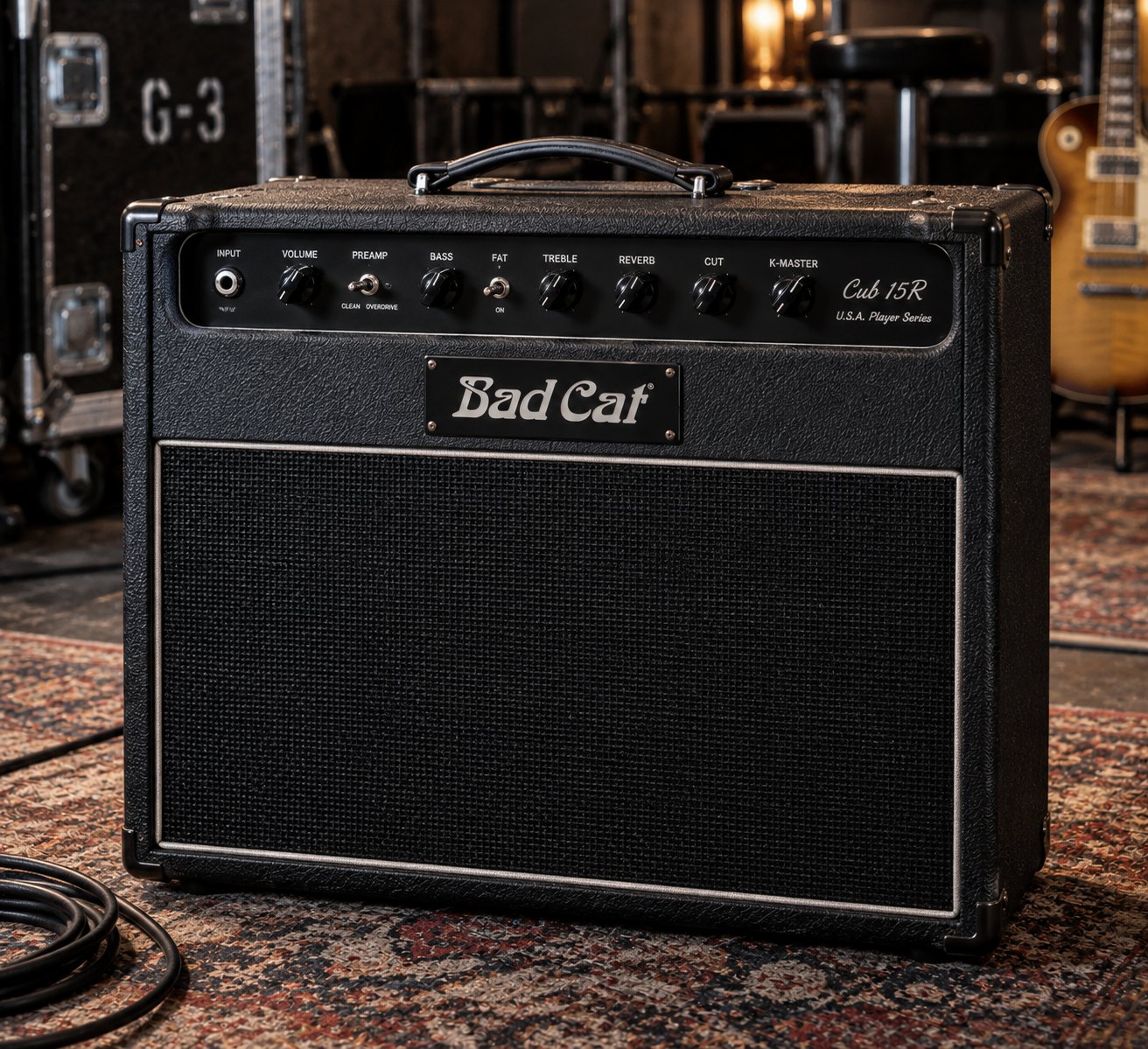
A note on the USA Player Series (circa 2016–2023) for used-market buyers: these PCB-based versions used digital plate-style reverb rather than a spring tank, solid-state rectification, and a K-Master control instead of dual master volumes. The K-Master works as a separate amplification circuit post-phase inverter, able to drive the power amp independently from the preamp volume—an elegant solution that lets you set preamp gain separately from overall output level. These are still very capable amplifiers and trade used at a fraction of the Cub V’s price, but they are a different instrument in terms of feel and touch response. The spring reverb on the Cub V is meaningfully richer than the digital reverb on the Player Series.
The Circuit Character: Why 12AX7 and EF86 Sound Different
The Cub’s defining party trick—and it is genuinely useful rather than a spec-sheet checkbox—is the ability to switch between a 12AX7 and an EF86 in the first preamp position, selectable via front-panel toggle or the included footswitch. Understanding why this matters is understanding half of what makes the Cub a versatile studio tool.
The 12AX7 is the industry-standard high-gain triode. It is linear, predictable, and abundant. In a Cub, the 12AX7 mode delivers the brighter, chimier, more open response—what you reach for when playing Strats and Teles where you want the single-coil edge preserved and extended, not compressed. It sparkles, it breathes, it lets the pick attack arrive at the speaker mostly intact. Think of the classic Vox Top Boost clean tone, chiming and clear, ready to break up with the right push.

The EF86 is a pentode, not a triode. It has higher transconductance, a more complex gain character, and a distinctly different saturation curve. In the Cub, EF86 mode is thicker, more harmonically dense, with a little more perceived volume even at the same dial position—it compresses differently under pick attack, sustains longer, and takes a humbucker into a zone of midrange density that the 12AX7 mode does not quite reach. Vintage Guitar’s Dave Hunter, reviewing the Cub V EL34 in February 2025, described the EF86 as “thicker” versus “a little more sparkly” for the 12AX7, which is an accurate shorthand. The trade-off is that a single shared Gain control means the balance between modes is whatever Bad Cat’s voicing puts there; you cannot independently set the EF86 drive level and the 12AX7 drive level. Hunter noted this as the one additional feature he might like to see. It is worth knowing before you buy.
The five-way Depth control adds a further layer of versatility. It acts as a voicing switch—different positions alter the low-frequency content and midrange presence before the tone stack, giving the amp a range of tonal characters from tight and punchy to warm and round without touching the Bass or Treble knobs. The Cut control at the back end of the chain manages high-frequency harshness from the power section, functioning similarly to a presence or negative feedback control. Between Depth and Cut, you can shape the Cub’s fundamental voice across a wider palette than the controls count might suggest.
Famous Players: Honest Assessment
The Bad Cat brand has accumulated a genuine touring-level roster over its 25-year history, but—and this is worth stating plainly—most of the artists associated with the brand play specific Bad Cat models that are not the Cub. Josh Homme and Jamie Cook of Arctic Monkeys are associated with the Hot Cat 30R, a higher-gain two-channel model. Bonnie Raitt has been documented on the Black Cat 30 combo, a 20-watt Class A design descended from the original Black Cat circuit. Keith Urban is listed as a Bad Cat brand endorser, but no specific model has been confirmed in primary sources connecting him to the Cub. They are Bad Cat users, not confirmed Cub users.
For the Cub 40R Player Series specifically, Equipboard documents three artists with YouTube-verified source citations: Rhett Shull, Rick Beato, and Peter Honoré. Shull is a Nashville-based guitarist and YouTube educator with a substantial following among players interested in boutique gear and clean tone architecture. Rick Beato is a music educator, producer, and YouTube creator whose channel has become one of the most-watched guitar resources online; his documented Cub use is via his own YouTube content. Neither Rhett Shull nor Rick Beato is a touring artist in the traditional sense—they are studio and content players whose gear choices filter into the broader guitar community through video rather than through stage rigs. This matters because it tells you something accurate about who the Cub actually reaches: it is an amp beloved by players who care deeply about tone for its own sake, who sit close to the speaker, and who have the attention span to hear what it does at different volumes. That is not a knock. It is a description of the amp’s spiritual audience.
Billie Joe Armstrong is listed on Bad Cat’s brand roster but his primary Bad Cat association is the Siamese Drive preamp pedal, not the Cub. Pete Townshend belongs in any Vox Top Boost-lineage discussion as the artist who defined what that circuit topology sounds like under a pick attacking with full-arm force—but he has no documented connection to Bad Cat amplifiers. He is a reference point for the sound, not a player of this instrument.
Tone Recipes
Recipe 1 — Single-Coil Chime (12AX7 Mode)
Mode: 12AX7. Gain: 9 o’clock. Depth: position 2. Bass: 12 o’clock. Treble: 2 o’clock. Cut: 10 o’clock. Reverb: 11 o’clock. Master 1: to room volume. Guitar: Stratocaster, neck or middle pickup. This is the Cub at its most Vox-adjacent—open, airy, harmonically lit but not breaking up on chord strikes. Fingerpicking or hybrid picking reveals the bloom and complex sustain that the EL84 power section produces. Works without any pedal between guitar and amp. If you need more shimmer, back the Cut control off by 10 degrees rather than raising the Treble—it avoids the thin, brittle zone that higher Treble settings can produce with bright single-coils.
Recipe 2 — AC30-Inflected Crunch (12AX7 Mode, Pushed)
Mode: 12AX7. Gain: 1 o’clock. Depth: position 3. Bass: 11 o’clock. Treble: 1 o’clock. Cut: 11 o’clock. Reverb: 12 o’clock. Master 2 (boost footswitch): set 15 percent higher than Master 1. Guitar: Telecaster, bridge pickup. The Cub does not have a dedicated boost channel, but the dual master volumes handle the clean-to-crunch transition for live use. With Gain at this level in 12AX7 mode, the amp breaks up just past the point where chord dynamics are doing the work—heavy picking breaks up, lighter picking cleans up. The Master 2 bump brings lead passages slightly louder and adds a touch more power-section saturation. Classic territory for blues-rock and jangly indie rock.
Recipe 3 — EF86 Midrange Punch (Humbucker)
Mode: EF86. Gain: 12 o’clock. Depth: position 4. Bass: 10 o’clock. Treble: 12 o’clock. Cut: 12 o’clock. Reverb: 10 o’clock. Master 1: moderate. Guitar: Les Paul with PAF-style pickups, tone rolled to 7. The Guitar.com USA Player Series review noted specifically that the Cub “marries particularly well with PAF-style humbuckers and really brings them to life.” That holds in EF86 mode above all—the pentode’s additional compression and harmonic density fills out the midrange of a mahogany-body guitar into something warm and singing without the flab that some full-on Class A amps produce under a thick-wound humbucker. Backing the guitar’s tone control off 30 percent tames any harshness in the EF86 gain character. An excellent jazz-tinged blues or classic rock tone that does not need an overdrive pedal.
Recipe 4 — P-90 Lead Sustain (EF86 Mode)
Mode: EF86. Gain: 1 o’clock. Depth: position 3. Bass: 12 o’clock. Treble: 11 o’clock. Cut: 10 o’clock. Reverb: 1 o’clock. Guitar: ES-335 or SG with P-90s. The EL84 version specifically reaches a singing, compressed sustain with P-90-equipped guitars that is difficult to replicate at the same volume with EL34s; the EL34 version covers similar ground with more headroom and grunt. Either works. This is the tone that studio players describe when they say the Cub “gets out of the way and lets the guitar breathe.”
Recipe 5 — Pedal Platform (Clean Foundation)
Mode: 12AX7. Gain: 7 o’clock (minimum). Depth: position 1. Bass: 1 o’clock. Treble: 12 o’clock. Cut: 11 o’clock. Reverb: 9 o’clock. Master 1: at rehearsal-room levels. Front-end: Ibanez TS9 Tube Screamer at drive 9 o’clock, level 2 o’clock. The Cub at minimum gain with the 12AX7 and a conservative Depth setting is one of the cleaner-feeling pedal platforms in the boutique world—it does not add its own dirt to the signal until it is pushed hard, so the overdrive’s character dominates. The buffered effects loop is a genuine asset here: time-based effects in the loop stay clean regardless of what the preamp is doing. The combination of a TS9 mid-hump through a Cub in 12AX7 mode approximates the classic pushed-blackface-via-Tube-Screamer sound at a quieter overall volume than the original.
Comparisons
Bad Cat Cub vs. Vox AC30C2
The AC30 is the Cub’s spiritual ancestor and its most obvious market competition. The AC30C2 costs less than half the Cub V EL34 head and offers tremolo and vibrato that the Cub does not have. The Vox is also 30 watts to the Cub’s 15 or 40—it sits in a different dynamic window. What the Cub has that the AC30 does not is the EF86/12AX7 switching, the dual masters, and the improved consistency of American boutique hand-build. Production-run Vox AC30s are solid instruments, but the tolerances and component quality in a $2,999 hand-built California amp are measurably different from a £700 factory combo. The Cub is a more sophisticated tool for discriminating players; the AC30C2 is the more practical choice for players who need tremolo and lighter lifting costs.
Bad Cat Cub V vs. Matchless Lightning Reverb
This comparison is the historical one—the Lightning is what the Cub came from, and the Lightning Reverb is the current production descendant of Sampson’s original circuit at Matchless. Both are hand-wired American boutique amps targeting the same tonal family. The Lightning Reverb runs 15 watts and costs roughly $2,695 (head) to $2,995 (combo). The Cub V EL84 head is $2,590. They are within competing price distance. The Lightning’s circuit is the parent; the Cub’s is the child that has been refined across 25 years of independent development. Players who want the more historically “correct” Vox-via-Matchless experience may prefer the Lightning; players who want the EF86/12AX7 switching architecture and the dual-master versatility may find the Cub the more modern tool.
Bad Cat Cub V vs. Carr Mercury V
The Carr Mercury V is a 16-watt mid-Atlantic amp (British preamp, American 6V6 power section) priced around $3,670 combo. It has a built-in attenuator—the Cub V does not. If you need to take a power-amp-saturated tone into bedroom volumes, the Mercury V’s Ironman-adjacent attenuator is a meaningful feature. The Cub’s advantage is the switchable preamp character (EF86 and 12AX7 vs. Mercury V’s single-voice preamp) and the tube spring reverb, which is warmer than the Mercury V’s spring. Both amps are point-to-point, California-built boutique tools; the choice depends on whether you want British girth with attenuator flexibility (Mercury V) or Vox-lineage chime with dual-character preamp switching (Cub V).
Bad Cat Cub V vs. Tone King Imperial MKII
The Tone King Imperial MKII occupies a similar price bracket and shares the built-in reactive-load attenuator feature the Cub V lacks. The Imperial’s Ironman II system allows near-silent power-section saturation—something the Cub cannot do without an external load box. The Imperial’s circuit is blackface-influenced (Fender lineage) where the Cub is Vox-influenced; these are genuinely different flavours. If your core sound is Fender-voiced clean headroom with a wide dynamic window, the Imperial is the stronger choice. If it is British chime and EL84/EL34 harmonic complexity, the Cub wins the comparison.
Bad Cat Cub V vs. Fender Deluxe Reverb
The Fender Deluxe Reverb costs a fraction of the Cub V and delivers what a Deluxe Reverb has always delivered: open, clean American headroom, spring reverb, and tweed-era breakup when pushed. It is the correct choice for players who want the canonical blackface voice. The Cub is not a blackface amp—its clean tone has more British harmonic complexity, more mid-register density, and less high-frequency glassiness than the classic Fender sound. They do not compete directly by ear; they serve different tonal philosophies. The Deluxe Reverb is a genre staple. The Cub V is a boutique refinement for players who have already found the Fender sound and want something with more tonal dimensionality under fingertip pressure.
Buying Guide
The first decision is generation: Cub V (hand-wired PTP, tube spring reverb, dual masters, ~$2,590–$2,999 new) versus USA Player Series (PCB, digital reverb, K-Master, typically $800–$1,300 used) versus Cub III (hand-wired, spring reverb, older generation, $700–$1,100 used). The Cub V is the engineering statement; the Cub III is the proven workhorse; the Player Series is the affordable entry point. All three share the EF86/12AX7 preamp switching architecture from the Cub III onward.
The second decision is power: 15-watt EL84 versus 40-watt EL34. The EL84 version saturates earlier, compresses more sweetly under pick attack at studio volumes, and is the correct choice for players who record at moderate levels or play smaller rooms. The EL34 version has more headroom before breakup, a tighter low end, and more sheer power stage authority—appropriate for larger stages or players who need to push into the amp with more physical headroom available before the output section clips. Dave Hunter’s Vintage Guitar review of the Cub V EL34 described it as having “more girth, punch, and bark” than the EL84 equivalent, with “not double the decibels—rather, a sturdy revoicing with more push and grunt.”
On the used market, check the serial number against known production eras if possible. Sampson-era Cubs (roughly 2000–2003) are collector pieces as much as players—expect to pay a premium and to be unable to date them precisely from cosmetics alone. Cub III units from the mid-2010s are the sweet spot for value; confirm the EF86/12AX7 switching works on both footswitch and panel toggle before buying. For USA Player Series units, check the digital reverb circuit—it can be more susceptible to component failures than the spring tank on legacy units.
Ownership Notes
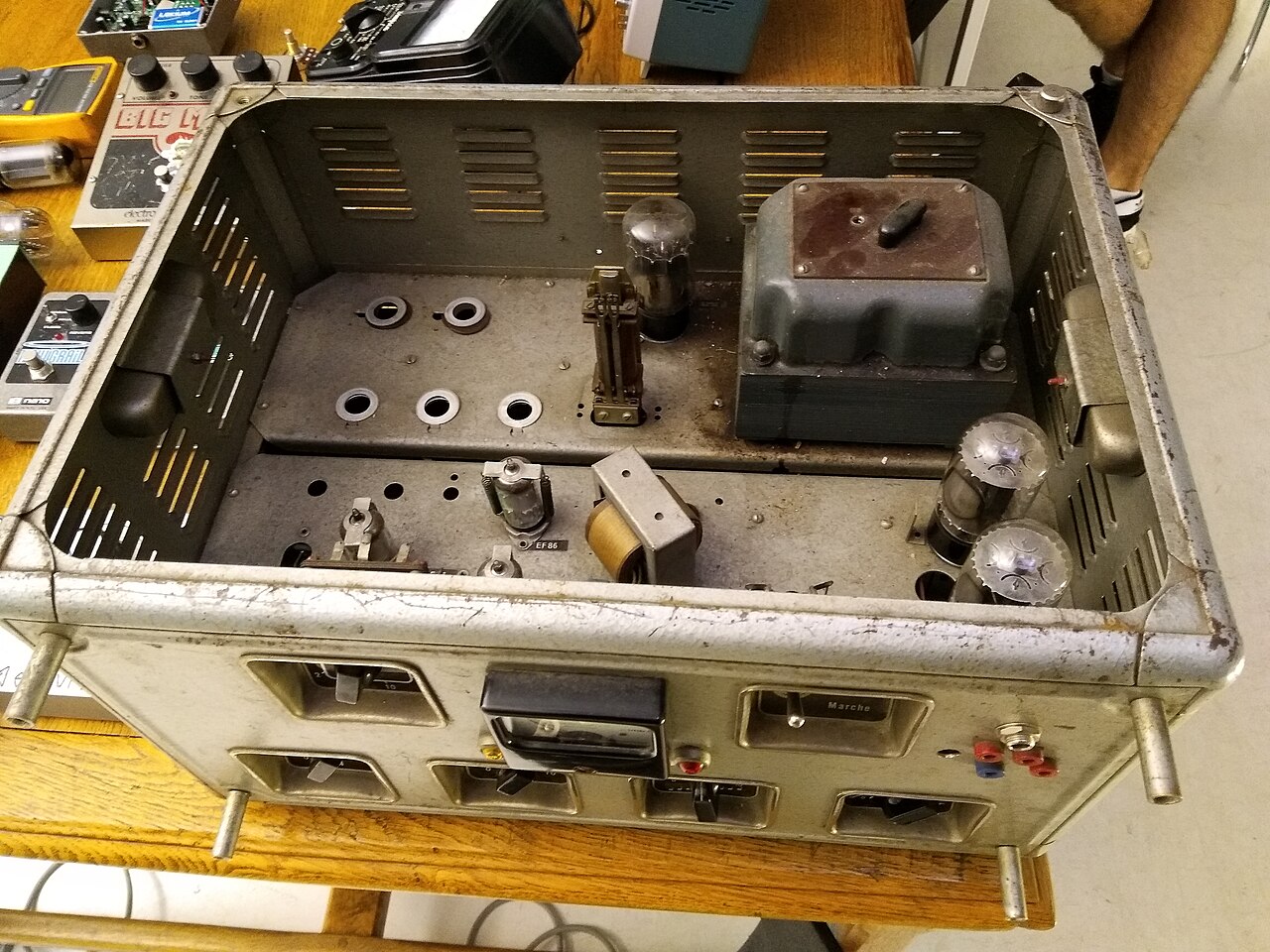
EL84 tubes in the Cub V are cathode-biased, which means tube swaps do not require a technician to rebias the amplifier. EL34s in the 40-watt version require a bias check after tube replacement—not a difficult procedure, but one that should go through a qualified tech if you are not comfortable with it. The Cub V’s hand-wired PTP construction makes it straightforward to service and fault-trace compared to PCB amps; any competent valve-amp technician can work on it.
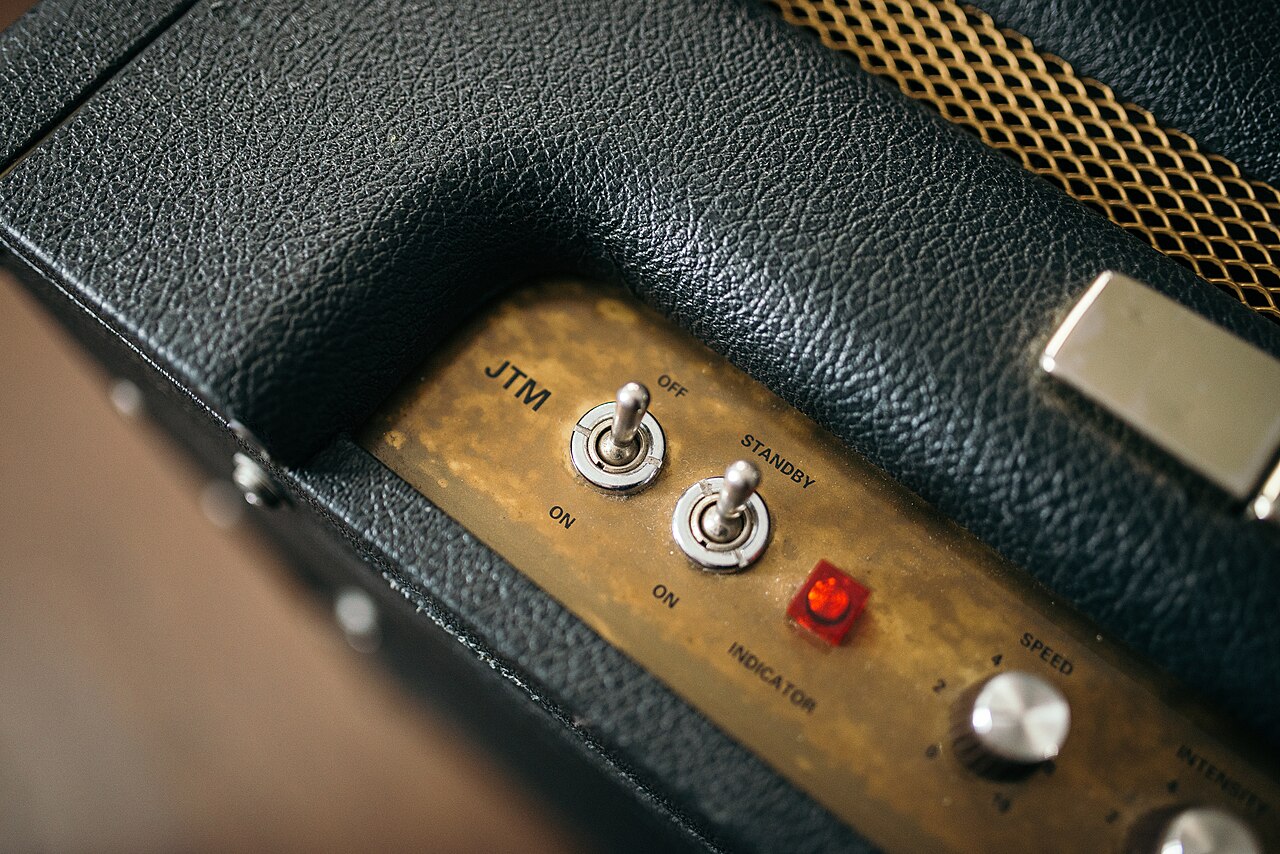
The tube-driven spring reverb on the Cub V is a mechanical system—it will be sensitive to physical shock. Do not knock or drop the amp while the reverb is active, and allow the spring to settle after transport before gig use. The digital reverb on USA Player Series units does not have this consideration.
The buffered effects loop is a genuine working loop, not an afterthought. It is correctly sized for rack units as well as floor pedals, and the buffer prevents capacitance buildup from long cable runs. If you run time-based effects (delay, reverb, chorus) before the amp input rather than in the loop, they will interact with the preamp gain—usually workably, but placing them in the loop keeps the preamp signal clean and the effects return consistent regardless of the gain setting.
The dual master volumes handle the most common live use case—clean verse, louder lead—without requiring a second amp or a clean-boost pedal. They are genuinely pre-configured to serve different overall levels, not just increment adjustments. Set Master 1 for your playing-room position tone and set Master 2 approximately 20 percent higher for lead passages. The footswitch handles both the preamp tube selection and the master volume switch on a single two-button unit included in the box.
FAQ
What is the difference between the Cub V and the Cub III?
The Cub III was the previous-generation hand-wired Bad Cat Cub and is now available primarily on the used market. The Cub V (2024–present) returns to point-to-point wiring after the PCB-based Player Series era, adds tube-driven spring reverb, updates the tone stack voicing, and benefits from Mark Sampson’s renewed involvement. The Cub III also has EF86/12AX7 switching but uses older voicing and transformers. The Cub V is the more refined instrument; the Cub III is a capable predecessor at lower used-market prices.
Does the Bad Cat Cub have a built-in attenuator?
No. Neither the Cub V nor the Cub III has a built-in attenuator or power-reduction switch. The USA Player Series uses a K-Master control that allows the preamp and power amp levels to be set independently, which gives some voltage-sag-flavoured control over the output level, but it is not a true reactive load attenuator. Players who need bedroom-volume power-amp saturation should pair the Cub V with an external reactive load box such as a Universal Audio OX or a Two Notes Captor X, or consider an amp with a built-in attenuator such as the Tone King Gremlin or Carr Mercury V.
Is the Bad Cat Cub based on the Vox AC30?
Not directly—but the lineage is honest. The Cub descends from the Matchless Lightning, which was itself inspired by the Vox Top Boost circuit used in AC30s of the early 1960s. This is the Vox-derived branch of the boutique amp family tree, meaning the harmonic character, the compression behaviour under pick attack, and the way the amp responds to guitar volume control all belong to that tradition. It is not a replica or a clone—it is a 25-year refinement of an inspired starting point.
Which preamp tube mode should I use—12AX7 or EF86?
Start with 12AX7 if you play single-coil guitars (Strat, Tele) or want the classic chime, openness, and bright harmonic ring the Cub is known for. Switch to EF86 if you play humbuckers or P-90s and want more midrange density, more complex overdrive character, and a slightly more compressed feel. Many players find 12AX7 works better for clean and low-gain sounds, and EF86 works better for lead and pushed tones—both presets accessible via the footswitch.
What speakers work well with the Cub V head?
The combo version ships with a Bad Cat Custom 12-inch speaker made by Celestion, voiced specifically for the Cub’s tonal character. For head buyers choosing a cabinet, Celestion Vintage 30, Celestion G12M-65 Creamback, and Eminence Cannabis Rex are common pairings that suit the Vox-lineage character. Avoid high-efficiency ceramic-magnet speakers with very flat response curves—the Cub’s character relies partly on speaker interaction, and a studio-flat speaker can make it sound thin in the upper mids where the EF86 pushes hardest.
How does the Bad Cat Cub handle pedals?
Very well, by broad consensus. The clean input impedance and buffered effects loop make it a good pedal platform. Overdrive pedals (Tube Screamer, Klon-style boosters, Blues Driver) work well into the 12AX7 mode, which has enough headroom to let the pedal’s character define the overdrive tone rather than fighting with preamp saturation. Fuzz pedals (especially germanium varieties) work best with the guitar’s volume control rolled slightly back and the amp in its cleanest state—the Cub does not fight fuzz the way some higher-gain amps do.
What happened to James Heidrich and Bad Cat?
James Heidrich founded Bad Cat in 1999, built it into a respected boutique brand over more than a decade, and sold the company in 2011. He continued in the music industry in other capacities. On February 11, 2023, he died unexpectedly of a pulmonary embolism at age 64. The amp community remembered him as a founder whose taste and commitment to quality had given a generation of boutique players a brand worth caring about. Bad Cat continues operating under different ownership, with Mark Sampson—one of the original architects of the circuit philosophy—back in the building as of the Cub V’s development in 2024.
Is the Bad Cat Cub worth the price?
If you are comparing against the Vox AC30C2 or Fender Blues Junior on price alone, the Cub V is more expensive by a significant margin and does not include features like tremolo or the AC30’s vibrato circuit. What you are paying for is American hand-wired point-to-point construction, the specific EF86/12AX7 dual-character preamp architecture, a tube spring reverb, and the harmonic complexity of a 25-year-old circuit lineage that has been refined by the people who originated it. Vintage Guitar’s Dave Hunter called the Cub V “a first-class amp by any measure.” That is the honest answer. Whether that price is worth it depends on whether that specific measure is what you are optimising for.
Image credits
- Control knobs and switches on an amplifier: Shixart1985, Wikimedia Commons, CC BY 2.0.
- A bass player on stage with an amp stack: Stéphane Gallay from Laconnex, Switzerland, Wikimedia Commons, CC BY 2.0.
- The inside of a converted tube amp: Skimel, Wikimedia Commons, CC BY-SA 4.0.
- Top image: GuitarGangsters AI-generated reference illustration, not a photograph.
Latest News
Related
On This Day
Monday 9 November
From this week: