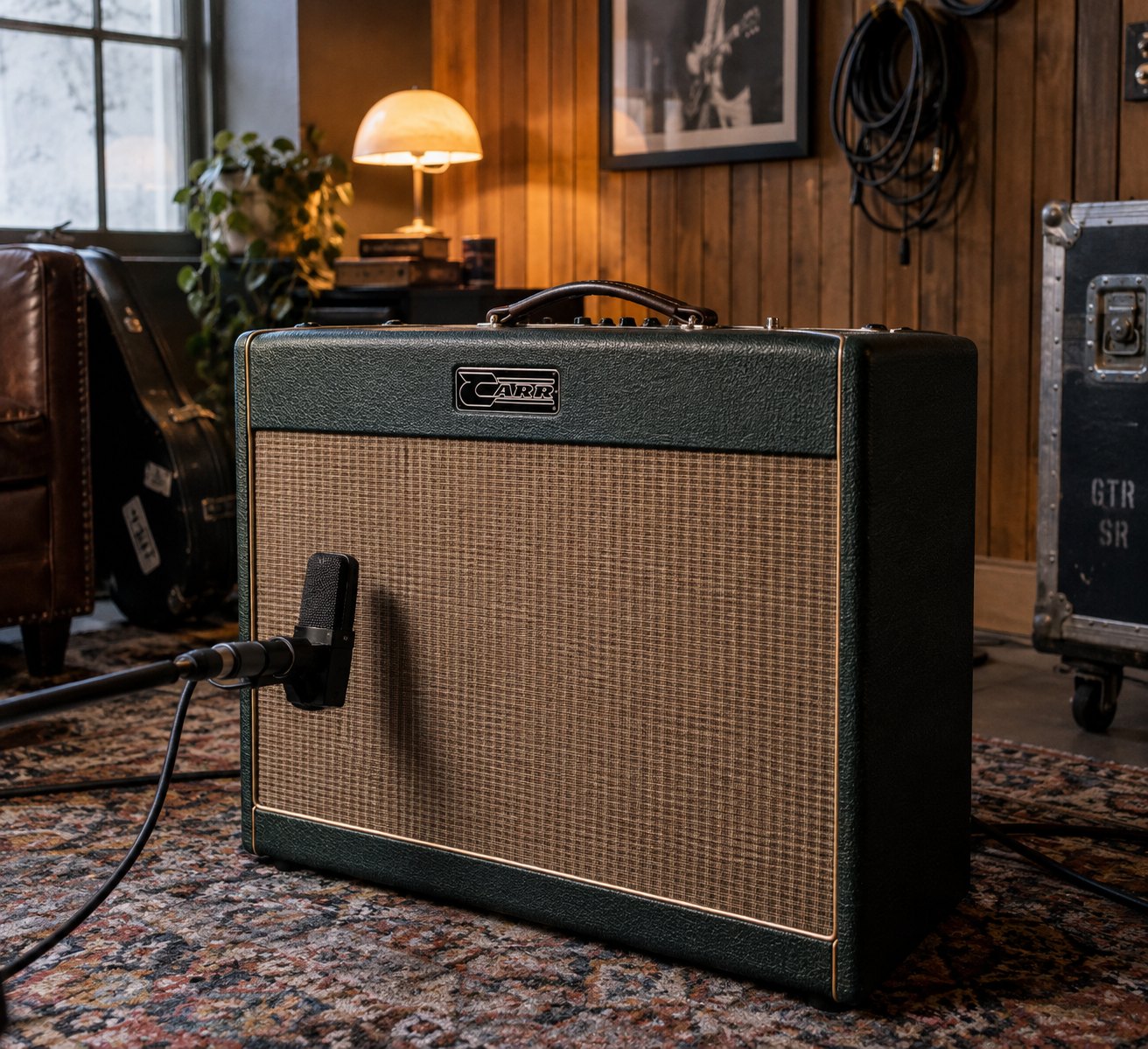
The Club Amp That Nashville Built Its Sessions Around: Inside the Carr Rambler
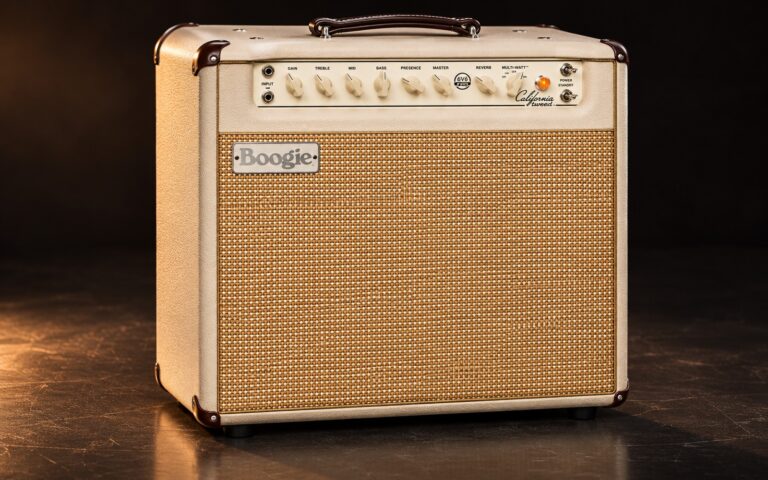
Carr Rambler Combo. AI-generated reference illustration, not a photograph.
Carr Rambler: 28W hand-wired 1x12 combo blending Princeton Reverb clarity and tweed Pro authority. Specs, verified player rigs, tone recipes, buying guide.
Ask a working Nashville session player what they reach for when they need a single amp to cover any gig, take any pedal thrown at it, and sound expensive without demanding a roadie to carry it, and the Carr Rambler turns up on a surprisingly short list. Steve Carr launched it in May 1999 as his second model — a hand-wired point-to-point combo he described as “a collage” of a black-panel Fender Princeton Reverb and a tweed Fender Pro. That description is still the fastest way to explain what a Rambler sounds like to someone who hasn’t played one: the chime and bloom of the Princeton, the authority and warmth of the Pro, squeezed into a 40-pound dovetailed yellow-pine box with reverb and tremolo already inside.
Twenty-five years later it’s still in the catalogue, still hand-built in Carr’s Pittsboro, North Carolina facility, and still the first amp most visitors to that facility are pointed toward when they want to understand what the brand stands for. This isn’t a nostalgia play — it’s because the Rambler solved something genuinely hard: delivering classic American-voiced clean headroom at club-appropriate wattages without any of the compromises that cheap out the clones.
From a Chapel Hill Barn to the Quintessential Club Amp
Steve Carr spent the mid-1990s repairing amps for the Triangle-area band circuit — Chapel Hill, Raleigh, Durham — getting a crash course in what went wrong with Fenders, Marshalls and their knockoffs under nightly gigging conditions. The repair work taught him the industrial supply chain, the component quality tiers, and, most importantly, the difference between an amp that sounds good in a quiet room and one that holds together on a noisy stage.
His first build was the Slant 6V, a marriage of a black-panel Fender Deluxe Reverb’s clean channel with the drive architecture of a non-master-volume 50-watt Marshall. He sold the first two in the fall of 1998, and they went to Eddie Berman at the Music Loft in Wilmington, North Carolina — Berman later said the clean channel was “broad, cinematic and sweet-sounding, free from any top-end harshness.” That reputation spread fast through the Southeastern dealer network, in part because Matchless had just folded in 1998, leaving boutique-minded dealers looking for a replacement line.
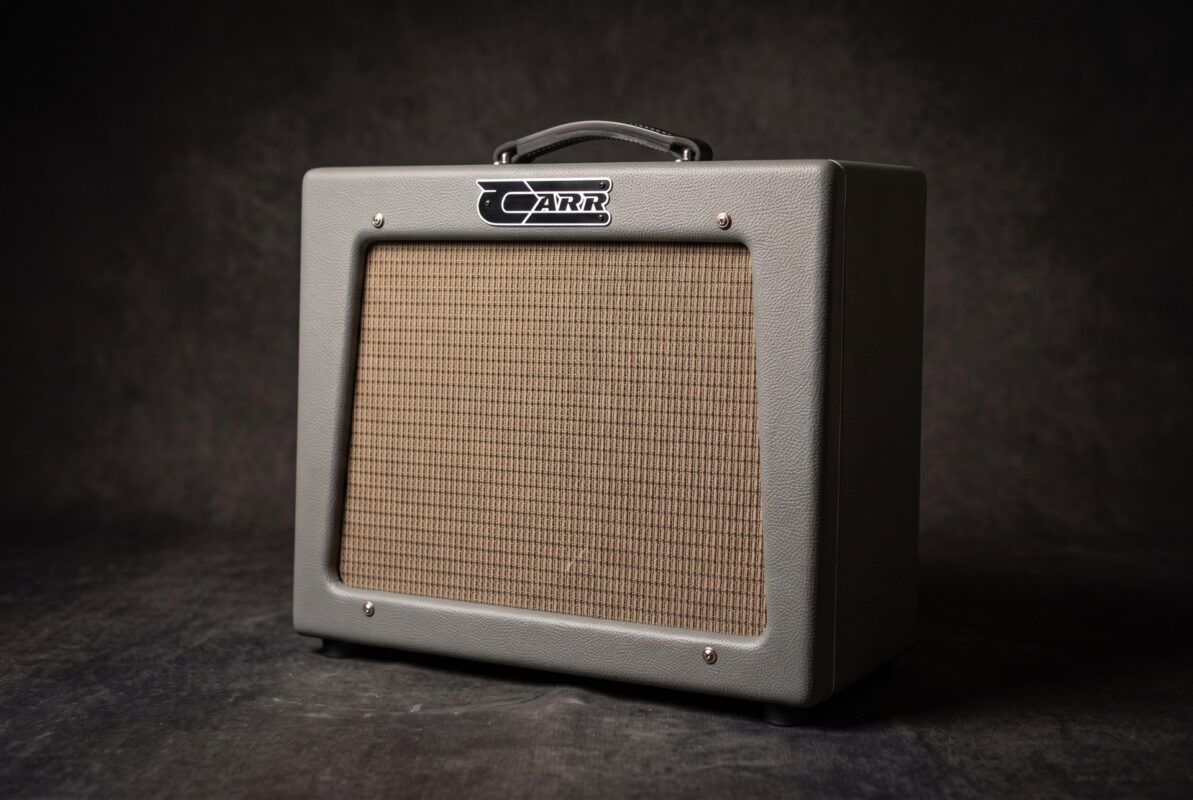
In May 1999, the Rambler followed. Where the Slant 6V married American and British gain architectures, the Rambler stayed entirely on American ground: Princeton Reverb tone stack and voicing for the clean platform, tweed Pro DNA for the power section’s weight and warmth. The goal was a 1×12 club combo with reverb, tremolo, and enough clean headroom that a working guitarist could run any overdrive pedal in their bag without the amp adding its own unwanted compression before the signal had been shaped.
Carr ran the operation out of a wooden barn on the outskirts of Chapel Hill through about 1999 and into 2000, then relocated to a former chicken hatchery in Pittsboro — a two-room rental that eventually expanded to 4,500 square feet as the business grew. In-house cabinet building started in 2003, with Peter Mather of Virginia Beach training the Carr team in the dovetail yellow-pine construction that has become as much a part of the brand’s identity as the circuits inside. Steve Carr has cited 1920s through 1960s art deco design as the key visual influence on the cabinet shapes — which explains why the Rambler’s sloping baffle and understated hardware feel more intentional than most amp aesthetics.
The Rambler became the first Carr model that Nashville session players gravitated toward, and it has stayed there. As Carr himself said in a 2024 Premier Guitar interview: “The names of these folks, people may not know, but you’ve probably heard a lot of these session guys who’ve got Ramblers.”
Specifications
Note on wattage: The Carr product page contains an internal discrepancy — the Features bullet list says “26 watts pentode / 13 watts triode” while the Specs section on the same page says “28 watts pentode operation, 14 watts triode.” The price list and independent retailers (Humbucker Music) consistently state 28W/14W. Article uses 28W/14W as the operative figure, consistent with the price list and the majority of retailer spec sheets. This is a copy-paste artefact in Carr’s own documentation, not a meaningful sonic variable.
Note on pricing: The Carr price list (effective 1/1/2024) and the live product page show a significant gap — approximately $310–$330 depending on configuration. As established with the Mercury V, the product page is updated more frequently than the price list. Confirm current pricing directly with an authorised Carr dealer before ordering; neither figure is guaranteed to reflect what you’ll actually be invoiced.
Note on speaker: The Rambler’s speaker has changed at least twice since launch. A 2009 JazzTimes review noted an Eminence Red Coat “The Wizard.” Later listings cite the Eminence Elsinore 12″. The current product page lists the “Carr Valiant 8 ohm speaker” — a Carr-branded driver. Used buyers should verify which speaker they’re getting, as all three voice the amp differently at its top end.
Famous Players
Charlie Hunter is the most documented professional Rambler user with the most specific on-record details. The seven-string guitarist and bassist — whose simultaneous bass-guitar technique makes his amplifier requirements unique — runs two touring rigs, one on each coast. In his own words in a Premier Guitar interview: “For the West Coast, I have a Rambler chassis that actually houses a Carr Impala, with the master volume removed because I don’t need that. Sometimes those amps get swapped and the West Coast becomes the East Coast and vice versa. Both are absolutely great amps, and I’ve never had anything resembling a problem with either one.” His East Coast amp is a genuine Rambler modified to Class A/B operation — a change driven by his extended low-frequency bass strings, which benefit from an amp voicing with more percussive attack and less of the Rambler’s inherent sweetness.
Neko Case is confirmed on the Rambler via Equipboard and press interviews. She describes it as small but very loud, praises its “untouchable sustain and reverb,” and notes that she uses it as her sole amplifier without any pedals — a genuinely unusual claim about a 28-watt combo that speaks to how the Rambler’s natural headroom, reverb character, and three-band EQ handle tone-shaping duties that most players delegate to a pedalboard.
Dave Gregory, the guitarist best known for his work with XTC, uses a Carr Rambler and keeps it in pentode mode for what he describes as a clean, beautiful tube sound. He pairs it with an EHX Soul Food for extra lift when a crunchier rock-and-roll edge is needed — a pairing that illustrates the Rambler’s function as a platform that accepts simple boosts without compressing or muddying them, rather than as a drive-generating amp in its own right.
Buddy Miller was a documented Rambler user for a significant period of his career, and his name circulates widely in discussions of the amp’s Nashville credibility. His current rig, as confirmed by a Premier Guitar Rig Rundown, has moved on to Swart AST Pro amplifiers in parallel configuration — so the Rambler connection is historical rather than current, but it represents the Nashville chapter of the amp’s story accurately.
Bill Frisell first encountered Carr amplifiers through a Rambler — bassist Viktor Krauss loaned him one during a Nashville recording session. As Frisell told Premier Guitar in a July 2024 interview, that experience led him to seek out the Mercury at a later session, then visit the Carr shop in Pittsboro to pick up a Mercury of his own. When the Sportsman came out, he bought one of those too. His primary touring and home Carr is now the Sportsman, which he uses alongside early-1960s Gibsons and Fenders. The Rambler was the gateway — the amp that made him want more Carr in his life — but Frisell’s ongoing documented Carr instruments are the Mercury and Sportsman. That said, the image of one of the most harmonically sophisticated guitarists alive being handed a Rambler on a session and immediately getting it is its own kind of endorsement.
The Carr brand artist page lists over forty players — Alex Kapranos, Billy Gibbons, Eric Johnson, Richard Thompson, Jorma Kaukonen, Nels Cline, Joe Perry, Paul Simon, Jeff Tweedy, Keith Richards — but as established in the Mercury V article, that page does not specify models for any entry. None of those names can be attributed to the Rambler from the artist page alone. The four confirmed Rambler users documented above come from primary interviews and per-model Equipboard data, not from the brand roster.
The Circuit: What “Collage” Actually Means
When Steve Carr calls the Rambler a collage of a black-panel Princeton Reverb and a tweed Pro, he’s pointing at the two most important axes of American clean-amp design: clarity versus authority. The Princeton Reverb (1964–1979, in its canonical black-panel form) is a 12-watt single-6V6 combo whose clean headroom is modest but whose bloom, reverb, and top-end shimmer became the gold standard for studio and small-room work. The tweed Pro (5E5A, mid-to-late 1950s) is a very different beast: two 6L6s in cathode-biased Class A operation, a bass-heavy voice, and a natural compression under heavy picking that earned it a spot in countless 1950s recordings. Marrying those two isn’t obvious — the Princeton wants to stay clean and sweet, the Pro wants to push the output tubes into harmonic saturation.
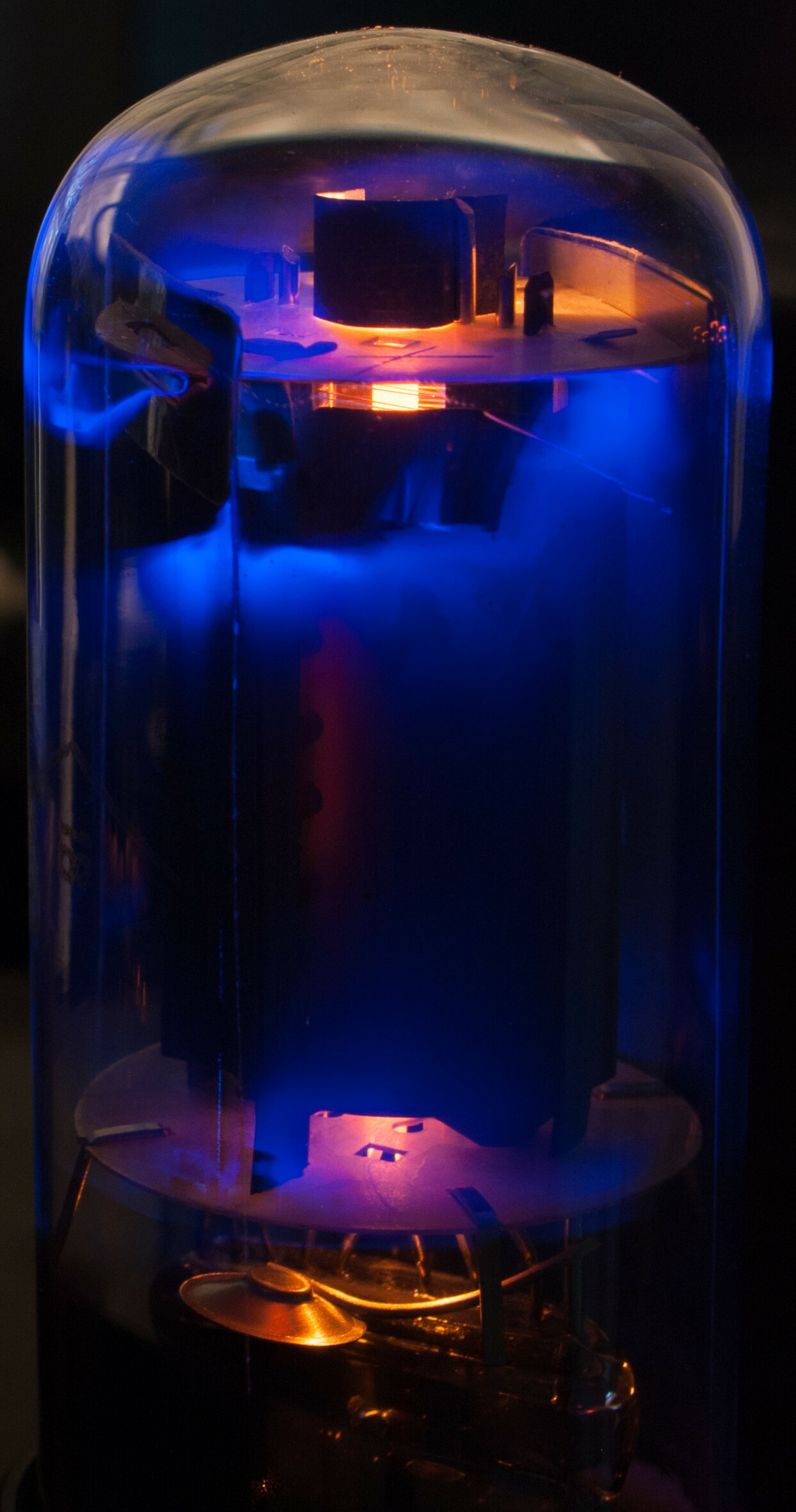
What Carr resolved was the power section. The Rambler uses two 5881s (the military designation for what is functionally a 6L6GC) in cathode-biased Class A configuration, producing zero negative feedback. No NFB is a design choice with audible consequences: it means the amp’s output impedance is higher, the bass response is less damped and tighter, and the transient response has a faster, more immediate quality — which is exactly what session players are describing when they call it the “best clean platform.” The harmonic structure is simpler and more exposed than a feedback-loop amp, which is why the Rambler sounds so transparent under overdrive pedals: there’s no hidden midrange push from the amp itself interacting with the pedal’s voicing.
The cathode-biased output stage also means the Rambler is self-biasing — swap the 5881s for any matched pair of 6L6GCs and there is no bias procedure required. This is a practical touring and session advantage that gets less attention than it deserves. No tech with a bias probe required; no downtime mid-tour. The amp adjusts itself.
The Triode/Pentode switch is the Rambler’s second major design tool. In pentode mode — the default, the full 28 watts — the amp operates as described above: clear, articulate, high headroom, pedal-transparent. In triode mode (14 watts), the output tubes are re-configured to triode topology, which changes the amp’s character substantially. Triode mode produces a thicker, warmer midrange, a more compressed feel, and less clean headroom — the kind of sound that breaks up more readily and sits differently in a mix. The JazzTimes 2009 review noted that in triode at low volume the low and low-mid frequencies felt slightly lean, with more authority appearing as the volume came up. In pentode at high volume, the same reviewer found the low end could become mushy under very hard picking in certain registrations. Both observations hold: the Rambler is voiced for its sweet spot in pentode mode at moderate volumes, which happens to be exactly the level at which a working club guitarist runs it.
The 5751 preamp tube — one of the three preamp valves, rather than a 12AX7 — is a smaller design choice worth noting. The 5751 is a lower-gain 12AX7 substitute (approximately 70% of 12AX7 gain) that gives the preamp a cleaner, quieter character at the input stage. It’s the reason the Rambler’s noise floor is so low and its touch-response feels so open: the first gain stage isn’t amplifying every breath of hiss along with your guitar signal.
Tone and Frequency Profile
The Rambler’s native voice sits in the range of approximately 200Hz to 8kHz, with its most characteristic energy in the 800Hz–4kHz window — the upper-midrange presence that carries pick attack, string clarity, and harmonic content through a full-band mix without needing to be boosted at the board. This is the Princeton inheritance: the original amp’s voice sat in that upper-mid zone, which is why it cuts so well on recordings even at low volume. The Rambler expands on it with the tweed Pro’s lower-octave authority: the bottom end is present, controlled, and articulate rather than the slightly thin quality you get from smaller single-ended Princeton circuits.
The Mid control is, as Carr describes it, the feature the original never had — and it’s the one that makes the Rambler genuinely versatile rather than just a better Princeton. A full clockwise Mid sweep adds a forward, slightly nasal quality that sits the amp in the same tonal space as a Vox AC30 Normal channel, useful for jangle and chord-melody work. Rolling it back produces the characteristic Princeton scooped mid sound, which is where country pickers and clean funk players usually land. The Bass and Treble controls interact with it the way a blackface tone stack does — but with more authority at the bottom because the bigger output section actually has the headroom to deliver it.
In a live band mix, the Rambler at 28 watts pentode through its 12-inch driver has enough headroom to stay clean across most club-volume situations with a standard guitar signal. Players who need to get the amp into natural overdrive territory at gigging volume are better served by the Mercury V (16 watts, 6V6s, attenuator built in) or by using a quality boost or overdrive pedal in front of the Rambler — which is what the amp is famous for accepting gracefully.
Tone Recipes and Settings
Recipe 1: Nashville Session Clean
The reference setting. Use this with a Fender Stratocaster middle-pickup or neck pickup. Switch to pentode mode. Set Volume around 4–5 (just below where the amp starts to compress), Treble at 6, Mid at 5, Bass at 5, Reverb at 3. The result is the archetypal American clean: clear, warm, bell-like, with enough room ambience to feel musical without washing out chord definitions. This is the setting that made session players in Nashville adopt the amp. No pedals needed; add a Tube Screamer-style device at low gain if the tracking needs to sit slightly forward.
Recipe 2: Country and Twang
Bridge pickup on a Telecaster or a Stratocaster. Pentode mode. Volume 5–6, Treble 7, Mid 3–4 (slightly scooped), Bass 4, Reverb 4, Tremolo Depth 4, Tremolo Speed 5 (moderate flutter). The mid scoop opens up the brightness on top without harshness — the Mallory 150 signal caps contribute to the top-end roll that keeps it from going shrill. The tremolo circuit is tube-driven and modulates the entire signal path, producing a warmer, less mechanical movement than optical designs. This is the country-picker’s version: cluck on attack, ring on sustain, bounce from the tremolo.
Recipe 3: Touch-Sensitive Blues Overdrive (Pedal Platform)
Set the Rambler clean in pentode: Volume 4, Treble 6, Mid 6, Bass 5, Reverb 2. Run an Ibanez TS-9 Tube Screamer or similar mid-focused overdrive in front at low Drive and moderate Level — just enough to push the signal into the Rambler’s input stage. The amp’s zero-NFB cathode-biased circuit responds to the Tube Screamer’s harmonic content without adding its own midrange push; the result is a transparent but saturated blues tone where picking harder produces more breakup and lighter picking cleans up. This is precisely what Neko Case is NOT doing — she uses the amp clean with no pedals — and precisely what the Rambler is also famous for enabling at the opposite end of the pedalboard spectrum.
Recipe 4: Triode Room Recording
Switch to triode mode (14 watts). Volume 6–7 (the reduced headroom means this runs the output stage warmer), Treble 5, Mid 6, Bass 4, Reverb 5. Use a Gibson Les Paul on the neck pickup. This recipe exploits the triode mode’s thicker midrange and faster compression: the amp responds like a bigger amp turned down, not a small amp turned up. The sustain is long and harmonically layered. As a recording source, mike 2–3 inches off-centre at the speaker’s dust cap and mix in a room mic for depth. Keep an eye on the low-mids — the JazzTimes reviewer found them could go mushy at this kind of output in triode; a gentle cut at 250–350Hz at the desk keeps the picture clean.
Recipe 5: Classic Rock Crunch (Dave Gregory style)
Pentode mode. Volume 5, Treble 7, Mid 7, Bass 5, Reverb 2. Engage an EHX Soul Food or transparent boost pedal in front at moderate gain. Humbucker-equipped guitar. This is the configuration Dave Gregory (XTC) describes using — the Rambler providing a very clean, harmonically detailed foundation and the Soul Food adding the character and compression of a slightly pushed output stage without asking the amp to do it itself. The result is a classic British-influenced crunch that sits closer to an early Marshall sound than the amp’s native American voice, which illustrates the Rambler’s chameleon quality under the right overdrive pedal. The JCM800 does this internally, in the amp itself; the Rambler farms that work out to the pedal chain and is cleaner for it.
Comparisons
vs. Fender Deluxe Reverb
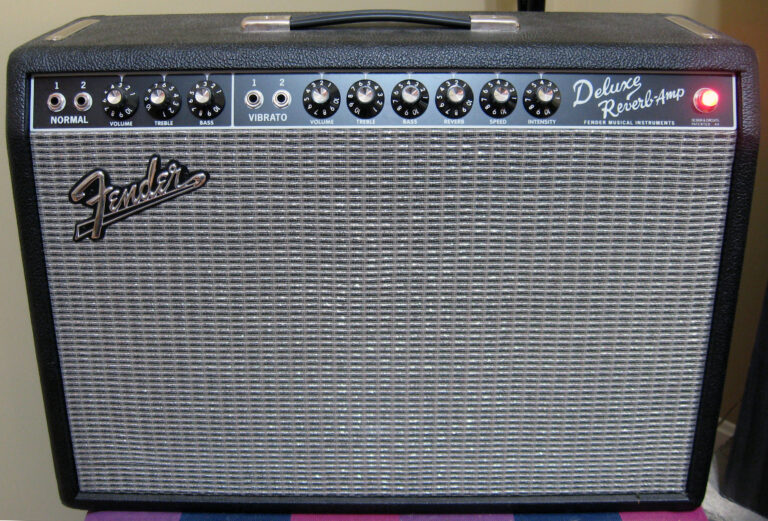
The Deluxe Reverb is the amp the Rambler is most often pitched against, because they share the same basic brief: a 1×12 combo with reverb and tremolo at club-appropriate wattage. The differences are real and audible. The Deluxe Reverb uses a fixed-bias Class AB output stage with negative feedback, which produces a tighter, slightly more scooped-mid sound and a slightly more aggressive clean headroom that breaks up earlier when pushed. The Deluxe Reverb at $1,349 new costs roughly a third of the Rambler’s current retail price. What the extra money buys: the Rambler’s lower noise floor, the cathode-biased zero-NFB circuit’s warmer and more bloom-y clean tone, the Mid control the Deluxe doesn’t have, the Triode/Pentode switch, the pine cabinet’s acoustic properties, and the hand-wired point-to-point construction’s repairability. Both are legitimate first calls. The Deluxe Reverb replaces itself more cheaply when things go wrong; the Rambler sounds better when things go right.
vs. Carr Mercury V
The Carr Mercury V is the other Carr combo most often compared to the Rambler, and the differences define each amp’s intended use. The Mercury V: 16 watts, 2× 6V6GT (smaller, warmer tubes), three-position Boost switch, built-in attenuator (16W → 4W → near-0W), post-power-amp Line Out with speaker roll-off simulation, no tremolo. The Rambler: 28 watts, 2× 5881/6L6GC (bigger, more headroom), Triode/Pentode switch only, tube tremolo included, no attenuator. The Mercury V is the better choice for players who need to push output tubes into saturation at low stage volumes — its attenuator solves that problem directly. The Rambler is the better choice for players who want the maximum clean headroom available from a Carr 1×12 and plan to manage their drive from pedals. The Mercury V at $3,340 (combo, price list) costs $190 more than the Rambler’s $3,150 on the same list — effectively even. The functional difference is the attenuator versus the tremolo.
vs. Tone King Imperial MKII
The Tone King Imperial MKII is a 20-watt two-channel combo with built-in Ironman II attenuator, tube-driven reverb and tremolo, and an Eminence ‘Tone King 33’ speaker at $2,695. It occupies a similar tonal territory — American-voiced clean platform, reverb and tremolo included, boutique construction — but covers different design priorities. The Imperial MKII has two channels (Rhythm blackface / Lead tweed), the Ironman II reactive attenuator for power-tube saturation at low volume, and PCB construction (mostly). The Rambler is single-channel, no attenuator, point-to-point construction, and costs more on the current product page. The Imperial MKII’s two channels give it more tonal flexibility without pedals; the Rambler’s PtP construction and cathode-biased zero-NFB circuit give it a different quality of headroom and repairability. Neither is obviously superior — they solve different problems for different players.
vs. Matchless Lightning
The Matchless Lightning is a 15-watt EL84 single-channel combo that represents the British boutique tradition: tight, cutting, harmonically complex, with an almost self-contained quality that doesn’t warm up further under pedals. The Rambler is the opposite temperament: warm, bloom-y, inviting of pedal interaction, American-voiced. Both are hand-wired boutique amps at comparable price points. The Lightning rewards players who want a sound that fights to assert itself over a band; the Rambler rewards players who want to build a sound in layers — amp clean, pedal drive, EQ at the board. For jazz, the Rambler; for indie or jangle rock, the Lightning.
vs. Dr. Z MAZ 18 Jr NR
The Dr. Z MAZ 18 Jr NR is an 18-watt cathode-biased EL84 combo with a single volume control and a simple three-band EQ — significantly less expensive and sonically more one-dimensional. It excels at getting into natural output-tube saturation at moderate volumes and producing a Vox-influenced harmonic character that breaks up consistently. The Rambler has a Mid control, Triode/Pentode switching, built-in reverb and tremolo, and far more clean headroom. The MAZ 18 is the better answer for players who want amp-generated breakup and simplicity; the Rambler is the better answer for players who want clean headroom and the flexibility to bring their own sounds. The price gap is significant: the MAZ 18 Jr NR runs around $1,800 new.
Buying Guide
New (2026): The Rambler is in active production with a 3–10 day lead time from Carr. The discrepancy between the 1/1/2024 price list ($3,150 combo / $3,030 head) and the current product page ($3,460 combo / $3,330 head) means the transaction price will depend on when you order and which price your dealer is currently working from. Call your authorised Carr dealer and get a current quote before making assumptions based on either published figure.
Custom colour options add $100 (single-tone non-black), $150 (two-tone), or $200 for the exotic finishes: tweed, brown gator, or black gator. These are the most common reasons for used Ramblers to command a premium over a standard black example.
Used: Ramblers hold value exceptionally well. Used prices on Reverb range from approximately $2,200 to $2,900 depending on condition, cosmetic finish, and which speaker is currently installed. When buying used, confirm the following: (1) which speaker is in the cabinet — Red Coat Wizard, Eminence Elsinore, or Carr Valiant each voice the amp differently and only the Carr Valiant represents the current production spec; (2) whether the tremolo footswitch is included (the original included one; sourcing a replacement is straightforward but worth negotiating into the price); (3) which tubes are installed and when they were last replaced. The self-biasing output stage means tube swaps are simple and require no tech visit, but matched pairs of 5881/6L6GC of comparable quality vary significantly in price.
Head vs. combo: The head configuration weighs 30 pounds versus the combo’s 40 and can pair with any 8-ohm external cabinet. If you already own quality 1×12 or 2×12 cabinets, the head saves weight and lets you choose your speaker. The combo’s yellow-pine floating-baffle cabinet is a voiced enclosure, not a generic box — it contributes to the amp’s low-mid warmth in ways that a generic MDF cab will not replicate. Players who buy the head should budget for a quality open-back pine cabinet to approximate what the Carr factory delivers.
What it doesn’t have: No effects loop. No master volume (the Triode/Pentode switch is the only power attenuation available). No built-in attenuator — unlike the Mercury V, the Rambler cannot be turned down to studio-whisper levels while keeping the output tubes working. No footswitchable reverb (the reverb is always on). No reverb defeat switch. Players who need an effects loop for time-based effects will need to work around this: many delay and reverb pedals work fine in front of the input without significant tone degradation at these wattages.
Ownership Notes
Self-biasing output stage: The cathode-biased Class A output stage adjusts itself automatically when you swap output tubes. There is no bias procedure to perform and no tech visit required. Use any matched pair of 5881, 6L6, or 6L6GC tubes from a reliable supplier. Allow the amp to warm up for 15–20 minutes before heavy use after a tube change, but there’s no test equipment involved.
Speaker break-in: The Carr Valiant (current production) benefits from break-in, as most high-quality guitar speakers do. The amp will sound slightly stiff and constrained in the first 10–20 hours of use. Don’t judge the low end or the midrange bloom until it has run for a while. This is particularly relevant for used buyers who are testing an amp with a new speaker installed.
Tremolo: The Rambler’s tube-driven tremolo circuit modulates the entire signal path — bias tremolo rather than optical tremolo — which produces a warmer, less mechanical movement. It is not footswitchable on/off via the panel; the included footswitch handles tremolo bypass. If you don’t use tremolo, the footswitch simply stays off and the circuit contributes nothing to the signal path. The tremolo’s Depth and Speed controls are highly interactive: at high Depth settings the tremolo chops the signal significantly; at moderate settings it produces the gentle swell associated with 1960s American amp tremolo. The Speed range covers everything from a slow wash to a fast stutter.
Reverb: The spring reverb in the Rambler is always in the circuit — there is no reverb defeat switch. The Reverb control’s lower limit produces a barely audible room ambience; at its maximum, the spring character becomes prominent. For dry tones (or for situations where the stage reverb from the PA system makes the amp’s own reverb muddy), keep the Reverb control at its minimum position. Some players prefer to use the Reverb for tracking and turn it down for live work.
Cabinet and humidity: The solid yellow-pine cabinet is sensitive to significant humidity swings, as any solid-wood cabinet is. If you’re transporting the amp between climate-controlled environments and outdoor gigs in summer heat, allow it time to equalise. The floating speaker baffle is designed to allow the cabinet to breathe and resonate — it is not a design flaw that it moves slightly. Don’t force the baffles or treat them as though they should be fixed rigidly.
Noise floor: The combination of the 5751 preamp tube at the input stage and the zero-NFB output stage produces one of the lower noise floors among vintage-voiced boutique amps in this wattage class. If you’re experiencing unusual hum or hiss, check the output tube seating (cathode-biased amps are sensitive to loose tube pins) before assuming a component problem.
Frequently Asked Questions
What’s the difference between the Rambler and the Carr Mercury V?
The Mercury V (16 watts, 6V6 tubes) has a built-in attenuator for power-tube saturation at low volume, a three-position Boost switch, a post-power-amp Line Out, and no tremolo. The Rambler (28 watts, 5881/6L6 tubes) has the higher clean headroom, a tube-driven tremolo, the Triode/Pentode switch, and no attenuator. Choose the Mercury V if power-tube saturation at controllable volumes is the priority; choose the Rambler if maximum clean headroom and pedal transparency are the priority.
Does the Carr Rambler have an effects loop?
No. The Rambler has no effects loop. Time-based effects (delay, reverb pedals) can run in front of the input without significant tonal penalty at club volumes, since the amp’s high headroom means it won’t interact destructively with the pedal’s output level. Players who absolutely require a true effects loop should look at other Carr models or add an external loop-switcher.
Can I use 6L6 tubes in the Rambler instead of 5881s?
Yes. The 5881 is the military designation for a tube functionally equivalent to the 6L6GC. Any matched pair of 5881, 6L6, or 6L6GC tubes from a quality supplier will work. The cathode-biased self-biasing output stage requires no bias adjustment on tube swap. Different brands of 6L6GC will produce subtly different sound — Sovtek, JJ, Electro-Harmonix, and NOS Sylvania variants all have documented sonic differences — but all are electrically compatible.
How loud is 28 watts from the Carr Rambler compared to a 22-watt Fender Deluxe Reverb?
Louder, but not dramatically so in terms of perceived volume. The difference between 22 and 28 watts is approximately 1dB — barely audible in isolation. The more significant difference is the Rambler’s cathode-biased zero-NFB circuit, which responds differently to the speaker load and produces a different kind of headroom rather than simply more volume. The Rambler stays cleaner at a given stage level than the Deluxe Reverb; it doesn’t simply get louder.
Is the Carr Rambler appropriate for jazz?
Yes, unambiguously. The amp’s warm, clean, articulate character suits hollow and semi-hollow instruments (ES-335, ES-175, L-5) well, and the Mid control allows the player to dial in the slightly forward midrange presence that jazz guitarists want without rolling into the nasal quality that makes some blackface amps sound thin under archtop pickups. The reverb quality is musical for jazz — it’s a spring, so not entirely natural, but at low settings it adds room ambience rather than cave echo. Charlie Hunter is the clearest example of the Rambler serving extended-range and unusual harmonic territory at a professional level.
What does “zero negative feedback” mean in practical terms?
Negative feedback is a circuit technique where a portion of the output signal is fed back to the input out of phase, which reduces distortion, tightens the bass response, and lowers output impedance. Most classic Fender amps use some degree of NFB. Removing it produces a higher output impedance, slightly looser bass control, a faster and more dynamic transient response, and a different quality of harmonic distortion when the amp is pushed. In practical terms, a zero-NFB amp like the Rambler feels more “immediate” under the pick and responds more directly to the player’s dynamics — which is the quality that makes it such a transparent pedal platform. The flip side: the bass control is slightly less damped than in an NFB amp, and some players find the extra bloom in the low-mids less controlled at high volumes.
Is the Carr Rambler hand-wired point-to-point?
Yes. Carr specifies “Hand wired point-to-point in the USA” for the Rambler. This distinguishes it from amps using turret boards or PCBs. PtP construction means individual components are soldered between connection points directly, which affects both the amp’s sonic character (shorter signal paths, component selection more directly audible) and its long-term serviceability (a competent amp tech can diagnose and replace any component without sourcing proprietary boards). This is one of the primary reasons Carr amps hold their value on the used market: they are repairable for decades by any qualified technician.
What pedals work best with the Carr Rambler?
The Rambler’s zero-NFB cathode-biased circuit is notably transparent under a wide range of overdrive and boost pedals, which is why it has accumulated the “quintessential pedal platform” reputation. The most documented pairings: transparent boosts (Soul Food, Klon-type circuits, clean boosters) for pushing the input stage without adding colour; mid-focused overdrives (Ibanez TS-9 and variants) for blues and classic-rock textures; fuzz pedals (silicon and germanium both) at the input for a harmonically dense saturation that the amp’s clean headroom keeps from compressing into mush. The amp generally rewards pedals that are well-matched to its own voicing character — it is not particularly forgiving of low-quality cheap overdrives, which will make it sound generic rather than expensive.
Image credits
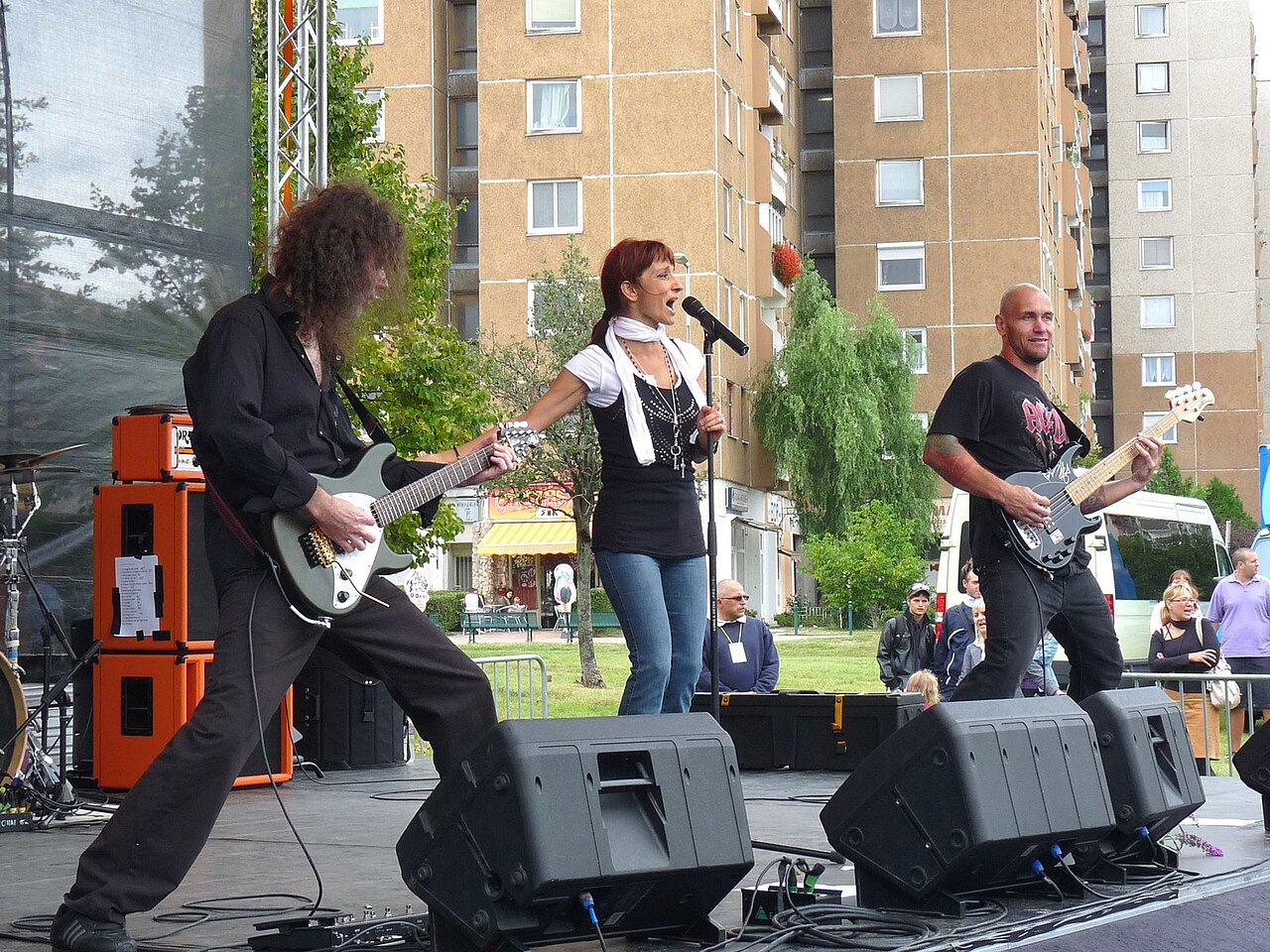
- A band playing outdoors with an orange amp: Fekist, Wikimedia Commons, CC BY-SA 4.0.
- A glowing power tube: Rob Robinette, Wikimedia Commons, CC BY-SA 4.0.
- Top image: GuitarGangsters AI-generated reference illustration, not a photograph.
- Carr Rambler: AI-generated illustration by GuitarGangsters, based on the manufacturer’s product design (not a photograph).
- Fender Deluxe Reverb: DlxReverbFront, Wikimedia Commons, CC BY-SA 3.0.
Latest News
Related
On This Day
Monday 9 November
From this week: