The Invisible Hand: How the Boss GE-7 Equalizer Shapes the Sounds You Already Love
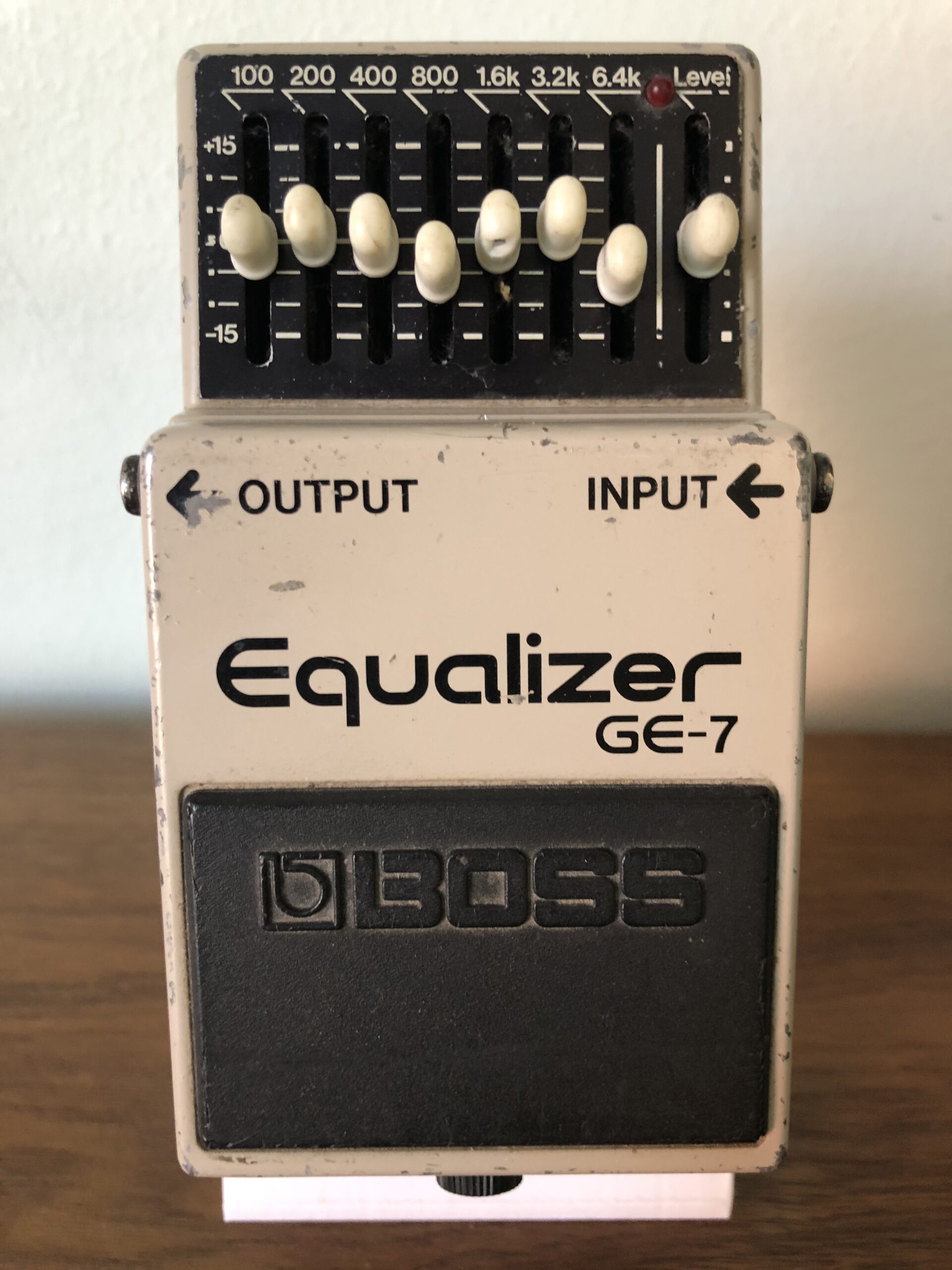
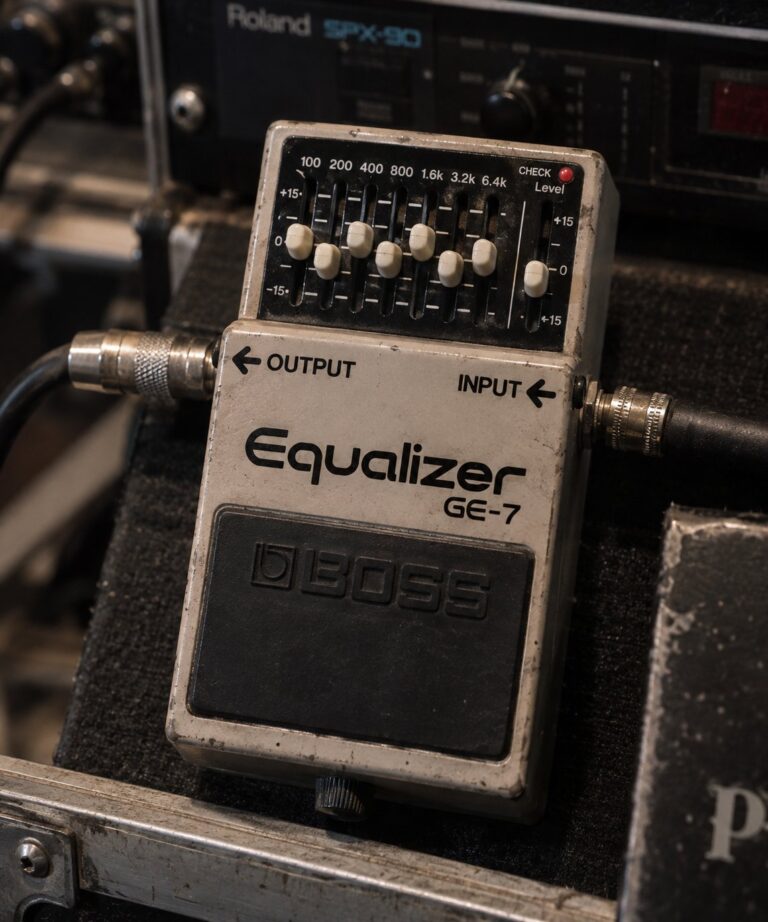
Boss GE-7 Equalizer, photographed 8 April 2021. Photo: “Boss GE-7 Equalizer.jpg” by Kuriosatempel, CC BY-SA 4.0 (https://creativecommons.org/licenses/by-sa/4.0/). Full source frame shown with its stored EXIF orientation; resized for the web. Web version: CC BY-SA 4.0. Source: https://commons.wikimedia.org/wiki/File:Boss_GE-7_Equalizer.jpg
The Boss GE-7 Equalizer is the most powerful tone-shaping pedal on your board. Guitar tone recipes, famous player settings, and honest buying guide.
Some pedals announce themselves. A fuzz explodes, a wah sweeps, a chorus shimmers — you know exactly what’s doing the work. The Boss GE-7 Equalizer is not that kind of pedal. Sitting quietly on boards from Hiwatt-driven Pink Floyd rigs to QOTSA’s desert-baked amp stacks, it operates as the silent architect of tone, adjusting frequencies with surgical precision while everything else takes the credit. It has been in continuous production since 1981 — longer than most of the players using it have been alive — and it remains the world’s most widely adopted graphic EQ pedal for guitar. Over 320 professional musicians use it, according to Equipboard. Most of them don’t advertise it. They don’t need to. The GE-7 works quietly, and that’s exactly the point.
Origin: The Boss Compact Pedal Line Finds Its Frequency Tool
When Boss launched its compact pedal lineup in 1977 with the OD-1 Overdrive, the goal was clear: studio-quality effects in a pocketable, pedalboard-friendly format. By 1981, the lineup had expanded to cover distortion, chorus, and delay. What it still lacked was a dedicated frequency management tool — a pedal that could correct problems, enhance strengths, and surgically sculpt tone at the frequency level. The GE-7 filled that gap.
The design brief was straightforward but ambitious: seven bands covering the full range of electric guitar frequencies, enough cut and boost to solve any tonal problem or create any tonal effect, all in the same compact housing as the rest of the Boss lineup. The result was a pedal that has never needed a significant revision. The GE-7 you can buy today for $135.99 at any music retailer is functionally identical to the unit that launched over four decades ago. Boss has added other EQ tools — the 10-band EQ-200, the parametric PQ-4 — but the GE-7 has never been replaced, revised, or retired. It simply works.
Early units manufactured in Japan (MIJ) from the early 1980s carry a slight collector premium on the used market, primarily among vintage gear enthusiasts rather than working players. The circuit and sound are identical to later Taiwanese production runs. If you’re buying to play, the year on the label is irrelevant.
The Seven Sliders: What Each Band Actually Does
The GE-7’s seven frequency bands — 100 Hz, 200 Hz, 400 Hz, 800 Hz, 1.6 kHz, 3.2 kHz, and 6.4 kHz — were not chosen arbitrarily. They correspond to the frequency regions that matter most for electric guitar: the fundamental low end, the body and midrange warmth, the critical attack frequencies where notes cut through a mix, and the upper harmonics that determine brightness and air. Understanding what each band actually does is the difference between guesswork and precision.
The 100 Hz band handles the sub-bass foundation — the rumble and weight below the actual guitar fundamentals. Most electric guitars rarely produce much energy here in normal playing, but a slight boost can add warmth and perceived body, while cutting can tighten up a flabby amp response. The 200 Hz band covers the low mid region where mud lives. Boosting this frequency thickens tone, but too much creates a boxy, trapped sound. Most players find small cuts here useful for cleaning up distorted tones.
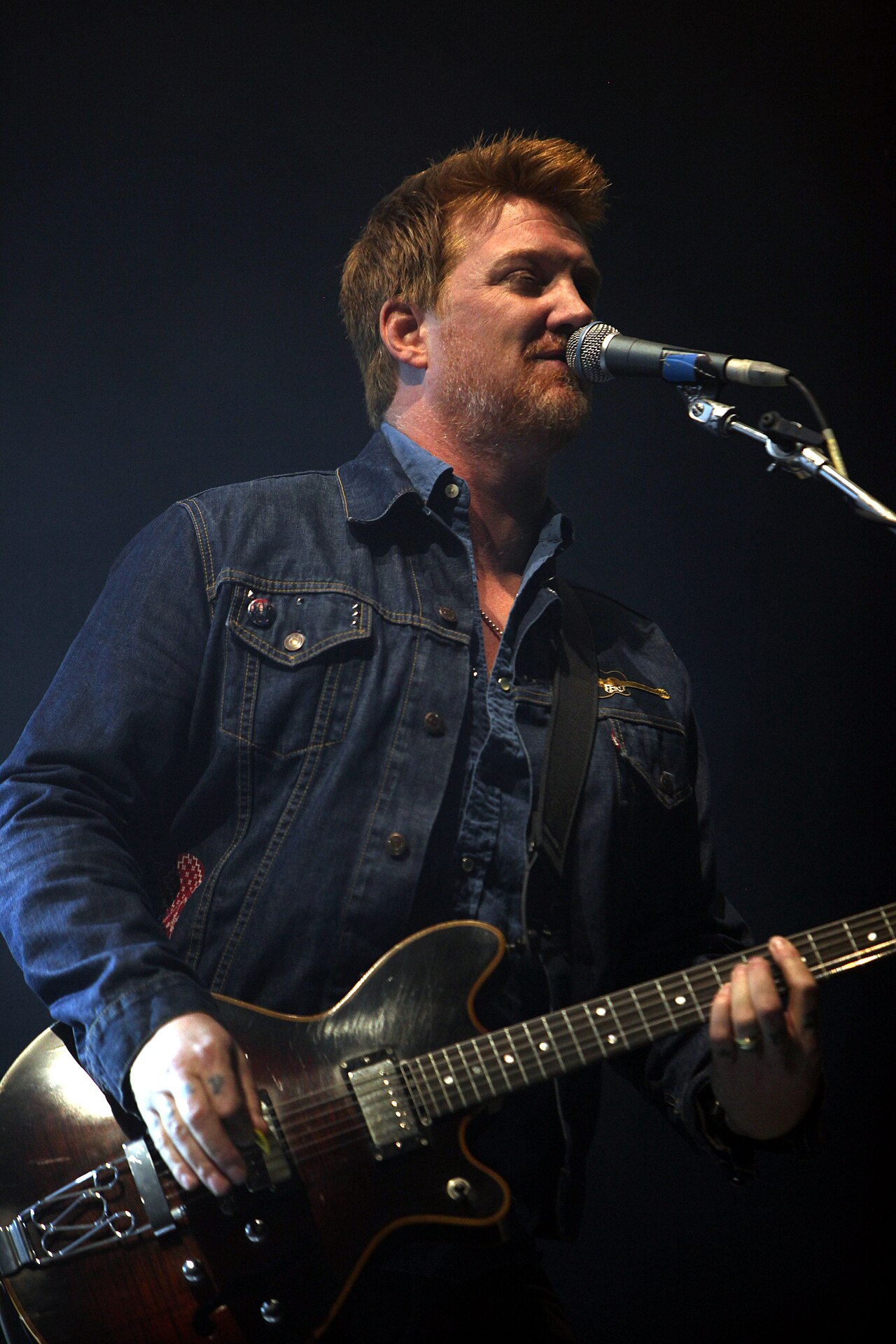
The 400 Hz band is where guitars live and where tone battles are won and lost. A boost here adds midrange presence and makes the guitar assert itself in a mix. Josh Homme specifically uses a GE-7 to boost 400 Hz — it’s the key to the vocal, punchy midrange that makes Queens of the Stone Age guitar tones cut through the band’s dense low end without sounding harsh. The 800 Hz band works similarly but adds more upper warmth and bite — boosting here thickens leads, while cutting creates a scooped, “metal” character.
The 1.6 kHz band affects the presence and attack of individual notes — where pick attack registers and where articulation lives. Boosting it makes the guitar feel more immediate and percussive. The 3.2 kHz band handles upper harmonics and the nasal, reedy quality of some overdrives — a gentle cut smooths harsh gain tones. Finally, the 6.4 kHz band is the GE-7’s only shelving filter, meaning it affects everything above that frequency as a broad shelf rather than a narrow peak. This is the air and sizzle control — slight boosts add sparkle and presence, large boosts can become harsh or expose hiss.
The Level Slider: The GE-7’s Secret Weapon
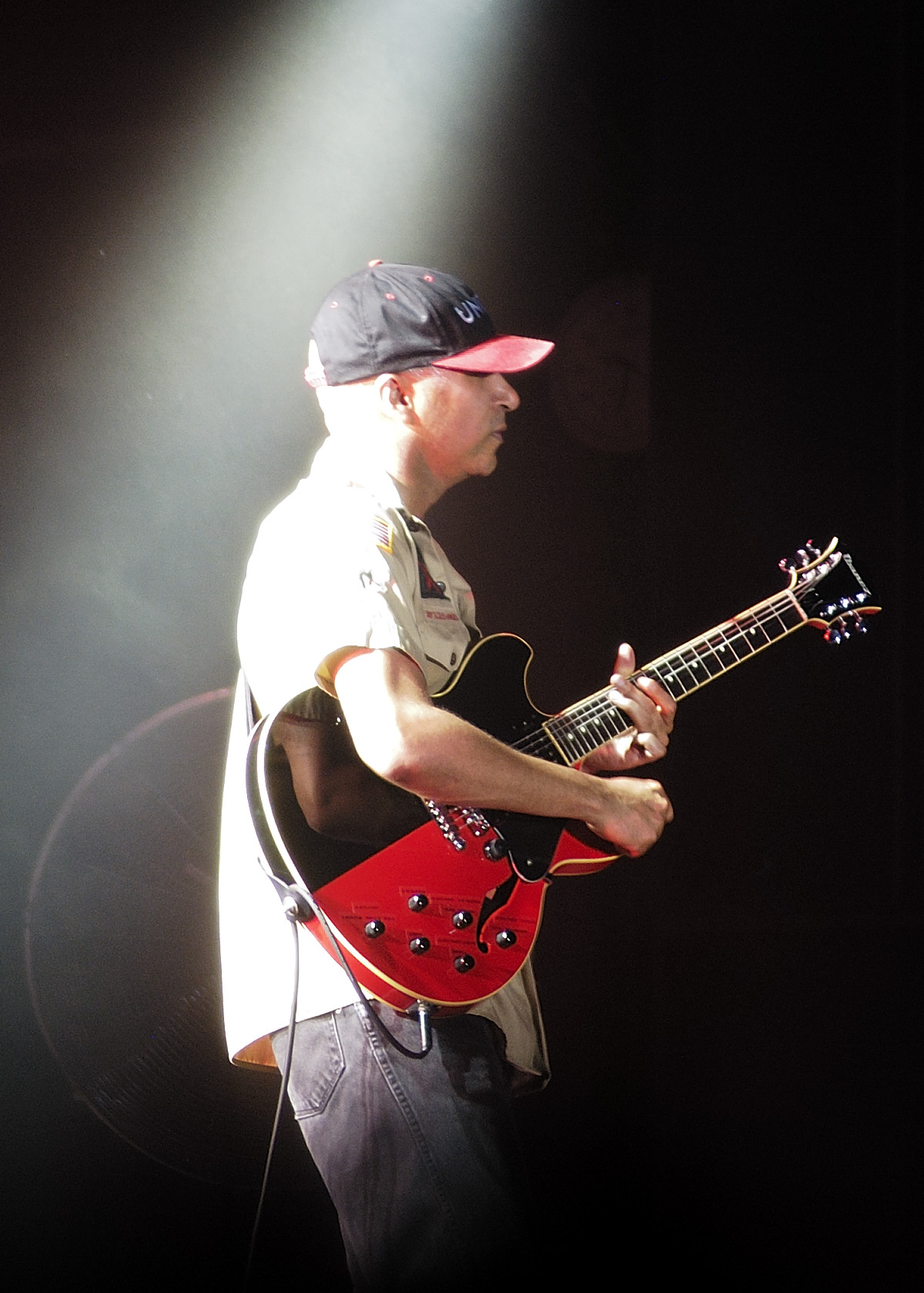
Every discussion of the GE-7’s seven frequency bands misses the most important control: the Level slider. Operating at ±15 dB of overall output level adjustment — completely independent of the frequency sliders — the Level control transforms the GE-7 from a tone shaper into a precision boost or cut tool. Set all seven frequency sliders to flat (center position), raise the Level slider, and you have a clean, flat boost with the exact amount of gain you dial in. This is how Tom Morello’s equivalent pedal — the DOD FX40B, not the GE-7 — is used in his signal chain: all sliders flat, Level raised, deployed as a clean solo boost. (See the Famous Players section for the full correction on Morello’s actual gear.)
The Level slider combined with frequency shaping is where the GE-7 becomes genuinely powerful. Raise the Level and boost selected midrange frequencies for a solo boost that not only increases volume but makes the guitar sing above the mix. Lower the Level to reduce how hard you’re hitting a tube amp’s preamp, simultaneously shaping the resulting cleaner tone with the EQ bands. This degree of simultaneous volume and frequency control is something no standard boost pedal, overdrive, or tone control can provide.
Specifications
Famous Players: Who Actually Uses the GE-7
The GE-7’s role as a supporting utility rather than a lead-tone effect means famous player associations are harder to pin down than for a fuzz or overdrive. Many players use it without ever mentioning it publicly. The confirmed users on the following list have been verified via rig rundowns, primary source interviews, or gear documentation — not aggregator sites or tone-chasing forums.
David Gilmour
Perhaps the most famous GE-7 user in rock history, David Gilmour has incorporated the Boss graphic EQ into his pedalboard across multiple touring and recording periods, including the On an Island tour of 2006 and Wall Live recordings from 2010–2012. For Gilmour, the GE-7 functions as a precision solo boost, allowing him to elevate his lead volume while simultaneously shaping the midrange emphasis that differentiates his solo tone from his rhythm tone. His playing consistently demonstrates the GE-7’s core value proposition: a smooth, controlled lift that feels musical rather than mechanical. When Gilmour soars into the upper register on a carefully crafted lead line, there’s a good chance the GE-7 is part of what separates that moment from the rhythm context underneath it. His use is extensively documented in guitar gear databases and fan-maintained rig records, making him the most prominent ambassador for the EQ-as-expressive-tool approach.
Josh Homme
Queens of the Stone Age’s principal guitarist and architect uses the Boss GE-7 in a highly specific, deeply intentional way that reveals a lot about how EQ pedals work at their most sophisticated. Confirmed via Guitar World’s January 2023 Chris Gill feature, Homme deploys the GE-7 to boost the 400 Hz band — the precise frequency region where guitar midrange assertion lives — as part of his signal chain alongside a Boss SD-1 Super OverDrive run with Drive at zero and Tone and Level at maximum, all feeding into vintage Ampeg equipment. The combination creates his signature sound: tonally dense, vocal, and assertive in the midrange, with none of the harsh treble that often accompanies high-output drive settings.
What makes Homme’s approach instructive is how deliberately he separates the functions of his pedals. The SD-1 handles frequency emphasis and amp driving. The GE-7 adds targeted midrange lift at the precise frequency where his guitars and amps naturally sing. Neither pedal is doing the other’s job. The result sounds like a single cohesive voice — which is exactly what a well-integrated EQ pedal produces when used thoughtfully rather than applied as a cure-all.
Billie Joe Armstrong
Listed among the GE-7’s documented professional users on Equipboard’s verified gear database, Green Day’s Billie Joe Armstrong maintains a straightforward pedalboard philosophy: use the minimum number of tools to achieve the maximum impact. His documented board includes a Boss TU-3 tuner and a Boss BD-2 Blues Driver as his primary drive source — the GE-7 appears as a utility tool for managing frequency balance when moving between venues with different acoustic environments. A consistent complaint about live rock guitar is that a tone dialed in for one room sounds entirely different in the next — the GE-7’s quick-adjust slider bank is built precisely for this kind of in-field correction. Armstrong’s long-running, album-spanning career with virtually the same core gear setup is evidence of finding the right tools and trusting them. The GE-7 fits that philosophy exactly.
Kevin Parker
Tame Impala’s Kevin Parker, the multi-instrumentalist and producer who records, engineers, and plays every guitar part on his recordings, uses the Boss GE-7 as part of a pedalboard that reflects his studio-informed approach to live sound. Parker’s use is confirmed via Equipboard’s documented gear database. For a player whose recorded guitar tones are famously dense, swirling, and studio-processed, the GE-7 provides the kind of frequency control that bridges the gap between studio perfection and live performance reality. When a guitar sound is supposed to sit in a specific frequency pocket — which Parker’s characteristically do — an EQ pedal ensures it stays there regardless of the PA, the room, or the monitor mix.
The Tom Morello Correction
Numerous gear sites list Tom Morello as a Boss GE-7 user. This is inaccurate. Morello’s live pedalboard, confirmed via multiple primary source documents including Neural DSP’s official archetype documentation and multiple rig rundown analyses, uses a DOD FX40B — a discontinued seven-band graphic EQ with a similar frequency layout (100 Hz to 6.4 kHz) but different circuit characteristics. The DOD FX40B provides up to 18 dB of boost/cut per band versus the GE-7’s 15 dB. Morello uses it in a specific way: all frequency sliders flat, Level raised slightly for a clean volume boost during solos. The functional approach is identical to how many players use the GE-7, which explains the persistent confusion. The pedal is different. Both are excellent. Morello’s is the DOD.
Signal Chain Placement: Where to Put the GE-7
The GE-7 is one of the few pedals that genuinely works in four distinct positions in a signal chain, each producing meaningfully different results. Understanding the distinctions is essential to using it effectively.
Before all drive pedals is the most experimental position. An EQ here shapes the frequency content that enters your overdrive or distortion stage — boosting bass here creates a heavier, thicker drive, while boosting mids before a DS-1 creates a compressed, violin-like tone. The EQ becomes part of the drive character, not a correction applied afterward. Josh Homme’s 400 Hz boost runs in this type of configuration, shaping the character of the drive stage that follows it.
After drive pedals, before modulation is the most common professional position for correction and tone shaping. Here the EQ operates on the already-distorted signal, allowing precise sculpting of the drive’s frequency content without changing the gain characteristics. Cutting 200 Hz after a high-gain distortion removes mud. Boosting 1.6 kHz after a fuzz lifts the tone above the low-end density of bass and kick drum. The GE-7 in this position is a correction tool and a mixer’s ally.
In an amp’s effects loop keeps the EQ out of the preamp’s gain stage entirely. This is the purest form of tone shaping for players who run high-gain preamp channels — the EQ works on the fully amplified signal without adding any preamp-stage gain. Guitarists using single-channel tube amps who need multiple tonal characters frequently use the GE-7 in the loop this way: one setting for clean rhythm, Level dropped; second setting for leads with specific frequency emphasis. The GE-7’s buffered bypass means clean signal transfer through the loop without impedance issues.
As a standalone direct preamp — particularly for acoustic-electric guitars into PA systems — the GE-7 provides feedback management (cut 200 Hz and 400 Hz where acoustic feedback typically lives) and tonal sweetening in a single, compact unit. This application is less discussed in rock guitar contexts but accounts for significant professional use among session players and acoustic performers.
Tone Recipes
The Homme 400 Hz Assert (Josh Homme QOTSA Approach)
Position the GE-7 before your drive pedal. Set all sliders flat. Boost 400 Hz by +6 dB. Leave everything else flat. Level at unity or very slightly above. This is the precise midrange lift that makes guitar tones vocal and assertive in dense band mixes — it works equally well before a TS9, an SD-1 run treble-boosted, or a BD-2. You’ll hear the guitar push forward in the mix without any harshness in the upper frequencies.
The Gilmour Solo Lift (Clean EQ Boost Approach)
All frequency sliders flat. Level raised +8 to +10 dB. Engage for solos. This flat-boost approach raises overall volume while maintaining the tonal character of your amp and drive pedals unchanged. Add a slight boost at 800 Hz for additional vocal midrange presence without changing the fundamental character. This is the expressive-tool use of the GE-7: it makes solos breathe above the band while keeping the sonic DNA of your rig intact.
Tighten the Drive (After Distortion Correction)
Position after a high-gain distortion (MT-2, HM-2, any metal drive). Cut 100 Hz by −3 dB and 200 Hz by −4 dB to eliminate low-end mud. Boost 1.6 kHz by +3 dB for articulation and note definition. Level flat. The result is a tighter, more defined distortion tone — every note in a fast riff becomes individually audible instead of blurring into low-frequency soup. This is the most useful application for drop-tuned metal players.
Cocked Wah (Static Wah Effect)
Boost 400 Hz through 1.6 kHz to +10–12 dB each. Cut 100 Hz to −8 dB, 200 Hz to −6 dB, 3.2 kHz to −6 dB, and 6.4 kHz to −8 dB. Level at unity. This extreme mid-peak with cut high and low end replicates the sonic character of a wah pedal frozen in mid-sweep position — the nasal, vocal coloration that Mark Knopfler employed for his iconic “Money for Nothing” guitar intro tone. (Knopfler used a physical wah; this setting replicates the tonal result with a static EQ.) Omar Rodriguez-Lopez of The Mars Volta has explored similar territory with permanently engaged, frequency-shaped tones in his lead work.
Single-Channel Amp Two-Voice Setup (FX Loop)
In a single-channel tube amp’s effects loop: save two settings on the same GE-7. Rhythm setting — Level at −3 dB, all EQ flat. Solo setting — Level at +6 dB, 800 Hz boosted +3 dB, 1.6 kHz boosted +2 dB. Using the GE-7’s footswitch to toggle between these positions turns a single-channel amp into a two-voice instrument — clean/rhythm when bypassed, or a shaped mid-forward solo voice when engaged. This requires careful setting of the pedal and bypass states but is the most elegant use of the GE-7 for players who run non-master-volume tube amps on stage.
GE-7 Paired With Other Pedals
The GE-7 performs differently depending on what it’s paired with, and certain combinations are notably effective. Running the GE-7 before a Boss DS-1 Distortion allows you to shape the frequency content before the clipping stage — a mid boost entering the DS-1 creates a compressed, sustaining tone quite different from the standard DS-1 sound. This is the opposite of using EQ for correction; it’s using EQ for character formation.
Positioned after the Boss HM-2 Heavy Metal, the GE-7 becomes a precision correction tool for one of the most extreme tonal fingerprints in guitar. The HM-2 all-knobs-maximum Swedish death metal setting has a very specific frequency signature — adding post-EQ correction allows players to adapt that signature to different speaker cabinets and PA systems while maintaining the essential character. A slight 200 Hz cut and 3.2 kHz reduction can make an HM-2 recording sit better in a dense mix without losing the essential chainsaw quality.
Before a TS9 Tube Screamer, the GE-7 behaves like a precision input stage for the TS9’s famously mid-focused soft clipping. The TS9 already has a natural midrange hump around 720 Hz — adding EQ before it can shift or accent where that hump is most prominent, creating a custom voice that standard Tube Screamer clones can’t replicate without modification.
Buying Guide: New vs. Used, MIJ Premium, and the Silent Mod
At $135.99 new, the Boss GE-7 is not the cheapest pedal on the market, but it’s priced competitively for what it does. Used units in excellent condition typically sell in the $60–90 range, making the GE-7 one of the best-value acquisitions on the used market — you get a proven professional tool at less than half its new price with no meaningful sonic compromise.
Early Japanese-manufactured units (MIJ, roughly 1981–late 1980s) command a modest premium of $20–40 over standard Taiwanese production units on the used market. Sonically, the units are functionally identical — the premium is driven by collector sentiment rather than tonal difference. If you’re buying to play, buy the cheapest well-cared-for unit available.
The most common complaint about the GE-7 in professional use is its noise floor. At high boost settings — particularly with multiple bands boosted simultaneously — the GE-7 raises the noise floor measurably. This is a function of the circuit’s gain structure, not a defect. The widely discussed “Silent Mod” (also available as a professional service from various boutique technicians) replaces the op-amp chip and certain resistors to dramatically reduce hiss and noise. Modified GE-7 units are available on the used market at a premium; whether the modification is worthwhile depends on how aggressively you intend to use the boost stages. Players using the GE-7 for subtle 3–4 dB adjustments rarely need the mod. Players pulling +10 dB at multiple frequencies find it transformative.
Boss’s expanded EQ lineup includes the EQ-200, a 10-band dual-channel EQ pedal with a parametric low band, memory presets, and stereo operation at approximately $229. The GE-7 is the simpler, more pedalboard-efficient choice for players who need seven bands in a compact format. The EQ-200 is the choice for players who need the additional resolution, stereo operation, or programmable recall.
Ownership Notes
The GE-7 is a buffered bypass pedal. This means it actively drives your signal even when bypassed, which provides a consistent impedance for the rest of your signal chain. The buffered bypass is generally advantageous — it maintains treble response through long cable runs and helps maintain tonal consistency across the full chain. The one caveat applies to germanium fuzz pedals: the same Fuzz Face caveat that applies to other buffered Boss pedals means a germanium fuzz should go before the GE-7 in the signal chain if both are used. Silicon fuzz pedals are not affected.
At 30 mA current draw, the GE-7 is one of the more power-hungry Boss compact pedals — compare to the DS-1’s 8 mA or the SD-1’s 6 mA. On a standard multi-pedal power supply, this means allocating the GE-7 to one of the higher-current outputs, or using a power supply with 100 mA+ total capacity. A GE-7 plus two Boss compact drive pedals on a small supply can strain an underpowered board.
The noise floor increase at high boost settings is real and manageable. The practical guidance: boost the minimum amount necessary to achieve the desired result, and cut unwanted frequencies (which reduces output noise) instead of boosting desired ones wherever possible. A −6 dB cut in a problem frequency achieves more perceptible result than a +6 dB boost in the target frequency, with significantly less noise consequence.
Frequently Asked Questions
What is the Boss GE-7 used for?
The GE-7 is a seven-band graphic equalizer used for frequency-specific tone shaping. Common applications include boosting mid frequencies for solo presence, cutting problematic low-end mud from high-gain tones, creating cocked-wah tonal effects, and using the Level control as a clean volume boost. It works before drive pedals to shape gain character, after drive pedals for tonal correction, and in amp effects loops for clean frequency management.
What are the GE-7’s frequency bands?
The seven bands are 100 Hz, 200 Hz, 400 Hz, 800 Hz, 1.6 kHz, 3.2 kHz, and 6.4 kHz. Each provides ±15 dB of boost or cut. The first six bands (100 Hz through 3.2 kHz) use peaking filters that affect a narrow range centered on that frequency. The 6.4 kHz band uses a shelving filter, affecting everything above that frequency in a broader sweep. A separate Level slider provides ±15 dB of overall output adjustment independent of the EQ settings.
Does the Boss GE-7 add noise to my signal?
Yes, at high boost settings. The GE-7 raises the noise floor when multiple frequency bands are boosted significantly — particularly when boosting above +8 dB at any band. At moderate settings (±5 dB adjustments), the noise increase is negligible in most live performance contexts. In quiet studio recording environments or when boosting aggressively, the “Silent Mod” circuit modification significantly reduces noise. Stock GE-7 units used with restraint are quiet enough for professional use in the vast majority of situations.
Where should I put the GE-7 in my signal chain?
It depends on your goal. Before drive pedals: the EQ shapes the character of the distortion that follows. After drive pedals: the EQ corrects or sculpts the distorted signal without changing gain character. In the effects loop: the cleanest application, with no impact on preamp gain. As the last pedal before the amp: a final frequency adjustment on the full signal. Most players find the post-drive position most useful for correction, and the pre-drive position most useful for creative tone shaping.
Does Tom Morello use a Boss GE-7?
No. Despite this being widely reported on gear aggregator sites, Tom Morello uses a DOD FX40B — a discontinued seven-band graphic EQ with a similar frequency range (100 Hz to 6.4 kHz) but a different circuit and up to 18 dB of boost/cut per band (versus the GE-7’s 15 dB). Morello uses it in a flat configuration with the Level raised for solo boosts. The functional approach is similar, but the pedal is different. The DOD FX40B is no longer manufactured and trades for significantly higher prices on the used market due to its association with Morello’s rig.
Is the GE-7 good for boosting solos?
Yes — it is one of the most effective solo boost tools available. The Level slider provides a clean, flat boost of up to +15 dB without any frequency coloration, while the seven EQ bands allow simultaneous tonal shaping. A combination of Level raised +6–8 dB with a slight boost at 800 Hz and 1.6 kHz produces a solo tone that cuts through a band context both in volume and tonal presence — more effective and musical than a simple clean boost alone. David Gilmour’s approach to the GE-7 reflects exactly this application.
Is the early MIJ (Made in Japan) Boss GE-7 better than current production?
No. The circuit is functionally identical across all production runs. Early Japanese-manufactured units carry a small collector premium due to vintage sentiment, not tonal superiority. The frequency response, control range, noise floor, and buffered bypass behavior are the same across production eras. Buy the cleanest used unit at the best price — year of manufacture is not a meaningful variable for players prioritizing use over collection.
Can the GE-7 replace a dedicated boost pedal?
Yes, and it often does more. Setting all seven frequency sliders flat and raising the Level control provides a clean, linear boost identical in function to a dedicated boost pedal. The GE-7 adds the option to simultaneously shape the boosted signal’s frequency content — something no simple boost pedal can do. The trade-off is size (the GE-7 occupies a full Boss compact footprint) and cost (more expensive than basic boost pedals). For players who need both precise EQ control and a clean boost in a single unit, the GE-7 is the more efficient solution.
Image credits
- Josh Homme: Rama, Wikimedia Commons, CC BY-SA 2.0 fr.
- Tom Morello: deep ghosh, Wikimedia Commons, CC BY 2.0.
- Top image: Boss GE-7 Equalizer, photographed 8 April 2021. Photo: Boss GE-7 Equalizer.jpg by Kuriosatempel, CC BY-SA 4.0. Full source frame shown with its stored EXIF orientation; resized for the web. Web version: CC BY-SA 4.0.
- Boss GE-7 Equalizer: GuitarGangsters AI-generated reference illustration, not a photograph.
Latest News
Related
On This Day
Monday 9 November
From this week: