ZVEX Super Hard On: The One-Knob Pedal That Made Boutique Boost a Thing
Inside the ZVEX Super Hard On (SHO): the 5-megohm MOSFET boost used by Muse, Josh Homme, Billy Gibbons and Steve Albini. Specs, settings and buying advice.
There is a moment, somewhere in the first thirty seconds of playing through a ZVEX Super Hard On, when the guitar stops sounding like a guitar going into a pedal and starts sounding like a guitar plugged directly into an amplifier that has been quietly upgraded overnight. Nothing has been added. Nothing has been coloured. The top end simply opens up like a window that had been painted shut, and the amp — which you thought you knew — starts responding to your right hand in a way it did not five minutes ago.
That is the whole trick. One knob, one transistor, five million ohms of input impedance, and a name that has embarrassed guitar shop staff on three continents since the mid-1990s. The Super Hard On — universally abbreviated to SHO, because saying the full name out loud in a music store is a commitment — is one of the most quietly influential pedals ever built. It is the boost that a generation of boutique builders reverse-engineered, the circuit ZVEX kept bolting into its own other products, and the box that Steve Albini reportedly kept reaching for in the studio while the rest of the world was arguing about Tube Screamer clipping diodes.
A Housekeeping Note Before We Start: This Is Not Really a “Boost Pedal”
Every catalogue, every retailer and every spec sheet files the Super Hard On under boost, and technically they are right — it makes things louder. But calling the SHO a boost pedal is a bit like calling a telescope a magnifying glass. Both are true and neither is useful.
What the SHO actually is, in Zachary Vex’s own words on the instruction sheet, is “the perfect preamp pedal.” Its defining feature is not gain at all: it is an input impedance north of five million ohms, roughly five to ten times what a typical amplifier input presents. The volume increase is a side effect of the circuit topology. The reason people keep the thing switched on permanently is the impedance.
The second piece of housekeeping is the word “transparent.” ZVEX’s own marketing uses it — “an ultra-transparent boost” — and it has been repeated so often that buyers arrive expecting a completely neutral, tone-preserving lift. That is not quite what happens. The SHO is transparent in the sense that it does not add a midrange hump or a clipping character. It is emphatically not neutral in the sense of leaving your tone unchanged, because relieving the load on your pickups changes the top end. It makes your guitar brighter. Players who buy an SHO expecting an invisible volume pedal and receive a noticeably shinier guitar are not victims of a faulty unit; they are hearing the pedal doing exactly the job it was designed to do.
Where the SHO Came From
ZVEX Effects has been in business since 1995, founded in Minneapolis by Zachary Vex, a former recording engineer who left the studio world after developing tinnitus. The company’s origin story is one of the more charming in boutique effects: hand-painted enclosures, circuit boards machine-milled rather than chemically etched (Vex was pointedly proud of not putting etchant into the water supply), and boxes hand-drilled without petroleum lubricants.
The Octane octave-fuzz was the first ZVEX pedal. The Fuzz Factory — designed in November 1995 — became the flagship and the one that got Billy Gibbons buying a dozen at a time as Christmas presents. The Super Hard On arrived in that same first wave, and in commercial terms it turned out to be the sleeper. ZVEX released a 25th Anniversary Vexter Series edition of the SHO with its own dedicated instruction sheet, which places the design firmly in the mid-1990s — a boost pedal designed before the boutique boost was a recognised product category at all.

Its evolution has been slow and well documented by dealers who carried it from the start. Analog Man’s long-running ZVEX page records two hardware milestones: from July 1998 the pedal shipped with two output jacks, at a slightly higher price; and from mid-2002 it gained an LED, at a slightly higher price again. A third, invisible change is described in the manual itself: “During 2000 I installed a protection circuit to prolong the life of these transistors and I’ve seen no failures since.” Early units had the sensitive MOSFET mounted in a socket so owners could swap it themselves — Vex even published the DigiKey part number, BS107P-ND, and offered to email static-handling instructions personally. That is not a sentence you find in a Boss manual.

The Circuit, In Plain English
Vex described the design to Analog Man in one of the most quoted paragraphs in boutique pedal history: “The super hard-on has an input impedance of 5 million ohms and delivers up to 8.5 volts peak-to-peak, making it the loudest box available with a 9V battery. It uses no bipolar, fet, or op-amp devices, but rather a mosfet switch. Try listening to one turned down low with a strat. When it is on, you can clearly hear the pickup ‘open up’ as the load is taken off by the very high input impedance.”
Three things are worth unpacking there.
The MOSFET. The heart of the circuit is a single small-signal MOSFET — a BS170 or, in some units and clones, a 2N7000. Both parts are worth a few cents. One of the few user reviews on Equipboard, from a player who has clearly swapped them, notes the difference bluntly: “BS170 is softer and more round sounding while 2N7000 is tighter and fizzy on high gain.” That a boutique pedal’s entire voice can hinge on which sub-dollar transistor is in the socket is either the greatest argument for or against boutique pedals, depending on your temperament.
The impedance. A guitar pickup is an inductor, and it hates being loaded. Every cable, every input stage, every non-buffered pedal in bypass pulls current from it and drags the resonant peak down and to the left — which you perceive as lost top end and lost detail. The manual’s framing of this is characteristically vivid: “Most vintage guitars suffer from steadily deteriorating magnets in their pickups, since permanent magnets aren’t really forever. The Super Hard-On’s input impedance is so high (>5 Meg) that it refuses any current flow from your pickup… maintaining the most magnetic field around each string, so you can hear exactly what your pickup sounded like the day it came off the winder.”
The headroom. Eight and a half volts peak-to-peak out of a nine-volt battery is essentially the theoretical ceiling. This is why the SHO can slam a valve amp harder than most fuzzes can, and why the manual carries a distortion note that most boost pedals cannot: “The output level can exceed 8 volts peak, and when it finally distorts, the wave is shaped like triode overload, not fuzz.” When you finally run out of clean headroom, the pedal breaks up like a valve stage rather than like a clipping diode. That is the entire reason people describe cranked SHO tones as “Hendrix-like” rather than “fuzzy.”
Specifications
“Crackle Okay”: The Most Honest Knob Label in the Business
The SHO has exactly one control, and its legend is not a volume marking but a disclaimer. “Crackle Okay” exists because the pot is wired as a negative-feedback control — the topology used on classic 1960s recording console input stages, which crackled when you adjusted them mid-take. Vex chose the sound over the silence and then, rather than hiding the consequence, printed the excuse on the enclosure.
Owners confirm the label appears on every version of the pedal. It is not a defect, it is not a worn pot, and cleaning it will not help. If your SHO crackles when you sweep the knob with the pedal engaged, it is behaving correctly. Set it, then leave it.
The manual adds a second quirk that trips up new owners at the worst possible moment. “After plugging in your pedal turn it on and off a few times to equalize the voltages between your guitar, other pedals, your amp, and the SHO. Otherwise you may hear a ‘POP!’ when you turn on your SHO during a gig.” The pop is a DC-offset settling issue, it goes away after a few switches, and the fix costs nothing but five seconds during your line check.
The Power Spec Contradicts Itself — In One Document
We have flagged manufacturer power-draw discrepancies repeatedly in this guide, usually between a product page and a manual, or between a press release and a review. The SHO manages something more impressive: it contradicts itself inside a single instruction sheet. The operation section says the circuit runs “about 2mA.” The power supply section, two paragraphs later, says the pedal “uses less than 20mA.”
Both are almost certainly true and describing different things — roughly 2 mA for the audio circuit, and a ceiling figure of under 20 mA that comfortably covers the LED on later units plus manufacturing spread. Our standard advice applies: budget the larger number. Give the SHO a 20 mA allowance on your supply, use a regulated, filtered 9 V DC output with a Boss-style centre-negative barrel connector, and stop thinking about it. In practice this is one of the least demanding pedals you will ever power; a battery in an SHO lasts a comically long time, which is exactly why the input-jack battery switch matters — leave a cable plugged in overnight and you have defeated the pedal’s single best consumable feature.
The SHO Is Inside Half the ZVEX Catalogue
The strongest argument for the circuit’s quality is that its designer kept re-using it. Once you know what to look for, the SHO turns up everywhere in the ZVEX line:
- Super Duper 2-in-1 — literally two complete SHO circuits in one enclosure, cascaded, with a master volume added so the result is survivable. Vex’s own launch text opens with “This pedal is so dangerous that I’m sure I’ll be getting a lot of complaint emails that people have blown up their amps using it.” Cascade two SHOs and turn the master down and you have a distortion pedal built entirely out of boost.
- Wah Probe — an SHO in front of the Seek-Wah’s filter, so the boost drives the wah’s input rather than its output. Vex on the result: “it makes that single-transistor circuit really go into snappy class-a distortion when you crank up the boost. It makes my plexi marshall absolutely ‘splode.”
- Tremolo Probe — described by ZVEX as “a hopped-up volume pedal with an SHO at its heart.”
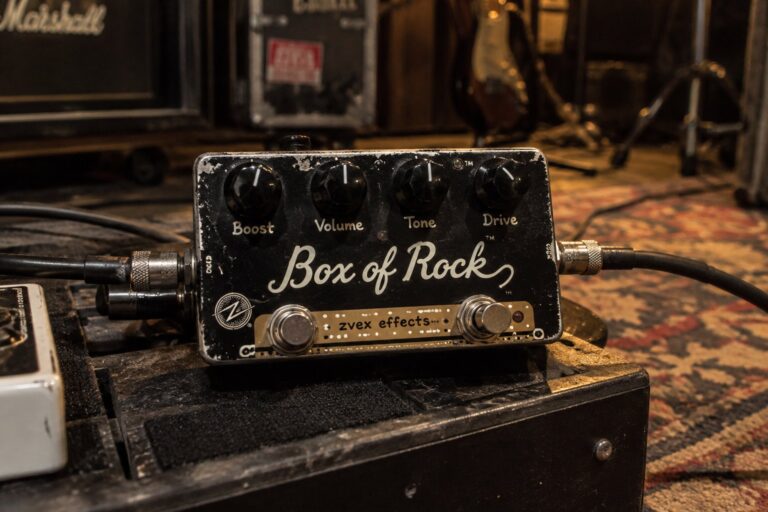
- Box of Rock — its clean channel is, in ZVEX’s own words, “very similar to the SHO boost circuit, with refinements to make it sound more like a standard amp input and less glassy.” Owners have noticed: the community consensus is that the Box of Rock’s boost is deliberately darker, and that swapping a couple of resistors reverts it to full SHO brightness.
That last point is the clearest statement anyone has made about what the SHO actually sounds like. When ZVEX wanted a boost that behaved more conventionally, they took the SHO and made it duller on purpose.
Famous Players — Sorted by How Good the Evidence Actually Is
The SHO has an unusually strong artist record for a one-knob boost, and unusually good documentation, because ZVEX’s own artist page names specific models rather than vaguely crediting “various pedals.” We still sort by evidence class, because a brand roster on its own is marketing, not proof.
Class 1: Named in third-party technical sources, with detail
Matt Bellamy and Muse. The best-documented SHO usage on this list comes not from a guitarist but from an engineer. Tommaso Colliva, discussing the recording of Drones (2015) with Sound on Sound, listed the pedals that got the most use: “the ZVex Fuzz Factory, the ZVex Super Hard On, which gives a nice clean boost so it distorts the amplifier, the Super Duper, and the Machsonic Thrust Drive pedal… the JHS Colour Box, which mimics the sound of the Neve 1073, and a Roland SDD 3000 pedal.” Note that he explains the SHO’s function correctly and in one clause — it is not there to be heard, it is there to make the amp misbehave. Note also that Bellamy’s famous ZVEX association is the Fuzz Factory built into his guitars; the SHO is a studio tool in that camp, not a live signature.
Josh Homme and Queens of the Stone Age. Guitar tech Dan Druff, in a filmed rig walkthrough, names the ZVEX Super Hard On as one of the main pedals Homme used during the Songs for the Deaf era. Equipboard also lists the record itself among the album credits for the pedal. This is a tech naming a specific box for a specific record — about as good as this gets short of the player saying it himself. It also makes intuitive sense: the SHO’s job of pushing an already-loud amp into natural saturation without adding a voice of its own is precisely the ingredient that record runs on.
Brad Delson, Linkin Park. Premier Guitar’s “In the Studio with Linkin Park” feature lists the Z.Vex Super Hard-On among Delson’s studio gear. Print gear lists are a softer class of evidence than an interview, but a named model in a magazine’s own studio inventory is solid.
Class 2: Named model on ZVEX’s artist page, corroborated elsewhere
Billy Gibbons. ZVEX’s artist page reads: “Billy Gibbons of ZZ Top uses the Nano Amp and SHO, among other ZVEX pedals he owns.” Gibbons’ relationship with the brand is long and independently documented — he bought Fuzz Factories by the dozen in the 1990s — which makes the SHO attribution credible in a way that a cold brand roster entry would not be. A player whose entire tonal identity is built on tiny pinched dynamics and a very particular top end has obvious reasons to like a pedal that unloads the pickups.
Steve Albini. The ZVEX page states that Albini “frequently uses a ZVEX Super Hard On when recording albums.” This one is worth pausing on, because Albini was famously, ferociously sceptical of gear mystique and boutique pricing. A producer with that reputation keeping a hand-painted one-knob boost within reach in the studio is the single most persuasive endorsement in this article — and it also tells you the pedal’s real use case. In a recording context the SHO is not a solo boost; it is a way to make a guitar hit tape or a preamp harder without a console EQ getting involved.
John Agnello. The other producer on ZVEX’s list, credited with a whole shelf of their pedals including the SHO. Agnello’s discography — Dinosaur Jr., Sonic Youth, Kurt Vile — is a reasonable description of the pedal’s natural habitat.
Beck. The ZVEX page entry is as terse as it gets: “Beck: SHO.” Model-specific, first-party, but with no independent corroboration we have been able to fetch. ⚠ A note for our own internal linking: Beck is not in the GuitarGangsters guitarist archive — searching it returns Jeff Beck and Jason Becker, who are different people entirely. No link here.
Carrie Brownstein, Sleater-Kinney. “Sleater-Kinney: Carrie Brownstein uses a SHO,” per the ZVEX artists page. A guitarist whose sound is built on wiry, trebly, deliberately un-fattened single-coil attack is an extremely plausible SHO customer.
Brent Paschke — session guitarist for Pharrell, N.E.R.D., Snoop Dogg and Katy Perry — is credited with a Seek Wah, SHO, Woolly Mammoth, Fuzz Factory and Jonny Octave. Worth noting because it puts the SHO on records that are not rock records at all.
Class 3: Photographic and video evidence of working rigs
Gustavo Cerati, Soda Stereo. A photograph of Cerati’s recording setup for Siempre es Hoy (2002) shows the Super Hard On on the right-hand side of the pedalboard. Cerati is the most internationally under-discussed guitarist on this list and one of the most sophisticated tone-shapers in Latin American rock; his presence here is the most interesting single entry in the block.
Daniel Kessler, Interpol (board photo), Brian Bell, Weezer (board photo), Jeordie White (rig walkthrough video, from his period playing guitar rather than bass), beabadoobee (her own Instagram post, 17 March 2019, captioned “cute ass pedals”), and Jordan Cook of Reignwolf (hand-painted SHO visible on his board at the 2012 Seattle Capitol Hill Block Party).
What the roster tells you
Look at the spread. Two record producers. A Latin American art-rock icon. A nu-metal studio guitarist. A stoner-rock architect. A stadium prog band’s engineer. An indie singer-songwriter born fifteen years after the pedal was designed. Equipboard’s genre breakdown reflects it: Rock 59, Alternative Rock 28, Metal 14, Psychedelic Rock 11, Experimental Rock 9, Blues Rock 8, Art Rock 8.
There is no SHO sound. That is the point, and it is the strongest thing anyone can say about a boost pedal. Compare it with any drive box on this list, where the artist roster clusters tightly around one genre because the pedal has a voice. The SHO’s roster is scattered because the SHO’s contribution is amplification of whatever was already there.
One more pattern worth naming: a disproportionate number of these credits are studio credits rather than live rigs. Albini, Agnello, Colliva’s Muse sessions, Delson’s studio gear list, Cerati’s recording setup. For a pedal that looks like a stage utility, the SHO’s centre of gravity is a control room.
Tone Recipes and Settings
1. The Always-On Buffer (knob at 8 o’clock, first in chain)
Barely above unity. Plug in, put the SHO first, set it just past the point where the pot leaves zero, and forget it. You lose nothing in level and gain back the top end that a long cable run and a row of true-bypass pedals were quietly stealing. Community consensus is that this is the single most common way owners actually use it, and that it works best with old single-coil guitars. This is the setting Vex is describing when he tells you to listen to one turned down low with a Strat.
2. The Brightener for a Dark Amp (knob at 11 o’clock, last in chain)
Reverse the placement. Put the SHO at the very end, after everything, and use it to push a dark or woolly amp. Owners specifically recommend this for amps that need waking up. Note what happens to the impedance benefit here: it is gone, because the pedal is no longer looking at your pickups. Placed last, the SHO is purely a level-and-sparkle device.
3. The Solo Lift (knob at 1 o’clock, after your drive)
Set your amp on the edge of breakup, place the SHO after your Tube Screamer or Blues Driver, and use it to add level rather than gain. Because the SHO adds no midrange bump of its own, your drive pedal’s voice survives the boost intact — a real difference from stacking two midrange-forward overdrives.
4. The Amp Cooker (knob at 3 o’clock, into a valve amp already working)
This is the setting the manual is warning you about. Eight-plus volts into a valve front end produces natural amp overdrive, not pedal distortion. The manual’s own pitch for it is the best description anyone has written of why boosts exist: “This sound can be the solution to the ‘disappearing guitar’ effect you get sometimes on stage when you stomp on your distortion and sound weaker.”
5. The Hendrix Approximation (knob at 4–5 o’clock, single coils, loud amp)
Owners repeatedly report a Hendrix-adjacent tone at maximum. This is the triode-overload character the manual promises: it does not fuzz, it saturates. It needs volume to work — at bedroom levels a cranked SHO is just loud and thin.
6. The Fuzz Feeder (knob at noon, before a germanium fuzz)
Careful. Putting a low-impedance-output buffer in front of a vintage-style fuzz changes the fuzz’s behaviour, usually for the worse. But the SHO’s extreme output makes it a useful corrective here: if you have already lost the fuzz’s guitar-volume cleanup by putting a buffer somewhere in the chain, the SHO can re-establish a level and attack that gets it back. Experiment; there is no universal answer.
7. Wet/Dry Splitting (post-1998 units)
Units from July 1998 onward carry two output jacks. Owners have noted these can drive two amps for a faux wet/dry setup. It is a mono split rather than a true stereo output, so treat it as two identical feeds rather than a stereo image — but as a free way to hit two amps from one boost, it is a genuinely underused feature.
8. Tame It for Active Pickups
The manual carries a warning that reads like nothing else in pedal literature: “The very high input impedance of this pedal can cause strange reactions (sometimes mildly pleasant and/or arousing) when used with a vintage ‘junk’ (read ‘cool’) guitar. The solution is to simply lower the ‘crackle okay’ gain knob a little or leave the guitar volume wide open.” Translation: with unusual, high-output or badly-shielded guitars at maximum boost, you may get instability. Back the knob off, or open the guitar volume fully.
With one knob, “settings” means position plus placement. The placement is where the real decisions live.
How It Compares
vs the MXR M133 Micro Amp. The reference point for “cheap one-knob boost.” The Micro Amp is op-amp based, has a modest input impedance and a mild low-mid warmth; the SHO is single-MOSFET, ten times the input impedance and considerably brighter. If you want a boost that makes things slightly bigger and rounder, the MXR is a better and vastly cheaper choice. If you want a boost that changes how your pickups behave, only the SHO does that.
vs the Xotic EP Booster. The EP Booster is a deliberate colour: an Echoplex preamp emulation with a documented low-mid bump. It is not neutral and does not claim to be. Choose it when you want the character; choose the SHO when you want the clarity.
vs the Xotic RC Booster V2 and Keeley Katana. Both are far more practical products — EQ controls, sensible sizes, no crackling pot, no name to explain to your bandmates. The RC Booster in particular does everything the SHO does plus tone shaping. The counter-argument is that neither reaches the SHO’s input impedance, and shaping is not the same as unloading.
vs the Klon Centaur. The most instructive comparison. Both are famous for “transparency”; both are actually doing something specific and audible. The Klon’s parallel clean path and treble-forward gain structure add a characteristic glassy midrange presence. The SHO adds nothing and removes a load. If the Klon is a very expensive equaliser pretending to be a boost, the SHO is a very expensive impedance converter pretending to be a boost. Neither is neutral. Only one of them costs less than a used car.
vs the ZVEX Box of Rock. If you already own a Box of Rock, you own most of an SHO. Its boost channel is the same design with resistor values changed to add bass and reduce glassiness. Community lore holds that reverting those resistors restores full SHO brightness. Buying both is redundant unless you specifically want the extra sparkle in a standalone box.
vs the ZVEX Fuzz Factory and Mastotron. The other two ZVEX dirt boxes on this list are voices; the SHO is a lens. In practice ZVEX owners tend to run the SHO before or after one of the fuzzes, using it to solve the level mismatch that made the fuzz unusable in a band. Equipboard’s “used with” data puts the Fuzz Factory and Box of Rock among the SHO’s most common companions.
vs a $30 clone. Let us be direct: the SHO circuit is one transistor and a handful of passives, and clones sell online for the price of a set of strings. Community discussion openly acknowledges this. What you pay ZVEX for is the enclosure — the hand-painted version is a genuine one-off artwork with a lifetime warranty — plus the specific transistor selection and the fact that the thing has been in continuous production for three decades. Whether that is worth $279 is a question about you, not about the circuit.
Buying Guide
Hand-painted ($279 direct). Each one is unique, painted by hand in Minneapolis, and carries a lifetime warranty. In stock direct at time of writing. Used examples run around $189 and up on the secondary market. Buy this version if the artwork is part of the appeal; it holds value accordingly.
Vexter ($199 direct, currently sold out). UV-printed artwork; ZVEX are explicit that “the parts inside Vexters are identical to the hand painted pedals.” Warranty is one year, or two if you send in the card. The 25th Anniversary Vexter has its own graphics and its own instruction sheet. Sonically there is nothing to choose between them.
Which era? Pre-July-1998 units have a single output jack. Pre-2000 units lack the transistor protection circuit — not a reason to avoid one, but worth knowing if you are buying vintage. Pre-mid-2002 units have no LED, which on a pedal you intend to leave on permanently matters less than you would think, but on a dark stage matters more than you would like. If you want two outputs and an indicator, buy 2002-or-later.
Who should not buy one. Players with a crowded pedalboard and a dark amp; players who want an EQ; players who already have a Box of Rock; players who need to explain their board to a corporate function’s event manager. All of these are real objections and none of them are about the sound.
Living With One
The enclosure is a ZVEX standard box: 4.70″ × 2.38″ × 1.82″. That is taller and more awkwardly proportioned than a Boss compact, and at least one reviewer has complained about the pedalboard fit. It is a real drawback on a packed board.
Battery access means removing four screws on the bottom plate. Alkaline is recommended; ZVEX ship carbon-zinc. On LED-equipped units the input jack is the battery switch, so the manual’s instruction is emphatic: unplug the input when you are not using it. At roughly 2 mA a battery lasts an extremely long time; leave a cable in and it will not.
Do not power it from an unregulated wall wart. The manual asks for a “standard filtered/regulated musical 9VDC power supply with a Boss-style connector (negative-tip barrel connector).” A dedicated isolated output on a proper supply is ideal — this is a very high-gain, very high-impedance circuit and it will faithfully amplify any noise on your power rail.
One genuine safety note, raised by a reviewer and worth repeating: the SHO’s output is high enough that pushing a vintage or fragile amplifier hard with the knob near maximum is a real stress on the input stage. The name is a joke; the warning is not. ZVEX’s own text for the Super Duper 2-in-1 — two of these circuits stacked — opens by telling you to monitor your amp for potential damage. Start with the knob down.
Frequently Asked Questions
Why does the knob crackle when I turn it?
Because it is a negative-feedback control, the same topology used in 1960s recording console inputs, which crackled too. ZVEX printed “Crackle Okay” on the pedal specifically so owners would stop sending them back. It is present on every version and is not a fault.
Is the Super Hard On truly transparent?
Not in the sense most people mean. It adds no midrange voice and no clipping character, so it is transparent in the tonal-colouring sense. But its very high input impedance unloads your pickups and audibly opens up the high end, so your guitar will sound brighter with it on. ZVEX describe this as hearing “exactly what your pickup sounded like the day it came off the winder.” Some players hear that as restoration; some hear it as brightness they did not ask for.
How much current does it draw?
The manual gives two figures — “about 2mA” for the circuit and “less than 20mA” as the ceiling. Allocate 20 mA on your power supply and you will never have a problem. Use regulated, filtered 9 V DC with a Boss-style centre-negative connector.
Can it damage my amplifier?
The output can exceed 8 volts peak, which is far above what an amp input normally sees. Reviewers have flagged this as a genuine risk with sensitive or vintage circuitry at high settings. It will not casually destroy a healthy amp, but treat maximum boost into a fragile valve front end with respect, and start with the knob low.
Where should I put it in the chain?
First, if you want the impedance benefit — that only works when the pedal is looking directly at your pickups. Last, if you want to brighten and push a dark amp. After your drive pedals, if you want a level-only solo lift. All three are common and none is wrong.
What is the difference between the hand-painted and Vexter versions?
Artwork and warranty only. ZVEX state plainly that the internal parts are identical. Hand-painted units are unique pieces with a lifetime warranty at $279; Vexters are UV-printed with a one-year warranty (two with the card) at $199.
Is the Box of Rock’s boost the same circuit?
Very nearly. ZVEX describe the Box of Rock’s clean channel as “very similar to the SHO boost circuit, with refinements to make it sound more like a standard amp input and less glassy” — in other words, deliberately darker. Owners report that changing a couple of resistors reverts it toward SHO brightness.
Does it work on bass?
Yes, and well. It is a clean, wide-bandwidth boost with no low-end filtering, so it lifts level without thinning the bottom. Reviewers specifically praise its touch sensitivity and harmonic richness on bass.
Why does it pop when I switch it on?
A DC-offset settling issue between your guitar, the pedal and the rest of your rig. The manual’s fix: after plugging in, switch it on and off a few times to equalise voltages. It stops after a few cycles.
Image credits
- Billy Gibbons: Ralph Arvesen, Wikimedia Commons, CC BY 2.0.
- Billy Gibbons: Tilly antoine, Wikimedia Commons, CC BY-SA 4.0.
Latest News
Related
On This Day
Monday 9 November
From this week: