Eight Delays, One Footswitch, Zero Excuses: The TC Electronic Flashback 2 Is the Swiss Army Knife Your Pedalboard Has Been Waiting For
TC Electronic Flashback 2 Delay guide — 8 delay types, MASH footswitch, Crystal algorithm, TonePrint, famous users, settings, and buying advice.
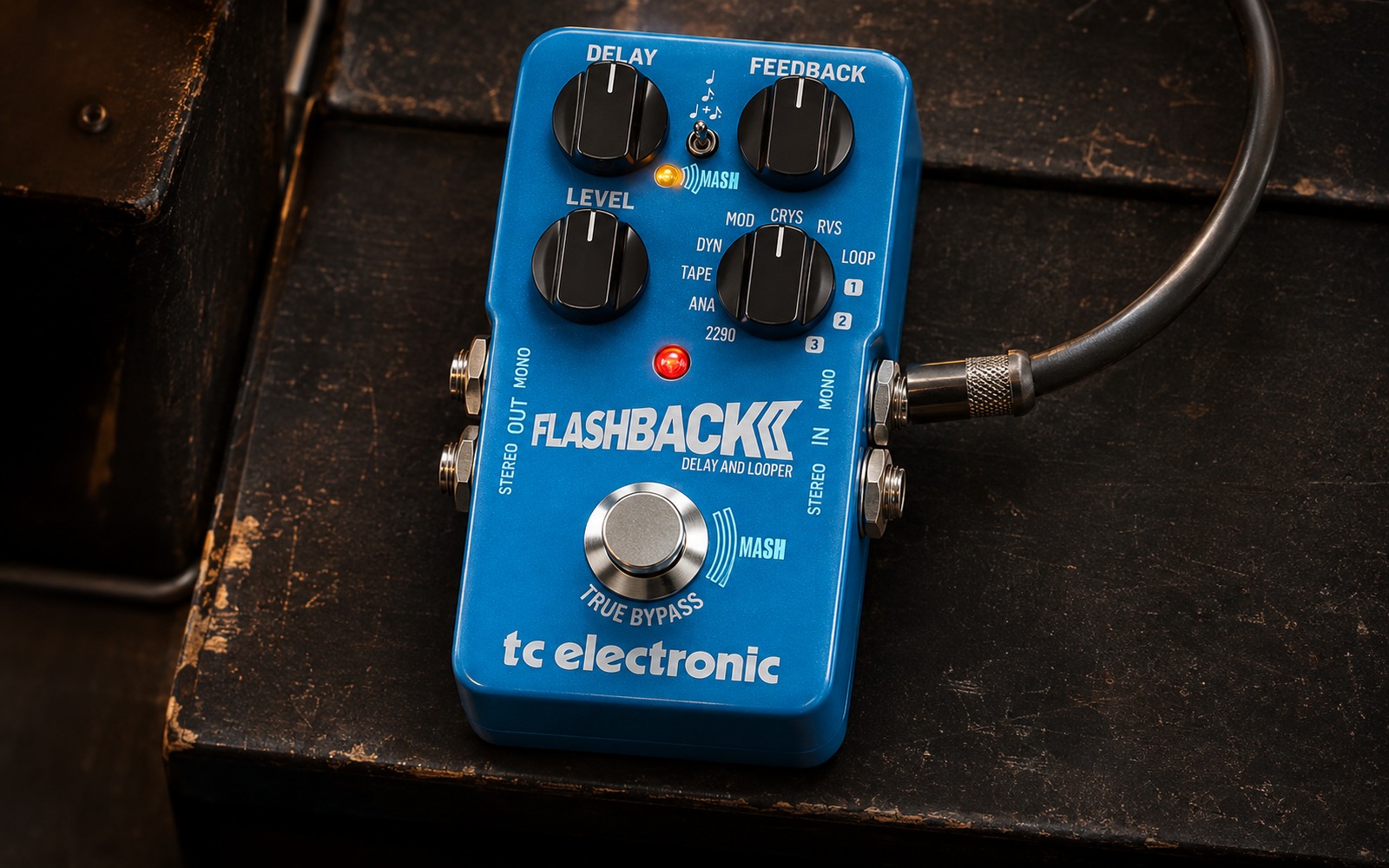
There is a room in Aarhus, Denmark where the delay pedal as you know it was reinvented. Not once, but twice. The first time, TC Electronic introduced TonePrint technology — the idea that you could beam a famous guitarist’s signature delay settings directly into your pedal from a smartphone, bypassing the decades-long gulf between “pro gear” and what the rest of us could afford. The second time, they took everything they knew about the stompbox format and rebuilt it from scratch. The result, released in June 2017, was the TC Electronic Flashback 2 Delay: eight distinct echo types, a pressure-sensitive MASH footswitch that turns a simple stomp into an expression control, a brand-new Crystal algorithm borrowed from their octave division technology, and three dedicated TonePrint slots that let you carry the DNA of any delay in history inside a box the size of a paperback novel. The Flashback 2 didn’t replace other delay pedals. It replaced the argument for owning multiple delay pedals.
To understand what TC Electronic actually built here, you have to go back to 1985, when a pair of brothers from Risskov, Denmark — Kim and John Rishøj — shipped the first unit of the 2290 Dynamic Digital Delay out of their small company’s workshop. That rack unit became one of the most celebrated delay processors in the history of recorded music. The Edge ran two of them, in stereo, with two Vox AC30s, as the foundation of U2’s stadium sound throughout the 1980s and into the 1990s. David Bowie’s touring productions specified the 2290. Session musicians from Los Angeles to London put it on riders as a non-negotiable. The 2290 was expensive, rack-mounted, and absolutely out of reach for most players — which is precisely why TC Electronic spent the following quarter-century figuring out how to get that sound onto a pedalboard that could fit in the overhead bin of a budget flight to a regional club gig. The Flashback 2 is where they succeeded.
TC Electronic: From Danish Basement to Global Delay Authority
TC Electronic was founded in 1976 in Risskov, near Aarhus on Denmark’s Jutland peninsula. Kim and John Rishøj started as a studio electronics company building custom audio tools, expanding through the 1980s into signal processors and effects units that caught the attention of touring professionals. The 2290 Dynamic Digital Delay, launched in 1985, was the product that established their global reputation: it offered 6.4 seconds of high-quality digital delay, MIDI control, full stereo operation, and a modulation section that outperformed anything else available at the price. In an era when digital technology was transforming studio recording, the 2290 delivered pristine repeats with none of the artifacts and hiss that plagued tape and analog equivalents.
Through the 1990s and 2000s, TC Electronic built out a comprehensive catalogue of studio and live processors — reverbs, dynamics, modulation — all anchored by their reputation for audio quality. The pivotal shift came in 2011, when the company released the first TC Electronic Flashback Delay: their first genuine guitar pedal. At a time when boutique analog delays commanded $200 and up, the original Flashback offered ten delay algorithms including a convincing simulation of the 2290 itself, TonePrint technology, a built-in looper, and true bypass in a standard stompbox format. It sold in enormous numbers. TC Electronic had found something that worked. Music Tribe (formerly Behringer’s parent company) acquired TC Electronic in 2013 and provided the manufacturing scale to expand the Flashback family into what it is today.
The Flashback 2, launched at Winter NAMM 2017 and shipping from June of that year, was the ground-up redesign. The original Flashback had one TonePrint slot. The Flashback 2 has three. The original had no MASH technology. The Flashback 2 introduced MASH as a signature feature. Most significantly, the Flashback 2 added the Crystal delay algorithm — a pitch-shifting shimmer effect that TC had developed for their Sub ‘N’ Up Octaver, repurposed here to generate an other-worldly cascading octave as each feedback loop passes through — and redesigned the Tape and Analog modes with improved modeling. The dry signal path is entirely analog regardless of delay settings: your clean guitar signal bypasses the digital processing chain completely, only the wet delay signal goes through the DSP, and both are blended at the output. The result is zero latency on the dry signal and maximum tonal clarity in a true-bypass or buffered configuration.
Eight Algorithms, One Pedal: The Delay Types Explained
The Flashback 2’s eight delay modes aren’t eight variations on the same theme — they are eight genuinely distinct echo characters, and understanding each one is the key to getting maximum utility out of the pedal.
The 2290 mode replicates TC Electronic’s landmark rack unit. The repeats are clean, precise, and digital in character — not warm, not colored, not approximate. If you want to chase The Edge’s “Where the Streets Have No Name” rhythmic bounce or the crisp delay fills of 1980s post-punk, this is where you live. MASH in this mode raises the feedback and input level simultaneously, creating a freeze effect — the last delay repeat sustains indefinitely while you hold down the footswitch, releasing when you let go. It’s a legitimate performance tool.
Analog mode replicates the warmth and natural high-frequency roll-off of a bucket brigade delay. Repeats are slightly darker than the dry signal and grow warmer with each regeneration — exactly the behavior you’d expect from a real BBD chip. TC updated this mode significantly for the Flashback 2: the modeling is more accurate than the original Flashback’s Analog setting, particularly in the way feedback builds at higher regeneration values. MASH in Analog mode boosts feedback while reducing delay time, creating self-oscillation with pitch swooping upward — a controlled madness that is genuinely musical when deployed deliberately.
Tape simulates the flutter, head wear, saturation, and frequency response of a tape echo machine. It’s not just about warmth — proper tape echo has a mechanical imprecision that creates a liveness that digital precision can’t replicate. TC’s Tape mode captures that imprecision in a convincing way. MASH controls delay time and pushes feedback toward maximum, creating the kind of space-echo feedback that defined 1970s dub and psychedelic recordings.
Dynamic delay is the most practical innovation in the lineup. It applies a gate to the delay signal: when you play, the delay is reduced in the mix. When you stop, the delay swells up. The result is a delay that never clutters your playing — you hear the repeats in the spaces between notes, not fighting against them during phrases. MASH removes the gate, converting Dynamic to a standard 2290-style delay on demand.
Modulation delay adds chorus-style pitch wobble to the delay repeats — a lush, slightly seasick quality that sits beautifully under clean arpeggios and sustained chords. The dry signal stays clean; only the repeats are modulated. MASH increases the modulation depth progressively as you press, adding dramatic chorus intensity on demand.
Crystal is the Flashback 2’s signature algorithm and the most distinctive delay type in its class. Using the same octave-shifting processing from TC Electronic’s Sub ‘N’ Up pedal, each feedback loop passes through a pitch shifter that raises it by one octave. As the repeats cascade, the shimmer builds: a bright, angelic harmonic wash that sits an octave above your played notes. It is the ambient guitarist’s secret weapon — one chord, one press of Crystal, and you have a shimmering orchestral texture underneath your playing. MASH raises the octave send, the feedback, and the filter bank spacing simultaneously, intensifying the shimmer for dramatic swells.
Reverse delay plays back the delay signal backward — each repeat arrives as a backwards ghost of the previous phrase. As a production tool in the studio it’s been used since the 1960s; as a live performance effect it creates a genuinely alien atmosphere when used strategically. MASH engages Kill Dry mode, muting the direct signal entirely so only the reversed sound remains — an effect best deployed for specific atmospheric passages.
The three TonePrint slots round out the lineup. These aren’t additional algorithms you choose from a menu — they are fully programmable delay engines where any parameter can be customized via the TC Electronic TonePrint app or editor software. Load an artist-designed preset via your smartphone (no cable required: the app literally beams the TonePrint data through your guitar pickup using an audio signal), save three different presets to the three slots, and switch between them via the mode selector. The TonePrint Library includes designs from dozens of professional guitarists, all available for free.
Specifications
| Specification | Flashback 2 | Flashback 2 Mini | Flashback 2 X4 |
|---|---|---|---|
| Delay Types | 8 + 3 TonePrint slots | Same engine, 1 knob | 8 + 3 TonePrint slots |
| MASH Footswitch | Yes | Yes | Dedicated tap + expression |
| Looper | 40 sec mono / 20 sec stereo | None | 40 sec mono / 20 sec stereo |
| TonePrint Slots | 3 | 1 | 3 |
| Tap Tempo | External TRS (not included) | None | Dedicated footswitch |
| Stereo I/O | Yes | No (mono) | Yes |
| Bypass | True or Buffered (switchable) | True bypass | True or Buffered |
| Analog Dry-Through | Yes | Yes | Yes |
| Power | 9V DC, 100mA | 9V DC, 100mA | 9V DC, 100mA |
| Dimensions (W×D×H) | 72 × 122 × 50mm | Compact (smaller) | Larger 4-switch format |
| Price New | ~$129–149 USD | ~$79–99 USD | ~$249–299 USD |
| Price Used | ~$70–100 USD | ~$40–65 USD | ~$120–180 USD |
Famous Players
Lee Ranaldo (Sonic Youth)
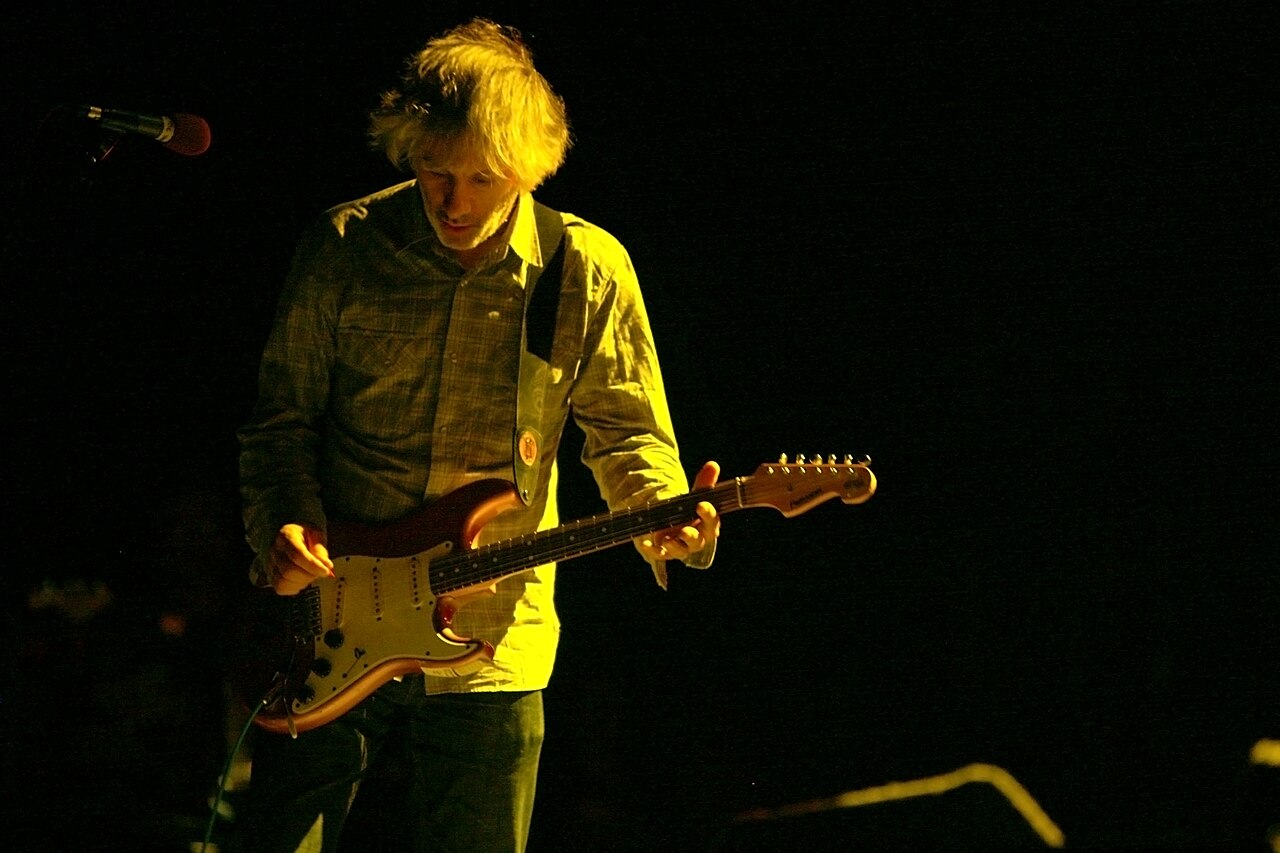
Lee Ranaldo is the most thoroughly documented professional user of the TC Electronic Flashback in the noise-rock and experimental guitar world. In a dedicated interview with TC Electronic — part of the company’s official artist documentation — Ranaldo discusses his use of the Flashback delay and its role in his signal chain. As one of the architects of Sonic Youth’s detuned, extended-technique guitar sound, Ranaldo has always operated at the outer edge of conventional delay use: long feedback trails, extreme modulation, and layered ambience that functions more as texture than as rhythmic echo. The Flashback’s combination of multiple delay modes and the TonePrint customization system suits his exploratory approach more effectively than single-algorithm delay pedals. Lee Ranaldo’s full gear profile and the extended GuitarGangsters guide to his rig document his equipment in detail.

Joe Duplantier (Gojira)
Joe Duplantier, the guitarist and driving sonic force behind Gojira, appeared in TC Electronic’s official “Gojira Gear Run” video on the TC Electronic YouTube channel demonstrating his use of the Flashback delay. Duplantier’s playing sits at the intersection of extreme metal precision and tightly controlled dynamics — Gojira’s music is among the most rhythmically sophisticated in heavy music, and his approach to delay reflects that. He doesn’t use it for ambient wash or psychedelic dissolves; he uses it for specific spatial positioning and controlled rhythmic enhancement. The TC Electronic Flashback’s Dynamic delay mode, which ducks the repeats while playing and brings them up in the gaps, is precisely suited to this approach. His use is confirmed via the official TC Electronic Gear Run video documentation.

Steven Wilson (Porcupine Tree)
Steven Wilson — guitarist, producer, and the creative force behind Porcupine Tree, Storm Corrosion, and his extensive solo career — created an official TonePrint for the TC Electronic Flashback delay called “Ghostly Delay.” TC Electronic published the preset and a video of Wilson demonstrating and explaining it. The “Ghostly” label is apt: Wilson’s TonePrint applies a long-feedback, darkened, modulated delay character that creates a spectral presence behind sustained notes — the kind of effect you can hear throughout Porcupine Tree’s later albums where atmospheric depth sits under the guitars. Wilson’s involvement with the TonePrint program reflects both his use of the Flashback in practice and his technical engagement with the signal chain as a producer. His TonePrint creation and demonstration video are the primary sources.

Steve Vai and the TonePrint Endorser Ecosystem
Steve Vai is a TC Electronic TonePrint contributor — he designed a signature delay preset for the Flashback X4, the larger four-footswitch variant in the Flashback family. Guitar World reported on TC Electronic’s announcement of new Vai-designed TonePrints, confirming his active involvement in the program. In practice, TC Electronic’s TonePrint artist roster functions as both an endorsement list and a practical resource: when a guitarist of Vai’s caliber invests the time to customize a delay algorithm down to its individual parameters, it reflects genuine engagement with the tool. His TonePrint is available free from the TC Electronic app. Steve Vai’s GuitarGangsters profile documents his full equipment history; note that the Flashback 2 specifically, rather than the X4 variant, is what his TonePrint translates to in stompbox format.
Honest Corrections: What the Usual Lists Get Wrong
The TC Electronic Flashback 2 frequently appears in lists alongside The Edge, David Gilmour, John Frusciante, and Andy Summers. These associations require clarification, because the specific product matters and accurate attribution serves players better than marketing myth-making.
The Edge is a TC Electronic customer — but the TC Electronic product he built his career around is the 2290 Dynamic Digital Delay, a rack-mounted processor from 1985 that costs a multiple of the Flashback 2’s price and operates on a completely different form factor. His current live rig runs TC Electronic 2290s alongside Korg SDD-3000 delays and Fractal Audio Axe-Fx processors. He has not been confirmed as a Flashback 2 user via any primary source. His association with TC Electronic is genuine; the specific pedal is wrong.
David Gilmour also has a legitimate TC Electronic connection — the 2290 appeared on his pedalboards during the 1980s and 1990s — but his delay arsenal consists primarily of the Binson Echorec (early Pink Floyd), TC Electronic 2290, and Boss DD-2 and DD-3. The Flashback 2 represents a different market tier and a different use case. He is listed among Equipboard’s Flashback users, but his long-established professional delays are the rack units. His confirmed Flashback use remains unverified through a primary source.
John Frusciante’s delay in his documented 2022 Unlimited Love touring board is the MXR M299 Carbon Copy Mini, confirmed via Instagram soundcheck photography. He is not a TC Electronic Flashback user. Frusciante’s gear history covers his actual delay chain.
Andy Summers used the vintage MXR Analog Delay (M108/M113) as his primary echo in the Police era — a completely different manufacturer and circuit. Summers’ documented Police-era rig covers this in full.
Tone Recipes and Settings
The 2290 Rhythmic Delay (Edge-Style Dotted-Eighth)
Set the mode to 2290. Use an external tap tempo footswitch (TRS connection required — not included) to lock the delay to the song’s tempo. Select dotted-eighth subdivision via the subdivision switch. Set Feedback to 9-10 o’clock (two to three clear repeats), Mix to 10-11 o’clock (present but not overwhelming the dry signal). The 2290 mode’s clean digital character means the repeats are bright and distinct — they cut through a full-band context without dissolving into mud. At 120 BPM, dotted-eighth = 375ms. At 100 BPM = 450ms. MASH applies the freeze effect: hold down to sustain the last repeat for atmospheric moments between sections.
Analog Warmth: The Rhythm Guitar Depth Trick
Switch to Analog mode. Delay time at 8-9 o’clock (100-150ms for slapback), Feedback minimum to 9 o’clock (one repeat), Mix at 9-10 o’clock (subtle). This is the delay that doesn’t sound like delay — it adds thickness and spatial dimension to clean rhythm guitar without calling attention to itself as an effect. Country, blues, clean rock rhythm. The BBD-style darkening on the repeat gives the single echo a naturally warm character. Increase Feedback to 11 o’clock and Delay time to noon for a longer, more musical ambient loop.
Crystal Shimmer: Ambient Bed
Switch to Crystal. Delay time at noon to 3 o’clock (400-600ms). Feedback to 2-3 o’clock (high, building repeats). Mix to 2 o’clock or higher. Play single notes or sparse chords on a clean or lightly driven amp. The Crystal mode’s octave-shifted feedback builds a shimmering harmonic cloud above each note. Press MASH to intensify the shimmer during moments of peak drama — the footswitch raises the octave level and filter bank spacing simultaneously for a swelling, cinematic effect. This is the Flashback 2’s most distinctive capability and the one no analog BBD delay pedal can replicate.
Dynamic Delay: The Live Performance Workhorse
Switch to Dynamic. Delay time at noon (300-400ms), Feedback at 10-11 o’clock, Mix at 11-noon. Play normally. Notice that the delay recedes while you play and fills the space when you stop. This is the professional live performance setting: delay that enhances without cluttering. Solos, single-note runs, melodic passages all benefit from the Dynamic mode’s intelligent gating. MASH removes the gate on demand when you want a more conventional delay fill — stomp and hold to flood the signal with full-wet delay, release to return to gated mode.
Modulated Delay: Chorus-Echo Blend
Switch to Mod. Delay time at 10-11 o’clock (180-250ms), Feedback at 9-10 o’clock, Mix at 10-11 o’clock. The modulated repeats create a moving, slightly chorus-like texture that sounds particularly good on clean guitar through a Vox AC30 or a Fender clean amp. The dry signal remains unmodulated — only the repeats wobble. Use MASH to increase modulation depth progressively for dramatic swells.
The Flashback Family: Which Model Is Right for You?
TC Electronic has built out the Flashback 2 name into a family of three distinct pedals, each sharing the same DSP engine but configured for different live scenarios.
The standard Flashback 2 is the focus of this article. At $129-149 new and $70-100 used, it represents the core value proposition: eight delay modes, three TonePrint slots, MASH, 40-second looper, and stereo I/O in a compact standard-format stompbox. The one limitation is tap tempo: an external TRS footswitch is required to tap in tempo hands-free, and that cable needs to be TRS (not a standard TS guitar cable), which catches players by surprise. Many users solve this with a cheap TRS-wired tap switch. The internal DIP switches allow configuration of Kill Dry mode (for parallel effects loops, where adding wet signal without dry prevents doubling), True or Buffered bypass, and the Mod subdivision behavior.
The Flashback 2 Mini compresses the same engine into a smaller footprint with a single large knob controlling delay time. There are no Delay and Feedback controls visible on top — all secondary parameter editing happens via the TonePrint app. The Mini is the right choice when pedalboard space is the binding constraint and you primarily use one or two dialed-in TonePrint presets. No looper, mono only, one TonePrint slot, no tap tempo.
The Flashback 2 X4 is the flagship stompbox in the family — four footswitches, a dedicated tap tempo button, expression pedal input, and stereo I/O with separate looper control. The X4 solves the standard Flashback 2’s tap tempo problem permanently, and adds per-preset storage in a format that suits players who switch between fundamentally different delay modes mid-set. At $249-299 new, it’s a significantly larger investment, but for players who need multiple delay characters in immediate recall during live performance, it is the professional solution. The X4 also supports stereo trails — delay repeats that continue after you bypass the pedal, which the standard Flashback 2 cannot do in true bypass mode.
Flashback 2 vs. the Competition
The MXR Carbon Copy and the TC Electronic Flashback 2 serve different masters. The Carbon Copy is a single-algorithm analog BBD delay — it does one thing, it does it beautifully, and every parameter choice you make is focused on that one thing. The Flashback 2 does eight things and does each of them well enough to replace a specific analog delay for all practical purposes, but none of them with the absolute character commitment of a dedicated analog circuit. The question is philosophical as much as sonic: if you want the Carbon Copy’s BBD warmth as your core delay identity, buy the Carbon Copy. If you want access to eight different delay characters — including a very convincing BBD simulation — in one pedal, buy the Flashback 2. Both occupy the same pedalboard space.
The Electro-Harmonix Deluxe Memory Man occupies a different category entirely. It is a purely analog delay with a built-in LFO for chorus and vibrato modulation, and its character is defined by the Xvive MN3005 BBD chip. The DMM sounds like the DMM — specific, warm, vintage in character. It cannot do digital, reverse, crystal shimmer, or dynamic gating. The Flashback 2 can do a convincing simulation of the DMM’s BBD warmth in Analog mode and then do five other completely different things besides. At $199-249 for the non-tap-tempo DMM versus $129-149 for the Flashback 2, the Flashback 2 also wins on price. The DMM wins on irreplaceable analog character. Both are worth owning; they are not duplicates of each other.

The Boss DD-8 is the most direct competitor in the digital multi-algorithm delay category: similar price, similar feature set, similar delay mode count. The Flashback 2 differentiates on MASH technology (no Boss equivalent), TonePrint customization (proprietary TC system), and the Crystal delay algorithm (no direct Boss equivalent). The DD-8’s Warp function offers some expression pedal-like behavior but operates differently from MASH. Players committed to the TC Electronic TonePrint ecosystem — particularly those who want to download and customize artist-designed presets — will find the Flashback 2 more rewarding. Players who prefer physical knob-per-function simplicity may prefer the DD-8’s more conventional interface.
Buying Guide
New Flashback 2 units sell for $129-149 USD at most retailers; Sweetwater lists them at $129. There are no production run variations to chase — TC Electronic has made no significant circuit changes between 2017 and current production, and all units perform identically. Buy new if the warranty matters; buy used ($70-100 in excellent condition) if budget is the driver. The only caveat on used units is the tap tempo situation: verify the TRS tap tempo input is functional if the previous owner used an external footswitch, as the TRS jack can be damaged by incorrect cables.
The Flashback 2 X4 at $249-299 is worth the premium if your live performance requires immediate recall of multiple delay modes or dedicated tap tempo without the external footswitch workaround. Used X4 units at $120-180 represent strong value for the feature set. The Flashback 2 Mini at $79-99 new makes sense only when pedalboard footprint is the primary concern — the tradeoffs in looper, tap tempo, and parameter access are significant.
One purchase that many Flashback 2 owners overlook: a TRS-wired single-button footswitch for tap tempo. This is a necessary accessory for any player who uses delay in a tempo-locked context. The MXR Tap Tempo Switch ($20-30) is a common choice; any single-button TRS footswitch will work.
Ownership Notes
The internal DIP switches are under a small cover on the bottom of the pedal and allow three configurations: Kill Dry mode (routes wet-only signal, disabling the analog dry pass — essential for parallel effects loop setups where the dry signal travels a separate path), True Bypass vs Buffered Bypass (factory is True Bypass; switch to Buffered for long cable runs where the buffer’s impedance drive improves signal integrity), and a third switch for specific Mod subdivision behavior. These DIP switches are not accessible without a small screwdriver and are intended as setup-time configurations, not live adjustments.
True bypass on the Flashback 2 means the delay trail cuts instantly when you bypass the pedal — no spillover. Players who want repeats to continue after bypass should either use the Flashback 2 X4 (which supports trails in its buffered mode) or engage a loop switcher that keeps the Flashback 2 wet signal path open after the dry signal is muted.
The TonePrint beaming feature works with passive pickups and most active pickups at standard output levels. Hold your phone speaker against the guitar body near the pickup (or strings), select the TonePrint in the app, press the beam button, and play a chord when the loading animation completes. The data transmits as an audio signal through the guitar’s electronic system into the TonePrint input. It takes under ten seconds. Alternatively, the TonePrint Editor software allows USB-connected editing with full parameter control — considerably more detailed than the simplified phone-beam workflow.
The 40-second looper is functional and reasonably intuitive, but shares the pedal’s single footswitch with the delay bypass. Single-press toggles the delay on and off; long-press (holding for tap tempo) is how you access secondary functions. In Loop mode, MASH is disabled. The looper records immediately on first press, plays back on second press, and overdubs on third — no quantization, so your timing footwork determines the loop accuracy. For complex looping, the X4’s dedicated Loop footswitch is a significant improvement.
Signal chain placement: the Flashback 2 goes after drive pedals and before reverb in the conventional chain. In an effects loop (between the amp’s preamp and power amp stages), the delay operates on the amplified signal — particularly useful for maintaining amp dynamics through the drive stage. The Analog Dry-Through path means there is no latency penalty on the direct signal in any chain position, which distinguishes TC Electronic’s implementation from digital pedals that route dry signal through the DSP as well.
Pairing the Flashback 2 with a Fender Stratocaster through a clean platform — a Vox AC30 or a Fender blackface — reveals the full character of each delay mode without the masking effect of high-gain distortion. A Fender Telecaster‘s bright, articulate single-coil response interacts particularly well with the Tape mode’s frequency darkening, creating a natural balance.
Frequently Asked Questions
What is MASH technology on the Flashback 2?
MASH (Making A Simple Stomp Happen) is TC Electronic’s pressure-sensitive footswitch technology. Instead of just registering an on/off click, the MASH footswitch detects how hard you press it after the initial click engages the effect. This pressure data controls a delay-type-specific parameter in real time — in Crystal mode it intensifies the shimmer, in 2290 mode it creates a freeze effect, in Analog mode it triggers self-oscillation. It effectively gives you expression pedal-like control under your foot without requiring a separate expression pedal or additional cabling.
Do I need the TonePrint app to use the Flashback 2?
No. The three TonePrint slots come factory-loaded with three default presets (a Tape-based delay, a Crystal-based delay, and a Crystal delay with MASH as a volume controller). You can use the pedal indefinitely without ever engaging the app. The app and editor software are optional expansions that allow you to load artist-designed presets or create your own custom delay configurations beyond the eight standard modes.
What’s the difference between the Flashback 2 and the original Flashback?
The original Flashback (2011, discontinued) had ten delay modes, one TonePrint slot, no MASH technology, no Crystal algorithm, and an older Tape and Analog modeling. The Flashback 2 (2017, current) has eight modes (10 counting the 3 TonePrint slots), three TonePrint slots, MASH, the Crystal algorithm, updated Tape and Analog models, and a switchable True/Buffered bypass. The Flashback 2 is the better pedal in every measurable way; used original Flashback units at $50-70 are only worth purchasing for players who specifically need one of the modes the original had that the Flashback 2 dropped (LoFi and Slap are two such modes that some players prefer).
Can I use the Flashback 2 in a stereo setup?
Yes. The Flashback 2 has two quarter-inch inputs and two quarter-inch outputs for true stereo operation. In stereo mode, the looper capacity reduces from 40 seconds to 20 seconds. The Crystal and Modulation modes particularly benefit from stereo playback, where the pitch-shifted and modulated components can be panned for a wide spatial effect.
What external footswitch do I need for tap tempo?
You need a single-button footswitch wired with a TRS (stereo) cable, not a standard TS guitar cable. The TC Electronic PolyTune, the MXR Tap Tempo Switch, or any generic single-button TRS footswitch will work. If you use a standard TS cable by mistake, the tap tempo function will not operate correctly. This is the most common setup error new Flashback 2 owners encounter.
How does Kill Dry mode work?
Kill Dry mode, engaged via an internal DIP switch, removes the analog dry-through signal from the Flashback 2’s output. In standard use, this seems counterproductive — you’d lose your dry guitar signal. But in a parallel effects loop setup (where the dry signal travels a separate path and is mixed back in by the loop’s blend control), adding dry signal through the delay pedal as well would cause phase cancellation or volume doubling. Kill Dry mode outputs wet-only delay signal in these configurations. It’s a professional feature for specific routing setups, not something most players will need.
Is the Crystal mode only good for ambient music?
Crystal mode is most associated with ambient and atmospheric playing because of its shimmering quality, but it has practical applications in many contexts. At shorter delay times (200-300ms) with lower feedback, it creates a subtle harmonic enhancement under chord playing — less otherworldly, more like a lush hall reverb with a pitch component. The key is dialing back the feedback and mix compared to the long, swelling ambient settings most demonstrations favor. Used conservatively, Crystal can sit in a band mix without sounding like a post-rock interlude.
How does the Flashback 2 compare to the Boss DD-8?
Both offer broad digital delay libraries at a similar price point. The Flashback 2’s advantages are MASH (no equivalent on the DD-8), TonePrint customization depth, and the Crystal algorithm. The DD-8’s advantages are more physical knobs for direct parameter access, a waveform select for the modulation mode, and a shimmer algorithm (comparable to Crystal but differently implemented). The DD-8 also offers a 800ms more maximum delay time at its ceiling. Neither is objectively superior; the MASH technology and TonePrint ecosystem are the Flashback 2’s differentiating features.
Image credits
- Top image: GuitarGangsters AI-generated reference illustration, not a photograph.
- Lee Ranaldo: Bertrand, Wikimedia Commons, CC BY 2.0.
- Lee Ranaldo: Guido van Nispen, Wikimedia Commons, CC BY 2.0.
- Lee Ranaldo: DSCF4708-Edit by Guido van Nispen, Wikimedia Commons, CC BY 2.0.
- Joe Duplantier: Stefan Brending ( 2eight ), Wikimedia Commons, CC BY-SA 4.0.
- Steven Wilson: joergens.mi, Wikimedia Commons, CC BY-SA 3.0.
Latest News
Related
On This Day
Monday 9 November
From this week: