Boss TR-2 Tremolo: Three Knobs, One Mission, and the Sound That Powered “Like a Stone”
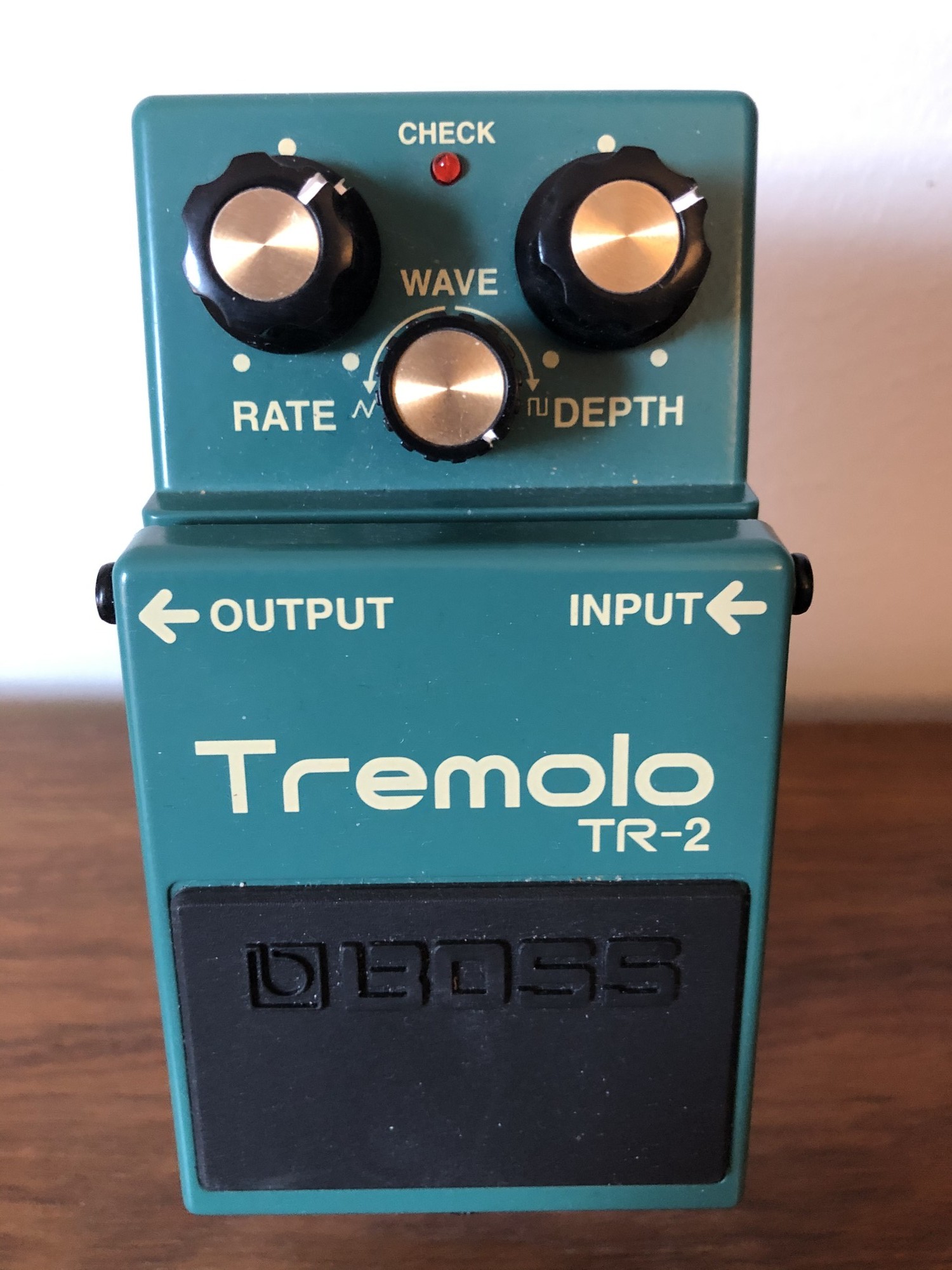
A Boss TR-2 Tremolo pedal, shown as a representative example of the model. Photo: Kuriosatempel, CC BY-SA 4.0. Source: Wikimedia Commons.
Boss TR-2 Tremolo: analog VCA tremolo since 1997. Wave knob spans smooth vintage pulsing to square-wave stutter. Used by Tom Morello and Billie Joe Armstrong.
There’s a scene in guitar-pedal history where less wins. Not because the designers got lazy, but because they figured out exactly what players actually needed and stripped everything else away. The Boss TR-2 Tremolo, released in 1997, is that story told in three knobs. In an era when every manufacturer was cramming digital presets and MIDI connectivity into effects boxes, Boss went the other direction: a single-channel analog tremolo with Wave, Rate, and Depth controls and nothing else. The result became one of the best-selling tremolo pedals ever made and earned a spot on the pedalboard of everyone from Tom Morello shaping the intro of “Like a Stone” to Billie Joe Armstrong pulsing his way into “Boulevard of Broken Dreams.”
The tremolo effect itself is ancient—it was built into tweed Fenders and vintage Magnatones decades before anyone thought to put it in a stomp box. What made those amp tremolos special wasn’t complexity; it was simplicity. A gentle rise and fall in volume, smooth or chopped depending on the style, riding beneath a clean guitar tone like a slow tide. The TR-2’s entire design philosophy is to put that sound on your pedalboard, with the Boss compact form factor’s legendary reliability and the added flexibility of a continuously variable waveform control that gives you everything from silky triangle-wave pulsing to hard, square-edged stuttering.
More than 322 professional artists have used the TR-2 according to Equipboard documentation, spanning genres as different as surf rock, post-hardcore, and indie folk. That breadth isn’t coincidence—it’s what happens when a pedal does one thing so well that no genre has a good reason to avoid it.
History: From the PN-2 to the TR-2’s Refined Simplicity
Boss’s history with tremolo is shorter than you might expect. For much of the company’s early existence, tremolo effects lived inside multi-effects units or inside amplifiers. The first Boss dedicated tremolo—the PN-2 Tremolo/Pan—didn’t arrive until 1987, nearly a decade after the BF-1 Flanger and CE-1 Chorus had established the compact pedal format. The PN-2 was ambitious: it offered both tremolo and stereo panning effects from a single enclosure, with stereo outputs that could send the pulsing effect left and right in alternating waves across two amplifiers. Complex and versatile, but not quite what most players wanted when they asked for “that tweed Fender thing.”
The TR-2 arrived in 1997 as a direct replacement for the PN-2, and its design philosophy is the most instructive thing about it. Boss took the PN-2’s core tremolo engine, removed the panning function, removed the stereo outputs, removed everything that wasn’t essential to simple amplitude modulation, and delivered it in the same compact enclosure with three controls and a single mono output. The industry reaction was that this was somehow backwards—less technology for the same price. The market reaction was that it became the category standard for compact tremolo pedals that it remains almost thirty years later.
The TR-2 has stayed in continuous production since 1997 with only minor internal revisions. Unlike some Boss compact pedals (the CH-1’s analog-to-digital circuit switch, the BF-2’s Japan-to-Taiwan manufacturing change), the TR-2 has remained fundamentally consistent in character throughout its run. One notable quiet revision—documented by players who compared old and new units side by side—addressed a volume drop issue that some TR-2 units exhibited when the pedal was engaged. Boss corrected this internally without fanfare or a model number change, the kind of under-the-radar improvement that only gets noticed by obsessive shootout enthusiasts.
Circuit and Controls: The Analog VCA Engine
The TR-2 uses an analog VCA (Voltage-Controlled Amplifier) circuit to create its tremolo effect. Unlike optical tremolo (where an LED shines on a light-dependent resistor, creating volume fluctuations—the circuit type found in many vintage amplifiers and boutique pedals), the TR-2’s VCA approach uses a voltage-controlled attenuator driven by a low-frequency oscillator. The practical sonic difference between optical and VCA tremolo is subtle but audible: optical designs tend toward slightly softer, more “breathing” transitions at the peaks and troughs, while VCA circuits can feel fractionally more precise. In the TR-2’s case, the VCA approach means the Wave control genuinely shapes the LFO waveform in a continuously variable way, from triangle (smooth, symmetrical rise-and-fall) through intermediate shapes all the way to square (near-instant on/off transitions).
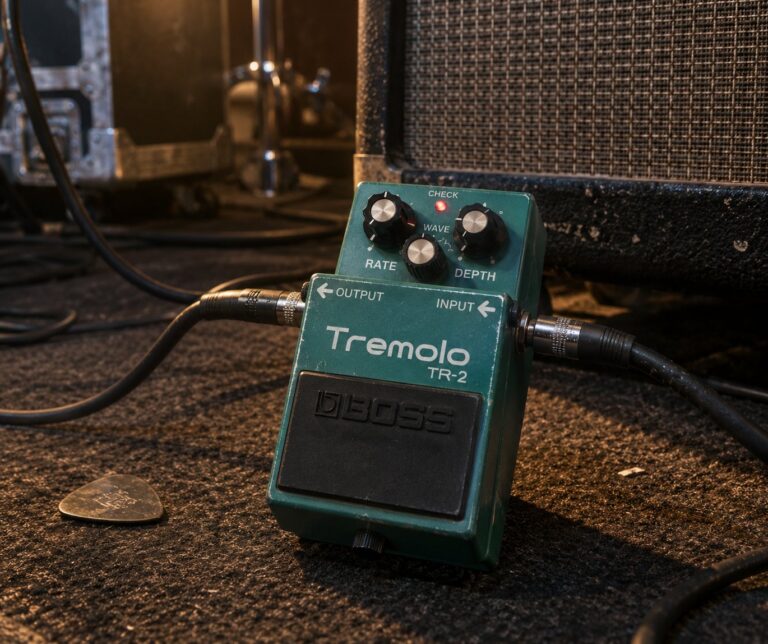
The three controls do more than they appear to:
WAVE is the TR-2’s most distinctive feature relative to simpler tremolos. At the fully counterclockwise position, the LFO waveform is a triangle wave, producing smooth, organic pulsing that closely resembles vintage amp tremolo—the rate rises and falls symmetrically with no abrupt edge. As you turn the Wave knob clockwise, the waveform progressively approaches a square wave. At the square-wave extreme, the tremolo becomes a hard chopper: volume jumps abruptly between full-on and full-off with minimal transition time, creating the staccato, stuttering effect used in spaghetti western soundtracks and experimental indie rock. The spectrum between these extremes gives players access to genuinely distinct sounds, not just subtle variations on the same character.
RATE sets the LFO speed, covering a range from approximately 1 second per cycle (slow, hypnotic pulsing) up to quite fast repeating. The LFO rate is measured in milliseconds per cycle: 90ms is fast (around 11 cycles per second, a buzzy flicker) and 900ms is slow (about one complete pulse per second). This range is wide enough to cover everything from gentle amp-tremolo undulation to aggressive stutter effects.
DEPTH determines how much the volume actually drops during the tremolo cycle’s low point. At minimum Depth, the tremolo is barely perceptible—a gentle shimmer in the signal. At maximum Depth, the signal drops nearly to silence at the bottom of each cycle, creating the most dramatic pulsing. For live playing, medium Depth settings (10 to 2 o’clock) are most musical; maximum Depth sounds dramatic in isolation but can create rhythmic gaps that are hard to play through in a band context.
An internal trim pot adjusts the output volume, allowing players to correct for any perceived volume difference between bypass and engaged states. This requires opening the enclosure with a screwdriver but takes only minutes to adjust.
Specifications
Famous Players: Who Actually Used the TR-2 and Why
The TR-2 attracts a notably specific kind of guitarist: players who know exactly what they want from tremolo and are confident enough to put an unassuming three-knob box on their professional rig without feeling the need to justify it to anyone. The two most documented primary-source users represent opposite ends of the rock spectrum—one a maximalist sonic architect, the other a punk-rock minimalist—and both used the TR-2 for specific song-level purposes rather than as an always-on texture.
Tom Morello — “Like a Stone,” Audioslave
Tom Morello’s relationship with the Boss TR-2 is among the most specific and well-documented of any player’s association with this pedal. Morello added the TR-2 to his Audioslave board specifically to handle the opening riff of “Like a Stone”—a descending figure played with the TR-2 engaged, creating the haunting pulsing tremolo that defines the song’s intro. The pedal also appeared on “Gasoline” from the same era. Ground Guitar’s documentation of Morello’s gear places the TR-2 on his confirmed 2004 rig diagram (originally published by Guitar.com), and fan photography from circa 2005 corroborates it in live settings. His reported settings are characteristically precise: every knob at approximately 3 o’clock—deep Depth, moderate-to-fast Rate, and the Wave control pushed well into square-wave territory for a slightly chopped character that gives “Like a Stone” its slightly urgent, anxious pulse rather than a smooth vintage-amp roll.
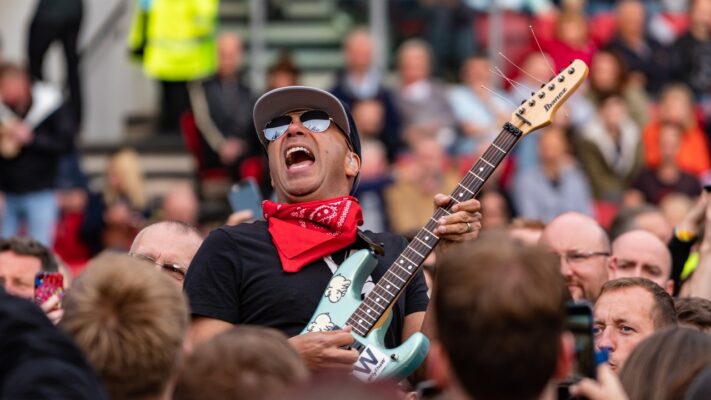
This is instructive beyond the specific settings. Morello already had the ability to create tremolo-like effects using his famous killswitch technique (the toggle switch on his Arm the Homeless guitar, which interrupts the signal in rhythmic on-off patterns). He added the TR-2 specifically because it gave him something the killswitch couldn’t: a continuously variable tremolo with controllable depth and waveform, synchronized to tempo, that could be engaged with a single footswitch. When a guitarist who can do something manually with his bare hands still chooses to use a dedicated pedal for a specific song, that says something concrete about the pedal’s value.
Billie Joe Armstrong — “Boulevard of Broken Dreams,” Green Day
Billie Joe Armstrong’s TR-2 documentation comes from Premier Guitar’s Rig Rundown filmed during Green Day’s spring 2013 99 Revolutions tour, where the TR-2 was confirmed as part of his rack system for the intro of “Boulevard of Broken Dreams.” The song’s iconic opening guitar figure—clean and slightly compressed, with a slow, regular pulse beneath it—uses the TR-2’s triangle-wave setting at a moderate rate and low-to-medium depth, capturing the most traditional amp-tremolo character in the pedal’s range. Unlike Morello’s square-wave approach, Armstrong’s application sits at the smooth, warm end of the Wave control, closer to the Fender amp tremolo aesthetic that makes the song’s opening feel simultaneously intimate and cinematic.
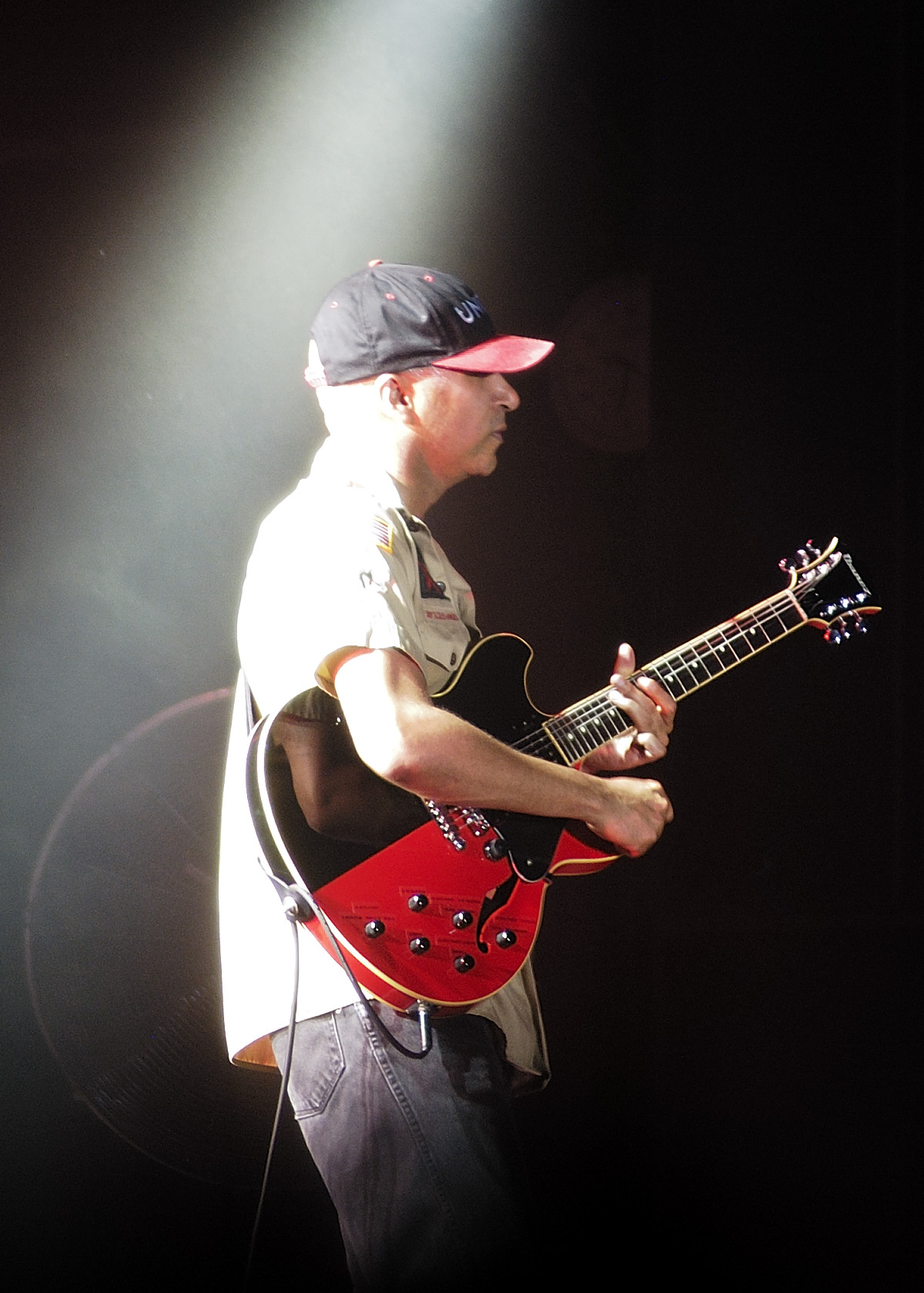
The documentation is specific about performance vs. studio use: the TR-2 isn’t always engaged live in the way it is in the studio recording, consistent with the practical realities of live sound where subtle effects can get lost. But its presence in the rack is confirmed, and the effect is present on the record in a way that’s immediately identifiable once you’ve heard it isolated.
Noel Gallagher — Equipboard-documented, with caveats
Noel Gallagher appears among the TR-2’s 322 documented Equipboard users, and multiple sources reference a TR-2 in his High Flying Birds-era rig. However, Gallagher is more definitively documented as a user of the TR-2’s predecessor, the Boss PN-2 Tremolo/Pan, which was photographed and documented on his Oasis-era boards. The distinction matters: the PN-2’s tremolo character is slightly different from the TR-2’s (the PN-2 is a more complex circuit with stereo panning capability), and it’s possible that community-sourced gear databases have conflated the two models over time. Without a specific primary-source quote or high-resolution pedalboard photo confirming TR-2 specifically on a Gallagher board, this one warrants a note of caution. He’s worth mentioning in context of Boss tremolo history, but the PN-2 is the more confidently attributed Boss tremolo in his documented rigs.
Tone Recipes: Five Sounds the TR-2 Does Better Than Almost Anything Else
1. Classic Fender Amp Tremolo (the vintage country baseline)
WAVE: fully counterclockwise (triangle). RATE: 9-10 o’clock (slow, about one pulse per second). DEPTH: 10 o’clock (noticeable but not dramatic). This setting reproduces the tremolo sound built into blackface and silverface Fender amplifiers—the soft, lapping-wave pulsing that was the default sound of country and early rock ‘n’ roll. A Stratocaster or Telecaster into a clean Deluxe Reverb with these settings is, frankly, hard to argue with.
2. Tom Morello’s “Like a Stone” Setup
WAVE: 3 o’clock (well into square-wave territory, creating a slightly harder chop). RATE: 3 o’clock (moderate-to-fast). DEPTH: 3 o’clock (deep, noticeable pulsing). This is Morello’s documented approximate setting. The harder waveform gives the tremolo more urgency and less warmth than the triangle setting—it cuts rather than washes. Works especially well with humbuckers into a clean or lightly crunch amp.
3. Boulevard of Broken Dreams Pulse
WAVE: 8-9 o’clock (triangle to slightly asymmetric—close to fully CCW). RATE: 10-11 o’clock (slow-to-moderate, unhurried). DEPTH: 9-10 o’clock (subtle, the tremolo is felt more than heard). This reproduces the intro of “Boulevard of Broken Dreams”—a clean guitar with gentle amplitude pulsing, transparent enough that the chord voicings remain fully audible. The effect disappears when the rhythm guitar joins in, which is correct: this is tremolo as cinematic atmosphere, not tremolo as effect.
4. Spaghetti Western Stutter
WAVE: fully clockwise (square). RATE: 1-2 o’clock (medium-fast). DEPTH: 2-3 o’clock (deep). Square wave at medium-fast rate with significant depth creates the hard-edged, rhythmically precise tremolo of Ennio Morricone-influenced cinema guitar—choppy, angular, slightly menacing. Pair with a slap-back delay for maximum outlaw resonance.
5. Psychedelic Wash (shoegaze substrate)
WAVE: 9 o’clock (close to triangle but with slight asymmetry). RATE: 8 o’clock (very slow, nearly half as slow as the slowest obvious pulsing). DEPTH: 11 o’clock (subtle). At extremely slow rates and moderate depth, the TR-2 creates a rising-and-falling sense of volume that blurs with the sustain of a note—not quite tremolo as a distinct rhythmic effect, but more like the guitar itself is breathing. Combine with heavy reverb (spring or plate) and a driven amp for the kind of atmospheric swell that sits underneath a wash of sustained chords without competing with them.
Signal Chain Placement and Practical Considerations
Tremolo’s ideal position in a signal chain depends on what you’re trying to achieve. Traditional placement is after overdrives and before modulation and delay/reverb—the order recreates how a vintage amp tremolo circuit worked, where the tremolo modulated the signal after the preamp gain stage. This gives you a driven tone that pulses cleanly in amplitude.
Placed after reverb or delay, the TR-2 tremolo chops the echoes along with the dry signal, creating a more aggressive, choppy effect where the reverb decay itself stutters in and out. This is valid but sounds different from “amp tremolo”—closer to a rhythmic gating effect on the reverb tail.
Placed before overdrive or distortion, the TR-2’s volume modulation gets compressed and partially swallowed by the gain stage, reducing the tremolo depth audibly and creating a more subtle swelling that can be interesting at low Depth settings but loses the classic tremolo character at high ones.
The TR-2’s 20 mA current draw is modest—among the lowest of any Boss compact pedal—and compatible with virtually any isolated power supply. Unlike the BF-3’s 60 mA or the DC-2W’s 65 mA, the TR-2 can share power rails without issue on most daisy-chain setups, though isolated power is always preferable for noise reduction.
Buffered bypass means the TR-2 maintains signal integrity even when bypassed, and its 1 MΩ input impedance loads pickups minimally. As with other Boss buffered designs, the TR-2 should come after any germanium fuzz pedals in the chain—true-germanium fuzzes interact poorly with the impedance presented by a buffered bypass input and will lose their character if they see one before they see the amp input.
Comparisons: Where the TR-2 Sits in the Tremolo Landscape
vs. Electro-Harmonix Pulsar
The EHX Pulsar is the TR-2’s most direct budget-to-mid competitor. The Pulsar has true bypass, a dedicated Rate LED for visual tempo reference, and also offers triangle-to-square wave shaping. The TR-2 has buffered bypass (useful for long cable runs) and a more established used-market support base. Sonically they’re close; the Pulsar’s true bypass may matter more to some signal chains than to others. If true bypass is a requirement, the Pulsar is the natural comparison; if board space and reliability history are the priority, the TR-2’s decades of professional documentation win.
vs. MXR M305 Studio Tremolo
The MXR M305 adds tap tempo—the TR-2 has no tap tempo function, which is its most frequently cited limitation. If you need to lock tremolo rate to song tempo in a live context without tap-to-foot-tap calculation, the M305’s advantage is real. The TR-2 is approximately $40–50 cheaper new and has a longer professional track record. For players who don’t work in strict tempo settings (studio writers, non-click-track live players, blues and country players who work loosely), tap tempo is a non-issue and the TR-2’s simplicity is an asset.
vs. Strymon Flint Tremolo Section
The Strymon Flint combines tremolo and reverb in one unit, models three specific vintage amp tremolo types (harmonic, photocell, opto), and offers reverb types that complement each tremolo flavor. It costs roughly three to four times the TR-2’s price. For players who want amp-modeled tremolo with deep reverb integration and the ability to recall specific vintage circuit behaviors, the Flint is a categorically different tool. The TR-2 cannot match the Flint’s depth of amp-specific modeling. But the TR-2’s Wave control gives it flexibility the Flint’s three-position switch doesn’t—you can dial in precisely where between smooth and choppy you want to live, whereas the Flint commits to its three character types.
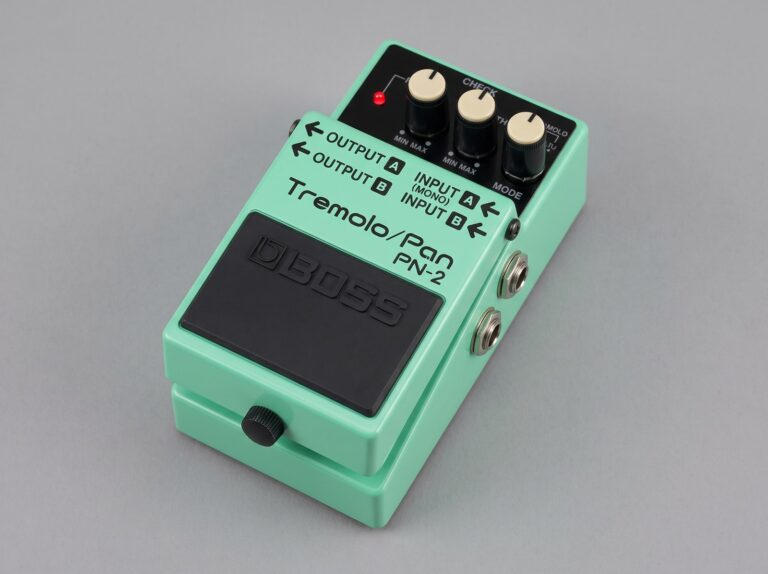
vs. Boss PN-2 Tremolo/Pan (the predecessor)
The PN-2 offers stereo panning in addition to tremolo—a genuinely different effect where the signal alternates between left and right outputs in a sweeping pan that, at faster rates, becomes a dizzying spatial rotation effect. If you run two amplifiers or two signal paths in stereo, the PN-2’s panning mode is a sound the TR-2 simply cannot produce. For mono rigs, the TR-2’s cleaner tremolo circuit and lower street price make it the more practical choice. PN-2 units (discontinued in 1997) sell used for $80–130 in excellent condition and are collectible partly for this stereo capability.
Buying Guide: New vs. Used, What to Watch For
The TR-2 is a relatively uncomplicated used-market purchase. Unlike the BF-2 (with its meaningful Japan/Taiwan manufacturing distinction) or the CH-1 (with its fundamentally different analog vs. digital circuits), all TR-2 units produced since 1997 use essentially the same circuit. There are no manufacturing variants that represent a meaningful sonic upgrade or downgrade, and no analog-to-digital transition to navigate. A used TR-2 in excellent condition from any point in production will sound like a new one.
The primary thing to test when buying used: engage the pedal and cycle through the WAVE control’s full range while holding a sustained note. The transition from triangle to square should be smooth and continuous, with no dropout, crackling, or stuck position. Also verify all three knobs sweep cleanly from minimum to maximum without crackling—dirty potentiometers are the most common issue on used Boss compacts and usually resolve with a spray of contact cleaner through the knob shaft.
Check the volume balance between bypass and engaged states. Some TR-2 units from certain production runs exhibit a slight volume drop when engaged (the effect sounds quieter than bypass). This is correctable with the internal trim pot if you’re comfortable opening the enclosure, or you can use your amp’s gain to compensate. Post-revision units from the past decade are less likely to exhibit this, but it’s worth verifying before committing to a used purchase.
The JHS Pedals “Versa-Trem” modification for the TR-2 was a popular mod during the early 2010s—it added a harmonic tremolo mode (splitting highs and lows and modulating them out of phase, in the manner of a Fender brown-panel amp) and other circuit improvements. JHS-modded TR-2 units appear on the used market at $80–120 and are worth seeking if you want harmonic tremolo capability alongside the standard TR-2 feature set.
New price is approximately $99–109 USD at major retailers. Used units in excellent condition sell for $45–75 depending on condition and included original box.
Ownership Notes: Living With the TR-2 Long-Term
The TR-2 earns a reputation as a permanent fixture on boards across styles—not an “I’ll try this” pedal but an “I’ve had this for twelve years and nothing has given me a reason to replace it” pedal. That durability of ownership reflects something real about how the pedal functions: its simplicity eliminates the decision fatigue that affects more feature-rich designs. There’s nothing to save presets for, nothing to map to MIDI, and no menus to navigate. You dial in your sound and move on.
The absence of tap tempo is the one limitation that actually matters in practice. In live band settings where the tremolo needs to lock exactly to a song’s beat—where an approximate rate won’t do—you’ll either need to adjust the Rate knob before each song (workable), accept that the tremolo runs free-time (often fine), or move to a tap-tempo tremolo for those specific applications. For studio work this is irrelevant; for live players who use tremolo on one or two songs rather than as a centerpiece of their sound, it’s unlikely to be a dealbreaker.
The buffered bypass is almost never a problem and occasionally a benefit. Players with long cable runs between guitar and pedal, or between pedal and amp, get a cleaner signal with buffered bypass than true bypass—the buffer maintains signal integrity over capacitance losses in long cables. This only matters in practice for players running cables beyond 15–20 feet or daisy-chaining many true-bypass pedals in series.
Frequently Asked Questions
Is the Boss TR-2 analog or digital?
The TR-2 is fully analog. It uses a VCA (Voltage-Controlled Amplifier) circuit driven by an analog low-frequency oscillator. No digital processing or modeling is involved in creating the tremolo effect. This is one of the reasons it’s remained in continuous production for nearly thirty years—the analog circuit ages gracefully and doesn’t become “outdated” the way digital modeling hardware does.
Why does my TR-2 seem quieter when it’s on than when it’s bypassed?
Some TR-2 units, particularly from certain earlier production runs, exhibit a slight volume drop when engaged. This is a known characteristic of that circuit revision. Inside the pedal is a trim pot (accessible by removing the screws on the enclosure) that adjusts the output volume. Turning it clockwise increases output level. Alternatively, a music tech or guitar tech can do this in a few minutes if you’re not comfortable working inside the pedal.
Does the TR-2 have tap tempo?
No. The TR-2 does not have a tap tempo function. Rate is set manually with the RATE knob. If you need to lock tremolo to precise song tempo in a live setting, you’ll need a different pedal—the MXR M305, the Source Audio Ultrawave, or the TC Electronic Pipeline are among the options with tap tempo in a reasonable price range.
What is the WAVE knob actually doing?
The WAVE knob continuously shapes the waveform of the LFO (low-frequency oscillator) that drives the tremolo. At the fully counterclockwise position, the waveform is a triangle—a smooth, symmetrical rise and fall that creates gradual, organic pulsing. At the fully clockwise position, the waveform approaches a square wave—an abrupt jump from full volume to near-silence and back, creating choppy, staccato stuttering. The positions between these extremes produce continuously variable intermediate shapes, letting you dial in exactly how abrupt or smooth you want the tremolo’s transitions.
Where should I put the TR-2 in my signal chain?
Traditional placement is after overdrives and dirt pedals, before reverb and delay. This puts the tremolo in the position it would occupy in a vintage amplifier’s circuit, where the signal passes through preamp gain and then gets amplitude-modulated. After reverb, the tremolo chops the reverb decay as well as the dry signal, creating a more aggressive effect. Before overdrive, the tremolo’s volume changes get partially compressed and swallowed by the gain stage. All three positions are useful; start with after-overdrive/before-reverb if you want the most classic amp-tremolo result.
What’s the difference between the TR-2 and the Boss PN-2?
The PN-2 (produced 1987–1997) was the TR-2’s predecessor. It offered both tremolo and stereo panning effects, with two outputs that could alternate the signal left and right across two amplifiers. The panning effect is a genuinely different sound from tremolo and requires a stereo rig to appreciate. The TR-2 dropped the panning function, focused entirely on tremolo, and produced a cleaner, more focused implementation of the amplitude modulation effect. For mono rigs, the TR-2 is the better tool; for players running stereo who want the panning effect, a used PN-2 is the only Boss compact that offers it.
Can the TR-2 do harmonic tremolo?
No, not in its stock configuration. Standard tremolo modulates the full-frequency signal uniformly in amplitude. Harmonic tremolo—the circuit type in certain Fender brown-panel amps, which splits the signal into high and low frequencies and modulates them out of phase with each other—produces a richer, more three-dimensional effect but requires a more complex circuit. The JHS Pedals “Versa-Trem” modification of the TR-2 added a harmonic tremolo mode, and those modified units appear on the used market. For stock harmonic tremolo in a compact pedal, options include the Fender Marine Layer Reverb (which has a harmonic tremolo section) or dedicated units from smaller builders.
Is the TR-2 good for bass guitar?
Yes. The TR-2’s analog circuit handles the full frequency range without bandwidth limitation, and the 1 MΩ input impedance is appropriate for passive bass pickups as well as guitar. Tremolo is used more sparingly in bass applications than guitar—extreme Depth settings can create rhythmic gaps that complicate the bass’s role as a foundational instrument—but at moderate Depth with a triangle waveform, the TR-2 adds movement to a bass part without making it sound hollow or incomplete.
Image credits
- Tom Morello: deep ghosh, Wikimedia Commons, CC BY 2.0.
- Top image: Kuriosatempel, Wikimedia Commons, CC BY-SA 4.0.
- Tom Morello: Tom Morello – MuseBristol 050619-10, Wikimedia Commons, CC BY 2.0.
- Boss PN-2 Tremolo/Pan: GuitarGangsters AI-generated reference illustration, not a photograph.
- Boss TR-2 Tremolo: GuitarGangsters AI-generated reference illustration, not a photograph.
Latest News
Related
On This Day
Monday 9 November
From this week: