One Pedal, Infinite Layers: Why the Boss RC-1 Loop Station Remains the Gateway to Live Looping
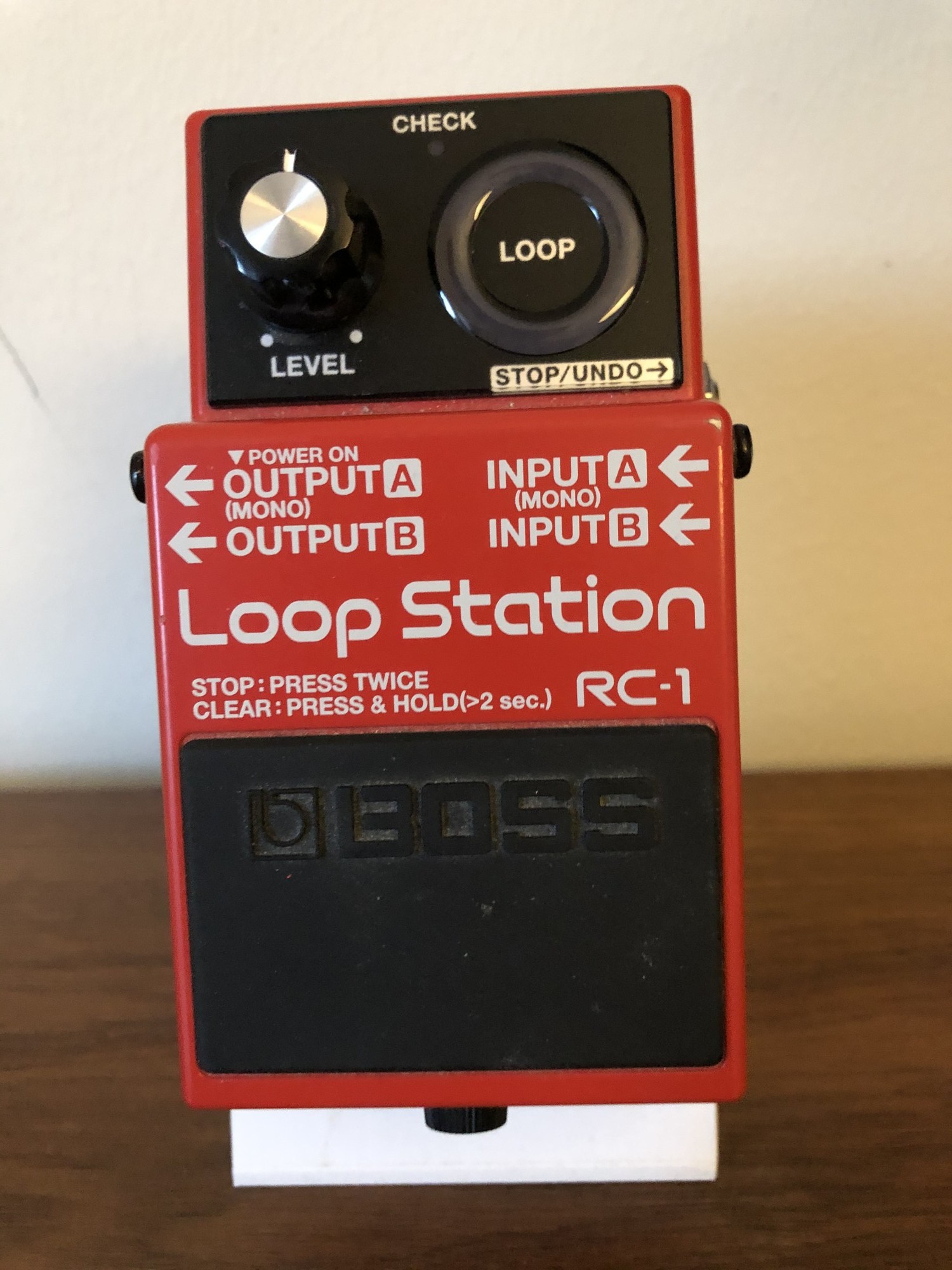
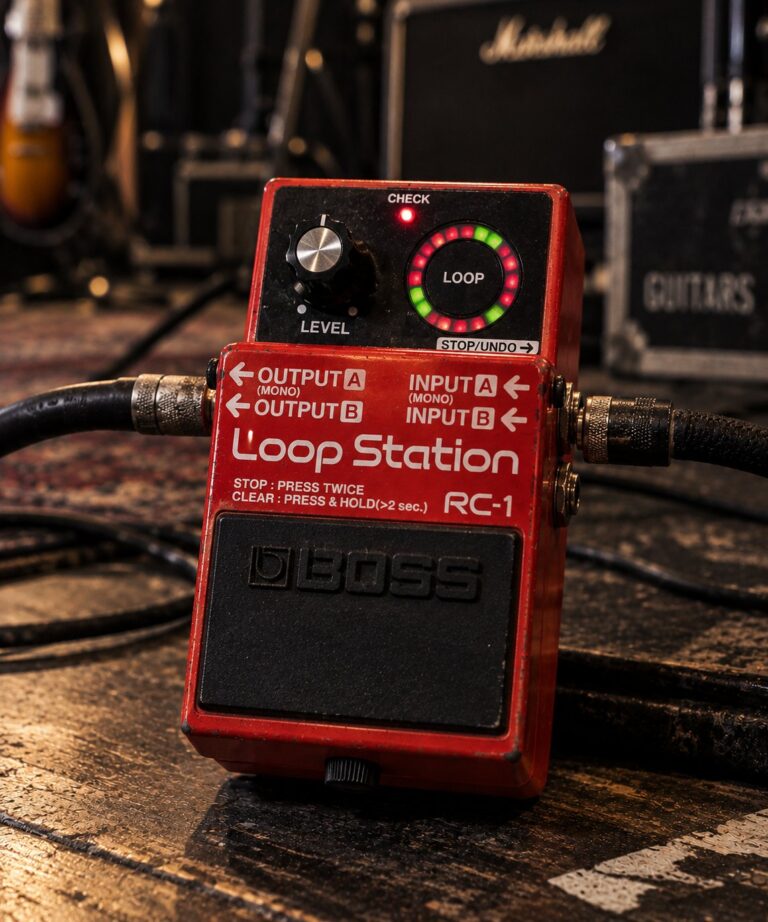
A Boss RC-1 Loop Station looper pedal, shown as a representative example of the model. Photo: Kuriosatempel, CC BY-SA 4.0. Source: Wikimedia Commons.
The Boss RC-1 Loop Station explained: specs, famous players, tone recipes, comparisons vs TC Ditto & RC-5, buying guide, and honest ownership notes.
There’s a before and after in the story of every guitarist who first stepped on a looper pedal. One moment you’re a solo player filling a room with a single guitar signal. The next, you’re building chords over your own bassline, soloing over your own rhythm track, turning a practice room into a one-person band. The Boss RC-1 Loop Station is where hundreds of thousands of players have experienced that exact moment — and it has been doing that job reliably since 2014 without pretending to be anything it isn’t.
That directness is the RC-1’s defining quality. At a time when Boss’s Loop Station lineup includes multi-track monsters with built-in rhythm sections and studio-grade memory banks, the RC-1 says: one footswitch, one knob, 12 minutes of stereo recording, and get on with it. That’s not a compromise. It’s a philosophy — the same philosophy that made the original Boss compact pedal format legendary in the 1970s. Strip the controls down to what you actually need, put it in an indestructible enclosure, and make sure it works every single time you press it.
This is not a pedal that will impress gear nerds at trade shows. It was never meant to. The RC-1 impresses the guitarist who shows up to an acoustic open mic and builds a full arrangement from scratch in real time. It impresses the teacher who loops a chord progression and hands the guitar to a student to solo over. It impresses the bedroom player who discovers, at ten o’clock on a Tuesday night, that practicing bending to a looped reference note is the fastest ear training tool they’ve ever used. That’s the RC-1’s audience — and Boss has been serving them exceptionally well for over a decade.
The Loop Station Lineage: How the RC-1 Fit Into Boss’s Big Picture
Boss launched the Loop Station concept in 2001 with the RC-20, a twin-pedal unit that gave guitarists a previously studio-only capability: record yourself, layer over yourself, repeat indefinitely. The RC-20XL followed in 2004 with sixteen minutes of recording time, and it became the pedal that a teenage Ed Sheeran used to develop the live looping technique that would eventually fill stadiums. The RC-2 in 2006 squeezed the technology into Boss’s standard compact footprint for the first time, and the RC-3 in 2011 improved on it with onboard rhythm patterns and 99 internal memory banks.
By 2014, Boss had a problem that was also an opportunity. The Loop Station lineup had grown sophisticated — multiple tracks, MIDI sync, USB connectivity, phrase storage. All features that pro loopers wanted. But the complexity was increasingly intimidating to the player who just wanted to record a loop and play over it. The RC-1 was the answer to that specific problem, announced on September 1, 2014, as the most stripped-back Loop Station Boss had ever built.
The timing was shrewd. Solo acoustic performance was having a cultural moment. The influence of artists like KT Tunstall — whose 2004 performance of “Black Horse and the Cherry Tree” on Later… With Jools Holland had introduced mainstream audiences to live looping — had trickled through the culture for a decade. Keller Williams had been building entire sets from loops for years, showing what one person and a pedalboard could do. Ed Sheeran’s ascent through the early 2010s on the strength of his loop-built live shows had made the technique aspirational for acoustic players everywhere. Boss read that cultural current correctly and gave it an accessible entry point.
The RC-1 has remained in production ever since, surviving the launch of the more feature-rich RC-5 in 2020 and continuing to hold its position as the series’ entry point through 2026. That’s twelve-plus years in a market segment where most products turn over every three to five years. That kind of longevity is earned, not marketing.
Specifications at a Glance
A few things in that spec sheet deserve direct attention. The 24-segment circular LED is more useful than it sounds — it shows you where you are in the loop at a glance, which matters more than you’d expect when you’re performing and can’t look at your feet the whole time. The single retained memory is a deliberate limitation; if you need to store multiple phrases and recall them on demand, you want the RC-5 instead. And the 95mA current draw puts it in the same category as multi-effect compact pedals — higher than a simple overdrive, low enough that any decent isolated power supply handles it without complaint.
Famous Players: Honest About Who Actually Uses the RC-1
Here’s where the GuitarGangsters honesty policy matters. The Boss RC-1 is the entry-level model in a lineup that goes much further. The most famous names associated with looping — Ed Sheeran, KT Tunstall, Keller Williams — are Loop Station users in a broad sense, but their documented, confirmed setups generally involve different models. Sheeran’s signature technique was built on the RC-20XL. Tunstall’s iconic 2004 Jools Holland performance used an Akai E2 Headrush. Keller Williams has used various Boss Loop Station models over the years, but specific RC-1 confirmation isn’t documented in primary sources. The RC-1 is too new (2014) and too entry-level to have the kind of “guitar hero on stadium stage” association that older flagship models accumulate. That’s fine. It’s built for a different purpose.
What we can confirm: Aaron “P-Nut” Wills, the bassist of 311, was documented using a Boss RC-1 Loop Station in the band’s Premier Guitar Rig Rundown from November 2017. That appearance showed P-Nut’s real-world bass rig on a touring production — not a boutique-fetishist’s fantasy board, but the actual tools he used night after night for a band that’s been filling clubs and theaters for three decades. Seeing an RC-1 on that board is, in a way, the most useful kind of endorsement: a working professional who selected it not to impress anyone, but because it does the job.
Equipboard documents 27 professional artists using the RC-1 as of 2026. The breakdown skews toward guitarist-vocalist soloists, acoustic performers, and bassists who need a simple looping tool without the complexity of the multi-track models. That’s exactly the use case the RC-1 was designed for, and it confirms that it’s doing that job at a professional level even if it isn’t the pedal you’ll see on the stage behind a 100,000-capacity stadium stage.
The looping artists who made the technique famous are worth mentioning in their own right, even without direct RC-1 confirmation. KT Tunstall’s Jools Holland moment in 2004 — building “Black Horse and the Cherry Tree” from a single vocal percussion loop and layering guitar and vocals on top in real time — remains one of the most-watched live performance moments in the history of the technique. It introduced millions of people to the idea that one person and a looper could fill a room the way a band does. Ed Sheeran took that idea further and made it commercially dominant. The RC-1 benefits from everything those artists taught the public about what a looper can do, even if the specific pedal on their boards was a different model.
Seven Ways to Use the RC-1: Practical Applications for Every Situation
1. The Practice Backing Track
This is where the RC-1 earns its place for more players than any other application. Loop a four-bar chord progression in the key and tempo you want to practice — a Stratocaster straight into a Fender Deluxe Reverb works perfectly for this — and then spend twenty minutes soloing over it. You’re training your ear, your phrasing, and your knowledge of the fretboard simultaneously, against a reference that you built yourself in the exact style you want. No app required, no subscription, no Bluetooth pairing. Press the footswitch, record four bars, press it again. That’s the whole workflow.
2. The Bending Accuracy Trainer
Loop a single note or chord, then try to bend a string to match it. This is deceptively demanding and extraordinarily effective. The loop gives you an instant pitch reference that you can’t tune out the way you can tune out a reference track you’ve heard a hundred times. Your ears tell you immediately whether your bend landed on pitch. Do it with your Tube Screamer engaged to add sustain that extends the pitch reference, and you have one of the best intonation training tools you can build for under $200 combined.
3. The Solo Acoustic Live Performance Base
Record a rhythm pattern — strumming, muted strings, or a fingerpicked ostinato — then layer a melody or bassline on top before playing your lead line over both. This is the core technique of solo acoustic performance, and the RC-1 handles it cleanly. The stereo I/O means you can split the signal to two amplifiers if the venue supports it. The 12-minute recording time means you won’t run out of space mid-set. The buffered bypass means your dry tone when you’re not looping isn’t degraded by the pedal sitting in your chain.

4. The Dual-Amp Stereo Spread
Plug a Stratocaster or any guitar with stereo effects capability into INPUT A and B simultaneously (or route a stereo effects board’s output into both inputs), then connect OUTPUT A to one amplifier and OUTPUT B to another. The RC-1 auto-detects the stereo configuration when both outputs are connected before power-on. Loop a chord bed and you get a wide stereo spread across two amplifiers that fills a room in a way a mono setup can’t replicate. This works particularly well alongside a wah pedal for expressive lead work.
5. The Drone Pad
Loop a sustained power chord or open-string drone — the kind of thing a JCM 800 sustains effortlessly — and let it breathe under your lead playing. This is particularly effective for players who practice in styles where drone is part of the vocabulary: Celtic fingerpicking, Indian classical-influenced fingerstyle, ambient metal, slide guitar. The RC-1 captures the natural decay of the note, which means the loop maintains the organic feel of a real sustained chord rather than the digital snap of a sample.
6. The Composition Sketchpad
Loop a chord progression you’ve been working on, then try different melody ideas over it. The undo/redo function means you can erase your most recent overdub and try again without losing the underlying loop. This makes the RC-1 a useful compositional tool even for players who don’t perform with loopers — you’re effectively sketching in real time, hearing how melodic ideas land against harmonic ones before you commit them to memory or notation.
7. The Two-Instrument Separator
Connect guitar to INPUT A and bass or a second instrument to INPUT B before powering on. OUTPUT A carries the guitar signal; OUTPUT B carries the bass signal. Both instruments play through the RC-1’s single loop simultaneously, but they appear at separate outputs that you can send to separate amplifiers. A guitarist and bassist in a rehearsal space can both run through a single RC-1 to loop a joint rhythm section and practice lead playing over it. Boss quietly built a fairly sophisticated routing capability into what looks like the simplest pedal in the lineup.
How the RC-1 Compares: The Looper Market in Context
The RC-1 sits at the entry level of a clearly defined market segment. Understanding where it excels and where it doesn’t requires comparing it honestly to the pedals players actually consider alongside it.
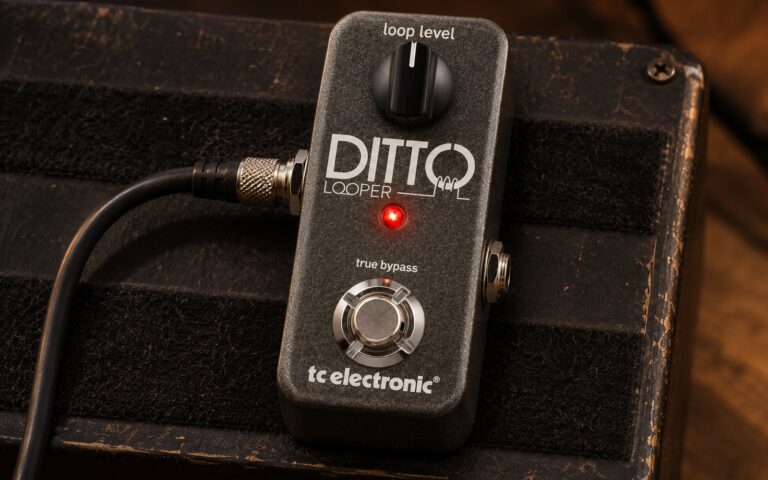
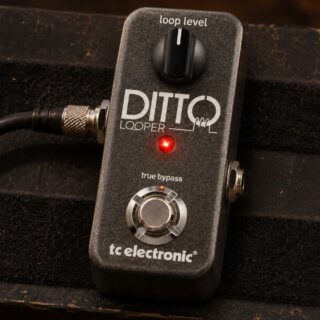
Boss RC-1 vs. TC Electronic Ditto: The Ditto was TC Electronic’s direct answer to the RC-1 concept — simple, compact, affordable. The Ditto has fewer controls (just a knob and a footswitch with no LED indicator) and records in mono only. The RC-1 wins on stereo capability and the circular LED, which genuinely helps with timing in performance. The Ditto wins on footprint — it’s physically smaller — and on price in some markets. If stereo is irrelevant to your setup, the Ditto is a worthy alternative. If you want stereo or you find visual loop feedback useful, the RC-1 is the choice.
Boss RC-1 vs. Boss RC-5: The RC-5 (released 2020) is the modern evolution of the compact Loop Station concept. It records in 32-bit WAV quality, stores up to 99 phrase memories, has 13 hours of recording time, connects via USB for phrase import/export, includes a built-in rhythm guide, and features a MIDI clock output. It costs significantly more. If you’re going to perform regularly with a looper and you need to recall specific phrases or sync to MIDI, the RC-5 is the right tool. If you want to practice or do simple live looping without managing memory banks or USB connections, the RC-1’s simplicity is a genuine advantage. Both pedals serve their audiences well; they’re different tools for different contexts.
Boss RC-1 vs. Boss RC-3: The RC-3 was the RC-1’s predecessor concept (though Boss still sells both). The RC-3 includes 99 phrase memories, rhythm patterns, and USB connectivity — features the RC-1 omitted deliberately. If you used an RC-3 and found yourself ignoring all of those features every time you played, the RC-1 is a cleaner and cheaper alternative. If you used any of those features, stay with the RC-3 or step up to the RC-5.
Boss RC-1 vs. EHX 720 Stereo Looper: Electro-Harmonix’s 720 is another stereo compact looper with a different operational character. The 720 records in stereo and offers 12 minutes of recording time, similar to the RC-1. The RC-1’s circular LED indicator is more informative than the 720’s simpler status lights. Boss’s build quality and 5-year warranty are stronger than EHX’s standard offering in this price range. The RC-1 wins on overall reliability and the quality of its operating indicator; the 720 competes on features at a similar price point but has a more complex learning curve than its appearance suggests.
Buying Guide: New vs. Used and What to Watch For
The Boss RC-1 has been in continuous production since 2014 with no significant hardware revisions. There are no special editions, limited runs, or “V1 vs V2” debates to navigate. Any RC-1 you buy, new or used, is the same circuit with the same feature set. Boss’s build quality control across all their compact pedals is excellent — the failure rate on the RC-1 is very low, and most used units that appear on the market are in fully functional condition.
New pricing as of 2026 sits around $93–$109 USD from major retailers. Used units in excellent condition typically run $55–$75 USD on resale markets. At that price difference, the case for buying used is stronger here than for complex multi-circuit pedals where component-level condition matters more. The RC-1’s circuit is simple and robust; a used unit showing normal cosmetic wear on the enclosure (common with Boss compact pedals that get gigged hard) almost certainly still works perfectly.
When buying used, test the footswitch across all its functions: one press records, a second press starts playback while simultaneously allowing overdubbing, a double-press stops playback, a long press erases the loop. Verify that the circular LED lights accurately and that the level knob has no scratching or drop-outs when turned. Check that both stereo outputs work by connecting two cables. If all of that checks out, the pedal is sound.
Boss’s 5-year limited warranty applies to new units purchased from authorized dealers. The warranty is specific to the original purchaser and doesn’t transfer with resale, which is standard for Boss products. For a pedal at this price point, that’s a factor worth knowing but not one that should determine your decision — if it works when you test it, it’s going to keep working.
Living with the RC-1: Real-World Ownership Notes
The operational quirk that catches most new RC-1 owners: by default, the pedal goes from recording directly into overdub mode on the second press, not into straight playback. To play back the loop without immediately adding more to it, you need to press once to stop, then press again to play. Some players prefer a different default. Boss allows you to configure the behavior through a specific power-on routine (hold the footswitch while connecting power). It’s in the manual and worth setting up in the first session if you find the default behavior counterintuitive.
Erasing a loop also briefly plays back the audio for approximately two seconds before clearing it. In a practice context, that’s a mild annoyance. On a live stage in a quiet moment, it can be audible to the audience. The workaround is to bring the loop level knob to zero before erasing, which silences the playback — manageable but requiring one extra step. This is the one behavior that genuinely earns criticism in real-world use rather than in specification comparisons.
The 95mA current draw is higher than most simple analog pedals but well within the range of any modern pedalboard power supply with isolated outputs. A Strymon Zuma, Cioks DC7, MXR ISO Brick, or similar supply handles it without any calculation required. Don’t run it off a daisy-chain from a shared 9V supply — not because the RC-1 will malfunction, but because the shared current can introduce noise to the other pedals on the chain.
The optional FS-5U, FS-6, or FS-7 footswitches unlock additional functions: loop decay (the loop gradually fades out naturally), reverse playback, and MIDI clock sync for the FS-7 specifically. If you find yourself wanting any of those features after spending time with the RC-1, adding an FS-6 (which provides two switches for about $30) is a cost-effective upgrade without changing pedals. Many players own an RC-1 for years before discovering this option exists.
Frequently Asked Questions
How do I stop the RC-1 from going into overdub mode automatically?
By default, the second press of the RC-1’s footswitch enters overdub mode rather than straight playback. You can change this behavior with a configuration routine: hold the footswitch down while connecting the power supply (or inserting the battery). This toggles between “Rec → Dub → Play” and “Rec → Play → Dub” modes. The latter gives you straight playback on the second press, which many players find more natural. The manual describes this process, and it takes about 30 seconds to set up.
Does the Boss RC-1 record in stereo?
Yes — with an important caveat about setup. You must have cables connected to both the INPUT A and INPUT B jacks, and to both OUTPUT A and OUTPUT B jacks, before powering the RC-1 on. The pedal auto-detects the connected cables at startup to determine whether to operate in mono or stereo mode. If you power it up with only one cable connected to each side, it defaults to mono and doesn’t switch to stereo mid-session.
Can the Boss RC-1 store multiple loops?
No. The RC-1 stores a single loop in memory, which is retained when you power down the pedal. If you need to store multiple separate phrases and switch between them during a performance, the RC-1 is not the right pedal — the Boss RC-5 (99 memory banks) or the Boss RC-3 are the appropriate step up within the Boss lineup.
What’s the Boss RC-1’s actual recording time?
Twelve minutes of stereo recording time. In mono (single output), this extends to 12 minutes as well — the recording time is fixed regardless of stereo or mono operation. Twelve minutes is more than sufficient for any single-phrase looping application; even the most complex solo performer builds rarely require more than a few minutes of actual loop content.
Does the Boss RC-1 work with bass guitar?
Yes, without any configuration or input switching. The RC-1 handles any instrument-level signal that plugs into a standard 1/4″ jack — bass guitar, acoustic guitar with a pickup, keyboards, and even vocal microphones through a suitable direct box. Aaron “P-Nut” Wills of 311 uses one on his bass rig, which is the most direct professional confirmation of this cross-instrument capability in the RC-1’s documented history.
What’s the difference between the Boss RC-1 and RC-5?
The RC-5 (released 2020) adds 99 phrase memory banks, 13 hours of recording time, 32-bit WAV quality recording, USB connectivity for phrase import/export, a built-in rhythm guide, and MIDI clock output. The RC-1 has none of those features and is simpler, cheaper, and easier to use. Choose the RC-1 if you want the most straightforward looping experience possible. Choose the RC-5 if you need to store multiple phrases, sync to external devices, or want higher recording quality for recording applications.
Can I add external footswitches to the Boss RC-1?
Yes, and it’s one of the RC-1’s more useful hidden capabilities. The pedal accepts optional Boss FS-5U, FS-6, or FS-7 footswitches (connected via a standard 1/4″ TRS cable). Depending on which switch you connect, you can unlock additional functions: loop decay (the loop fades naturally rather than repeating at full volume indefinitely), reverse playback, and with the FS-7, MIDI clock sync capabilities. If you find yourself wanting more control over the RC-1 without changing pedals, an FS-6 (two switches) is the most cost-effective upgrade path.
Is the Boss RC-1 still worth buying in 2026?
Yes, for its specific use case. If you want the simplest possible looper with stereo I/O, Boss build quality, and a visual loop indicator, the RC-1 delivers all of that for under $100. It won’t replace a multi-track loop station for complex live performance. It won’t give you stored phrases or MIDI sync. But it will let you loop a chord progression and play over it, build a layered acoustic performance, or train your ear against your own playing — reliably, every time you press the footswitch, without a learning curve that delays the music. That’s still a compelling proposition in 2026, and Boss knows it.
Image credits
- Boss OD-2 Turbo Overdrive and OD-2R pedals side by side: Kuriosatempel, Wikimedia Commons, CC BY-SA 4.0.
- A Boss Blues Driver BD-2 pedal: El Grafo, Wikimedia Commons, CC BY-SA 4.0.
- Top image: Kuriosatempel, Wikimedia Commons, CC BY-SA 4.0.
- Boss RC-1 Loop Station: GuitarGangsters AI-generated reference illustration, not a photograph.
Latest News
Related
On This Day
Monday 9 November
From this week: