Half a Second of Tape and Three Kinds of Room: The Keeley Caverns Delay Reverb V2 and the Sequel That Deliberately Did Less
Keeley Caverns Delay Reverb V2 explained: what the V2 traded away from the V1, all controls and modes, verified players, settings and buying advice.
Version two of anything is supposed to be more. More time, more modes, more knobs, more of whatever the first one had. That is the contract. You buy the sequel because the sequel is bigger.
The Keeley Caverns Delay Reverb V2 broke that contract on purpose, and it is the most interesting thing about the pedal. The original Caverns had a full one second of 24-bit delay, a studio plate reverb algorithm, a Morph control that reshaped each reverb mode from the inside, and an industry-first feature Keeley called Inverse Dynamic Modulation, where the repeats stayed clean until they started to fade and only then began to wobble. It was a clever, ambitious, slightly show-off pedal.
The V2 that replaced it in August 2017 has 650 milliseconds of delay. No plate. No Morph. No Inverse Dynamic Modulation. It is, on the spec sheet, a smaller pedal than the one it replaced — and it has now outlived its predecessor by nine years and counting, sitting on Keeley’s active product page in 2026 while the V1 lives in the archive with OUT OF PRODUCTION stamped across the top.
That is not an accident and it is not a cost-cutting story. It is a pedal that got rebuilt around a completely different question. The V1 asked how much can we fit in here. The V2 asks what do people actually turn on at the end of a pedalboard. The answer, it turns out, was a spring reverb and a tape echo — and once Keeley committed to that answer, everything else on the pedal fell into place.
Let us go through all of it: what changed, why the trade worked, who is genuinely using one, and where the internet’s story about this pedal falls apart.
The Origin Story: Oklahoma, Compressors, and a Company That Builds Its Own Algorithms
Keeley Electronics is an Oklahoma City operation that began in 2001 — the company marked its 25th anniversary in September 2026 — and made its name doing something unglamorous extremely well. Robert Keeley’s modified Ross-style compressor became the compressor that studio players quietly kept in the drawer, and the brand grew outward from there into overdrives, fuzzes, filters and eventually a genuinely deep bench of digital time-based effects. The Compressor Plus that descends from that first pedal is still the company’s flagship and still the single most common pedal to find sitting next to a Caverns on a board.
What separates Keeley from most American boutique shops is that the digital side is not outsourced. Keeley writes its own delay and reverb algorithms in house — the company has said as much in its own product copy going back to the V1 Caverns, which was built on what Keeley described as a “newly designed dual DSP platform engineered completely in house.” Plenty of respected pedal companies license a reverb engine or buy a chip with the algorithms baked in. Keeley’s reverbs and delays sound like Keeley’s reverbs and delays because they were written at Keeley, and that voice — slightly dark, slightly forgiving, never brittle — is the through-line from the Hooke to the Caverns to the Halo.
The Magnetic Echo Connection
The delay half of the Caverns V2 is not a new circuit. It is Keeley’s Magnetic Echo engine, a standalone pedal in the catalogue built specifically to emulate the behaviour of an analog tape delay line. That matters, because it explains the pedal’s most-criticised number.
650 milliseconds sounds short in 2026, when a $99 box will give you four seconds and a $500 box will give you a minute. But 650 ms is roughly what a well-maintained Echoplex or Space Echo actually delivers before the repeats become mush, and the Magnetic Echo was designed to model that character rather than to win a spec war. Every repeat gets darker and slightly more unstable than the last. Wow and flutter can be dialled in. The maximum time is not a limitation so much as a boundary drawn around the sound the engine was written to produce.
Whether you find that persuasive or defensive probably depends on what you wanted the pedal for, and we will come back to it.
V1 to V2: What Was Actually Traded
This is the comparison nobody makes properly, so here it is in full. Both pedals existed; both were sold by Keeley; the differences are substantial and they run in both directions.
| Feature | Caverns V1 (archived) | Caverns V2 (current) |
|---|---|---|
| Maximum delay time | 1 second (1000 ms) | 650 ms |
| Delay character | 24-bit studio-grade digital | Magnetic Echo tape emulation |
| Delay modulation | Inverse Dynamic Modulation (grows as repeats fade) | 3-way switch: Off / Light / Deep, with Rate control |
| Reverb modes | Studio Plate, Modulation, Shimmer | Spring, Modulated, Shimmer |
| Reverb shaping | Morph control (mode-dependent) | Warmth, Decay, Rate (Rate is mode-dependent) |
| Bypass | True bypass | Two internal switches: true bypass or trails, per side |
| Jacks | Side-mounted | Top-mounted |
| Loop-switcher integration | None | 4 internal DIP switches, TRS breakout routing |
| Footswitch spacing | Tight | Widened |
| Finish | Black and blue | White with decal |
Read that table and the logic becomes obvious. The V1 gave you a longer, cleaner, more configurable delay and a plate reverb. The V2 gave you a shorter, dirtier, more characterful delay and a spring reverb, plus every single practical pedalboard feature the V1 lacked: trails, top jacks, room for two feet, and the ability to be split into two independent effects by a loop switcher.
Gearnews, covering the launch in August 2017, ran the headline “Not much of an upgrade?” and concluded the visual redesign was the main change. That reading was half right and half a missed catch. The cosmetic and ergonomic changes were real and they were the ones you could see in a press photo. The engine swap underneath — plate to spring, studio digital to tape emulation — was the actual product decision, and it is the reason a nine-year-old design still sells.
Specifications
Two numbers on that list deserve a second look. The first is the 75 mA current draw, which is high enough to matter on a crowded board — that is a full slot on most isolated supplies and roughly three times what an analog overdrive wants. The second is 50 mm of height, which is taller than a standard enclosure and will make life awkward on a board with a tight tier above it.
The Price Story
The Caverns V2 launched at a $249 RRP with a $179 early-bird price for pre-orders. Nine years on, Keeley’s own store lists it at $199 — meaning the pedal has effectively settled roughly $50 below its launch RRP and $20 above its introductory price, which in nine years of pedal-market inflation amounts to a real-terms price cut. In September 2026 Sweetwater was running it at $169.15 during a promotional window, Thomann listed it at $222, and used examples were turning up on Sweetwater’s Gear Exchange from $139.95 and on Equipboard’s aggregated listings from the same figure.
Note also that stock is genuinely patchy in 2026: Keeley’s direct store showed the pedal out of stock in the autumn, and Sweetwater listed it as “Available Soon” with an estimated October 2026 restock. That is the normal rhythm of a small American factory building in batches, not a discontinuation signal — the product carries Keeley’s Active tag and does not appear in the archive.
Famous Players: What Holds Up and What Does Not
Here is where this article has to be careful, because the Caverns V2 has an artist list that is longer than you would expect and softer than it looks.
The solid ones
Lucy Dacus is the best-documented user, because she named the pedal herself. In a Guitar.com interview around the making of Home Video, discussing how her board had grown from near-nothing into an actual rig, she listed it directly: “I’ve got a KTR Klon, which is on almost all the time, an Xotic SP compressor, the Keeley Caverns, the Iron Horse for big distortion, the Longsword, and the Walrus Julia chorus…” That is a first-person account from the player, which is the strongest evidence class there is. One honest caveat: she says “the Keeley Caverns,” not “the Caverns V2,” so the version is an inference rather than a fact.
Nick Hakim is quoted on Keeley’s own artist page describing exactly how he uses it, and the quote is unusually specific about a non-guitar application: “I have the Caverns which is incredible! I started using it like an outboard effect at home sending all kinds of things through it. Love how it sounds. I think I may start using it live to send my vocals through.” A player describing running his own vocals through a guitar pedal is not the sort of thing a marketing department invents.
Mike Kinsella of American Football has the pedal visible on camera in the band’s KEXP session, with a documented timestamp. Johnny Stevens of Highly Suspect shows it on his board in a filmed rig rundown. Daniel Donato demonstrates it on his board in a Six String Country video. Those three are video-confirmed, which is the second-strongest evidence class.
Joey Landreth, Sarah Lipstate (Noveller), Larry Mitchell and Teddy Kumpel all appear on Keeley’s official artist pages. That is a real endorsement relationship rather than a spotted-in-a-photo claim, but it is also exactly the category where an artist page can list a company’s whole catalogue rather than the specific pedal a player uses nightly. Treat those as “affiliated with the brand” rather than “documented on stage with this SKU.”
The one that does not hold up
You will find Jack White credited with a Caverns V2 on Equipboard, and the citation is worth reading in full because the site itself does not claim certainty. The entry describes a Union Tube & Transistor Instagram post showing White’s copper-painted board for the 2019 Raconteurs tour and concludes: one of the pedals has eight knobs, two footswitches and two toggle switches, “which happens to be the exact layout for the delay+reverb pedal,” and the submitter writes “I believe to be the Keeley Electronics Caverns v2.”
That is a shape match on a repainted pedal in a photograph. It is not evidence. An eight-knob, two-footswitch, two-toggle layout is common enough across dual-effect pedals that the deduction proves very little, and White is not a Keeley artist. Anyone telling you Jack White uses a Caverns is repeating a guess that the original poster explicitly flagged as a guess.
Two more database errors worth flagging
Equipboard’s own page for the Caverns V2 lists it under “Album Usage” as heard on Lucy Dacus’s No Burden, released in 2016. The Caverns V2 was announced in August 2017 and shipped that same month. The pedal did not exist when that record was made. The V1 was out by then, so the attribution may be a version mix-up, but as written it is chronologically impossible.
The same page credits Teddy Kumpel as a member of Nine Inch Nails. He is not, and never has been. Kumpel is a New York session and touring guitarist best known for long stints with Joe Jackson and Rickie Lee Jones and for his own Loopestra project. The Keeley artist-page listing is real; the band credit attached to it is not.
None of this is a knock on the pedal. It is a reminder that crowd-sourced gear databases are a starting point for research and never the finish line — and that a pedal at this price point tends to accumulate optimistic attributions precisely because it is affordable enough to be plausible on almost anyone’s board.
The player profile that actually emerges
Strip out the noise and a consistent picture is left. Indie and alt-rock songwriters who want atmosphere without a learning curve — Dacus, Kinsella, Hakim. Roots and country players who want a spring tank and a slapback in one box — Donato, Landreth. Session and touring guitarists who need a reliable end-of-chain unit that does not require a tablet to operate — Mitchell, Kumpel, Lipstate. That is a coherent constituency and it maps exactly onto what the pedal is good at.
How the Controls Actually Work
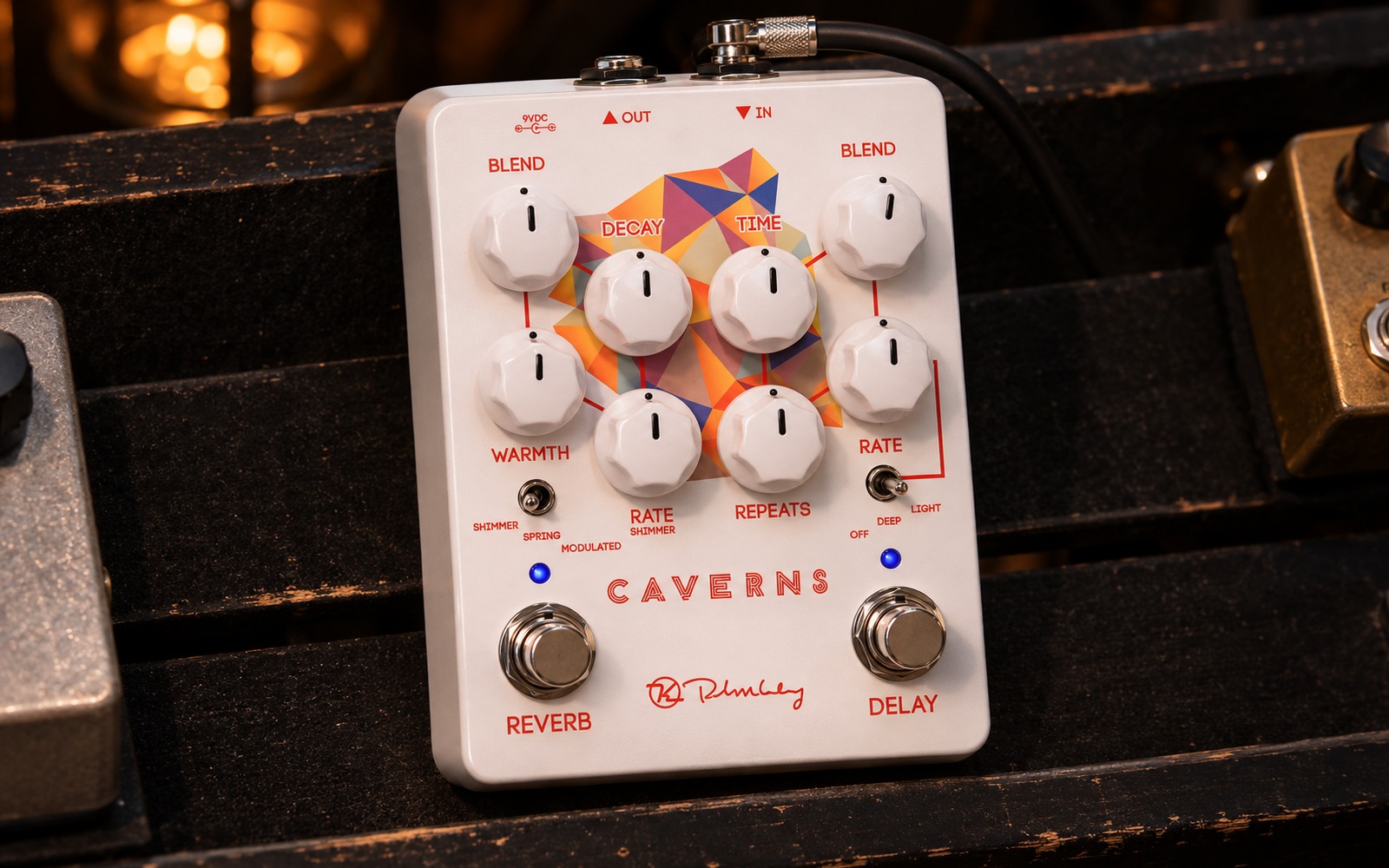
Eight knobs, two toggles, two footswitches. It looks like a lot and it is not, because the layout is symmetrical: four knobs and a toggle per side. The only genuine complexity is that one knob per side changes its job depending on the mode.
The reverb side
Blend sets how much reverb you hear. Decay sets how long the tail lasts. Warmth rolls the reverb’s tone from bright to dark — and this is the control that does most of the work in making a digital reverb sit under a band rather than on top of it.
Rate is the mode-dependent one, and understanding it is the difference between a good Caverns and a confusing one:
| Reverb mode | What the mode is | What Rate does in that mode |
|---|---|---|
| Spring | Blackface-amp spring tank with Fender-style tremolo available | Sets the tremolo speed — a genuine rate control |
| Modulated | Choral modulation over a large reverb space | Sets depth / pre-delay of the modulated reverb |
| Shimmer | Reverb with octave-up voices in the tail | Sets the level of feedback blend — how much shimmer |
So on Spring, Rate is a speed. On Modulated, it is a depth. On Shimmer, it is an amount. If you have ever set the Caverns up in Shimmer, loved it, flipped to Spring and found the pedal suddenly wobbling, that toggle is why.
The Spring mode deserves a specific mention. Building the amp tremolo into the reverb mode is a very Keeley decision — it is the sound of a blackface combo with the reverb and vibrato both on, packaged as one setting. Most reverb pedals give you a spring model. Very few give you a spring model with the amp’s tremolo attached.
The delay side
Time spans 30 ms to 650 ms. Repeats sets feedback. Blend sets level. Rate sets the speed of the modulation, and the three-position toggle sets its depth: Off, Light, Deep.
Off is a clean tape echo — dark repeats, no pitch movement. Light adds the subtle drift of a well-serviced tape machine. Deep adds the wow and flutter of one that has been on the road for a decade. The absence of a Tap Tempo footswitch is the pedal’s most-cited limitation and it is a fair complaint; with 650 ms of range and a Time knob you are setting delay by ear, which is fine in a studio and a genuine nuisance on a dark stage.
The two things hidden inside the box
Open the enclosure and there are two separate trails switches, one per side. That is more thoughtful than it sounds: you can run the reverb with trails so tails decay naturally when you stomp it off, while keeping the delay in true bypass so it cuts dead. Most dual pedals give you one global setting.
There are also four internal DIP switches that enable what Keeley calls switching-system mode. Flip them, and with two TRS breakout cables the pedal splits into two independent effects that a loop switcher — or a looper — can address separately. It is a pro-rig feature buried inside a $199 pedal, and it is the single most under-discussed thing about the Caverns V2. If you run a switching system, this pedal occupies two loops while taking up one board slot.
Tone Recipes
Blackface Combo — the default
Reverb mode Spring. Blend 10 o’clock, Decay 11 o’clock, Warmth 1 o’clock, Rate fully counter-clockwise (tremolo off or barely moving). Delay off. This is the sound the pedal exists for and the one most owners leave it on. Warmth at 1 o’clock is the sweet spot where the tank stops sounding like a plugin.
Rockabilly Slapback
Delay Time around 9 o’clock (roughly 100–130 ms), Repeats fully counter-clockwise plus a hair, Blend 11 o’clock, modulation toggle Off. Reverb in Spring at Blend 9 o’clock. The Magnetic Echo’s darkening repeats do the tape-machine work here that a clean digital delay cannot. Add a touch of Light modulation if you want a Brian Setzer-adjacent shimmer on the single repeat.
Surf
Reverb Spring, Blend 2 o’clock, Decay 2 o’clock, Warmth 11 o’clock (brighter than usual — surf wants the splash), Rate around 10 o’clock for a slow tremolo pulse. Delay off. Bridge pickup, flatwounds, and heavy right hand.
Ambient Pad
Reverb Shimmer, Blend 2 o’clock, Decay 3 o’clock, Warmth 2 o’clock, Rate 1 o’clock for a strong octave-up feedback blend. Delay Time 2 o’clock, Repeats 1 o’clock, Blend 11 o’clock, modulation Deep. Run the delay into the reverb — which is the pedal’s internal order — and play sparse. This is the setting that gets the Caverns compared to boxes costing twice as much.
Dark Repeats Under Distortion
Delay Time 11 o’clock, Repeats 11 o’clock, Blend 9 o’clock, modulation Light. Reverb Modulated, Blend 8 o’clock, Decay 10 o’clock, Warmth 3 o’clock. Warmth fully clockwise is the key: it pushes the reverb below the guitar so the tails add size without adding mud in front of a driven amp. This is roughly the territory a Thomann reviewer described as getting a Petrucci-adjacent lead sound out of the pedal.
Vocal / Outboard
Nick Hakim’s use case, and worth trying. Reverb Modulated or Shimmer, Blend low, Decay high, Warmth high. Send an aux into the pedal at instrument level and return it to a channel. At 75 mA and 450 g it is a cheap way to get a genuinely characterful reverb into a home setup that would otherwise be using a stock plugin.
These are starting points, described as clock positions. The Caverns rewards small moves on Warmth more than large moves on anything else.
How It Compares
Against single-purpose pedals
The honest framing of the Caverns V2 is that it is two good pedals, not two great ones. A dedicated TC Electronic Hall of Fame 2 has more reverb algorithms and TonePrint editing; a dedicated MXR Carbon Copy is a real bucket-brigade circuit with a warmth the Caverns emulates rather than produces. What neither gives you is both, in one enclosure, with independent footswitches and a coherent voice across the pair.
Against the big ambient boxes
Against a Strymon BigSky or a Strymon TimeLine, the Caverns loses on every measurable axis: presets, MIDI, stereo, algorithm count, editing depth. It wins on price — roughly a quarter of the pair — and on the thing that does not appear in spec tables, which is that nobody has ever had to stop mid-set to remember which bank they were in. If your relationship with a pedal is “turn it on, turn a knob, play,” the Caverns is arguably the better tool. If you build patches, it is not remotely competitive.
Against the other affordable delay-plus-reverb pedals
This is the Caverns’ actual competitive set. The EHX Canyon gives you eleven delay types and a looper for less money but only one footswitch and no reverb. The EHX Oceans 11 gives you eleven reverbs and no delay. The JHS 3 Series Delay and 3 Series Reverb are cheaper still and deliberately simpler, but that is two pedals and two power draws. The EarthQuaker Dispatch Master does delay and reverb in one small box at a similar price with one footswitch and far fewer controls — the cleanest philosophical opposite to the Caverns, which gives you two switches and eight knobs precisely so you can use the halves independently.
Against the rest of the Keeley delay range
Within Keeley’s own catalogue the Caverns sits below the Halo Andy Timmons Dual Echo (dual-engine, more expensive, more specialised) and alongside the Memphis Sun, which does echo, reverb and doubletracking in a much smaller enclosure for slightly less. The Caverns is the one with two footswitches and full knob-per-function control — the Keeley you buy when you want to reach down and change something mid-song.
Buying Guide
Buy one if
You want a spring reverb and a tape echo at the end of your chain and you do not want to think about it again. You need the two effects on separate footswitches. You have a loop switcher and would like one board slot to serve two loops. You play surf, rockabilly, country, indie or anything else where the reference reverb is a physical tank rather than a hall.
Do not buy one if
You need tap tempo — the omission is real and there is no workaround. You need more than 650 ms. You need presets, MIDI or stereo. You have a shallow board tier, because 50 mm is tall. You have a tight power budget, because 75 mA is not nothing.
New versus used
New sits at $199 direct, with $169 promotional pricing appearing periodically and around $222 in Europe. Used runs from roughly $140. The gap is small enough that new makes sense if you value the warranty and want a current-batch unit, but this is a solid-state pedal in a metal enclosure with no moving parts beyond four pots per side and two switches — a clean used example is a low-risk purchase.
What to check on a used one
Confirm which trails settings the previous owner left the internal switches on, and confirm the four DIP switches are in standard mode unless you actually want switching-system routing — a Caverns that seems to have lost half its signal is very often a pedal someone left configured for TRS breakout. Check both footswitches for reliable engagement. Check the toggle detents. There is no battery compartment, so no corrosion risk from a forgotten 9V.
Also budget for
A 9V centre-negative supply, because none is included and 75 mA rules out daisy-chaining with much else on a shared output. Two TRS breakout cables, if you intend to use switching-system mode.
Living With One
The Caverns V2 has been in continuous production for nine years, which by pedal standards makes it an institution rather than a product. Thomann’s 61 customer ratings average 4.8 out of 5, with 51 of those being five-star; Sweetwater carries 76 reviews. Long-run averages that high on samples that size are unusual and tell you something reliability-wise that no spec sheet will.
The recurring themes in owner feedback are consistent and worth repeating because they are honest about both sides. Owners praise how quickly it gets to a usable sound and how well the two halves interact — one Thomann reviewer noted that the magic is specifically in the combination rather than either effect alone. The most common complaint, from the same reviews, is the absence of preset storage: players who tweak constantly find themselves re-dialling. And a recurring practical use case is offloading spring reverb and tape echo out of a digital modeller’s effects loop so the modeller’s DSP can be spent elsewhere — a use the pedal was never marketed for and is very good at.
On maintenance: there is essentially none. Keep the jacks clean, keep it dry, and use a proper isolated supply. Keeley’s Oklahoma repair operation handles service directly, and European buyers who register through Warwick’s distribution get an extended four-year warranty on top of the standard cover.
The special editions
Keeley has run a steady stream of limited Caverns finishes over the years — a Custom Shop “Double Down” edition, a Japan release, a “Spooky Glow” glow-in-the-dark run, and various artist and anniversary decals. They are cosmetic; the circuit is the circuit. But they trade at a premium on the used market and they are the reason a Caverns search on a reseller site turns up a confusing spread of prices for what is functionally the same pedal.
Frequently Asked Questions
Is the Caverns V2 still in production in 2026?
Yes. Keeley lists it with an Active tag at $199, and the product page was updated in July 2026. Stock has been intermittent — Keeley’s direct store showed it out of stock in the autumn and Sweetwater estimated an October 2026 restock — but the pedal is current production, not archived. The V1 is archived, and Keeley’s own V1 page carries an OUT OF PRODUCTION banner.
Why does the V2 have less delay time than the V1?
Because the delay engine was replaced. The V1 ran a 24-bit studio-grade digital delay with a one-second maximum; the V2 runs Keeley’s Magnetic Echo tape-emulation engine, which tops out at 650 ms. The trade bought tape character, wow and flutter, and darkening repeats in exchange for raw time. Whether that was a good trade depends entirely on whether you wanted long clean repeats or short dirty ones.
Does it have tap tempo?
No. This is the pedal’s most frequently cited limitation. Delay time is set by ear with the Time knob across a 30–650 ms range. If tap tempo is non-negotiable, look at a Boss DD-8 or step up to a preset-based unit.
What does the Rate knob do on the reverb side?
Different things in each mode. In Spring it sets the speed of the built-in Fender-style tremolo. In Modulated it sets depth and pre-delay. In Shimmer it sets the level of feedback blend, which is effectively how much octave-up content you hear. This is the single most misunderstood control on the pedal.
Can the delay and reverb be used separately?
Yes, in two senses. Each half has its own footswitch, so you can run either alone or both together with no configuration at all. And with the four internal DIP switches set to switching-system mode plus two TRS breakout cables, the two effects become independently addressable by an external loop switcher — meaning the pedal can occupy two separate loops in a pro rig while taking one slot on the board.
True bypass or trails?
Both, and independently per side. There are two internal switches. Set the reverb to trails so tails ring out when you stomp it off and leave the delay in true bypass, or any other combination. Keeley says the buffers in trails mode are engineered to maintain full signal strength into the amp.
How much power does it need?
9V DC, centre negative, 2.1 mm × 5.5 mm barrel, approximately 75 mA. There is no battery compartment and no PSU in the box. 75 mA is enough that it wants its own isolated output on most supplies rather than sharing a daisy chain.
Does Jack White use one?
There is no reliable evidence that he does. The claim traces to a single Equipboard entry about a photograph of his copper-repainted 2019 Raconteurs board, where the submitter identified a pedal by knob and switch count and explicitly wrote that they believed it to be a Caverns V2. That is a guess about a repainted pedal in a photo, flagged as a guess by the person who made it. White is not a Keeley artist. The properly documented users are Lucy Dacus, Nick Hakim, Mike Kinsella, Johnny Stevens and Daniel Donato.
Image credits
- Top image: GuitarGangsters AI-generated reference illustration, not a photograph.
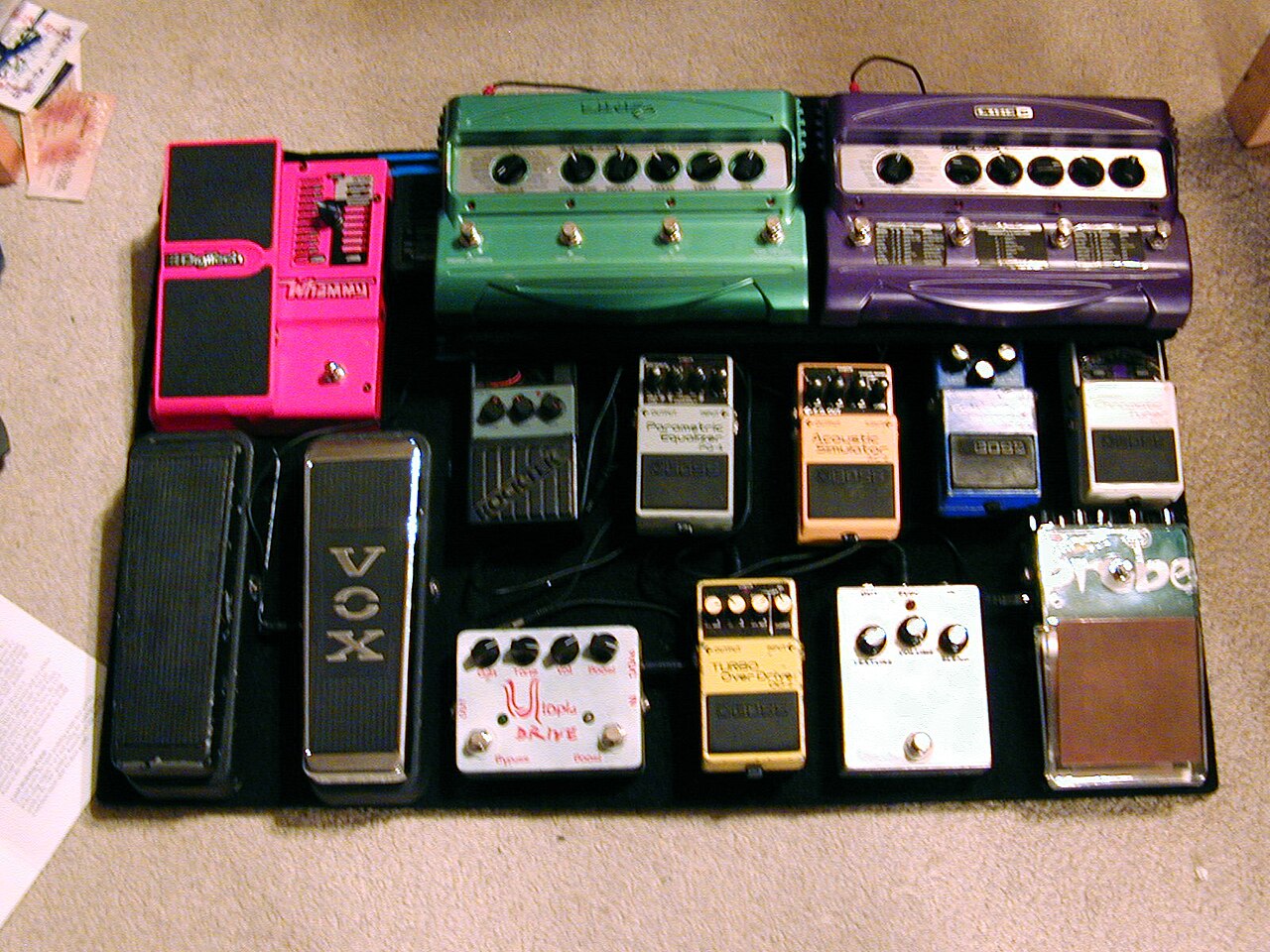
- A pedalboard with wah and effects pedals: John Athayde, Wikimedia Commons, CC BY 2.0.
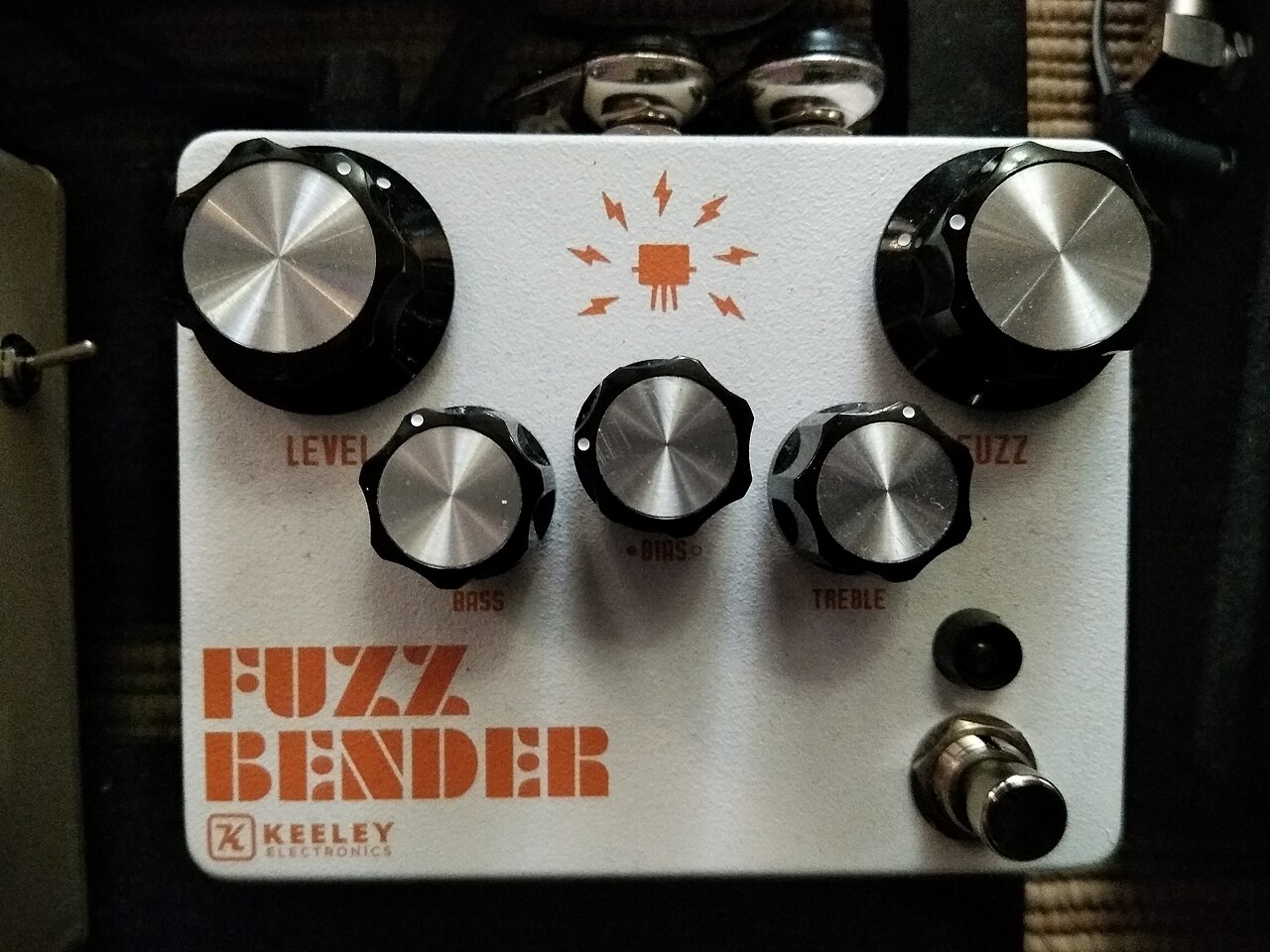
- A Keeley Fuzz Bender pedal: Skimel, Wikimedia Commons, CC BY-SA 4.0.
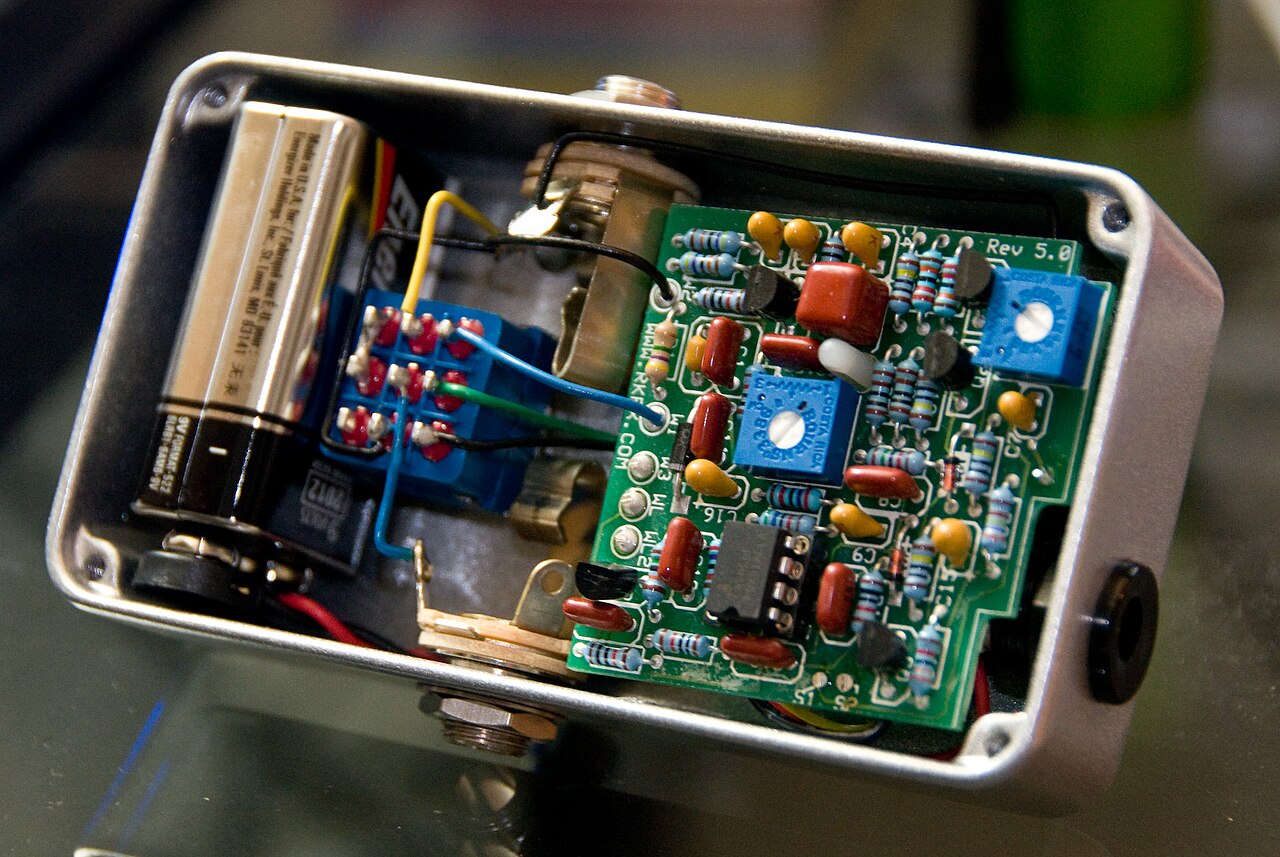
- Inside a Keeley compressor pedal: ArtBrom from Seattle, Wikimedia Commons, CC BY-SA 2.0.
Latest News
Related
On This Day
Monday 9 November
From this week: