One Knob for Room, One for Space, One for the Cosmos: The JHS 3 Series Reverb
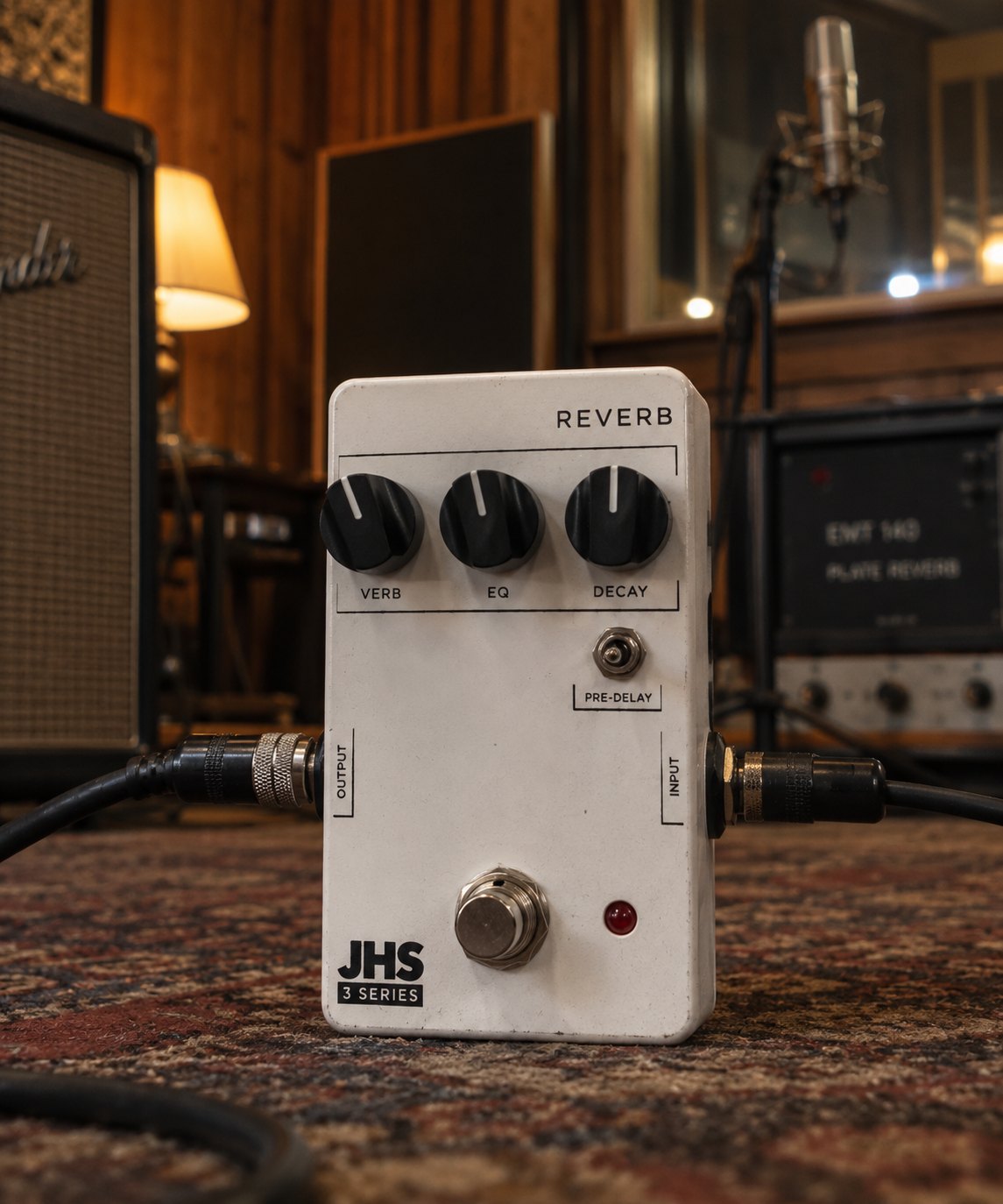
JHS 3 Series Reverb Pedal. AI-generated reference illustration, not a photograph.
Three knobs, one toggle, zero compromises. The JHS 3 Series Reverb delivers hall-quality digital reverb for $99—the smartest space pedal under $100.
There is a school of guitar philosophy that says reverb is the only effect that is always on, even when the reverb pedal is off. Every room you play in reflects sound back at you. Every amp cabinet projects into space. Reverb is reality. The question is how much of it you want to control.
The JHS 3 Series Reverb answers that question with exactly three knobs and one toggle switch. For $99 — made in Kansas City, Missouri, from the same components and quality standards as JHS’s full-price boutique line — this pedal offers a digital reverb that stretches from barely-there room ambiance to 15-second cathedral wash without making you read a manual to get there. It is the most intentionally simple reverb pedal JHS makes, and for a specific kind of player, that simplicity is exactly the point.
The 3 Series Story: Boutique Quality at Pedalboard-Friendly Prices
JHS Pedals launched the 3 Series in 2020 as a deliberate answer to a real problem: the best-sounding circuits in guitar effects were locked behind boutique price tags that most working guitarists couldn’t justify for a single pedal. The 3 Series concept was straightforward — build the same quality in the same Kansas City factory using the same component selection and attention to detail, but simplify each pedal to three controls plus one toggle and sell it for $99.
The lineup that launched included seven pedals: Compressor, Fuzz, Overdrive, Distortion, Chorus, Delay, and Reverb. Each pedal shares the same die-cast aluminum chassis — all-white powder-coated finish, matte texture, plain black lettering — and the same general control philosophy. Three knobs. One toggle. No battery operation. True bypass. Made in Kansas City.
The 3 Series Reverb sits at the ambient end of the lineup. If the Overdrive is about grit and the Delay is about time, the Reverb is about space. It is the final pedal in the original seven, the one that puts your signal into a room — or a hall, or a cavern, or a glacier — and lets it echo back into the void.
Since the original launch, JHS has expanded the 3 Series with additional variants including the 3 Series Hall Reverb (a more specific hall-algorithm unit with a Dampen knob and Modulate toggle) and other effects. But the original 3 Series Reverb remains the entry point — the single-algorithm workhorse for players who need one great reverb sound rather than a menu of them.
Specs at a Glance
Controls Explained: Three Knobs That Cover the Full Range
The genius of the 3 Series control scheme is that three knobs, applied thoughtfully, can cover nearly the full practical range of what a reverb pedal needs to do. Here is what each control actually does:
VERB — The Mix Knob
This is your wet/dry blend. Counterclockwise is dry signal only. Clockwise is full wet. At minimum, the pedal adds zero reverb to your signal — functionally bypassed without engaging the footswitch. At maximum, the dry signal is nearly gone and you are swimming in reverb wash. Most practical playing positions live between 8 o’clock and 2 o’clock depending on how present you want the effect.
What makes the Verb knob particularly useful is its linearity — there are no dead zones. At any position from 7 o’clock to 5 o’clock you are getting a musically useful blend. Setting it to 9 o’clock gives you the classic studio reverb sound: present enough to add dimension, subtle enough that you would not call it a reverb pedal. Setting it between noon and 2 o’clock gives you the hall reverb territory that most players associate with reverb. Above 3 o’clock you are in ambient or shoegaze territory.
EQ — The Tone Shaper
The EQ knob adjusts the brightness of the reverb tail itself — not of your dry signal, just the wet signal. Turn it counterclockwise and the reverb becomes darker, rolling off high frequencies and giving the tail a warm, vintage character that pushes it back in the mix. Turn it clockwise and the reverb brightens up, becoming more present and shimmering.
This is important for understanding why the 3 Series Reverb can cover more sonic territory than a single-algorithm unit might suggest. In the bright position with moderate Verb and short Decay, it approximates a spring reverb character — bright and present, almost slap-like. In the dark position with high Verb and long Decay, it becomes a thick ambient wash. The EQ control is doing a significant amount of algorithm-substitution work.
For most band contexts, noon is a good starting point and you adjust from there based on how the reverb sits in the mix. Single coil guitars often benefit from EQ slightly counterclockwise (darkening the potentially harsh high-end reverb artifacts). Humbuckers often work well with EQ slightly clockwise to add air to the thicker fundamental.
DECAY — The Tail Length
Decay controls how long the reverb continues after you stop playing. At minimum, the tail is short — almost slap-like, a quick reflective sound like playing in a small tiled room. At noon, the tail is medium — a convincing hall reverb character with a natural fade. At maximum, the tail reaches approximately 15 seconds of sustained reverb wash — a cathedral or industrial space character that sustains almost indefinitely against your playing.
At maximum Decay, the reverb washes start to blur together. Individual notes lose definition as each new note’s reverb overlays the previous one. This is where the Pre-Delay toggle becomes the essential companion control.
PRE-DELAY TOGGLE — The Note Saver
Toggle up engages the pre-delay. Toggle down bypasses it. The pre-delay adds a short delay — measured in milliseconds — before the reverb begins. That brief pause after your pick attack before the reverb kicks in makes the most important thing about your note visible: the transient. The snap of your pick, the initial attack of the string, the actual moment of playing, all of that comes through clearly before the reverb engages.
Without pre-delay, high Verb and Decay settings can drown the pick attack completely, turning single-note lines into a smear of ambient wash. With pre-delay engaged, those same settings become usable for melodic playing — you hear the note first, then the reverb tail blooms beneath it. Tremolo-picked arpeggios, single-note lead lines, fingerstyle passages — all of them maintain definition at extreme reverb settings when the pre-delay is active.
One practical note: the pre-delay toggle has no illuminated indicator. Toggle-up is engaged, toggle-down is bypassed, and you learn this by position rather than by a LED. For live use, put a small mark or piece of tape on the chassis if you switch between positions frequently and need a visual reference.
The Single Algorithm: A Feature and a Limitation
The JHS 3 Series Reverb has one reverb algorithm. Not labeled as spring, plate, hall, or room — just “reverb.” Its character leans toward hall and room territory: it is smooth, dense, and even across the frequency range, without the metallic high-end drip of a plate algorithm or the percussive slap of a spring.
JHS does not publish circuit specifics or DSP chip details, so the specific processor running the algorithm is not publicly confirmed. What is confirmed by ears and review consensus is that the algorithm is well-voiced — not harsh, not thin, not obviously digital in a bad way — and that the EQ control gives it enough range to cover multiple reverb personalities without technically being multiple reverb types.
For players who need spring reverb for country and rockabilly, this pedal is not the right choice. You want the Electro-Harmonix Holy Grail Neo or a pedal with a dedicated spring algorithm. For players who need switchable plate, hall, church, shimmer, reverse, and modulated reverb from a single pedal, the Electro-Harmonix Oceans 11 or the TC Electronic Hall of Fame 2 are better choices. The 3 Series Reverb is for players who know what reverb sound they want, want one great version of it, and do not need or want to menu-dive for it mid-set.
The single algorithm is also the source of this pedal’s greatest strength: speed. With the 3 Series Reverb, dialing in a tone takes seconds. Verb at noon, EQ at noon, Decay at noon, pre-delay off — you have a perfectly usable hall reverb that works in virtually any context. The only way to make it faster would be no controls at all.
The No-Spillover Situation
When you disengage the JHS 3 Series Reverb — stomp the footswitch to bypass — the reverb tails cut off immediately. There is no spillover. Whatever was ringing in the reverb at the moment of bypass stops.
This matters significantly in live contexts where you stomp reverb off to enter a dry rhythm section or a different song. If your reverb is at high Decay settings and you stomp it off mid-sustain, there will be a noticeable cut — the wash stops. Professional reverb pedals at higher price points, including the Boss RV-6 and the Strymon BigSky, offer spillover as a standard feature. The 3 Series Reverb does not.
For many players this is a non-issue. If you are running the reverb at moderate settings, the tail is short enough that the cut is not audible in a band context. If you are using the reverb as a subtle room enhancer that you keep on most of the time and only bypass for specific sections, spillover rarely comes up. It becomes a problem specifically for players who run long ambient settings and need to stomp off cleanly. If that is your use case, factor it into the decision.
Power: The 74mA Question
At 74mA, the 3 Series Reverb draws more current than any other pedal in the original 3 Series lineup. The Delay draws 71mA, the Chorus draws 70mA, and the Overdrive, Distortion, and Fuzz all draw under 15mA. Digital reverb processing is computationally intensive compared to analog circuits, and that shows in the current draw.
The practical implication: do not daisy-chain this pedal from the same power output as other pedals unless your supply has significant headroom. Budget multi-pedal daisy chains rated at 500mA might seem to have plenty of capacity, but daisy chains share a ground reference and create ground loops that show up as noise — especially in digital circuits. Use an isolated 9V output rated at 100mA or more. Any quality pedalboard power supply from Strymon, Voodoo Lab, Cioks, or Truetone will handle it without concern. The 74mA draw is well within any dedicated isolated output.
No battery operation is the other power note. DC adapter only. If your gig or practice session requires portability without power access, the 3 Series Reverb is not a battery-powered option.
Famous Players: What the Research Actually Shows
The Edge, U2’s guitar architect and one of the architects of reverb-drenched guitar playing in rock history, is documented using Korg SDD-3000 delays, TC Electronic gear, and various rack-mounted digital processors to create his signature sound. No primary-source documentation — Premier Guitar Rig Rundown, manufacturer artist page, or confirmed interview — links him to the JHS 3 Series Reverb. He is sonic lineage: the template for the kind of playing this pedal enables, not a confirmed user of this specific pedal.
Mateus Asato, the Brazilian guitarist whose Instagram-era single-note phrasing made him a modern standard for expressive playing, has publicly described the Neunaber Wet Reverb V5 as his favorite reverb — calling it “the most underrated reverb pedal by far.” Earlier in his career he used a Strymon Flint. No primary-source documentation links him to the JHS 3 Series Reverb. Like The Edge, he represents the ambient and expressive guitar tradition this pedal serves, without being a confirmed user of it. You can find Mateus Asato’s documented gear history in the Mateus Asato Gear Guide.
Mark Lettieri, the Snarky Puppy and Fearless Flyers guitarist known for immaculately voiced tone, runs a TC Electronic TonePrint Plethora X5 for his reverb and spatial effects in documented rig rundowns. No confirmed JHS 3 Series Reverb use on record.
John Mayer, whose tone has been a reference point for clean guitar playing for two decades, uses Strymon pedals and other boutique-tier reverb options in documented rigs. No confirmed JHS 3 Series Reverb use.
The Equipboard database lists approximately 10 pro artists using the JHS 3 Series Reverb, including Rhett Shull and Eirik Stordrange. Eirik Stordrange has made YouTube content specifically about the JHS 3 Series Reverb — that is secondary source documentation (a YouTube video, not a Premier Guitar Rig Rundown or primary-source gear interview). Rhett Shull, a Nashville-based guitarist and YouTube content creator with a large following, has featured JHS 3 Series pedals in content and is listed on Equipboard. Neither represents the kind of touring-rig primary-source documentation we treat as confirmed use in these articles.
The honest framing: the JHS 3 Series Reverb is popular among working club guitarists, YouTubers, bedroom producers, and players who want a simple, quality reverb at a budget price. The famous names associated with its sonic territory — The Edge, David Gilmour (a guitarist for whom reverb and space are fundamental to tone), Kevin Shields (whose shoegaze universe is built on reverb and feedback, documented in the Kevin Shields Gear Guide) — are sonic lineage. They represent the tradition the pedal serves. They are not confirmed users of this specific circuit.
Tone Recipes and Settings
Recipe 1: Room Presence (Practice and Home Recording)
This setting adds just enough reverb to make dry guitar sound like it was recorded in a treated room rather than a closet. Keep it on all the time as your baseline tone.
- VERB: 8–9 o’clock
- EQ: noon
- DECAY: 8–9 o’clock
- PRE-DELAY: Off (toggle down)
Recipe 2: Classic Hall (Live Rhythm Playing)
The middle of the road setting that works in virtually any genre and any mix. Add dimension without drawing attention to the reverb itself.
- VERB: noon
- EQ: 12–1 o’clock (slightly bright)
- DECAY: 1 o’clock
- PRE-DELAY: Off
Recipe 3: Lead Presence (Single-Note Lines with Definition)
The pre-delay preserves your pick attack while the reverb tail adds sustain and air to melodic lines. Works well with overdriven or clean tones into medium Decay.
- VERB: noon–1 o’clock
- EQ: 1 o’clock
- DECAY: noon
- PRE-DELAY: On (toggle up)
Recipe 4: Edge-Style Space (U2 / Post-Rock Territory)
High Verb, long Decay, pre-delay on for note clarity. Use with a repeat-based delay pedal for the full David Evans architecture. The pre-delay is essential at these settings to keep lines intelligible.
- VERB: 2–3 o’clock
- EQ: noon
- DECAY: 3 o’clock–max
- PRE-DELAY: On (toggle up)
Recipe 5: Dark Ambient Wash (Shoegaze / Post-Rock Texture)
Maximum Decay, dark EQ, full Verb. This is a texture tool, not a lead tool. Works best with volume swells, e-bow, or sustained chords. Pick attack is intentionally swamped by design.
- VERB: 3 o’clock–max
- EQ: 9–10 o’clock (dark)
- DECAY: max
- PRE-DELAY: On (toggle up) — preserves a trace of initial attack in the wash
Recipe 6: Slap-Room (Nashville Country Sparkle)
Short Decay with Pre-Delay on creates a quasi-spring-reverb / slap-echo hybrid. Bright EQ for the classic Telecaster Nashville sound. Not a true spring reverb but approximates the quick reflective quality.
- VERB: 10–11 o’clock
- EQ: 1–2 o’clock
- DECAY: 8–9 o’clock (short)
- PRE-DELAY: On (toggle up)
Comparisons: Where the 3 Series Reverb Fits in the Reverb Pedal Market
The reverb pedal market in 2026 is dense — everything from $30 no-name boxes to $500 studio processors. The 3 Series Reverb lives at a specific point in that range.
Against the TC Electronic Hall of Fame 2 ($129): the TC wins comprehensively on algorithm variety — eight reverb algorithms, TonePrint custom programming, stereo operation, and the Mash footswitch function for expression. The JHS wins on price, simplicity, and build quality. If you need one reverb sound and want to dial it in fast, the JHS makes more sense. If you need spring for country and hall for worship and shimmer for post-rock, pay the $30 premium for the TC.
Against the Electro-Harmonix Holy Grail Neo (~$89): this comparison is close. The Holy Grail Neo also offers simple operation at a comparable price, but it gives you three algorithm choices (Room, Hall, Spring) via a mode selector rather than a single algorithm with an EQ sweep. The spring mode on the Holy Grail Neo is the reason to choose it over the JHS. The JHS wins on build quality, the Pre-Delay toggle, and a more sophisticated EQ control.
Against the Boss RV-6 (~$149): the Boss offers eight reverb modes, stereo operation, an expression pedal input, and spillover. It costs $50 more than the JHS. The 3 Series Reverb is the right choice if you only need one reverb mode and cannot justify spending more. The Boss is the right choice if you need mode variety, spillover, or expression control.
Against the MXR M300 Reverb (~$129): the MXR offers six reverb algorithms, stereo I/O, and an expression pedal input at $30 more. Both are excellent build quality. The JHS wins on price and simplicity; the MXR wins on versatility and stereo capability.
Against the Strymon BigSky (~$479): the BigSky is a studio-quality reverb workstation with twelve algorithms, MIDI, stereo I/O, and deep parameter editing. The JHS 3 Series Reverb costs $380 less. These pedals exist at opposite ends of the reverb spectrum — the BigSky for players who want everything, the JHS for players who want simplicity. The 3 Series Reverb sounds remarkably good for its price, but it is not a BigSky alternative. It is a BigSky’s travel companion on the small practice board.
It is also worth acknowledging the JHS 3 Series Reverb’s own expanded family. The newer JHS 3 Series Hall Reverb adds a Dampen knob (rolling off high frequencies in the reverb tail) and a Modulate toggle that introduces subtle pitch modulation into the decay. It has a more specifically hall-voiced algorithm. If you want the JHS philosophy and build quality but want more character shaping, the Hall Reverb is worth the same $99 consideration. The original 3 Series Reverb is the more versatile of the two — the Hall Reverb has more specific personality.
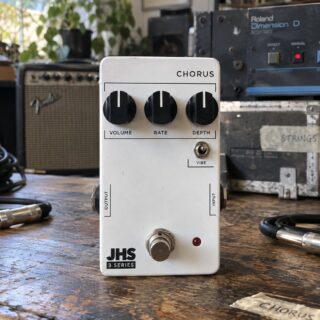
The 3 Series Reverb also sits contextually alongside the full JHS 3 Series lineup. Running it alongside the JHS 3 Series Delay gives you a complete ambient rig for $198 — delay and reverb from the same family, the same build quality, the same control philosophy. The JHS 3 Series Chorus adds modulation to that stack for another $99. The entire 3 Series time-and-space section — Chorus, Delay, and Reverb — costs $297 total. That is a complete modulation, delay, and reverb rig made in Kansas City for under $300.
Who Should Buy the JHS 3 Series Reverb
This pedal is right for you if you want a single, great-sounding reverb for your pedalboard and you do not need to switch between reverb types. If you have already decided that hall/room is your reverb character and you just need to control how much and how long, the 3 Series Reverb gives you that decision in three knobs.
It is right for beginners encountering their first reverb pedal. The control layout is completely intuitive — three descriptive knobs, one practical toggle. There are no secondary parameters, no mode menus, no hidden functions. You plug it in and it works exactly as you expect.
It is right for gigging guitarists who run a lean board and want one reverb that covers every job without taking mental bandwidth. Setting it once and leaving it there is a legitimate professional strategy.
It is right for guitarists who already own a more complex reverb for studio and recording and want a simple, durable live pedal that costs less to replace if the flight case gets mishandled.
It is not right for players who need spring reverb specifically — country, rockabilly, surf guitar traditions where spring character is part of the sound. It is not right for players who need multiple reverb algorithms for diverse set lists — worship guitarists playing ambient one song and dry rhythm the next, for instance, will want the TC Hall of Fame 2 or the Boss RV-6. It is not right for players who need spillover, stereo, MIDI, or expression pedal connectivity.
Ownership Notes
Several practical details are worth documenting before purchase. The 74mA current draw is the highest in the original 3 Series lineup — make sure your pedalboard power supply has an isolated 9V output at 100mA minimum. Do not daisy-chain it with other pedals.
No battery operation means no backup if your power supply fails at a gig. Carry a spare 9V adapter or ensure your power supply is a reliable brand with redundancy options.
No spillover. If you are running the reverb at medium-to-high settings and stomp the footswitch, the tail stops. Adjust your technique accordingly — stomp reverb off in musical gaps rather than mid-sustain.
True bypass is confirmed. When the pedal is disengaged, your signal passes through the pedal unaffected. No coloration, no buffering. If you are running a long cable chain and need a buffer, place a buffered pedal before the 3 Series Reverb in the chain — the true bypass is an asset for tone purity but not a substitute for impedance management in long chains.
Pre-Delay toggle up is engaged. This is not marked with an illuminated indicator on the chassis. Learn the position by touch and muscle memory. It matters in live performance when you need to engage or disengage it between songs.
The reverb sounds best in the effects loop of a tube amp rather than in front of the preamp, particularly at high Verb and Decay settings. Running reverb into a hot tube preamp creates reverb-into-distortion — which is a sound, but generally not the intended one. In the loop, reverb sits on top of the amplified signal. In front of the amp, it gets amplified along with the dry signal in ways that can muddy high-gain tones.
FAQ
Does the JHS 3 Series Reverb have true bypass?
Yes. True bypass is confirmed. When the pedal is disengaged, your signal passes through the input to output jack with no circuit interaction.
Can I power the JHS 3 Series Reverb with a 9V battery?
No. The 3 Series Reverb requires a 9V DC center-negative adapter. There is no battery compartment. Budget for DC power from your pedalboard supply.
What reverb algorithm does the JHS 3 Series Reverb use?
JHS does not publish the specific DSP chip or algorithm name. The character is a smooth digital reverb in the hall and room family — no metallic plate drip, no spring slap. The EQ control shapes the tail’s brightness to approximate different reverb personalities within that character range.
Does the 3 Series Reverb have spillover?
No. When you engage the footswitch to bypass, reverb tails cut off immediately. Factor this into your live technique if you are running long Decay settings.
How is the original 3 Series Reverb different from the JHS 3 Series Hall Reverb?
The Hall Reverb is a newer 3 Series addition with a dedicated hall algorithm, a Dampen control (rolling off reverb tail brightness), and a Modulate toggle (adding subtle pitch modulation to the tail). The original 3 Series Reverb is more flexible across reverb characters due to its EQ sweep. The Hall Reverb has a more specific, character-forward sound. Both are $99.
Is the JHS 3 Series Reverb good for ambient guitar?
Yes, with one caveat: no spillover. For ambient playing where you stomp reverb on and leave it engaged throughout a piece, the 3 Series Reverb works extremely well — the Decay can sustain up to 15 seconds of wash at maximum, and the Pre-Delay toggle keeps notes articulate even at high Verb settings. The problem is using it in a live context where you need to stomp it off and expect tails to continue fading. They will not.
Can the JHS 3 Series Reverb self-oscillate or produce infinite reverb?
At maximum Decay, the reverb tail reaches approximately 15 seconds of sustained wash. This approaches but does not reach true self-oscillation — the kind of runaway feedback loop available in some analog spring reverb circuits or specifically designed digital units. At maximum Decay, the reverb functions more like a very long hold than a true infinite loop. For self-oscillation as a performance tool, look at dedicated units or verbs with a freeze function.
Where should I place the JHS 3 Series Reverb in my signal chain?
Reverb generally belongs at the end of the chain, after all drive pedals, modulation, and delay — unless you are deliberately running reverb into distortion for a specific textural effect. In a standard chain: guitar → tuner → drives → modulation → delay → reverb → amp input. In an amp with an effects loop, run the reverb in the loop where it sits after the preamp distortion stage, which gives the cleanest reverb character and the most amp-like result.
Image credits
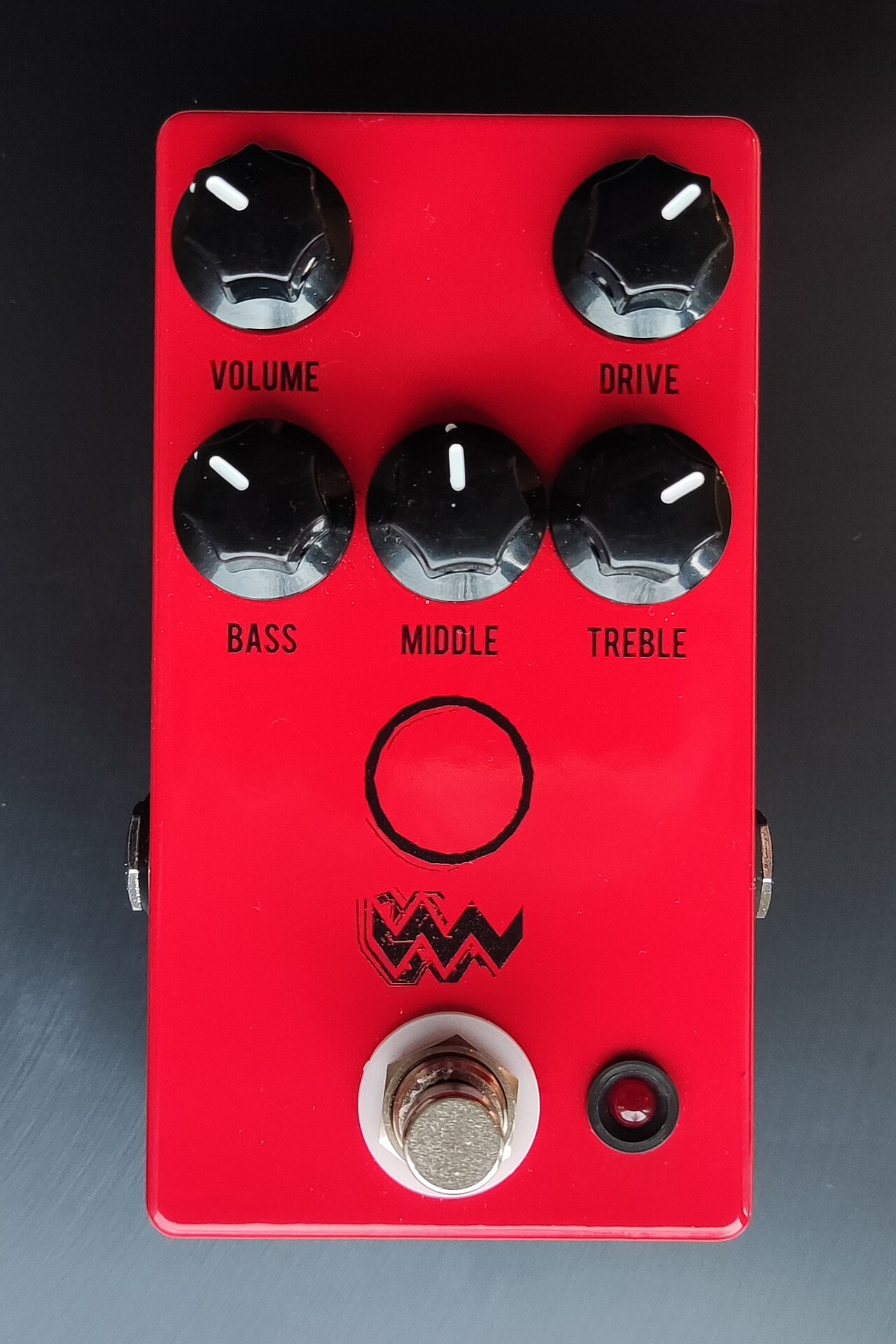
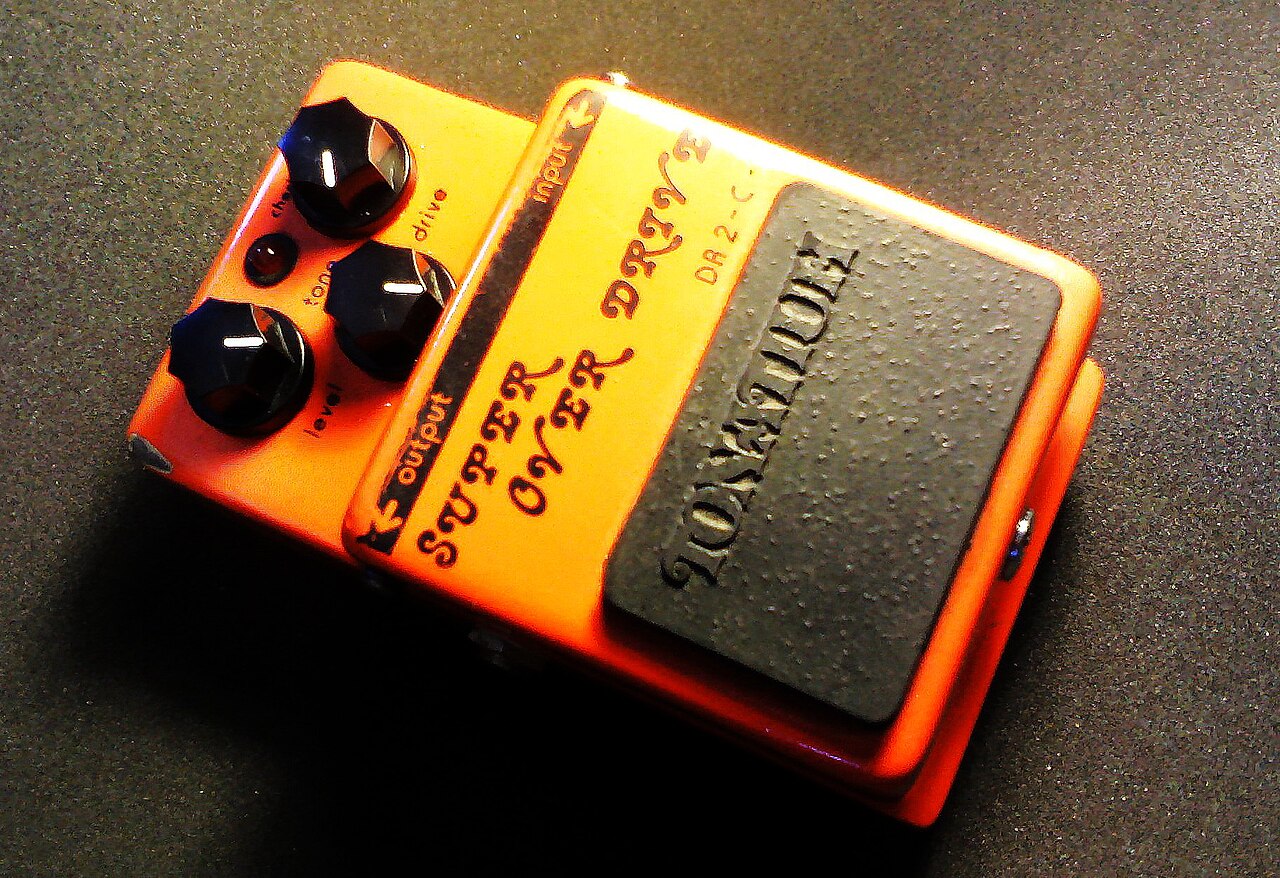
- An orange overdrive pedal: Andrés Galeotti, Wikimedia Commons, CC BY 2.0.
- A JHS Angry Charlie pedal: El Grafo, Wikimedia Commons, CC BY-SA 4.0.
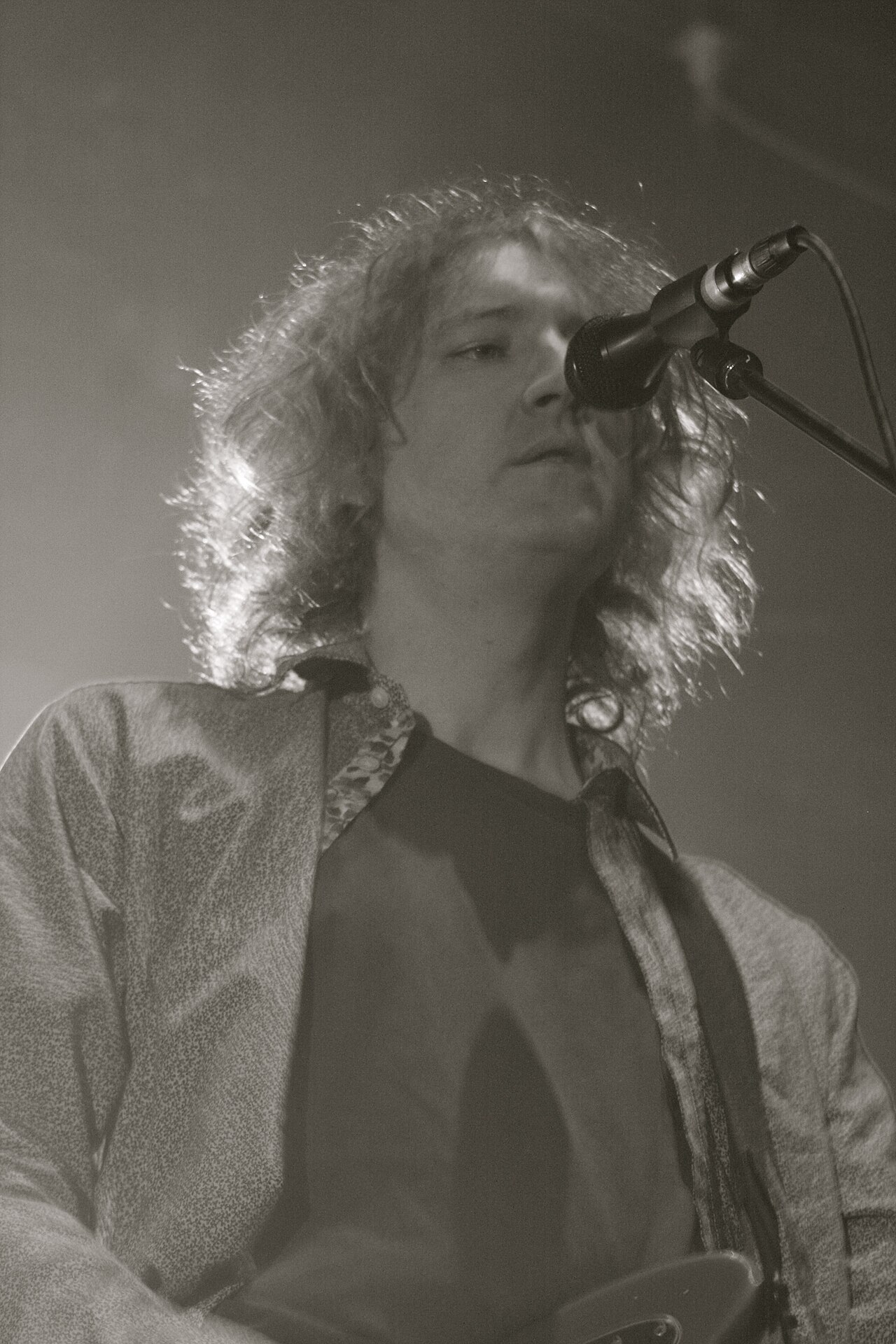
- Kevin Shields: Julio Enriquez, Wikimedia Commons, CC BY 2.0.
- Top image: GuitarGangsters AI-generated reference illustration, not a photograph.
Latest News
Related
On This Day
Monday 9 November
From this week: