Empress Effects Reverb: Twelve Modes, Thirty-Five Presets, No Screen — and a Beer Mode
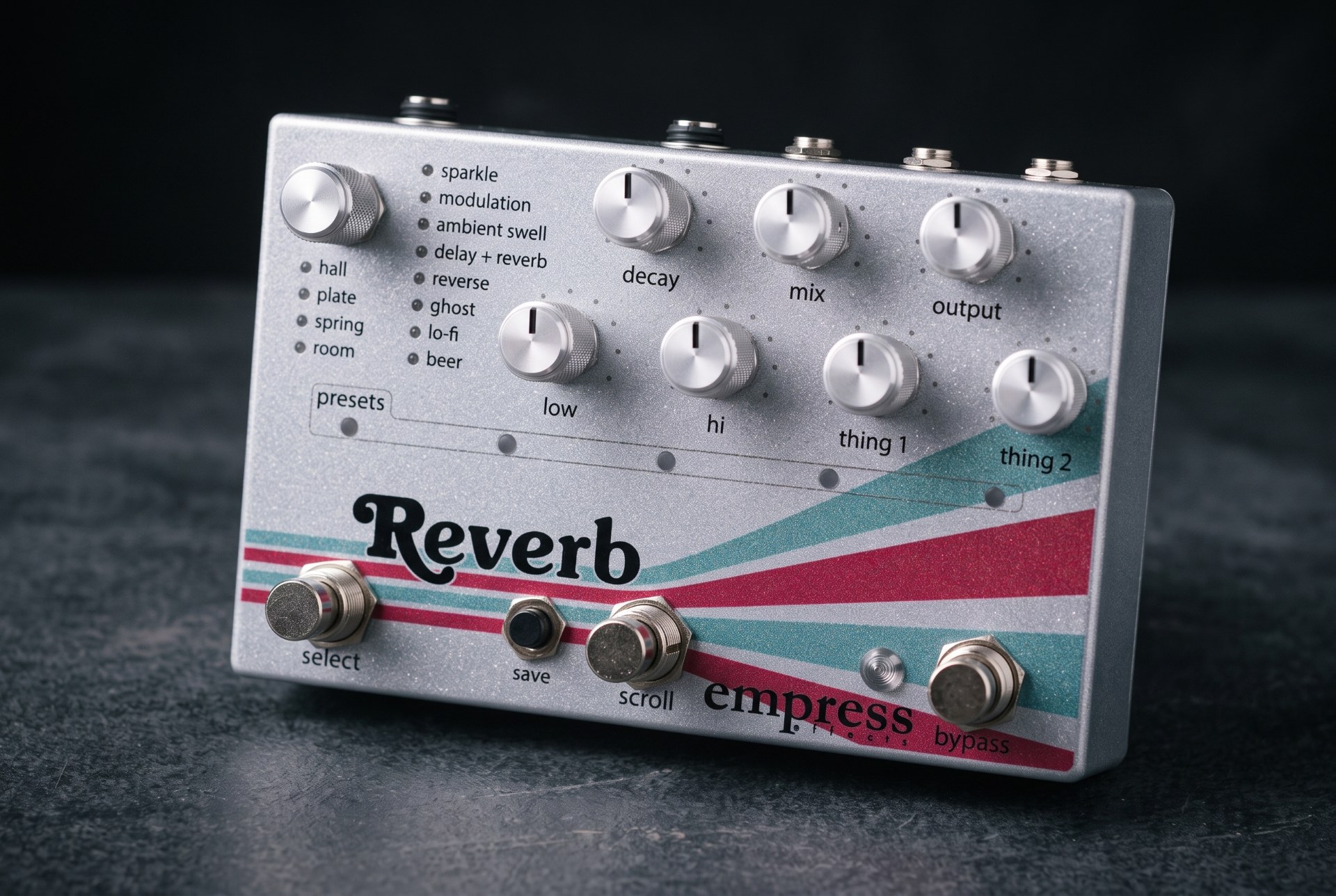
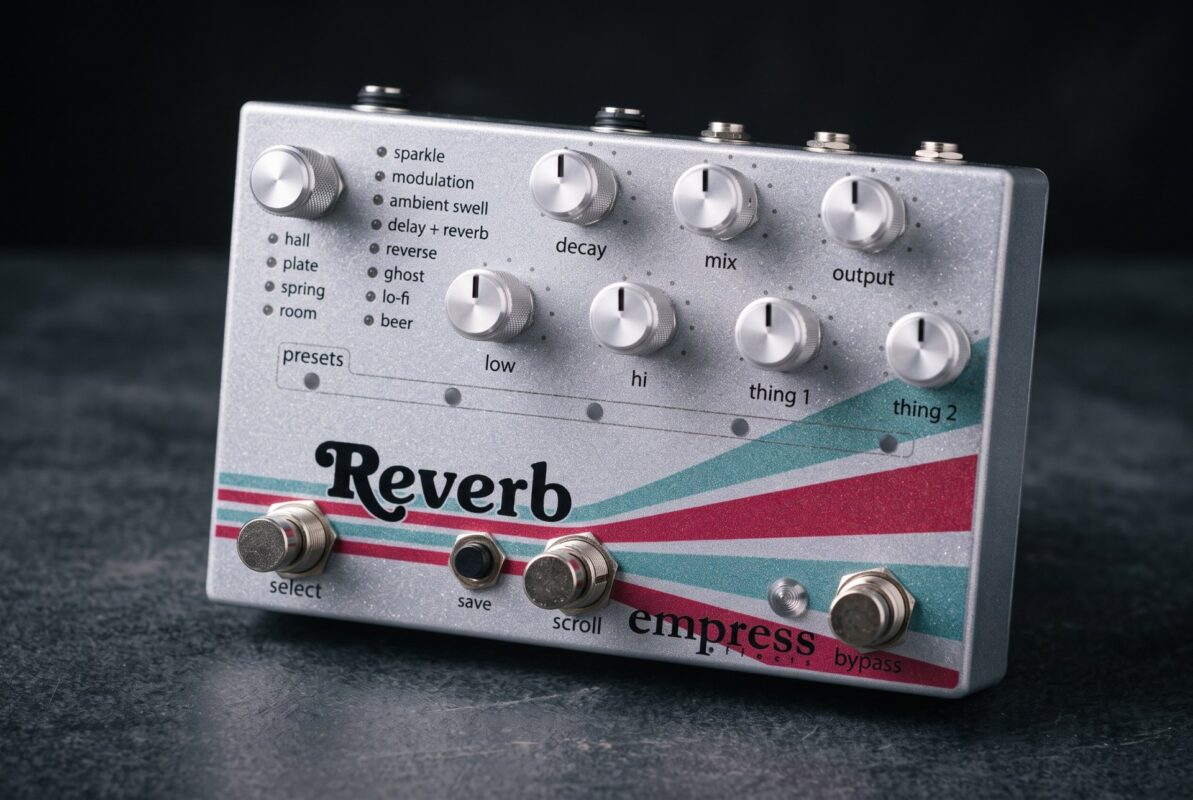
An AI-generated illustration of the Empress Reverb.
Empress Effects Reverb guide: all 12 modes explained, verified players, 10 tone recipes, full specs, 2026 pricing and the honest truth about its spring.
Somewhere in the specification sheet of the Empress Effects Reverb, between the 1 MΩ input impedance and the 106.9 dBA dry dynamic range, is a mode called Beer. Inside Beer mode there is a sub-algorithm called Destroyer Pad, and its two parameter knobs are labelled, in the manufacturer’s own official documentation, “Robot Screams” and “Pitch Shift.” The description of what the algorithm is for reads, in full: “For sternly communicating with household appliances.”
That single detail tells you almost everything about this pedal. Empress Effects built a reverb with laboratory-grade measured performance — a dry frequency response flat to 50 kHz, total harmonic distortion of 0.09 percent, an isolated transformer-balanced second output to kill ground loops between two amps — and then filled it with a spooky mode called Ghost, a friendlier version of Ghost called Casper, a filthy lo-fi mode called 50’s Radio, and a category explicitly described as “the stuff that doesn’t fit anywhere else.” The measurement bench and the joke live in the same aluminium box.
This is a feature article, not a review. What follows is where the pedal came from, what is genuinely inside it mode by mode, who has actually been photographed or filmed using one, how to get specific sounds out of it, and how it stacks up against the reverbs it is perpetually cross-shopped against.
Origins: The Reverb That Needed Its Own Web Page
Empress Effects, Briefly
Empress Effects was founded in 2005 by electrical engineer Steve Bragg, operating out of Ottawa, Canada. The company’s early reputation was built on absurd feature density in small enclosures — a tremolo, then the Vintage Modified Superdelay, a pedal whose control panel looked more like a piece of test equipment than a stompbox. By the mid-2010s Empress had established a house identity that has barely shifted since: pro-audio measured performance, an analog dry path, deep configuration menus for the people who want them, and a refusal to hide the primary controls behind a display.
The company still builds in Canada and still prices in US dollars, with a note on its own store page that reads: “We price and charge in USD because we ship globally, and most of our customers expect it. We’re still 100% Canadian, we promise!”
The Timeline: NAMM 2016 to Retail
The Reverb was first shown publicly at Winter NAMM in January 2016 — the earliest surviving video coverage is a Shnobel Tone walkthrough dated 23 January 2016, and Effects Database logged the product page on 22 January 2016. Then came a long, quiet development gap.
The real launch signature appears on 13 May 2016, when Empress itself uploaded five official mode demos on a single day — Hall, Plate, Modulated, Room and Spring — followed by four more (Reverse, Lo-fi, Delay + Reverb, Ghost) on 18 May, Beer on 24 May, and Sparkle on 31 May. Third-party demos cluster immediately behind that wall: ProGuitarShop on 16 May, Burgerman666 on 20 May, Mike Hermans on 26 May. That pattern — a dense same-day cluster of manufacturer content followed within seventy-two hours by retailer and demo-channel uploads — is the standard fingerprint of a lifted press embargo. Retail availability followed in June 2016, and Premier Guitar‘s review ran on 23 September 2016 in the October 2016 pedal issue, at a street price of $449.
An Odd Little Fingerprint in the Code
There is a genuinely strange artefact buried in the metadata of Empress’s own product page. The Twitter card description field, which is supposed to contain marketing copy, instead contains a developer’s note dated 5 May 2016, signed “-Dan,” reading: “This isn’t used for Reverb. It can only hold 64kb of data and the reverb page is bigger, so I made a theme template that we use for the reverb.”
Nine years later it is still there in the live page source. It is trivial, but it is also a nice piece of evidence about the scale of the thing: the Reverb needed a bespoke website template because the standard product page could not hold its documentation. Twelve modes, each with two to four sub-algorithms, each with its own pair of context-dependent parameter descriptions and a set of audio examples, is simply a lot of page.
What It Actually Is: Specifications
The “Thing 1 / Thing 2” Idea
The control layout is the pedal’s central design decision and the reason it either clicks with a player immediately or never does. Six of the eight knobs are fixed in function: Decay, Mix, Hi and Lo tone controls, the mode selector, and Output. The remaining two are called, without embarrassment, Thing 1 and Thing 2, and they change function entirely depending on which algorithm is loaded.
In Modern Hall, Thing 1 is pre-delay time and Thing 2 is early reflection level. In Bright Spring, Thing 1 is rattle decay and Thing 2 is rattle level. In Ghost, Thing 2 is officially named “Resonance (aka. Spookiness).” In Glitch, Thing 1 sets how fast the filter randomly flips between high-pass and low-pass states. Premier Guitar’s Yoel Kreisler called the arrangement “an impressive bit of extra tone tailoring power,” and it is — but it also means the pedal has roughly sixty-four distinct parameter behaviours across its algorithm set, and no screen to remind you which one you are currently turning.
Empress’s answer is colour-coded LEDs and a very good manual. The community’s answer is a strip of gaff tape. Both work.
The Twelve Modes, Honestly Described
The Four Classics
Hall comes in Vintage and Modern variants. Empress describes the vintage one as “reminiscent of the classic modulation characteristics of the Lexicon 224XL with a bit more density and smoothness in the top end that you’d expect from a modern reverb.” That is a real and checkable claim — the 224XL’s chorused tail is one of the most recognisable sounds in eighties record production — and the mode’s Thing 2 early-reflection control is the parameter that most affects perceived room size in stereo.
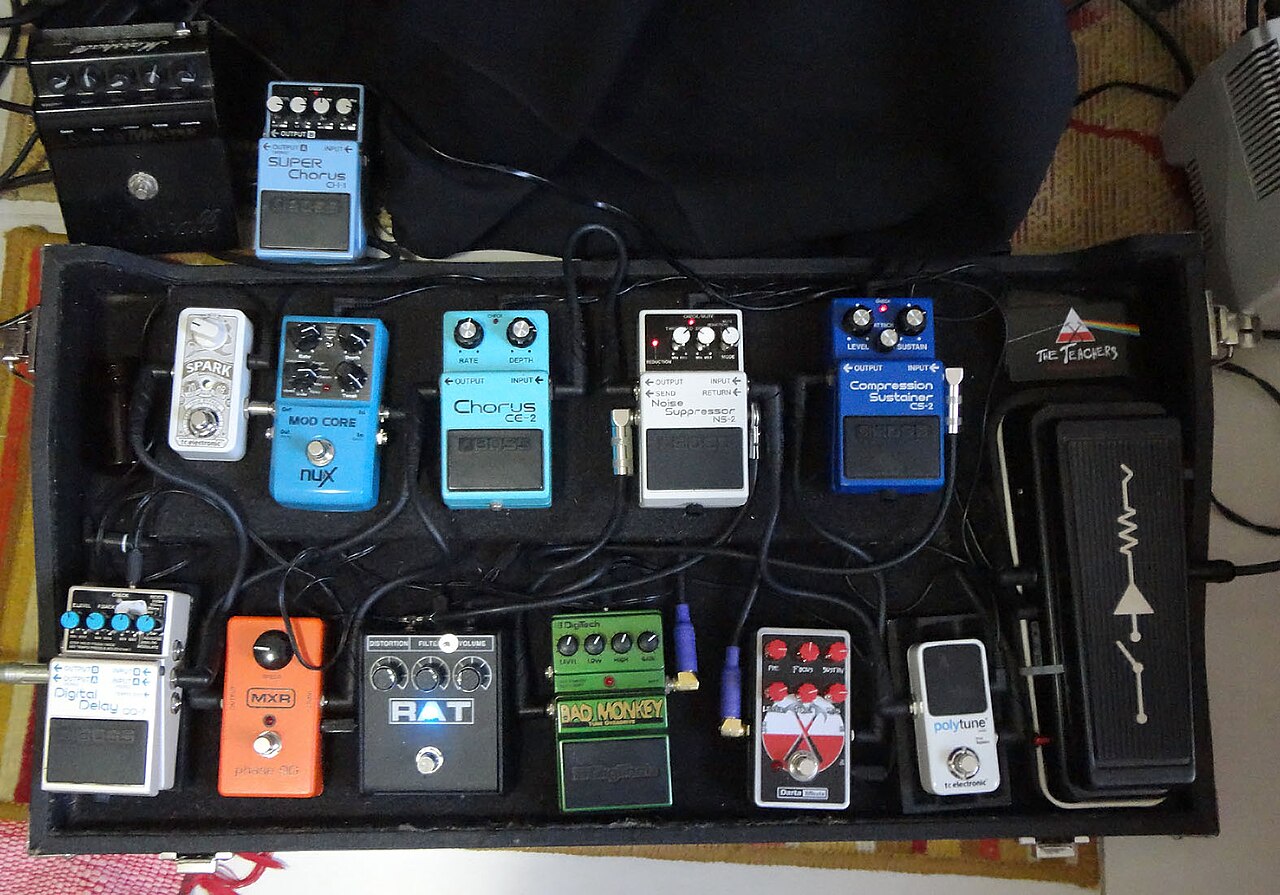
Plate offers a vintage variant “modeled after the classic EMT140” and a studio variant with no modulation at all, which Empress claims “rivals studio processors at much higher price points.” The studio plate is, in practice, the mode most likely to end up on a session player’s preset 1.
Spring is where the pedal takes its only consistent public beating, and we will come back to it. Empress’s own copy on the mode is unusually good technical writing, explaining the driver-coil-transducer mechanism and noting that “the sound varies depending on the amount of springs, the spring tension, and how much the signal is being driven.” The bright spring variant is described as sounding “similar to a Fender Twin Reverb” and includes an overdriven sub-preset where Thing 2 controls the amount of break-up.
Room is the least glamorous and arguably the most used mode on the pedal. Empress’s rationale is the correct one: “Because we spend most of our lives in small or medium sized rooms, it’s a very natural sounding reverb.”
The Eight That Justify the Price
Sparkle is Empress’s shimmer. The mechanism is described plainly: an octave effect fed into a large tail, where “the octave is a little bit slow to build, and it goes higher and higher in pitch as time goes by.” Sub-presets carry names like Delicate, Jangly and Organ Swells.
Modulated holds four sub-algorithms — Modulated, Chorus, Flanger and Tremolo. The technical explanation is the clearest one anyone has published on why modulated reverb differs from a chorus pedal into a reverb: “in the modulated reverb tail, there is modulation applied to each of the delay lines so you get a similar sound, but you don’t hear the distinct chorus pulse because there’s so many going on at once.” Empress then throws the register: the result is “sort of like wrapping the guitar sound in a big soft blanket, on a cold Canadian winter night.”
Ambient Swell contains Triggered Swell and the remarkable Gated Swell with Octave, which Empress admits is “a gate, compressor, various gritty and stereo delays, an octave up and a reverb” chained inside one algorithm. The practical payoff, in their words: “if you leave space between notes, you can get volume pedal swells without the volume pedal.”
Delay + Reverb holds four algorithms including Skitter — “delay lines that morph into a reverb” — and a Blendable Delay whose 12 o’clock point is an exact 50/50 split. Empress flags a genuine limitation here rather than hiding it: because the left select stomp is used to tap delay time, that mode “can’t be used with the bank preset system without an external tap stomp — Sorry Bankers.”
Reverse has three flavours, and the manufacturer copy contains a name-check worth quoting: on the Reverse and Stop algorithm, “if you turn the diffusion all the way down and add some distortion from your favorite stomp, you’ll be in My Bloody Valentine.” That is the manufacturer explicitly pointing at Kevin Shields‘ vocabulary as the target, which is a rarer thing than the internet suggests.
Ghost — plus its gentler sibling Casper — layers resonant, modulated elements behind the dry signal. Empress recommends operating it as a two-person job or with an expression pedal on the filters, and notes they “built some compression in so that it won’t blow up on you with high decay and resonance settings.”
Lo-fi holds 50’s Radio and Warble, both of which dirty the dry path as well as the wet. Premier Guitar heard it as “a bit like a broken spring reverb or a really crusty Binson Echorec.” Empress’s suggested use case: “if you’re working on Tarantino film soundtracks.”
Beer holds Glitch, Gated Reverb and Destroyer Pad. Glitch runs the tail through a filter that randomly flips between high-pass and low-pass states; PG described the result as capable of making “your guitar sound like an aggressive synth pad.” Gated Reverb is a real, usable, eighties-drum-room effect keyed off the dry input level, and is much more musically applicable than its neighbours. Empress’s own advice on the category is characteristic: “These modes are not recommended for everyday, all-day excessive use. They’re more recommended as a weekend indulgence — especially if you’re supporting a family.”
Who Actually Uses One
Reverb pedals attract bad artist data, and this one is no exception. What follows is separated by evidence quality, and the weak claims are labelled as weak.
Filmed or Photographed
- Taylor York (Paramore) — discusses the Empress Reverb on camera in EarthQuaker Devices’ Board to Death series, Episode 12. This is the strongest single piece of evidence in the set, and York is a repeat Empress user; he also appears in the verified list for the Empress Echosystem.
- Kid Koala — Empress filmed two dedicated sessions with him using the Reverb, both published 21 February 2017. Manufacturer-shot footage of a named artist actually playing through the product is about as solid as endorsement evidence gets.
- Andrew Huang — states it on camera at 3:47 in a studio walkthrough: “and then this Empress Reverb doing a combo of delay and reverb.” He is also a verified Echosystem user.
- Justin Meldal-Johnsen — 2018 Instagram post showing the pedal in his studio, plus a place on Empress’s own artist roster.
- Charlie Barnes (Bastille) — Instagram photo, plus Empress roster listing.
- Saul Davies (James) — photographed with the pedal in Washington, DC on 6 October 2024.
- Gwenifer Raymond — visible in live footage from The Dog and Duck, Bognor Regis. Worth noting because she is a Welsh American-primitive fingerstyle player, which is not the demographic this pedal is marketed at.
- Hakan Özoğuz (Athena) — photo evidence.
- Benn Jordan (The Flashbulb) and Tyler Larson — both shown using it in their own video and story content.
Empress’s Own Roster
Empress lists twelve artists on the Reverb product page: MILKBLOOD, John Smith, Justin Meldal-Johnsen, Charlie Barnes, Bryce Jacobs, Andrew Huang, Joff Oddie (Wolf Alice), Douglas D’Lima, Louis Wu, Kid Koala, Blair Dunlop and Donna Grantis. Roster listings are endorsements rather than proof of specific use, so treat them as one tier below the filmed evidence — but note that this exact roster overlaps heavily with the one Empress publishes for the Echosystem and the ParaEq MKII Deluxe, which suggests these players are Empress users broadly rather than Reverb users specifically.
Donna Grantis is a former member of Prince’s 3RDEYEGIRL, which makes Prince a legitimate contextual link, not a usage claim.
A Claim That Does Not Fully Check Out
Third-party gear databases credit Brandon Beaver of mewithoutYou as a Reverb user, sourcing the claim to Premier Guitar. A Premier Guitar Rig Rundown with Beaver and Michael Weiss does exist — filmed on the fifteenth-anniversary tour for [A→B] Life — and it documents his 1967 Gibson ES-335, a 1973 Fender Deluxe Telecaster with Lollar humbuckers, an Epiphone ES-335 Dot, a stock 1964-reissue Fender Twin, a modified Guyatone VTm-5 and an EHX POG2. We could not confirm the Empress Reverb in that Rundown’s documented gear list. The pedal may well be on the board; the citation as published does not establish it, and we are not going to repeat it as fact.
Likewise, one worship-guitar rig writeup places the Reverb after a Strymon TimeLine on Jordan Holt’s board (Kari Jobe / The Belonging Co.). Plausible and consistent with the pedal’s church-and-session user base — but a secondhand rig writeup is not primary evidence, and it is flagged as such.
The Numbers Problem, Again
The main community gear database claims 15 artists for this pedal in its navigation, its hero text and its page metadata, then renders exactly 12 before a “Load More” button that does nothing. This is the same twelve-item rendering ceiling documented on multiple other pedals in this series. When a database tells you it has more artists than it will show you, the number in the headline is not a number you can cite.
Tone Recipes
1. The Invisible Session Room
Mode: Room. Decay 9 o’clock, Mix 8:30, Hi 1 o’clock, Lo 12, Thing 1 (pre-delay) 9 o’clock. This is the setting that answers Premier Guitar’s one real criticism — that natural modes “can sound a bit too clean” — by simply using less of it. At this mix the reverb is inaudible as an effect and only audible when bypassed.
2. Fender Twin Surf
Mode: Spring, bright variant. Decay 2 o’clock, Mix 11 o’clock, Hi 2 o’clock, Lo 10 o’clock, Thing 1 (rattle decay) 1 o’clock, Thing 2 (rattle level) 2 o’clock. The rattle controls are the whole point — they give you access to a parameter no real tank offers. Push Thing 2 past 3 o’clock and it stops being convincing, which is exactly the criticism the spring mode attracts.
3. Lexicon 224XL Eighties Hall
Mode: Hall, vintage variant. Decay 3 o’clock, Mix 11 o’clock, Hi 11 o’clock, Lo 1 o’clock, Thing 1 (pre-delay) 11 o’clock, Thing 2 (early reflections) 2 o’clock. Long, chorused and slightly dark. Run in stereo into two amps with the isolated Output 2 engaged.
4. Post-Rock Sparkle Bed
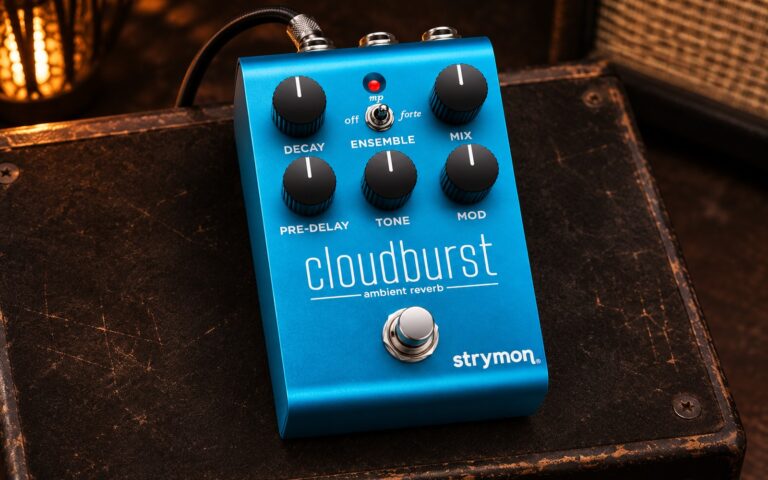
Mode: Sparkle. Decay 4 o’clock, Mix 2 o’clock, Hi 1 o’clock, Lo 9 o’clock, Thing 1 (sparkle level) 12, Thing 2 (sparkle length) 3 o’clock. Rolling Lo back is what keeps the octave from turning to mud. This is the territory occupied by the Walrus Audio Slö and the Strymon Cloudburst, at roughly twice their price and with considerably more control.
5. Volume Swells Without a Volume Pedal
Mode: Ambient Swell, Gated Swell with Octave. Decay 4 o’clock, Mix 3 o’clock, Thing 1 (gate attack) 12, Thing 2 to taste. Strum hard and deliberately — the trigger detection needs a clear transient — then leave gaps. Empress explicitly designed this to replace the volume-pedal technique.
6. My Bloody Valentine Stop
Mode: Reverse, Reverse and Stop. Decay 1 o’clock (this knob sets ramp time in this algorithm), Mix 3 o’clock, Thing 1 (pre-delay) 9 o’clock, Thing 2 (diffusion) fully counter-clockwise. Then add a fuzz in front. This is the manufacturer’s own recipe, not ours.
7. Ghost Pad
Mode: Ghost. Decay 4 o’clock, Mix 1 o’clock, Hi and Lo assigned to an expression pedal via the control port, Thing 1 (modulation rate) 10 o’clock, Thing 2 (spookiness) 2 o’clock. Sweeping the filters live while the tail holds is the entire technique here, and it is why the control port matters more on this pedal than on most.
8. Gated Eighties Snare, For Guitar
Mode: Beer, Gated Reverb. Decay 3 o’clock, Mix 12, Thing 1 (gate threshold) 11 o’clock, Thing 2 (gate release) 10 o’clock. Chop sixteenth-note rhythm parts through it. The gate keys off your dry input, so your right hand controls the effect directly.
9. Binson-Style Grime
Mode: Lo-fi, 50’s Radio. Decay 12, Mix 11 o’clock, Hi 10 o’clock, Lo 9 o’clock, Thing 1 (delay level) 1 o’clock, Thing 2 (dirtiness) 11 o’clock. Because this mode dirties the dry signal too, it is best used as a section change rather than an always-on.
10. Ambient Infinite Hold
Mode: Delay + Reverb, Skitter. Decay 4 o’clock, Mix 3 o’clock, Thing 1 (diffusion) 3 o’clock, Thing 2 (size) 4 o’clock — then hold the select stomp. In this algorithm holding the switch makes decay time infinite, giving you a sustaining bed to play over. Most of the modes on this pedal share that infinite-hold behaviour, and it is under-advertised.
Settings are starting points on a 7 o’clock to 5 o’clock knob sweep, assuming a mono-in, stereo-out rig unless noted.
How It Compares
Against the Strymon BigSky
The Strymon BigSky is the reverb this pedal was cross-shopped against from the first week — there were head-to-head shootout videos up within a month of launch. The trade is clean. BigSky has a display, twelve machines, 300 presets and a smoother, more finished-sounding set of core algorithms. The Empress has more parameter access per algorithm, a genuinely analog dry path, a cab simulator, CV and external-audio input on the control port, an isolated output transformer, and firmware that has kept adding algorithms for years. BigSky is easier. Empress is deeper.
Against the Eventide Space
Eventide Space owners who have A/B’d the two consistently cite the screen as the deciding factor, and Eventide’s Blackhole remains a sound the Empress has no direct equivalent for. Space also does pitch-shifted and algorithmic weirdness that predates the whole boutique ambient category. The Empress wins on immediacy: no menu diving, and every parameter you need for the current algorithm is already under your hand.
Against the Source Audio Ventris
This is the most interesting comparison because of how the community splits. Players who have owned both generally prefer the Empress overall — except on spring reverb, where the Ventris is widely considered better, and where its editor software allows parameter tweaking the Empress does not expose. If spring is your primary reverb, that matters a great deal.
Against the Strymon Flint
The Strymon Flint keeps appearing in Empress owner discussions for exactly one reason: its spring reverb is repeatedly described as closer to a Fender Custom ’64 Deluxe Reverb than the Empress spring mode gets. A $499 flagship losing a direct A/B to a two-effect pedal at less than half the money, on one specific algorithm, is a real and repeatedly reported outcome. It also explains why a lot of Empress Reverb owners keep a Flint or a Boss RV-6 on the board alongside it.
Against the Cheaper Field
If the deep modes are not the draw, the value case collapses fast. The EHX Oceans 11, the MXR M300, the TC Electronic Hall of Fame 2 and the JHS 3 Series Reverb all deliver perfectly good hall, plate, spring and room at a fraction of the price. Premier Guitar said it directly: “Players that aren’t interested in such exploration will probably not be able to justify the price.”
Inside the Empress Line
The Reverb shares its enclosure, its control port, its 35-preset architecture, its cab simulator and its no-screen philosophy with the Echosystem. The two are designed to sit side by side and are the most-paired items in each other’s owner data. Running the Compressor MKII into either one and the ParaEq MKII Deluxe after is, essentially, the complete Empress signal chain.
Buying Guide
Current Pricing, September 2026
Direct from Empress: $494. Sweetwater, Guitar Center, B&H and Vintage King: $494. Reverb: $446.49 new. Thomann: $499. Average across tracked merchants: roughly $460. Used examples sit around $300.
Two things are notable. First, there is no discounting — every major US retailer holds identical MAP, which is unusual in a category where flagship reverbs routinely see fifteen to twenty percent off. Second, the pedal is not flagged discontinued anywhere, and Empress still publishes current firmware and a manual revised to v6.41 for it. A decade after launch it remains a current product.
Resale
At roughly $300 used against $494 new, the Reverb retains about 61 percent of its value at ten years old. That is respectable for a digital pedal of that age but below the eighty-percent retention seen on some smaller boutique units in this series. The owner community’s own framing is more useful than the raw number: high-end pedals like this “can resell with minimal loss,” and they typically list $30 to $40 below comparable Strymon units on local marketplaces.
Who Should Buy One
Buy it if you want one reverb to be your only reverb, you run stereo, you like turning knobs more than reading screens, and you will genuinely use modes beyond hall and plate. Buy something else if you mostly want a great spring reverb, if you need a display to work quickly on a dark stage, or if your reverb use is a light room sound on an always-on setting.
New or Used
Used is a sound proposition here for one reason specific to this pedal: firmware is user-updatable via SD card, so a 2016 unit and a 2026 unit run identical software. There is no hardware revision to worry about. Check that the seller includes the power supply — 300 mA is a real requirement and not every board can spare it.
Living With It
The Power Draw Is the First Problem
300 mA at 9 V is a lot. That is more than most isolated supply outputs deliver, and there is no battery option. Plan the power before you plan the placement, and do not daisy-chain it.
The Learning Curve Is Real
Premier Guitar’s advice holds a decade on: “keeping the manual at your side for first experiments is a very good idea.” The absence of an LCD means the pedal communicates state through coloured LEDs, and remembering which colour means which algorithm is a genuine and frequently reported friction point. Most long-term owners solve it by building their five or six presets in the first month and then never touching the mode selector again.
The Spring Complaint
It is the one consistent criticism across a decade of owner discussion, and it deserves a straight answer: the Empress spring mode is the weakest thing in the box relative to its competition, several owners report a persistent whine in that mode specifically even with the guitar volume down, and firmware updates that have added algorithms elsewhere have not been reported to fix it. It is also true that some owners think it sounds fine and authentic. Both of those things are true at once, and a buyer whose primary need is spring should audition it specifically.
A Slight Level Bump
Premier Guitar flagged one hardware quirk worth knowing: “a tendency to boost signal just a bit,” noticeable when an overdrive is placed in front. For most players this is welcome. For anyone stacking multiple gain stages into a hot amp front end, it is worth checking your gain staging after the pedal goes on the board.
Stereo Is the Point
The isolated, transformer-balanced Output 2 exists specifically so two amps can be run without a ground loop, and the difference between mono and stereo on the Hall and Modulated algorithms is substantial. Empress notes that the Hall mode’s early reflections “add a nice sense of space and envelopment, especially in stereo mode.” If you will only ever run mono, a large part of what you are paying for is unused.
Placement
The conventional slot is last, after modulation and delay, into the amp’s front end or a stereo pair. But the Lo-fi and Reverse modes both alter the dry path, and the ambient swell modes respond to picking dynamics, so both reward being placed before dirt — the same trick that works with the EarthQuaker Devices Afterneath and the Walrus Audio Fathom. The 1 MΩ input, the input pad options and the analog dry path make it unusually well-behaved wherever it lands.
Not Just Guitar
The pedal’s genre data skews electronic ahead of rock, which is unusual for a guitar stompbox. Demo coverage on harp, bass and modular synth exists in volume, and the input pad settings, the isolated output and the 48 kHz converters make it credible in a studio rack context. Empress users pair it most often with the Echosystem, a Meris Enzo, an Origin Effects Cali76 and a TC Electronic PolyTune.
The Wider Context
Reverb as a compositional element rather than a finishing touch runs from Robin Guthrie’s Cocteau Twins textures through Neil Halstead’s Slowdive washes, Jason Pierce’s Spiritualized drones and Vini Reilly’s Durutti Column filigree, into the ambient improvisation of Bill Frisell and the tuned-guitar drone work of Thurston Moore and Lee Ranaldo. None of those players used an Empress Reverb — most of the records predate it by decades — but they define the vocabulary its Sparkle, Ghost and Ambient Swell modes are built to speak.
What is different about the Empress is that it treats all of that as engineering rather than mystique. The reverse mode has a documented ramp-time parameter. The shimmer has a documented octave-feedback length. The spooky mode has a knob officially labelled Spookiness. It is a very Canadian piece of design: rigorous, self-deprecating, and quietly convinced that if you explain the mechanism properly, people will make better art with it.
FAQ
How many algorithms does the Empress Reverb actually have?
Thirty-two as of firmware 6.0, spread across twelve mode families. It shipped in 2016 with twenty-four. The confusion in most listings comes from the twelve modes being counted instead of the individual algorithms inside them; both numbers are correct, they just count different things.
What are the “Thing 1” and “Thing 2” knobs?
Two context-sensitive parameter controls whose function changes with the loaded algorithm. In Modern Hall they are pre-delay and early reflection level; in Bright Spring, rattle decay and rattle level; in Ghost, modulation rate and resonance; in Glitch, glitch speed and glitch tone. There are roughly sixty-four distinct behaviours across the full algorithm set.
Is the spring reverb really bad?
It is the weakest algorithm in the pedal relative to dedicated competition, and it is the single most consistent owner complaint across ten years. Some owners report a persistent whine in that mode. Others think it sounds authentic. If spring is the reverb you use most, audition it directly against a Strymon Flint or a Source Audio Ventris before buying.
How much power does it need?
9 V DC through a 2.1 mm centre-negative barrel jack at 300 mA. There is no battery option, and 300 mA exceeds what many isolated supply outputs provide. Check your power brick first.
What is Beer mode?
Empress’s catch-all category for algorithms that fit nowhere else. It currently holds Glitch (a reverb tail through a randomly flipping high-pass/low-pass filter), Gated Reverb (a genuinely useful eighties gated effect keyed off your dry signal), and Destroyer Pad, whose knobs are officially named “Robot Screams” and “Pitch Shift.”
Does it have MIDI, and do I need extra hardware?
MIDI runs through the Universal Control Port on a single 1/4″ jack, which also handles expression, external tap, control voltage and external audio input. You will need an appropriate cable or adapter to connect standard MIDI hardware to that jack — the port is on the pedal, but the interface between it and a five-pin DIN world is on you.
Can I still update the firmware on an old unit?
Yes. Updates load via SD card, Empress still hosts current and archived firmware, and the published manual is at revision 6.41. A 2016 unit and a 2026 unit can run identical software, which is a strong argument for buying used.
Is the Empress Reverb still in production?
Yes. As of September 2026 it is a current product at $494 direct, stocked at six or more major retailers, with no discontinuation flag anywhere and active firmware support.
Which famous players actually use one?
Filmed or photographed users include Taylor York of Paramore, Kid Koala (in Empress’s own session videos), Andrew Huang, Justin Meldal-Johnsen, Charlie Barnes of Bastille, Saul Davies of James, Gwenifer Raymond and Benn Jordan. Empress’s own roster adds Joff Oddie of Wolf Alice, Donna Grantis, Bryce Jacobs, Blair Dunlop, John Smith, MILKBLOOD, Douglas D’Lima and Louis Wu.
Image credits
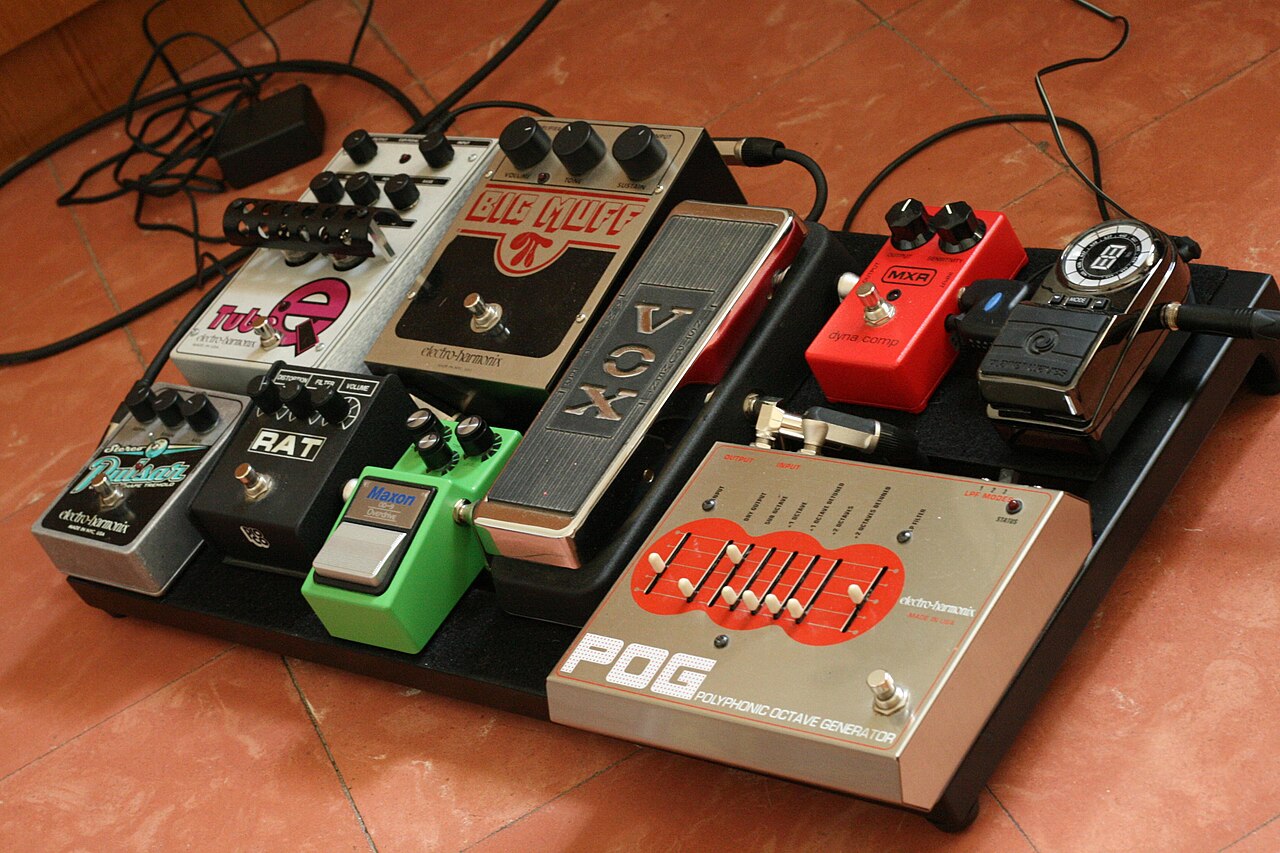
- A pedalboard with a mix of pedals: marcelodonati, Wikimedia Commons, CC BY 2.0.
- A pedalboard with overdrive, wah and fuzz pedals: Michael Morel from Barcelona, Spain, Wikimedia Commons, CC BY 2.0.
- Top image: GuitarGangsters AI-generated reference illustration, not a photograph.
- Empress Reverb: AI-generated illustration by GuitarGangsters, based on the manufacturer’s product design (not a photograph).
Latest News
Related
On This Day
Tuesday 10 November
From this week: