Fifty Years After the Fire: How the Keeley Monterey Packed the Summer of Love Into One Enclosure
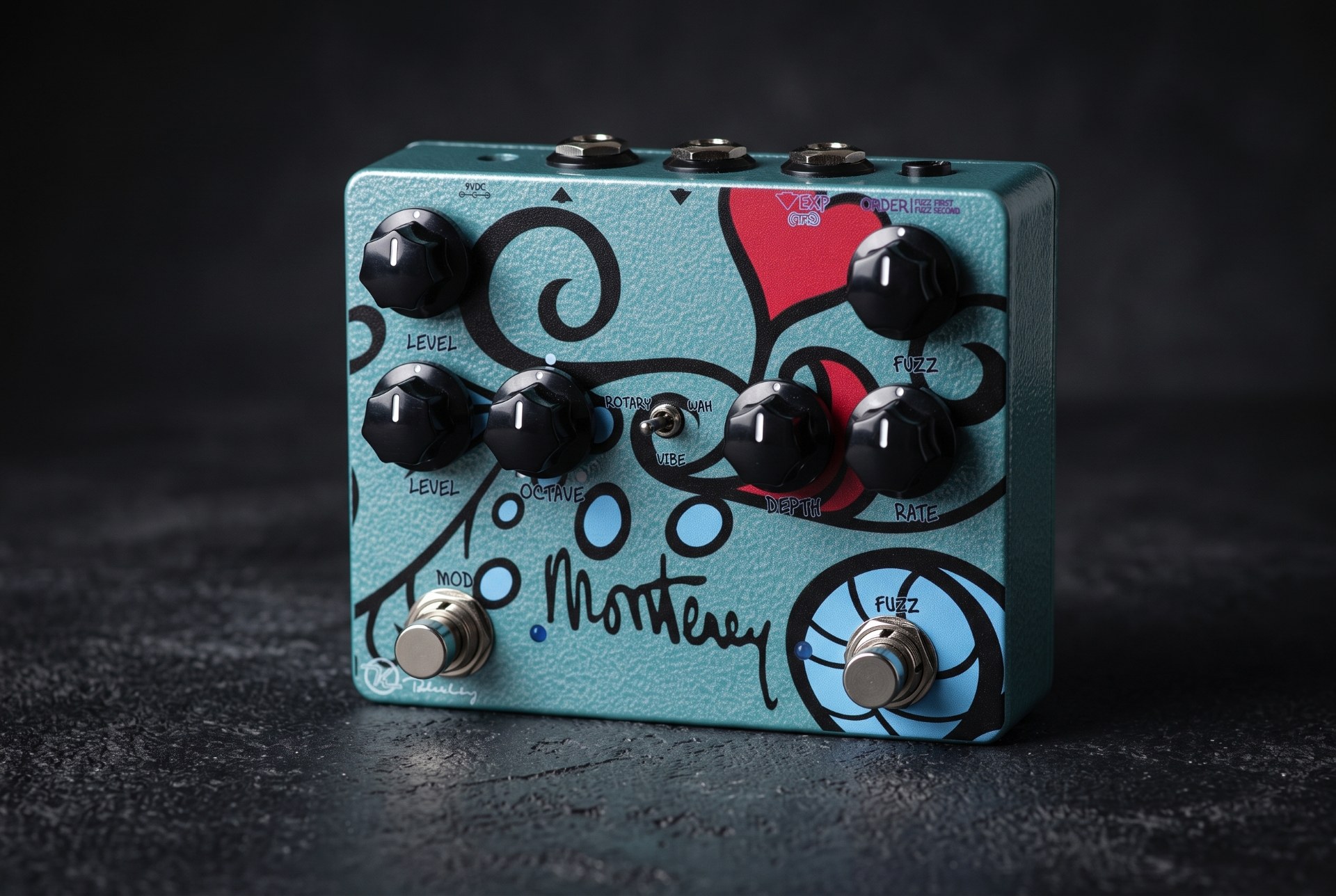
An AI-generated illustration of the Keeley Electronics Monterey Rotary Fuzz Vibe.
Keeley Monterey Rotary Fuzz Vibe guide: silicon fuzz, Uni-Vibe, rotary, harmonic wah, octave. Specs, verified players, tone settings, buying advice.
On 18 June 1967, at the Monterey International Pop Festival, Jimi Hendrix knelt in front of a hand-painted Fender Stratocaster, doused it in lighter fluid and set it alight. It is the single most reproduced image in the history of the electric guitar. Almost fifty years later, an amp tech turned pedal builder in Edmond, Oklahoma decided that the sound surrounding that moment — fuzz, Uni-Vibe, wah, rotating speaker, octave — could be compressed into one box the size of a hardback novel.
The Keeley Monterey Rotary Fuzz Vibe is the result. It is a two-channel workstation with a silicon fuzz on the right footswitch and a three-mode modulation engine on the left, and between them it covers a spread of ground that would have required four separate pedals and a Leslie cabinet in 1967. It is also, as of 2024, out of production — which changes the shopping calculus entirely and is the reason this article exists in its current form.
What follows is what the Monterey actually does, what it demonstrably sounds like according to the people who reviewed it when it was new, who genuinely has one on a working pedalboard, and where the internet’s received wisdom about this pedal quietly falls apart.
Origin: A Workstation, Not a Tribute Act
Keeley Electronics announced the Monterey via press release on 24 March 2016, describing it as a “boutique hand-made multi-effect unit” producing “3 modulation effects, octave and vintage fuzz.” Street price was set at $299. It joined what Keeley was then calling the Workstation Series — the company’s format for pairing a dirt circuit with a deep modulation section under independent footswitches, so that either half could work alone.
There is a small dating discrepancy worth clearing up, because it appears in a lot of secondhand listings. Keeley’s own 2024 farewell copy for the limited Monterey 69 states that the original Monterey was “first released on July 21st, 2016.” The Premier Guitar press release announcing the pedal as shipping is dated 24 March 2016, and a review was published on a guitar blog that same month. The most likely explanation is that March 2016 marks the first shipments and July 2016 marks a formal launch or wide retail availability date; either way, if you see a listing claiming a 2017 or 2018 introduction, it is wrong. The Monterey is a 2016 pedal.
The name and the artwork do the marketing. The enclosure carries a swirling psychedelic paint treatment that MusicRadar’s Trevor Curwen described as inspired by “the man and his Monterey Strat,” and that Legendary Tones called “very reminiscent of the painted guitar Hendrix sacrificed at the pedal’s namesake festival in 1967.” Keeley shipped it in a black velvet bag. Subtlety was not the objective.
Where the Monterey Sits in the “Jimi in a Box” Tradition
It was not the first attempt. Curwen name-checked the Foxrox Captain Coconut, a cult unit that bolted Fuzz Face, Uni-Vibe and Octavia emulations together and left you to add your own wah. The Dunlop and Fulltone catalogues have circled the same territory from different angles for decades — individual reissues of each element, sold separately, at considerable cumulative cost. The Monterey’s argument was integration: one enclosure, one power supply, one pair of footswitches, one expression jack, and an internal switch to reorder the two halves.
That argument still holds. If you want the Dunlop JH-F1 Jimi Hendrix Fuzz Face, a Uni-Vibe clone, a rotary simulator, an octave box and a wah, you are looking at five pedals, five power draws and roughly four times the footprint. The Monterey compresses that to two switches. What you give up is the ability to run more than one modulation flavour at once, and the deeper tweakability of dedicated units.
Specifications
The Fuzz Side: Silicon, and Why That Was the Right Call
Keeley’s fuzz channel is a two-transistor design in the Fuzz Face lineage, but built around vintage Fairchild Semiconductor silicon parts rather than germanium. The company is explicit about why: these “moderate gain transistors offer the perfect fuzz tone and do not have the temperamental temperature related problems that germanium devices exhibit.”
That is not marketing evasion — it is the correct engineering answer for a pedal that also has to house a digital modulation engine and survive a touring rack. Germanium fuzz drifts with temperature, and a two-transistor germanium circuit sitting next to a warm DSP section is asking for an unstable evening. Silicon holds its bias. The trade is a slightly brighter, more aggressive fuzz with less of the soft germanium bloom, which is exactly the trade Hendrix himself made from 1968 onwards when he moved to BC108 silicon units for the arena years.
Reviewers were consistent about the character. Curwen at MusicRadar called it “a useful vintage-style fuzz-for-all-seasons, nicely touch-sensitive” that “serves up a bright edge that cuts through while still offering plenty of girth,” and noted that the Fuzz knob “takes a bit of travel for satisfying results, but is at its best in its upper reaches for a smooth singing tone.” Legendary Tones’ Jon Dunn, testing it through an early-Seventies Marshall 50-watt half stack with a 1974 Strat, described “a smoother gain than more faithful fuzz face variants” and “a good blend of germanium warmth and silicon sustain.”
The One Real Omission
There is no tone control on the fuzz. MusicRadar listed this as the pedal’s only meaningful weakness: “A tone knob for the fuzz sound would have been nice, but it’s not an essential addition.” That is a fair verdict. Two controls is authentically Fuzz Face, and it forces you to shape the sound with your guitar volume and your amp — which is period-correct — but a player used to a modern fuzz with a full tone stack, such as the Keeley Fuzz Bender and its twenty decibels of active EQ, will feel the absence immediately.
Keeley effectively acknowledged this with a workaround that both reviews flagged and that is genuinely the most underrated feature of the pedal. Set the modulation toggle to Rotary, turn the Rate control fully off so the cabinet stops spinning, and engage the fuzz. The Depth and Octave controls now function as a static speaker-cabinet voicing — Depth setting the cabinet character, Octave balancing the simulated upper horn against the lower drum. In Keeley’s own words, this gives you “fuzz with tonal control like you’ve never had before,” and in practice it is a footswitchable tone stack for the fuzz that nobody talks about.
The Modulation Side: Three Effects, Eight or Nine Sounds
A three-position toggle picks between the modes. All four knobs remain live in every mode, but only Level keeps a fixed job.
“Les Rotary”
A rotating-speaker simulation that models both the lower bass rotor and the upper treble horn, plus short reverberant cabinet reflections for a doubling effect. Rate and Depth do what you expect. Octave does not produce an octave here — it balances the horn against the drum, which is functionally a brightness control for the simulated cabinet. Curwen described the result as “a tasty approximation of a rotary speaker” and highlighted the minimum-depth static-cab trick as “a footswitchable tonal shift.”
Set slow, it is the drifting Leslie chorus of late-Sixties psychedelia. Set fast, it develops the throbbing Doppler shimmer that no analogue chorus pedal can imitate, because a chorus modulates delay time while a rotary cabinet modulates pitch, amplitude and physical position simultaneously.
“Kool Vibe”
The Uni-Vibe emulation, and by consensus the strongest sound in the pedal. It is not built on the original’s optical photocell-and-lamp arrangement, but Keeley designed it to reproduce the frequency response and the specific asymmetric pulsing that the photocell produced. Curwen: “may not use the optical circuitry of an original Uni-Vibe, but it gives a really accurate reproduction of the sound.” Dunn described “very deep, throbbing pulses that you could feel in the floor” and, through a cranked Marshall, being “across the Bridge of Sighs within moments” — which is a Robin Trower reference, and a fair one.
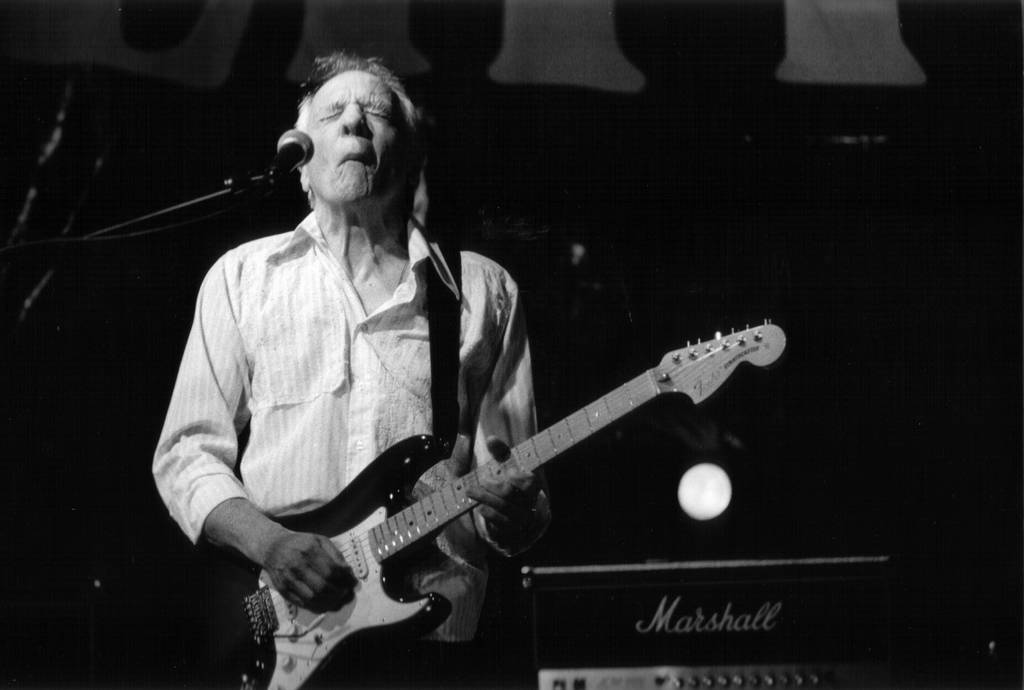
This is where the pedal earns its keep beyond Hendrix. The Uni-Vibe belongs as much to David Gilmour and Robin Trower as it does to Jimi, and Curwen additionally heard Ernie Isley in the fuzz-plus-vibe combination, which is precisely right for “That Lady.”
“Harmonic Wah”
The most misunderstood mode, because it is really four effects on one knob. With Depth fully off you get a fixed or “cocked” wah, with the Rate control selecting which frequency gets boosted. Plug in an expression pedal and that same setting becomes a conventional sweepable wah. Nudge Depth up slightly and it becomes an auto-wah driven by pick attack. Past twelve o’clock, you reach the harmonic wah proper — which, as Curwen accurately noted, is “more tremolo than wah, and a very close relation to the sort of gorgeous harmonic tremolo found on vintage Fender ‘brownface’ amps.”
That last sound is the genuinely novel one in the box. Harmonic tremolo splits the signal into high and low bands and alternates between them; centring that behaviour on wah-style filter frequencies produces a vocal, rocking pulse that a standard Cry Baby cannot make and a standard tremolo pedal cannot make either.
The Octave
Available in Vibe and Wah modes, bipolar around a centre detent. Up gives you the Octavia-adjacent harmonic ear-candy that sits on top of a fuzz lead; down gives you a synthetic sub that Dunn described as “almost synth-like” and useful for unison guitar-and-bass riffing. Curwen reported that “it all tracks extremely well,” which is worth flagging — analogue octave-up circuits historically track badly below the twelfth fret, and polyphonic units such as the EHX POG2 exist precisely because that problem was hard. The Monterey’s octave is a modern DSP implementation and behaves accordingly.
Famous Players: What Actually Holds Up
This is a pedal whose entire identity is borrowed from a dead guitarist who never touched it, so the evidence needs sorting carefully. Jimi Hendrix has no connection to the Keeley Monterey beyond the name, the artwork and the target tones. He died in 1970. Saying so out loud is not pedantry — it is the difference between a tribute and an endorsement, and a great deal of online copy blurs the two.
The real question is who has one on a working board. Here the evidence sorts into three tiers.
Tier One: Photographic or Video Confirmation
Mark Lettieri is the flagship user and the evidence is unambiguous. The Snarky Puppy and Fearless Flyers guitarist runs a Monterey Custom Shop Edition first in his signal chain, ahead of an MXR Deep Phase, a J. Rockett HRM, his signature J. Rockett Melody OD, a Pigtronix Octava and a Dunlop volume pedal, with a TC Electronic Plethora X5 handling switching — documented in Premier Guitar’s Pro Pedalboards feature and visible in the Fearless Flyers Rig Rundown video. Lettieri has also gone on record about why, saying that between the Monterey and Keeley’s 30ms he has “just about all my favorite 60’s/70’s guitar tones covered with only two pedals.” For a player whose day job is precision funk rather than psychedelia, that is a meaningful vote.
Ally Venable, the Texas blues-rock guitarist and singer, has been photographed with a Monterey on her live board, documented at New Morning in Paris on 7 February 2024. Mariah Schneider has one visible in pedalboard photography posted to her own social media. Tyler Larson of Music Is Win has one on his pedal wall on video — though a pedal wall is a collection, not a rig, and that distinction is worth keeping.
Tier Two: First-Person Statements
Nancy Wilson of Heart is quoted directly via Keeley: “I’m really enjoying my new Dark Side and Monterey guitar pedals. A great friend and talented producer Sue Pelino referred me to them and I’m looking forward to adding them to my live stage rig.” Read that carefully. It is a genuine first-person statement about owning and enjoying the pedal, but the phrase “looking forward to adding them” is forward-looking. It confirms possession and enthusiasm, not documented stage use. That is a real endorsement and it should not be inflated into more than it is.
Chris Turpin — of Kill It Kid and, latterly, Ida Mae — gave Keeley a much more technically specific statement: “There is so often a unique twist to [Keeley’s] designs that has pushed me into sonic territory I hadn’t considered before…the Caverns (rate shimmer) and Monterey (octave level) are perfect examples of this. And the D&M drive…is now cemented to my pedalboard.” Naming a specific control on a specific pedal is the kind of detail a player only produces from actual use. Turpin’s other two named pedals both have their own entries here: the Keeley Caverns Delay & Reverb V2 and the Keeley D&M Drive.
Tier Three: Brand Roster Only — Treat With Caution
Several names circulate as Monterey users on the strength of nothing more than an appearance on Keeley’s artist page. That includes Simon McBride (now of Deep Purple), “Captain” Kirk Douglas of The Roots, Teddy Kumpel, Adam Meisterhans of Rozwell Kid, and bassist Ira Dean. A brand artist page establishes a relationship with the company. It does not establish that a specific SKU is on a specific board, and in this series we have repeatedly found brand rosters recycling the same names across a whole catalogue. Treat these as unconfirmed.
One correction while we are here: the widely-mirrored gear databases list Teddy Kumpel as a member of Nine Inch Nails. He is not, and never has been. Kumpel is a long-serving New York session and touring guitarist — Joe Jackson’s guitarist and backing vocalist since 2015, a Rickie Lee Jones collaborator, and the leader of the LOOPestra project that ran a Monday-midnight residency at Rockwood Music Hall for the better part of a decade. The Nine Inch Nails attribution appears to be straightforward database contamination.
Tone Recipes
Monterey 1967 — Fuzz and Vibe
- Mode: Kool Vibe
- Fuzz: 3 o’clock — Curwen’s note about the upper reaches applies; this is where the singing tone lives
- Fuzz Level: unity or slightly above
- Rate: 9 o’clock (slow, seasick drift)
- Depth: 2 o’clock
- Octave: centre (off)
- Order: Fuzz > Mod
This is the canonical combination and the reason the pedal exists. Neck pickup for lead, bridge for rhythm stabs. Roll your guitar volume to 7 and the fuzz cleans up into a chiming, phase-swirled clean that most people do not expect a silicon fuzz to produce.
Band of Gypsys Lead
- Mode: Kool Vibe
- Fuzz: maximum
- Rate: 11 o’clock
- Depth: 1 o’clock
- Octave: 2 o’clock (moderate octave up)
Dunn specifically identified this configuration as the “Machine Gun” and “Them Changes” territory. The added upper octave is what gives the lead its glassy top edge; too much and it turns to whistle, so keep it below three o’clock.
“That Lady” Isley Rhythm
- Mode: Kool Vibe
- Fuzz: 1 o’clock, Level up
- Rate: 12 o’clock
- Depth: maximum
- Octave: centre
Bridge pickup, hard pick attack, and let the vibe do the rhythmic work. The faster rate and maximum depth are what separate this from the Hendrix setting.
Bridge of Sighs — Trower Slow Vibe
- Mode: Kool Vibe
- Fuzz: off (or 10 o’clock for edge)
- Rate: fully counter-clockwise, just above stop
- Depth: maximum
- Amp: loud and only just breaking up
Trower’s sound is more about a saturated amp and glacial vibe than about a fuzz pedal. Let the amp do the distortion, use the Monterey purely as the vibe, and play behind the beat.
Leslie Ballad Clean
- Mode: Les Rotary
- Fuzz: off
- Rate: 10 o’clock
- Depth: 1 o’clock
- Octave: 2 o’clock (emphasises the horn — brighter, more chorus-like)
Neck pickup, fingers rather than pick, big open chords. Adding an expression pedal here gets you the genuine Leslie trick of ramping between slow and fast mid-phrase, which is the thing a fixed-rate rotary pedal can never do.
Fuzz With a Cabinet Voice (The Hidden Tone Stack)
- Mode: Les Rotary
- Rate: fully OFF (no rotation)
- Fuzz: to taste
- Depth & Octave: use as a two-band cabinet voicing
- Both footswitches engaged
This is the answer to the missing fuzz tone control. Octave towards the horn brightens and adds definition; towards the drum darkens and thickens. Keeley described the range as “anything from dark overdrive to hard, edgy, squared fuzz.”
Cocked Wah Lead
- Mode: Harmonic Wah
- Depth: fully off
- Rate: 1 o’clock (sets the boosted frequency — sweep by ear)
- Fuzz: 2 o’clock
- Order: Mod > Fuzz for a nastier, more compressed result
The parked-wah honk of a Michael Schenker or a mid-period Mick Ronson, without a treadle taking up floor space. The order switch matters more here than anywhere else in the pedal.
Brownface Harmonic Tremolo
- Mode: Harmonic Wah
- Depth: 3 o’clock (past noon = harmonic wah territory)
- Rate: 11 o’clock
- Fuzz: off
- Octave: centre
Clean amp, reverb up, and this becomes the moody band-splitting throb of an early-Sixties Fender amp — arguably the most useful non-Hendrix sound in the box for anyone playing Americana, surf or atmospheric rock.
Funk Envelope Filter
- Mode: Harmonic Wah
- Depth: 10 o’clock (just above off = auto-wah)
- Rate: noon
- Octave: 10 o’clock (touch of octave down)
- Fuzz: on, low
Bridge pickup, sixteenth-note muted scratching, and the pick attack drives the filter. This is the Lettieri end of the pedal’s range, and it is much further from Monterey Pop than the paint job suggests.
All settings assume a Strat-style guitar into a moderately clean amp, with the internal order switch set to Fuzz > Mod unless stated. Clock positions are approximate starting points, not gospel.
Comparisons
Versus a Dedicated Fuzz Face
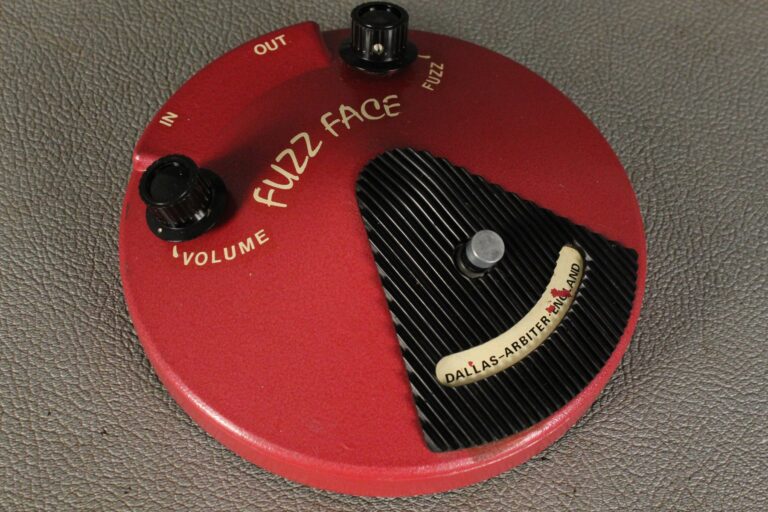
The Dunlop JH-F1 gives you one fuzz, executed to a period-correct hand-wired standard in a circular chassis, with more of the raw, uncooperative character of the original. The Monterey gives you a smoother, more consistent silicon fuzz plus four other effects. If the fuzz itself is the point, buy the dedicated pedal. If the fuzz is one ingredient in a Sixties palette, the Monterey is better value and takes a quarter of the space.
Versus a Uni-Vibe Clone Plus a Rotary Pedal
Dedicated vibe pedals go deeper — more control over throb shape, wet/dry balance and stereo output. Dedicated rotary units model horn and drum speeds independently and often add microphone-distance parameters. The Monterey’s versions of both are, by reviewer consensus, convincing rather than exhaustive. What you gain is that they share a footswitch, an enclosure and a power connection, and that you can move between them with a toggle rather than a tap dance.
Versus a Modern Multi-Effect
A Boss GX-100 or similar will produce all five of these effects and two hundred more, with presets and MIDI. What it will not give you is a hand-built analogue silicon fuzz with real transistors in it, or the immediacy of one knob per function. The Monterey is deliberately not a preset machine — every sound is a physical knob position, which is a limitation on stage and a virtue in a writing room.
Versus the Rest of the Keeley Catalogue
Within Keeley’s own line, the Monterey is the outlier — the most ambitious, most feature-dense and least focused pedal the company has made. Against the single-purpose precision of the Compressor Plus, the Katana Clean Boost or the 1962X Overdrive, it is a sprawling thing. It is also the one that most obviously bears Robert Keeley’s fingerprints as a designer who likes putting two ideas in one box and adding an order switch.
Versus the Monterey 69
In July 2024, Keeley released the Monterey 69 Rotary Fuzz Vibe Custom Shop Edition — fifty units, $199, explicitly described by the company as “our heartfelt goodbye to the iconic current-gen Monterey pedal.” It swapped the original two-transistor fuzz for Keeley’s Blacktop Fuzz circuit, which the company characterised as trimming the fat and beefing up the gain for “a wider, fully articulated fuzz signal,” and dressed the enclosure in textured black and grey with black aluminium knobs. The modulation side, expression input and order switch carried over unchanged. Keeley stated it was “limited to just 50 pieces and never to be manufactured again.” Note that Mark Lettieri’s board runs a Custom Shop edition — so the pedal with the strongest professional endorsement is not quite the standard unit most buyers will find used.
Buying Guide
The Monterey is discontinued. Both the standard model and the Monterey 69 now sit in Keeley’s Archive category on the company’s own website, which means new old stock and the used market are your only routes in.
Pricing as of September 2026 is a genuinely odd picture. Gear-tracking aggregators show the pedal at seven retailers spanning roughly $226 to $349, with Sweetwater still listing at the original $299 street price. That is a discontinued pedal trading at, above and below its launch price simultaneously — which usually indicates thin remaining stock rather than a settled collector premium. If you find one at or below $250 in good condition, that is a fair deal. Above $300 you are paying a scarcity tax on a pedal that has not yet established itself as a genuine collectible.
What to Check on a Used Unit
- The expression jack. This is the feature that unlocks perhaps a third of the pedal’s value, and it is the connector most likely to have been abused. Test it with an actual expression pedal before buying, not just by looking at it.
- The internal order switch. It lives inside the enclosure behind the backplate. Confirm the previous owner has not lost the screws or stripped the plate, and confirm the switch actually toggles the order rather than sitting mid-position.
- The three-position mode toggle. A worn toggle that will not sit reliably in the centre position costs you the entire Vibe mode.
- The finish. The psychedelic artwork is the whole visual identity, and heavily gigged units show pick-guard-style wear around the footswitches. Cosmetic, but it affects resale.
- Which version. Standard Monterey and Monterey 69 look completely different — swirled colour versus two-tone black and grey — so misidentification is unlikely, but confirm which fuzz circuit you are buying, because they are not the same.
Who Should Buy One
The Monterey makes most sense for three players. First, anyone building a small board around Sixties and early-Seventies tones who wants breadth without a five-pedal chain. Second, session and studio players who need convincing period colour on demand — Lettieri’s endorsement is exactly this use case. Third, players who already own an expression pedal and will actually use it, because the Monterey without expression control is a meaningfully smaller pedal than the Monterey with it.
It makes least sense for a player who wants one perfect fuzz, or one perfect vibe. In both categories there are dedicated pedals that go deeper. The Monterey’s proposition is coverage, and coverage is only valuable if you use the range.
Living With It
Power. 9V DC centre-negative at 100 mA, no battery option. That draw is above what some older daisy-chain supplies deliver cleanly per output, so give it an isolated 100 mA or better output. Underpowering a pedal with a DSP section produces intermittent digital misbehaviour rather than an honest failure, which makes it hard to diagnose.
Board placement. Standard position is early in the chain, immediately after tuner and wah, before time-based effects. Because the fuzz is silicon rather than germanium, it is far less fussy than a germanium Fuzz Face about what sits in front of it — Keeley specifically notes it “works well with a buffer,” which is the opposite of the usual fuzz advice and a direct consequence of the transistor choice.
The order switch is not set-and-forget. Fuzz into modulation is the conventional, historically correct arrangement and produces the cleaner result. Modulation into fuzz compresses the modulation’s dynamics and produces something more chaotic and more aggressive — Keeley’s own copy calls it “alien amplitudes of gain and fuzz.” It is a genuinely different pedal in the two positions. Open the back and try it before deciding.
Expression pedal choice. Any standard TRS expression pedal works; Keeley recommended an inexpensive M-Audio unit. Note that the expression pedal replaces the Rate knob rather than supplementing it, so in Rotary and Vibe modes you lose the knob’s function while it is connected.
Independent switching. The two footswitches are fully independent, which means four states: bypass, fuzz only, modulation only, both. That is more useful live than it sounds. Modulation-only on a clean amp for verses, both engaged for the solo, and the fuzz’s own Level knob acting as a solo boost.
Frequently Asked Questions
Did Jimi Hendrix ever use a Keeley Monterey?
No. Hendrix died in September 1970 and the Monterey was announced in March 2016. The pedal is named for the 1967 Monterey International Pop Festival and its artwork references the Stratocaster Hendrix burned there, but there is no connection beyond homage. The sounds it targets are ones Hendrix made with separate vintage units — a Fuzz Face, a Uni-Vibe, a Vox wah and an Octavia.
Is the Keeley Monterey still in production?
No. Both the standard Monterey and the limited Monterey 69 are filed under Archive on Keeley’s own website. The Monterey 69 was a fifty-unit farewell run that shipped in July 2024, and Keeley described the pedal at that point as “never to be manufactured again.” Available stock is new old stock or used.
Does the fuzz use germanium transistors?
No — silicon, specifically vintage Fairchild Semiconductor devices from the 1960s. Keeley chose silicon deliberately to avoid the temperature instability of germanium, at the cost of some of germanium’s softness. The result was described by reviewers as sitting between the two, with silicon consistency and a degree of germanium-like warmth.
Can I use the modulation section without the fuzz?
Yes. The two channels have independent footswitches and either can be used alone. Many owners run the pedal primarily as a vibe and rotary unit and engage the fuzz only occasionally.
Do I need an expression pedal to get full use of it?
Not strictly, but you lose a great deal without one. The expression jack turns the fixed wah into a real sweepable wah, and gives you Leslie-style speed ramping in Rotary and Vibe modes rather than a fixed rate. If you already own an expression pedal, connect it. If you do not, budget for one — it changes the pedal’s character substantially.
What does the Octave knob do in Rotary mode?
Nothing octave-related. In “Les Rotary” the Octave control balances the volume of the simulated upper horn against the lower drum, functioning as a brightness or voicing control for the cabinet simulation. The actual pitch-shifted octave up and down is only available in Vibe and Wah modes.
What is the difference between the Monterey and the Monterey 69?
The fuzz circuit and the cosmetics. The Monterey 69 replaced the original two-transistor Fairchild-based fuzz with Keeley’s Blacktop Fuzz circuit for higher gain and, per the company, “a wider, fully articulated fuzz signal,” and wore a textured black and grey finish with black aluminium knobs instead of the psychedelic paintwork. The modulation section, expression input and order switch are unchanged. Only fifty units were made.
Is the Monterey true bypass?
Yes. Keeley’s press release described the units as “hand-made and true bypass.” That means no tone loading when disengaged and no buffering, so a long cable run into the pedal will cost high end.
Which guitarists actually use one?
The best-documented user is Mark Lettieri of Snarky Puppy and the Fearless Flyers, who runs a Custom Shop Monterey first in his chain, verified in Premier Guitar’s pedalboard coverage and rig rundown footage. Ally Venable and Mariah Schneider have both been photographed with one on their boards. Chris Turpin of Ida Mae and Nancy Wilson of Heart have both given Keeley first-person statements about the pedal. Several other names circulate on the strength of Keeley artist-page listings alone and should be treated as unverified.
Can I use it with a Les Paul or humbuckers?
Yes — Keeley states explicitly that the fuzz “plays well in any position on a Strat or Les Paul style guitar,” and Legendary Tones tested it with both a 1974 Strat and a korina Flying V-style guitar. Humbuckers will push the fuzz harder and darker; expect to use less Fuzz knob and to lean on the hidden static-cabinet voicing trick to recover top end.
The Verdict
The Keeley Monterey is a rare thing: a themed pedal that turned out to be more useful than its theme. The paint job and the name sell a Hendrix fantasy, and the pedal delivers on that fantasy competently — but the reason it earned a place on Mark Lettieri’s funk board and in Chris Turpin’s roots-rock rig is that the individual effects inside it are good on their own terms. The harmonic tremolo is a genuinely original sound. The vibe is the best thing in the box. The static cabinet-voicing trick solves a problem the fuzz section would otherwise have.
Its weaknesses are real and were identified accurately at launch: no tone control on the fuzz, and a knob-per-function layout with no presets, which on a dark stage means you commit to your settings before the downbeat. Those are the costs of the format.
Now that it is discontinued, the calculation shifts. A pedal that was a reasonable $299 proposition in 2016 against five separate purchases is, in 2026, a used-market item at variable prices with no warranty and no more coming. If the Sixties palette is central to what you play and one enclosure appeals more than five, it remains an excellent buy at the right price. If you want one perfect fuzz or one perfect vibe, the money goes further elsewhere.
Either way, the thing worth remembering is that Hendrix never needed any of this. He had a Fuzz Face, a Vibe, a wah and a burning Stratocaster. Keeley’s achievement was making all of that fit on a pedalboard — and then quietly including a harmonic tremolo that nobody at Monterey in 1967 had ever heard.
Image credits
- A display of Keeley pedals on a board: ArtBrom from Seattle, Wikimedia Commons, CC BY-SA 2.0.
- Two Keeley compressor pedals: ArtBrom from Seattle, Wikimedia Commons, CC BY-SA 2.0.
- Robin Trower: Sardognunu, Wikimedia Commons, CC BY-SA 3.0.
- Top image: GuitarGangsters AI-generated reference illustration, not a photograph.
- Dallas Arbiter Fuzz Face: sploshette, Wikimedia Commons, CC BY 2.0.
Latest News
Related
On This Day
Monday 9 November
From this week: