Nobels ODR-1 BC: The Nashville Secret, Now With Teeth
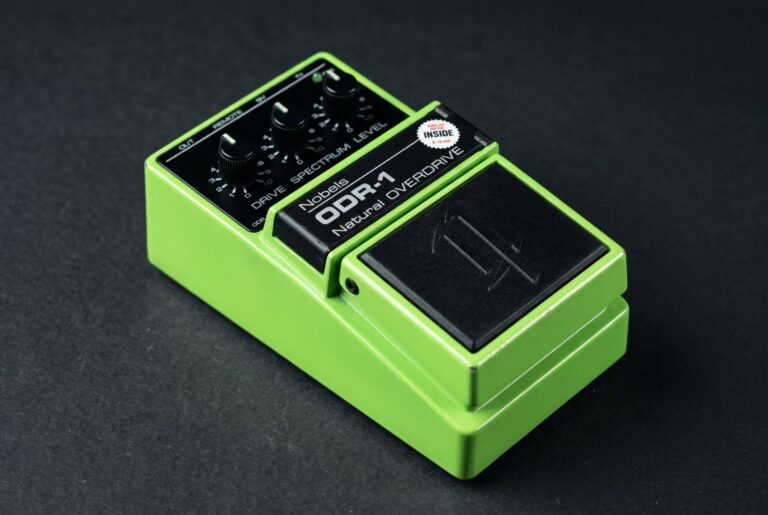
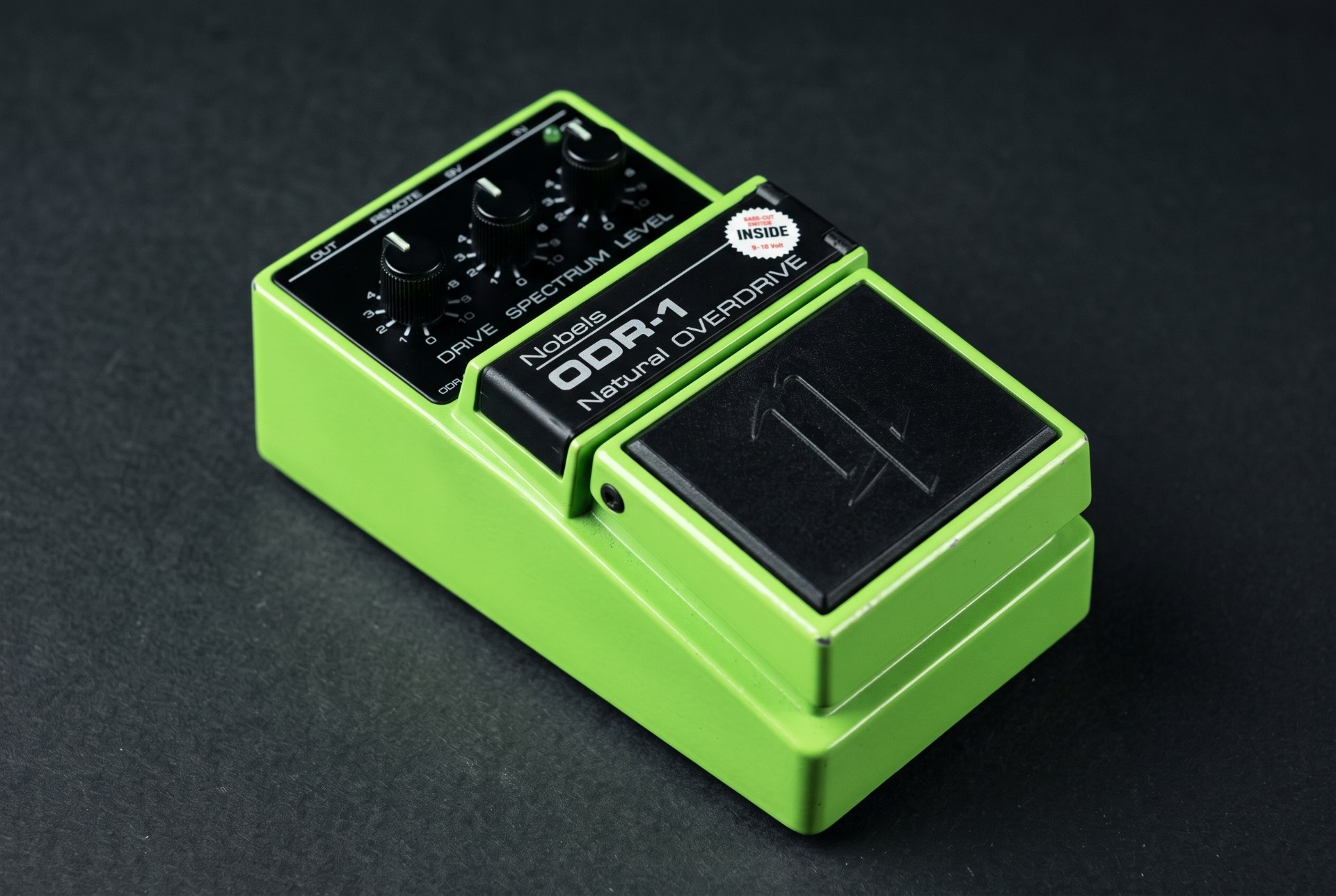
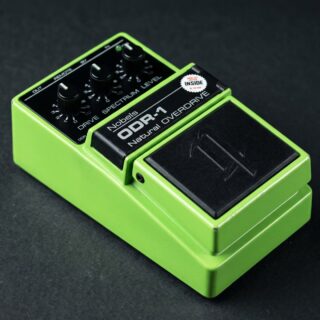
An AI-generated illustration of the Nobels ODR-1 BC.
Nobels ODR-1 BC explained: what the bass cut really does, Spectrum decoded, verified players, 18V tricks, ODR-1X comparison and honest buying advice.
Two letters. That is the entire difference between the pedal that spent twenty-seven years being whispered about in Music Row control rooms and the pedal you can buy today for a hundred and nineteen dollars. Two letters, stamped after the model number, standing for a feature you cannot even see without unscrewing something.
BC. Bass cut. And behind those two letters sits one of the more interesting small stories in overdrive: a German company, run by a Hamburg businessman who used to sell Fender parts to eighteen hundred shops, quietly listening to a very specific complaint from a very specific group of guitar players — humbucker guys, mostly, who loved the pedal and wished it had less mud underneath it — and then doing something about it without redesigning the thing everyone already loved.
That restraint is the whole point of this article. The ODR-1 BC is not a reinvention. It is a 1992 circuit with a switch added, a voltage range widened, and glow-in-the-dark paint on the knob pointers. It is also, importantly, the version most working guitarists now actually own, because since early 2020 it has simply been the ODR-1. If you walked into a store any time in the last several years and bought “a Nobels,” you bought a BC.
This is not a review. This is a field guide: what the two letters do, what the marketing gets wrong, which famous players are genuinely documented on this circuit and which claims fall apart when you check them, how to dial it, and — the part most buying guides skip entirely — whether the newer ODR-1X has already made this one obsolete.
What “BC” Actually Means, and Why the Name Confuses Everyone
You will see this pedal written five different ways: ODR-1 BC, ODR-1(bc), ODR-1BC, ODR-1 bc, and simply “the new ODR-1.” Nobels themselves use the parenthetical lower-case form on some materials and the spaced capitals on others. Retailers pick whichever they feel like. None of them are wrong, exactly, and all of them refer to the same box.
What they refer to is the ODR-1 as revised for 2020. Nobels did not launch the BC as a separate model sitting alongside a continuing “classic” ODR-1. They revised the ODR-1 and appended the letters to the name so that the trade would know which one they were getting. That is a small distinction with a big practical consequence, and it is worth stating plainly because a great many articles get it wrong:
The ODR-1 BC is not a variant of the ODR-1. It is the ODR-1. Every non-BC ODR-1 on the market is a used or new-old-stock unit built before the revision. If you are comparing “the BC versus the regular one,” what you are actually comparing is 2020-and-later production against pre-2020 production.
This also means the BC inherits the entire history, mythology and Nashville reputation of the full-size Nobels ODR-1 wholesale — while, as we will see in the players section, inheriting almost none of the specific documented artist sightings, because most of those sightings are of older units.
Where the Circuit Came From: Hamburg, a Bassman, and a Grudge Against the Mid-Hump
The ODR-1 exists because one engineer did not like the way the most popular overdrive pedal in the world sounded.
Kurzke and Tachibana
Nobels is the company Bernhard Kurzke built. A Hamburg businessman with an MBA from the University of Hamburg, he took over a one-man guitar operation in 1977 and grew it into “No1 in American Guitars,” a shop whose customers included the Rolling Stones and the Scorpions. In 1979 CBS-USA made him the exclusive Fender, Rogers and Rhodes parts distributor to eighteen hundred German retailers. In 1983 he founded an import business that by 1985 had been renamed NOBELS, with a design team of eight people building effects, multi-effects, MIDI foot controllers and a range of small utility boxes.
The engineering half of that partnership was Kai Tachibana, and Tachibana is the reason the ODR-1 sounds the way it does. As Guitarist‘s Trevor Curwen put it in his review of this very pedal, the ODR-1 came about because Tachibana “was not keen on the fact that the Ibanez and other overdrives featured a strong middle hump.” He was not chasing a boutique aesthetic or a vintage revival. He had a specific reference amp in his head — a bluesy-sounding 40-watt black-panel Fender Bassman — and he wanted a pedal that behaved like it.
The design brief, in Curwen’s summary: a drive pedal that reacted to the volume pot on the guitar, “where the overdrive increased slowly and evenly without changing the basic tonal character.” That is a functional specification, not a marketing slogan, and the finished pedal delivers on it to an unusual degree.
Nashville Adopts an Orphan
The pedal is generally dated to 1992. For most of the next two decades it did essentially nothing commercially notable in the English-speaking world. It was a green box from a German company nobody had heard of, sitting in a market that had already decided which green box mattered.
Then Nashville found it. Premier Guitar credits one man in particular: session veteran Tom Bukovac, known to his enormous online following as “Uncle Larry,” who “almost singlehandedly” popularised the ODR-1 among his Nashville friends and collaborators. Robert Keeley — who would later build a pedal around the circuit — describes the phenomenon geographically: “There’s a constituency in Nashville, Brentwood, and Franklin that really loves this pedal. They’re all friends and they’re damn near family, and this pedal works so well with their music.”
That is the reputation the BC inherited in 2020: a cult overdrive with roughly zero mainstream advertising and a devoted, professionally credible user base concentrated in about three zip codes.
What Actually Changed in 2020
Nobels made four changes. None of them touch the core voicing.
1. The bass cut
The headline feature, and the one that gave the pedal its letters. Nobels added a small slide switch on the circuit board, accessed through the hinged top-loading battery compartment lid. The owner’s manual is specific about the labelling that no review mentions: the “+” position is a normal ODR-1, and the “−” position is the one that attenuates the bottom end. Note also that it is a slide switch, not a DIP switch — Guitarist called it a DIP and most retailer copy repeated that, but Nobels’ own documentation says Schiebeschalter, a slider, sitting directly under the battery on the left. Flip it one way and you get the original ODR-1 response. Flip it the other and a slice of sub-bass disappears.
The reason it exists is a genuine customer-feedback story rather than a marketing invention: humbucker players kept telling Nobels the bottom end was too heavy. This is a real and predictable consequence of the design. The ODR-1’s whole selling proposition is that it does not scoop the lows the way a Tube Screamer does. That is exactly what makes it sound huge under a Telecaster and exactly what makes it sound like a wet blanket under a Les Paul into a dark amp.
2. 18-volt operation
The revised pedal accepts 9V to 18V DC. More voltage means more headroom, less compression, a wider dynamic window and a slightly stiffer feel under the pick. This is the single most underrated feature on the pedal and we will come back to it in the settings section.
3. Glow-in-the-dark knob pointers
Sounds like a gimmick. Is not a gimmick. GitD pointers mean you can see where your Drive and Spectrum are set on a dark stage or in a dim tracking room, which is precisely the working environment this pedal lives in.
4. Mounty-P mounting plates
Four preinstalled mounting plates for pedalboard attachment. A small, practical, session-player-brained inclusion.
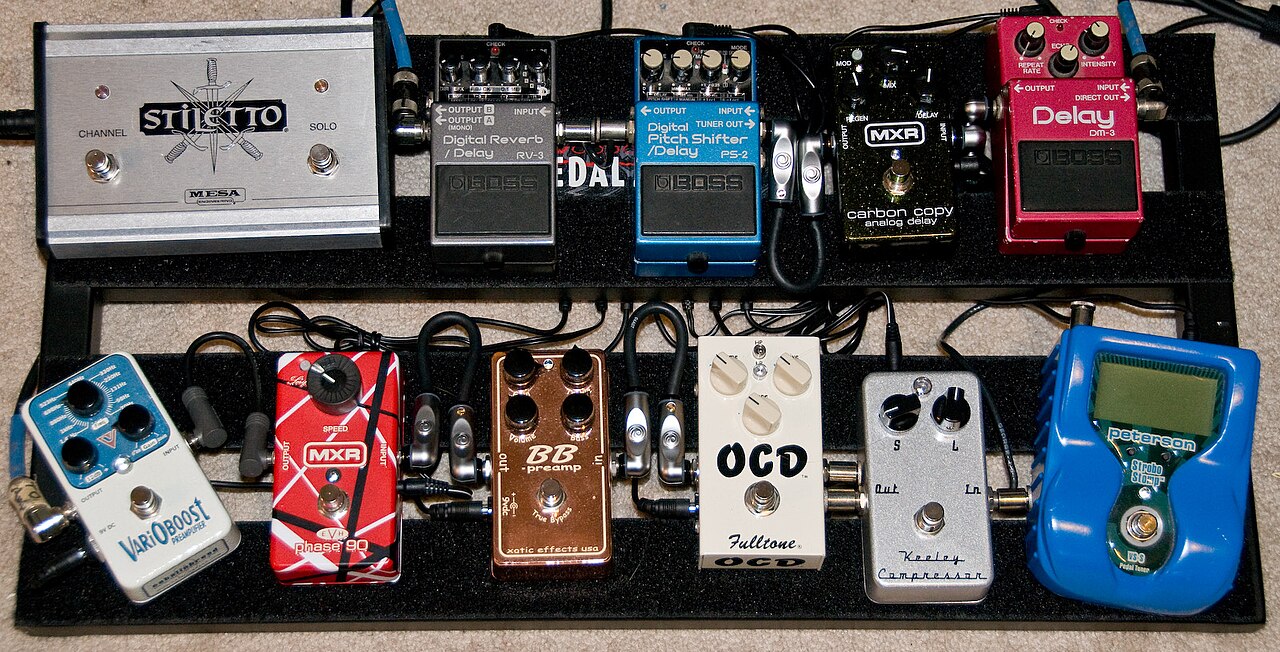
There is also a feature that predates the BC but deserves more attention than it gets: the remote jack. The ODR-1 BC can be switched on and off remotely via Nobels’ own MF-2 or MS-4 controllers, which makes it viable inside a switched rack or a hybrid loop-based board rather than only as a stomp-on-the-floor pedal.
Specifications
| Specification | Nobels ODR-1 BC |
|---|---|
| Type | Analogue overdrive pedal |
| Circuit lineage | Nobels ODR-1, designed by Kai Tachibana 1992, released 1993 |
| Revision introduced | 2020 — Thomann catalogue entry dated February 2020; reviewed by Guitarist October 2020 |
| Origin | Designed in Hamburg, Germany; manufactured in China |
| Controls | Drive, Spectrum, Level, internal bass-cut slide switch (“+” normal / “−” cut), bypass footswitch |
| Bass cut | Slide switch on circuit board, directly under the battery (left), accessed via hinged battery-compartment lid |
| Bypass | Buffered bypass — confirmed by Nobels’ own knowledge base; widely misreported as true bypass |
| Connections | Standard input, standard output, Remote jack (works with Nobels MF-2 / MS-4) |
| Power | 9V battery or regulated 9V–18V DC adaptor (not supplied), max. 11mA, 2.1mm centre-negative |
| Input / output impedance | Approx. 1 MΩ in, approx. 2.2 kΩ out; max. input level +6 dB |
| Weight | 450 g without battery |
| Extras | Glow-in-the-dark knob pointers, integral pedalboard mounting plates, metal chassis |
| Dimensions | 74 (w) x 126 (d) x 58mm (h) |
| Launch price | $119 / £99 |
| Typical street price (2026) | Around $95–119 new; roughly $85–100 used |
The dimensions are worth registering: this is a Boss-compact-sized enclosure, near enough. Curwen noted the ODR-1’s form factor is “not dissimilar to a Boss pedal,” which is both a compliment about build and a warning about pedalboard real estate. If space is your constraint, the ODR-mini exists for exactly that reason.
The Spectrum Control: The Reason This Pedal Is Not a Tube Screamer
Every conversation about the ODR-1 eventually arrives at the middle knob, and most of them describe it incorrectly.
Spectrum is not a tone knob in the ordinary sense. A Tube Screamer‘s tone control is a simple low-pass filter — turn it down, lose treble — and that filter working alongside the circuit’s bandpass character is what produces the famous midrange hump. Spectrum is a double filter that cuts and boosts lower mids and treble simultaneously, leaving the core midrange alone.
Curwen’s description in Guitarist is the cleanest one in print: the Spectrum knob “simultaneously adjusts treble and lower mids to add crispness to the clarity or to mellow things down.” Robert Keeley, who reverse-engineered the circuit for his Noble Screamer, puts it in engineering terms: “The Noble Screamer’s ODR tone control is a spectrum control, and it moves up the bass and the treble at the same time. The Tube Screamer is a simple low-pass filter that helps create the midrange hump.”
Practically, this means:
- Spectrum below noon — warm, thick, mid-focused, the bass and treble pulled back together. Good for cutting through a dense mix without brightness.
- Spectrum around noon to 4-ish — the closest thing to flat. This is where most Nashville settings live.
- Spectrum above noon and climbing — added bass and added treble, an open, hi-fi, almost scooped-feeling response that sounds enormous on a bright single-coil guitar and gets muddy fast on humbuckers.
That last bullet is exactly why the bass cut had to be invented. Spectrum giveth low end at the same time as it giveth top end, and there is no way to separate them. The BC’s slide switch is the separation mechanism.
The Bass Cut: What It Does, and What the Reviewers Actually Said
Here is where an honest article has to depart from the marketing copy.
The bass cut works. Curwen calls it “a very effective tonal tweak, tightening up the real low-end for those who want it.” That is a genuine endorsement of the function.
But the same review continues: “we preferred the standard sound with its full-bodied warmth.” Guitarist tried the feature, confirmed it does what Nobels says, and then set it back to off and left it there. That is not a criticism of the pedal — the review’s Cons section reads, in full, “None” — but it is a very useful piece of information for a buyer. The bass cut is a fix for a specific problem, not an improvement everyone should engage.
Engage the bass cut if:
- You play humbuckers into a dark or bass-heavy amp and the ODR-1 pushes it over the edge into flub.
- You are stacking the ODR-1 with another drive and the low end is stacking too.
- You are recording and the engineer wants the guitar out of the bass guitar’s way.
- You use Spectrum past noon habitually and want the treble lift without the accompanying low-end lift.
Leave it off if:
- You play a Telecaster, a Strat, or anything else with single coils. The low-end body is the point.
- You are chasing the classic Nashville ODR-1 sound. That sound is the bass-cut-off sound.
- You run into a bright amp — a blackface Fender, an AC-style circuit, a clean Pro Junior-type box — where the extra bottom is doing structural work.
Owners are split in a way that is worth reporting, because it tells you how big the effect actually is. One Thomann reviewer was unconvinced by the pedal until he flipped the switch — “at first I wasn’t completely sure because it was a bit muddy, but once I used the BC internal switch I was convinced,” adding that it “gives a much better degree of clarity, especially when stacked with other drive/distortion pedals.” Another, writing a few months later, reached the opposite conclusion: “the basscut switch inside is a cool feature but does not make that big of a difference I think.” A third turned it on, listened, and turned it back off “to keep my guitars from sounding too thin.” Aggregated forum discussion adds a fourth camp: a minority who find the pedal too bassy even with the cut engaged, particularly on neck pickups. Across 160 Thomann ratings the pedal still averages 4.8 out of 5, so none of this is a warning — but it does mean you should not buy the BC for the switch expecting a transformation. It is a trim, not a tone stack.
The one legitimate complaint about the implementation is ergonomic rather than sonic: it is inside the pedal. You cannot reach it mid-set, you cannot use it as a per-song adjustment, and it is a two-position switch rather than a sweep. Nobels evidently agreed, because the fix appeared five years later.
Famous Players: An Honest Accounting
This is the section where most gear articles lie by omission, so let us be precise about what kind of evidence exists.
Independently documented ODR-1 users
Tom Bukovac is the single most important name in this pedal’s history and the evidence is solid. Premier Guitar‘s Rig Rundown with him documents a rehoused Nobels ODR-1 in a gain section alongside a Vertex boost, an Analog Man King of Tone, an old ProCo Rat, a Greer Lightspeed and a Spontaneous Audio Son of Kong. Premier Guitar also credits him, by name, with popularising the pedal in Nashville. Note the word “rehoused” — Bukovac’s is not a stock BC.
Guthrie Trapp is the second pillar. His Premier Guitar Rig Rundown places an ODR-1 in his signal chain after his boost pedal, and he appears on camera A/B-ing the Keeley Noble Screamer against a vintage ODR-1, saying of the comparison: “we’re sitting here and can hardly tell the difference.” Again, note “vintage.”
Tim Pierce is named by Guitarist as one of the players for whom the ODR-1 is “currently the go-to pedal” in the Nashville session scene, alongside Trapp. Pierce is an LA session player rather than a Nashville resident, which tells you how far the pedal’s reputation travelled.
The honest caveat
Every one of those documented sightings is of an ODR-1, and in at least two cases explicitly of an older or modified one. There is, at the time of writing, no widely documented case of a marquee player specifically endorsing the BC revision as opposed to the circuit in general. Equipboard’s page for the ODR-1 BC lists community setups but no verified artist roster, while its page for the plain ODR-1 lists dozens.
This is not a scandal. It is what you would expect: professionals who found the pedal in 2005 are still playing the one they found in 2005. But it means any list that presents Bukovac, Trapp and Pierce as “ODR-1 BC players” is doing something slightly dishonest, and you should treat the connection as circuit-level rather than SKU-level.
Names to be careful with
Nobels’ own artist references page carries a long roster, and Bernhard Kurzke’s company history names players who used Nobels products over the years — including Gary Moore. That is manufacturer-supplied evidence, which is a real but weaker class of information, and in Moore’s case the timing rules out this specific pedal entirely: he died in February 2011, eight years before the BC existed. Any Moore association can only refer to earlier Nobels gear. The same logic disqualifies the BC for every player whose active career ended before 2020, no matter how enthusiastically a retailer’s copy links them to “the ODR-1.”
Country and session names frequently attached to the ODR-1 in forum lore — Brad Paisley, Keith Urban, Vince Gill, Brent Mason — should be treated the same way: plausible given the Nashville concentration, but requiring per-player photographic or interview confirmation before you repeat them, and in no case confirmable as BC-specific.
The Keeley Detour: When a Cult Pedal Gets Cloned by Name
In 2023, Robert Keeley did something that had not happened to the ODR-1 before: he put it in a mass-market pedal and said so out loud.
The Keeley Noble Screamer houses two circuits — a TS808 voicing and an ODR-1 voicing — with the ability to cross-wire them, pairing the Tube Screamer’s clipping with the ODR’s Spectrum tone stack, or vice versa. Four pedals in one box, and a de facto tutorial in what actually distinguishes the two most important green overdrives.
Keeley was open about the stakes. “We carefully compared this to some great examples of 808s and ODRs — using audio analyzers, too — and then we took it to Nashville and asked veteran players to compare it to the original units.” Bukovac’s verdict on camera: “They sound pretty similar. The guitar tone sounds great.” Trapp’s, as quoted above, was that he could hardly tell the difference — and he pointed out the economic subtext: “to not have to spend $1,500 or $2,000 on a pedal.”
That number is worth pausing on. Trapp is talking about the collector market for vintage silver-knob ODR-1s, which by the early 2020s had gone somewhere absurd. Meanwhile Nobels was selling a brand-new ODR-1 BC, same circuit family, for $119. The cult had inflated the old ones so hard that people were paying more than ten times the price of the current-production pedal for an earlier revision of it.
Keeley’s own catalogue is worth exploring on this axis, incidentally — the D&M Drive and the 1962X come at amp-like drive from other angles entirely.
Tone Recipes: Six Settings That Actually Work
1. The Nashville Default
Drive 8 o’clock · Spectrum 12 · Level 1 o’clock · Bass cut OFF
This is the setting the pedal’s whole reputation rests on. Barely any gain — just enough to thicken the attack and add a low-level crunch to a clean amp. Level pushed above unity so the pedal works as a core-tone enhancer and a solo lift at the same time. Curwen singled out this territory: “we liked the magic that happens in the lower reaches of the drive knob where you find early break-up and low-level crunch that can add just the right amount of grit to a clean amp for core tone or as a solo booster.”
2. Telecaster Into a Blackface
Drive 10 o’clock · Spectrum 2 o’clock · Level 12 · Bass cut OFF
Spectrum past noon brings up bass and treble together, which is precisely what a bright single-coil guitar into a bright amp wants. Guitarist found both the full-size and the mini “work really well with a Telecaster; they are a perfect complement to a Fender amp if you play country.” Roll your guitar volume back to 7 and the whole thing cleans up without changing character — that is the Tachibana design brief working as intended.
3. Humbucker Rock, Tightened
Drive 1 o’clock · Spectrum 1 o’clock · Level 11 o’clock · Bass cut ON
The reason the BC exists. A Les Paul into a mid-gain amp with the ODR-1 wide open can turn to soup; the slide switch clears the sub-bass and lets the Spectrum-boosted treble do its job. If it still feels loose, drop Spectrum to noon before you touch Drive.
4. 18-Volt Clean Push
Drive minimum · Spectrum 11 o’clock · Level 3 o’clock · 18V supply · Bass cut OFF
Drive off, Level way up, higher rail voltage. You get a clean boost with a gentle EQ tilt and considerably more headroom than the same setting at 9V. Curwen confirmed the equivalent on the ODR-1X: “Keeping the Drive control at minimum and pushing the Level to somewhere in its final quadrant delivers a useful clean boost.” Use it in front of an amp that is already breaking up, or as an always-on tone-thickener.
5. The Stack
ODR-1 BC: Drive 9 o’clock · Spectrum 12 · Level 2 o’clock · Bass cut ON
With the ODR-1 first in the chain as a low-gain foundation and something midrange-forward after it — a TS808, a Tumnus, an EP Booster — engage the bass cut so the two pedals are not both adding bottom. Stacking is where the BC switch pays for itself most reliably.
6. Filthy, Because You Can
Drive maximum · Spectrum 10 o’clock · Level 11 o’clock · Bass cut ON
Not what the pedal is famous for, and the review consensus is that it is “capable of a fully driven sound” without that being its best trick. Players report the ODR-1 at full gain producing surprisingly heavy, round, un-fizzy distortion — more musical than most high-gain amp channels at low volume. Pull Spectrum back to keep it from getting shrill and let the bass cut stop it from getting woolly.
Knob positions given on a clock face. Bass cut noted per recipe. All assume a reasonably clean amp; the ODR-1 is not a pedal you feed into an already-saturated channel unless you enjoy chaos.
How It Compares
ODR-1 BC vs the ODR-mini
The mini is the same voice in a smaller box for roughly two-thirds the price. Guitarist ran the A/B: with the mini’s Spectrum knob in its centre detent, the sound matches the full-size pedal (bass cut disengaged) with the big one’s Spectrum at about 4. Both cover the same tonal range and both clean up identically with guitar volume. What the mini loses: the bass cut, the remote jack, the battery option, and roughly 20mm in every dimension of pedalboard presence. What it gains: a centre detent on Spectrum, which is genuinely useful, and a lower price. Full comparison in our ODR-mini feature.
ODR-1 BC vs the ODR-1X
This is the comparison that matters most in 2026, because the ODR-1X is the newer pedal and it directly addresses the BC’s one real weakness.
The ODR-1X, reviewed by Guitarist in November 2025, takes the bass cut out of the battery compartment and puts it on a mini knob on the face of the pedal — a continuous low-end sweep instead of a two-position switch. It adds a Gain Boost offering up to 27dB of extra gain, selectable true or buffered bypass, and a remote footswitch that can trigger the boost as well as bypass. Price: $149 / £129.
Curwen’s verdict on the variable control is unambiguous: the ability to roll bass off “to your exact needs is a very practical asset and a distinct upgrade on a purely switched bass-cut.” His only reservation was the boost, which he found “may be too much of a jump as a footswitched boost.”
So: if the bass-cut function is why you are interested in this pedal at all, the X is the better instrument and the thirty-dollar difference is money well spent. If you want the ODR-1 sound and expect to set the bass cut once and forget it — which is what most owners do — the BC is the cheaper route to the same core tone, and it is the version with the Boss-compact footprint and the simpler face.
ODR-1 BC vs Tube Screamer
The foundational comparison, and the one the circuit was designed as a rebuttal to. A TS808 or TS9 rolls off bass, humps the mids and slightly attenuates the top — a shape purpose-built for pushing an amp into focused sustain. The ODR-1 does none of those things. It leaves the mids where they are, keeps the low end, and lets Spectrum tilt bass and treble together. If the Tube Screamer is a lens, the ODR-1 is a window. Neither is better; they are answers to different questions. The Noble Screamer exists precisely so you can hear the difference in one enclosure.
ODR-1 BC vs the transparent-overdrive field
Against the Klon Centaur lineage: the Klon and its descendants add a treble-forward, clean-blended lift with a hard mid-and-treble emphasis; the ODR-1 is broader and warmer and considerably cheaper. Against the Timmy: the Timmy’s independent bass and treble cuts give you finer EQ surgery, while the ODR-1’s single Spectrum knob is faster to use and harder to get lost in. Against the King of Tone: the KoT is the gold standard for amp-like transparency and comes with a multi-year waiting list and a price to match; the ODR-1 BC is available this afternoon for $119. Against the Boss BD-2: the BD-2 is spikier, more compressed and more aggressive in the upper mids; the ODR-1 is rounder and more amp-like. Against the Fulltone OCD: the OCD goes much further into distortion territory and has a harder-edged clipping character.
Buying Guide
New
List is $119 / £99, and that number has been remarkably stable: Guitarist quoted $119 in October 2020 and Sweetwater still lists $119 in 2026, which for a pedal that has lived through five years of component-cost inflation is a small quiet compliment to Nobels’ pricing. Thomann has carried it since February 2020 (item 486304) at $95, currently sitting around number 72 in their distortion-pedal sales rank with a 4.8-out-of-5 average across 160 ratings — 139 of them five stars. Aggregators track street prices from roughly $89 to $119. Real-world 2026 pricing therefore sits in the $95–119 range depending on retailer, with European pricing around £99 and Thomann frequently the cheapest route in the EU. This is one of the few pedals where the used market barely undercuts new — expect roughly $85–100 for a clean secondhand example, which is a small enough saving that the warranty is usually worth the difference.
How to tell a BC from a non-BC before you pay
This matters on the used market and almost nobody mentions it: the enclosure does not say “BC” anywhere. The faceplate says ODR-1 Natural Overdrive, exactly as it did in 1993. Nobels’ own owner’s manual for the revision is titled simply “ODR-1” — the letters live in the catalogue, not on the pedal. The manuals page is the clearest statement of the split, listing three ODR-1 documents: first series (1993), “No Bass Cut (pre 2020)” and “With Bass Cut (from 2020).”
So there are exactly two reliable tests, and both take about ten seconds. Open the top-loading battery door and look directly under the battery, on the left: a BC has a small slide switch there, a pre-2020 unit has bare board. Or look at the knob pointers under low light — the BC’s are glow-in-the-dark, the older ones are printed paint. If a seller’s photos show neither, ask for a shot of the open battery compartment before you buy, because a listing that says “ODR-1 BC” over a photo of a pre-2020 pedal is more likely to be carelessness than fraud, and either way you are the one who ends up without the switch.
Used, and the vintage question
Pre-2020 ODR-1s come in several flavours, and the earliest Korean-built silver-knob units have become genuine collector items. Prices in the four figures have been recorded and Guthrie Trapp’s “$1,500 or $2,000” figure is not hyperbole.
Our honest read: pay it only if you want the object. The tonal delta between a vintage silver-knob and a current BC is smaller than the price delta by an enormous margin — which is the entire premise of the Noble Screamer’s existence and the reason two of the most respected players in Nashville went on camera saying they could hardly tell a well-made clone from the original. If you want the ODR-1 sound, buy the current one and spend the remaining $1,400 on an amp.
Which version should you actually buy?
- Want the classic sound, standard pedal size, lowest price: ODR-1 BC.
- Want a real, usable, adjustable bass cut: ODR-1X.
- Short on board space and don’t need the bass cut: ODR-mini or its successor the ODR-mini2.
- Want the ODR voice plus a Tube Screamer in one box, made in the USA: Keeley Noble Screamer.
Ownership Notes
Power it properly
Current draw is a modest 11mA, so any isolated supply will run it. But the 9V–18V range is not a footnote — it is a second voicing. At 18V the pedal is less compressed, more dynamic, and noticeably stiffer under the pick. Many owners never try it because 9V is the default and the pedal sounds good at 9V. Try it. If your supply has an 18V output or a doubler cable, that experiment costs nothing.
The battery compartment is top-loading with a hinged lid, which is genuinely good design and — critically — is also how you reach the bass-cut switch. No screwdriver, no unscrewing the backplate.
Set the bass cut once, deliberately
Because it is internal, treat it as a configuration choice rather than a performance control. Set it with your actual rig, at gig volume, with the guitar you actually use. If you switch between a Strat and a Les Paul mid-set, set it for whichever guitar is causing you problems and adjust Spectrum for the other.
Placement
First or near-first in the drive section. The ODR-1 is designed to interact with your guitar’s volume pot, and burying it behind a compressor or a buffer that flattens dynamics defeats the design. Wah and filters before it; delay, reverb and modulation after.
Bypass: the spec almost everyone gets wrong
This is the single most misreported number on the pedal, so it is worth being blunt about it. The ODR-1 BC is buffered bypass, not true bypass. Guitarist‘s review spec box says “true bypass,” and because that review is the most-cited English-language source on this pedal, the phrase has been copied into the product listings of a long line of otherwise respectable retailers. It is wrong.
Nobels say so themselves, in a knowledge-base article whose title is literally the question: Why does the ODR-1 have a buffered bypass? Their answer is a defence of the choice rather than an apology for it — a buffer “strengthens your tone and drives it through the chain,” and it does that whether the pedal is on or off, which starts to matter once you are running more than about eighteen and a half feet of cable in total. Nobels published a separate article explaining why the ODR-mini, by contrast, is true bypass. Two pedals, two deliberate decisions, both documented on the manufacturer’s own site.
The manual corroborates it without using the word. The OUT jack, it says, “delivers a low impedance output signal best for the input of your amplifier” — roughly 2.2 kΩ out from a roughly 1 MΩ input is a buffer’s job description, not a piece of wire.
The practical consequence is the opposite of what you would conclude from the misprint. If your board is otherwise all true bypass and your top end goes soft over long cable runs, you do not need to go shopping for a buffer: you already own one, and it is the green box. Put the ODR-1 BC early in the chain and it will drive everything downstream of it. Players who object to buffers on principle should note that the ODR-1X exists partly for them — it puts true-or-buffered on an internal switch.
The remote jack
Frequently ignored, occasionally decisive. If you build switching systems, the ability to trigger the ODR-1 BC from a Nobels MF-2 or MS-4 without a physical stomp turns it from a floor pedal into a rack-controllable module.
Frequently Asked Questions
What does “BC” stand for on the Nobels ODR-1 BC?
Bass cut. It refers to a slide switch on the circuit board — reachable through the hinged battery-compartment lid — that attenuates the pedal’s sub-bass content. Nobels added it for the 2020 production run in response to humbucker players who found the ODR-1’s bottom end too heavy.
Is the ODR-1 BC different from the regular ODR-1?
It is the regular ODR-1, as revised for 2020. Nobels did not launch it as a parallel model; they updated the ODR-1 with the bass cut, 9–18V operation, glow-in-the-dark knob pointers and Mounty-P mounting plates, and appended the letters. Any non-BC ODR-1 you find is pre-2020 stock.
Is the bass cut switch worth using?
Situationally. Guitarist called it “a very effective tonal tweak, tightening up the real low-end for those who want it” — and then said they preferred the standard sound with its full-bodied warmth. Use it with humbuckers, into dark amps, or when stacking drives. Leave it off for single coils and for the classic Nashville voicing.
What is the Spectrum knob and how is it different from a tone control?
Spectrum is a double filter that simultaneously cuts or boosts lower mids and treble while leaving the core midrange untouched. A Tube Screamer’s tone control is a simple low-pass filter whose interaction with the circuit produces the famous mid-hump. Turning Spectrum up adds bass and treble together; turning it down warms and thickens.
Does the ODR-1 BC sound better at 18 volts?
Different rather than universally better. 18V gives more headroom, less compression and a stiffer, more dynamic response; 9V is more compressed and slightly more forgiving. Both are officially supported and the pedal draws only 11mA either way, so it is a free experiment.
Which famous players use the ODR-1 BC?
Honestly: the documented names are ODR-1 users rather than confirmed BC users. Tom Bukovac (a rehoused ODR-1, per Premier Guitar), Guthrie Trapp (an ODR-1 in his Rig Rundown chain, and a vintage unit on camera for the Keeley comparison) and Tim Pierce (named by Guitarist as a current go-to user) are all solidly documented on the circuit. None is documented specifically on the 2020 BC revision, and any list claiming otherwise is overstating its evidence.
Should I buy the ODR-1 BC or the ODR-1X?
If you care about the bass cut, buy the X — it moves the function to an external variable knob, adds up to 27dB of gain boost and selectable true-or-buffered bypass, for $149 versus $119. If you want the classic ODR-1 voice and expect to set the bass cut once and never touch it, the BC does the same core job for less money.
Is a vintage ODR-1 worth the money over the BC?
For most players, no. Early silver-knob units command collector prices — Guthrie Trapp cited “$1,500 or $2,000” — while the BC sells new for $119. Trapp and Bukovac both went on record saying they could hardly distinguish a well-executed modern version of the circuit from an original. Buy vintage for the object, not for the tone.
Is the Nobels ODR-1 BC made in Germany?
Designed in Germany, built in China. Nobels is a Hamburg company and the ODR circuit was developed there by Bernhard Kurzke and Kai Tachibana, but production has been Chinese for many years. Guitarist lists the ODR-1 BC’s origin as China, and rates it “boutique performance at a bargain-basement price” regardless.
Image credits
- A pedalboard with a mix of effects pedals: ArtBrom, Wikimedia Commons, CC BY-SA 2.0.
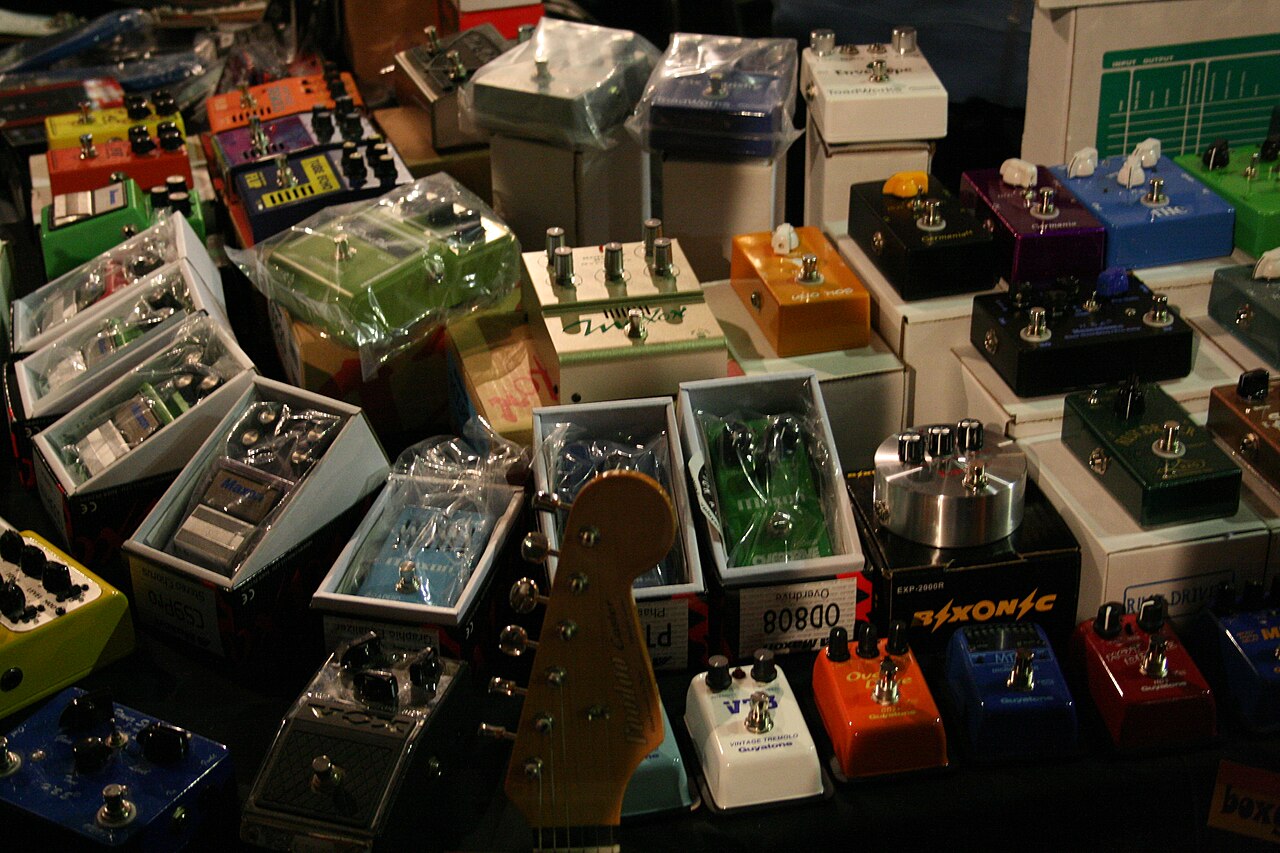
- Effects pedals piled together with a guitar behind them: Alessio Bragadini from Milan, Italy, Wikimedia Commons, CC BY-SA 2.0.
- Top image: AI-generated illustration by GuitarGangsters, based on the manufacturer’s product design (not a photograph).
Latest News
Related
On This Day
Tuesday 10 November
From this week: