Mythos Mjolnir Overdrive: The Man Who Cloned His Own Klon, Then Made It Better
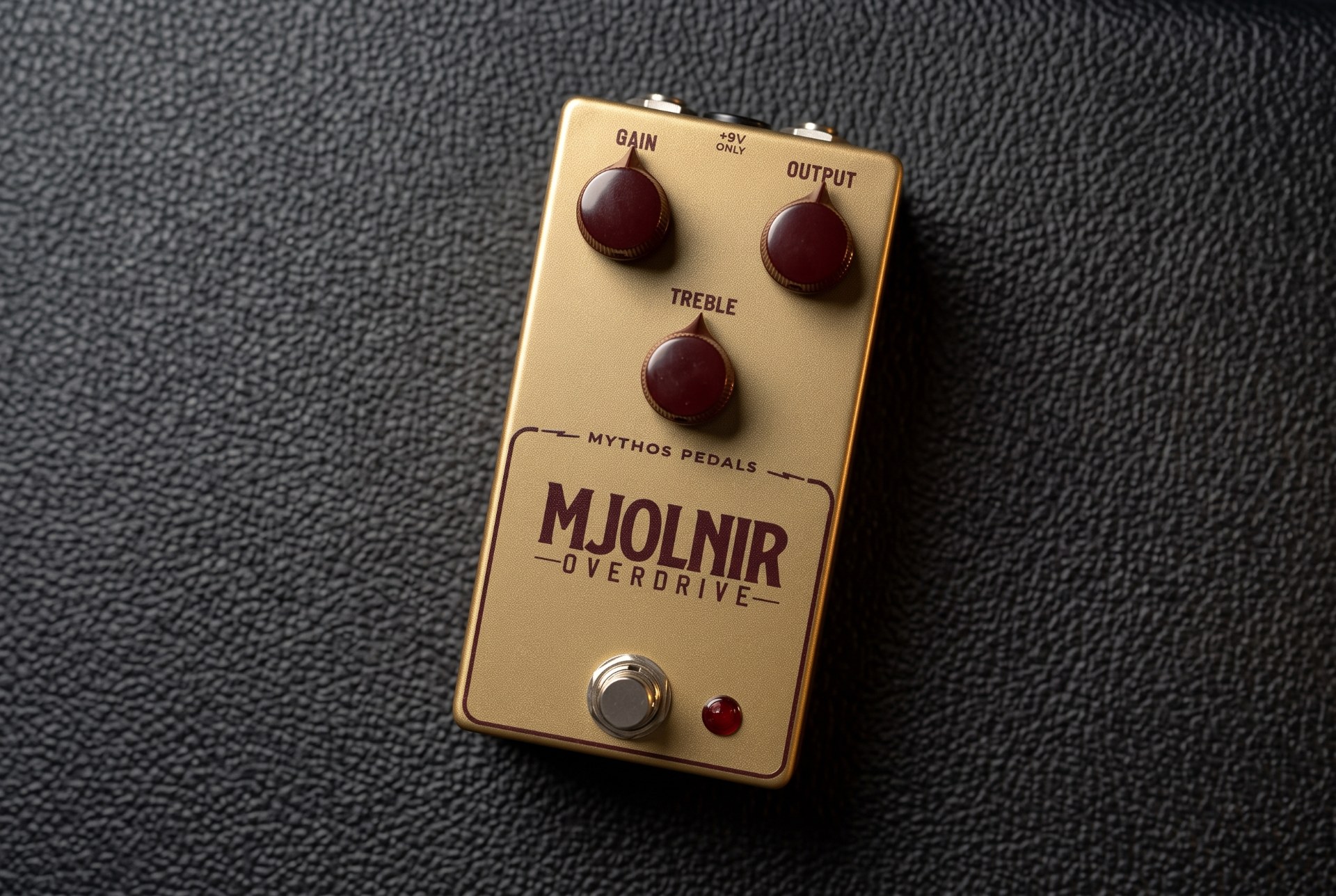
An AI-generated illustration of the Mythos Pedals Mjolnir Overdrive.
Mythos Mjolnir Overdrive: specs, every variant explained, verified players, tone recipes and how this Klon-style drive really compares. 2026 guide.
Somewhere outside Nashville there is a guitarist who cannot play a barre chord. He broke his left wrist as a child, it healed wrong, and the hand only rotates halfway. He plays with his thumb wrapped over the neck and has spent thirty years inventing his own fingerings for chords the rest of us learned in week two.
He also owns a Klon Centaur, serial number 1666, and he has spent the better part of sixteen years taking that circuit apart to find out why it works.
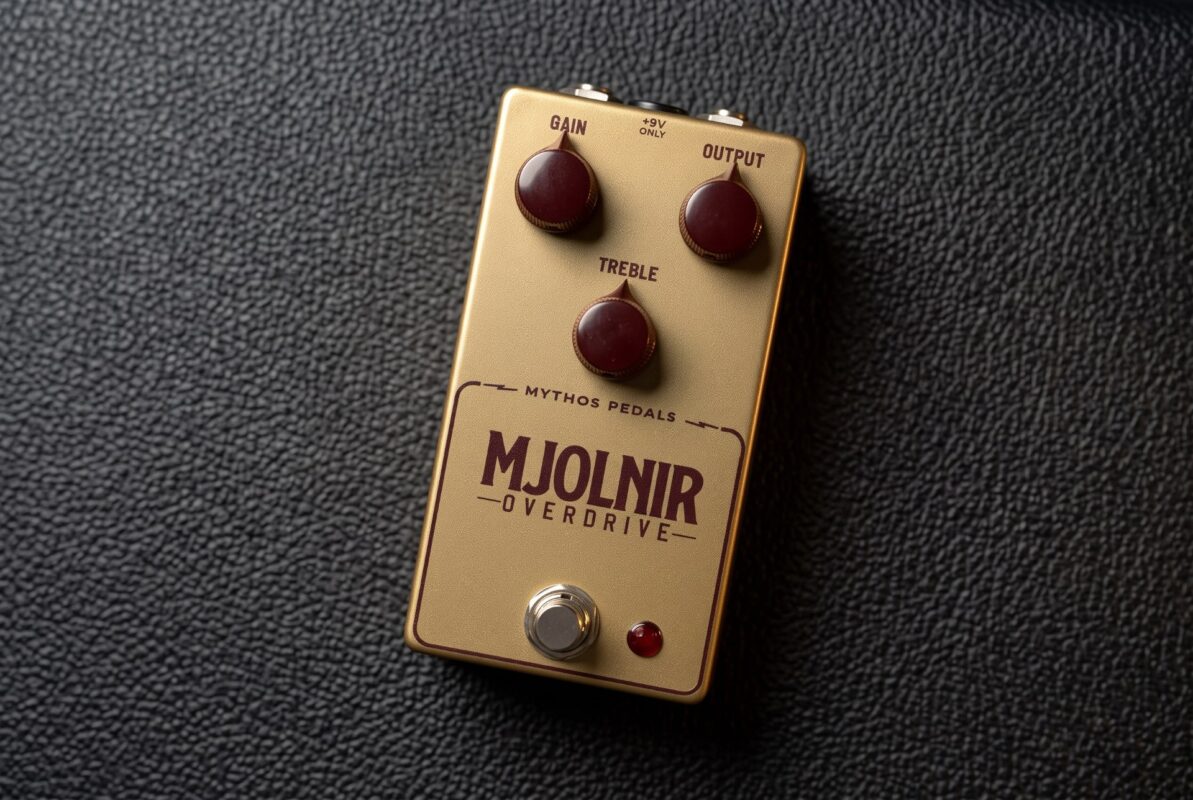
His name is Zach Broyles, his company is Mythos Pedals, and the Mjolnir Overdrive is the pedal that made both of them famous. It is a K-style drive in a world drowning in K-style drives — and the reason it survived the flood is that Broyles did the one thing most Klon-clone builders refuse to do. He admitted the original had flaws, and he fixed them.
The short version
The Mythos Mjolnir Overdrive is a Klon-derived transparent overdrive and clean boost, hand-built by a small team outside Nashville, Tennessee. Three controls: Gain, Treble, Output. Buffered bypass — not true bypass, and that is deliberate. Runs on 9V DC only, drawing roughly 25 mA. Input impedance 1M ohm, output impedance 1k ohm. Enclosure measures 4.82″ x 2.62″ x 1.43″.
Price as of September 2026: $199 direct from Mythos. Used examples surface on Reverb from around $96, which is one of the great bargains in boutique overdrive if you can catch one.
Against the original Klon topology, Broyles pulled the mids back, added low-end push, dialled the gain down slightly, sweetened the top end — and, on current standard units, deleted the charge pump entirely. That last decision is the most interesting thing about the pedal and we will come back to it at length.
If the Klon Centaur is a museum piece with a waiting list and a mythology, the Mjolnir is what that circuit looks like when somebody builds it to be gigged.
Sparta, Tennessee, and a Fuzz Face that only picked up radio
Broyles grew up in Sparta, a small town on the Cumberland Plateau, and got his first guitar for his fifteenth birthday. Nobody else in the family played. What the family did have was records: his mother’s blues — B.B. King, Buddy Guy — and his father’s rock, which meant Led Zeppelin, ZZ Top and Eric Clapton.
The tone he actually chased, though, and still chases, belongs to somebody else entirely. Ask Broyles what perfect sounds like and the answer is Paul Kossoff of Free: a Les Paul, a cranked Plexi-era Marshall, and nothing whatsoever in between. “Kossoff had the most natural, pure sounding tone,” he told Original Fuzz, “and he was getting all of that from a Les Paul plugged straight into a Marshall. That’s it for me.”
Note the shape of that ambition. A man whose entire business is selling boxes that go between the guitar and the amp holds up, as his ideal, a tone with no boxes in it at all. That tension explains an enormous amount about how Mythos pedals are voiced. They are built by somebody who is faintly suspicious of pedals.
Learning the hard way
Around age twenty, Broyles bought Brian Wampler’s How to Modify Guitar Pedals — the same book that launched a generation of American boutique builders, including the man behind the Wampler Tumnus, itself one of the Mjolnir’s most direct rivals. He started buying stompboxes, modifying them, selling them on, and emailing Wampler with questions. By his own account Wampler answered every one.
The first pedal he built from nothing was a Dunlop Fuzz Face that had stopped being a Fuzz Face. “I bought one of those big-old red ones, and it died,” he recalls. “Actually, it didn’t die, but it only picked up radio signals.” He learned to read a schematic, ordered the parts, and rebuilt the whole thing on perfboard, bending leads and soldering them end to end.
Mythos was founded in 2010 as a way of branding the pedals he was already making for himself and his friends. It took years to become a business. The turning point was moving to Nashville and getting a job at Carter Vintage Guitars, where he was surrounded daily by the exact instruments and amplifiers his circuits were supposed to flatter. In late 2017 he quit the day job and went all in.
These days Broyles is arguably as well known for talking about gear as for building it: since 2020 he has co-hosted Dipped in Tone with Rhett Shull, a weekly podcast now well past a hundred episodes, built on the premise of debunking gear mythology. It is worth holding that fact in your head while you read the rest of this article, because the Mjolnir is a pedal made by somebody with a professional interest in not being fooled by pedals.
What Broyles actually changed
Mythos’s own copy refers to the Klon as “the iconic Horsey-Man pedal,” which tells you the trademark lawyers have done their work. The description of what was altered, though, is unusually specific for a boutique brand:
“I took the original Klon topology and tweaked it to give it less mids, more low end overall, less gain, and a sweeter top end.”
Four changes, all of them addressing the four complaints people actually make about K-style pedals. The honking midrange. The thin low end. The fact that the gain control’s useful range is compressed into the last third of its travel. The glassy, slightly brittle treble.
Then there is the fifth change, which is structural rather than tonal.
The charge pump question
The original Klon runs an internal charge pump that doubles the 9V supply to around 18V internally, giving the op-amps more headroom. Current standard Mjolnirs do not have one. Mythos are blunt about why:
“We removed the charge pump from this circuit so there is less risk of frying the pedal with incorrect power. This gives the drive a slightly smoother sound as the op-amps clip and help push the hard clipped diodes.”
Two things are happening in that sentence. The first is a reliability argument, and anybody who has ever plugged the wrong wall-wart into a boutique pedal at 11pm in a load-in corridor will appreciate it. The second is a tonal claim: with less headroom, the op-amps themselves begin to clip, and that soft op-amp clipping stacks on top of the hard diode clipping. You get two clipping characters instead of one.
Mythos go further on their FAQ, saying the germanium models without a charge pump “honestly perform better as an overdrive and stack beautifully.” That is a builder saying, in public, that removing a famous feature made his pedal better at its job. Take it with whatever salt you like, but it is not the sort of claim marketing departments volunteer.
The buffer, which stays
What Broyles emphatically did not remove is the buffered bypass. The Mjolnir is buffered when off, exactly like the original, and Mythos treat this as a feature rather than a compromise: “The now iconic buffered bypass of this circuit remains so it vastly improves the signal quality of long cable runs or big pedalboards.”
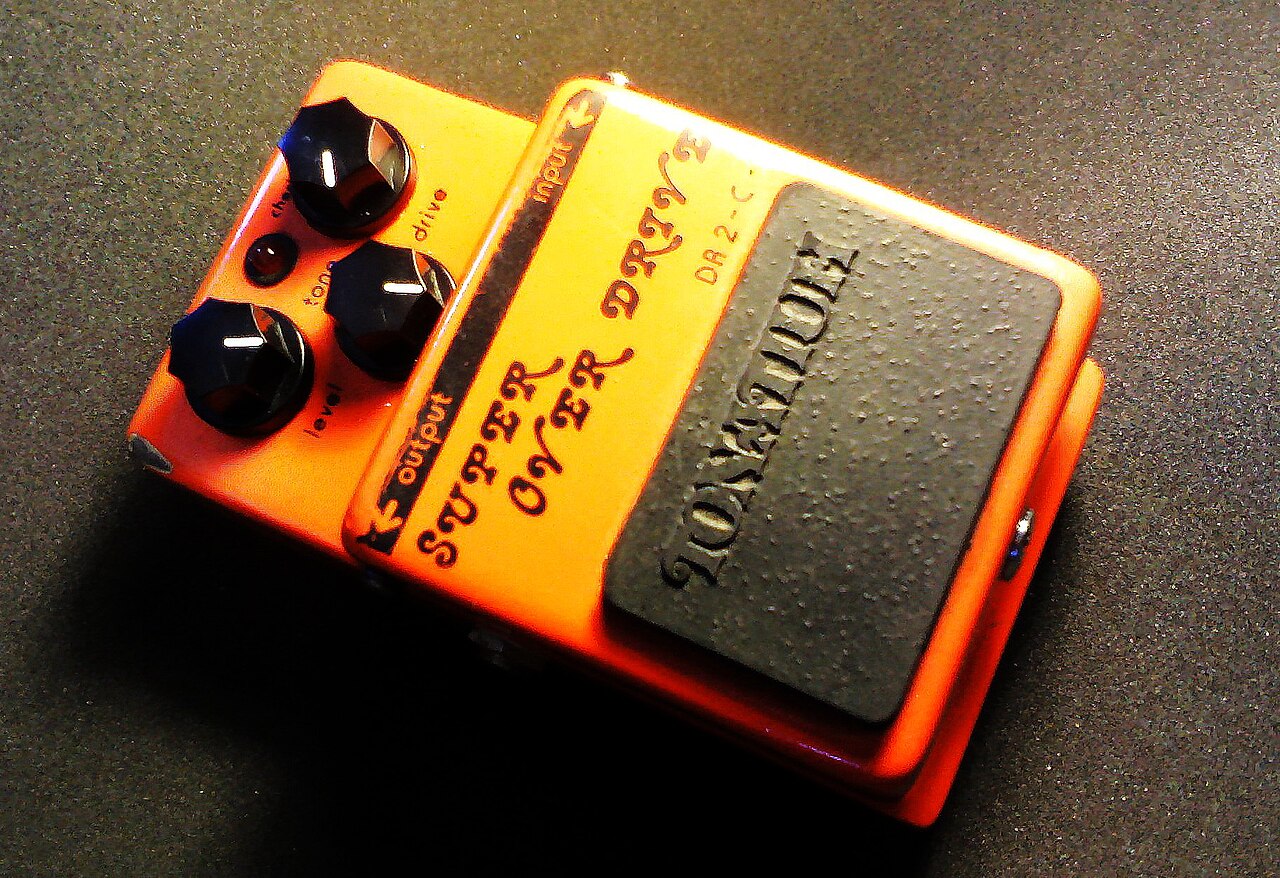
A correction worth flagging. Equipboard’s auto-generated FAQ for the Mjolnir states that the pedal “features true bypass switching.” It does not. Mythos’s own product page and specification sheet both say buffered bypass, and the buffer is one of the pedal’s selling points. If you have read that the Mjolnir is true bypass anywhere, that page is wrong, and it matters — a buffered pedal behaves differently in front of a vintage-style fuzz.
Which brings us to placement. Mythos’s own guidance is that the Mjolnir works anywhere in a chain. Their fuzzes — the Golden Fleece family, the Cestus, the Hephaestus, the 210 Double Drive — need to sit before any buffer. If you own a Mjolnir and a vintage-voiced fuzz, the fuzz goes first. This is not a Mythos quirk; it is how germanium fuzz input stages work with buffered signals generally.
Specifications
The dual-ganged Gain control
This is the part of the K-style topology that people most often misunderstand, so it is worth spelling out. The Gain knob is not a simple drive control. It is a dual-ganged pot that simultaneously fades your clean signal out and fades the overdriven signal in. At minimum you are hearing pure clean tone through the buffer. At maximum you are hearing pure drive. Everywhere in between is a blend.
That is why K-style pedals feel the way they do — the low end and pick attack that survive at moderate gain settings are your actual dry signal, not a simulation of it. It is also why the Mjolnir works as a boost at settings where a Tube Screamer would already be well into its midrange hump. Broyles says he tuned the taper “to strike a perfect balance of clean push and gain,” and the practical effect is that the useful range is spread across the whole sweep rather than crammed into the top quarter.
Famous players — and what the evidence actually shows
Mythos do not publish an artist roster on their site, which spares us the usual problem of brand-level lists that say nothing about who owns which pedal. What exists instead is a set of video-and-photo citations, most of them timestamped, and they hold up better than most.
One honest caveat first: the majority of documented sightings are of the Mjolnir MK IV, the earlier gold-with-black-knobs generation in the larger enclosure, not the current compact standard. The circuit lineage is continuous and Broyles has tweaked it throughout, so these are the same pedal in the sense that a 1963 and a 1972 Fender Bassman are the same amp. Read the list with that in mind.
Joey Landreth — the one with a signature model
The strongest connection by a distance. Landreth, of The Bros. Landreth, met Broyles at a Nashville venue in 2014 and the two became friends; Broyles built him a Mjolnir shortly afterwards. Landreth has told the story of acquiring the pedal on camera, an older Mjolnir is visible on his board throughout that same video, and Equipboard credits the pedal on his 2019 record Whiskey.
Mythos went on to release a Joey Landreth Mjolnir at $229 — sparkle orange, cream Dakota-style knobs, orange LED, hand-matched NOS germanium clipping diodes, and, per Mythos, a voice that is “much more mellow than the other units.” It is currently sold out. Landreth also collaborated on the High Road version of the Golden Fleece fuzz, where Broyles says he wanted the attack to feel “more like a Silicon Fuzz of yesteryear.”
One name to be careful with: Joey Landreth is not Sonny Landreth. Different players, different families, different techniques. Sonny is the Louisiana slide master; Joey is the Winnipeg-born singer-guitarist whose open-C slide playing is the reason the low-end behaviour of this pedal matters to him. Search results conflate them constantly.
Charlie Worsham
The only artist documented on the current standard Mjolnir page rather than the MK IV. Worsham’s Premier Guitar Rig Rundown, shot by John Bohlinger at Sony/ATV Studios in Nashville, shows a board running a Sonic Research ST-300 tuner, a Browne Amplification Protein, the Mjolnir, a Guyatone ST-2 compressor, an Electro-Harmonix Canyon, a Neunaber Immerse, a Strymon El Capistan and a Chase Bliss Warped Vinyl HiFi.
That Protein-plus-Mjolnir pairing is instructive. The Protein is a two-channel Bluesbreaker-and-transparent-drive machine; the Mjolnir sits alongside it as the always-available push rather than a competing crunch. Two boutique drives on one board only makes sense when they do genuinely different jobs.
Chris Buck
The Welsh guitarist behind Cardinal Black, and one of the more influential tone voices of the last decade. The Mjolnir is clearly visible at 9:40 in his own touring-and-recording rig walkthrough. Buck’s playing — feel-first, dynamics-first, very little compression — is close to the ideal use case for this circuit.
Rob Chapman and Lee Anderton
Two of the most-watched gear figures in Britain, both documented on the MK IV. Chapman, of Dorje and Chapman Guitars, showed his in an Andertons video in June 2017. Lee Anderton — “The Captain” — appears with a silver MK IV in the Andertons pedalboard build filmed with Dan Steinhardt of The GigRig.
These two matter less as tonal endorsements and more as distribution history: Andertons exposure in 2017 is a large part of why a one-man Nashville brand became a name in the UK at all.
Joe Langridge-Brown and Drew Shirley
Langridge-Brown of Nothing But Thieves shows his at 24:43 in a rig video — a useful data point, because that band’s guitar tones run considerably heavier and more processed than the blues-rock world this pedal is usually filed under. Drew Shirley of Switchfoot flashes his board at 5:10 in a video listing new additions and returning pedals.
What this list does not contain is a stadium headliner. The Mjolnir is a working guitarist’s pedal, bought by people who make their living playing and by the people those players watch on YouTube. That is a perfectly respectable pedigree and it is more honest than the alternative.
Tone recipes
1. “Just a Push” — the always-on boost
Gain 8 o’clock, Treble 11 o’clock, Output 2 o’clock.
Mythos’s own boost setting, and the one most Mjolnirs live on. At this Gain position the dual-ganged pot is passing mostly clean signal, so what you are really hearing is your rig with more level, a firmer low end and slightly rounded transients. Owners describe the pedal’s ability to “shave transients” — taking the spike off a hard pick attack without dulling the note.
Use it to push a cranked amp harder rather than to make dirt of your own. This is where it does the Kossoff-adjacent job Broyles built it for.
2. “Mayor of Wonderland” — the pushed drive
Gain 12 o’clock, Treble 12 o’clock, Output 1 o’clock.
Mythos’s own name for their clear, pushed drive setting. Straight up the middle: enough clean signal left in the blend to keep chords readable, enough drive to sustain single notes. Owners consistently report this as the sweet spot with a Fender Blues Deluxe, where the pedal “enhances warmth and tightens low end, giving a round, organic tone without overwhelming the signal.”
Humbuckers into a Deluxe Reverb at this setting is the single most reliable good sound the pedal makes.
3. “Follow My Lead” — thick hard-clipped saturation
Gain 4 o’clock, Treble 1 o’clock, Output 11 o’clock.
Mythos’s maximum-drive setting, and further than most people take a K-style box. The clean blend is nearly gone and you are hearing the hard-clipped diodes with the op-amps contributing their own soft clipping on top. Roll the Output back, because you will not need it.
Compared to a Klon at full gain this stays smoother and less fizzy, which is the standard silicon diode pair doing its work. The germanium versions get hairier here, with more top-end fizz — the classic sound people associate with the original.
4. The stacking position — Mjolnir last
Gain 9 o’clock, Treble 11 o’clock, Output 3 o’clock, placed after your other drives.
Owner-derived, and one of the best-documented uses of the pedal. Positioned at the end of the overdrive section, the Mjolnir boosts volume and reshapes what is coming into it — reported working stacks include a TS9 in front and a ProCo RAT in front.
This works because the Mjolnir’s own voicing is subtractive where a Tube Screamer is additive: it fills the low end back in and takes the nasal quality out of what the first pedal did.
5. Pushing a high-gain amp
Gain 10 o’clock, Treble 10 o’clock, Output 2 o’clock, into an already-dirty channel.
Owners specifically call out Orange amplifiers here — the Mjolnir “adds warmth and fullness without sounding boxy or nasally.” The reduced-mids voicing is the reason. Push an Orange with a Tube Screamer and you pile midrange onto an amp that already has plenty; push it with a Mjolnir and you get level and low-end authority instead. Roll the Treble back further than feels right, because a hot amp will supply its own top end.
Mythos publish three of their own starting points, which is rare and useful. All settings below are clock positions with the pedal into a clean or edge-of-breakup amp.
How it compares
Mjolnir vs the Klon Centaur
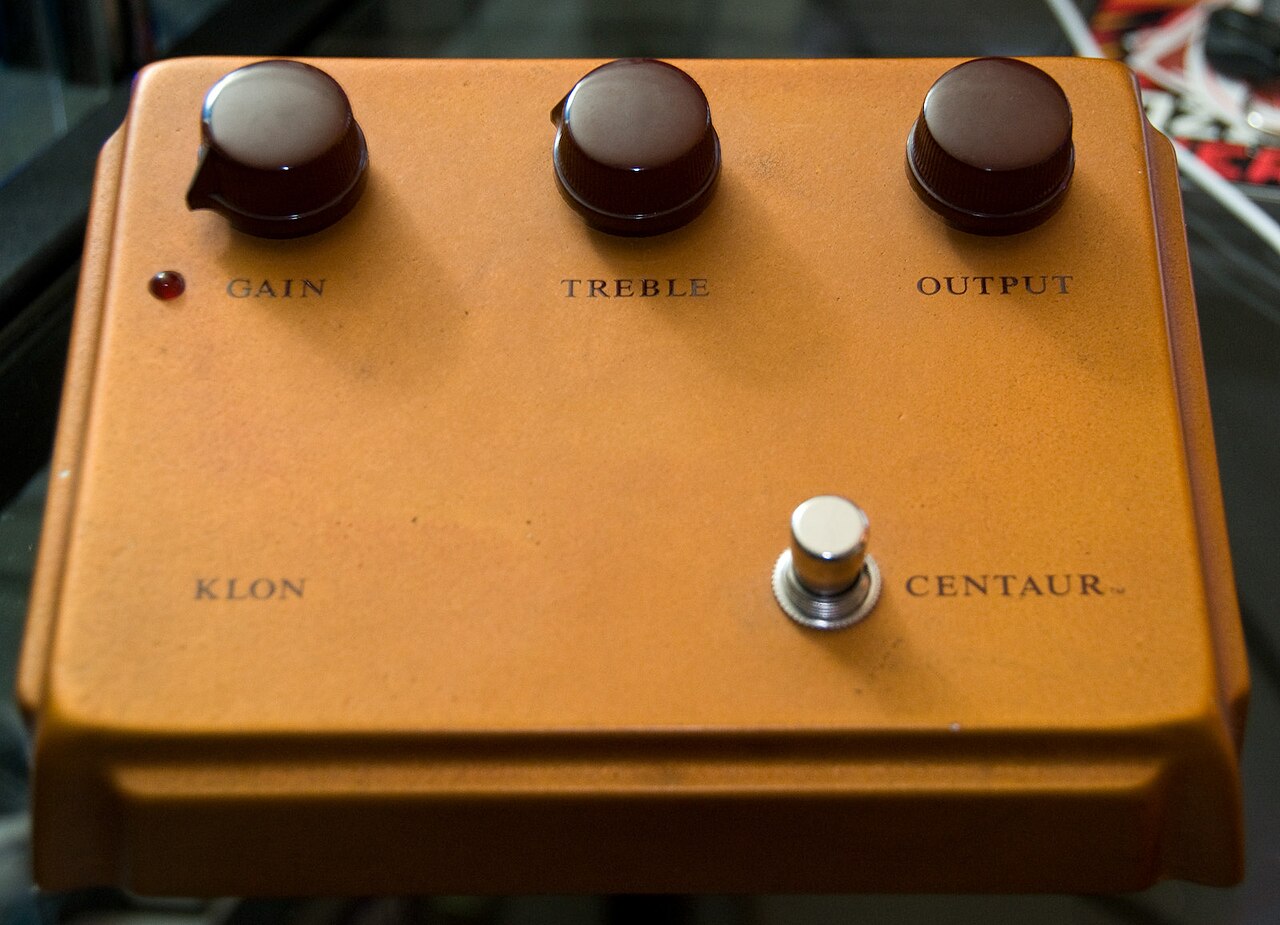
The Mjolnir is $199 and available; a genuine Klon Centaur is five figures and a story. Sonically the Mjolnir has less midrange emphasis, more low-end push, slightly less gain and a sweeter top, with no charge pump on standard units. If your goal is specifically to own the original’s character rather than an improved version of it, Mythos will sell you that too — see the Wildwood and 1N34A editions below.
Mjolnir vs Wampler Tumnus
The Tumnus is the mass-market answer: cheaper, mini-enclosure, extremely competent, and voiced closer to the original’s midrange character. The Mjolnir costs more, is hand-built in smaller numbers, and is voiced away from the original on purpose. If you want a Klon in a small box for not much money, the Tumnus wins on value. If the honk is the specific thing you dislike about K-style pedals, the Tumnus will not solve it and the Mjolnir will.
Mjolnir vs J. Rockett Archer / Archer Ikon
The most instructive comparison, because owners keep making it unprompted. The recurring verdict: the Mjolnir “adds low mids for a fuller sound compared to other Klon clones, avoiding the nasal and honky characteristics often found in models like the JRAD Ikon Archer.”
Interestingly, Ultimate Guitar’s shootout against the RYRA Klone reached a partly opposite conclusion, describing the Mjolnir as having reduced low mids for a clearer, more present tone with a tighter low end. Both can be true depending on what you are comparing against and where the low end is measured — Mythos’s own claim is more low end overall but fewer mids, and “low mids” is exactly the frequency band where those two descriptions collide. The practical takeaway is consistent across all three sources: the Mjolnir is tighter and less nasal than its rivals. Which direction you hear that as depends on your amp.
Mjolnir vs Greer Lightspeed
Different families entirely. The Greer Lightspeed is a low-gain transparent drive with no clean blend — it makes your amp slightly better and refuses to do more. The Mjolnir has a genuine clean-to-dirty blend and a much longer gain range, reaching saturation the Lightspeed cannot. If you want a second channel, Lightspeed. If you want a boost that can also be a drive, Mjolnir. If you want the Greer that does reach saturation, that is the Southland.
Mjolnir vs Analog Man King of Tone
The King of Tone is Bluesbreaker-derived, dual-channel, and famously requires a wait measured in years. The Mjolnir is single-channel, K-derived, and ships. They are not really substitutes — a Bluesbreaker circuit compresses and rounds in a way a Klon topology does not — but if the KoT waiting list is what sent you here, the honest advice is that the Prince of Tone is the closer sonic match and the Mjolnir is the better boost.
Mjolnir vs EHX Soul Food
The Soul Food exists to prove that a K-style circuit can cost under $100. It does the job. The Mjolnir costs roughly three times as much and buys you: hand selection of the clipping diodes, low noise floor as a design priority, panel-mount jacks, a limited lifetime warranty, and a builder who answers his own email. Whether that is worth $120 depends entirely on whether you gig.
Which Mjolnir? A guide to the variants
Mythos make, in Broyles’s own words, “a lot of different Mjolnirs,” and their FAQ exists largely to untangle them. Here is the map.
| Version | Diodes | Charge pump | Character | Availability |
|---|---|---|---|---|
| Standard Mjolnir ($199) | Selected silicon pair | No | The house voicing: less mid honk, more low end, less fizz | Current, direct |
| GE Mjolnir ($229) | NOS USA mil-spec germanium | No | Softer, more compressed, less focused; hairier when cranked | Mass Street Music exclusive |
| Wildwood Edition ($249 at launch) | NOS germanium | Yes, +18V | Deliberate clone of Broyles’s own silver Klon | Wildwood Guitars exclusive |
| 1N34A Mjolnir (£224) | Vintage ITT 1N34A germanium | Yes, internal | Closest published match to Klon #1666 | Limited run, Black Friday 2024 |
| Joey Landreth Mjolnir ($229) | Hand-matched NOS germanium | No | Lower gain, softer clipping, notably mellow | Sold out |
| MK IV | Varies by run | Varies | Earlier larger-enclosure generation; most artist sightings | Used market only |
The two structural rules: germanium diodes mean softer, more compressed breakup with more top-end fizz when cranked; silicon means tighter and less fuzzy. And the charge pump is the difference between the reliability-first standard pedal and the historically faithful Wildwood lineage.
Broyles is refreshingly candid that enclosure format forces PCB changes, and that those changes are audible: “These, seemingly, small changes do amount to sonic differences. So, all of that to say… they are all a little different.” Very few builders will admit that in print.
The 1N34A story
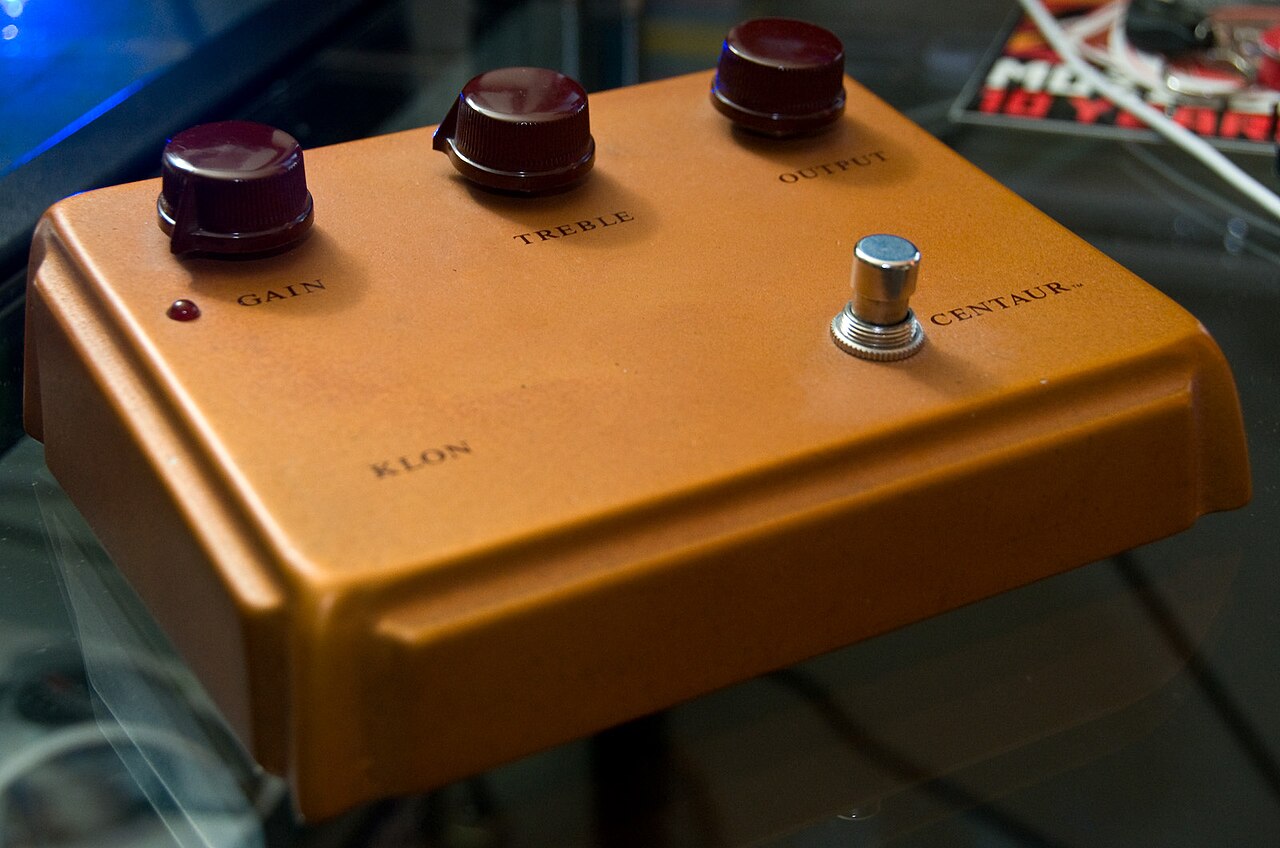
Worth telling because it is the most Broyles thing in the catalogue. Having spent years chasing his own Klon — serial number 1666, which he says simply “sounds really good” — he had never managed to try the vintage 1N34A germanium diodes many people believe are the secret. NOS 1N34As are not easy to come by.
Then, as MusicRadar reported in November 2024, a stranger emailed offering him a freezer bag full of them. Mythos built a limited run on the Wildwood platform, A/B’d it against pedal 1666, and reported they could not tell the difference. “We were shocked with how much it replicates the sound of Zach’s original unit. The amount of gain is the same, voicing, output, it’s all there.”
A limited-edition pedal that exists because someone mailed a builder a sandwich bag of 1960s diodes is a better origin story than most brands manage on purpose.
Buying guide
Buy a Mjolnir if
- You want a K-style pedal that lives on all night rather than one you step on for solos.
- Your amp already has plenty of midrange and adding more makes it worse.
- You run a large board or long cable runs and want a good buffer that also happens to be a drive.
- You stack drives and need something at the end of the chain to fill the low end back in.
- You value a quiet noise floor — Broyles treats it as a design constraint, not an afterthought.
Look elsewhere if
- You need true bypass for a germanium fuzz sitting behind it. Put the fuzz first, or buy a different pedal.
- You want a distortion. The Mjolnir reaches saturation but it is not a Browne Carbon and it will not do metal rhythm.
- You are outside the US and price-sensitive. Owners in Europe and Ireland report significant VAT charges and patchy dealer availability, which can push a $199 pedal well past what it costs an American buyer.
- You specifically want the original Klon’s honk. Broyles removed it deliberately.
- You want to run it at 18V. You cannot. See below.
Buying used
The used market is where the Mjolnir gets genuinely interesting, with clean examples turning up on Reverb from around $96 — under half of new. Two things to check before you buy.
First, establish which version you are looking at. Enclosure size and knob colour are the quickest tells: the larger gold-with-black-knobs unit is a MK IV, the sparkle orange with cream knobs is a Joey Landreth, and the compact current standard is the $199 pedal. Ask the seller directly and ask for a photo of the bottom plate.
Second, the warranty does not travel. Mythos’s limited lifetime warranty applies to the original purchaser only and is void if anyone has modified the pedal or attempted an outside repair. On a used unit you are on your own — though Mythos do run a paid repair service and have a stated willingness to fix things where a fix is possible.
Living with one
Power
9V only. Never 18V. Mythos are unusually emphatic about this: construction methods have changed over the years and older units in particular were built for 9V. “NEVER plug in an 18 volt supply unless you know it can handle it or you will kill your pedal.” At around 25 mA the current draw is trivial for any isolated supply.
Their recommended brands are Voodoo Lab, CIOKS and Truetone. They also note that Strymon supplies have caused problems with some Mythos fuzzes — not the Mjolnir specifically, but worth knowing if you own more than one Mythos box.
The footswitch pop
Mythos use an old-school 3PDT mechanical footswitch, and it can pop on engagement. Broyles addresses this head-on and declines to apologise for it: he has resisted moving to a soft-touch relay system, most pops are capacitors discharging and disappear after switching the pedal a few times, and the rest are usually cables or power supplies. His actual published advice is “crank up and rock out and embrace the pop.”
Whether that reads as charming or as a dodge probably depends on whether you play in a quiet room. It is at least honest.
Placement
Anywhere. Mythos say they have never had a problem putting the Mjolnir later in a chain. The only hard rule is the buffer one: vintage-voiced fuzzes go in front of it, not behind it.
What it does not do well
Two things, drawn from owner reports rather than marketing. It is not a high-gain pedal — the top of the Gain sweep is thick and saturated but it is still an overdrive, and asking it to be a distortion produces something soft rather than aggressive. And if your rig is already low-mid-heavy, the Mjolnir’s added low-end push can tip it into woolliness; several owners specifically choose it because their setup is thin, which is a hint about who it does not suit.
FAQ
Is the Mythos Mjolnir a Klon clone?
It is Klon-derived rather than a clone. Mythos took the original topology and changed the voicing on purpose — less midrange, more low end, less gain, sweeter treble — and on current standard units removed the charge pump. If you want an actual clone from Mythos, that is the Wildwood Edition or the 1N34A, both built to match Broyles’s personal Centaur.
Is it true bypass?
No. It is buffered bypass, deliberately, exactly like the circuit it descends from. Some third-party listings incorrectly state true bypass; Mythos’s own specification says buffered. This matters if you run a vintage-style fuzz, which should sit in front of the Mjolnir rather than behind it.
Can I run it at 18 volts?
No. 9V only. Mythos are explicit that doing otherwise will kill the pedal, and that older units in particular were built to 9V tolerances. Current draw is around 25 mA.
What is the difference between the standard and the germanium Mjolnir?
The circuit is the same; the clipping diodes are not. Silicon in the standard gives a tighter, less fizzy overdrive. NOS germanium in the GE model gives softer, more compressed gain that turns hairier and fizzier when cranked — closer to the classic sound people associate with the original. The GE version also breaks up slightly earlier.
Which famous players actually use one?
Documented, with video or photo evidence: Joey Landreth of The Bros. Landreth, who has a signature version and a credited album use; Charlie Worsham, per his Premier Guitar Rig Rundown; Chris Buck of Cardinal Black; Rob Chapman of Dorje; Joe Langridge-Brown of Nothing But Thieves; Drew Shirley of Switchfoot; and Lee Anderton of Andertons. Most of those sightings are of the earlier MK IV rather than the current standard pedal. There is no stadium-headliner endorsement, and we found no evidence for one.
Why does my footswitch pop?
Mythos use a mechanical 3PDT switch by choice. Most popping is capacitors discharging and settles after a few actuations; the rest is usually cabling or power. Broyles has publicly declined to switch to relay-based soft touch. If a silent switch is a requirement for you, this is the wrong pedal.
Where should it go on my board?
Almost anywhere. It works in front of other drives as a base tone, after them as a level-and-EQ shaper, or alone as an always-on boost. The one placement rule is that vintage-voiced germanium fuzzes must come before it, because its buffer will change how they load your pickups.
Is it worth $199 when the Soul Food is under $100?
If you play at home, probably not. If you gig, the case is: hand-selected diodes, a deliberately low noise floor, panel-mount jacks that survive cable yanks, a limited lifetime warranty, and a voicing that solves the honk problem rather than reproducing it. The used market at around $96 makes this question much easier to answer.
Image credits
- An orange overdrive pedal: Andrés Galeotti, Wikimedia Commons, CC BY 2.0.
- A Klon Centaur pedal, front view: ArtBrom from Seattle, Wikimedia Commons, CC BY-SA 2.0.
- A Klon Centaur pedal: ArtBrom from Seattle, Wikimedia Commons, CC BY-SA 2.0.
- Top image: GuitarGangsters AI-generated reference illustration, not a photograph.
- Mythos Pedals Mjolnir Overdrive: AI-generated illustration by GuitarGangsters, based on the manufacturer’s product design (not a photograph).
Latest News
Related
On This Day
Monday 9 November
From this week: