Fairfield Circuitry Shallow Water: The Modulation Pedal That Refuses to Repeat Itself
Inside the Fairfield Circuitry Shallow Water K-Field Modulator: random modulation circuit, LPG envelope, internal jumpers, tone recipes and verified players.
Every chorus pedal ever built runs on a lie you have agreed not to notice. Somewhere inside it, a low-frequency oscillator is sweeping back and forth, back and forth, at a fixed rate you set with a knob, and it will keep doing exactly that until the heat death of the universe or the end of the song, whichever comes first. Your ear learns the cycle inside four bars. After that, the pedal is furniture.
The Fairfield Circuitry Shallow Water was built by somebody who found that unbearable. It is a bucket-brigade chorus and vibrato circuit in the most literal, textbook sense — signal delayed by a few dozen milliseconds, delay time modulated to bend pitch, wet mixed back against dry to make the comb filters move. And then, at the exact point where every other builder wires in a triangle-wave LFO, Fairfield wired in a microcontroller running a pseudo-random number generator. Random voltage steps at random time intervals. No cycle. No period. Nothing for your ear to lock onto and file away.
Fairfield call the result a “k-field modulator,” a category that contains exactly one pedal because they invented both the pedal and the category. The Shallow Water has been in production since 2017, it costs more than most people expect a five-knob modulation box to cost, and it sits on the boards of Jeff Tweedy, Bartees Strange and Joey Landreth — three players who agree on almost nothing else. This is how it works, what it is actually for, and why it does not sound like anything else you own.
Hull, Québec: The Company Behind the Box
Fairfield Circuitry has been building effects since 2008 out of Hull, Québec — the old industrial half of Gatineau, sitting on the north bank of the Ottawa River with Canada’s capital directly across the water. Founder Guillaume Fairfield’s shop describes its own hometown, in the company’s about page, as a place “where music, and the eccentric flourish amidst a backdrop of civil servitude.” That is a fairly precise self-portrait: Fairfield make strange, uncompromising devices in a town full of government offices, and the contrast is the point.
The company’s operating statement is worth reading closely, because it explains the Shallow Water better than any spec sheet does. Fairfield describe themselves as “experimenting with sound, exploring its limits, then gracefully pushing those limits further to the edge in order to create effect pedals with sounds that generate wonder and curiosity.” They close with a line that could be the Shallow Water’s epitaph: “Simplicity intentionally hidden, transparency deliberately shown.”
The roster is deliberately small — ten pedals at the time of writing, all built in Hull by a single team. That includes the Barbershop overdrive, the Randy’s Revenge ring modulator, the ~900 fuzz, the Accountant compressor, the Meet Maude analog delay and the Shallow Water. It is a catalogue with no filler in it, which is unusual, and it is a catalogue where several pedals turn up on the same professional boards, which is more unusual still.
Fairfield’s house design language is instantly legible: spidery line-drawn graphics, control names in wide-tracked capitals, a small clamp logo, and the phrase “UNIQUE & ROBUST / MADE IN HULL, QUÉBEC” printed on the manual. Every pedal gets a two-page quick-start document that explains the actual circuit topology — block diagram included — rather than a marketing paragraph. Builders who publish their signal-flow diagrams are telling you something about what they think of their customers.
What a K-Field Actually Is
Fairfield’s product copy for the Shallow Water is not a spec list. It opens with “poolside conversations while staring at your own reflection” and moves through phenomena and noumena before it gets anywhere near a control layout. Buried in the middle is the only definition anyone has ever offered:
“K-field (Simulation mathematics), an undefined, two-dimensional, non-linear field where past and future forces interact at irregular intervals.”
Then the practical translation: “Shallow Water generates this k-field by randomly modulating a short time delay to create unexpected shifts in pitch. The result is this non cyclical vibrato/chorus/flanger-type thing favouring old tape flavours.” And the closing warning, which is also the naming joke: “The water is shallow on this side of the pool. Do not dive and you will not drown.”
Strip the poetry and the claim is specific and testable. Conventional modulation is cyclical. The Shallow Water is non-cyclical. Everything else about the pedal follows from that one architectural decision, including the things people find frustrating about it.
Inside the Circuit
Fairfield’s own manual is unusually generous here, so we can be specific rather than hand-wavy. The abstract states plainly that Shallow Water is “an effect built around your typical analogue chorus/vibrato circuit wherein the signal is delayed by a few dozen milliseconds using a bucket brigade device.” That is the same foundational idea as a Boss CE-2 or an EHX Small Clone. What differs is what drives it, and what cleans up after it.
The pseudo-random generator
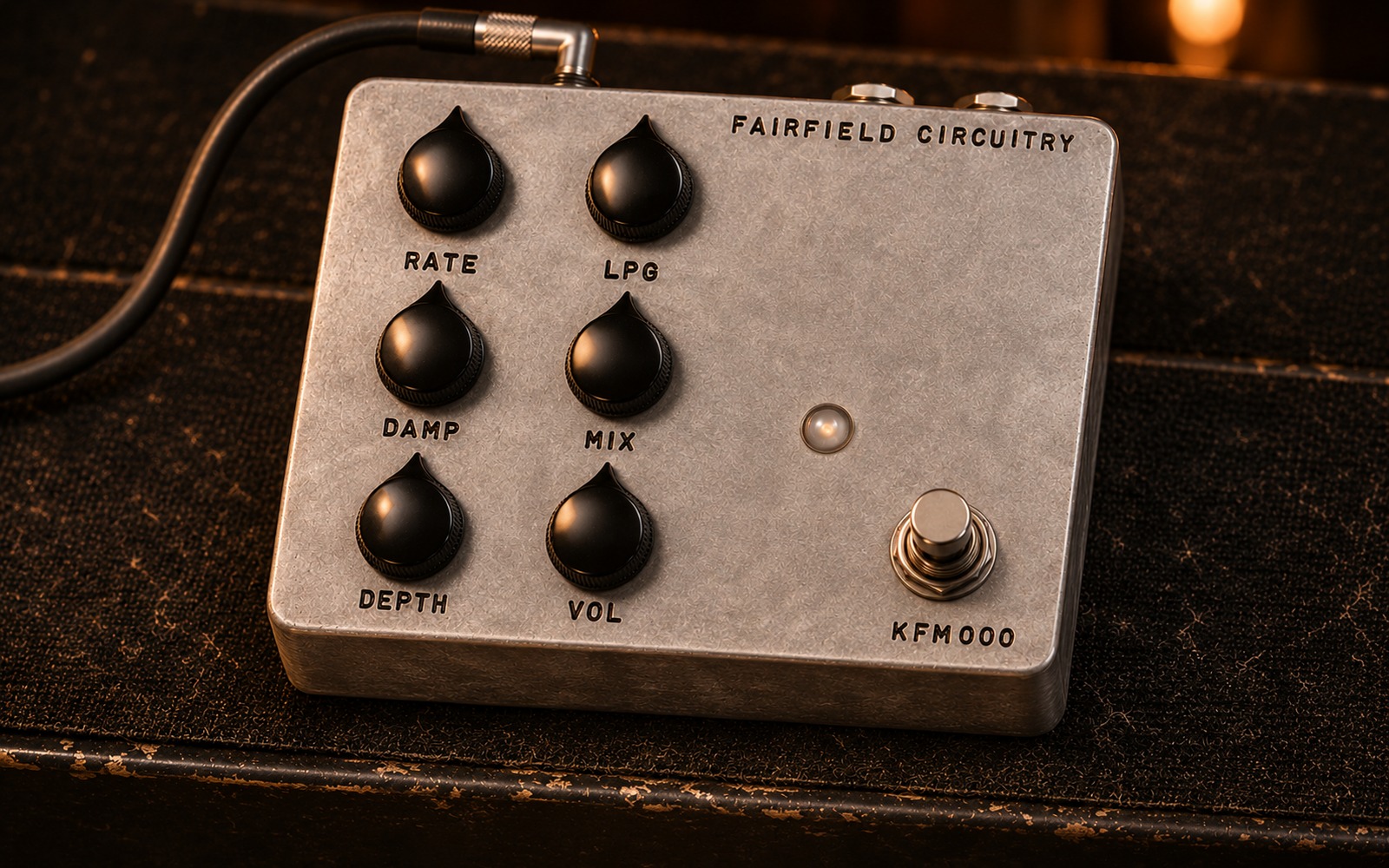
The randomness begins, in Fairfield’s words, in “a simple program residing on a microcontroller. Its output resembles steps of random voltages, separated by random time intervals.” The RATE control does not set a frequency. It sets the overall range of those intervals. This is the single most important thing to understand about operating the pedal: you are not dialling in a speed, you are dialling in a probability window.
The integrator
Raw random steps would sound like a broken sample-and-hold — instant, jagged pitch jumps. So the stepped voltages pass through a filter/integrator that governs how fast each step travels to its new value. That is the DAMP knob. At minimum, “the pitch modulations are quick and sudden; the random changes in modulation voltage are almost instantaneous.” Turn it up and the steps become, in Fairfield’s phrase, “slow and sluggish, instead of sharp and abrupt.”
DEPTH then scales how much of that shaped random voltage reaches the delay line’s clock. Fairfield’s guidance is blunt: “The range of modulation is focused towards subtle variations. Adjust to taste, though less is more.”
The envelope follower and recovery filter
This is the second thing that makes the Shallow Water its own category, and it gets far less attention than the randomness. Any bucket-brigade device generates noise and clock artefacts that have to be filtered out after the delay line. Most pedals do this with a fixed low-pass filter. Fairfield made theirs move.
Per the manual: “the input’s envelope is followed and used to modulate the frequency of a low pass filter. The amount of envelope is set by the LPG control, yielding bouncy, lo-fi responses to quick and snappy gate-like behaviours.” LPG stands for low-pass gate — a concept borrowed wholesale from modular synthesis, where a single element simultaneously controls brightness and amplitude the way an acoustic instrument does.
The audible consequence: at low LPG “the signal will be darker, choke subtle notes and reduce sustain,” and at high LPG “the sound will be brighter, have more sustain and might reveal some noise produced by the bucket brigade device.” Fairfield are telling you, in their own documentation, that their pedal hisses if you push the filter open. That candour is rare and it is useful — it is the same instinct we saw from Caroline Guitar Company publishing the noise floor of the Kilobyte Lo-Fi Delay, and from Chase Bliss admitting the background hiss on the Warped Vinyl HiFi.
The signal path in one line
Input → envelope follower → voltage-controlled low-pass filter; and in parallel, input → anti-aliasing filter → delay line (clocked by a voltage-controlled clock driver fed from the pseudo-random generator via the integrator and DEPTH) → recovery filter → MIX against dry → VOLUME → output.
Specifications
The Controls, One at a Time
RATE
Sets the range of the random time intervals. Fairfield describe the span as running “from rare to nervous,” which is the best two-word summary of a modulation control anyone has written. Counter-clockwise, pitch events are occasional and unpredictable — the pedal seems to be doing nothing until it suddenly does something. Clockwise, the events pile up into a shimmer.
Critically, the manual warns of an interaction: “At high RATE and DAMP settings, the quick variations have trouble passing through the swampy filter and integrator, effectively reducing perceived modulation. This is normal.” So the two controls fight each other at their extremes, and the fight is by design. Fairfield’s advice: “The interaction between these two knobs is particular and needs to be tamed through experimentation.”
DAMP
The slope control. Minimum gives near-instantaneous voltage jumps — abrupt, warbling, broken-tape pitch behaviour. Maximum gives movement so slow that, per the manual, “the changes become so slow that they are not heard as pitch modulations. To hear the changes, some dry mix needs to be applied. Then, the slow movement of the delay time can be heard as chorus.”
That sentence is the key to using the pedal as a chorus. High DAMP plus dry signal in the mix equals the slowest, least mechanical chorus you will find in a stompbox.
DEPTH
Modulation intensity, deliberately scaled toward the subtle. There is no seasick end of this control. If you are looking for pitch-bending extremity, this is not the pedal; the Red Panda Tensor or Chase Bliss Thermae are the boxes for that.
LPG
The envelope amount into the low-pass gate. This is the control most owners underuse. Low settings choke quiet notes and shorten decay, producing something like a lo-fi gate; high settings open up sustain and brightness at the price of some BBD noise. It is also the control that makes the pedal touch-responsive, which is not a thing you can normally say about a chorus.
MIX
Fully clockwise is 100 percent wet — pure vibrato, in the true Boss VB-2W sense of the word, no dry signal at all. Blending dry back in produces the comb filtering we call chorus. There is no third mode. The pedal is a continuum between the two.
VOLUME
Output level, with unity around noon, and considerable headroom above. Fairfield’s manual entry for this knob reads in full: “The VOLUME knob controls the output volume. Unity is around noon and beers around 5 at my place.” The panel legend simply says “plenty of output volume.”
The Two Jumpers and the Trimpot
Open the backplate and there are three more adjustments. This matters more than usual, because the Shallow Water’s input stage is genuinely gain-staged rather than merely buffered.
BOOST and PAD are two jumpers, each a small black block sitting across two of three pins. From the factory, BOOST is on and PAD is off — “a typical setting for high impedance, low output signals like a guitar’s single coil pickups.” If your signal is hotter than that and you hear grit at the input, moving BOOST to its off position takes 6 dB off the overall gain. If you are feeding the pedal line level, switching PAD on removes a further 6 dB “while also reducing the input impedance by a factor of 10.”
That is the single most practical piece of information in this article for anyone running the Shallow Water after high-output humbuckers, an always-on boost, or a synth. Unexplained distortion in a Shallow Water is very often just the factory BOOST jumper doing exactly what it was designed to do for a Strat.
LPG ADJUST is a trimpot that sets the recovery filter’s resting frequency. Fairfield’s procedure: MIX full wet, LPG minimum, DEPTH minimum, then adjust while listening to a signal passing through. Clockwise raises the frequency, counter-clockwise lowers it, and lowering “emphasises the action of the low pass filter, effectively raising the threshold of sensitivity.” The manual is emphatic that “the trimpot is very sensitive” and adjustments should be minimal, with LPG turned up momentarily after each nudge to check envelope response. Mark the original position before you touch it.
Verified Players
The Shallow Water has an unusually well-documented user base for a pedal from a ten-model Canadian shop. All three players below are named in Premier Guitar prose alongside a photographed board, which is our house standard for a verified citation.
Jeff Tweedy — Wilco
Tweedy’s Rig Rundown, filmed by John Bohlinger at the Caverns in Grundy County, Tennessee on 29 October 2025 and published 19 November 2025, contains the most emphatic Fairfield endorsement in print. Tweedy was touring his fifth solo album, the thirty-track triple record Twilight Override, recorded at Wilco’s Chicago studio the Loft.

PG reports that one of Tweedy’s boards “is dedicated almost entirely to pedals by Fairfield Circuitry, based in Hull, Quebec.” Alongside a TC Electronic PolyTune 3 Noir, an Electro-Harmonix Holy Grail and a Black Mountain volume pedal, there are seven Fairfield units: the Accountant compressor, Barbershop overdrive, ~900 fuzz, Randy’s Revenge ring modulator, Shallow Water k-field modulator, and two Meet Maude analog delays. A second board for acoustics carries another Holy Grail, another PolyTune, three more Black Mountain volume pedals, a Radial Shotgun splitter and three Rupert Neve RNDI-M DIs.
The guitars in that Rundown are pure pawn-shop archaeology: a heavily modded Jaguar he guesses is a 1964, bought cheap and rewired to run only its Seymour Duncan Antiquity bridge humbucker; a Chicago pawn-shop Jazzmaster bought for around $500, Mastery bridge, strung with bass strings for lower-tuned material like “Dawned On Me”; an early-’80s Greco SG copy with Maxon Dry Z pickups that he brings out specifically because he disliked being handed a $20,000 Gibson SG onstage and wanted to model affordable instruments for his fans; a rare top-loading Telecaster from RetroFret in New York, kept in open G; and six or seven Kawai MoonSaults, the 1980s Japanese oddity with a scorching onboard preamp that Ric Ocasek also played. The amp is a 1954 Fender Deluxe — a 10-watt wide-panel 5D3 with original speaker and transformer, bought in 1994 for a couple of hundred dollars.
The editorial point is not that a famous person owns the pedal. It is which famous person. Tweedy’s rig is a collection of dark, low-output, midrange-heavy instruments into a ten-watt tweed. That is precisely the context where a modulation pedal with a moving, envelope-driven recovery filter earns its place — it reacts to the way the note decays rather than smearing a fixed sweep over everything. Wilco bandmate Nels Cline handles most of the band’s outward-facing noise; Tweedy’s own signal chain is quieter and stranger, and it is built almost entirely out of one small Québécois shop.
Bartees Strange
Chris Kies filmed Bartees Strange (born Bartees Leon Cox, Jr.) and his two other guitarists at Nashville’s Basement East for a Rundown published 1 February 2023, at the end of the Farm to Table touring cycle. PG‘s pedalboard breakdown is explicit: “Bartees’ modulation machines are a Farm Pedals Tombstone Tremolo and a Fairfield Circuitry Shallow Water K-Field Modulator.”
The rest of the board is a study in controlled chaos — a Land Devices HP-2, an unmarked Fowl Sounds Obsidian Fuzzstortion, a Bondi Effects Breakers Overdrive and a ZVEX Box of Rock for dirt; an Alexander Rewind, a Boss DM-3 and a Source Audio Ventris reverb for time — a sibling of the Source Audio Collider; plus a Chase Bliss Blooper and a G-Lab BC-1. Guitars include a 1959 Gibson Custom Shop ES-335 Murphy Lab reissue built to Chicago Music Exchange spec, a Baranik RE-1 with a sliding handwound gold-foil and a “Never Die” pickguard, and a Fender-built recreation of his 1959 Jazzmaster in Aztec gold. Amps are Vox AC30C2X and AC15HW1X.
Strange describes the three-guitar arrangement as “guitar wars” and the collective rig as “Tone Capital.” In a band where three players are constantly competing for the same frequency band, a modulation pedal whose behaviour is unpredictable is a feature, not a bug — it prevents his part from locking into a mechanical grid alongside two other guitars. He also cites Omar Rodríguez-López and Thomas Erak of the Fall of Troy as his adolescent heroes, then in the same breath admits to loving Nelly and Brad Paisley’s playing, which tells you most of what you need to know about how his rig ended up sounding the way it does.
Joey Landreth — The Bros. Landreth
John Bohlinger filmed Landreth before a Bros. Landreth show at Nashville’s Riverside Revival for a Rundown published 13 June 2023. Among the pedals PG lists on his board: “the Maxon SD-9, Fairfield Circuitry Randy’s Revenge, Fairfield Circuitry Shallow Water, DanDrive Bonk Machine, Mythos High Road Mini Fuzz, and Axess Electronics Obvious Boost/Overdrive.”
Landreth’s is the most elaborate routing of the three. Everything goes into a GigRig G3, with wet effects run through a Morningstar ML10X hiding under the board so every preset can have custom routing through a single stereo loop. That wet loop contains an Empress Echosystem, a Chase Bliss Thermae, a Chase Bliss Blooper, a Chase Bliss MOOD MkII, a Chase Bliss Generation Loss and a Chase Bliss CXM 1978, all feeding a GFI Duophony used as a parallel mixer and master wet volume on an expression roller he built himself. Amps are a three-Two-Rock array: his signature model carrying dry signal only, flanked by two Two-Rock Studio Signatures carrying only wet.
Note where the Shallow Water sits. It is not in the wet loop with the six Chase Bliss units. It is on the main board with the drives, running into the dry amp. For a slide player working in open tunings on a Sorokin Pluma, a Mulecaster with benders and a Novo baritone, that placement makes sense: the Shallow Water is being used as part of the core voice, not as an effect thrown over the top. The band’s profile got a substantial lift when Bonnie Raitt covered “Made Up Mind” from Let It Lie on her 2022 album Just Like That….
One name we are explicitly not claiming: Joey Landreth is no relation to Sonny Landreth, and the two are constantly confused in gear discussion. Nothing here should be read as a citation for Sonny.
What we could not verify
The Shallow Water circulates widely in ambient, shoegaze and post-rock circles, and its name appears on countless aggregated gear lists. We are naming three players because three players are documented to our standard: named in prose, in a dated publication, alongside a photographed board. Social-media board shots and crowd-sourced equipment databases do not clear that bar, and the “recycled roster” problem — where a brand’s artist page or an aggregator attributes a whole catalogue to everyone who has ever owned one item from it — is real enough that we would rather print a short true list than a long plausible one.
Tone Recipes
1. The Warped Cassette
Rate 10 o’clock · Damp 9 o’clock · Depth 1 o’clock · LPG 11 o’clock · Mix 2 o’clock · Volume noon
Fast slope, moderate rate, generous depth, mostly wet. This is the tape-that-sat-in-a-hot-car sound — occasional lurches of pitch, a general instability that never settles. Play sustained chords and let them sag. This is the setting that sells the pedal in demos, and it is also the one people tire of first.
2. The Slowest Chorus in the Room
Rate 8 o’clock · Damp 3 o’clock · Depth 11 o’clock · LPG 1 o’clock · Mix 11 o’clock · Volume noon
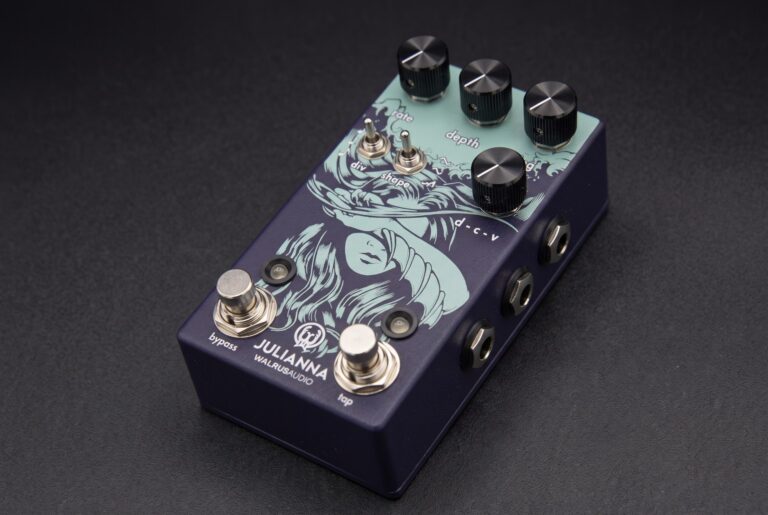
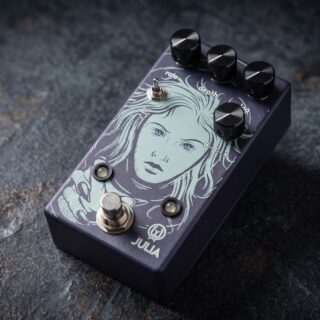
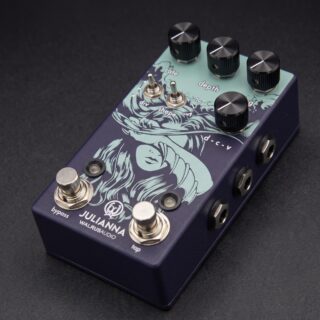
High DAMP, low RATE, plenty of dry. Per Fairfield’s own note, this is where the modulation stops reading as pitch movement and starts reading as chorus. Compare it directly against a Boss CE-2W or a Walrus Julianna: those are gorgeous and regular, this one drifts. On arpeggios it sounds like a slightly detuned twelve-string that keeps changing its mind.
3. Full Vibrato, Broken Rotary
Rate noon · Damp 11 o’clock · Depth 2 o’clock · LPG noon · Mix full clockwise · Volume 1 o’clock
100 percent wet. No dry signal means no comb filtering, so this is pure pitch movement. Because the rate is random, it never resolves into the rotating-speaker pulse you get from a Strymon Mobius Leslie model. It sounds like something mechanical that has lost a bearing. Superb under a clean tremolo-picked figure.
4. Lo-Fi Gate
Rate 1 o’clock · Damp 10 o’clock · Depth 10 o’clock · LPG fully counter-clockwise · Mix 1 o’clock · Volume 2 o’clock
LPG at minimum chokes quiet notes and shortens decay. Hit hard and the note opens; play softly and it half-disappears. Add Volume to compensate. This is the Shallow Water at its most synthetic, and the setting that most clearly reveals its modular-synth ancestry.
5. Ambient Bed
Rate 9 o’clock · Damp 2 o’clock · Depth noon · LPG 2 o’clock · Mix 1 o’clock · Volume noon
Into reverb — a Caroline Météore or an OBNE Dark Star — this is the pedal’s natural habitat. High LPG keeps sustain long, high DAMP keeps movement slow, and the randomness means a held chord under a long reverb tail never sits still. The mild BBD hiss at this LPG setting reads as air rather than noise once there is reverb behind it.
6. Just Enough
Rate 11 o’clock · Damp 1 o’clock · Depth 9 o’clock · LPG 11 o’clock · Mix 10 o’clock · Volume noon
Depth low, mix mostly dry. Almost inaudible when you A/B it quickly, obviously missing when you switch it off after ten minutes. This is the always-on setting, and it is the one most professional users are actually running. Fairfield’s “less is more” note in the manual is aimed squarely here.
All settings assume BOOST on, PAD off, LPG Adjust at factory position, and a guitar with moderate-output pickups. Clock positions are approximate; this pedal rewards small movements.
How It Compares
Against conventional BBD choruses
The CE-2, the CH-1, the Nano Clone and the JHS 3 Series Chorus all do something the Shallow Water cannot: produce a stable, repeatable, musically-locked shimmer. If you need the sound of a 1981 record, buy one of those. The Shallow Water cannot be made to sound like a CE-2 at any setting, and Fairfield have never suggested otherwise.
Against Chase Bliss
The Warped Vinyl HiFi is the closest philosophical relative — a BBD modulator built around waveform manipulation and tape-warble aesthetics. But the Warped Vinyl’s radicalism is in shaping a waveform (its ModuShape splits the LFO’s rise and fall between different wave types), which is still a cyclical proposition. The Shallow Water abolishes the waveform entirely. The Warped Vinyl also brings presets, MIDI, expression and sixteen dip switches; the Shallow Water brings six knobs, two jumpers and a trimpot. Different theories of how much control a musician should be handed.
Against tape emulations
Strymon’s El Capistan and Volante both offer wow and flutter parameters that model tape instability, and the Volante’s mechanics are genuinely convincing. But they are delays with instability applied; the Shallow Water is instability with a delay attached. If you want the warble without the repeats, this is a more direct route than turning a tape echo’s feedback to zero.
Against the flanger/phaser world
Fairfield’s own copy calls it a “vibrato/chorus/flanger-type thing,” and at high Depth with a mostly-wet mix there is a metallic edge that gestures toward an Electric Mistress. But there is no feedback path and no resonance control, so it never gets to jet-plane territory. A Phase 90 or a Small Stone does something else entirely.
Against pitch manipulators
The Thermae and the Red Panda Particle V2 are the pedals people reach for when they want overt, dramatic pitch movement. The Shallow Water’s DEPTH range is deliberately narrow. It is a texture device, not a special-effects device.
Buying Guide
New: $455 CAD direct from Fairfield, with international dealers listed on their site. It launched in 2017 at $325 CAD with a $275 CAD presale price, so the current figure reflects nearly a decade of inflation on a hand-built product rather than a repositioning.
Used: The Shallow Water holds value well and rarely sits long. Because it has been in continuous production with no version changes, a used unit from 2018 is functionally the same pedal as a new one — a genuinely unusual situation in the boutique market, and the opposite of the mkI/mkII/HiFi archaeology that surrounds Chase Bliss purchases.
Special Edition: Fairfield have released Special Edition finishes of the Shallow Water, with an SKFM variant demonstrated on their own channel in September 2023. These are cosmetic runs; the circuit is the standard one. Pay a premium only if you want the look.
What to check on a used unit: Open the backplate. Confirm the BOOST and PAD jumpers are in factory position (BOOST on, PAD off) unless the seller told you otherwise, and be aware that a previous owner may have moved the LPG Adjust trimpot. Neither is a fault, but both change how the pedal behaves out of the box, and a “this one sounds wrong” complaint about a Shallow Water is very often just a trimpot someone turned.
Who should not buy one: Anyone who needs a chorus to sit in a specific place in an arrangement every night. Anyone playing to a click with layered parts that must phase-align. Anyone who wants presets, MIDI or stereo. It has none of those things and never will.
Living With It
Power. 9 to 9.6 V DC regulated, centre negative, 2.1 mm, 40 mA maximum. There is no battery compartment. Any isolated supply with a spare 9 V output handles it comfortably. Fairfield build in reverse-polarity and overvoltage protection, which is more than many boutique builders bother with, but check polarity anyway.
Placement. Conventional wisdom puts modulation after drive and before delay and reverb, and that works. But because the LPG responds to input envelope, the Shallow Water behaves noticeably differently depending on what hits it. After a compressor, the envelope flattens and the LPG’s gating action becomes less dramatic. Straight after the guitar, it is at its most responsive. Both are valid; they are not the same pedal.
Gain staging. Repeating this because it is the number one owner complaint: if you hear unwanted breakup, the BOOST jumper is probably still on and your signal is hotter than a single-coil. Move it off for 6 dB less gain. Line-level sources should also engage the PAD.
Noise. The BBD hisses at high LPG settings. Fairfield say so in the manual. It is audible in a quiet room at bedroom volume and essentially irrelevant in a mix or on a stage. If it bothers you, roll LPG back — you will lose some sustain and brightness in the bargain.
Bass and other instruments. True bypass, 1 MΩ input, and a delay of only a few dozen milliseconds mean the Shallow Water works on bass, keys and other sources without the low-end mud a longer modulation delay would create. Fairfield’s own positioning is instrument-agnostic: “any style of music, any type of instrument.”
Build. 4.7″ x 3.8″ is a mid-size enclosure — bigger than a Boss compact, smaller than a two-footswitch box. Top-mounted jacks are not part of the design, so budget for cable clearance on a crowded board.
Frequently Asked Questions
Is the Shallow Water a chorus or a vibrato?
Both, on one control. MIX fully clockwise is 100 percent wet, which is vibrato — pitch modulation with no dry reference. Blending dry back in creates the moving comb filters we hear as chorus. There is no switch and no separate mode; it is a continuous blend between the two.
What does “k-field” actually mean?
It is Fairfield’s own coinage, defined in their product copy as “an undefined, two-dimensional, non-linear field where past and future forces interact at irregular intervals.” Practically, it is a name for what the pedal does: modulate a short delay time randomly rather than cyclically. No other manufacturer uses the term because no other manufacturer builds this.
Is it analog or digital?
Both, in a specific division of labour. The audio path is analog — a bucket-brigade delay device, exactly like a vintage chorus. The modulation source is a program running on a microcontroller, generating pseudo-random voltages. Your signal never gets converted; only the control voltage is digitally derived.
Why does it distort when I plug in my humbucker guitar?
Almost certainly the internal BOOST jumper, which ships in the on position because Fairfield voiced the default for high-impedance, low-output signals like single coils. Moving it off drops overall gain by 6 dB. For line-level sources, also switch the PAD on for another 6 dB and a tenfold reduction in input impedance.
Why does turning DAMP up seem to reduce the effect?
Because it does, at high RATE settings, and Fairfield document this as normal behaviour. Rapid random variations struggle to pass through the integrator and filter when DAMP is high, so perceived modulation drops. The manual’s advice is that this interaction “needs to be tamed through experimentation.” Reduce RATE as you increase DAMP.
Can I get a fixed, predictable chorus out of it?
No. There is no LFO to set. Randomness is architectural, not a mode. If you need a repeatable sweep, you need a different pedal — the CE-2W, the Walrus Julia V2, or a Mobius.
Is there a stereo version, MIDI, or an expression input?
No, no and no. The Shallow Water is mono in, mono out, six knobs, true bypass, no presets. Everything else that can be adjusted lives inside the enclosure.
Which famous players have one on their board?
Three are documented by name in Premier Guitar: Jeff Tweedy of Wilco, whose 2025 Rundown board carries seven Fairfield pedals including the Shallow Water; Bartees Strange, whose 2023 Rundown names it as one of his two modulation pedals; and Joey Landreth of the Bros. Landreth, whose 2023 Rundown lists it alongside a second Fairfield, the Randy’s Revenge.
Image credits
- Top image: GuitarGangsters AI-generated reference illustration, not a photograph.
- Jeff Tweedy: Tristan Loper, Wikimedia Commons, CC BY-SA 2.0.
Latest News
Related
On This Day
Tuesday 10 November
From this week: