The Sober Sibling: Why the Marshall 2061X Handwired Head Hits Harder Than Its Famous Brothers
Marshall 2061X Handwired Head: the discontinued 20W JMP reissue. EL84 voice, silicon rectifier, verified players, tone recipes, buying guide.
Every conversation about small Marshall amps eventually drifts toward the tremolo-equipped 18-watt 1974X or the mythologized Bluesbreaker 1962 combo. The Marshall 2061X Handwired Head — the 20-watt “Lead & Bass” reissue — tends to sit quietly in the corner while its siblings collect the spotlight. That is partly by design. The 2061X has no tremolo, no tube rectifier, no reverb, and no standby switch. It is the stripped-to-the-bones member of the family, and precisely because of that, it does something the fancier models struggle to replicate: it punches. When Drive-By Truckers needed a small-format head that could compete with a live drummer without managing a complex signal path, Mike Cooley reached for a pair of them. When Andy Bell wanted a foundation for Ride’s shoegaze walls of noise, he plugged into a 2061X. When Jeff Beck was experimenting with low-wattage Marshalls late in his career, the 2061X was part of the rig. None of these players needed a tremolo. All of them needed authority at manageable volumes.

This is the guide for the 2061X — what it is, where it came from, what it does differently from the 1974X and the Plexi heads it sits alongside in the Marshall family tree, who actually plays one, what it sounds like at various volumes, and how to find one now that Marshall has discontinued it.
From 18 Watts to 20: How the 2061 Was Born
The story starts in 1965. Marshall had just finished building their first 100-watt stack — the amp that would eventually define stadium rock — but they were also building smaller combos for players who needed something portable and directive. The 1958 (2×10″), 1973 (2×12″), and 1974 (1×12″) were Marshall’s low-power line, each running 18 watts from a pair of EL84 output tubes with three ECC83 preamp valves and an EZ81 tube rectifier. They had two channels and four inputs, a tremolo circuit on the first channel, and — on special order — a spring reverb driven by an ECC86 valve. They sounded magnificent and cost more than average, partly because the tube rectifier and extra preamp valve added cost, and partly because hand-wired point-to-point construction at low volume runs is never cheap.
By 1967 Marshall had rationalised the range. The 18-watt models went out of production and the 20-watt JMP series replaced them. On paper it sounds like an upgrade. In practice it was a cost-reduction exercise that, accidentally, produced a different instrument. The new 20-watt amps lost the EZ81 tube rectifier — replaced by solid-state silicon diodes — and lost one ECC83 preamp valve, dropping from three to two. The tremolo circuit was removed entirely, as was the reverb option. The result was cheaper to build, more reliable in the field, and commercially far more successful. But it was also a tighter, punchier, more mid-forward beast than the tremolo-equipped originals. Less organic sag, more immediate attack.
The 20-watt JMP heads came in several versions. The 2019 was voiced for bass, the 2022 was a guitar-only “Lead” head, and the 2061 split the difference as the “Lead & Bass” — a dual-purpose amplifier that could handle either instrument through its two identically-controlled channels. All three ran the same basic circuit and all three stayed in production until 1973, when Marshall consolidated and moved on. The 2061 never appeared in an official Marshall catalog during its original production run, which makes it historically interesting: a significant amplifier that was somehow never properly documented by the company that built it.
Fast forward to the mid-1990s. A boutique-amplifier movement was growing around appreciation for exactly these low-power British circuits. Small builders — Matchless, Komet, Divided by 13, Germino — were hand-wiring EL84-based amps for players who wanted cranked-amp tone without SPL problems. Marshall watched the market it had invented being reclaimed by cottage-industry competitors and responded in mid-2004 with the Hand Wired Series. Two amps launched simultaneously: the model 1974X (the 18-watt 1×12″ tremolo combo) and the model 2061X (the 20-watt “Lead & Bass” head). Both were built from the original blueprints, fitted with Dagnall transformers wound to the original specifications, and assembled by hand using tagboard point-to-point construction at Marshall’s Bletchley facility. The 2061X stayed in production until approximately 2017, when it was quietly discontinued. Used units now represent the only way to own one new-in-box.
The 1974X vs the 2061X: Two Different Animals in the Same Family
A persistent misconception treats the 1974X and the 2061X as essentially the same amplifier in different form factors — one a combo, one a head. They are not. The circuit differences between the 18-watt and 20-watt designs produce audibly different instruments, and understanding the distinction matters both for buying decisions and for getting the right sounds out of whichever one you own.
The Marshall 1974X uses three ECC83 preamp valves, two EL84 power valves, and one EZ81 tube rectifier. The EZ81 is the key variable. Tube rectifiers introduce a degree of power-supply sag under hard playing — the voltage drops slightly when you dig in, creating a natural compression and bloom that is slow, smooth, and harmonically complex. That sag is part of why the 18-watt Marshalls became famous in the boutique-amp era. The 1974X also has a tremolo circuit on its second channel, adding a dimension of movement that the 20-watt models never offered.
The 2061X, by contrast, uses two ECC83 preamp valves, two EL84 power valves, and a solid-state silicon diode rectifier. Silicon diodes do not sag — the power supply stays stiff and constant under load. The result is tighter low-end, faster attack, and more immediate response. Players who love the 1974X’s bloom may find the 2061X blunter. Players who need a small Marshall to sit in a band mix without getting woofy will find the 2061X is the answer. Vintage Guitar’s February 2006 review of both amps — the definitive early critical assessment — put it cleanly: the 2061X produced “more sparkly highs, with plenty of low-end” and was “slightly more touch-sensitive” than the 1974X. The forum consensus that has accumulated over two decades is similar: the 2061X is a rhythm amp that can compete with a drummer; the 1974X is a lead player’s amp for cranked-up saturated tones at lower stages.
Neither characterisation is absolute. Both amps run the same basic EL84 power stage, and both deliver that particular flavour of Marshall — the mid-forward British character that is neither the Fender scoop nor the Vox chime but something between them. But the 2061X is the punchier, more aggressive of the two. Think of it as the difference between a tube-rectified tweed Fender Deluxe (1974X territory) and a solid-state rectified Fender Pro (2061X territory) — the family resemblance is real, but the personalities diverge under pressure.
Specifications
A Note on the No-Standby Design
First-time owners occasionally assume the missing standby switch is a manufacturing omission or a defect. It is neither. The original 1967–73 model 2061 had no standby switch, and Marshall’s faithful circuit recreation preserves that detail. The 2061X turns on and turns off — there is no intermediate warm-up/idle state. This was standard for amplifiers of this era: the standby circuit became common on larger, more powerful amps where tube longevity under high-voltage idle conditions was a practical concern. On a 20-watt EL84 circuit, simply switching the amp off when not playing is the correct procedure. The EL84s do not require standby to achieve a long service life.
Self-Biasing EL84 Power Section
The cathode-biased EL84 output configuration means the amp automatically sets its own operating point. When your EL84s wear out — and they will, though EL84s in a relatively lightly driven 20-watt circuit tend to last well — you replace them and play. No trip to a technician, no bias probe, no trimmer adjustment. This is a meaningful ownership advantage over fixed-bias amplifiers like the Plexi-derived JCM800 and JVM families, where tube replacement requires professional rebias or at minimum a multimeter and some confidence. For a working player who takes their amp on the road, the 2061X’s self-biasing architecture is a genuine practical asset.
Famous Players
None of the five names most often attached to Marshall amps — Slash, Zakk Wylde, Kerry King, Gary Moore, and Tom Morello — is documented on the 2061X. Slash’s touring and recording rig centres on the Silver Jubilee; Zakk Wylde and Kerry King both use JCM800 2203 heads as their primary Marshall; Tom Morello built his sound on a JCM800 2205; and Gary Moore died in February 2011, four years before the 2061X was discontinued and long after any association with it would need to be established by primary sources. The 2061X carries a different history — quieter, more specific, and more genuinely interesting than a recycled celebrity checklist.

Read our guide to Slash’s guitars and gear.
Jeff Beck
In a Premier Guitar Rig Rundown video, Jeff Beck is documented using a Marshall 2061X Handwired 20W head alongside a Marshall DSL 100, with the 2061X functioning as a secondary amplifier in his rig. Beck’s relationship with his tone was famously exacting — he was not someone who kept gear around without purpose — and his inclusion of the 2061X alongside a full-size modern Marshall suggests he valued what the small EL84 head contributed: a dimension of harmonic complexity and touch sensitivity that the heavier, higher-wattage DSL could not provide on its own. Beck died in January 2023; the Rig Rundown documentation predates his death and constitutes the primary source for his use of this particular amplifier.
Andy Bell (Ride)
The strongest primary-source verification in this article belongs to a player from a genre the 2061X is not typically associated with. Andy Bell of the Oxford shoegaze band Ride is documented as a 2061X user in a February 2016 Premier Guitar feature (“Ride’s Andy Bell: Addicted to Noise,” by Alex Maiolo). Bell’s gear list in that article is unambiguous: “Marshall 2061X 20-watt head” paired with a “vintage Marshall 1960A slant front 4×12 cab.” Bell uses the 2061X as the foundation underneath a dense two-pedalboard effects setup including an Ibanez TS9 Tube Screamer, Fulltone Octafuzz, Eventide TimeFactor, Strymon Mobius, and Eventide Space reverb — the amp itself providing the raw British character that his effects sculpt into the droning, layered textures Ride is known for. The 2061X under Bell’s pedalboard is, in a sense, the opposite of how most players think about this amp: it is not a vintage-blues purism exercise but a high-gain foundation for experimental noise architecture. That versatility says something significant about what the circuit can do when pushed through effects.
Paul Gilbert
Paul Gilbert is listed on Equipboard as a 2061X user. Gilbert is known primarily for high-output humbucker-into-British-amp tones — his Mr. Big years defined a certain flavour of late-1980s arena hard rock — and his use of a 20-watt EL84 head suggests ongoing experimentation with lower-wattage circuits that he has documented in various YouTube and interview contexts. The Equipboard documentation does not specify the recording or live context in which Gilbert used the 2061X, so this is framed as a verified Equipboard listing rather than a confirmed primary-source touring rig.
Mike Cooley (Drive-By Truckers)
The Premier Guitar “Sing Out!” article on Drive-By Truckers (John Bohlinger, November 2016, covering the making of the band’s American Band album) documents the collective rig used during sessions, which included both a Marshall 2061X and a Marshall 1974X. Mike Cooley is Equipboard’s primary attribution for the 2061X within that rig. The article is careful to note that “both Hood and Cooley had a hard time recalling who played what on many tracks,” which creates some ambiguity about instrument-by-instrument attribution, but the 2061X was confirmed present in the session environment. Cooley’s public Instagram from roughly the same period is more specific: “Just finished putting my ‘lil rig together. Two 20 watt Marshall Amplification 2061Xs with custom 2×10 Swanson cabs loaded with Celestion Alnico Golds. Killer sounding set-up for small stages.” Two units, specific cab spec, explicit rationale (small stages). That is about as clear a verification as the used-market amp world offers.

Hammock
The Nashville ambient duo Hammock — Andrew Greer and Marc Byrd — documented their live rig in an Instagram post identifying a “Hand Wired 20-Watt Marshall head” as a new addition to their touring setup. For a band whose sound is built on reverb-drenched guitar washes and layered drone textures, the choice of a minimal 20-watt British head as the signal foundation is consistent with the Andy Bell approach: use the amp as a structural anchor and sculpt the sound with effects.
The Sound of the 2061X
The EL84 output tube is the defining voice of this amplifier, as it is of the broader 18/20-watt Marshall family and of Vox’s AC15 and AC30. Compared to the 6L6 of American Fender amps or the EL34 of the large-format British Marshalls, the EL84 is lighter in the low end, more prominent in the upper midrange, and breaks up at lower thresholds. That breakup character — the specific harmonic content of two driven EL84s into a reasonably efficient speaker — is the reason boutique builders spent the 1990s recreating this circuit in small numbers at high prices.
What distinguishes the 2061X from its EL84 cousins is the silicon diode rectifier. Where the 1974X’s EZ81 tube rectifier adds sag and bloom under attack, the 2061X responds immediately — every pick stroke arrives at the speaker with full voltage behind it. The result is tighter, more percussive, and more mid-forward than the 1974X. Vintage Guitar’s reviewers noted that it produced “more sparkly highs” with a sound that was “slightly louder, with more low-end” than the combo — attributing the extra punch partly to the closed-back 2×12″ companion cabinet, which pressurises the low frequencies in a way an open-backed combo does not.
The Lead channel (high-sensitivity inputs) is the brighter, more present voice — turning up the Tone control all the way increases gain on the high channel in a useful, non-harsh way that experienced 2061X players treat as a primary dirt-generation technique. The Bass channel (second set of inputs) is slightly darker and fuller, more willing to stay clean at moderate volumes. Both channels are simple: Volume and Tone. No bass, mid, or treble separation. The Tone control is a single passive control that rolls off the top end as it goes counterclockwise — it is most accurately described as a “treble cut” rather than a full three-band EQ. For players accustomed to the Presence/Resonance/Treble/Mid/Bass architecture of the JVM or DSL series, the 2061X’s control set is an education in how much tone is available from a single circuit when the fundamental design is right.
The Channel-Link Technique
A technique specific to Marshall amps with two sets of inputs on separate channels is channel linking: use a short ¼” instrument cable to connect the low-sensitivity input of one channel to either input of the other, then plug your guitar into the high-sensitivity input of the first channel. The result is a blended signal that combines the tonal characters of both channels — in the 2061X’s case, the Lead channel’s brightness with the Bass channel’s warmth and body. The Volume and Tone controls of both channels remain active, giving you a level of tonal shaping that the individual channels cannot provide. This is not a Marshall modification; it was a technique used with original JMP-era amps in the 1960s and 1970s and remains fully applicable to the 2061X reissue. When Cooley ran two 2061Xs, he had two full amplifiers to blend — a stereo approach that amplifies the technique further.
Tone Recipes
1. Touch-Sensitive Blues — Jeff Beck Territory
Lead channel, high-sensitivity input. Volume at 5–6, Tone at 7. Use a Stratocaster with single-coil pickups into the amp clean-ish — the amp should just start to growl at the peak of a hard pick attack but stay clean when you back off. The silicon rectifier’s tightness rewards the kind of attack-variable playing Beck built his career on: dig in for hair, roll back for clean. No overdrive pedal. If you need more push, add an Ibanez TS9 Tube Screamer with the drive below noon and the level above unity — the amp does the distorting, the TS9 adds sustain and focus.
2. Shoegaze Foundation — Andy Bell Approach
Lead channel, Volume at 7, Tone at full. A Les Paul or P-90-equipped semi-hollow into the high-sensitivity input. The amp should be breaking up significantly — at 7 on the volume, 20 watts into an efficient 2×12″ is loud and saturated. Stack a heavy reverb (Strymon Big Sky or EHX Holy Grail on Hall) post-amp for depth, then add modulation (chorus or phaser) before the reverb. The 2061X’s tight, direct response prevents the reverb from becoming muddy; the silicon rectifier’s consistency under sustained chords is the foundation the wash builds on. Loud. This is not a bedroom amp setting.
3. American Band — Cooley’s Dual-2061X Approach
Two 2061Xs, each into a 2×10″ or 2×12″ cabinet. Bass channel on the left, Lead channel on the right. Volume matched across both at 6–7, Lead channel Tone at 8, Bass channel Tone at 5. A Telecaster or a semi-hollow into a Boss SD-1 before the split — the SD-1’s mid push fills the frequency gap between the two channels and tightens the attack without obscuring the amp’s natural character. This is a working-band country-rock setting that can compete with a loud drummer at reasonable microphone distances.
4. Classic British Crunch — Rhythm Rock
Channel-linked: short cable from low-input of Bass channel to high-input of Lead channel, guitar into high-input of Lead channel. Lead channel Volume at 6, Bass channel Volume at 4. Tone on Lead at 7, Tone on Bass at 6. Les Paul with humbuckers. The blended channels give a midrange richness the individual channels cannot achieve alone, and the slight volume imbalance creates a natural harmonic layering in the distorted signal. No external overdrive needed. A Pro Co RAT 2 before the input can push the amp harder when you need a solo boost.
5. Low-Volume Studio Reference — Small-Room Recording
Lead channel, Volume at 3–4, Tone at 6. A vintage-spec or boutique attenuator (THD HotPlate or Rivera RockCrusher) between the amp and a closed-back 1×12″ cabinet loaded with a Celestion G12H-30 — the same speaker as the companion 2061CX. With the attenuator pulling 6–12dB, the 2061X operates in its power-amp saturation zone at speaker volumes suitable for close-microphone placement in a control room. This is where the silicon rectifier’s tightness becomes a studio advantage: the recorded transient response is clean, defined, and consistent across takes, without the variable sag that can make single-coil recordings sound inconsistent on a tube-rectified amp.

How the 2061X Compares to Its Marshall Relatives
vs. the Marshall 1974X Handwired Combo
The most common comparison and the one most worth making carefully. The 1974X uses a tube rectifier (EZ81), three ECC83 preamp valves, and includes a tremolo circuit. The 2061X uses silicon rectification, two ECC83s, and has no tremolo. The 1974X is warmer, more organic, more sag-heavy — it blooms under attack and has a Vox-adjacent quality that makes some players describe it as “sweeter.” The 2061X is tighter, punchier, more midrange-dominant, and responds more immediately. For lead playing and blues expression, many players prefer the 1974X. For rhythm-track work and competing in a loud band, the 2061X wins. The 1974X is a combo (1×12″ open-back); the 2061X is a head that pairs with the closed-back 2×12″ 2061CX, adding low-end presence. For home recording: the 1974X. For small-venue gigging with a drummer: the 2061X.
vs. the Marshall 1987X Plexi Reissue
The 1987X is 50 watts, EL34-based, and was designed to serve stadiums and large clubs. Its tonal character is aggressive, mid-heavy, and demands high volume for the power section to saturate. The 2061X reaches its sweet spot at 20 watts — usable in clubs, studios, and rehearsal rooms. The 1987X has more headroom at lower volumes and more presence in the upper midrange. The 2061X has more bloom and harmonic complexity at its working volume range. If you play a medium-sized venue regularly, the 1987X may suit your stage volume requirements; if you want cranked-Marshall tone in contexts where the 1987X cannot be cranked without disrupting everyone else, the 2061X is the practical choice.
vs. the Marshall Origin 20H
The Origin 20H is Marshall’s modern EL34-based 20-watt head with a power reduction switch. It is cheaper than a used 2061X, currently in production, and easier to service. Its tone is voiced toward the classic Marshall JTM45 and Plexi character — bright, present, clear. The 2061X’s EL84 power section is a fundamentally different voice: softer in the high-mids, more compressed at clipping, with a distinctive upper-harmonic texture that EL34 amps do not produce. Players who want the specific EL84 character should not assume the Origin 20H is a direct substitute just because the wattage matches. They are different amps serving the same wattage bracket.
vs. the Marshall Studio Classic SC20H
The SC20H is a modern, PCB-based recreation of the JCM800 circuit with a power reduction switch. It uses EL34 output tubes and has master volume control, channel selection, and the full architectural flexibility of a JCM800. The 2061X has none of those features. The SC20H is for players who want JCM800 tones at bedroom-to-small-stage volumes with modern convenience. The 2061X is for players who want a direct connection to 1960s Marshall simplicity — two channels, four inputs, Volume and Tone, and nothing else between the guitar and the speaker. They are almost philosophically opposite products despite being in the same wattage neighbourhood.
vs. the Marshall JCM2000 DSL100
Jeff Beck used both in the same rig, which is the best illustration of why they are not interchangeable. The DSL100 is 100 watts, EL34-based, multi-voiced, with a master volume, channel switching, effects loop, and a wide range of gain structures. It can approximate many Marshall archetypes and handles modern music’s demands for quickly-switchable tones. The 2061X can only do what it can do: 20 watts of EL84 voice, two channels, no frills. What it does, it does completely. Beck was apparently using the DSL100 as his primary workhorse and the 2061X as a second voice — supplementing the bigger amp’s breadth with the small head’s specific harmonic character.
Buying Guide: Finding a 2061X in 2026
Marshall discontinued the 2061X around 2017, which means your only purchase option is the used and vintage market. The good news is that the used supply is reasonably healthy — Reverb typically shows multiple listings, and specialty dealers like Carter Vintage and Chicago Music Exchange occasionally stock them. The bad news is that prices have not collapsed the way discontinued Marshall production models sometimes do, because the 2061X was never cheap and was always produced in relatively limited numbers. Expect to pay $800–1,000 for a player-condition head with cosmetic wear, $1,100–1,400 for an excellent or near-mint example.
The companion 2061CX cabinet — loaded with two Celestion G12H-30 reissues in a closed-back 2×12″ enclosure — turns up on Reverb as well, sometimes alongside a 2061X head and sometimes separately. Many players pair the 2061X head with other 2×12″ or 4×12″ cabinets; the closed-back G12H-30 combination is specifically what Marshall voiced the head against, but the circuit’s relatively flat response at the output stage means it is more speaker-agnostic than some highly-coloured circuits. A Celestion V30 or a vintage-spec G12M-65 Creamback are common alternative pairings in forum accounts.
What to Check Before Buying
The EL84 power tubes are the first thing to assess. EL84s in cathode-biased circuits run warmer than those in fixed-bias configurations and have shorter lifespans under heavy use. Any used 2061X should have its power tubes checked with a tube tester, or the budget for replacement should be factored in — a matched pair of quality EL84s costs $30–80 depending on brand and provenance. The self-biasing circuit means you replace them yourself without a technician. New Old Stock (NOS) EL84s from Brimar, Mullard, or Telefunken are sometimes used by players chasing a specific vintage character; current-production Electro-Harmonix, Tung-Sol, or JJ EL84s are reliable and significantly less expensive.
The ECC83 preamp valves (two of them) are longer-lived but worth swapping if the amp sounds unduly noisy or has microphonic ring. Marshall-spec Dagnall transformers rarely fail; if a unit shows signs of transformer trouble (hum that does not relate to gain settings, no output despite otherwise-functioning valves), walk away unless you are confident in your ability to source and install period-correct replacements.
Cosmetically: the brushed gold aluminium faceplate scratches easily, and the gold-script Marshall logo on the control panel is a period detail that reproduction-market versions sometimes get slightly wrong. Originals have a specific font weight and logo proportioning — a useful reference point when comparing listings. The cabinet’s birch plywood construction is durable; check corner joints and the integrity of the grill cloth (the original black-and-gold design is period-correct; any other covering indicates modification or replacement).
A “Royal Standard” limited-edition variant of the 2061X exists — in a dark green “Racing Green” tolex instead of the standard black — produced in limited quantities during the amp’s production run. These command a modest premium on the used market for their rarity and distinctive appearance; the circuit is identical to the standard version.
Ownership Notes
The 2061X is not a complicated amplifier to own. Its simplicity is its greatest long-term advantage. There are no software-controllable parameters to become incompatible with future operating systems, no MIDI routing to troubleshoot, no digital reverb to develop glitches. The circuit that was drawn in 1967 is the same circuit that plays today.
Impedance matching matters, as it does with any valve amplifier without output transformer protection circuitry. The 2061X’s impedance selector should be set to match the cabinet’s nominal impedance. Running the amp into an open circuit (no speaker connected and switched on) can damage the output transformer; always connect a speaker before switching on.
The no-standby design means you switch on, play, switch off. There is no intermediate warm-up ritual required. If you want to warm the amp before playing, simply switch it on, wait two minutes for the EL84s to settle, and play. The absence of a standby switch is a feature, not an omission.
Volume. Twenty watts into an efficient closed-back 2×12″ cabinet is genuinely, practically loud. The 2061X at volume 6 on the Lead channel, playing through the companion 2061CX in a small rehearsal room, will require hearing protection. Players accustomed to the clean headroom of a 100-watt Marshall sometimes underestimate how much pressure a driven 20-watt EL84 amp generates. If you need lower stage volumes with the amp in its saturation zone, a quality power attenuator is the appropriate solution — the circuit responds well to attenuation, maintaining its character at reduced levels in a way that master-volume amps do not always replicate.
The 2061X in the Marshall Family Tree: A Contextual Summary
The Marshall 2061X sits at an unusual intersection in the Hand Wired Series: it is the only handwired head without a tube rectifier, without tremolo, and without the 18-watt circuit mythology that made boutique-market EL84 Marshalls famous. In exchange for those features, it offers something none of its premium siblings can provide: the silicon-rectified punch and midrange authority of the original JMP-era 20-watt design, in a faithful reproduction that Marshall assembled by hand from the original Dagnall transformer specifications.
The players who have used it are a genuinely diverse group. Jeff Beck brought fastidious tone standards to his selection; Andy Bell brought shoegaze noise-architecture ambitions; Paul Gilbert brought shred-school technique; Mike Cooley brought working-band pragmatism and ran two of them simultaneously. None of these players needed the amp to be anything other than what it is: honest, direct, characterful at volume, and small enough to take anywhere.

If the 1974X is the romantic EL84 Marshall — tremolo shimmer, tube-rectifier sag, the sound of 1960s British rock in its most vulnerable and expressive form — the 2061X is the working EL84 Marshall, the one that punches rather than sighs, that pushes rather than blooms. Both are necessary. Both are irreplaceable in their own way. For players who have spent years chasing sag and bloom in boutique circuits, the 2061X may seem blunt at first. Give it a band context and it reveals its purpose immediately.
Frequently Asked Questions
Is the Marshall 2061X still being made?
No. Marshall discontinued the 2061X around 2017. The used and vintage market — primarily Reverb, specialist dealers like Carter Vintage and Chicago Music Exchange, and occasionally eBay — is the only purchase channel. Budget $800–1,400 depending on condition; the companion 2061CX cabinet adds roughly $400–700 if found in good condition.
What is the difference between the 2061X Lead channel and the Bass channel?
Both channels run through fundamentally the same circuit with the same component values. The Lead channel (first channel, high and low inputs) has a slightly brighter and more present character; the Bass channel (second channel) is marginally darker and fuller. In the original 1967–73 model, the naming indicated the intended instrument — Lead for guitar, Bass for bass guitar — but the circuit differences are subtle enough that guitarists regularly use both channels. Channel linking (connecting the two with a short patch cable) blends both characters into a third, richer voice.
Why does the 2061X sound different from the 1974X if they use the same power tubes?
The rectifier is the primary reason. The 1974X uses an EZ81 tube rectifier, which introduces power-supply sag under hard playing — the voltage drops when you dig in, creating compression and bloom. The 2061X uses silicon diodes, which maintain constant voltage under load: no sag, no compression, just immediate linear response. The 2061X also uses two ECC83 preamp valves vs. the 1974X’s three, which affects gain staging. The result is a tighter, punchier character versus the 1974X’s warmer, more organic response.
Is the 2061X loud enough for a gigging band?
Yes, but context matters. Twenty watts into a closed-back 2×12″ cabinet with efficient speakers can compete with a moderately played drum kit in a small-to-medium venue. For larger rooms or louder drummers, you will need either supplementary amplification or microphones and a PA. Mike Cooley’s solution — two 2061Xs simultaneously — effectively doubled available power and gave him stereo imaging on small stages without resorting to a 100-watt Marshall. At volume levels where the 2061X saturates its output stage, it is genuinely loud.
Can I use the 2061X with any 8-ohm or 16-ohm speaker cabinet?
Yes. The impedance selector on the rear panel allows you to match the output transformer to the cabinet’s nominal impedance. Use the correct setting for whichever cabinet you are connecting. The 2061CX companion cabinet is 16 ohms; the more common 4×12″ and some 2×12″ cabinets are 8 or 16 ohms. Always verify the cabinet’s impedance before connecting.
Do I need to rebias the 2061X when replacing EL84 tubes?
No. The cathode-biased EL84 output configuration is self-biasing: the operating point is set automatically by the circuit. Replace the matched EL84 pair, switch on, and play. No rebias procedure, no test equipment required. This is one of the 2061X’s practical ownership advantages over fixed-bias Marshall circuits like the JCM800 and JVM families.
What is the “Racing Green” variant?
During the 2061X’s production run Marshall released a limited “Royal Standard” edition in dark green “Racing Green” tolex — the same colour scheme used on certain vintage Marshall export variants. The circuit is identical to the standard black-tolex version; the premium is for rarity and appearance. Racing Green examples turn up occasionally on Reverb at a modest premium over standard examples.
What speakers work best with the 2061X head if I can’t find the 2061CX cabinet?
The companion 2061CX uses Celestion G12H-30 reissues in a closed-back 2×12″. Players who have used alternative pairings most frequently recommend the Celestion V30 (more aggressive upper-mid presence, good for rock), the Celestion G12M-65 Creamback (warmer, more balanced), or — for the most authentic vintage character — original 1960s or 1970s Celestion G12M “Pulsonic cone” speakers in a period Marshall 2×12″ cabinet. Avoid pairing the 2061X with very high-efficiency speakers (above 100dB/W/m) unless you are running a power attenuator: the amp’s 20 watts will be considerably louder than expected.
Image credits
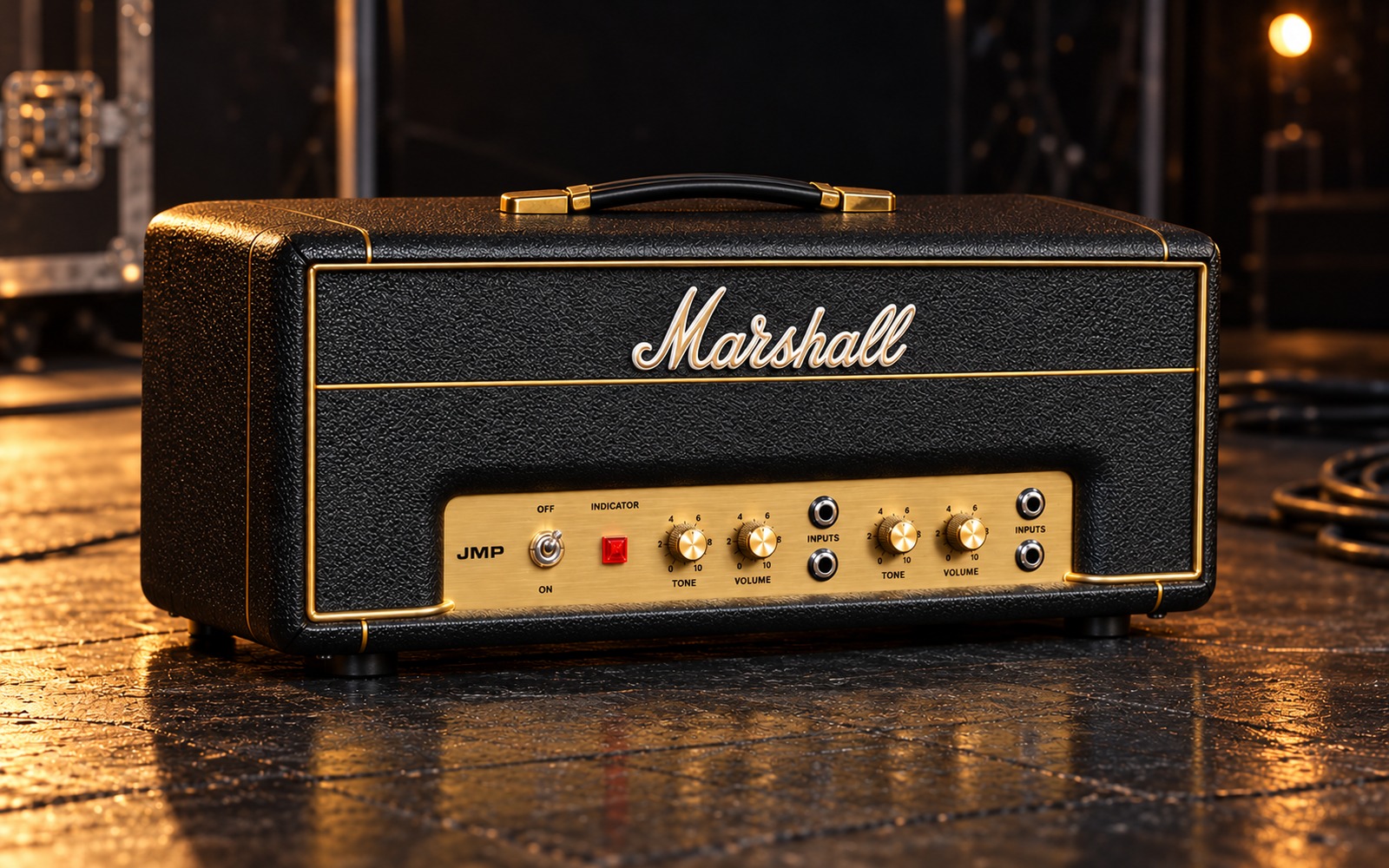
- Top image: GuitarGangsters AI-generated reference illustration, not a photograph.
- Jeff Beck: Shannon Kringen from USA, Wikimedia Commons, CC BY-SA 2.0.
- Zakk Wylde: Joanna Corwin, Wikimedia Commons, CC BY-SA 3.0.
- Paul Gilbert: matt barsden, Wikimedia Commons, CC BY-SA 2.0.
- Jeff Beck: Shannon Kringen, Wikimedia Commons, CC BY-SA 2.0.
- Mike Cooley: The original uploader was Saverivers at English Wikipedia, Wikimedia Commons, CC BY-SA 2.5.
Latest News
Related
On This Day
Tuesday 10 November
From this week: