Fender Deluxe Reverb: The 22-Watt Amp That Quietly Recorded Everything
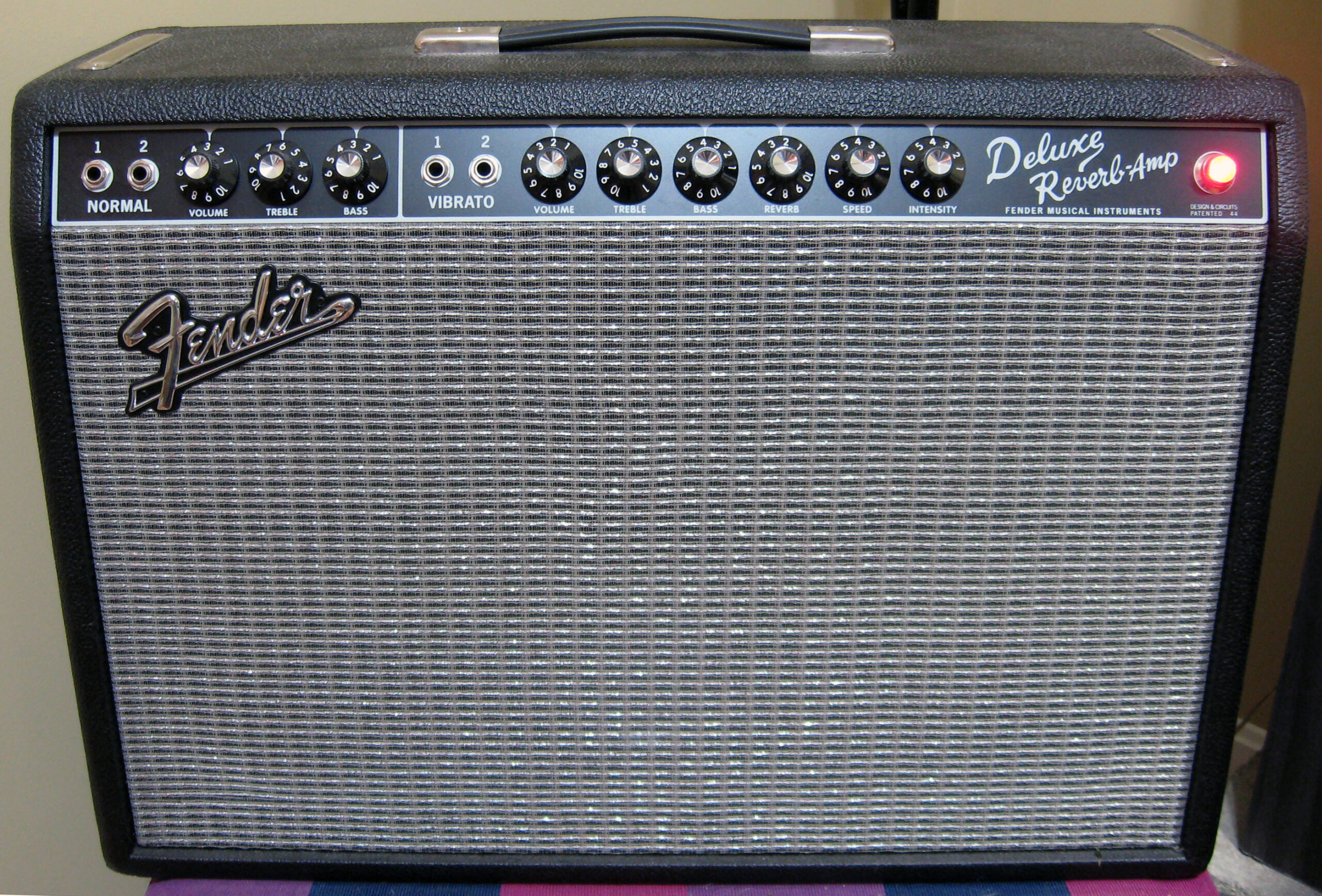
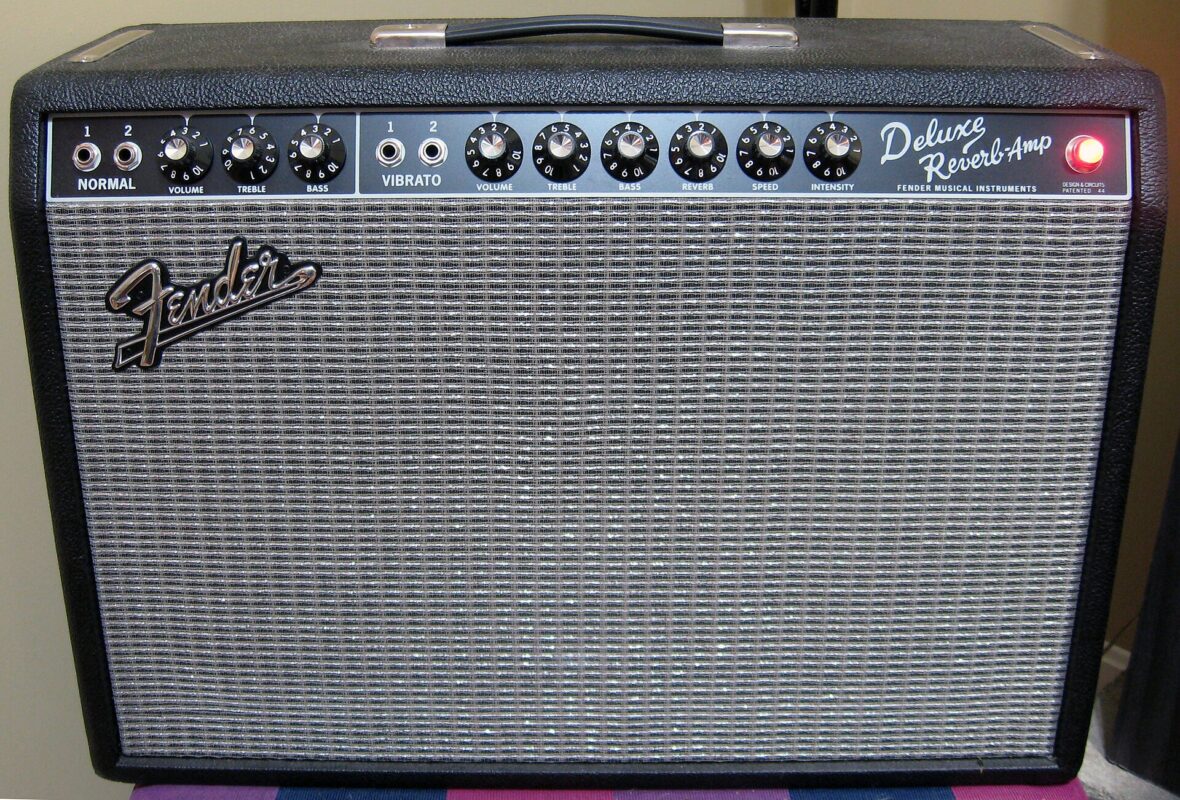
Fender Deluxe Reverb amplifier, front view. Photo: DlxReverbFront.jpg by Diego at English Wikipedia, CC BY-SA 3.0 (https://creativecommons.org/licenses/by-sa/3.0/). Original source preserved; full frame retained with resized web versions. This image derivative is licensed under CC BY-SA 3.0. Source: https://commons.wikimedia.org/wiki/File:DlxReverbFront.jpg
The full story of the Fender Deluxe Reverb: AB763 circuit, blackface vs silverface dating, verified players, tone recipes and a 2026 buying guide.
There is a particular kind of fame that comes from being the loudest thing in the room. The Marshall 1959 Super Lead has it. The JCM800 2203 has it. And then there is the other kind of fame, the kind that belongs to the amplifier sitting on the studio floor in the corner of a thousand photographs, the one nobody points at, the one that is actually making the sound you remember.
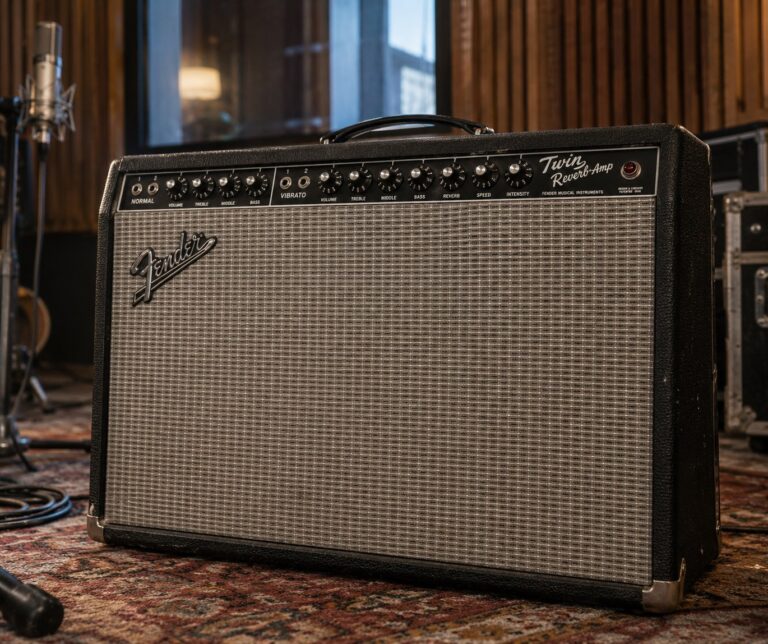
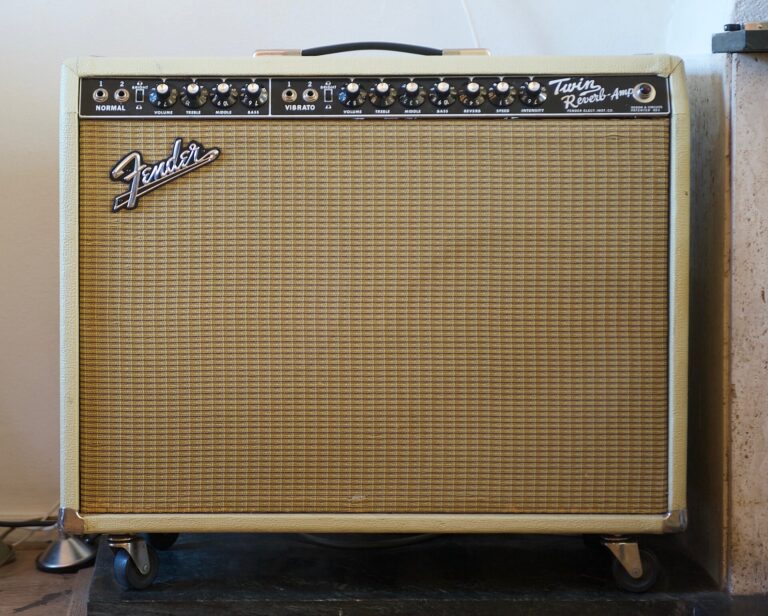
That is the Fender Deluxe Reverb. Twenty-two watts. One twelve-inch speaker. Two channels, one of which does nothing clever at all. No master volume, no effects loop, no channel switching, no gain stage stacked on top of another gain stage. Forty-two pounds of birch plywood and black Tolex that has been in almost continuous production since late 1963 and which, by any reasonable accounting, appears on more finished records than any other guitar amplifier ever built.
The Deluxe Reverb is the amp that solved a problem nobody had articulated yet: how do you make a Fender that is loud enough to gig, quiet enough to record, light enough to carry, and clean enough to let the guitar and the pedals be the interesting part? Leo Fender’s engineers did not set out to build the default. They set out to add a reverb tank to a mid-power combo. What came out the other end became the reference tone for clean American electric guitar, and it has not been dislodged in sixty-three years.
This is the story of that amp: where it came from, why the circuit behaves the way it does, which famous players actually used one and which ones the internet has quietly invented, and what to look for if you are about to spend money on one.
Before Reverb: The Deluxe Family Tree
The Deluxe name is older than the reverb tank by a long stretch. Through the tweed era Fender built a run of Deluxes ending in the legendary 5E3 — a cathode-biased, no-negative-feedback, interactive-volume-control amp that starts to compress and howl at about four on the dial and is beloved precisely because it is so badly behaved. The 5E3 is not the ancestor of the Deluxe Reverb in any circuit sense. It is the ancestor in name only.
Between the tweed and the blackface came the brown-Tolex era: the 6G3 Deluxe, built roughly 1961 to 1963, with fixed bias, negative feedback, a proper tone stack and Fender’s tube-driven tremolo. This is where the modern Deluxe voice begins. The brown-panel amps are the transitional generation that turned Fender combos from raucous small-club machines into the hi-fi-adjacent clean platforms of the mid-sixties.
Then, in late 1963, Fender did to the Deluxe what it had already done to the Twin: it dropped the whole line into the new black-panel cosmetic scheme and added the outboard-quality spring reverb that had previously only lived in the standalone Fender Reverb Unit. The Deluxe Reverb arrived alongside the Princeton Reverb, the Vibrolux Reverb and the Twin Reverb, all cut from the same circuit cloth. Within a year it had become the default backline amp on studio floors across America, and it never really stopped being that.
AA763, AB763, and Why Nobody Can Hear the Difference
The earliest production Deluxe Reverbs, from late 1963 into early 1964, carry the AA763 circuit designation. In 1964 Fender revised it to AB763, changing phase inverter resistor values — the long-tail resistor went from 22k to 27k, and the 12AT7 phase inverter’s upper plate resistor dropped from 100k to 82k — which nudged the headroom up slightly.
Here is the honest version: in a band, through a speaker, at playing volume, AA763 and AB763 are the same amp. Both are universally called “blackface.” AB763 is the one every reissue and every boutique clone is based on, and it is the circuit designation that became a shorthand for an entire school of amplifier design. If a seller is charging you a premium for an AA763 chassis on tonal grounds, they are selling you a story.
The Engineering: Four Reasons It Sounds Like That
The Deluxe Reverb’s character is not mystical. It comes from four specific, identifiable design decisions, and understanding them tells you more about how to use the amp than any amount of listening to demo videos.
1. Two 6V6s, run hard. The nominal 22-watt rating is achieved by operating a pair of 6V6 output tubes substantially above their published maximum plate voltage. This was deliberate. It is also the single most consequential decision in the whole design, because it means the power section is always close to its limit — which is exactly why the amp goes from clean to singing so gracefully somewhere around six on the volume knob, and why it never has the glassy, unbreakable headroom of a 6L6 amp. The trade-off is real: sixties new-old-stock 6V6s are working near their ceiling in this amp, and modern production 6V6s from JJ, Tung-Sol, Sovtek or Electro-Harmonix are designed for the higher plate voltages and are the more sensible choice for a gigging amp.
2. A tube rectifier. Every blackface and silverface Deluxe Reverb, and every current tube reissue, uses a 5AR4 (also stamped GZ34) rectifier tube. This is the opposite of the Twin Reverb, which has used a solid-state rectifier from day one because its power draw made a rectifier tube impractical. The 5AR4 sags: when you hit the amp hard, the supply voltage momentarily dips and recovers, which softens the transient attack and adds a bloom to the note that players describe as “feel.” Half of what people love about a Deluxe Reverb and cannot articulate is the rectifier.
3. One twelve, and not a big one. Blackface Deluxe Reverbs shipped with the small-magnet Jensen C12Q or, later in the run, an Oxford 12K5. Neither is a high-headroom speaker. The cone starts to move and compress at volumes where a Twin Reverb‘s pair of twelves are barely awake. That speaker compression is part of the voice, not a limitation to be engineered out — which is why Fender’s own ’64 Custom deliberately reverts to the C12Q rather than fitting something louder.
4. The Vibrato channel is not the same as the Normal channel. Channel one, Normal, is a straight two-stage preamp into the tone stack. Channel two, Vibrato, picks up an extra gain stage (shared with the reverb recovery) plus the reverb and tremolo circuits. The practical consequence: the Vibrato channel is hotter and breaks up earlier at the same volume setting. Experienced players use this as a built-in two-stage volume system — Normal for the clean pedal-platform sound, Vibrato when you want the amp itself to contribute.
Tube Positions in an AB763 Deluxe Reverb
| Position | Tube | Function |
|---|---|---|
| V1 | 7025 / 12AX7 | Normal channel preamp |
| V2 | 7025 / 12AX7 | Vibrato channel preamp |
| V3 | 12AT7 | Reverb driver (drives the tank transformer) |
| V4 | 7025 / 12AX7 | Reverb recovery + Vibrato channel second stage |
| V5 | 12AX7 | Tremolo oscillator |
| V6 | 12AT7 | Long-tailed-pair phase inverter |
| V7, V8 | 6V6GT | Output tubes, push-pull, 22 W into 8 ohms |
| V9 | 5AR4 / GZ34 | Tube rectifier |
Nine tubes. The “7025” stamp on vintage units is not a different tube — it is a low-noise selected 12AX7, electrically identical, which Fender specified for the high-gain positions. When you read old documentation that says “three 7025s and one 12AX7,” it is describing four 12AX7-family preamp tubes. Modern replacements marked 12AX7 drop straight in.
Specifications: Vintage and Current Production
| Spec | Vintage blackface | ’65 Reissue | ’64 Custom | ’68 Custom | Tone Master |
|---|---|---|---|---|---|
| Years | 1963–1967 | 1993–present | 2018–present | 2013–present | 2019–present |
| Power | 22 W | 22 W | 20 W | 22 W | 22 W modelled (100 W digital) |
| Output tubes | 2 x 6V6 | 2 x 6V6 | 2 x 6V6 | 2 x 6V6 | None |
| Preamp | 4 x 7025/12AX7, 2 x 12AT7 | 4 x 12AX7, 2 x 12AT7 | 4 x 12AX7, 2 x 12AT7 | 4 x 12AX7, 2 x 12AT7 | None |
| Rectifier | 5AR4 / GZ34 | 5AR4 | 5AR4 / GZ34 | 5AR4 | None |
| Channels | Normal + Vibrato | Normal + Vibrato | Normal + Bright | Custom + Vintage | Normal + Vibrato |
| Reverb / tremolo | Vibrato channel only | Vibrato channel only | Both channels | Both channels | Modelled, Vibrato channel |
| Speaker | Jensen C12Q or Oxford 12K5 | Jensen C-12K | Jensen C-12Q | Celestion G12V-70 | Jensen N-12K neodymium |
| Cabinet | Solid pine / fir ply | Birch plywood | Solid pine | Birch plywood | Solid pine |
| Construction | Hand-wired eyelet board | PCB | Hand-wired eyelet board | PCB, hand-wired sockets | Digital |
| Weight | 42–46 lb | 42 lb / 19.0 kg | 38.2 lb / 17.3 kg | 42 lb / 19.05 kg | 23 lb / 10.4 kg |
| Dimensions (H x W x D) | 17.5″ x 24.5″ x 9.5″ | 17.5″ x 24.5″ x 9.5″ | 16.9″ x 24.3″ x 9.3″ | 17.5″ x 24.5″ x 9.5″ | 17.5″ x 24.5″ x 9.5″ |
| Effects loop | None | None | None | None | None (XLR out instead) |
| New price, 2026 | n/a | $1,400–1,600 | $2,500–2,800 | $1,500–1,700 | $1,000–1,100 |
A note on that table that catches people out constantly: no tube Deluxe Reverb in Fender’s current lineup uses solid-state rectification. Forum posts claiming the ’65 Reissue is solid-state rectified are simply wrong. Solid-state rectification appears in exactly two places in this model’s history — the 1982–1986 Deluxe Reverb II, and the entirely digital Tone Master.
The Era Guide: Blackface, Silverface, Rivera, Reissue
Blackface, 1963–1967
Black Tolex, black control panel, white lettering, silver-and-black sparkle grille cloth, cream chicken-head knobs. Fender was sold to CBS in January 1965, and the panel script changes from “Fender Electric Instrument Co.” to “Fender Musical Instruments Corp.” That is a genuine cosmetic marker but a weak sonic one — a late-1964 amp and an early-1965 amp were built by the same people at the same benches from the same parts bins. The pre-CBS premium is a collector preference, not a measurable difference.
One genuinely useful dating oddity: Fender’s tube-chart date stamps use a year letter followed by a month letter. January 1966 should read “PA,” but the production staff forgot to advance the year stamper, so January and February 1966 amps are stamped “OA” and “OB,” in dark green ink rather than the usual black. If you see OA or OB, check the panel script: “Fender Electric Instruments” means it really is 1965; “Fender Musical Instruments Corp.” means the stamp is wrong and the amp is a 1966. This anomaly, along with most of the modern Fender amp dating framework, traces back to the research Greg Gagliano, Devin Riebe and Greg Huntington published in 20th Century Guitar in the late nineties.
Silverface, 1968–1981
The silverface era splits neatly into two halves, and the split matters more than the cosmetics.
1968 to 1971 amps retained the AB763 circuit underneath the new silver-and-blue face. The tube chart will say AB763. These are blackface amps in different paint — same tubes, same transformers, same topology. The aluminium “drip edge” grille trim used in 1968–69 is a desirable cosmetic marker. And here is the practical point for anyone shopping in 2026: early silverface Deluxe Reverbs deliver essentially the blackface sound at a substantial discount, because the market prices the panel colour rather than the circuit.
1972 to 1981 amps received CBS-era circuit revisions — bias resistor values, tone stack component changes, negative feedback modifications, and from the mid-seventies an output transformer wiring arrangement Fender referred to as “ultra-linear.” The result is cleaner, harder and thinner at the same settings. A competent tech can revert these to AB763 values in what is universally called a blackface conversion, and a documented conversion by a known shop is treated as a plus on the used market, not a modification penalty.
The 1982 Blackface Transition, and the Rivera Amp That Isn’t One
In 1982 Fender briefly returned the Deluxe Reverb to blackface cosmetics before discontinuing it. Those transition amps are uncommon and trade near late-silverface money.
The same year, Fender launched the Deluxe Reverb II, a Paul Rivera design that shares the name and nothing else. Twenty watts, hand-wired, two footswitchable channels with a master-volume gain channel, presence control, push-pull bright and mid-boost switches, a rear-panel direct out, three preamp tubes, no tremolo at all, and a solid-state rectifier. It was Fender’s answer to the boutique high-gain market of the early eighties, it sold modestly, and it was dropped in 1986. It has a small, genuine following. It is not a blackface Deluxe Reverb by any definition, and anyone advertising one as “the classic Deluxe Reverb” is either confused or hoping you are.
From 1986 to 1992 there was no Deluxe Reverb in the Fender catalogue at all — a six-year gap that seems astonishing in hindsight.
The Reissue Era, 1993 to Now
The ’65 Deluxe Reverb reissue arrived in 1993 and has now been in production for over thirty years — longer than the blackface and silverface eras combined. It is built in Corona, California, on a printed circuit board rather than an eyelet board, with a Jensen C-12K speaker. Early reissues from the nineties used different reverb tanks, tube suppliers and transformer specs than current units; collectors are starting to distinguish “early reissue” from “modern reissue,” though the tonal gap is small.
Fender has since built out the family in four directions:
- ’68 Custom Deluxe Reverb (2013–): silverface cosmetics, a Bassman-derived tone stack on the Custom channel, reduced negative feedback for earlier breakup, Celestion G12V-70, reverb and tremolo on both channels. Explicitly a hot-rod, not a faithful 1968 reissue.
- ’65 Deluxe Reverb Head (limited run summer 2013, permanent from January 2014): the identical 22-watt circuit in a head cabinet, announced alongside a ’57 Deluxe head. Pair it with an 8-ohm cab.
- ’64 Custom Deluxe Reverb (2018–): hand-wired point-to-point on eyelet board, solid pine cabinet, Vintage Blue tone capacitors recreating the original Astron blue moulded caps, Jensen C-12Q, 20 watts, Normal and Bright channels with reverb and tremolo on both. The lightest tube version at 38.2 lb.
- Tone Master Deluxe Reverb (2019–): no tubes, no transformers, DSP modelling of the ’65 circuit, 23 lb, rear-panel six-way attenuator down to 0.2 W, balanced XLR out with IR cab sims, universal 100–240 V operation.
A spec-sheet caution on the ’64 Custom: Fender’s own product page and owner’s manual list four 12AX7 plus two 12AT7. A number of dealer listings still carry an older “three 12AX7” figure from an early announcement sheet. The Fender documentation is canonical — nine tubes, same as the original.
Famous Players: What Actually Holds Up
The Deluxe Reverb presents a specific verification problem. It is so ubiquitous in studios that almost every guitarist alive has recorded through one at some point, which makes “famous players” lists both trivially true and almost meaningless. Worse, its ubiquity means secondary sources cheerfully assert connections that fall apart the moment you read the primary interview. We checked four names.
Mike Campbell — verified, and the story is better than the version you’ve read
Mike Campbell‘s blackface Deluxe Reverb is genuinely woven into the birth of the Tom Petty and the Heartbreakers sound, and it is one of the great gear origin stories. In 1976, during the recording of the band’s debut, Campbell had two guitars: a $120 pawnshop Gibson Firebird and a Stratocaster that Petty was using. At Nadine’s Music in Hollywood he found a 1950 Fender Broadcaster with a $600 price tag — an impossible sum for a man on a $60-a-week band salary with a pregnant wife working at a grocery store. The store owner told him to plug it into a blackface Deluxe Reverb. “I was a goner,” Campbell writes in his memoir Heartbreaker. He drove back to the Shelter Records office, grabbed the band’s PA, and traded it in. Petty was furious until he heard the sound. Then they cut “American Girl.”

And here is where it gets interesting, because two Guitar Player articles two months apart tell it two different ways. Joe Bosso’s March 2025 piece, drawing on the memoir, says Campbell traded the PA “for both the guitar and amp” and that Petty softened “when he heard the bright and brilliant sound of the Broadcaster through the Deluxe Reverb” — the Deluxe came home with him. Phil Weller’s May 2025 piece quotes Campbell directly, from Guitarist: “I had to put our P.A. and a blackface Deluxe Reverb on consignment to afford it.” In that telling the Deluxe went out the door as part of the payment.
We are not going to pretend to resolve a contradiction between two accounts in the same magazine, one of them a direct quote from the man himself. What is verified beyond dispute is that a blackface Deluxe Reverb is the amp that made him buy the guitar. Whether it then became the recording amp or the currency is genuinely unsettled — and aggregator sites that state flatly that “the Broadcaster-through-blackface-Deluxe combination became the defining Heartbreakers studio sound” are asserting a resolution that the sources do not support. When two primary accounts disagree, say so.
Vince Gill — verified, with the rest of the rig stated honestly
Vince Gill is a real, photographable, video-documented Deluxe Reverb user: a ’65 Deluxe Reverb at the 2010 Crossroads Guitar Festival, and regularly at the Time Jumpers’ Monday nights at 3rd and Lindsley in Nashville. That is the kind of evidence that counts — moving pictures of a specific man in front of a specific amp.

What we will not do is imply it is his only amp or his signature sound. Gill’s amp collection is deep and mostly not Fender-blackface: his and Paul Franklin’s Bakersfield sessions ran through Little Walter amps, including a VG-50 head — a 50-watt, 6550-equipped design with volume, bass and treble, which Gill uses primarily as a studio amp. He has run pairs of Rivera R100s live for long stretches. And he has spoken warmly about a ’59 Bassman given to him by a friend in Cincinnati, which finally got him the crunch he had been hearing from Eric Clapton’s middle-position Strat sound: “I plugged in and I said, ‘Oh, there it is.'” A Deluxe Reverb is one tool in a large box.
John Mayer — true, but not in the way the phrasing implies
John Mayer’s headline amps are Dumble-lineage: Two-Rock, including a limited-edition signature model based on the Custom Reverb, actual Dumbles, and latterly his PRS J-MOD 100. If you are trying to sound like Mayer, a Deluxe Reverb is not the shortest route.
That said, there is a real Deluxe Reverb in his story and it is a strange one. In a 2015 Periscope stream Mayer described a Deluxe Reverb built for him by Chris Fleming of the Fender Custom Shop, reportedly with input from Alexander “Howard” Dumble himself, and said he had used it a great deal — including for “American Pie” on Letterman. So the honest framing is: Mayer is documented on a one-off, bespoke, Dumble-influenced Custom Shop Deluxe Reverb, not on the amp you can buy at a dealer. Listing him next to Campbell and Gill without that qualifier would be misleading, and this is a pattern worth internalising for any ubiquitous model — a famous-player claim is worthless unless it names the era, the variant and the year.
Robben Ford — correction
Robben Ford is not a Deluxe Reverb player in any meaningful sense, and the association appears to be brand-level drift rather than anything documented. Ford’s defining amp is a Dumble Overdrive Special, serial number 002 — 001 belongs to Alexander Dumble — which he has used on every major release since Talk to Your Daughter in 1983 and which he has discussed at length on camera. His famous Fender is not a Deluxe either: it is a 1966 Super Reverb, an AB763 4×10, which Dumble spent “literally months” servicing (and, per the emails included with its 2019 Reverb listing, explicitly did not modify). That amp was offered at $15,000 against roughly $1,495 for a comparable unserviced late-sixties Super Reverb.
Both of Ford’s signature amps sit in the AB763 family tree, which is presumably how the confusion starts. But a 4×10 Super Reverb is not a 1×12 Deluxe Reverb, and a Dumble is not a Fender. We are calling this one what it is: unsupported.
Who else genuinely belongs on the list
Eric Johnson is the most substantial addition — he has long used Deluxe Reverbs and Twin Reverbs for his clean voice alongside a 100-watt Marshall for leads, and the bell-like clean arpeggios that define his playing are Fender-derived, not Marshall-derived. Larry Carlton belongs for the same reason on the fusion and session side. Beyond the named individuals, the truest thing you can say about the Deluxe Reverb’s player list is institutional: it is the most common amp on a Nashville session shelf and one of the two or three most common in Los Angeles rooms, alongside a Vox AC30 and some flavour of Marshall combo. Its fingerprints are on records by artists who never owned one, because it was simply what was already plugged in when they walked into the room.
Seven Tone Recipes
The Deluxe Reverb has six knobs that matter and one narrow, glorious window where it does its best work. These are starting points, not gospel.
1. Telecaster country clean. Normal channel. Volume 4–5, Treble 4, Bass 5. No amp reverb available on this channel, so add a reverb pedal if you want it. The Normal channel’s lack of an extra gain stage is the point — it stays glassy where the Vibrato channel would start to thicken.
2. Strat fingerpicking. Vibrato channel. Volume 3–4, Treble 3, Bass 5, Reverb 3–4. Bridge pickup with the guitar tone rolled back to 8. The rolled-off guitar tone is doing the work the amp’s Treble control cannot do politely.
3. Humbucker jazz comping. Vibrato channel. Volume 3–4, Treble 3, Bass 6, Reverb 2–3. Neck pickup, guitar tone at 7. If it is still too bright, this is the single best argument for the Normal-channel bright-cap removal mod (see below), which the ’64 Custom does at the factory.
4. Pedal platform. Normal channel. Volume 5–6, Treble 4, Bass 5. Set the amp just below its own breakup point so the pedals have somewhere to go. This is what a Tube Screamer, a Klon or a Boss SD-1 was designed to hit, and it is why the Deluxe Reverb has been the standard pedalboard test bench for forty years.
5. The sweet spot. Vibrato channel. Volume 6–7, Treble 4, Bass 6, Reverb 3. This is the AB763 sound everybody is actually chasing: power tubes just starting to compress, rectifier sagging on the attack, speaker beginning to move. It is also loud enough to annoy a drummer, which is the eternal Deluxe Reverb bargain.
6. Studio direct. Vibrato channel. Volume 5, Treble 4, Bass 5, Reverb 2–3. An SM57 slightly off-axis on the cone edge, blended with a ribbon a foot back. The Deluxe Reverb records so easily that engineers reach for it reflexively; the 1×12 open back needs less room treatment than a 4×12 and less distance than a Twin.
7. Tremolo ballad. Vibrato channel. Volume 4, Treble 3, Bass 6, Reverb 5, Speed around 4, Intensity 6–7. Fender’s tube tremolo on the blackface amps is an optical-free, genuinely amplitude-modulating circuit, and it is far more musical than most pedal imitations. Underused, mostly because players leave it off out of habit.
A general rule: below 3 on the volume the amp feels stiff and unresponsive, and above 7 it is committing to power-tube breakup whether the song wants it or not. Between 4 and 7 is where a Deluxe Reverb lives.
How It Compares
vs. Fender Princeton Reverb. Twelve watts, 1×10, seven tubes, about 34 lb. The Princeton breaks up earlier and sweeter and is genuinely usable at home volume; the Deluxe needs mic support in a loud band where the Princeton needs it in almost any band. If you record more than you gig, the Princeton is arguably the smarter buy. If you do both, the Deluxe is.
vs. Fender Twin Reverb. Eighty-five watts, 2×12, solid-state rectifier, around 65 lb. The Twin stays clean at volumes that would have a Deluxe fully saturated, which makes it the better pure pedal platform and the worse amp if you ever want the amp itself to distort. The weight difference is not academic — 42 lb versus 65 lb is the difference between carrying it up a flight of stairs and dreading it.
vs. Vox AC30 Top Boost. The other studio default, and the philosophical opposite. The AC30 is cathode-biased, EL84-powered, midrange-forward and chimey, and it compresses in a completely different way. Fender scoops where Vox pushes. Most serious studios keep both for exactly this reason; if you only ever hear one voice on your records, you have chosen a genre, not an amp.
vs. Marshall JCM800 2203. Worth stating because it clarifies what the Deluxe is for. The 2203 solved the “too loud to distort indoors” problem by adding a master volume and a cascaded preamp gain stage. The Deluxe Reverb never had that problem to solve, because it was never intended to distort — its overdrive is a happy accident of running 6V6s hard, not a design goal. Two entirely different philosophies of what an amplifier is.
vs. Roland JC-120. The other famous “never breaks up” amp, but by a completely different route — solid state, 120 watts, stereo chorus. The JC-120 is cleaner than a Deluxe can ever be and colder than a Deluxe can ever be. Choose accordingly.
vs. the Tone Master Deluxe Reverb. The comparison most players actually face. Twenty-three pounds versus forty-two. Bedroom-usable versus not. XLR direct out with cab sims versus a microphone. Zero maintenance versus a cap job every couple of decades. In exchange you give up resale value, the tube-and-rectifier interaction under the hands, and whatever you personally think that is worth. The honest 2026 answer: for a working player carrying gear to three rooms a week, the Tone Master is the practical choice, and the tube version is the one you keep at home.
Buying Guide
Buying new
Four tube options and one digital, and the decision tree is unusually clean:
- You want the classic Fender clean platform and your dirt comes from pedals — ’65 Reissue, $1,400–1,600. Nothing else needs to be considered.
- You want hand-wired construction, a pine cabinet and the pre-CBS character, and the price is not the deciding factor — ’64 Custom, $2,500–2,800. Note it is 20 watts, not 22, and that reverb and tremolo are on both channels, which the original 1964 amps did not offer.
- You want the amp itself to break up earlier and you lean blues, indie or rock — ’68 Custom, $1,500–1,700. The Celestion and the Bassman-derived Custom channel push it noticeably toward British territory.
- You need light weight, bedroom volume or a direct out — Tone Master, $1,000–1,100.
- You want to choose your own speaker cabinet — ’65 Deluxe Reverb Head, $1,200–1,400, into an 8-ohm cab.
Buying vintage
Approximate 2026 market ranges for amps in good-to-excellent condition with documented originality. Mint original examples run 25–40% above these; project amps with non-original parts run 30–50% below. European and Asian prices typically sit 15–30% higher on scarcity and shipping.
| Era | Good | Excellent | Mint |
|---|---|---|---|
| Pre-CBS blackface, 1963 – early 1965 | $2,800–3,800 | $3,800–5,500 | $5,500–8,500 |
| CBS blackface, 1965–1967 | $1,650–2,500 | $2,500–3,500 | $3,500–5,000 |
| Early silverface AB763, 1968–1971 | $1,400–2,200 | $2,200–3,000 | $3,000–3,800 |
| Mid silverface, 1972–1976 | $1,000–1,500 | $1,500–2,200 | $2,200–2,800 |
| Late silverface, 1977–1981 | $900–1,400 | $1,400–2,000 | $2,000–2,500 |
| 1982 blackface transition | $1,100–1,700 | $1,700–2,200 | $2,200–2,800 |
| Deluxe Reverb II, 1982–1986 | $900–1,200 | $1,200–1,500 | $1,500–1,800 |
The value sweet spot, as with most sixties Fenders, is the early silverface: an AB763 circuit at roughly half the price of a cosmetically blacker amp with the same guts inside.
Checklist before you hand over money
- Establish the era before you discuss the price. Blackface, drip-edge silverface, post-1972 CBS circuit, 1982 transition, Rivera II — five different amps under two names.
- Check the speaker. Original Jensen C12Q (EIA code 220) or Oxford 12K5 (EIA 465). The three-digit prefix identifies the maker; the following digits give year and week. A speaker dated more than about ten months from the chassis is a replacement, which costs $300–600 of value on a blackface amp.
- Know the C12N myth. A widespread belief holds that blackface Deluxe Reverbs shipped with the big-magnet Jensen C12N. They did not — that speaker went into Twins, Pro Reverbs and Bassmans. A vintage C12N in a vintage Deluxe Reverb is a period modification by an owner chasing headroom, not factory spec. Price it accordingly.
- Match the date codes. Chassis stamp, transformer codes, speaker code and tube chart should agree within a few months. Mixed dates suggest replaced parts and knock 10–20% off.
- Ask when it was last recapped, and by whom. Sixty-year-old electrolytics are a liability, not patina. A dated receipt naming a tech is worth $300–500 in itself.
- Play it at 6. A Deluxe Reverb’s faults — hum, crackle, a tired output transformer, a failing rectifier — only reveal themselves in the part of the dial where the amp works hardest. A quiet showroom test at 2 tells you nothing.
Living With One
Cap job. Budget $300–500 in 2026 for a full electrolytic replacement on a vintage unit: four filter caps in the power supply, cathode bypass caps, and any coupling caps showing leakage. Parts are $40–80; the rest is labour. This is maintenance, not modification, and it preserves value rather than reducing it.
Bias. The 6V6s are fixed-bias and must be re-biased when replaced. Target roughly 70% of maximum plate dissipation — on a 14 W 6V6 at typical Deluxe Reverb plate voltages of 380–420 V that lands around 25–32 mA per tube. There is an adjustment pot at the rear of the chassis. A matched pair plus bias adjustment runs $90–180 at a tech. Never swap power tubes and walk away without checking; you risk the tubes and, worse, the output transformer. Preamp tubes need no rebias and can be swapped freely.
Safety. If the amp still has a two-prong power cord and a “death cap” from the AC line to chassis, have both replaced with a modern three-prong grounded cord. This is a safety fix with zero modification stigma and it is the first thing any tech will recommend. Separately: the filter capacitors in a tube amp hold lethal charge long after it is unplugged. Do not go inside the chassis unless you know how to drain them.
Sensible mods. Bright-cap removal on the Normal channel (warmer with humbuckers; the ’64 Custom does this from the factory). Braided shielded reverb tank cables in place of the cheap originals. A three-prong cord. All reversible, all cheap, none of them value-destroying.
Mods to avoid unless you are certain. Master volume installations, cathode-bias conversions, output transformer swaps, and anything that puts a new hole in the chassis. These reduce vintage value materially even when technically reversible.
Speakers. Keep the original, whatever you do to the amp. Store it if you swap. If you want more headroom and bass, a Weber 12A150 or modern Jensen C12N does it; for more midrange grind a Celestion Greenback-family speaker or a Vintage 30 shifts it toward British; for efficiency at low volume, a Warehouse G12C or Eminence Maverick. Every one of those is a tonal upgrade and a collector-value downgrade at the same time.
Frequently Asked Questions
How loud is 22 watts, really?
Louder than the number suggests and quieter than you need in a loud band. A Deluxe Reverb will comfortably hold a small club or a theatre stage without mic support against a considerate drummer. Against a heavy hitter, or in a room bigger than a couple of hundred people, it wants to be miked. It is emphatically not a bedroom amp — at any setting above 1 on the dial it is loud in a domestic room, which is precisely the problem the Tone Master’s 0.2 W mode was built to solve.
Does the ’65 Reissue use a solid-state rectifier?
No. It uses a 5AR4 tube rectifier, as do the ’64 Custom, the ’68 Custom and the ’65 Head. This is one of the most persistent pieces of misinformation about the model. The only Deluxe Reverbs with solid-state rectification are the 1982–1986 Deluxe Reverb II and the fully digital Tone Master.
Blackface or early silverface — is there a real difference?
Between a 1967 blackface and a 1969 silverface, no meaningful one: both are AB763. The tube chart will confirm it. The price difference is substantial and is driven by cosmetics and collector convention. If you are buying for tone rather than resale, the early silverface with drip-edge trim is the best value proposition in the whole vintage Fender combo market.
Why does my Vibrato channel sound louder than my Normal channel?
Because it is. The Vibrato channel has an extra gain stage that the Normal channel does not. This is by design and is genuinely useful — treat Normal as your clean rhythm setting and Vibrato as a built-in lead boost with reverb and tremolo attached.
Can I use a Deluxe Reverb with an external cabinet?
Yes. There is an external speaker jack wired in parallel, and the correct total load is 8 ohms. The most common error is plugging in an 8-ohm cab alongside the internal 8-ohm speaker, which gives 4 ohms and mismatches the output transformer. Either use the external jack with an appropriately rated cab and understand the maths, or use the ’65 Head, which was designed for exactly this.
What does “blackface conversion” mean and does it hurt value?
It means reverting a post-1972 silverface amp’s bias resistors, tone stack values and negative feedback loop to AB763 specification. Cosmetics are untouched — the amp stays silver. A documented conversion by a reputable tech is generally treated as a positive on the used market, because it delivers the blackface voice on a cheaper chassis. Undocumented hack work is a different matter entirely.
Is the ’64 Custom worth nearly twice the ’65 Reissue?
That depends entirely on whether hand-wiring and a pine cabinet matter to you as objects as well as as sounds. What you are demonstrably buying: point-to-point construction on eyelet board, Vintage Blue tone caps, a Jensen C-12Q instead of a C-12K, four pounds less weight, reverb and tremolo on both channels, and 20 watts instead of 22. What you are not buying is a categorically different amplifier. Play both before deciding; the ’65 Reissue is a genuinely excellent amp and always has been.
Why do so many pedal companies demo through a Deluxe Reverb?
Because it is the closest thing the industry has to a neutral reference. It has enough headroom to stay out of the way, enough character that a good pedal sounds good and a bad one sounds bad, and it is the amp the largest number of listeners will recognise. Any overdrive designed since about 1979 — TS808 onwards — was voiced, consciously or not, against this circuit.
Which speaker was actually in a 1965 Deluxe Reverb?
Most commonly a 12″ Jensen C12Q, EIA code 220. From 1966 into 1967 the Oxford 12K5 (EIA 465) became more common as Jensen’s quality slipped and Fender diversified suppliers. Early silverface amps often carry an Oxford 12T6. If someone tells you a factory blackface Deluxe Reverb left Fullerton with a C12N, they are wrong.
Image credits
- Top image: Fender Deluxe Reverb. Photo: DlxReverbFront.jpg by Diego at English Wikipedia, CC BY-SA 3.0. Original source preserved; full frame retained with resized web versions. This derivative is licensed under CC BY-SA 3.0.
- Deluxe Reverb: photo by Diego at English Wikipedia, via Wikimedia Commons, CC BY-SA 3.0.
- Mike Campbell: musicisentropy, Wikimedia Commons, CC BY-SA 2.0.
- Vince Gill: Amy Grant, Wikimedia Commons, CC BY 2.0.
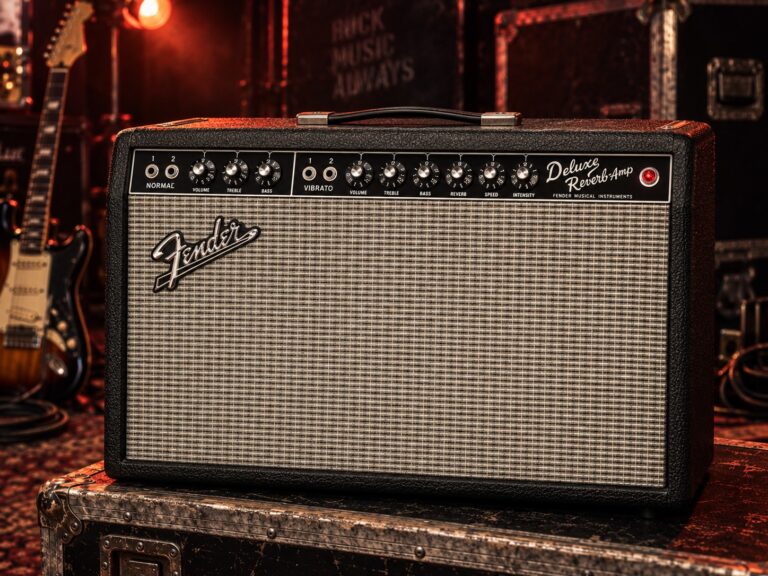
- Fender Deluxe Reverb: GuitarGangsters AI-generated reference illustration, not a photograph.
Latest News
Related
On This Day
Monday 9 November
From this week: