The Guitar That Was Never Supposed to Exist: The Gretsch White Falcon
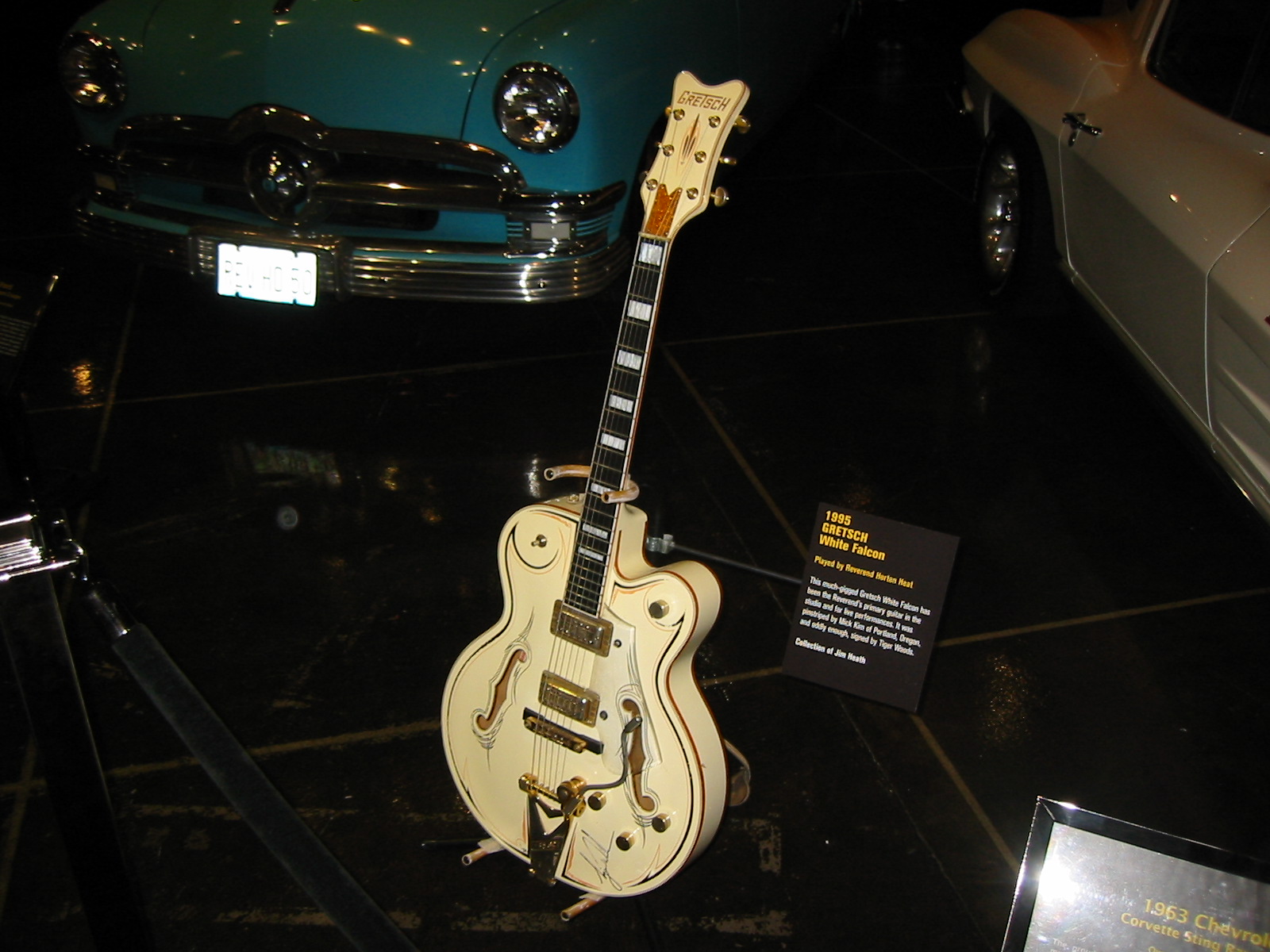
Gretsch White Falcon with custom pinstriping, displayed at the Petersen Automotive Museum, photographed 4 September 2006. Photo: Eric Kilby. CC BY-SA 2.0 (https://creativecommons.org/licenses/by-sa/2.0/). Source image unchanged; automatically resized web versions: CC BY-SA 2.0. Source: https://commons.wikimedia.org/wiki/File:Gretsch_White_Falcon_(1995),_played_by_The_Reverend_Horton_Heat,_Petersen_Auto_Museum.jpg
The Gretsch G6136T White Falcon: 17-inch hollowbody with gold hardware, Filter'Tron pickups and Bigsby. Neil Young, Billy Duffy and John Frusciante's choice.
In 1954, Gretsch sent a guitar to the Chicago NAMM trade show that was not supposed to be for sale. It was a showpiece — a concept, a vision of what the future of the electric guitar might look like if a manufacturer ignored every practical constraint and simply built the most magnificent, most extravagant, most visually overwhelming instrument imaginable. The guitar was 17 inches wide, fully hollow, and dripping in gold: gold hardware, gold sparkle binding, gold-engraved pickguard, jeweled arrow-shaped control knobs. The finish was white. The headstock bore a stylized falcon. It was called, with appropriate immodesty, the White Falcon.
Dealers at the show went berserk. Orders flooded in for an instrument that technically didn’t exist as a production model. Gretsch — a Brooklyn company that had been making drums, banjos, and guitars since 1883 — quickly realized it had accidentally created something historic. Within months, the White Falcon went into full production. Within years, it had become the most visually iconic instrument in the electric guitar world. Seventy years on, that assessment has not changed.
This is the story of a guitar that began as a dream and became an obsession — for the company that builds it, for the players who can’t let it go, and for everyone who’s ever looked across a stage and felt the air leave their lungs at the sight of it.
Jimmie Webster and the Dream Guitar of the Future
The man primarily responsible for the White Falcon’s existence was Jimmie Webster, a jazz guitarist who worked closely with Gretsch as both an artist and a product developer throughout the 1950s. Webster had a theatrical sensibility that aligned perfectly with the decade’s appetite for spectacle — the 1950s were, after all, a time of tail fins and Technicolor and the birth of television, a cultural moment that demanded visual impact on a scale previously unimagined.
Webster conceived the White Falcon specifically as a “dream guitar of the future” — a phrase used in Gretsch’s own promotional materials for the 1954 NAMM debut. He designed it to be everything at once: the largest hollowbody on the market, the most ornate, the most expensive, the most unmistakable. The original 1955 production model featured a single-cutaway body of laminated maple, a spruce top braced with parallel tone bars, and two DeArmond single-coil pickups wired to a novel roller knob volume control system. The Cadillac “G” tailpiece — a chrome script G that echoed the General Motors logo — was another Webster invention, the automotive age bleeding directly into guitar design.
The 1955 White Falcon sold for $600 — an astronomical sum when a Gibson Les Paul cost $249 and a Fender Stratocaster ran $249.50. Gretsch understood exactly what it had built: not a working musician’s instrument, but the guitar equivalent of a Cadillac Eldorado, a statement of ambition and taste that existed at the extreme edge of what the market would bear. Production numbers were tiny — fewer than 300 White Falcons were made between 1955 and 1959, according to Gretsch historian Ed Ball — which today makes original 1950s examples among the most valuable production guitars in existence, frequently selling for $25,000 and above.
Evolution Through the Decades: From Jazz Dream to Rock Machine
Through the late 1950s and into the 1960s, the White Falcon evolved rapidly. The 1958–1960 models — widely considered the golden era of the design — introduced the double-cutaway body shape, stereo wiring options (a decidedly forward-thinking innovation that proved more complicated than useful in practice), and the Filter’Tron humbucking pickups that would become the defining sonic signature of all subsequent Gretsch guitars. The Filter’Trons had been developed specifically for Gretsch by Ray Butts — the same engineer who independently invented the PAF humbucker in parallel with Seth Lover at Gibson — and they produced a sound unlike any other pickup: bright and chimey where PAFs were warm and thick, with a clarity and sparkle that made them identifiable in a single note.
In 1967, Gretsch was sold to the Baldwin Piano Company, beginning an era of declining production quality and diminishing market relevance that lasted until 1981. The Baldwin-era White Falcons from the late 1960s and 1970s are often overlooked, but they produced instruments that would later become significant: Billy Duffy’s primary guitar, the one that defined The Cult’s sound across four decades, was a mid-1970s Baldwin-era double-cutaway White Falcon. The Falcon’s cultural moment in rock had not yet arrived, and it arrived precisely when it was least expected.
The modern era of the White Falcon began in 1989 when the Gretsch family reacquired the company and began the process of restoring quality and historical authenticity. A partnership with Fender Musical Instruments Corporation in 2002 brought manufacturing expertise and distribution reach, and the White Falcon line expanded dramatically: vintage-spec reissues, Players Edition updates, artist signature models, extended range variants, and multiple color options have made the Falcon family one of the broadest and most actively maintained model lines in the electric guitar world.
The G6136T Anatomy: What Makes a White Falcon
The G6136T designation covers the standard single-cutaway White Falcon with Bigsby tremolo, the configuration most commonly associated with the instrument across its production history. Understanding its specification is to understand a guitar designed from the beginning for maximal resonance, visual impact, and tonal character.
Body: The Biggest Stage Presence in the Room
The White Falcon’s body is 17 inches wide at its broadest point and 2¾ inches deep — dimensions that place it firmly in the jazz archtop tradition, larger than a Gibson ES-335 by a considerable margin and comparable to a Gibson L-5. It is a fully hollow design: no center block, no feedback-suppressing wood running through the middle, just resonant air surrounded by laminated maple. The 3-ply maple construction — top, back, and sides — with either parallel tone bars or the period-specific trestle bracing of 1959-spec models provides structural integrity without sacrificing the acoustic responsiveness that defines the Falcon’s character.
The consequence of this construction is a guitar that breathes. Pick a chord on a well-set-up White Falcon in a quiet room, and the sound fills the space the way an acoustic instrument does. The laminated maple resonates differently from solid wood — it sustains in a particular controlled way, with a midrange focus and a roll-off at the extremes that suits the Filter’Tron pickups’ inherent brightness perfectly. The body’s size also creates a natural tendency toward feedback at high volumes, which is either the instrument’s most characteristic feature or its most challenging management problem, depending on who you ask.
Neck, Fingerboard, and Frets
The standard neck profile on the G6136T is the comfortable “U” shape — deeper than modern thin necks, more substantial in the hand, with a vintage-appropriate feel that suits both chord playing and single-note lead work across the instrument’s typical stylistic range. The 25.5″ scale length is longer than a Gibson’s 24.75″ — it puts the White Falcon in Fender territory, delivering tighter bass response and a slightly more aggressive attack than shorter-scale hollow guitars. The 12″-radius ebony fingerboard carries 22 medium-jumbo frets and pearloid Neo-Classic thumbnail inlays, one of the most recognizable fingerboard aesthetics in guitar history: the cream-colored parallelogram shapes that have been part of the Falcon’s visual identity since the earliest models.
Pickups: Filter’Trons and the Gretsch Voice
The White Falcon’s sonic identity is inseparable from its pickup configuration. Current production G6136T models carry either TV Jones TV Classic Filter’Trons (on vintage-spec Vintage Select and Golden Era editions) or the newer FT-67 Filter’Tron humbuckers (on Players Edition models), both variants of the Filter’Tron design Ray Butts developed for Gretsch in the mid-1950s.
TV Jones Filter’Trons are widely regarded as the finest modern expression of the original design: clear, detailed, with a particular treble response that is bright without hardness and a midrange that sits forward in a mix without crowding. They are not PAF-voiced humbuckers — comparing a Filter’Tron to a Gibson humbucker is like comparing a Telecaster to a Les Paul. Both cancel hum, but the tonal character occupies entirely different territory. The Filter’Tron’s clarity and spank, its almost single-coil openness without the single-coil hum, is what gives the White Falcon its characteristic voice: warm but not muddy, chimey but not thin, with a pick attack that registers dynamically at low volumes and a richness that fills out at higher gain settings.
The controls include individual volume knobs for each pickup, a master volume, and a three-position master tone switch — the latter a Gretsch invention that provides preset high-frequency roll-off options rather than a conventional tone pot. The switching is not immediately intuitive to players coming from Fender or Gibson instruments, but the Gretsch tonal palette — particularly the “bright” setting that opens the pickup signal completely — rewards exploration. Gretsch’s “Squeezebox” paper-in-oil capacitors, specified on premium models, add an additional dimension of tonal silkiness in the high end that distinguishes the Falcon’s voice from instruments using standard film capacitors.
The Bigsby Vibrato
The “T” in G6136T designates the Bigsby vibrato tailpiece — a spring-loaded arm vibrato that provides subtle pitch modulation of a fundamentally different character from a Floyd Rose or even a Fender vintage tremolo. The Bigsby is not designed for dive bombs or dramatic whammy bar theatrics. It is designed for the gentle, vocal shimmer that characterizes classic country and rockabilly — the slight wavering pitch that gives a sustained note life without leaving the guitar catastrophically out of tune. The Bigsby B6G on the standard G6136T is a gold-plated V-cutout design that contributes visually as much as functionally, adding another element of gold hardware to an instrument that needs no excuse to add more.
Tuning stability with a Bigsby requires attention to setup. The Falcon’s pinned Space Control bridge — pinned into the body to prevent movement — and bone nut substantially improve stability over older designs, and a properly lubricated Bigsby arm pivot will maintain reasonable tuning across moderate vibrato use. Players who want to use the arm extensively should treat the nut slots with graphite and ensure the bridge saddles are smooth. A well-set-up Bigsby-equipped White Falcon stays in tune remarkably well for a non-locking system.
The Hardware and Cosmetics
To discuss the White Falcon’s hardware without discussing its appearance is to miss the point entirely. The Falcon is gold: gold pickguard, gold tuners, gold nut, gold bridge, gold Bigsby, gold binding sparkle. The control knobs are jeweled arrow-head shapes in gold and black. The headstock carries the Falcon logo — actually an eagle, despite the name — in horizontal gold sparkle lettering. The f-holes are bound in gold sparkle. The body binding is multi-ply black and white with gold sparkle accents. The finish is vintage white nitrocellulose lacquer on premium models, aging to a warm cream over decades in the way only lacquer finishes do.
There is nothing subtle about a White Falcon. It was designed to be seen from the back of a large room, to communicate before a single note is played that something significant is about to happen. This is not an instrument that disappears into the background. It announces itself. When Billy Duffy first acquired one in 1981, it cost him his entire savings — a significant commitment at a time when Gretsches were imported to the UK at considerable premium. The investment was not just in a guitar. It was in an identity.
Famous Players: The Falcon Across Genres and Generations
The White Falcon’s appeal has never been genre-specific. It arrived first in the jazz world, briefly flirted with hillbilly country, and then — improbably, given its origins — became one of rock’s most identifiable weapons.
Neil Young and Stephen Stills
Neil Young is the player most closely associated with the White Falcon in the classic rock era. He acquired a vintage single-cutaway stereo White Falcon that he has owned since the 1960s and has played on stage and in studios across six decades. Young famously talked Stephen Stills into buying one so the two of them could engage in what contemporaries described as “dueling White Falcon guitar wars” during their Crosby, Stills, Nash, and Young performances. Young’s relationship with the guitar is characteristic of his approach to instruments generally — he plays what speaks to him regardless of what it costs, what it weighs, or what anyone else thinks about it. The Falcon’s size and resonance suit his style: open tunings, massive chord voicings, the kind of playing that needs a big box underneath it to sound complete.
Billy Duffy and The Cult
Billy Duffy bought his first White Falcon in 1981, spending everything he had on a mid-1970s Baldwin-era double-cutaway stereo model. He quickly replaced it with a single-cutaway mono version — the stereo wiring created complications he had no use for — and that guitar became the sound of The Cult’s early recordings. On “Spiritwalker,” The Cult’s 1983 debut single, Duffy used the Falcon with heavy flanging to create one of post-punk’s most distinctive guitar tones. On the Love album (1985), the White Falcon defined “She Sells Sanctuary” — a record that would go on to be one of the most recognizable guitar sounds of the decade, its shimmering, chorused, flanged Gretsch tone immediately identifiable regardless of context.
Duffy’s commitment to the White Falcon while his contemporaries moved toward modified superstrats and active-pickup metal machines was a conscious aesthetic choice. “I was very conscious of not wanting to be a bad version of Steve Jones,” he has said. “I wanted to be a good version of Billy Duffy.” The Falcon’s size, its visual presence, its particular combination of chime and thickness, became inseparable from his identity. Gretsch eventually honored that four-decade relationship with a dedicated Billy Duffy Signature Falcon — chrome hardware replacing gold, Black Top Filter’Tron pickups, 1970s-style Bigsby and headstock, based on his original Baldwin-era instrument.
John Frusciante
John Frusciante of the Red Hot Chili Peppers brought the White Falcon into the alternative rock world on Californication (1999), using a vintage Falcon for several of the album’s most memorable guitar moments. Frusciante’s approach to the instrument was characteristically unconventional — he was drawn to its complexity and its resonance, the way it responded differently from the Stratocasters that were his primary tools. The Falcon’s appearance on one of the best-selling rock albums of the 1990s introduced the instrument to an entirely new generation of players who had no knowledge of its jazz and country roots.
Other Notable Players
The White Falcon’s guest list across its seven-decade history is remarkable for its range. Brian Setzer of the Stray Cats played Gretsches throughout his career, the Falcon’s rockabilly heritage connecting directly to his music. Malcolm Young of AC/DC used White Falcons on occasion, the guitar’s acoustic resonance contributing to the band’s characteristic crunching rhythm sound. Joe Strummer of The Clash brought a Falcon into punk’s stripped-down aesthetic with deliberate provocation — the most expensive, most extravagant guitar in a movement that prized cheap instruments. Mike McCready of Pearl Jam has been photographed with White Falcons backstage and on stage, the guitar fitting comfortably within the band’s wide-ranging tonal palette. Roy Orbison played them in the 1950s and 1960s, adding his enormous voice to an instrument of equally enormous physical presence.
Tone Recipes for the White Falcon
Classic Gretsch Twang
For the canonical Gretsch hollowbody tone — chimey, percussive, with that particular picking-hand attack — plug the White Falcon into a clean tube amplifier with moderate headroom and let it breathe. A Fender Twin Reverb or Deluxe Reverb at moderate volume is ideal: the amp’s natural compression as it approaches breakup interacts with the Filter’Trons’ upper-mid clarity to produce a sound that is immediately, obviously Gretsch. Set the amp’s treble at 6–7, bass at 4–5, mids at 5–6, reverb at 3–4 for a light ambient wash. The master tone switch on position 2 (switch out of circuit, pickups wide open) gives the fullest, most dynamic response. Pick close to the bridge for the characteristic snapping attack; move toward the neck for warmth and body. Use the Bigsby for the gentle vibrato shimmer on sustained chords and you have the sound of every great rockabilly record ever made.
Billy Duffy’s Cult Sound
Duffy’s White Falcon tone on Love and beyond is built on the guitar’s natural voice processed through chorus and flanger simultaneously — a combination that should, by rights, be too much, but that somehow creates a shimmer and depth that became instantly identifiable. Into a Marshall or Hiwatt-voiced amplifier at moderate-to-high gain: treble around 6, bass 5, mids 5–6, presence 6. Add a Boss CE-1 or MXR Flanger at slow speed and moderate depth, then layer a chorus effect behind it at 25–30% mix. The result is the atmospheric, swirling quality that defined “She Sells Sanctuary.” Duffy famously packed t-shirts into the body of his White Falcon to manage feedback at stage volumes — a practical solution that affects the acoustic resonance minimally while dramatically reducing the risk of runaway feedback through an amplified hollow body.
Neil Young’s Open-Tuning Sound
Young’s White Falcon sound is built around open tunings — predominantly open E and open D — into a Fender Deluxe or Twin Reverb at the point of natural breakup, sometimes with a light overdrive pedal in the chain to push the tubes harder. The 25.5″ scale length of the Falcon makes open tunings particularly resonant on this instrument — the longer scale keeps string tension appropriate for single-note clarity even with the lower pitches of open tuning, where a shorter-scale guitar might sound loose. Position the neck pickup for the warmest, most voice-like tone on lead lines. Roll the guitar’s master volume to 6–7 for a slightly compressed, blooming character that adds sustain. The body’s natural feedback characteristics, carefully managed at stage volume, contribute the vocal sustain that defines Young’s lead playing on instruments like this.
Californication-Era Alternative Rock
Frusciante’s use of the Falcon on Californication was characteristically unpredictable — a vintage hollow guitar through what was, by rock production standards, a relatively clean-to-crunch signal chain. For this territory: plug into a Fender Deluxe or Marshall-voiced 18-watt combo at moderate overdrive. Bridge pickup for the cutting, articulate rhythm work; neck pickup for the warmer melodic lines. The Filter’Trons’ natural tendency to clean up at lower guitar volumes makes the White Falcon surprisingly responsive to guitar-volume dynamics — rolling back to 6–7 from a high-gain setting gives a cleaner, more glassy result without requiring footswitching. This responsiveness is the characteristic that players like Frusciante find most compelling about vintage-voiced pickups like Filter’Trons.
The White Falcon’s tonal range is wider than its reputation might suggest. It is not a one-trick instrument, despite its visual maximalism suggesting a guitar of extreme specialization. The Filter’Trons’ inherent clarity and the body’s natural resonance make it adaptable across a surprising range of styles.
The Falcon Line: Navigating the Models
Gretsch currently offers more than a dozen White Falcon variants, which can be bewildering for buyers approaching the line for the first time. The distinctions matter and understanding them saves considerable confusion and money.
Vintage Select and Golden Era Editions
The top of the production line. The G6136T-59 Vintage Select Edition ’59 Falcon and the G6136-55 Vintage Select Edition ’55 Falcon represent the most historically accurate modern Gretsch instruments: nitrocellulose lacquer finishes, TV Jones Classic pickups, bone nuts, gold sparkle binding, period-correct trestle bracing (on 1959 spec) or parallel tone bars (1955 spec). These instruments are built in Japan and priced in the $3,000–$4,000 range. They are the guitars to consider for players who want the closest modern experience of a 1950s White Falcon without paying $25,000 for an original.
Players Edition
The G6136TG Players Edition represents Gretsch’s modernized professional offering: the same 17-inch hollow maple body and gold hardware aesthetic, but with updated FT-67 Filter’Tron humbuckers designed for a more well-rounded modern voicing, Grover Imperial locking tuners, a string-through Bigsby design for improved tuning stability, and a urethane rather than nitro finish. The Players Edition trades period authenticity for practical improvements that working players appreciate: better out-of-the-box tuning stability, more predictable pickup behavior, more durable finish. Priced around $2,000–$2,500 new.
Standard Production G6136T
The core G6136T model sits below the Vintage Select in price and specification but retains the essential White Falcon architecture. These instruments typically come with Gretsch’s own Filter’Tron pickups rather than TV Jones units, urethane finish, and a gold hardware package that captures the visual impact at a more accessible price point — typically $1,500–$2,000 new. They represent strong value for players who want the White Falcon experience without the premium cost of the vintage-spec editions.
Billy Duffy Signature Models
Gretsch has produced several Billy Duffy signature Falcon models, most recently the G8424T in celebration of The Cult’s 40th anniversary. The Duffy signature features chrome rather than gold hardware — a fundamental departure from the standard Falcon aesthetic that reflects his original Baldwin-era instrument — Black Top Filter’Tron pickups, 1970s-style Bigsby, and the V-shaped Falcon headstock from his preferred era. Priced at $4,499, it is a specialist instrument for fans of Duffy’s specific sound and period, but one built to genuinely exacting standards.
Electromatic and Streamliner Series
For players who want access to the White Falcon aesthetic at lower price points, Gretsch offers Falcon-style bodies through the Electromatic and Streamliner lines, manufactured in China and Korea respectively. These instruments share the visual character of the White Falcon — the gold hardware, the white finish, the thumbnail inlays — while using different pickup systems and construction techniques. They are competent entry-level instruments but should not be confused with the professional-grade Falcon line in terms of tonal character, construction quality, or resonance.
The White Falcon Against Its Competition
The White Falcon occupies unusual competitive territory because no guitar looks or sounds quite like it. Its hollow competitors are numerous but each occupies different stylistic ground.
The Gibson ES-335 is the White Falcon’s most obvious comparison point in hollow and semi-hollow territory, but they are fundamentally different instruments. The ES-335’s laminate-over-centerblock construction suppresses feedback that the fully hollow Falcon invites. The PAF-voiced humbuckers produce a warmer, darker, more “Gibson” tone against the Filter’Trons’ brightness. The 335 is 15.5 inches wide versus the Falcon’s 17. These are not the same instrument in different clothing — they answer different questions and suit different playing contexts.
The Gretsch G6120 Chet Atkins Hollow Body is the White Falcon’s closest sibling within the Gretsch family — same Filter’Tron pickups, same hollow maple construction, similar body depth, but a 16-inch body rather than 17 and a visual character defined by orange and mahogany rather than white and gold. The G6120 is slightly more manageable in size, fractionally less visually dramatic, and often preferred by players who want the Gretsch voice without the full theatrical statement of the Falcon. Both are excellent instruments; the choice between them is as much aesthetic as sonic.
The Epiphone Casino offers fully hollow construction at dramatically lower cost, with P-90-style pickups that produce a notably different character — warmer, more overtone-rich — than the Filter’Trons. The Casino lacks the Falcon’s visual impact and size but delivers its own compelling argument for fully hollow electric guitar design.
Buying a White Falcon: Practical Considerations
New versus Vintage
Original 1950s White Falcons are serious collector’s instruments. Pre-1960 examples in good condition regularly sell for $20,000–$30,000 and above, with particularly desirable configurations and exceptional condition pushing higher. These are investments as much as playing instruments, and buying one requires expertise in vintage Gretsch identification — original hardware, correct serial number ranges, appropriate aging patterns — that demands specialist knowledge or a trusted specialist dealer.
For most players, the modern Japanese-made Vintage Select editions represent the most compelling compromise: period-accurate construction and voicing, excellent build quality, and a price in the $3,000–$4,000 range that, while significant, keeps the guitar within the realm of working musicians. The nitro finish will age naturally. The TV Jones pickups sound genuinely great. The build quality from Japan’s Terada factory — which has been producing premium Gretsches since the 1990s — is consistently high.
Feedback Management
The single most important practical consideration when owning a White Falcon is feedback management. A 17-inch fully hollow guitar at high stage volumes will feed back. This is not a defect — it is a characteristic of the design, and for players like Neil Young and Billy Duffy, that feedback has been exploited as a musical tool. But players who need the guitar to behave at high volumes have several options: stuffing the body with foam or fabric (Duffy’s solution, which reduces feedback without significantly affecting acoustic tone), fitting a Faraday cage inside the body (more effective, more invasive), or simply understanding the guitar’s relationship with its amplification and stage volume well enough to position themselves appropriately. A White Falcon that feeds back at stage volume is not broken. It is being honest about what it is.
Setup and Action
The White Falcon’s floating bridge — the Space Control bridge that sits on the guitar’s top without being glued — moves with temperature and humidity changes. Pinning the bridge (as Gretsch does on premium models, drilling a locating pin through the bridge feet into the top) significantly reduces this movement while retaining the tonal advantages of a floating bridge design. On unpinned models, players should mark the bridge position before restringing and check it afterward. The Bigsby tailpiece should be lubricated at the pivot point and the string slots should be smooth — a small amount of graphite or specialized lubricant keeps the strings returning to pitch consistently after vibrato use.
Frequently Asked Questions
What is the difference between the G6136 and G6136T White Falcon?
The “T” designation indicates a Bigsby vibrato tailpiece. The G6136 without the T uses either a Cadillac G tailpiece or a fixed stop tailpiece depending on the specific model variant, providing a simpler stringing arrangement and marginally better tuning stability for players who don’t use vibrato. The G6136T is the more commonly seen configuration, as the Bigsby is both a functional tool and a visual element that contributes to the guitar’s overall aesthetic. Both variants share the same body, neck, pickups, and hardware package otherwise.
How does a White Falcon compare to a Gretsch G6120 Chet Atkins?
The G6120 is 16 inches wide versus the Falcon’s 17, making it slightly smaller and more manageable in physical terms. Both use fully hollow maple construction and Filter’Tron-style pickups, so their tonal families are closely related. The Falcon’s larger body produces more acoustic volume and resonance — it’s a bigger-sounding guitar in the room, more prone to feedback at high volumes, and more visually imposing. The G6120 is more subdued in presentation and slightly easier to manage live. Tonally, the differences are smaller than the size difference suggests, but the Falcon’s additional resonance gives it a particular warmth and depth on sustained notes that the G6120, for all its qualities, doesn’t quite match.
Are the Filter’Tron pickups on a White Falcon the same as TV Jones pickups?
No, though they share the same design ancestry. TV Jones pickups are built by luthier Tom Jones (TV Jones) to his specifications based on the original Ray Butts Filter’Tron design, and are widely considered the finest modern expression of that design. They are fitted to Gretsch’s Vintage Select, Golden Era, and other premium models as an upgrade over Gretsch’s own production Filter’Tron units. Standard production Gretsch Filter’Trons and the newer FT-67 units (in Players Edition models) are competent but have a different character — the TV Jones units have superior clarity, dynamics, and tonal complexity. Whether the difference justifies the price differential between models is a personal assessment, but it is a real and audible distinction.
Can a White Falcon handle high-gain rock and metal?
With care, yes — but it requires managing feedback proactively. Billy Duffy used his White Falcon on The Cult’s Electric album, a considerably harder-rocking record than Love, and achieved compelling results. The Filter’Trons’ natural brightness and clarity translate into a cutting, aggressive character at high gain that is different from but not inferior to humbuckers. The challenge is the feedback from the fully hollow body at high stage volumes, which becomes significant as gain increases. Players who need to push into serious high-gain territory with a White Falcon should invest in feedback management — body stuffing, careful amp positioning, vigilance about sustain — rather than assuming the guitar cannot handle it. It can. It just requires working with its nature rather than against it.
What strings and gauge does the White Falcon work best with?
The White Falcon’s 25.5″ scale length and Filter’Tron pickups respond well to .011–.049 or .011–.052 string gauges — slightly heavier than typical rock guitar gauges, which adds warmth and body to the Filter’Trons’ inherently bright character. Pure nickel wound strings (rather than nickel-plated steel) complement vintage-voiced pickups like Filter’Trons particularly well, adding a slightly warmer, rounder tone that suits the Falcon’s stylistic range. Players who use the Bigsby extensively should avoid very light gauges, which respond unpredictably to the spring tension changes during vibrato use. Flatwound strings are an option for players primarily using the guitar for jazz or clean work — they significantly change the tonal character, reducing the natural brightness of the Filter’Trons, but the result can be extremely pleasing.
How heavy is a White Falcon?
Typically 7.5–8.5 lbs depending on specific body construction and hardware. The size of the instrument suggests it should be heavier than it is — the hollow construction keeps weight reasonable despite the 17-inch body. Players who are concerned about weight for long performance sets should try specific instruments before purchasing, as individual guitars vary within that range. A wide, padded strap is a practical necessity: the Falcon’s size means a narrow strap distributes its weight uncomfortably across the shoulder over an extended set.
Is the White Falcon appropriate for beginners?
The White Falcon is not an ideal first guitar. Its size makes it physically demanding for smaller players, the Bigsby requires patience to retune after string bends or vibrato use, the floating bridge needs periodic repositioning, and feedback management at any significant volume requires experience to handle gracefully. Beginners attracted to the Falcon’s visual appeal and sound would be better served starting on a more manageable instrument and returning to the Falcon when they have developed the technique and experience to appreciate what it offers. The Gretsch Streamliner or Electromatic Falcon-style guitars represent more forgiving entry points into the Gretsch hollowbody world.
The Falcon at Seventy: Still the Most Beautiful Guitar in the Room
There are instruments in the electric guitar world that earn their status through ubiquity — they are everywhere because they are excellent, and their excellence has been ratified by generations of players across genres. The Stratocaster. The Les Paul. The Telecaster. The White Falcon is not in that category. It has never been ubiquitous. It has always been rare, expensive, demanding, and particular. It has always required something specific from the player who chooses it, and not every player has that something to offer.
What the White Falcon demands is commitment to its character. You do not tame a White Falcon into being a different kind of guitar. You learn what it is — its size, its resonance, its tendency toward feedback, its Filter’Tron voice, its theatrical visual presence — and you play accordingly. The players who have done that most successfully — Young, Duffy, Frusciante, Setzer, Stills — all built significant parts of their musical identities around the instrument’s specific character rather than trying to impose a character onto it.
That is the deal the White Falcon has always offered. It will give you everything it has: the most spectacular visual presence in any room, a voice unlike any other electric guitar, a resonance and acoustic liveliness that connects electric playing to something more physical and immediate than most solid-body instruments allow. In return, it asks you to meet it where it is.
Seventy years after Jimmie Webster brought it to a trade show as a concept that was never supposed to be sold, players are still accepting that deal. They will keep accepting it long after the rest of the lineup has changed again. Some guitars are made for a moment. The White Falcon was made for all of them.