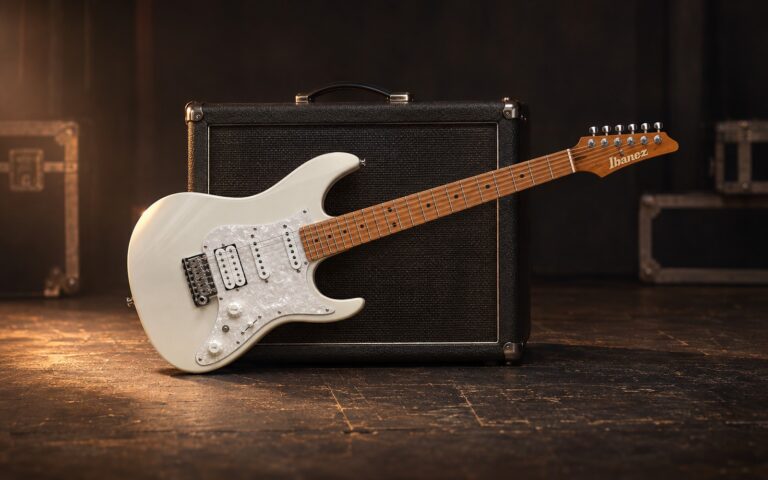
Ibanez AZES40: The $300 Guitar an Ibanez Signature Artist Put Up Against $15,000
No Ibanez shredder ever touched the AZES40 — but YouTube star Bernth put it up against $15,000 worth of gear, and it held its own.
Steve Vai, Joe Satriani, Paul Gilbert, Nita Strauss, and Tim Henson have zero documented connection to the guitar actually in question. The AZES40 is a $299 beginner instrument with a tremolo bridge, and none of these five shredders has ever been photographed near one.
The guitar’s real story belongs to Bernth, the Austrian guitarist and YouTube phenomenon with over a million subscribers, who deliberately picked up an AZES40 for one of his signature comparison videos: “$300 vs $15,000 Guitar!” Bernth isn’t some random content creator reaching for a prop — he’s an Ibanez-endorsing artist with his own signature model in the works, a former touring member of the extreme metal band Belphegor, and a guitarist who’s headlined a 120,000-person Austrian festival. When a player with that resume deliberately reaches for the AZES40 to make a point about value, it’s worth paying attention to.

A Shared Design Story, A Different Pickup Configuration
Same Fujita DNA, Different Layout
The AZES40 launched alongside its hardtail sibling, the AZES31, in October 2021, and shares that guitar’s full design story: both were built in direct collaboration with Tomo Fujita, the Berklee College of Music professor who mentored a young John Mayer, Soulive’s Eric Krasno, and Lettuce’s Adam Smirnoff. That collaboration’s full backstory — Fujita’s own career, his teaching philosophy, and how the AZ Essentials line came to exist — is covered in depth in the AZES31 article; the short version is that Ibanez handed the entire beginner-guitar brief to a working educator rather than a marketing team, and the AZES40 is the second half of what came out of it.
HSS Instead of SSS: What Actually Changes
Where the AZES31 keeps things simple with three single-coils and a fixed bridge, the AZES40 swaps in an Accord humbucker at the bridge position, keeping Essentials single-coils at the neck and middle, and adds a T106 tremolo. It’s a genuinely different guitar rather than a simple colorway variant — the humbucker gives it meaningfully more push for overdriven and distorted tones, and the tremolo opens up vibrato and dive-bomb techniques the hardtail AZES31 simply can’t do. Guitar.com’s review of the model called it an entry-level instrument with semi-pro aspirations, noting that with a pickup upgrade it could comfortably venture into genuinely professional territory.
Anatomy of the AZES40
Body and Neck
The AZES40 shares its poplar body and bolt-on maple neck with the AZES31, in the same AZES C profile — a slim, comfortable shape at roughly 20.5mm at the first fret and 22.5mm at the twelfth. The jatoba fretboard carries white dot inlays and side dots, sitting on a 250mm (9.84-inch) radius that splits the difference between a vintage Fender curve and a flatter modern board. The 25-inch scale length, a half-inch shorter than standard, remains aimed at making the guitar approachable for younger or smaller-handed players without feeling undersized once they’ve grown into it. The nut measures a narrow 42mm, cut from plastic rather than bone on this model.
Electronics
Two Essentials single-coils handle the neck and middle positions, with an Accord humbucker at the bridge rounding out the HSS layout — all passive, ceramic-magnet designs built specifically for this line. Guitar.com’s technical measurement put the bridge humbucker’s DC resistance at 6.6 ohms, describing it as not far from vintage output territory, giving beginners a forgiving amount of push for sustaining fretted notes without tipping into modern hot-output aggression. That’s a deliberate design choice rather than a cost-cutting one — a hotter, more compressed humbucker would mask the kind of dynamic picking control beginners are still developing, while a vintage-leaning output rewards touch sensitivity from the start. The dyna-MIX9 switching system — one combination richer than the AZES31’s dyna-MIX8, thanks to the added tonal possibilities the humbucker unlocks — pairs a five-way blade switch with a two-way Alter mini-toggle for nine total tonal combinations, including a series-wired mode that taps the neck and middle single-coils together to approximate a second humbucker voice. In practice, that means a genuinely wide tonal range from a guitar with only three physical pickups and two switches — enough range that reviewers note many owners stay satisfied with the AZES40 rather than immediately shopping for a second, different-sounding guitar.
Bridge and Hardware
The T106 tremolo bridge uses newly developed comfort-round steel saddles, offering a wider range of height adjustment and smoother action under the picking hand than typical budget-tier bridges. It’s a non-locking, six-saddle vibrato system — genuinely functional for expressive dips and light dive-bombs, though multiple owners note the trem arm itself has some wobble out of the box, and that tuning stability, while reliable under normal play, can drift somewhat under heavier tremolo abuse without a nut or saddle upgrade. Chrome die-cast tuning machines and the same all-access neck joint and mono-unit output jack found on the AZES31 round out the build.
Who Actually Played It — Bernth’s Viral Comparison
Extreme Metal Roots to YouTube’s Guitar Star
Bernth — full name Bernth Brodträger — graduated with honors from the Vienna Music Institute before touring internationally as a live guitarist for the Austrian extreme metal band Belphegor. He later joined the chart-topping Austrian pop-rock act Seiler und Speer, contributing guitar work across multiple hit releases and headlining Vienna’s 120,000-capacity Donauinselfest festival in 2016. He started his YouTube channel in 2018, and it’s since grown past 1.3 million subscribers on the strength of technical playing videos, gear demonstrations, and genuinely bizarre experiments — he’s played guitar underwater, built a neckless guitar controlled by pulling the headstock, set off fireworks inside an acoustic, and even performed an entire song submerged in the Caribbean Sea, nearly losing consciousness during the shoot. All of it is in service of a stated goal: getting more people curious about the guitar who might not otherwise bother, using stunts and content hooks that traditional gear demos rarely attempt. His 2021 debut solo album, Elevation, drew coverage in Guitar World and Premier Guitar, and by 2025 he’d relocated to Los Angeles, performed at Carnegie Hall, and become part of the first Austrian act to sell out the 50,000-capacity Ernst Happel Stadium. He’s also an Ibanez-endorsing artist in his own right — the company has developed a signature electric guitar around his playing style and content, marketed around helping players perform faster and cleaner, a genuinely different kind of Ibanez artist relationship than any of this project’s usual shred-guitar names.
The $300 vs $15,000 Guitar Video
In the video that puts him in this article, Bernth explicitly names and plays an Ibanez AZES40 in black, pitting it against gear costing fifty times its price to make a point about how much genuine playability and tone a beginner-tier instrument can deliver. It’s the kind of content built entirely around Bernth’s own credibility as a working, gigging, Ibanez-endorsed guitarist — if a player at his level says a $300 guitar holds its own, that carries real weight with an audience of over a million subscribers. It’s a different kind of endorsement than a festival rig or a signature model, but it’s a genuine, verifiable, on-camera choice by an artist with every reason to know the difference between a guitar worth taking seriously and one that isn’t.
Setting the Record Straight on the Shred List
Steve Vai, Joe Satriani, Paul Gilbert, Nita Strauss, and Tim Henson remain, once again, without any documented connection to this specific guitar. Each has spent their career on dedicated high-end signature instruments — Vai’s JEM and PIA guitars, Satriani’s JS series, Gilbert’s PGM line, Strauss’s JIVA series, and Henson’s THBB10 and AZ-based instruments — built for extended technique and high-gain tone, and none of them has any documented reason to pick up a $299 beginner guitar with a non-locking tremolo. As with the AZES31, this is a clean mismatch — not a near-miss on a specific SKU, but a complete category mismatch between five professional shredders and a guitar built explicitly for people just starting out.

Tone Recipes for the AZES40
Clean and Worship Rhythm
Neck or neck-plus-middle single-coil, amp clean channel, light reverb. Guitar.com’s review specifically noted the AZES40 lives comfortably in pop, rock, worship, and indie territory in this configuration — genuinely versatile clean tones for a guitar at this price.
Classic Rock and Blues Lead
Bridge humbucker, amp gain around 4-5. The Accord humbucker’s moderate output pushes sustained notes without becoming muddy, a forgiving starting point for beginners learning bends and vibrato.
Funk and Pop Rhythm (In-Between Positions)
Positions 2 or 4 on the five-way switch, light compression. The in-between “quack” tones the AZES40’s SSS-adjacent wiring produces at the neck and middle are well-suited to funk and pop rhythm work, an area owner reviews single out as a genuine strength.
Light Hard Rock and Heavier Territory
Bridge humbucker with the Alter switch’s series mode engaged, amp or modeler gain pushed further. Guitar.com’s review noted the AZES40 can stretch into heavier territory with the right amp or modeler, though players focused specifically on tight, low-tuned metal will likely want a purpose-built instrument instead.
The AZES40 Against Its Family and Its Competition
Against its own sibling, the choice between the AZES31 and the AZES40 comes down almost entirely to whether a beginner wants a tremolo and a hotter bridge tone (AZES40) or a simpler, more vintage-leaning hardtail SSS setup (AZES31) — both share the same neck, body, and overall build quality. Stepping up in the AZ family, the AZ2204 and AZ2402 Prestige carry the same design lineage into genuinely professional territory with Seymour Duncan electronics and Japanese construction. Against direct budget competitors, owner comparisons consistently rank the AZES40 above a Squier Stratocaster and a Yamaha Pacifica in side-by-side testing, though some owners prefer rival budget guitars like the Jet JS-400 for out-of-the-box feel — a reminder that even within the beginner tier, personal preference plays a real role and it’s worth testing more than one option where possible.
Buying Guide
- Know your configuration before you shop. The AZES40 (HSS, tremolo) and AZES31 (SSS, hardtail) share a name family but deliver meaningfully different playing experiences — don’t assume interchangeability.
- Expect to tighten up the trem eventually. Owner reports consistently flag some wobble in the stock tremolo arm and note that a nut or saddle upgrade — a GraphTech TUSQ nut is a commonly recommended step — improves tuning stability under heavier vibrato use.
- Watch for regional colorway differences. The AZES40 has shipped in Black, Purist Blue, Mint Green, and Tungsten depending on market and year — check current availability before settling on a specific finish.
- It’s a genuinely viable project-guitar platform. Multiple owners have picked up used AZES40s well under retail specifically to use as a modification platform, reporting strong results from pickup and hardware upgrades on top of the already-solid neck and body.
- Consider the AZES31 first if you don’t need a tremolo. Players who know they won’t use vibrato techniques regularly may find the AZES31’s simpler hardtail bridge one less thing to maintain, without losing much in the way of overall build quality.
Living With One: Ownership Notes
Owner sentiment on the AZES40 is strongly positive, with particular praise for how the guitar compares to instruments costing considerably more — one detailed review specifically noted its playability and build quality rival guitars five times its price. The most common complaint, consistent with its sibling, is the missing gig bag; beyond that, owner criticism centers mainly on the tremolo arm’s initial wobble and the neck single-coil’s tendency to sound slightly muddy under heavier overdrive. Neither issue seems to meaningfully dampen enthusiasm — one long-time player with over fifty years of experience specifically noted plans to use an upgraded AZES40 as an active gigging guitar, a genuinely unusual vote of confidence for a beginner-branded instrument from someone with the most experience to know better.
Fretboard maintenance comes up more often in AZES40 owner discussion than with many budget guitars, simply because the jatoba board can arrive looking noticeably pale and dry from the factory — a quick treatment with lemon oil or a similar conditioner brings out a richer color and improves the board’s feel within minutes, and most reviewers treat it as a five-minute first step rather than a flaw. Some owners have also reported light fret oxidation on guitars that sat in storage before purchase, similarly resolved with basic steel wool and the same lemon oil treatment. None of it points to a guitar that needs professional attention out of the box — just the kind of light first-day setup ritual most new owners enjoy anyway.
The AZES Family Tree — and Closing This Chapter
Beyond the standard black, blue, green, and Tungsten finishes, Ibanez also released the AZES40B with a black pickguard and the AZES40L for left-handed players — modest variations on the same core instrument rather than meaningfully different guitars. Together with the AZES31, the AZES40 completes the entire AZ Essentials line as it currently stands — just two models, both born from the same Fujita collaboration, sitting at the accessible base of a much larger AZ family tree that stretches up through the AZ2204 and AZ2402 Prestige covered earlier in this run, and further still toward artist-driven instruments like Tim Henson’s THBB10.
Frequently Asked Questions
Did any famous Ibanez shredders play the AZES40?
No documented connection exists between the AZES40 and Steve Vai, Joe Satriani, Paul Gilbert, Nita Strauss, or Tim Henson. The guitar’s real documented player is Bernth, an Austrian YouTube guitarist and Ibanez-endorsing artist with over a million subscribers, who featured it in his viral “$300 vs $15,000 Guitar!” comparison video.
What’s the difference between the AZES40 and the AZES31?
The AZES40 has an HSS pickup configuration (Accord humbucker at the bridge, two Essentials single-coils) and a T106 tremolo bridge, while the AZES31 has three single-coils (SSS) and a fixed hardtail bridge. They share the same body, neck, and overall design philosophy.
Who designed the Ibanez AZES40?
The AZES40 was developed in direct collaboration with Tomo Fujita, a Berklee College of Music guitar professor whose former students include John Mayer, Eric Krasno, and Adam Smirnoff.
Is the AZES40’s tremolo reliable?
It’s a functional, non-locking system suitable for light vibrato and moderate dive-bombs, though some owners note initial arm wobble and recommend a nut or saddle upgrade for improved tuning stability under heavier use.
What pickups come stock in the AZES40?
An Accord humbucker at the bridge and two Essentials single-coils at the neck and middle, all passive with ceramic magnets, wired through a five-way blade switch and two-way Alter mini-toggle for nine total tonal combinations.
Can the AZES40 handle metal and hard rock?
It can push into lighter hard rock and modern rock territory with the bridge humbucker and a decent amp or modeler, but players focused specifically on tight, low-tuned metal will generally get better results from a purpose-built extended-range or higher-output instrument.
Does the AZES40 come with a case?
No — like its AZES31 sibling, the AZES40 is sold without a gig bag or case, which most reviewers flag as worth budgeting for separately.
How much does an Ibanez AZES40 cost?
New pricing runs around $299 to $349 depending on retailer and finish, with used listings sometimes available well below that.
Image credits
- Paul Gilbert: MrPanyGoff, Wikimedia Commons, CC BY-SA 3.0.
- Steve Vai: Wojciech Pędzich, Wikimedia Commons, CC BY 4.0.
Latest News
Related

On This Day
Sunday 15 November