EarthQuaker Devices Hizumitas: The Fuzz That Flew Halfway Around The World
EarthQuaker Devices Hizumitas guide: the Elk BM Sustainar origin, why the Tone knob is backwards, verified Wata and Jonny Greenwood use, plus 8 settings.
There is a moment in every clone project where the engineers have to admit they are guessing. EarthQuaker Devices hit theirs early. They had gathered vintage Big Muff Pis. They had gathered several different Elk Sustainars. They plugged them in one after another, and what they found was chaos — every single unit sounded like a different pedal. Fifty-year-old carbon resistors and unmatched transistors had drifted so far apart that there was no such thing as “the” Elk sound to copy.
So they asked Wata to mail them her pedal. Her actual pedal. The one that has been the core of Boris’s guitar tone for the better part of three decades, the one that had already been broken and repaired more times than she wanted to count. She put it in a box in Japan and sent it to a workshop in Akron, Ohio.
That is how the Hizumitas exists. Not as a tribute, not as a “in the spirit of,” but as a measurement of one specific, beaten-up, irreplaceable object — and then a production run of thousands built to match it. The result was announced on 4 November 2021, arrived with a purpose-recorded Boris track called Reincarnation Rose, and did something signature pedals almost never do: it retired the original. Wata took the Elk off her touring board and put the Hizumitas there instead.
This is a feature, not a review. We are not scoring it. What follows is where the circuit came from, what a Japanese Big Muff bootleg from 1973 actually sounds like, why the Tone knob works backwards, which players are genuinely documented using this thing and which attributions we could not stand behind, eight settings worth stealing, and an honest read on who should buy something else.
What The Hizumitas Actually Is
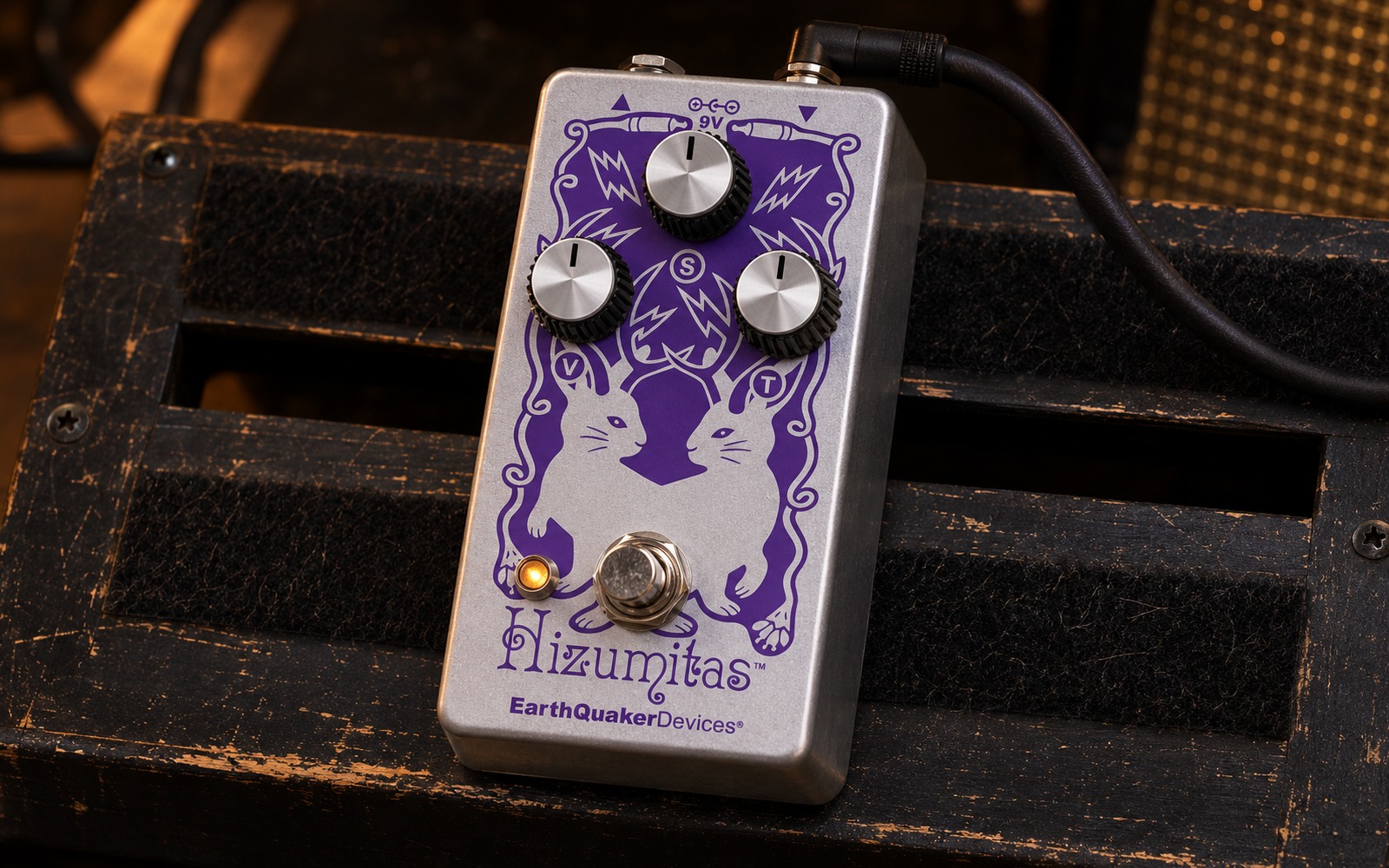
Strip away the story and you have a three-knob, four-transistor-topology fuzz in a standard EarthQuaker enclosure: Volume, Sustain, Tone. It is a Big Muff Pi derivative in the broad sense — the Elk was an unlicensed Japanese copy of the “Triangle” era circuit — but it is not a Big Muff clone in the way a modern reissue is. It is a clone of a clone that had drifted, and the drift is the point.
EarthQuaker’s own copy is unusually specific about what they were chasing: “heavy saturation with a gritty edge and a massive bottom while still maintaining a clear and dynamic tone with enough mids and top end to cut through the sludge.” Every clause in that sentence is doing work. The mids are the giveaway. A stock Muff scoops its midrange into a canyon and then vanishes underneath a loud band. The Elk does not scoop nearly as hard, which is why one guitarist in a three-piece playing next to a wall of full stacks can still be heard as a distinct instrument rather than a low-frequency weather event.
The name is a Japanese pun that survives translation reasonably well. Hizumi means distortion; the suffix turns it into something like “the distorted one.” And the model designation is “Fuzz Sustainar” — with an “a” — which is a deliberate nod to the misspelling on the original Elk faceplate. Boris’s guitar tech is emphatic on this point: it is Sustainar, not Sustainer. EarthQuaker kept the typo. That is the level of fidelity this project was operating at.
The Elk BM Sustainar: The Ghost In The Circuit
Japan’s Big Muff bootleg era
The Elk Sustainar is an early-1970s Japanese copy of the triangle-knob Electro-Harmonix Triangle Big Muff Pi, built at a time when international trademark enforcement in the Japanese music-electronics trade was, to put it charitably, aspirational. Wata’s unit dates to somewhere around 1973 and carries a brazen, copyright-ignoring “Big Muff” logo right in the middle of the box. Elk later thought better of it and rebadged the pedal “Super Fuzz Sustainar,” dropping the borrowed name.
Collectors will find the family under at least three labels: Elk Big Muff Sustainar, Elk Super Fuzz Sustainar, and Electro Sound Co. Big Muff Sustainar. All of them are rare, all of them are expensive, and — this is the part that matters — none of them reliably sound like each other. Wata found hers, in her own account, in an internet auction, back when she was working through fuzz pedals because of the artists she and the people around Boris were listening to. She had already bought and tried genuine Big Muffs. She fell in love with the Elk the first time she plugged it in.
A small, telling detail from the same interview: Boris bassist and guitarist Takeshi also owned an Elk fuzz, a “Super Fuzz Sustainar” variant, and it sounded very different from hers. Both of them played their Elks on the track Feedbacker. Two pedals from the same factory, same era, same nameplate lineage, and they were different enough to use as two distinct voices on a recording. That is the variance EarthQuaker ran into.
Fuzz 2.5, distortion 7.5
The most useful technical description of Wata’s Elk did not come from EarthQuaker. It came from Yuichiro Hosokawa, Boris’s stage tech, owner of the Yokohama pedal shop CULT, and a self-confessed Big Muff obsessive who has played through roughly forty of them.
Hosokawa judges Muffs on two axes: “the bottom end that fills up when you palm mute,” and “the mix ratio between fuzz and distortion.” By his subjective scale, the classic 1973–74 Muffs land around fuzz 4 : distortion 6. The 1975–76 units with the BC239C transistor sit near 6 : 4 — coarser fuzz, but they play like a distortion pedal. The early-’80s “third Muff” is a 5 : 5 he does not care for.
Wata’s Elk? Fuzz 2.5 : distortion 7.5. Which is barely a fuzz at all by the standards of the genre. It bites like a distortion, tracks like a distortion, and articulates like a distortion — but the bottom end fills in with fuzz-style bloom, and the top end keeps the aggressive Muff snarl. That combination is why it survives inside Boris’s mix. Wata runs a Matamp GT-120 clean, so what you are hearing on record and on stage is the pedal, undiluted, at frightening volume.
Why they needed the actual pedal
EarthQuaker’s design notes are unusually candid about the process. They sourced multiple vintage Big Muffs and multiple Elks, measured them, listened to them, and concluded that “all of them were wildly different.” Component tolerance drift over five decades had made the target unhittable from the outside. The only honest path was to get Wata’s specific unit on the bench.
What they found on it was, in their words, something none of the others had. And Hosokawa’s verdict on the result carries more weight than any marketing line, because he had every reason to be a snob about it: the Hizumitas properly recreates both the palm-muted bottom fill and the 2.5:7.5 ratio, and while a 100% dead-on clone is impossible, “at least this can replace an original ELK with no problem for you.” He then notes the thing that closes the argument — Wata has replaced the Elk on her own board with the Hizumitas.
Specifications
The Controls, And The Knob That Works Backwards
Volume
Unity lands around 9 to 10 o’clock at most Sustain settings, which means roughly three-quarters of the knob’s travel is dedicated to boost. EarthQuaker’s own manual says everything above unity “is set to destroy,” and that is not hyperbole — you have enough output on tap to slam a valve preamp into a second, entirely different stage of breakup. If you play through a clean platform, this is a feature. If you play through an already-hot amp, treat the top half of the Volume knob as a separate pedal with its own personality.
Sustain
This is the gain control, and its most important characteristic is what it will not do: it will not clean up. It starts hot and climbs from there. There is no “edge of breakup” hiding at 8 o’clock. The range across the sweep is enormous, though, and it is compressed into small movements — a nudge of fifteen degrees genuinely changes the character of the pedal. Set it by ear in small increments, not by knob position.
Tone (read this bit twice)
The Tone control on the Hizumitas is inverted relative to almost every other Muff-family pedal on earth, and it is active rather than a simple passive blend between a low-pass and a high-pass.
- Fully counterclockwise — maximum treble. Piercing highs at the extreme, an aggressive midrange grind just short of it.
- Fully clockwise — maximum bass. Mids recede, highs are tamed, and a genuinely thunderous low end steps forward.
Two consequences follow. First: if you demo this pedal the way you demo a Big Muff, you will get the wrong idea within ten seconds, because your hands will do exactly the wrong thing. Second: because the control is active and interacts hard with Sustain, it becomes a performance control rather than a set-and-forget EQ. Premier Guitar’s Nick Millevoi described using it as an almost synth-like filter on sustained notes, letting drop-D riffs change shape as they decayed. That is a legitimate technique and it is available to you the moment you stop treating Tone as furniture.
The one honest caveat, and Premier Guitar flagged it too: the far-treble side can be harsh and noisy. Some players will find it unusable. Others will find it is the only setting that cuts through a genuinely loud stage. Both reactions are correct.
Famous Players
Our standing policy on this site is that a name only gets printed if we can find it in a manufacturer statement, a player’s own words, a photographed board, or a magazine interview. Here is what survived that filter, in descending order of evidence.
Wata (Boris) — the whole reason it exists
Not an endorsement. A collaboration. The pedal is a measurement of her personal Elk, and she has retired that Elk from touring in favour of it. Her words to Guitar World in November 2021: “The Hizumitas is not inferior to my ELK when I A/B them. I’ve already played a few shows with it and it was really good, so from now on, I will take the Hizumitas on tour.”
Her core rig, by her own description, has barely moved in decades: an ’86 Gibson Les Paul Custom, the Elk BM (now the Hizumitas), and a Roland tape echo. Amps are Orange and Matamp — chosen specifically because they stay clean and loud, since she builds her tone entirely from pedals. She also confirmed the stacking approach that most Hizumitas owners eventually discover on their own: “For the Hizumitas, I often use it with a distortion to create a more chaotic feel.” She runs it alongside a MASF Watafuzz, sometimes together, sometimes separately, with wah, reverb and echo in the chain. Wata cites David Gilmour, Eddie Hazel and Michio Kurihara as formative influences — a lineage that explains a lot about why her fuzz tone is melodic rather than merely destructive.
Boris’s album W, released 21 January 2022, features Wata playing the Hizumitas throughout. The Reincarnation Rose single was recorded specifically to launch it.
Jonny Greenwood — the strongest independent case
Jonny Greenwood added a Hizumitas to his pedalboard partway through The Smile’s May–July 2022 tour, alongside an Electro-Harmonix Pitch Fork. It is documented in photographs of his board across that tour and the 2023 and 2024 tours that followed, tracked in obsessive detail by the long-running Greenwood gear archive The King of Gear.

Two details make this more interesting than a standard “artist owns pedal” note. The Hizumitas was used to debut Bending Hectic at Montreux on 12 July 2022, and it supplies the core texture of that song’s outro — the pedal is load-bearing in the composition, not decoration. And it is, according to that archive, the only fuzz pedal Greenwood has toured with. A player whose reputation rests on Boss and Electro-Harmonix boxes, who had never gigged an EarthQuaker pedal before The Smile, picked this one and kept it. The same archive suggests the EarthQuaker interest may have come via Stephen Malkmus.
Takeshi Ohtani (Boris)
Boris’s bassist and second guitarist owned his own Elk variant long before the collaboration and played it on Feedbacker. He is listed as a Hizumitas user, which is entirely consistent with the band’s history, though we have not found an interview in which he discusses the EarthQuaker version specifically. Treat him as very likely rather than confirmed-in-his-own-words.
The community-database tier — flagged as such
Beyond those, the Hizumitas turns up in photo-sourced player databases attached to a spread of names: Buzz Osborne of the Melvins, Frank Iero of My Chemical Romance, Alex Rosamilia of The Gaslight Anthem, Neige of Alcest, Justin Trosper of Unwound, Steve McDonald of Redd Kross and the Melvins, Devin Shidaker of The Acacia Strain, Kevin McKeown of Black Pistol Fire, and Mercedes Arn-Horn of Softcult. The McKeown entry is backed by a dated board photograph from a Bilbao festival show in June 2025, which is the kind of evidence we like.
We are printing that list with a clear label: these are crowd-sourced entries of varying quality, not first-party confirmations, and we have not individually chased a photograph or interview for each one. If you are here to settle an argument, use Wata and Greenwood. Everything else in the paragraph above is a lead, not a fact.
What we could not verify
This is one of the most thoroughly documented artist collaborations in the entire modern fuzz market. The manufacturer named the collaborator, the collaborator gave a long on-record interview about it, and an independent archivist photographed a second major player using it for three consecutive tour cycles. The failure mode here was the opposite of the usual one — not an inflated roster, but a real story that had been missed entirely.
Eight Settings Worth Stealing
Knob positions are given as clock face. Remember throughout: counterclockwise Tone = treble, clockwise Tone = bass. All of these assume a clean amp; if your amp is already breaking up, pull Volume back to 9 o’clock and start again.
1. The Boris Wall
Volume 11, Sustain 3 o’clock, Tone 2 o’clock. Neck pickup on a humbucker guitar, amp clean and loud. This is the low, wide, slow-motion sound — huge in the bottom, still articulate on open chords. Palm-mute a drop-tuned root note and listen for the bottom end filling in behind the attack. If it does not fill, your Tone is too far counterclockwise.
2. Millevoi’s Filter Trick
Volume 11, Sustain maxed, Tone starting at 3 o’clock. Hit a sustained drop-D power chord and sweep Tone counterclockwise while it rings. Because the pedal sustains so long, the note changes shape as it decays and you get a synth-filter effect out of a fuzz pedal with no modulation section in it. Costs nothing, sounds like an expensive rack unit.
3. Cutting Lead
Volume 1 o’clock, Sustain 2 o’clock, Tone 10 o’clock. Neck pickup, and let the extra output push your preamp. The treble-forward side of the Tone control gives you a lead voice that will not disappear under a second guitar. This is the setting that reveals whether your amp likes the pedal — if it sounds like a wasp in a jar, back Tone off toward noon.
4. Wata’s Chaos Stack
Hizumitas at Volume 11, Sustain noon, Tone 1 o’clock, into a separate distortion running at low gain and unity. Wata’s own approach. The second stage compresses the fuzz and adds a layer of grind that the Hizumitas alone will not produce. Order matters: fuzz first. A ProCo RAT 2 or an Ibanez TS9 Tube Screamer both work, and they work very differently.
5. Direct-In Sizzle
Volume noon, Sustain 3 o’clock, Tone 9 o’clock, straight into an interface with a touch of reverb after it. Premier Guitar found this cut through a heavy low riff on a track with no amp involved at all. Useful for layering a second guitar in a mix without adding another cabinet’s worth of low-mid mud.
6. Doom Rhythm, No Mud
Volume 11, Sustain 1 o’clock, Tone 12 o’clock. The compromise setting, and the one most people should start from. Noon on the Tone keeps enough midrange to hold a chord’s identity while still giving you the bloom. Play a slow Tony Iommi-style tritone figure and listen for whether the third note in the phrase is still distinguishable. If it is, you are in the right place.
7. Shoegaze Bed
Volume 11, Sustain 4 o’clock, Tone 2 o’clock, into a long modulated delay and a big reverb. Open chords high on the neck, minimal picking attack. The Hizumitas’s note separation on open voicings is unusually good for something this saturated, so the chords stay legible instead of turning into a single grey block. Pair it with an EarthQuaker Afterneath V3 for the full effect.
8. Bass Fuzz
Volume 10 o’clock, Sustain 11 o’clock, Tone 3 o’clock, blended with a clean signal if your rig allows it. The bass-boosted side of the Tone control makes this genuinely viable on bass, which is not true of every Muff derivative. Without a clean blend you will lose your fundamental, so either use a parallel loop or accept the trade.
How It Compares
Against a standard Big Muff
The Electro-Harmonix Big Muff Pi scoops mids aggressively; the Hizumitas does not. In a solo bedroom context the Muff often sounds bigger. In a band, the Hizumitas is the one you can still hear. The Hizumitas is also the more compressed, longer-sustaining of the two, and its Tone control has more usable range at both extremes despite — or because of — being backwards.
Against the era-specific Muff reissues
The Triangle Big Muff is the Hizumitas’s direct ancestor and the closest thing to a fair fight; it is brighter and looser, with less of the low-end fill. The Ram’s Head is smoother and more scooped — the Gilmour end of the family. The Green Russian is the other big-bottom option and the most genuinely competitive alternative here; it is darker and less articulate on top, where the Hizumitas keeps its bite. If you want one Muff-family pedal for down-tuned riffs, the choice is basically Green Russian versus Hizumitas, and it comes down to whether you want clarity or murk.
Against the rest of the EarthQuaker fuzz line
The Hoof is EarthQuaker’s own hybrid germanium/silicon Muff variant with a Shift control, and it is the more versatile pedal — it will do things the Hizumitas cannot, including cleaning up. The Hizumitas is the more specific one. The Acapulco Gold is a different animal entirely, a one-knob power-amp emulation with no tone shaping at all. And the Plumes sits at the opposite end of the gain spectrum as a transparent overdrive — the two stack beautifully in that order.
Against other heavy boxes
The Way Huge Swollen Pickle MkII offers far more internal tweakability and a wider low-end range, at the cost of being genuinely difficult to dial in; the Hizumitas gets you to a usable heavy sound in about eight seconds. The Boss HM-2 is the other famous “wrong” EQ pedal and the Swedish-death-metal comparison comes up constantly online — but the HM-2 is a mid-scooped chainsaw and the Hizumitas is a mid-present bulldozer. They do not substitute for each other.
Buying Guide
New: around $179 at major US retailers as of 2026, up from a $149 launch street price. That is still the low end of the boutique-adjacent bracket for a US-built, hand-assembled pedal with a lifetime warranty.
Used: roughly $130–150. This is a pedal that gets bought on the strength of the story and then sold by people who discovered they wanted an overdrive, so supply on the used market is reasonable and prices are soft. There is no meaningful reason to pay near-new money for a used one.
Colourways: the standard finish is the purple-and-silver, which is what most people picture. A Reverb-exclusive black edition shipped at launch bundled with a Reincarnation Rose EP on vinyl at $169 for the pair; that combination now trades as a collector’s item and is priced accordingly. A piano-black retailer-exclusive has also circulated. None of the finishes are sonically different — pay for the colour only if you want the colour.
Buy it if: you play down-tuned, you need saturation that survives a loud band, you like a fuzz that stays articulate on open chords, or you specifically want the Boris sound and have accepted that you will not get it without also getting very loud.
Do not buy it if: you want a fuzz that cleans up with the guitar volume knob, you need low-gain textures, you play in a genre where mid-scoop is the point, or you are allergic to noisy treble settings. It is also the wrong choice as a first fuzz — the inverted Tone control will teach you habits that do not transfer to any other pedal you will ever own.
Ownership Notes
It will not run on a battery
The relay-based true bypass switching needs power to pass signal at all. There is no battery compartment and no battery workaround. If your board loses power mid-set, this pedal does not fall back to a passive bypass — your signal stops. Plan your power accordingly, and if you gig, carry a spare supply.
Power supply quality is not optional
At 10 mA the current draw is trivial, so any supply will technically run it. But EarthQuaker are explicit that daisy chains and generic switching adapters let ripple through, and a high-gain fuzz is exactly the circuit that will amplify that ripple into audible hum. Use an isolated output. And take the “DO NOT RUN AT HIGHER VOLTAGES” warning literally — this is not an 18V-tolerant design.
Placement in the chain
Early, before everything else, is the default and the right starting point. The 150 kΩ input impedance is low by modern standards, which means the pedal is sensitive to what feeds it — a buffered pedal upstream will change its character, sometimes for the better and sometimes not. If you use a Cry Baby wah, try it both before and after; Wata runs a wah in the same chain and the interaction is a real tone, not a mistake.
Pickup response
EarthQuaker specifically call out the pedal’s response to different pickup types, and they are not overselling it. Humbuckers give you the Wata voice; single coils give you something considerably nastier and more treble-forward that pairs better with the clockwise end of the Tone knob. Neck-pickup single notes are where this pedal is at its most flattering.
Noise
It is a high-gain fuzz built from a fifty-year-old topology. It hisses. At high Sustain with the Tone counterclockwise it hisses a lot. This is not a defect and no amount of power conditioning will remove it entirely; a noise gate after the pedal is a legitimate answer if your material has silence in it.
Frequently Asked Questions
Is the Hizumitas just a Big Muff clone?
It is a clone of a Japanese unlicensed copy of a Triangle-era Big Muff, cloned from one specific fifty-year-old unit rather than from the schematic. The lineage is Muff; the voice is not. The midrange is far more present and the Tone control is inverted and active. Anyone who tells you it is “just a Muff” has not spent time with the Tone knob.
Why is the Tone knob backwards?
Because the original Elk’s was. EarthQuaker cloned the behaviour rather than correcting it. Counterclockwise boosts treble, clockwise boosts bass, and the control is active rather than a passive blend — which is also why it has such a dramatic effect on the pedal’s character at different Sustain settings.
Can I get Wata’s tone with just this pedal?
Partially. The missing ingredients are an ’86 Les Paul Custom, a clean high-headroom amp — she uses Orange and Matamp — a Roland tape echo, and stage volume that produces a physical breeze in front of the cabinets. Premier Guitar’s reviewer put it best: you will never achieve Wata’s tone, but the pedal will take you to the same neighbourhood.
Does it work on bass?
Yes, better than most Muff derivatives, because the clockwise Tone range genuinely boosts bass rather than just rolling off treble. You will still lose fundamental at high Sustain, so use a clean blend or a parallel loop if low-end retention matters.
Is it still in production?
Yes. As of September 2026 the manufacturer’s product page carries no end-of-production notice and the pedal is stocked at major retailers. That is worth stating explicitly because several EarthQuaker pedals of the same vintage have quietly moved to the Legacy page while remaining listed elsewhere.
Hizumitas or Hoof?
Hoof if you want one fuzz that covers ground, cleans up a little, and has a mid-shift control. Hizumitas if you want a specific, uncompromising, heavily saturated voice with more low-end authority and no interest in subtlety. Owning both is not redundant — they overlap less than the shared brand and shared ancestry suggest.
Why does it need power to bypass?
The switching is relay-based rather than mechanical. The upside is silent, click-free switching and no mechanical switch to wear out. The downside is that no power means no signal, and no battery option. It is a deliberate trade EarthQuaker make across most of their current line.
What does the name mean?
Hizumi is Japanese for distortion. “Sustainar,” with the “a,” is a deliberate preservation of the misspelling printed on the original Elk faceplate — Boris’s tech is insistent on the point, and EarthQuaker kept the typo as part of the tribute.
Image credits
- Top image: GuitarGangsters AI-generated reference illustration, not a photograph.
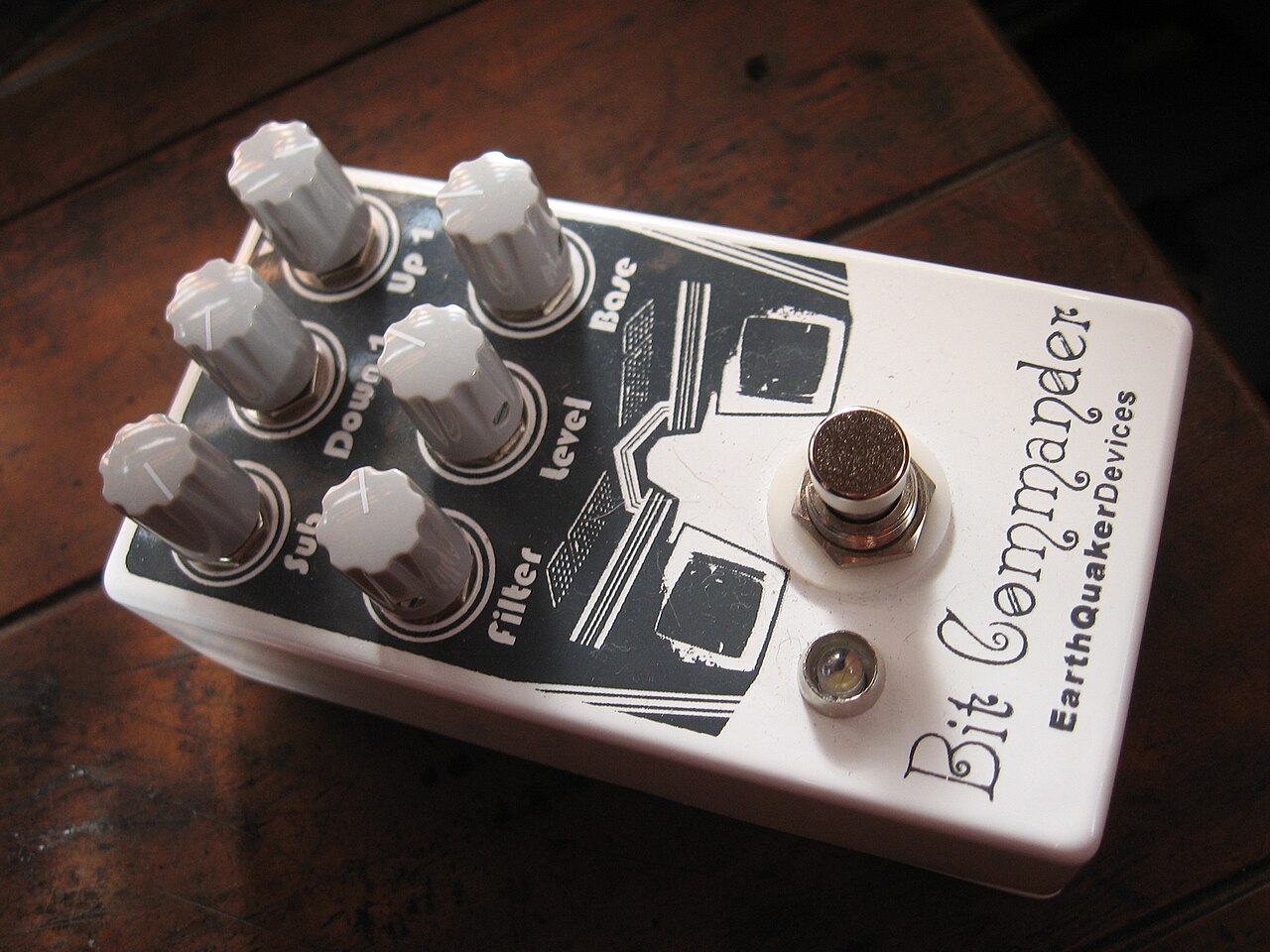
- An EarthQuaker Devices Bit Commander pedal: Victor Sounds, Wikimedia Commons, CC BY-SA 2.0.
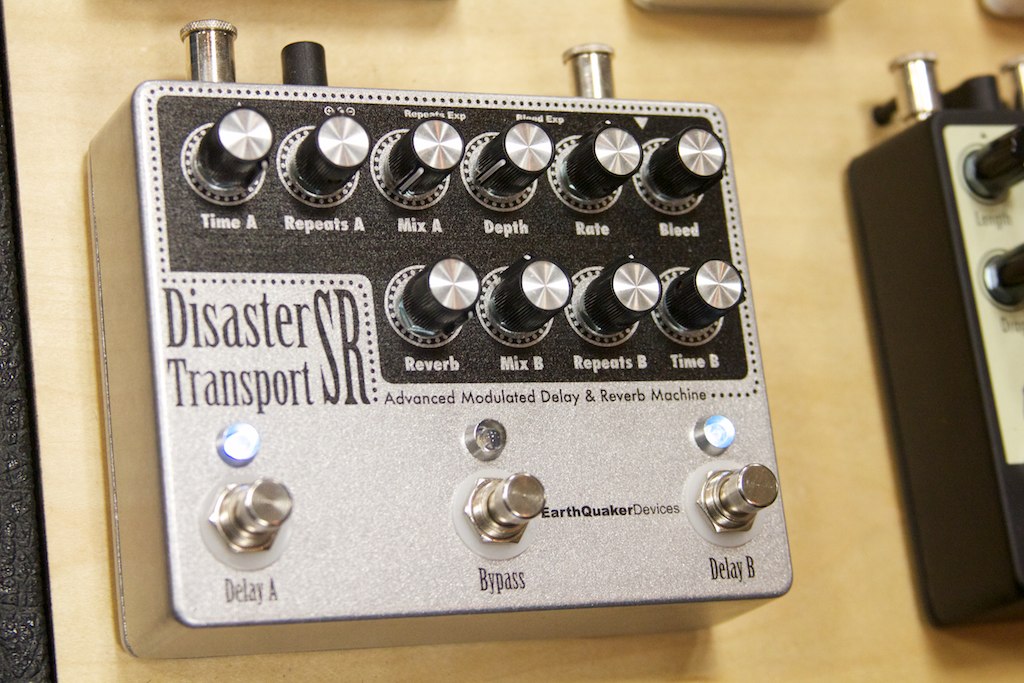
- An EarthQuaker Devices Disaster Transport SR pedal: Steve Castellano from Toronto, Wikimedia Commons, CC BY 2.0.
- Jonny Greenwood: radiohead in amsterdam by Michell Zappa, Wikimedia Commons, CC BY-SA 2.0.
Latest News
Related
On This Day
Monday 9 November
From this week: