DigiTech Trio+ Band Creator + Looper: The Pedal That Hires a Rhythm Section You Never Have to Text
DigiTech Trio+ Band Creator + Looper guide: Band-in-a-Box origins, full specs, verified players, settings that make it track, and buying advice.
Every guitarist has had the same evening. You have written eight bars that feel like something. You play them again. They still feel like something. You play them a third time and the silence underneath them starts to sound like a problem rather than a space, because eight bars of unaccompanied guitar is not a song, it is a fragment waiting for a bass player to turn up and tell you whether the fragment is any good.
The traditional solutions are all compromised. A metronome tells you the tempo and nothing about the harmony. A backing track requires you to already know what the song is. A drum machine requires programming, which requires stopping, which is the precise moment the idea evaporates. Band-in-a-Box on a laptop does the job brilliantly but involves typing chord symbols into a grid — again, stopping. And an actual bass player and drummer involve scheduling, a rehearsal room, and the specific social awkwardness of asking two adults to drive across town so you can play them eight bars.
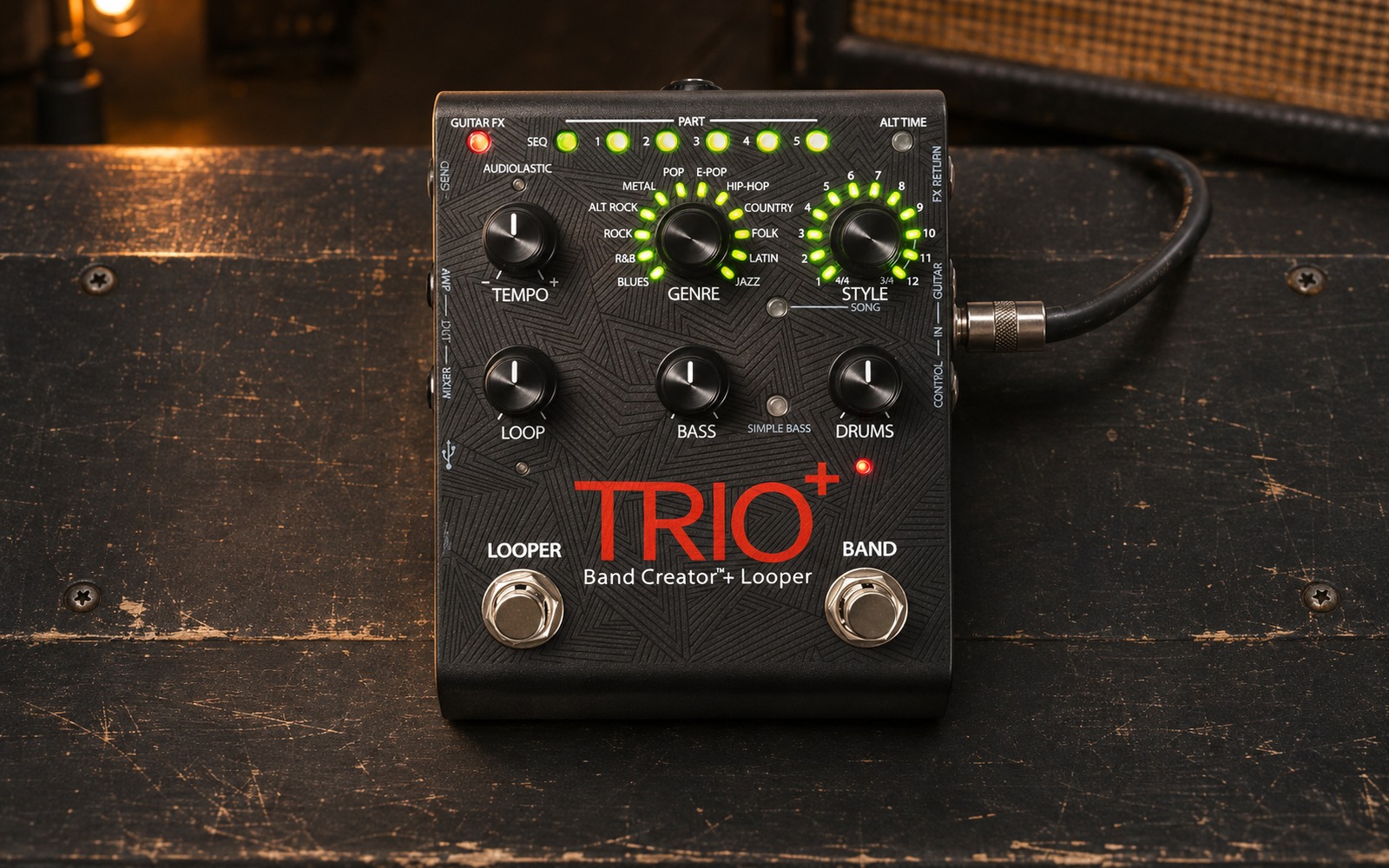
The DigiTech Trio+ Band Creator + Looper is a stompbox that removes every one of those steps. You plug a guitar into it, press the left footswitch, play your chord progression once, press the footswitch again, and a bass player and a drummer who have been listening arrive on the downbeat playing your changes. They do not need the chart. They have already worked it out.
That trick was impressive enough in the original Trio of 2015. The Trio+ is the version that took the trick out of the practice room: a synchronised looper, an effects loop, five song parts per song, twelve songs stored on a memory card, and a separate mixer output so the band goes to the PA instead of through your guitar amp. This guide covers where it came from, who actually supplies the musicians inside it, exactly what the spec sheet says, which players have genuinely been documented using one, how to play so the pedal understands you, and whether it belongs on your board or in your spare room.
Housekeeping: what this pedal is not
Two clarifications before the history, because both cost people money.
It is not a looper with drums bolted on. The looper is real and it is genuinely useful, but the Trio+ is a generative accompaniment device first. A looper records what you played. The Trio+ analyses what you played, works out the chords and the harmonic rhythm, and then has two virtual musicians improvise parts over those changes in a style you choose after the fact. Change the genre from Folk to Metal and the bass and drums play something completely different over the same progression. No looper does that, because a looper has no idea what a chord is.
It is not an amp pedal in the normal sense. It is a 5.4-inch-long, 1.46 lb box drawing 800 mA that wants to feed a full-range system. Running the band through a guitar amp works, but you are asking a mid-focused speaker to reproduce a kick drum. MusicRadar said the quiet part out loud in its review: for live use you will “probably want to use the mixer output to run the backing into a full-range PA rather than through your mid-focused guitar amp.” Plan for that before you buy, not after.
Origin: a stompbox with Band-in-a-Box inside it
The story starts with software. Band-in-a-Box, made by PG Music of Victoria, British Columbia, has been generating accompaniment from typed chord symbols since the late 1980s. Its “Styles” — the rulebooks that tell a virtual bassist and drummer how a shuffle differs from a bossa nova — are the accumulated work of decades and the reason the program never went away.
DigiTech’s original Trio, launched in 2015, put that engine in a pedal and replaced the typing with listening. And DigiTech did not build the musical brain itself: PG Music confirmed the arrangement publicly and has repeated it since. Announcing the sequel on its own forum on 26 January 2016 — NAMM week — PG Music’s Callie wrote: “Last year we announced that the Digitech Trio uses Styles by Band-in-a-Box, and that hasn’t changed with their just-released Trio+!”
That single sentence explains more about how the Trio+ sounds than any spec on the box. The bass lines walk and the drums fill the way they do because the rules generating them were written for a music-notation product used by jazz educators and songwriters, not by a pedal company trying to approximate a groove. It also explains the pedal’s blind spot, which we will come to: the engine wants chords, cleanly stated in time, because that is the only vocabulary it has ever been given.
In the same forum thread, users pressed PG Music on price and availability. PG Music did not know — “we won’t be selling it directly” — and a forum veteran supplied the answer that turned out to be correct: $299 street, mid-April 2016. Buyers outside the US saw £219 and €285 at launch. There is also a nice piece of forum folklore in that thread: a long-time PG Music user pointing out that he had posted “Trio + Looper” as a product suggestion on the same forum a year earlier, and asking, with a wink, where his royalty cheque was.
What the Trio+ added over the original Trio
DigiTech’s own framing was that the Trio+ was a response to what Trio owners asked for, and the upgrade list reads exactly like a list of complaints being answered one by one.
- A synchronised looper. The headline. A dedicated Looper footswitch records a guitar loop with an unlimited number of overdubs, locked to the band’s tempo — or on its own, with no band at all, as an ordinary looper.
- Storage. The original had nowhere to keep anything, which is why MusicRadar noted it “wasn’t designed for live use.” The Trio+ stores up to 12 songs plus their loops on a microSD card, and DigiTech includes an 8 GB card in the box. Fill it and you swap cards.
- Five song parts instead of three. Enough for intro, verse, chorus, bridge and outro — an actual song shape rather than a sketch.
- Twelve genres instead of seven, with metal explicitly among the additions, alongside electronic pop, hip-hop and jazz.
- A Simple Bass button. The single most-repeated criticism of the original was that the bass line was too busy. The Trio+ answers it with three bass-line modes, which MusicRadar called “great news for acoustic players.”
- An effects loop. FX Send and FX Return jacks let you insert your own pedals rather than living with the onboard genre-matched effects.
- A sequencer. Program the five parts into an automated running order, or trigger them by foot as you go.
Full specifications
Two numbers on that table deserve to be read twice. 800 mA is not a pedal current draw; it is a multi-effects current draw. It is more than three times what the DigiTech FreqOut pulls and roughly eighty times a typical analogue overdrive. Most isolated pedalboard supplies have exactly one output that can feed it, and some have none. And 230 seconds per song part is generous — nearly four minutes of loop for a single section, which is more than any sane arrangement needs.
Famous players: an honest accounting
This is the section where the house style requires us to be straight with you, and on this SKU that means saying something uncomfortable.
The Trio+ has no famous-player story. Not a small one — essentially none. Nine years after launch, Equipboard lists exactly two professional users, and the pedal has never appeared in a Premier Guitar Rig Rundown that we can find. For a product this widely sold, that is a striking gap, and it tells you something true about what the pedal is for.
The two documented users
- Lige Curry — bassist and singer, credited on Equipboard via a YouTube video in which, at the 9:37 mark, he shows his Trio+. Curry is a working funk bassist, which is a mildly delicious detail given that the pedal’s headline feature is hiring a virtual bass player.
- Konrad Schmidt — guitarist with the German band SUKI, who has confirmed his use of the Trio+ on his own Backstage PRO profile. Self-reported, but self-reported by the player himself on a professional musicians’ platform, which clears our bar.
Equipboard’s aggregate data is more interesting than its artist list. The genres associated with the pedal skew Rock (38), Metal (15), Alternative Rock (12), Pop (10) — not, as you might assume, jazz and folk. And the gear it is most often paired with is instructive: an EQ pedal, a dynamic microphone, a fuzz, a reverb, a small practice combo. That is not a touring rig. That is a home setup, and a home setup is what this pedal is honestly for.
The artist list this SKU arrives with is not a user list
The artist list attaches three names to the Trio+: Ed Sheeran, KT Tunstall and Keller Williams. All three are famous for looping. None of the three has any documented connection to this pedal, and in Sheeran’s case the claim collapses on contact with the evidence.
Sheeran spent years on Boss Loop Stations, then moved to a bespoke unit built for him, and in the 2020s launched his own signature looper line — the Sheeran Looper + and Looper X — built in partnership with HeadRush, whose Prime and MX5 processors we have covered elsewhere. A man who designs and sells his own looper is not quietly using a DigiTech band creator. Tunstall’s live looping is built around dedicated loop hardware; Williams built a career on Echoplex and Boomerang-style looping long before the Trio existed. All three are looping figureheads whose names get magnetically attached to any looping product. That is a pattern we have now seen enough times to name: a shared sonic association is not a shared pedal. We flagged the same failure mode on the FreqOut and on the DigiTech Drop, and it is the same error each time.
Here is the more useful way to think about it. The Trio+ is a writing and practising tool, and writing and practising happen in rooms with no cameras in them. There is no photograph of the pedal that made the song, because nobody photographs their spare bedroom. The absence of pros on the Trio+ is not evidence against the pedal; it is evidence about which part of a musician’s life it belongs to.
Making it track: how to play so the pedal understands you
Almost every complaint about the Trio+ is really a complaint about teaching, and teaching is a skill you acquire in about twenty minutes.
The one rule
MusicRadar put it plainly: “stick to basic strumming, rather than arpeggiating or riffs, and the Trio will have no problems tracking your playing.” Teach in block chords, in time, with a clear final downbeat. Then play whatever you like over the result — the band is already committed to the changes and does not care what you do next. Teach like a rhythm guitarist, solo like yourself.
Teaching procedure
- Set your tempo first if you have one in mind — the pedal will follow your playing, but starting near the target saves a correction.
- Press the Band footswitch, wait for the count, and play the progression once, all the way through, ending on the downbeat where it would loop.
- Press Band again on that downbeat. The band starts.
- Now choose the genre. Turn the Genre encoder and listen — the same changes will be reinterpreted completely. The multi-coloured LEDs around the Style encoder indicate which styles best match what you played, which is the fastest way through 144 combinations.
- If the bass is doing too much, press Simple Bass and cycle the three modes.
- If the groove feels half-speed or double-speed, press Alt Time — it selects an alternate interpretation of the part’s tempo and fixes the problem instantly.
Four starting recipes
- Songwriting scratchpad. Folk or Country, Simple Bass on, Drums down around 9 o’clock, Bass at noon. You want a pulse and a root, not an arrangement. Teach a four-bar loop as Part 1 and a contrasting four bars as Part 2, then use the two parts to find out whether your verse and chorus are actually different from one another. They often are not, and this is the cheapest way to discover it.
- Lead practice. Blues or Rock, a style with a straight feel, Bass and Drums both at noon, tempo set below where you are comfortable. Teach a 12-bar. Then leave it running for forty minutes. The reason this beats a backing track is that it is your 12-bar in your key at your tempo, and you can nudge the tempo up two BPM at a time as the phrase gets clean.
- Solo gig, full band. Mixer Out to the PA, Amp Out to your combo, guitar level set at the amp, band level set with the Bass and Drums knobs. Programme the five parts as a sequence so the arrangement runs itself, and keep an accurate tuner in front of everything — a virtual bass player has perfect pitch and will make yours sound worse than it is.
- Looper only. Ignore the band entirely. Looper footswitch, record, overdub, done. It is not a deep looper, but it is a competent one, and the fact that it is there is why the Trio+ replaced two boxes on a lot of desks.
Signal chain and the FX loop
The Trio+ needs to hear chords clearly, which means it wants a relatively clean, uncluttered signal to analyse. Put dirt, modulation and delay in the FX loop rather than in front of the pedal: your overdrive, delay and reverb go in the Send/Return so they colour your guitar without confusing the chord detector. Heavy fuzz in front of the input — a Big Muff, say, or a DOD Carcosa — smears the harmonic content the analysis depends on, and tracking suffers accordingly. Teach clean, then bring the noise.
How it compares
Versus a dedicated looper
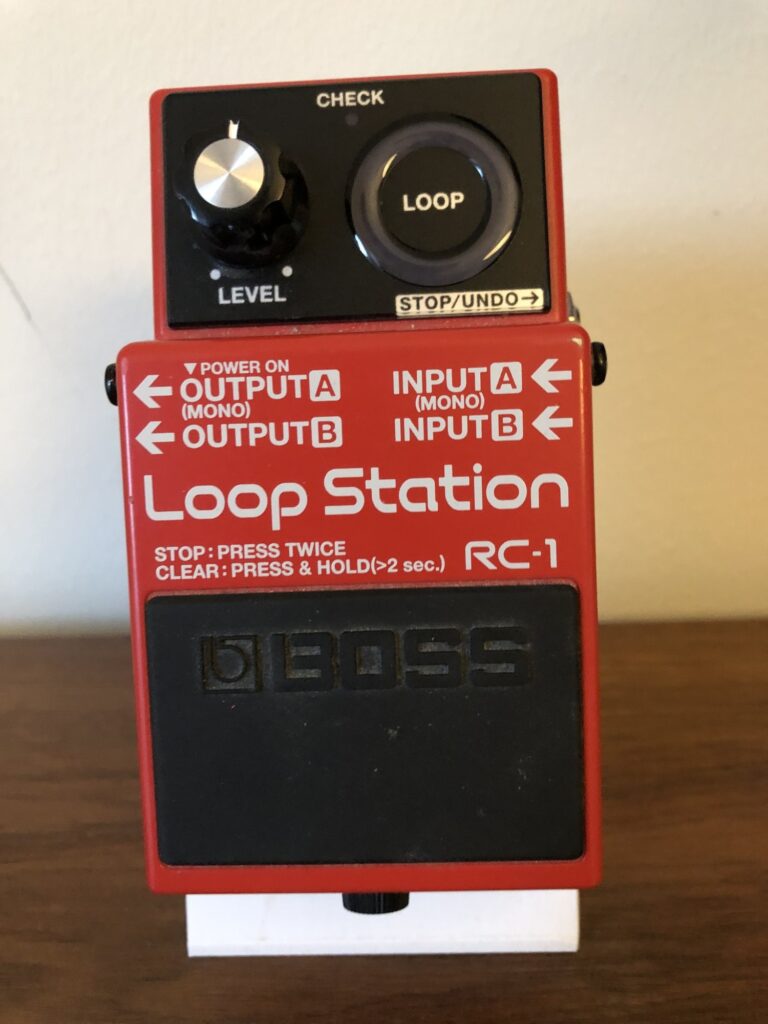
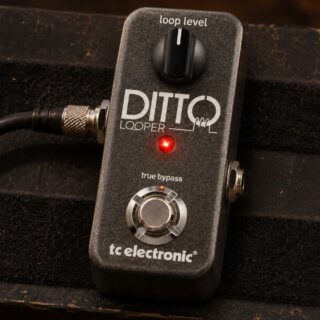
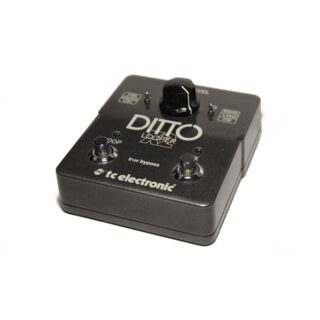
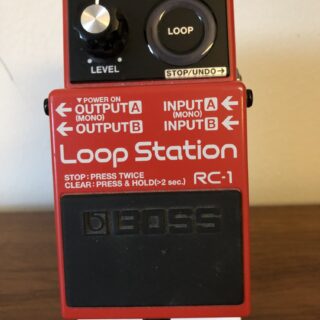
A Boss RC-1 or RC-5 will out-loop the Trio+ on every axis that matters to a looping specialist: undo/redo depth, loop-length control, stored phrases, rhythm variety, footswitch ergonomics. The RC-500 adds stereo and dual tracks. The Chase Bliss Blooper and the Line 6 DL4 exist in a different creative universe altogether, one where mangling the loop is the point. None of them will play a bass line over your chord changes. Different tools; the overlap is smaller than it looks.
Versus a multi-effects unit with a drum machine
A Boss GT-1000, a Line 6 POD Go or a Hotone Ampero II Stage gives you amps, effects, a looper and a rhythm machine in one box for comparable money, and if you need all of those things the multi-effects is better value. What it gives you is patterns, though — a drummer with no bassist and no idea what key you are in. The Trio+ trades the amp modelling and the effects library for the one thing none of them do.
Versus Band-in-a-Box on a laptop
The software the Trio+ borrows from is more powerful in every technical respect: more styles, real notation, editing, export, mixing. It is also a laptop, a screen, a keyboard and an audio interface, and it requires you to type your chords. The Trio+ is the same idea reduced to “play the thing and press the switch.” Which is better depends entirely on whether you are arranging or writing.
Versus the original Trio
The original is discontinued, cheaper on the used market and still charming, but the Trio+ answers every one of its documented limitations — storage, looping, simple bass, five parts, an FX loop, a mixer output. If you can find a Trio for a third of the price and only want a practice partner, it is a bargain. For any use beyond a single room, the Trio+ is the one worth having.
Buying and ownership notes
- Budget for power. 800 mA at 9 V, adapter only, no battery. Use the supplied adapter or an isolated supply output specifically rated for it. This is the single most common cause of grief with this pedal and it is entirely preventable.
- Budget for the footswitch. The optional DigiTech FS3X plugs into the TRS Control In and gives three modes of hands-free control. For live use it is close to essential; for desk use it is unnecessary.
- The SD card matters. microSDHC, Class 10, 8–32 GB. An 8 GB card ships in the box. Cheap slow cards are a false economy in any device recording audio in real time.
- Install the Trio Manager. The free librarian for Windows and Mac backs up and organises songs and loops. Card corruption is the failure mode nobody plans for; a backup takes two minutes.
- Two outputs, two destinations. Amp Out for your guitar, Mixer Out for the full band mix. Using one output for both works and is the compromise most people regret at their first gig.
- Headphones make it a different product. The 3.5 mm output with its own volume control turns the Trio+ into a silent full-band practice rig at midnight. For flat-dwellers this is arguably the best feature on the box.
- Buying used. Check that the microSD card and the original 9 V adapter are present — replacing a high-current adapter costs real money — and power it up and teach it a progression in front of the seller. Two minutes of chords tells you everything about whether the pedal is healthy.
The verdict from the press
MusicRadar‘s Trevor Curwen reviewed the Trio+ on 25 May 2016. The verdict: “This is truly a band in a box, and one that you can use live to boot.” Under Pros he listed “adds everything on our wish list from the original.” Under Cons, he listed, in full: “None.” His closing line is the fairest one-sentence summary anyone has written: as a practice and songwriting aid the original Trio always was a brilliant resource, “but, with such an increased range of possibilities, the Trio+ knocks it out of the park.”
Guitar World’s assessment ran along the same lines — enthusiastic about the songwriting and practice application specifically. Note what neither publication claimed: that this was a stage pedal for a band guitarist. Everyone who has looked at it closely has arrived at the same conclusion about where it belongs.
Frequently asked questions
What exactly does the DigiTech Trio+ do?
You play a chord progression into it once. It analyses the chords and the rhythm, then generates a bass part and a drum part that follow those changes, in a genre and style you select. It also contains a synchronised looper for recording your own guitar parts on top, and can store twelve such songs on a microSD card.
Does the Trio+ really use Band-in-a-Box?
Yes. PG Music, the developer of Band-in-a-Box, confirmed publicly on its own forum in January 2016 that the Trio+ uses Styles by Band-in-a-Box, exactly as the original Trio did. That licensing relationship is why the bass lines and drum parts behave with a musicality that pattern-based drum machines do not have.
Why won’t the Trio+ track my playing properly?
Almost always because of how you are teaching it, not because of a fault. Teach it with clear block-chord strumming, in time, and finish on the downbeat. Arpeggios, single-note riffs and heavy distortion in front of the input all obscure the harmonic information the analysis needs. Put your dirt and time-based effects in the FX loop and teach with a clean, chordal signal.
Can I use the Trio+ live?
Yes — that is the main thing it added over the original. The microSD storage holds twelve prepared songs, the five song parts can be sequenced for automatic playback or triggered by foot, and the separate Mixer Out sends the band to a PA while Amp Out feeds your guitar rig. Adding the optional FS3X footswitch makes hands-free part switching considerably easier.
How much power does the Trio+ need?
9 V DC, 800 mA, 7.2 W, from an external adapter only — there is no battery option. Use the included adapter or an isolated supply output rated for at least 800 mA. Many pedalboard power supplies cannot feed it from a standard output, so check before you plan your board.
Which famous guitarists use a DigiTech Trio+?
Very few, and we would rather say so than invent a list. Equipboard documents two: bassist and singer Lige Curry, who shows his in a YouTube video, and guitarist Konrad Schmidt of SUKI, who confirms it on his own Backstage PRO profile. Ed Sheeran, KT Tunstall and Keller Williams are frequently associated with this pedal and none of them has any documented connection to it — Sheeran in particular uses Boss Loop Stations, a bespoke custom unit and, latterly, his own HeadRush-built signature loopers.
Is the Trio+ a good looper on its own?
It is competent rather than deep. You get one loop with unlimited overdubs, its own level knob, and up to 230 seconds of recording per song part — fine for building parts and practising over changes, but short of what a dedicated unit like a Boss RC-500 offers in tracks, undo depth and stored phrases. Treat the looper as a valuable bonus rather than the reason to buy.
Is the Trio+ still worth buying?
If you write alone, practise alone, or gig alone, yes — nothing else does this specific job in this specific form, and the pedal has needed no revision in nearly a decade. If you play in a band with a real rhythm section and simply want to loop, buy a dedicated looper and save both money and 800 mA of current. The Trio+ is a superb answer to a question only some guitarists are asking, and knowing which group you are in is the whole decision.
Image credits
- Top image: GuitarGangsters AI-generated reference illustration, not a photograph.
Latest News
Related
On This Day
Monday 9 November
From this week: