The Crown Nobody Claimed: How the Wampler Sovereign Became the Best Distortion Pedal Almost Nobody Talks About
The discontinued Wampler Sovereign Distortion explained: real control names, Advanced Gain Structure settings, verified players and used-buying advice.
There is a particular kind of pedal that gets everything right and still ends up in the discontinued bin. It gets the reviews. It gets the five-star owner testimonials. It gets described, over and over, in the language people reserve for gear they actually love rather than gear they merely bought. And then one day you visit the manufacturer’s website and the product page has a grey banner across the top that reads DISCONTINUED, and the buy button says “Out of stock,” and that is that.
The Wampler Sovereign Distortion is that pedal. Brian Wampler built it, named it after a monarch, priced it at $199.97, sold it for well over a decade across two hardware revisions, and then quietly retired it. The used market now starts around seventy-four dollars. Remaining new-old-stock units float between roughly $163 and $222 depending on who still has one in a box.
What makes the Sovereign worth an article rather than a footnote is not the discontinuation. It is what the pedal was trying to do. Wampler built his reputation on amp-in-a-box designs — the Plexi-Drive Deluxe chases a Super Lead, the Pinnacle Deluxe V2 chases the brown sound, the Euphoria chases a Dumble. Every one of those pedals arrives pre-loaded with a story about somebody famous whose amp it imitates. The Sovereign has no such story, because it was not modelled on an amp at all. Wampler’s own launch copy framed the brief plainly: not “replicating an amp sound, but of just making the best sounding distortion pedal possible.”
That decision is the reason this article can be honest with you in a way that most Wampler coverage cannot. There is no borrowed roster of dead guitar heroes to name-drop. There is a pedal, a control layout that is smarter than its knob count suggests, three documented professional users of wildly varying evidential quality, and a naming problem that has quietly corrupted half the setting advice on the internet. Let us go through all of it.
The Origin Story: The One Wampler Pedal That Isn’t Chasing an Amp
Brian Wampler founded Wampler Pedals in Indiana in 2004, coming out of a modding and education operation rather than a boutique-mystique one. He wrote publicly and technically about how dirt circuits actually work at a time when most builders preferred to imply their tone came from unobtainium capacitors. That reputation for transparency is worth keeping in mind, because it is the same instinct that produced the Sovereign’s unusually well-documented manual.
By the early 2010s the catalogue had a shape to it. The Plexi-Drive and the Euphoria had, in Wampler’s own words on the Sovereign’s product page, “projected Brian Wampler well on the way to be the king of dirt.” The obvious commercial move was more of the same: pick another famous amp, put it in a box, name it after the amp’s most famous user. Wampler went the other way. The Sovereign’s brief was a distortion designed from first principles, judged only against other distortion pedals rather than against a reference amplifier.
The marketing that followed was, admittedly, ridiculous — “the monarch of distortion pedals, the only one you would ever need,” “not only was Brian the King of Dirt, but his new circuit was the King.” Regal-branding aside, the engineering brief was the genuinely interesting part, and it produced a control set that no amp-in-a-box pedal would ever have needed.
Two Versions, One Circuit, Thirteen Years
The Sovereign shipped in two physically distinct forms, and if you are shopping used you need to be able to tell them apart.
The original version was on sale in the United States by January 2013, when Sonic State reviewed it. That version’s published spec sheet lists “Completely true bypass” — a conventional mechanical 3PDT footswitch — along with a 9mA draw, a 2.5″ by 4.5″ enclosure and a US price of $199.99. The UK got it later; Guitarist magazine’s Trevor Curwen reviewed it for MusicRadar in February 2014 at £199 / €215 / $299.
The second version, whose manual carries a February 2017 print date, moved the input and output jacks to the top of the enclosure and replaced the mechanical footswitch with a relay-based true bypass operated by a soft switch. Everything else — the control set, the enclosure size, the price — stayed put. Equipboard even carries the two as separate catalogue entries, listing the V2 at $199.
No source, including Wampler, has ever claimed the circuit was revoiced between the two. Treat the difference as ergonomic: top jacks and a silent, clickless footswitch on the later one, side jacks and a mechanical click on the earlier one. Buy on condition and price, not on version — with one caveat about the relay covered in the ownership section below.
Customer reviews on Wampler’s own product page run from December 2019 through to November 2024, which tells you the pedal was still being bought and enjoyed right up to the end. The discontinuation appears to have been a catalogue-tidying decision rather than a response to the pedal falling out of favour.
Specifications
What Every Control Actually Does — And Why Half the Internet Gets the Names Wrong
Before the controls themselves, a correction that will save you a great deal of confusion. If you go looking for Sovereign settings advice online, a large proportion of what you find will describe controls the pedal does not have.
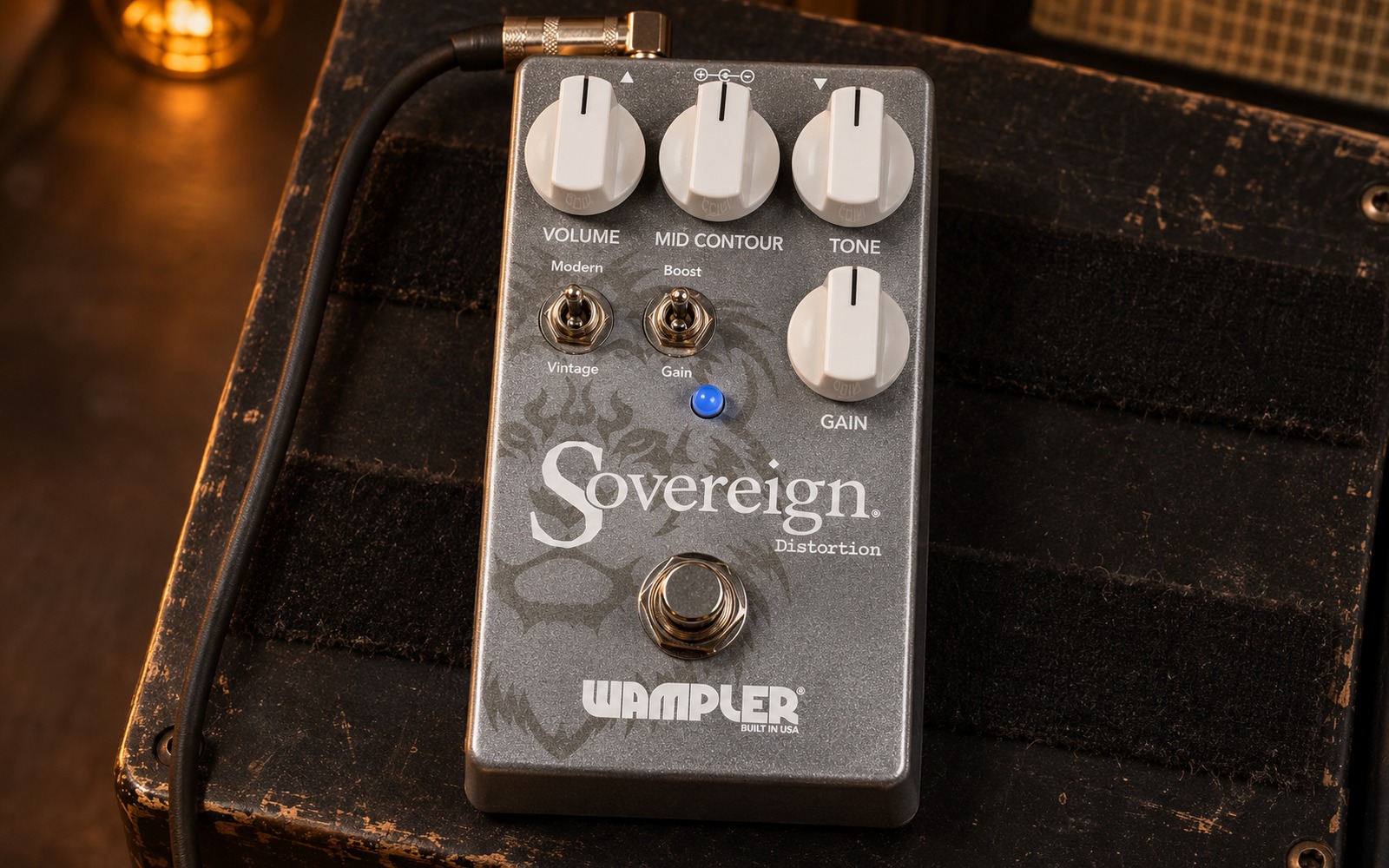
Retailer product copy, aggregator databases and a great many blog posts describe the Sovereign as having a “Mid Contour” knob and “Vintage/Modern” and “Gain Boost” switches. Wampler’s own marketing page contributes to the mess, referring to a “Contour control” and describing “Vintage mode” and “Modern mode” in its feature bullets.
The pedal itself, and the official manual, say something different. The knob is labelled Mid Behavior. The switches are Even/Bright and Standard/Boost. There is no Vintage/Modern switch on a Sovereign — that control belongs to the Pinnacle Deluxe V2, a different Wampler distortion entirely, and the two have been conflated in third-party copy for years. Once you know this, a lot of contradictory advice suddenly makes sense: people are describing two pedals as though they were one.
Here is what the actual controls do, per the manual.
The Advanced Gain Structure Group
Wampler’s contribution to pedal ergonomics here is a visual one. Three of the six controls — Gain, Even/Bright and Standard/Boost — are printed inside a boxed-off area on the enclosure face labelled “Advanced Gain Structure.” Everything inside that box changes how much distortion you get and what character it has. Everything outside it is level and EQ. The manual’s own instruction is explicit and worth following: set Mid Behavior and Tone to noon, dial in the Advanced Gain Structure first, and only then touch anything else.
Gain sets the distortion amount, and it interacts with both toggles rather than operating independently of them. Flip either switch and you will almost certainly want to move Gain afterwards. This is not a fault; it is the point of grouping them.
Even/Bright is the voicing switch. Even mode, per the manual, gives “a rock-solid foundation, with strong midrange and even treble and bass.” Bright mode rebalances toward the high frequencies, and Wampler is specific about the intended use case: “invaluable when you need to add highs to a setup that is naturally dark in tonality.” Dark humbuckers, dark amps, dark rooms. The manual’s own summary is unusually quotable — “In Even mode, the pedal can lay down the thunder; in Bright mode, you’ll unleash the lightning.”
Standard/Boost is the gain-structure switch, and it is best understood as two overlapping gain ranges rather than a clean/dirty toggle. Standard covers “responsive crunch to powerful, chunky distortion.” Boost, in the manual’s phrasing, “picks up where Standard leaves off,” adding more power and thicker saturation. The practical implication matters: if the pedal feels too polite, the correct move is to flip to Boost before you max out the Gain knob. Cranking Gain in Standard mode gets you a different, less satisfying result than a moderate Gain setting in Boost mode.
The Shaping Controls
Volume is output level, and there is plenty of it — comfortably past unity if you want the Sovereign to shove the front end of an amp. The manual warns that the AGS controls and the EQ both affect perceived output, so set Volume last and expect to re-trim it after any other adjustment.
Mid Behavior is the control that justifies the pedal’s existence. It is not a simple mid boost or a simple scoop; it adjusts the relationship between the midrange and everything around it, letting you place the guitar deliberately in a mix rather than just making it brighter or darker. Trevor Curwen’s Guitarist review picked this out as the differentiator, noting you can “dial in a real in-your-face upper midrange presence that cuts right through.” If you take one practical rule away from this article, take this one: when the guitar disappears in a band mix, raise Mid Behavior before you raise Tone.
Tone handles the high end and the harmonic edge. Between Tone and the Even/Bright switch you have two independent routes to the top end — a coarse voicing decision and a fine adjustment — which is more high-frequency control than almost any distortion pedal in the price bracket offers.
Famous Players: Three Names, Three Very Different Levels of Proof
This is the section where most gear coverage of the Sovereign quietly cheats, so let us do it properly. Equipboard lists three professional artists for the Wampler Sovereign. That is a small number, and the three are not equally well evidenced. Here they are in descending order of how much the evidence actually supports.
Gene Ween (Ween) — Strong Photographic Evidence
The best-documented Sovereign user is Aaron Freeman, better known as Gene Ween, singer and guitarist of the gloriously uncategorisable Pennsylvania band Ween. A photograph of his pedalboard taken at the Ween show at the Capitol Theatre in Port Chester, New York on 18 February 2022 shows the Sovereign in place alongside a Boss TU-3 tuner, an MXR Micro Flanger, an MXR Phase 90, an MXR Micro Chorus, an Xotic EP Booster, a Keeley 30ms double tracker, a Death By Audio Echo Dream 2 and a Boss AW-3 auto-wah.
This is the good kind of evidence: a dated, located, specific photograph of a working touring board, with the surrounding gear identified so you can sanity-check it. And the context makes sense. Ween’s material lurches across genres within single songs — the guitar has to go from clean psychedelic shimmer to genuinely heavy rock without a rack of pedals to do it. A single flexible distortion with a voicing switch and a real mid control is a rational choice for a player who needs one dirt box to cover an unreasonably wide stylistic range. Of the three names on the list, Gene Ween’s is the one that would survive a cross-examination.
Gilad Hekselman — Confirmed, But Historical
The Israeli-born, New York-based jazz guitarist Gilad Hekselman is documented with a Sovereign via a pedalboard photograph taken before the recording of one of his albums, from what the image metadata suggests was around 2016. Hekselman is a serious and widely respected player, and a modern jazz guitarist running a high-gain rock distortion is exactly the sort of detail that makes gear archaeology worth doing.
Honesty requires an important qualification, though. Premier Guitar filmed a full Rig Rundown with Hekselman in May 2021, and the Sovereign is not on the board. That session documents a Boss OC-3, an Electro-Harmonix Freeze, an EHX Pitch Fork, a Chase Bliss Mood, an EarthQuaker Devices Warden, a Valeton Coral Mod, a Donner looper, a Mooer A7 reverb, a Jam Pedals TubeDreamer, an EQD Avalanche Run and a Mooer graphic EQ — no Wampler at all. Premier Guitar’s own description of the setup explains why: the board is “cramped, ever-changing” and deliberately size-limited so it fits in a bag, and Hekselman rotates pedals in and out constantly.
So the accurate statement is: Gilad Hekselman used a Wampler Sovereign at one point in the mid-2010s, and by 2021 it had rotated off a board that rotates by design. That is a real credit, honestly framed — and considerably more useful to you than a bald claim that a famous jazz guitarist “uses” the pedal.
Brad Paisley — Thin Evidence, Strong Circumstantial Case
Brad Paisley is the third name, and it is the one to treat most carefully. The sole cited source is a timestamp — the pedal is said to be visible at 6:54 into a YouTube video titled “Mark Knopfler’s Guitar Heroes.” That is a single, unverifiable-at-a-glance frame in a video that is not primarily about Paisley’s rig, and it is not the kind of source this series treats as confirmation.

What is beyond doubt is Paisley’s broader Wampler relationship. The Wampler Paisley Drive Deluxe is his signature pedal, developed in genuine collaboration with Brian Wampler rather than badged after the fact. So a Sovereign appearing somewhere in his orbit is entirely plausible. But plausible is not documented, and there is no Rig Rundown, interview or rig-tech account placing a Sovereign in his working setup. File it as “possible, weakly sourced” — and note in passing that the video in question involves Mark Knopfler, whose own tonal world has nothing whatever to do with a high-gain distortion pedal.

What Isn’t Here, and Why That’s Fine
Two absences are worth stating out loud. First, Premier Guitar never reviewed the Sovereign. They reviewed the Super Plextortion, the Pinnacle, the SLOstortion, the Low Blow and plenty of other Wampler boxes, but not this one. Second, no Rig Rundown features it — the Hekselman one that exists actively documents its absence.
The demonstration videos that do exist are exactly that: demonstrations. Wampler’s official demo was played by Steve Townsend; Sweetwater made a store demo; the Australian demonstrator Brett Kingman filmed the pedal twice, into a Marshall Bluesbreaker, with a Charvel San Dimas and then a Les Paul Standard. Those are useful for hearing the pedal, and Kingman’s in particular are honest, well-recorded and worth your time. They are not endorsements, and this article will not dress them up as such.
Finally, the sonic-lineage trap. Because the Sovereign was deliberately not modelled on any amplifier, it has no legitimate list of legendary users to borrow. That is a structural point, not a gap in research. When a pedal chases a Super Lead you can reasonably invoke Angus Young and Tony Iommi as tonal reference points; when it chases the brown sound you can invoke Eddie Van Halen. The Sovereign chases nothing, so any article that hangs famous names on it is inventing a connection. What owners actually report is instructive: one Wampler customer, Jamie M. Harrison, writing in December 2019, described reaching for it for “Queensryche/EVH/Ozzy kind of tones” — that is a listener’s genre map, not a circuit’s ancestry, and the distinction matters.
Tone Recipes and Settings
1. Classic Rock Crunch (the default starting point)
Standard mode, Even mode. Gain 9–11 o’clock, Mid Behavior noon to 1 o’clock, Tone 10 o’clock to noon, Volume to unity. This is where the pedal is most immediately likeable and the setting to judge any used purchase from. Open chords ring, palm mutes have body, and the pedal cleans up reasonably well with the guitar’s volume knob. If it sounds thin here, the problem is Mid Behavior, not Gain.
2. Hard Rock Rhythm
Standard or Boost, Even mode. Gain noon to 2 o’clock, Mid Behavior 1–2 o’clock, Tone 10 o’clock to noon. The higher Mid Behavior setting is doing the heavy lifting: it keeps the guitar forward in a band without the brittleness that comes from chasing cut with treble. Keep Tone conservative through any bright amp. This is the setting closest to what most people buy the pedal for.
3. Lead Sustain
Boost mode, Even mode. Gain noon to 2 o’clock, Mid Behavior 1–3 o’clock, Tone at noon, Volume pushed a little above your rhythm level. The important discipline here is to get your lead lift from Volume rather than from more Gain — Boost mode already supplies the saturation, and additional Gain past this point buys compression and noise rather than sustain. Trevor Curwen singled out this territory in Guitarist, noting the pedal is “especially good if you like to squeeze out harmonics as you play lead.”
4. Dark Rig Rescue
Standard mode, Bright mode. Gain 10 o’clock to noon, Mid Behavior noon, Tone 11 o’clock to 1 o’clock. This is Bright mode’s actual job. Neck humbuckers, a dark-voiced amp, a 4×12 with worn-in speakers, a boomy room — Bright mode restores the definition that the rig is swallowing. Do not use it because a small practice amp sounds small; that is a volume and speaker problem and Bright mode will only make it shrill.
5. Bright Rig Control
Standard mode, Even mode, and stay there. Gain 9 o’clock to noon, Mid Behavior 1–2 o’clock, Tone 9–10 o’clock. Into a blackface-voiced Fender or a bright single-coil rig, the fix for harshness is mids up and treble down, not the other way round. Even mode’s stronger midrange foundation is precisely what a bright amp is missing.
6. Heavy Rhythm and Modern Gain
Boost mode, Even mode. Gain 1–3 o’clock, Mid Behavior noon to 2 o’clock, Tone 10 o’clock to noon. The Sovereign will genuinely go here, but with an honest caveat covered below: this is the setting where the pedal’s low-end weight becomes a factor, and it works best with amp bass pulled back and mids kept present. It is a hard-rock and traditional-metal setting rather than a djent one.
7. Lap Steel and Unconventional Sources
Worth including because a real owner documented it. Writing on Wampler’s product page in June 2024, Beau Jones described running a lap steel loaded with Lindy Fralin P-90s into the Sovereign, then into an Ampeg V4-B and a 4×10 loaded with Eminence Legends, for what he called “Low End, Slimy-Sludge, Nastiness.” The Sovereign’s mid control and its natural low-end weight make it unusually well suited to sources with more bottom end than a standard electric guitar — a genuinely useful data point if you play baritone, lap steel or anything in a dropped tuning.
All of these assume the manual’s workflow: Mid Behavior and Tone at noon, switches chosen first, Gain set second, Volume trimmed last. Knob positions are clock references.
How It Compares
Against the Obvious Cheap Alternatives
The honest starting question for any $200 distortion pedal is why you would not simply buy a Boss DS-1 or a Pro Co RAT 2. Both are canonical, both are cheap, and both have decades of records behind them.
The answer is control, and it is a real answer rather than a marketing one. The DS-1 gives you one tone knob. The RAT gives you one filter, and while that filter is one of the great controls in pedal history, it is still a single axis. The Sovereign gives you a mid control, a tone control, a voicing switch and a gain-range switch — four independent ways to fit the pedal to a rig, rather than one. If you play one guitar into one amp in one room, that flexibility is money you do not need to spend. If you play multiple guitars into backline amps you did not choose, it is the entire point.
The trade is character. The RAT has an unmistakable personality — you can identify it on a record. The Sovereign is deliberately more neutral, which is a virtue when you want it to be your amp’s dirty channel and a limitation when you want the pedal itself to be a sound.
Against the MXR Super Badass and the JHS Angry Charlie
The MXR M75 Super Badass Distortion is the closest philosophical competitor and costs less than half as much used. It offers a full three-band EQ, which on paper beats the Sovereign’s single Mid Behavior knob. In practice the comparison is closer than the spec sheet suggests: a conventional three-band EQ gives you three cuts and boosts, while Mid Behavior changes the relationship between the mids and everything else. Neither approach is better in the abstract. If you think in terms of bass/mid/treble sliders, buy the MXR. If you think in terms of where the guitar sits relative to the band, the Sovereign’s control is more directly useful.
The JHS Angry Charlie V3 is the amp-in-a-box answer — a specific JCM800 flavour with three-band EQ. If what you actually want is a Marshall, the Angry Charlie or Wampler’s own Plexi-Drive Deluxe gets you there more directly than a deliberately amp-agnostic circuit ever will.
Against the Rest of the Wampler Dirt Catalogue
This is the comparison that matters most, because if you are considering a Sovereign you are probably considering its siblings.
The Pinnacle Deluxe V2 is the brown-sound pedal: tighter, more specifically voiced, with its own Vintage/Modern and SAG switches and an independent boost footswitch. Choose it if you want a defined EVH-adjacent target. The Sovereign is broader and less opinionated.
The Ratsbane is a modified RAT in a mini enclosure — half the price, a quarter of the footprint, and a completely different design philosophy. It is a character pedal; the Sovereign is a chassis pedal.
The Tumnus occupies a different tier entirely as a Klon-style transparent overdrive, and pairs with the Sovereign rather than competing with it — Tumnus in front as a tightening stage, Sovereign doing the actual distorting.
Against a Metal Pedal
If tight, scooped, modern metal is the goal, the Boss MT-2 Metal Zone‘s parametric mid control and aggressive EQ are more purpose-built, and Wampler’s own Dracarys was designed for that territory. The Sovereign will produce heavy sounds, but it will not produce them as effortlessly as something designed exclusively for them.
Buying Guide: A Discontinued Pedal Is a Different Purchase
Buying a discontinued pedal changes the calculation in three ways, and it is worth thinking about all three before you commit.
Price. The used floor sits around $74, and the average tracked price across listings is roughly $153. Remaining new stock runs between about $163 and $222 depending on the seller. At the used floor this is an outstanding deal on a US-built pedal with a genuinely sophisticated control set. At $220 for new-old-stock you are paying above the original $199.97 MSRP for a discontinued product, which is difficult to justify unless the box, papers and warranty registration matter to you.
Version identification. Look at the jacks. Top-mounted input and output means the later relay-switched version; side-mounted jacks mean the original. Both are the same circuit. The V2 is more pedalboard-friendly and has a silent footswitch; the V1’s mechanical switch will keep working forever with no power at all. Neither is worth a significant price premium over the other.
Warranty reality. The Sovereign carried Wampler’s five-year limited warranty from the date of original purchase. On a pedal that left production, most units are now outside it. Wampler has a long-standing reputation for looking after owners regardless, and the company is still very much in business, but do not buy on the assumption of warranty cover. Buy on the assumption that you own the thing outright.
What to check on a used unit. Confirm all six controls are functional and free of crackle across their full sweep, especially Mid Behavior — it is the control that gets moved least and therefore oxidises most. Confirm both toggles click positively into both positions and produce an audible change. On a V2, confirm the relay footswitch engages reliably every time rather than intermittently. Check the battery compartment for corrosion; a battery left in a rarely used pedal for a decade is a genuine risk on a unit this old.
Living With It: Ownership Notes
Power is a non-issue. Nine milliamps at 9V, seventeen at 18V. Any isolated supply, any daisy chain, any half-decent wall wart will run it. The 18V option is officially supported and gives a more open, less compressed response with slightly more headroom; it is worth trying if your supply offers it, though the difference is subtler here than on lower-gain circuits.
The relay is worth understanding. On the V2, the footswitch is a soft switch controlling a relay, which means the switching mechanism needs power to operate. Wampler built in a sensible warning — the LED flashes three times when a battery is running low. If you gig this pedal on batteries, take that flash seriously. On a board with a proper supply it is a non-issue, and the payoff is a completely silent, click-free switch that will outlast a mechanical 3PDT by a wide margin.
The low end is heavier than you expect. This is the most consistent real-world criticism of the pedal and it deserves to be stated plainly rather than buried. One detailed user assessment describes the Sovereign’s low-end weight as making it challenging with humbuckers and awkward to stack with other pedals, and reports that it takes meticulous dialling with a Les Paul in particular, while noting that it is a notably quiet pedal in operation and shines with a Telecaster bridge pickup. That is a fair characterisation. The Sovereign is a mid- and low-forward distortion by design, and if you play a mahogany guitar with hot humbuckers through a bass-heavy amp, you will need to pull bass back somewhere in the chain. The fix is usually at the amp, not at the pedal.
It is a narrow enclosure. At 2.5 inches wide it is a standard-footprint pedal, not one of Wampler’s wider dual-footswitch boxes — six controls in a compact space. The knobs sit close together, so set-and-forget is a more realistic operating model than tweaking between songs in low light.
Be careful what you read. Between the Mid Contour / Vintage-Modern naming confusion and the volume of AI-assembled “review” content now surrounding discontinued gear, a great deal of Sovereign advice online is written by people who have never touched one. One widely circulating 2026 review states outright within its own text that it “is not presented as a long-term hands-on test.” When you research settings, weight the manual, the dated Guitarist review and demonstrator videos over anything that describes controls the pedal does not have.
Frequently Asked Questions
Is the Wampler Sovereign discontinued?
Yes. Wampler’s own product page now sits in the Discontinued category with the buy button showing out of stock. It was on sale for well over a decade across two hardware versions, and customer reviews on Wampler’s site run as late as November 2024, so it was retired while still being actively bought rather than because demand collapsed. Remaining new stock and a healthy used market mean it is still easy to find.
What controls does the Sovereign actually have?
Four knobs — Volume, Gain, Mid Behavior and Tone — plus two toggle switches, Even/Bright and Standard/Boost. Gain and the two toggles are grouped on the enclosure as the “Advanced Gain Structure.” Ignore any source describing a “Vintage/Modern” switch; that control is on the Pinnacle Deluxe V2, not the Sovereign, and the two pedals have been confused in third-party copy for years.
What is the difference between the two versions?
Jack placement and footswitch type. The original has side-mounted jacks and a conventional mechanical true-bypass switch. The later version, whose manual is dated February 2017, has top-mounted jacks and a relay-based true bypass operated by a soft switch. No source indicates any circuit revoicing between them. Buy on condition and price.
Is the Sovereign good for metal?
It handles hard rock and traditional metal comfortably in Boost mode with Gain past one o’clock, and its mid control is genuinely useful for keeping rhythm parts audible. It is not a specialist modern-metal pedal. Its low end is generous rather than surgically tight, so for scooped, high-precision modern metal a purpose-built pedal will get you there with less work.
Which famous guitarists used the Wampler Sovereign?
Three are documented, with very different levels of proof. Gene Ween of Ween is the strongest — a dated pedalboard photograph from a February 2022 show in Port Chester, New York. Jazz guitarist Gilad Hekselman used one around 2016, though it is absent from his May 2021 Premier Guitar Rig Rundown. Brad Paisley is listed on the basis of a single video timestamp, which this article does not treat as confirmation, though his Wampler relationship via the Paisley Drive signature pedal is beyond doubt. There is no Premier Guitar review of the Sovereign and no Rig Rundown featuring it.
Should I run it at 9V or 18V?
Either. Wampler officially supports 9V to 18V, and the draw goes from 9mA to 17mA. Eighteen volts gives a slightly more open, less compressed feel with a little more headroom. Unlike some Wampler circuits there is no manufacturer statement favouring one voltage as the intended voicing, so use whatever your supply offers and pick by ear.
Does it stack well with other pedals?
Cautiously. Its low-end weight makes it a less obliging stacking partner than a leaner circuit, and at least one detailed owner account cites exactly that as a frustration. The arrangement that works best is a low-gain overdrive in front as a tightening and focusing stage — an Ibanez TS9 or a Tumnus with gain low and level up — feeding the Sovereign, rather than the Sovereign feeding another dirt pedal. It is designed to be the main gain stage, not a colour in someone else’s chain.
Sovereign or Pinnacle Deluxe V2?
Different jobs. The Pinnacle Deluxe V2 is a brown-sound pedal with a specific target, a Vintage/Modern switch, a SAG control and an independent boost footswitch — buy it if you want that Van Halen-adjacent voice and the two-pedals-in-one architecture. The Sovereign is deliberately amp-agnostic and broader, with a better single mid control and a simpler feature set. If you want a specific amp, take the Pinnacle. If you want one distortion that adapts to whatever amp you are handed, take the Sovereign.
Is it worth buying now that it is discontinued?
At used prices, unreservedly yes. Around $90 to $140 buys a US-built pedal with a five-year design life measured in decades, six controls, and one of the better mid-shaping implementations in the category. At above its original $199.97 MSRP for new-old-stock, it is harder to justify — a Super Badass or an Angry Charlie V3 covers similar ground for less. The pedal is excellent. The premium for a discontinued box is not.
Image credits
- Top image: GuitarGangsters AI-generated reference illustration, not a photograph.
- Guitar pedals on a rug: Oldangelmidnight from Northampton, MA, Wikimedia Commons, CC BY-SA 2.0.
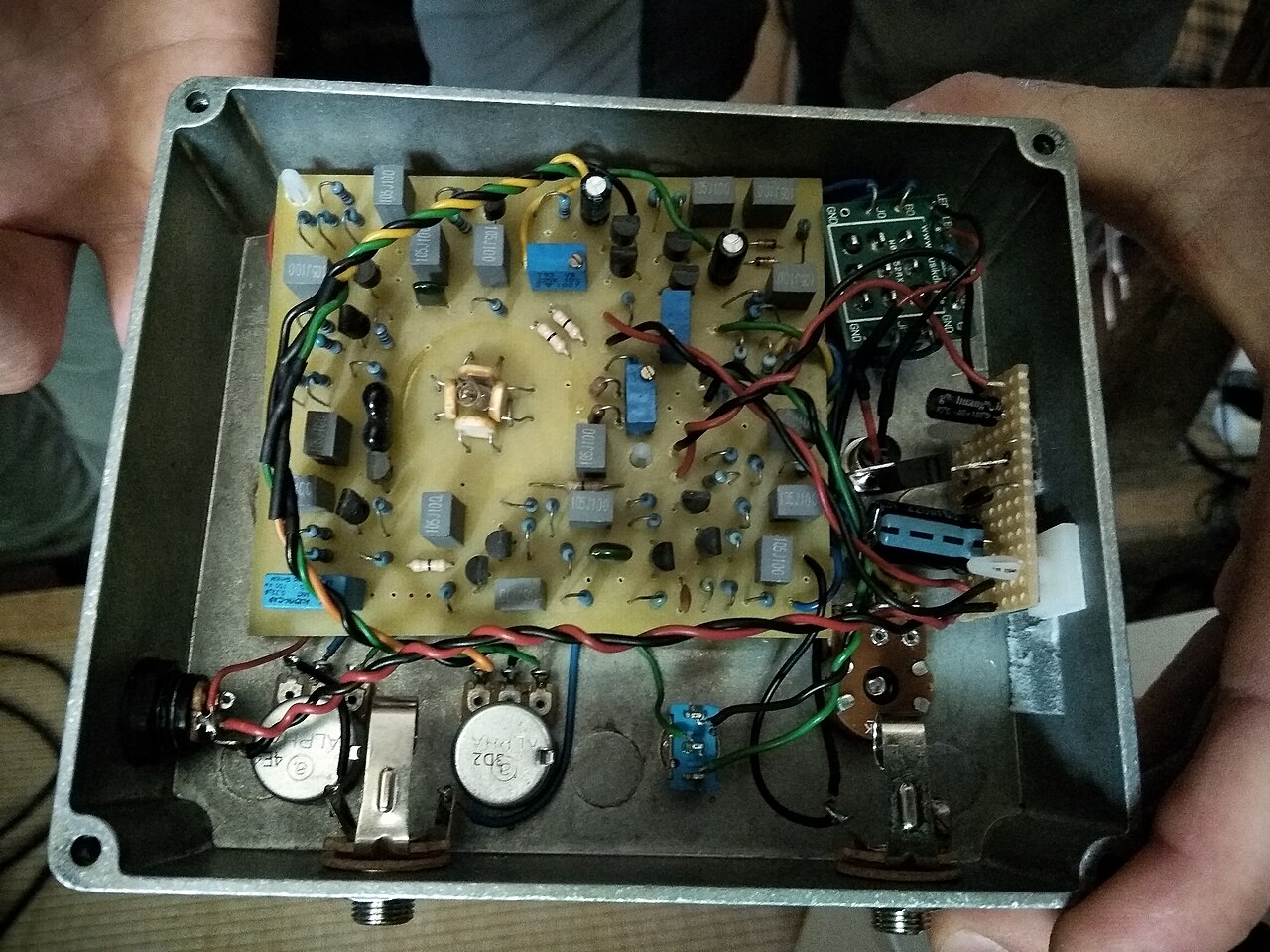
- Inside a DIY pedal showing the circuit board: Skimel, Wikimedia Commons, CC BY-SA 4.0.
- Brad Paisley: Crisco 1492, Wikimedia Commons, CC BY-SA 4.0.
- Brad Paisley: by Mass Communication Specialist 1st Class Toiete Jackson, Wikimedia Commons, Public domain.
Latest News
Related
On This Day
Monday 9 November
From this week: