J. Rockett PXO: The Two-Headed Signature Drive Built For Guitarists Who Never Know What Amp They’re Plugging Into
The J. Rockett PXO is Phil X's signature dual boost and overdrive. Full specs, tone recipes, honest player verification, comparisons and buying advice.
Most signature overdrives are built around a sound. This one was built around a problem. Phil X spends his working life walking onto stages he has never seen, in front of backlines he did not choose, and playing arena-sized parts that have to land in the first eight bars. The J. Rockett PXO was designed for exactly that job: a drive and a boost in one steel box, either one able to sit in front of the other, with enough EQ authority on both sides to talk a strange amp into behaving.
That is a less romantic origin story than the ones we usually tell around here. There is no mythical amp, no cork-sniffing serial number, no lost transistor. But it produced one of the more genuinely useful pedals J. Rockett have put their name on, and one that two of the most experienced reviewers in the business — Charles Saufley at Premier Guitar and Pete Emery at MusicRadar — independently landed on the same 4.5-out-of-5 verdict about, with the same single complaint attached: it costs a lot of money.
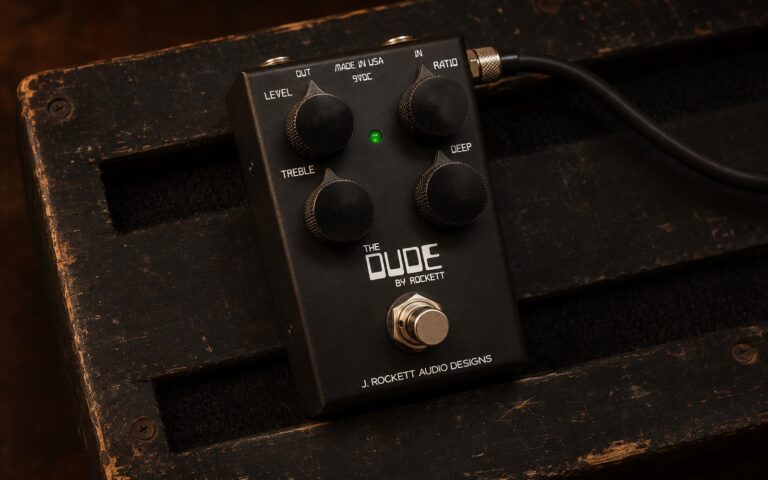
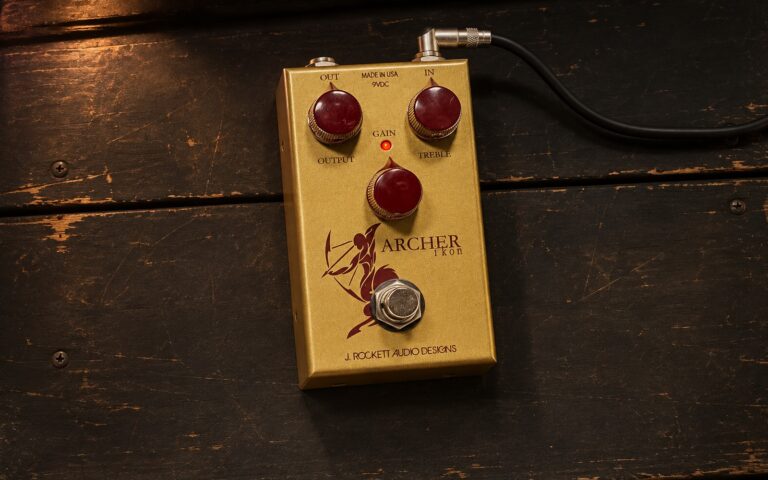
This is the fourth J. Rockett SKU in our countdown, and it is the odd one out. Where the Archer Ikon chases the Klon, The Dude chases a Dumble, and the Blue Note chases a certain kind of low-gain transparency, the PXO is not chasing anything. It is the only drive in the line whose brief was “make Phil X’s night easier,” and that turns out to be a very different design target.
Who Phil X Actually Is, And Why That Matters To The Circuit
If you only know the name from a Bon Jovi stage, you know about a third of it. Phil X — Phil Xenidis, Greek-Canadian, out of Toronto — built a following long before the arena gig, through the Fretted Americana video series, where he demonstrated vintage guitars with a combination of tone snobbery and total disrespect for the sanctity of a ’59 Les Paul. He fronts his own band, Phil X and the Drills. He is a long-time session player. And he stepped into Richie Sambora‘s spot in Bon Jovi in 2011, becoming a full member two years later and appearing on three studio albums by the time the PXO landed.

Our full Phil X gear guide covers the guitars and the amps in detail, but two things are worth pulling forward because they explain the pedal. First, his core amp is a 100-watt EL34 Friedman-built signature head — a hot, midrange-forward, British-voiced platform. Second, he is a working session and hired-gun player, which means the amp he owns is frequently not the amp in front of him.
J. Rockett’s own account of the pedal’s development is unusually candid on this point: they sent Phil an overdrive sample, and what he came back with was not “it sounds like my amp” but that it rescued him in backline situations and played nicely with other pedals. The pedal was then built out from that reaction. That is a rare thing to admit in signature-pedal marketing, and it is the single most useful sentence written about the PXO, because it tells you what to expect. This is not a cloning exercise. It is a survival tool.
Asked to describe the two circuits by MusicRadar, Phil X reportedly declined to talk about topology at all and answered with two expletives — one for the drive, one for the boost. Make of that what you will, but it is at least consistent with a pedal that was voiced by ear rather than derived from a schematic.
What It Actually Is: Two Pedals, One Chassis, And A Switch That Reverses Them
The PXO is a dual unit. On the left, an overdrive with Volume, Gain, Treble and Bass. On the right, a boost with Level and a single Tilt EQ control. Two footswitches, so either side runs on its own or both run together. And between them, the feature that defines the pedal: a small slider that swaps the internal order of the two sections.
That slider is labelled Pre/Post, and here is the first thing you need to know before you buy one — it refers to the position of the drive, not the boost. MusicRadar‘s Pete Emery flagged this as the one thing that caught him out, and argued in his Cons list that the labelling would make more sense referenced to the boost side. It is a five-second mental adjustment, not a design flaw, but it is the sort of thing that costs you a soundcheck if nobody warns you.
Why does the order matter so much? Because boost-into-drive and drive-into-boost are two completely different functions. Boost first means you are pushing the drive circuit harder — more saturation, more compression, a different gain structure, and with the Tilt EQ you get to choose which frequencies do the pushing. Drive first means the boost is a clean(ish) level and EQ stage after the fact — a solo lift, or a way to re-shape the drive’s output for a different amp. One box, two philosophies, one slider.
The Tilt EQ, And Why It Is Not A Tone Knob
The Tilt control on the boost side is the other reason this pedal is interesting. A conventional tone control removes or adds one end of the spectrum. A tilt control pivots the whole response around a centre point: turn it clockwise and you boost the highs while cutting the lows; turn it counter-clockwise and you boost the lows while cutting the highs. One knob, a see-saw instead of a filter.
The practical consequence is range. Both reviewers noted that the extremes of the Tilt control are genuinely extreme — Saufley described the most aggressive treble settings as potentially excessive in isolation, then immediately pointed out that those same settings are exactly what you want when you need a lead to cut through a muddy amp you have never met. Emery found the opposite end just as useful: dial Tilt toward the lows, run the boost into the drive side, and the PXO edges into fuzz-adjacent territory.
That is a lot of tonal ground from six knobs and a slider. It is also why Saufley’s summary of the pedal in Premier Guitar called the interaction between the controls “a surgeon’s scalpel” — the individual ranges are wide, but the way the drive’s Volume and Gain change the behaviour of the Treble and Bass controls is where the real vocabulary lives.
Specifications
| Model | J. Rockett Audio Designs PXO (Phil X Signature Boost and Overdrive) |
|---|---|
| Type | Dual analogue overdrive + boost, independent footswitches |
| Announced | Publicly shown around Guitar Summit 2024; announced in the guitar press 30 September 2024 |
| Drive controls | Volume, Gain, Treble, Bass |
| Boost controls | Level, Tilt EQ |
| Routing | Pre/Post slider switch — reverses the order of the drive and boost sections (refers to the drive‘s position) |
| Bypass | True bypass |
| Signal path | 100% analogue |
| Enclosure | Steel chassis, matte black finish |
| Dimensions | 4.1″ x 3.7″ x 1.1″ (approx. 104 x 94 x 28 mm) |
| Weight | 660 g / just under 1.5 lb |
| Connections | 1 x 1/4″ input, 1 x 1/4″ output |
| Power | 9V DC, centre-negative, sold separately |
| Current draw | 28 mA (see note below) |
| Country of origin | Hand-built in California, USA |
| Launch price | $349.99 / £359 |
| Street price (September 2026) | Roughly $280–$350 depending on retailer |
Two Spec-Sheet Discrepancies Worth Knowing About
Current draw. MusicRadar‘s spec box lists 30 mA; the body of the same review says 28 mA; Equipboard’s spec table says 28 mA. The difference is irrelevant to any modern isolated supply — anything with a 100 mA output will run it comfortably — but if you are counting milliamps on a maxed-out brick, budget 30 mA and you will not be surprised.
Battery operation. Equipboard’s feature list for the PXO states that it can be powered by a 9V battery or a DC adapter. We could not corroborate that anywhere: MusicRadar‘s connectivity list, which was compiled with the pedal physically on the bench, records a 1/4″ input, a 1/4″ output and a 9V DC socket, with no battery. Aggregator feature lists are frequently assembled from generic templates — we have caught the same site inventing bypass and power specs on other boutique drives in this series. Treat the PXO as a DC-only pedal, plan your board accordingly, and if a battery door turns out to exist, consider it a bonus.
Famous Players: An Honest Accounting
Here is where we have to be straight with you, because this is a signature pedal and signature pedals attract inflated player lists.
Phil X himself is the only documented user. As of September 2026 — nearly two years after launch — Equipboard’s artist tally for the PXO stands at exactly one, and the sourcing for that one is J. Rockett’s own demo video, in which Phil X plays the pedal that has his initials on it. That is not a gotcha; it is simply the state of the record. There is no Rig Rundown board photo of a third-party pro running a PXO that we could find and verify, and we are not going to invent one.
There is also nothing in the way of crowd-sourced owner data. Equipboard’s review count for the pedal is zero. Zero reviews, zero ratings. For comparison, the Archer Ikon on the same site carries a 5.0 average from 37 ratings. That gap is not a quality judgement — it is a volume judgement. The Ikon is a sub-$230 Klone that sells in numbers; the PXO is a $300-plus dual signature pedal aimed at a much narrower slice of players.
One more thing to disregard while you are here: the “genre usage” breakdown you will see on aggregator pages for this pedal, which lists Metal, Nu Metal, Hip Hop and Alternative Hip Hop alongside the obvious Hard Rock. Those tags are not derived from PXO owners. They are derived from the genre tags attached to the single artist in the database — Phil X, whose session résumé is broad — and then presented as if they described the pedal. With a sample size of one, the genre chart is an artefact, not information.
What about Richie Sambora? He appears in this article because he is the man whose gig Phil X took, and because his own tone is part of the Bon Jovi sonic furniture. He is not a PXO user, has no connection to the pedal, and we mention him purely for context. Same rule we apply to every “influenced by” claim in this series: a stylistic lineage is not an endorsement.
So the honest summary is this — the PXO’s credibility rests on the reviews and on the design brief, not on a roster. Fortunately the reviews are strong.
What The Reviewers Found
Premier Guitar published Charles Saufley’s review on 15 January 2025. It scored 4.5 and took a Premier Gear award. Saufley’s framing is the most useful thing written about the pedal: he tested it not with a Les Paul into a Friedman — the obvious Phil X setup — but with a Jazzmaster into a black-panel Vibrolux, roughly the opposite of arena rock. His conclusion was that the PXO’s EQ authority let a single-coil guitar into blackface-amp territory produce sounds a blindfolded listener would accept as a humbucker. Pros: chameleonic, interactive but intuitive, excellent range from scathing to fat. Con, singular: expensive.
MusicRadar‘s Pete Emery followed on 24 March 2025, also at 4.5 overall, with five stars for build quality. His test rig was a ’51 Custom Shop Telecaster into a Hot Rod Deluxe, plus JCM800 and Matchless DC30 amp models — again, deliberately not a Phil X rig. His observations, in order of usefulness:
- The drive side is smooth and warm through the midrange, with a tight bass and a present, bell-like top end that stops short of ice-pick territory.
- The high end retains detail as gain increases — which he noted, cheerfully, means it does not hide sloppy playing.
- The Treble control is powerful enough to be a double-edged sword: it can make bad sounds as easily as good ones, but it is precisely what lets the pedal cooperate with amps and other drives.
- He specifically tested it stacked with a Boss BD-2 Blues Driver and a Tube Screamer, and reported it played well with both.
- On the boost side, the first half of the Level pot’s travel does very little. That is his one genuine performance criticism, and it is worth knowing before you set a solo boost by knob position in a dark venue.
- Build quality: steel chassis, 660 g, and his verdict was that it will outlast its owner.
Pierre Journel at The Guitar Channel reviewed it in January 2025 and reached the same place from the European side — praise for the reversible routing and for the Tilt control’s ability to flip the entire spectrum rather than nudge one band, with price as the only real gripe, mitigated by the observation that you are buying two pedals. (For the record, his review describes Phil X as American; he is Canadian.)
Three reviewers, three different test rigs, one shared Con. When the only criticism three independent writers can agree on is the price, that is a meaningful signal.
Tone Recipes And Settings
1. The Backline Rescue (the pedal’s actual job)
Drive: Volume 12 o’clock, Gain 10 o’clock, Treble and Bass at noon to start. Boost: OFF. Slider: Post. Now do the EQ work with your ears rather than the amp: if the house amp is boxy, Treble to 2 o’clock and Bass to 10; if it is thin and brittle, reverse it. This is the setting you dial in during the first two minutes of soundcheck, and it is why the pedal exists.
2. Arena Rhythm
Drive: Volume 1 o’clock, Gain 1–2 o’clock, Treble 1 o’clock, Bass 11 o’clock. Boost off. Enough saturation for power chords with the low end kept tight so the bass player still has a job. If it sounds flubby, the Bass control is nearly always the culprit, not the Gain.
3. The Screaming Lead (Emery’s favourite)
Slider: boost feeding the drive. Boost: Tilt just past noon toward the treble side, Level around 2 o’clock. Drive: Gain at noon, Volume to taste. The result is a sustaining, singing medium-gain lead voice — and this was achieved on the bench with a Telecaster into a clean Hot Rod Deluxe, which tells you how much lifting the pedal is doing.
4. Fuzz-Adjacent
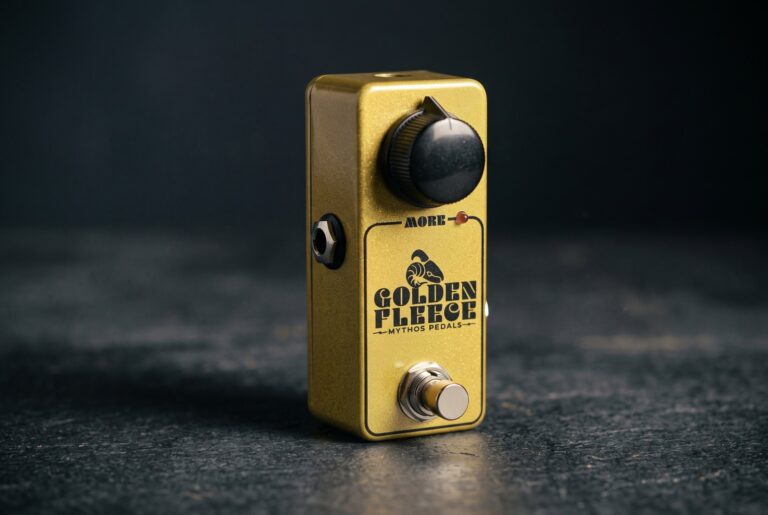
Slider: boost feeding the drive. Boost: Tilt hard counter-clockwise (lows boosted, highs cut), Level 1–3 o’clock. Drive: Gain 2 o’clock, Treble 1 o’clock to claw back some definition. Woolly, saturated, splatty at the front of the note. Not a real fuzz — see the Golden Fleece for that — but a genuinely different flavour from the same box.
5. Clean Solo Lift
Slider: drive first, boost after. Drive engaged at your rhythm setting. Boost: Tilt at noon, Level around 11–1 o’clock. Because the first half of the Level travel is subtle, start at noon and work backwards rather than forwards. This is the setting where the post-position genuinely earns its keep: you get more volume without changing the drive’s gain structure.
6. Stacking Into Another Drive
Both reviewers used the PXO as a partner rather than a soloist. Set the PXO drive low (Gain 9 o’clock, Volume 1 o’clock) and run it into a TS808 or a Fulltone OCD, and use the PXO’s Treble and Bass to pre-shape what the second pedal receives. Very few overdrives give you a real two-band EQ to do this with — that is the PXO’s structural advantage over almost every single-knob-tone drive in this list.
Knob positions are described as clock face. All of these assume a clean or edge-of-breakup amp; if your amp is already dirty, pull the drive Gain back by a third from every figure below.
How It Compares
Against the other J. Rockett drives
Within the brand’s own catalogue the PXO is the outlier. The Archer Ikon is a Klon interpretation with a fixed personality and a mid-forward push. The Dude is a D-style pedal built to a specific amp’s behaviour. The Blue Note is a low-gain transparency play. All three have a voice they are committed to. The PXO’s voice is deliberately movable — that is the product. If you already know what sound you want every night, one of the other three is cheaper and more direct. If your sound is a moving target, the PXO is the one that adapts.
Against the other famous two-in-one drives
The obvious comparison is the Keeley D&M Drive, which MusicRadar itself put forward as the alternative: a mid-humped boost on one side and a Bluebreaker-flavoured drive on the other, for around $230. The D&M is voiced — it has opinions. The PXO has range instead. Then there is the Analog Man King of Tone, the original two-circuits-one-box drive, which you cannot readily buy and which does not offer a two-band EQ or a routing switch. Its single-circuit sibling, the Prince of Tone, is the practical route into that flavour.
Against the transparents
If your instinct is that a drive should stay out of the way — the Timmy, the Greer Lightspeed, the Nobels ODR-1, the Vemuram Jan Ray — then understand that the PXO is playing a different game. Those pedals are designed so that your amp stays recognisable. The PXO is designed so that an amp you have never heard before can be made recognisable. The Timmy’s two-band EQ is the closest philosophical relative here, and at a fraction of the price it is a legitimate alternative if you do not need the boost side or the routing switch.
Against the modern boutique field
The Browne Protein is the other dual-drive most often cross-shopped at this price, and it is a real alternative: two drives rather than a drive and a boost, with its own blend logic. The Browne Carbon, Greer Southland and Mythos Mjolnir occupy adjacent ground with single, committed voices. And if what you actually want is the flexibility with presets and switching, the digital route — a Strymon Sunset, or an amp-modelling front end like the Strymon Iridium — gives you more control at the cost of the PXO’s simplicity.
Buying Guide
Who should buy one
- Fly-date and backline players. If you regularly plug into rented amps, this pedal was designed for your exact night. Nothing else in this section of the list is aimed at you so specifically.
- Session and function players. Multiple genres in one set, one board, no time. The routing switch plus the two-band EQ covers more ground than two separate drives of the same total cost.
- Players with one guitar and one amp who want more from both. This is Saufley’s point: the PXO meaningfully expands what a single guitar can be made to sound like.
- Anyone building a minimal board. Two footswitches, one power draw, one set of cables, two functions.
Who should not
- Players who already have their sound. If your amp and your one drive are dialled and you never move, you are paying for flexibility you will not use. Buy the Blue Note or the Ikon.
- Budget-sensitive buyers. Three reviewers, one shared complaint. It is expensive, and there is no way around that.
- Set-and-forget knob-avoiders. The controls are highly interactive by design. That is the feature. If you want one knob and a good sound, the PXO will frustrate you.
- Anyone expecting a Phil X clone box. It will not deliver his hands, and — despite what the enclosure says — it is not a model of his Friedman rig. It is a flexible drive that he helped voice.
Price and availability, September 2026
The PXO launched at $349.99 in the US and £359 in the UK. Two years on, the street picture has softened but not collapsed: aggregated pricing across seven tracked retailers runs from roughly $280 to $382 depending on the store, with the major US online retailer sitting near $280 and others still holding at the $349.99 list. Price tracking on the pedal only began in April 2026, so there is not yet a long enough history to identify a reliable seasonal low. Practical advice: $280 is a good price, $349.99 is list, and anything above that is a store betting on scarcity for a pedal that is not scarce.
Used examples exist but are not plentiful — signature dual pedals tend to be bought deliberately and kept. Expect to save 25–30% at most on the used market, and check that the seller has the box, since resale on boutique drives is materially better with it.
Living With It
Board space. At roughly 4.1″ x 3.7″ it is a wide pedal but not a deep one, and it replaces two enclosures. Net, it usually saves room. The 660 g weight is real, though — if you are running a lightweight flight board, this thing has mass.
Power. 9V DC, centre-negative, around 28–30 mA. Any isolated supply handles it. Do not assume a battery option exists.
Placement in the chain. Front of the board, after wah and compression, before modulation and time-based effects. If you are stacking with another drive, the PXO’s two-band EQ makes it the better candidate for the first position, where it can shape what the second pedal sees.
Bypass. True bypass, so if you have a long cable run and a lot of true-bypass pedals in front of a passive guitar, the usual buffer maths applies — put a good buffer at the front of the board.
The learning curve is real. Premier Guitar‘s own summary flagged it: the controls interact strongly, and the pedal rewards time spent. Give it an evening with your own amp before you take it to a gig. In particular, learn where the boost Level actually starts doing something, and learn what the Tilt extremes sound like through your rig, so that under pressure you are turning a knob you already understand.
Finish and legibility. Matte black with a tough-guy aesthetic. It looks the part. Under coloured stage lighting, matte black enclosures with small legends are never the easiest to read — if that matters to you, mark your two most-used settings with a paint pen and stop squinting.
Frequently Asked Questions
Is the J. Rockett PXO a clone of any classic circuit?
No, and unusually for a modern boutique drive, nobody involved has claimed otherwise. Both magazine reviews concluded that it does not sound closely derivative of any obvious predecessor — MusicRadar‘s headline verdict was essentially that it is an overdrive that sounds a little different, which in the 2020s counts as an achievement.
What does the Pre/Post switch actually do?
It reverses the internal order of the drive and boost sections. Critically, the label refers to the position of the drive, not the boost — the opposite of what most players assume on first look. Boost-into-drive changes the gain structure; drive-into-boost gives you a level and EQ lift after the dirt.
What is a Tilt EQ?
A single control that pivots the frequency response around a centre point rather than boosting or cutting one band. Clockwise adds treble while removing bass; counter-clockwise does the reverse. It gives you a very wide sweep from one knob, which is why it is worth learning rather than leaving at noon.
Can I run the two sides at the same time?
Yes. Each section has its own footswitch and works independently or in series with the other. That is the point of the pedal — four states from two switches, doubled again by the routing slider.
Does it take a 9V battery?
Treat it as DC-only. One aggregator listing claims battery operation, but the hands-on review specifications record only a 9V DC input alongside the two jacks. Bring a power supply.
How much current does it draw?
28 mA by the manufacturer-derived spec tables, 30 mA in one published spec box. Either way it is a trivial load for any modern isolated supply.
Does it sound like Phil X’s Bon Jovi tone?
It gets you into that territory — MusicRadar‘s reviewer explicitly ran through the catalogue and found the pedal had more than enough gain for that era of guitar-driven pop-rock. But the pedal was designed as a general-purpose drive that Phil X approved, not as a model of his amp. His signature 100-watt EL34 head is doing a great deal of the work in the records you are thinking of.
Is it worth $300-plus?
That is the only question every reviewer hesitated on, and the honest answer depends entirely on whether you need the flexibility. If you play the same amp every week, no — a Blue Note or a Tumnus at a third of the price will serve you better. If you plug into a different amp every night, the PXO does a job that cheap pedals genuinely cannot, and it does it in one enclosure. Two 4.5-star verdicts with “expensive” as the sole criticism is a fair summary of the value proposition: excellent pedal, premium price, buy it for the right reason.
The Verdict In Context
The PXO is the least mythological pedal J. Rockett make and possibly the most practical. It has no famous amp behind it, no cult circuit, no roster of secret users — just a working guitarist’s problem, solved competently, in a steel box that weighs more than some amps’ worth of hope. Two of the most respected reviewers in guitar journalism tested it on rigs that had nothing to do with arena rock and both came away impressed by its adaptability rather than its voice.
That is an unusual thing for a signature pedal to be praised for, and it is the reason the PXO earns its place. It is not the drive you buy because you want to sound like someone. It is the drive you buy because you are tired of walking onstage and hoping.
Image credits
- A guitarist using an effects pedal on stage: Shixart1985, Wikimedia Commons, CC BY 2.0.
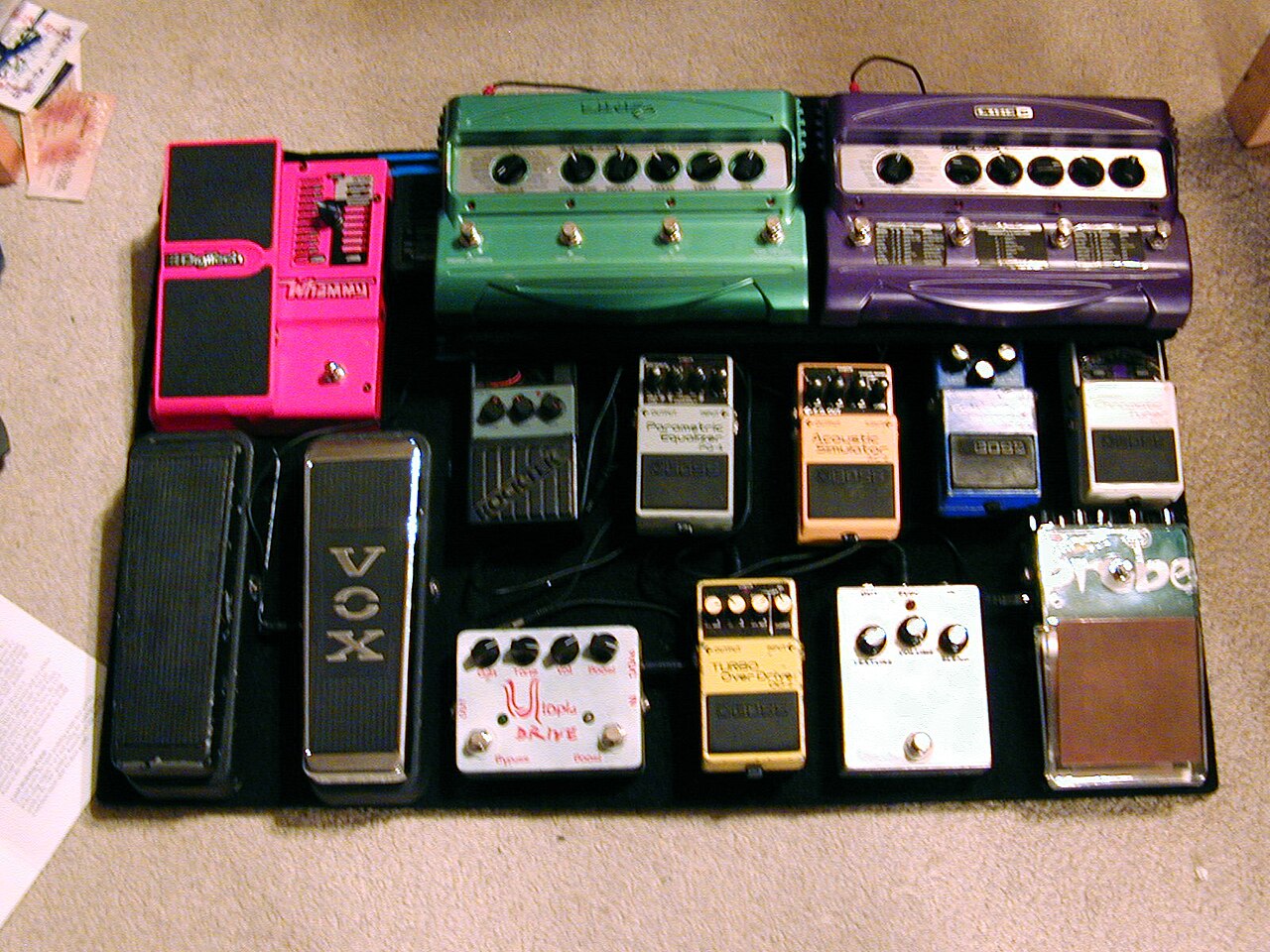
- A pedalboard with wah and effects pedals: John Athayde, Wikimedia Commons, CC BY 2.0.
- Richie Sambora: Justin Higuchi, Wikimedia Commons, CC BY 2.0.
Latest News
Related
On This Day
Tuesday 10 November