EarthQuaker Devices Hoof Fuzz: The Akron Muff That Built An Entire Company
EarthQuaker Devices Hoof Fuzz. AI-generated reference illustration, not a photograph.
EarthQuaker Hoof Fuzz guide: the Akron origin story, full specs, Shift knob explained, verified players, tone recipes and V1 vs V2 buying advice.
Boston, November 11, 2006. A two-piece band from Akron, Ohio is playing to a room, and somebody in that room is holding a cell phone up in the air. The video that survives is a smear of early-2000s compression artefacts. You can barely see the stage. But you can hear the guitar, and the guitar is enormous — a fuzz so wide and so structurally load-bearing that the band does not need a bass player, because there is no room left for one.
The guitarist is Dan Auerbach. The pedal doing the damage was built by the band’s then tour manager and sometimes-tech, a guy who had been soldering boxes in his bedroom and who had just decided that his own Russian Big Muff sounded like a wet blanket. His name is Jamie Stillman. The pedal was called the Hoof.
Twenty years and several thousand pedals later, EarthQuaker Devices occupies a building on West Bowery Street in Akron with a workforce, a 401k plan and — according to their own account of it — free yoga classes. The Hoof is still in the catalogue, still hand-built in the same city, still four knobs, still sounding like the wall of a barn falling in slow motion. This is the story of how one green-Russian-derived circuit turned a bedroom operation into one of the most recognisable names in American effects, what the pedal actually does, and who has genuinely used one.
The short version
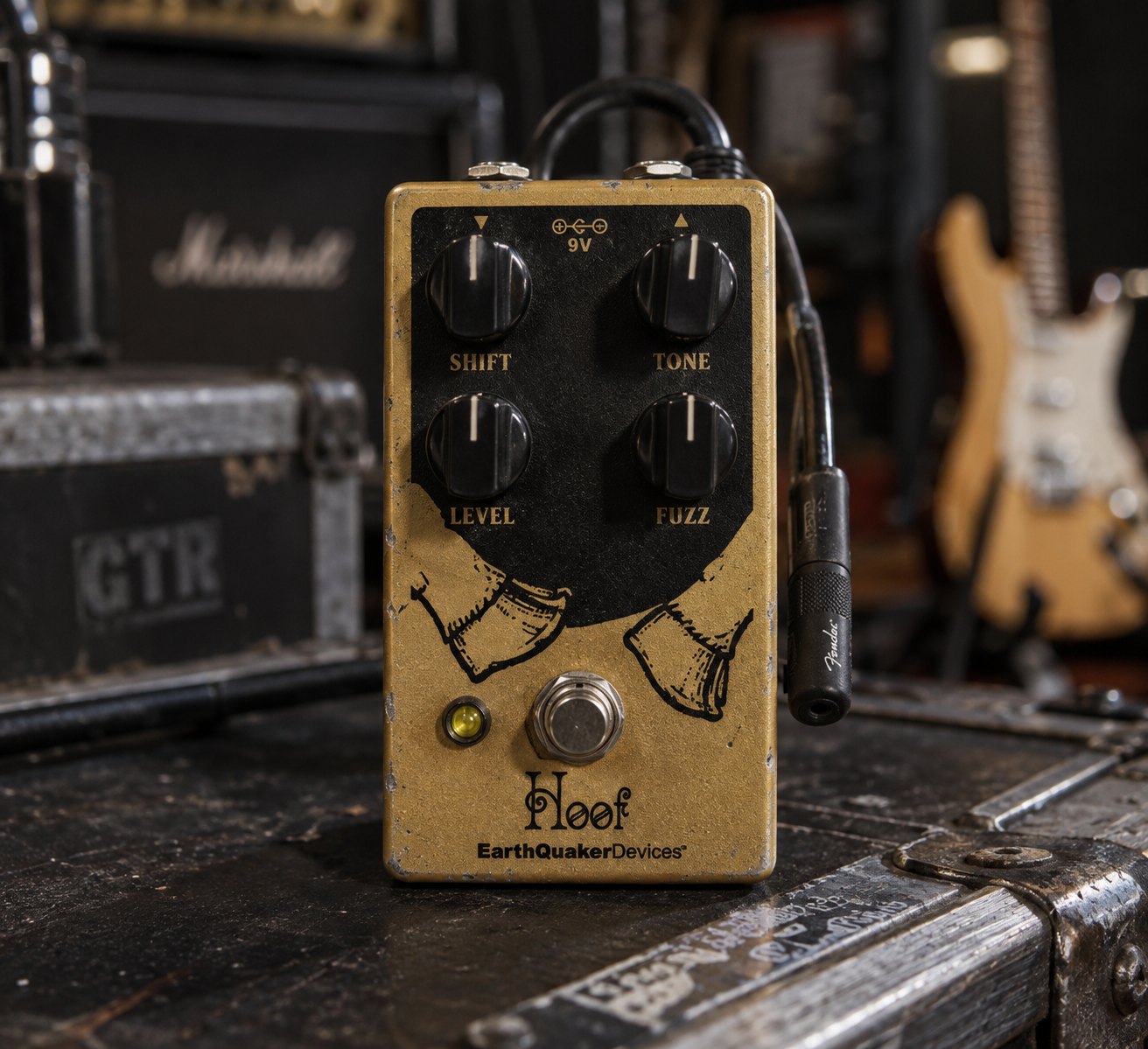
The EarthQuaker Devices Hoof is a hybrid germanium/silicon fuzz loosely based on the “green Russian” Sovtek-era Big Muff circuit. It has four controls — Fuzz, Tone, Level and Shift — and the Shift control is the entire reason the pedal is not just another Muff clone. It sweeps the midrange from the classic scooped Muff voice to a boosted, cutting, mid-forward voice, which means it can sit in a mix rather than disappearing into one.
Current retail is $179 in the US, with the pedal discounted to around $152 at major dealers as of September 2026. It is all-analog, true bypass with relay-based soft switching, draws 15 mA and runs on a standard 9V centre-negative supply. It is not a boutique-scarcity object: EQD have built thousands, and used examples are everywhere.
Where it fits: this is the Muff for people who love the sustain and the sludge of a Big Muff Pi but hate what a scooped Muff does to a three-piece band. It is also, unusually for a Muff-family circuit, genuinely good on bass.
Akron, a Russian Muff and a tour manager with a soldering iron
EarthQuaker Devices’ origin story is unusually well documented, largely because EQD themselves published it. Stillman was not a career electronics designer. He was a musician and a tour manager who started building pedals because he wanted specific sounds and could not buy them.
The specific sound in question was Auerbach’s. Vintage Russian Big Muffs are famously inconsistent — component tolerances, transistor gain and the general chaos of late-Soviet manufacture mean two units off the same bench can sound meaningfully different. Stillman’s own unit, by his account, was compressed and over-saturated and did not do what he wanted. Auerbach’s did. So Stillman set out to build a circuit that produced the dirty-but-defined raunch he was hearing from the other guy’s board rather than his own.
The solution was the hybrid. Instead of picking a camp, Stillman used both germanium and silicon transistors in the same circuit — germanium for warmth and touch response, silicon for gain structure and, critically, for temperature stability. Anyone who has watched a germanium Fuzz Face turn to mush under stage lights understands why that second property matters more than it sounds.
EQD hand-match their NOS germanium transistors to spec, which is the unglamorous but decisive part of the story. It is the reason a Hoof bought in 2026 sounds like a Hoof bought in 2012, and the reason the pedal became a reliable recommendation rather than a lottery ticket.
From bedroom to basement to building
The first full production run, with proper powder-coated enclosures, happened in 2007. The circuit caught on with the online guitar forum community — this was the era when a good demo thread could make a small builder — and the one-man operation became nine people assembling pedals in a basement.
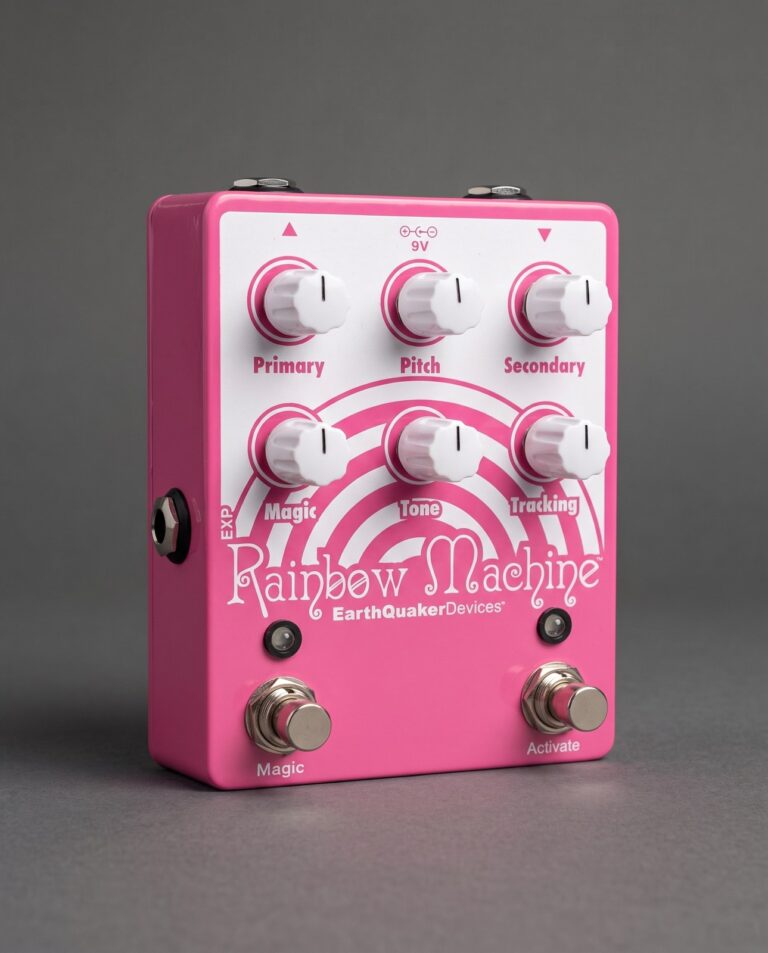
EQD have never been coy about the Hoof’s status in that history. Stillman’s line about it is direct: “It’s the pedal I really learned how to build pedals on.” Everything the company later became known for — the Plumes, the Avalanche Run, the Afterneath, the Rainbow Machine, the whole ecosystem of weird — is downstream of a fuzz box built to chase somebody else’s Big Muff.
Specifications
A note on the low input impedance
130 kΩ is low by modern pedal standards, and that is deliberate — it is a Muff-family trait, and part of why the pedal interacts with your guitar’s volume pot the way it does. It also means the Hoof, like most fuzzes, is happier first in the chain seeing your pickups directly. Put a buffered tuner or a buffered wah in front of it and the top end tightens up in a way some players like and others hate. Try it both ways before you decide the pedal is broken.
The Shift knob: what it actually does
Four knobs, three of them obvious. Fuzz is gain — clockwise for heavy, counterclockwise for light. Level is output. Tone is a conventional bass-left, treble-right sweep. Then there is Shift.
Per EQD’s own control documentation, Shift adjusts the mid content: clockwise for scooped mids, counterclockwise for boosted. That single sentence is the difference between the Hoof and every stock Muff on the market.
A stock Green Russian Big Muff has a fixed mid scoop baked into its tone stack. Solo, at volume, in a bedroom, this sounds gigantic. In a band, with a bass player and a keyboard occupying the low mids, it sounds like someone turned your guitar off. This is the single most common complaint about Muff-style fuzz, and it has launched an entire cottage industry of mid-boost mods, EQ pedals placed after the fuzz, and “Muff with a mids knob” designs.
The Hoof solves it at source. Roll Shift counterclockwise and the mids come up, the pedal starts to behave more like an aggressive distortion than a wall of sludge, and single-note lines cut. Roll it clockwise and you get the classic hollowed-out roar for doom, shoegaze and anything where the guitar is supposed to be the room rather than a voice in it.
Players on forums describe the interaction reasonably consistently: the Shift knob transitions from traditional Big Muff territory on one side to a full-range, mid-swelling response on the other, and it is what lets the pedal “stand out in a mix without sounding chaotic.” The same conversation throws up the recurring comparison that the Hoof is smoother and less grainy than a typical Muff — closer to a distortion pedal in feel, with less compression than the EHX reissues, and (from one player) something a little like an early Tone Bender with better clarity.
Famous players — what actually checks out
The Hoof is one of those pedals where the artist list is long and mostly verifiable by photograph, which is a pleasant change. Here is what holds up.
Dan Auerbach — the origin, verified by EQD themselves
This is the one that matters, and it is not marketing invention. EarthQuaker’s own published history places a Stillman-built Hoof on Dan Auerbach‘s board at the November 2006 Boston show that inspired the production circuit — Stillman was working for the band at the time. Equipboard separately logs Hoof sightings on Auerbach’s rig, and lists it as heard on El Camino (2011) and Turn Blue (2014).

The honest framing: the Hoof was not built to copy Auerbach’s tone in the way that a signature pedal copies a rig. It was built by Auerbach’s own tech, using Auerbach’s Big Muff as the reference for what a good one should sound like, and the Black Keys’ guitar sound and the Hoof grew up in the same rooms. That’s a stronger connection than most pedals can claim, and it does not need embellishing.
Matt Pike (Sleep, High on Fire)
Documented via rig photography as part of his touring and studio setup. This is the doom endorsement, and it explains the Shift knob’s clockwise end better than any demo video: Pike’s world is the one where the guitar is supposed to occupy all available air.

Thom Yorke (Radiohead)
A Hoof is visible on Yorke’s pedalboard in a soundcheck photograph from Radiohead’s Bologna dates in November 2025, shared via the band’s own Instagram in early 2026. That is a photo sighting rather than a quote from the player, and we’ll flag it as such — but a clear board shot from an official account is about as good as photo evidence gets. Radiohead’s guitar world has never been shy about fuzz; Jonny Greenwood‘s side of the operation has run on it for decades.

Dallas Green (City and Colour, Alexisonfire)
The best on-record quote of the bunch, given to MusicRadar: “The Hoof Fuzz is pretty awesome and kind of Big Muff-y. For Woman, which is a pretty long song, I use the Deco tape saturation for the first big ‘open up’ part and then, for the end, I use the Hoof Fuzz.” Note the structural use — the Hoof as the second escalation, not the only dirt sound.

Elizabeth Stokes (The Beths)
Stokes walks through her board on camera and is specific about it: the Hoof is “my fuzz,” used on the bridge of “Little Death” and on “Silence Is Golden,” where she combines it with a King of Tone-style overdrive. That stacking detail is worth stealing — a low-gain transparent drive under a Hoof is one of the most reliable ways to make a Muff-family pedal articulate. If you want the theory on the drive half of that pairing, we covered it in the King of Tone piece.
Courtney Barnett
Visible on her board in performance video. Barnett’s tone — jangly, conversational, then abruptly enormous — is a good argument for the counterclockwise Shift setting, where the fuzz stays legible enough to keep the lyric on top.
Taylor York (Paramore)
Photo-documented. Paramore’s late catalogue is full of textural, non-metal fuzz that behaves like a synth pad, which is very much within the Hoof’s range.

Pierce the Veil — Tony Perry and Vic Fuentes
Both members are logged as users; Perry discussed the pedal in a Premier Guitar Rig Rundown, crediting it with inspiring the song “Floral and Fading” and noting he later ran a profile of it on his Kemper. A songwriting credit for a fuzz box is a stronger claim than a board photo, and it is the sort of detail that tends to be true because nobody makes it up.
Justin Meldal-Johnsen
The bassist and producer (Nine Inch Nails, Beck, M83) logged the Hoof with the note “ended my fuzz search.” He is a bass player, which is the point — the Hoof’s low-end retention is not a marketing claim, it’s why bassists keep finding it. EQD’s own product page hosts bass demos recorded with a Precision and a Music Man.
Others in the file
Joff Oddie of Wolf Alice (board photo, sitting next to a Big Muff — an instructive pairing), Brendon Urie (video), Shana Cleveland of La Luz and King Princess on the current V2, Julianna Riolino, Blaster Silonga of IV of Spades, and yuuho kitazawa of the peggies. Equipboard also lists the Hoof on Wet Leg’s “Chaise Longue” (2021), which if accurate would explain a great deal about that guitar sound.
Where we’re being careful
Several of the above are single-photograph attributions on a crowd-sourced database. A pedal on a board is not proof it was used on a given record, and we have not claimed otherwise. The Auerbach connection is the one supported by the manufacturer’s own published history; the Green, Stokes and Perry connections are supported by the players’ own words on the record. Everything else here is a sighting, and is labelled as one. If you see a list somewhere claiming that Jack White, J Mascis or Kevin Shields built their sound on a Hoof, treat it with suspicion — those players’ fuzz histories are documented elsewhere and run through entirely different boxes.
Tone recipes
1. The band-friendly default
Fuzz 12, Tone 12, Level to taste, Shift 10 o’clock. Mids pushed up slightly. This is the setting that stops the “my fuzz disappeared when the bass came in” problem before it starts. Riffs stay chunky, single notes stay audible, and the pedal sounds like a very angry amplifier rather than a separate weather system.
2. Full doom scoop
Fuzz 3-4 o’clock, Tone 11, Shift 3 o’clock, Level high. Tune down. This is Matt Pike territory and the reason the pedal has a hoofed-beast graphic on it. It will vanish in a busy mix — which is correct, because in this style the guitar is not supposed to be in the mix, it is supposed to be the mix.
3. Almost-overdrive
Fuzz 8-9 o’clock, Tone 1 o’clock, Shift 9 o’clock, Level around unity. Owners consistently report the Hoof is more manageable at low gain than most Muffs, and this is where that shows. It gets you a thick, slightly compressed crunch that works for rhythm parts, then cleans up further with the guitar volume.
4. The stack (Stokes method)
A low-gain transparent overdrive into the Hoof, Hoof set to recipe 1. The drive tightens the front end and pushes the fuzz’s germanium stage harder, so you get more sustain without more fizz. Reverse the order — Hoof into the drive — and the overdrive acts as a post-EQ and compressor, which is the other half of the trick players describe on the forums.
5. Lead cut
Fuzz 2 o’clock, Tone 1 o’clock, Shift fully counterclockwise, Level above unity. Maximum mid boost, treble up. Aggressive, borderline nasal on its own, perfect over a busy arrangement. Bring the Tone back to noon if the top end gets brittle on single coils.
6. Bass
Fuzz 12, Tone 10-11, Shift 10, Level matched carefully by ear. The Hoof’s low-end retention is its party trick, but bass players should still A/B against bypass at gig volume, because “keeps the lows” and “keeps the right lows” are different claims. A blend loop solves the rest.
7. Volume-knob dynamics
Set recipe 2, then roll your guitar volume to 6. The Hoof does not clean up to sparkle the way a germanium Fuzz Face does, but it thins and softens usefully — enough to play a verse without stepping on anything. Humbuckers do this better than single coils here.
8. Post-EQ rescue
If you love the scooped setting but need it to translate live, players report good results with an EQ pedal after the Hoof pushing around 800 Hz and 1.6 kHz. This is a legitimate alternative to using the Shift knob, and it lets you keep the scoop in the fuzz’s character while re-inserting presence at the amp.
Knob positions are given as clock face. Start with everything at noon and move one control at a time; the Hoof’s controls interact more than the four-knob layout suggests, particularly Tone against Shift.
How it compares
Versus the Green Russian Big Muff
The direct ancestor. EHX’s Green Russian reissue is cheaper and delivers the authentic scooped Sovtek voice with more compression and more grain. The Hoof is cleaner, more defined, less compressed, and has the Shift control the Russian lacks. If you want the record-accurate thing, get the Russian. If you want to use it in a band without an EQ pedal behind it, get the Hoof.
Versus the standard Big Muff Pi
The Big Muff Pi is the reference point and roughly a third of the price. Players who own both describe the Hoof as more organic and “brown,” with a germanium-flavoured sag, against the Muff’s more plastic silicon character. The Muff also has a harder wall of compression at high gain settings. Neither is wrong; the Hoof is the one you keep if you play more than one style.
Versus the Rams Head and Triangle Muffs
The Rams Head is smoother and more mid-present than a Russian; the Triangle is looser and more open. The Hoof can approximate the territory between them via Shift, without nailing either exactly. Muff obsessives will still want the specific boxes. Everyone else can own one pedal.
Versus the Cloven Hoof
EQD’s own “evil twin.” The Cloven Hoof replaces the germanium with four selected silicon transistors, widens the sweep on Fuzz, Tone and Shift, and delivers substantially more gain — EQD’s own framing puts it at over four times the original’s — with a tighter low end and a nastier, grindier character. Choose the Hoof for warmth, sag and sitting inside a song; choose the Cloven Hoof for aggression, cleaner cleans at low Fuzz settings and modern high-gain fuzz.
Versus the Hoof Reaper
Three pedals in one enclosure: the Hoof, the discontinued Tone Reaper, and an octave-up that later became the Tentacle, in the signal path Octave > Tone Reaper > Hoof with seven switching combinations. It began as a 25-unit Black Friday special for the retailer Tone Factor in 2010 and became a permanent product. If you already know you want stacked fuzz, the Reaper is better value than buying the parts separately. If you don’t, it’s a lot of knobs.
Versus the Way Huge Swollen Pickle
The Swollen Pickle MkII is the other great “Muff with more control” and is regularly named as the cheaper alternative with similar mid-scoop adjustability. It has more internal trimmers and a wider, wilder range; the Hoof is more immediately usable and better built for the road. Toss-up, decided by whether you enjoy tweaking.
Versus the ProCo RAT
Not the same category, but the same job on a lot of pedalboards. The RAT 2 is tighter, more mid-forward by default and cuts without help. The Hoof is bigger and more harmonically chaotic. Boards that need both usually run the RAT for rhythm and the Hoof for the moments where the arrangement opens up.
Versus a Fuzz Face or Tone Bender
Different species. A germanium Sun Face-style Fuzz Face is more dynamic, more responsive to the guitar volume and far more temperamental about what sits in front of it. The Hoof is stable, consistent and sustains for days. Stillman himself has said the Tone Bender and Fuzz Face families are his favourite dirt pedals for his own playing, which is a nicely honest thing for the man who built the Hoof to admit.
Versus the Vemuram Myriad and other boutique fuzz
The Myriad Fuzz and similar high-end designs are aiming at refinement and studio-grade polish at two to three times the money. The Hoof is not trying to be refined. It is trying to be enormous and dependable, and at $150-180 it undercuts nearly everything with comparable build quality.
Versus the EQD Plumes
Not a competitor — a companion. Plumes is EQD’s Tube Screamer-derived low-gain overdrive, and it is the most common thing players put in front of a Hoof. Plumes into Hoof is close to a complete dirt rig in two boxes.
Buying guide
V1 versus V2 — what actually changed
The version question on the Hoof is simpler than on most EQD pedals. The original ran from the late 2000s through roughly 2019 in a series of finishes (gold with black print, grey texture, white with brown print, plus limited editions). The current V2 carries the same hybrid germanium/silicon circuit with the same four controls, in EQD’s current enclosure and graphic scheme, with relay-based soft-touch switching in place of the old mechanical footswitch.
Two honest caveats. First: the relay switching means the pedal will not pass audio without power — a mechanical true-bypass pedal will. If you gig with a dodgy power supply, know that. Second: EQD’s Flexi-Switch technology, which allows momentary as well as latching operation, was rolled out across several pedals from 2018 and does appear on the Hoof Reaper V2’s octave footswitch. EQD’s current Hoof documentation describes relay-based switching but does not list Flexi-Switch, so do not buy a V2 expecting momentary operation without confirming it with the dealer first.
Tonally, the community consensus is that V1 and V2 are the same pedal. Buy on condition and price, not on version.
The 20th Anniversary Edition
In December 2024, EQD marked twenty years with a 400-unit reissue of the original three-knob Hoof — the pre-Shift version. Stillman’s description of that circuit is worth quoting because it clarifies the timeline: “The original Hoof was finely tuned to produce everything from light overdrive to a thick sustaining wall of fuzz with a wide range tone control that featured pre-set mods in lieu of the ‘shift’ control found on later models.”
The anniversary run used hand-soldered through-hole construction and the same military-spec NOS germanium transistors as the first generation, in a platinum vein enclosure with black print, packed in a wooden box with a satin bag, pin, patch and sticker. It sold exclusively through Reverb at $229 and was gone quickly. If one appears secondhand, expect a collector premium — and understand you are buying the three-knob circuit, not a fancier version of the pedal on the shelf.
Buying used
The Hoof is a good used buy. There are thousands in circulation, EQD’s lifetime warranty is real, and the circuit has no biasing that drifts the way a vintage germanium fuzz does. Check the footswitch on older mechanical units — that is the usual failure point on any pedal of this vintage — and check the jacks. Cosmetic wear on the powder coat is normal and irrelevant.
Do not overpay for a “limited edition” finish unless you specifically want the graphic. The circuit inside is the circuit inside.
Who should skip it
If you play thrash or modern metal, this is the wrong tool — owners consistently note it does not do tight, fast, palm-muted aggression, and a proper high-gain distortion will serve you better. If you need a fuzz that cleans up to glassy with the guitar volume, a Fuzz Face variant does that better. And if you already own a Muff you love plus an EQ pedal, you may already have most of what the Hoof offers.
Living with one
A few practical notes from long-term use and from what owners report.
Power it properly. EQD are unusually blunt about this: 9V only, isolated supply preferred, and do not run it at higher voltages. Daisy chains and switching supplies will let noise through. At 15 mA it will run off almost anything, so there is no excuse.
Placement. First in the chain, or at least ahead of buffers, unless you have a reason to do otherwise. After a wah, it can get shrill; before it, the sweep stays musical.
The indicator LED. The single most-repeated complaint about the Hoof in owner reviews is that the LED is extremely bright on a dark stage. This is a trivial thing that becomes non-trivial at 11pm in a small room. Gaffer tape exists.
It rewards a loud amp. Like every Muff-derived circuit, the Hoof sounds thin and buzzy through a quiet clean amp at bedroom volume and enormous through a pushed one. If your first impression is disappointment, turn the amp up before you turn the pedal off.
Try it on bass. Seriously. If you own a bass and a Hoof and have never combined them, you are leaving the pedal’s best trick on the table.
Frequently asked questions
Is the EarthQuaker Devices Hoof just a Big Muff clone?
No, though the family resemblance is deliberate. It is loosely based on the green Russian Sovtek-era Big Muff circuit but uses a hybrid germanium/silicon transistor arrangement rather than all-silicon, and adds the Shift control for midrange adjustment. Players who own both describe the Hoof as less compressed, more defined and more organic than a stock Muff.
What does the Shift knob do on the Hoof?
It adjusts the midrange content of the fuzz. Per EQD, clockwise gives classic scooped mids, counterclockwise gives boosted mids. It works alongside the conventional Tone control, and it is the feature that lets the Hoof cut through a band mix rather than disappearing under the bass and drums.
Does Dan Auerbach actually use a Hoof?
Yes, and the connection is unusually well documented. Jamie Stillman built the Hoof while working as the Black Keys’ tour manager and tech, and EarthQuaker’s own published history places a Hoof on Auerbach’s pedalboard at a November 2006 Boston show. Equipboard lists it as heard on El Camino and Turn Blue.
Is the Hoof good for bass?
Unusually so for a Muff-family pedal. The circuit was designed to preserve low end, EQD publish bass demo samples on the product page, and bassist-producer Justin Meldal-Johnsen has logged it with the note that it ended his fuzz search. Use a blend loop if you need the fundamental untouched.
What is the difference between the Hoof and the Cloven Hoof?
The Cloven Hoof swaps the germanium for four selected silicon transistors, widening the Fuzz, Tone and Shift sweeps and delivering considerably more gain — EQD describe it as over four times the original — with a tighter bottom end and a grittier, more aggressive character. The Hoof is warmer and sags more; the Cloven Hoof is nastier and more modern.
Is the Hoof true bypass?
Yes. The current version uses true bypass with electronic relay-based switching, which is silent but means the pedal will not pass audio without power. Older mechanical units pass signal unpowered.
How much does a Hoof cost in 2026?
List price is $179 in the US, with major dealers commonly at around $152 as of September 2026. Used V1 units typically trade below that. The 400-unit 20th Anniversary Edition launched at $229 in December 2024 and now sells at collector prices when it appears at all.
Will the Hoof work for metal?
For doom, sludge and stoner metal, absolutely — Matt Pike’s use is the obvious endorsement. For thrash, death metal or anything requiring tight fast palm-muted rhythm, no. Owner reviews are consistent on this point, and it is a limitation of the Muff-derived architecture rather than a flaw in this particular pedal.
Should I buy a V1 or a V2?
Buy whichever is in better condition at a better price. The circuit is the same; the differences are the enclosure graphics and the switching mechanism. The one real consideration is whether you want a mechanical footswitch that passes audio unpowered (V1) or silent relay switching (V2).
Image credits
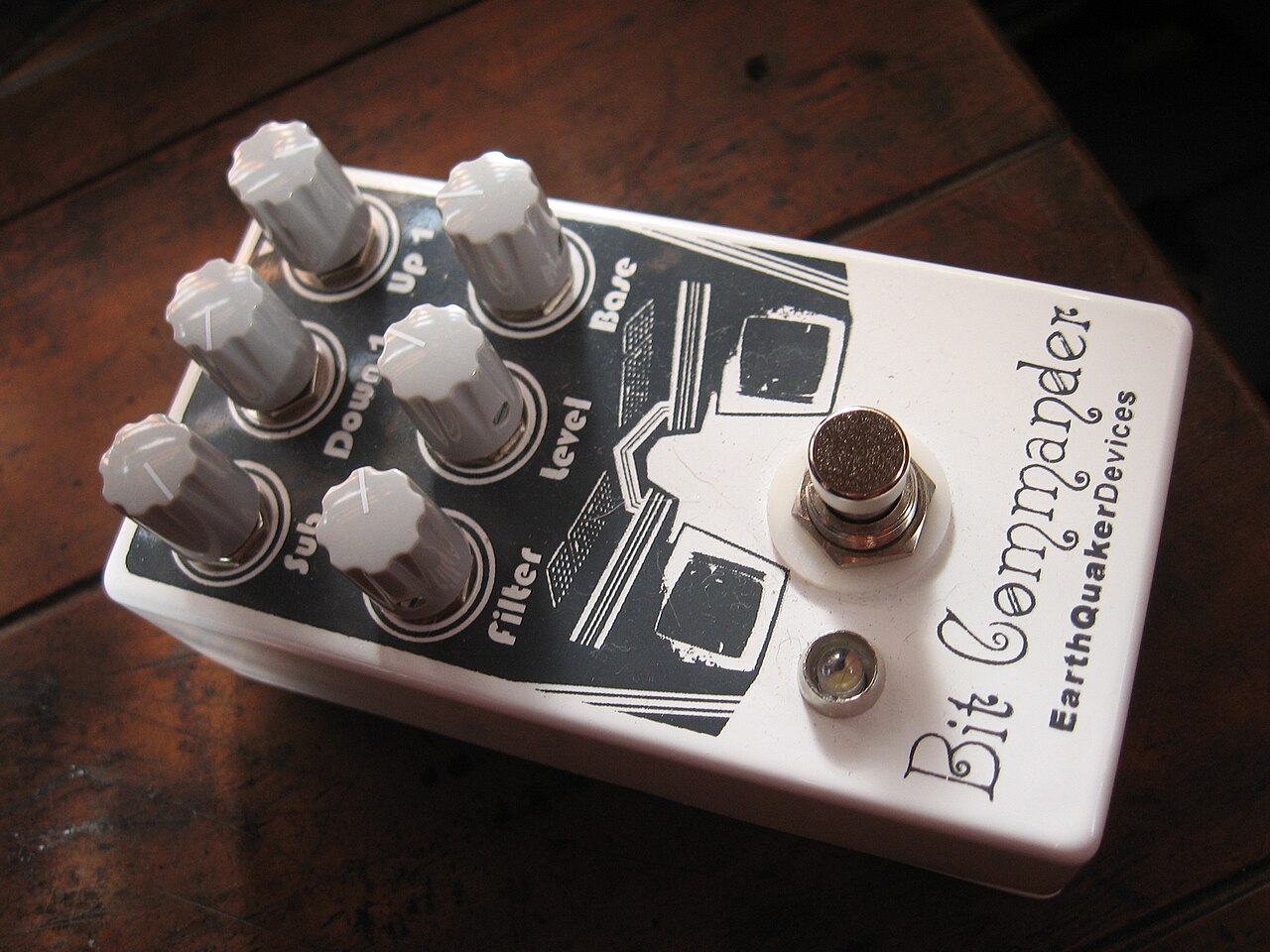
- An EarthQuaker Devices Bit Commander pedal: Victor Sounds, Wikimedia Commons, CC BY-SA 2.0.
- Top image: GuitarGangsters AI-generated reference illustration, not a photograph.
- Dan Auerbach: Andy Witchger, Wikimedia Commons, CC BY 2.0.
- Matt Pike: Selbymay, Wikimedia Commons, CC BY-SA 4.0.
- Dallas Green: eastscene, Wikimedia Commons, CC BY-SA 2.0.
- Taylor York: Karin Werts, Wikimedia Commons, CC BY 2.0.
- Thom Yorke: ღ ℂℏ℟ḯʂ ღ, Wikimedia Commons, CC BY 2.0.
Latest News
Related
On This Day
Monday 9 November
From this week: